


Your child is staring at a blank slide, a half-open textbook, and six browser tabs that all say different things. You can see the panic building. They were asked to “do some research”, but what they heard was, “work it out alone, get it right, and don't get overwhelmed.”
I see this often in live online lessons. A bright child freezes, not because they lack ideas, but because research feels foggy. Which question should they ask first? Which website can they trust? What if they choose the wrong facts? For some learners, especially those with SEN or SEMH needs, that uncertainty can feel bigger than the task itself.
Research skills development has to start there. Not with a checklist, but with the child. When we slow down, name the feeling, and break the work into manageable steps, children don't just produce better projects. They begin to trust their own thinking. That matters in primary school, at GCSE and A-Level, and far beyond the classroom.
Why Research Skills Matter and How Children Experience Them
A child researching volcanoes might look curious on the surface. Inside, they may be juggling excitement, confusion, urgency, and fear of getting it wrong. A teenager preparing for GCSE coursework might sound dismissive and say, “I can't find anything useful,” when what they really mean is, “There's too much information and I don't know where to begin.”
That emotional layer matters. If we treat research as a simple academic task, we miss the barrier. Children rarely struggle only because they can't search. They struggle because searching, choosing, rejecting, reading, and explaining all demand confidence.

What research feels like from the child's side
In lessons, I often see three moments repeat:
- The eager start. A child has a strong interest and wants to tell you everything they already know.
- The wobble. They meet unfamiliar words, conflicting sources, or too many possible directions.
- The lift. With support, they sort their ideas, make sense of evidence, and feel proud of saying something clearly.
That middle stage is where many children decide whether they're “good at research” or not. Most children aren't weak researchers. They're under-scaffolded researchers.
Research becomes manageable when a child knows what to do next, not when they know everything already.
A child-centred approach helps us respond differently. Instead of saying, “Find better sources,” we might say, “Let's choose one question and one source together.” Instead of, “You need more detail,” we might say, “Tell me which part feels muddled.” Those small shifts reduce shame and build independence.
Why this matters beyond one homework task
Research capability isn't a niche skill. It sits inside reading, writing, discussion, revision, project work, and decision-making. It also matters in the wider UK economy. Government analysis reports that UK businesses spent £49.9 billion on R&D in 2022, with £27.7 billion of that, or 56%, spent on salaries for 652,000 full-time-equivalent R&D staff. The same analysis notes that 156,575 individuals worked in research or teaching-and-research roles in higher education in 2023/24, and that the share of R&D workers in the total workforce rose from 5.4% in 2012 to 7.9% by June 2021 (UK government analysis of R&D skills supply and demand).
For children, that big national picture translates into very human habits. Can they ask a worthwhile question? Can they compare information? Can they explain what they've found to someone else? Those are also the foundations of critical thinking in online learning.
What confident young researchers can do
Confident doesn't mean fast. It means a child can:
- Start with a clear question instead of copying a title and hoping for the best.
- Find and compare sources without assuming the first result is the best one.
- Take useful notes in their own words.
- Spot uncertainty and ask for help when information doesn't line up.
- Share findings clearly in speech, writing, or a simple presentation.
That's the version of research skills development I want for children. Not polished performance. Calm, repeatable habits that help them cope with challenge and enjoy discovery.
Building Research Skills Step by Step From Curiosity to Communication
Children do better when research has a visible shape. If the task feels like one giant blur, anxiety rises. If the task feels like a sequence, children can move.
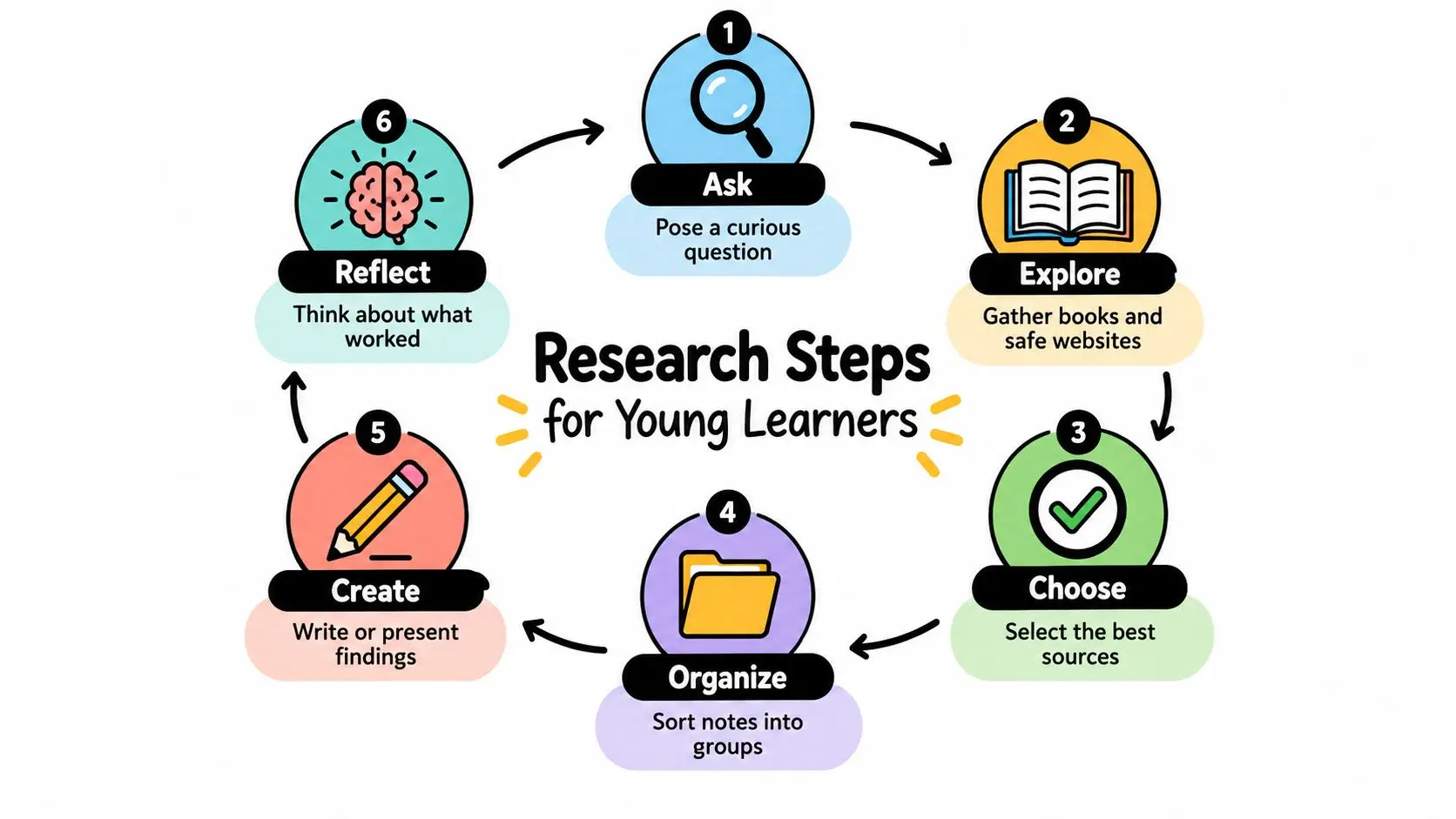
I teach research as a simple cycle that can be reused across ages and subjects. A Year 5 pupil can use it for an animals project. A Sixth Form student can use the same structure with harder texts and more independence.
Start with a question that is small enough to hold
Broad titles create vague thinking. “The Romans” is too wide. “How did Roman roads help the empire grow?” gives the child somewhere to go.
Useful question stems include:
- How does … affect … ?
- Why did … happen?
- What changed when … ?
- Which source best explains … ?
For younger learners, I often offer two or three possible questions and let them choose. That keeps ownership without creating overwhelm.
Practical rule: If a child can't answer, “What am I trying to find out?”, they aren't ready to search yet.
Search with a plan, not with panic
Once the question is set, children need a search plan. Otherwise they drift. I ask them to choose:
- one book or class text
- one trusted website
- one keyword combination
- one note page or document for recording findings
This is also where real-world methods can help older learners understand that research isn't only about books. For teenagers exploring how people gather evidence in practical settings, a clear guide to interviews surveys A/B tests methods can widen their understanding of how questions are tested and answered.
A simple classroom example:
A child researching coastal erosion might search “coastal erosion causes for children”, then refine to “how waves change cliffs”. That second search is usually better because it reflects understanding, not just topic copying.
Choose sources by asking better questions
Children often think source evaluation means spotting whether something “looks professional”. They need more concrete prompts.
Try these:
- Who made this?
- What is this trying to explain?
- Is the language clear or exaggerated?
- Does it match what another source says?
- Is this too hard, too shallow, or just right for me?
For a primary learner, that may be a teacher-led discussion. For an older student, it can become an independent checklist.
A common confusion point is disagreement between sources. Children can panic and assume one must be “fake”. Sometimes sources focus on different aspects. Teach them to ask, “What is each source helping me understand?”
Organise notes so the child can still think
Messy notes make children feel they've done research when they've only collected fragments. I prefer short note frames over long copied paragraphs.
A simple note grid might include:
| Heading | Prompt |
|---|---|
| Main idea | What is this source mostly about? |
| Useful detail | What do I want to remember? |
| My own words | How would I explain this simply? |
| New question | What do I still need to check? |
For families supporting homework, structured note-making often helps more than asking a child to “revise properly”. These note-taking methods for students can be especially useful when a learner needs clearer visual organisation.
Turn findings into communication
Research isn't finished when the notes are full. It's finished when the child can communicate what they now understand.
That might be:
- a labelled diagram
- a paragraph with evidence
- a short talk
- a comparison table
- a narrated slide
In UK workforce settings, communication sits near the heart of strong research practice. The 2024 UK Research and Innovation Workforce Survey found that 93% of respondents had taken part in at least one training or learning-and-development activity, and 94% rated communication and working with people as important. The same survey found applied research was the most common activity at 79%, followed by basic research at 68% and experimental development at 52%. It also reported statistically significant growth since 2022 in learning to use new technology, advanced digital skills such as programming, and commercial skills, while specialist knowledge refreshment fell as an “important” skill area from 89% to 82% (UKRI workforce survey 2024).
For children, that means this. Don't separate “finding out” from “explaining well”. Build both together.
Practical Classroom and At Home Activities That Make Research Stick
The best research activities don't feel like paperwork. They feel like guided discovery. Children remember methods when those methods are tied to movement, talk, choice, and emotional safety.
In online lessons, I've learned that children engage more readily when the first task is concrete. Not “research this topic for twenty minutes.” Something they can touch, sort, notice, or wonder about.

Use provocations that invite questions
A provocation is a starting point that nudges curiosity. It could be a photograph, an object, a short clip, a graph, or two contradictory statements.
Examples that work well:
- Primary science. Show two plants grown in different conditions and ask, “What do you notice? What do you wonder?”
- KS3 history. Display two accounts of the same event and ask, “Why do these descriptions sound different?”
- GCSE English or geography. Give a short extract and one image, then ask students to find one connection and one question.
This matters emotionally. A child who feels stuck by a blank page often feels steadier when they can first react to something visible.
Run a guided source hunt
A guided source hunt gives structure without removing independence. I might provide three pre-selected sources and ask children to label them:
- Most useful for facts
- Best for explanation
- Best for interesting detail
- Too hard for now
That last category is important. Children need permission to say a source is beyond their current reading level.
In UK local-government research capacity evidence, the most frequently rated “very important” general skills were communication or presentation of findings at 76%, writing or reporting findings at 74%, and interpreting secondary data at 72%. Quantitative skills were led by interpreting statistics at 69% and analysing survey data at 68%. The same survey found only 34% rated managing researchers as very important, which points to a common weakness around coordinating research work (Local Government Association research capacity survey).
For children, that tells us not to stop at collecting facts. They need support in handling information and managing the process.
Try jigsaw reading and evidence sorting
Jigsaw reading works brilliantly in online rooms and at kitchen tables. Each child reads one short source or one part of a longer text, then teaches the key idea to someone else.
You can make it simpler with evidence sorting:
- Cut statements apart and ask the child to group them under headings
- Mix strong and weak evidence and ask which pieces answer the question best
- Add one irrelevant fact so they learn to leave things out
Children who struggle with working memory often do better when the task is visible and movable like this.
When a child is flooded, reduce the quantity before you raise the quality.
Support SEN and SEMH learners with emotional scaffolds
Some children need direct emotional support built into research time, not added afterwards. The Department for Education says early-years practitioners should help children understand, name, and express emotions and use emotionally consistent responses built around recognition, empathy, feeling-labels, guidance, and problem-solving, with practical tools such as feelings cards used at arrival, during conflicts, and alongside stories or circle time (DfE guidance on emotions in early years).
That same principle carries into research lessons with older learners. A child may need:
- A feelings check-in card before starting independent work
- Chunked timings such as “find one fact in five minutes”
- A visual task strip showing first, next, then, finish
- Choice of output such as speaking, drawing, typing, or bullet points
- A calm script from the adult such as “You don't need to solve the whole task yet”
The Somerset Emotion Coaching Project describes a 5-step method: be aware of the child's responses, treat emotional moments as teaching opportunities, listen empathetically and validate feelings, help the child verbally label emotions, then set limits while helping the child problem-solve. It also notes that naming emotions can help soothe the nervous system and recovery rate (Somerset Emotion Coaching Project report.pdf)).
That's not separate from research skills development. It's part of it.
A short model can help:
“I can see this feels muddled.”
“You were expecting the answer to appear quickly.”
“Let's name the problem. Too many websites, or hard vocabulary?”
“We'll pick one issue first.”
Later in the lesson, a short demonstration can help families see what this looks like in practice.
Gather children's thinking in child-friendly ways
When we want to know what a child understands, formal questioning isn't the only route. UK government user research guidance suggests age-appropriate methods such as asking very young children to draw a picture of an experience while talking about feelings, and for slightly older children using toys or image cards to tell stories, plotting a journey together, or writing a letter to another child of the same age giving advice (DfE user research with children and young people).
Those approaches work beautifully for learning too. A child can draw what they found out before writing it. Another can explain their evidence through picture cards before turning it into a paragraph.
Digital Tools and Resources That Support Young Researchers
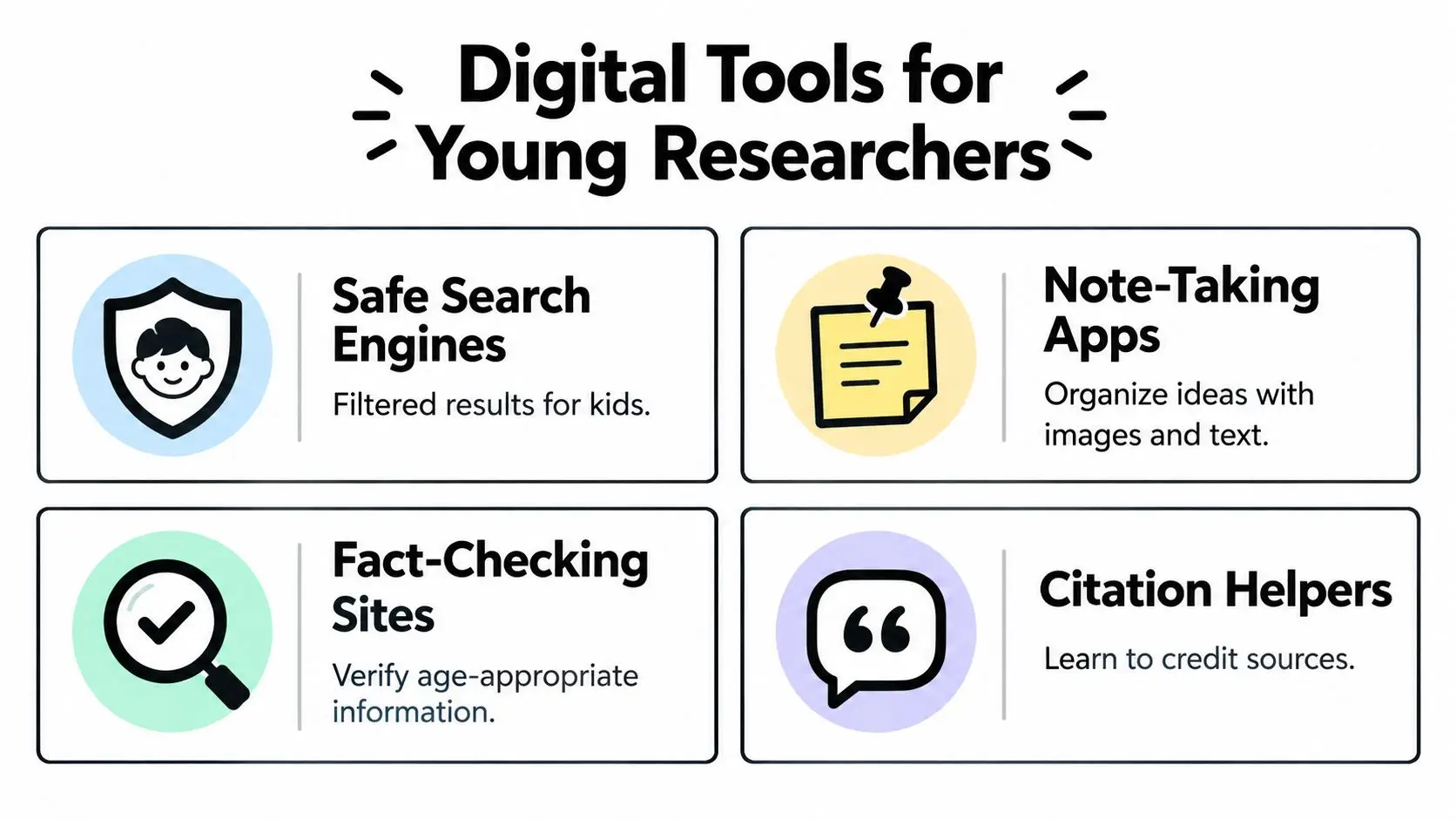
Digital tools can help. They can also distract, oversimplify, or do too much for the learner. The goal isn't to gather lots of apps. It's to choose a small set of tools that support thinking.
That matters because research training is often uneven. A Cardiff study found that 63.8% of student respondents had not received any training to improve information literacy (Cardiff research training study). In practice, that means many learners are expected to judge sources, organise findings, and use digital systems without much direct teaching.
Match the tool to the job
Here's a simple way to choose.
| Job to be done | What to look for | Good teaching focus |
|---|---|---|
| Safe searching | Child-friendly filtering or teacher-curated links | Asking better questions, not endless browsing |
| Reading and note-taking | Highlighting, image support, simple folders or boards | Sorting ideas into themes |
| Referencing | Age-appropriate citation help or teacher models | Crediting sources and avoiding copy-paste habits |
| Collaboration | Shared slides, documents, or whiteboards | Explaining thinking to others |
| Presentation | Tools for speaking, captioning, recording, or visual display | Turning findings into clear communication |
A younger child might use a school-approved search tool and a simple notes grid. An older student may need collaborative documents, folder systems, and a clear routine for storing extracts and references.
Compare wisely, don't collect endlessly
Families sometimes ask which platform is “best”. Usually the better question is, “Best for what?”
- For safe discovery choose tools that narrow rather than widen.
- For reluctant writers pick tools that allow audio notes, images, or drag-and-drop organisation.
- For group projects use a shared space where contributions are visible.
- For older students introduce systems that mirror real study habits, such as organised folders, labelled notes, and saved source lists.
For teams or older learners interested in how digital environments can support shared inquiry, it can be useful to look at examples of 1chat research features for teams. Not because every child needs advanced systems, but because it helps adults think clearly about how questioning, collecting, and organising can happen collaboratively.
Teach the habits, not just the buttons
Children don't become good researchers by learning where to click. They improve when they build habits such as:
- Naming files clearly
- Separating facts from opinions in notes
- Saving the source with the note
- Checking whether a claim appears in more than one place
- Returning to the original question before presenting
A useful digital routine is “open, collect, label, pause, explain”. That pause matters. It stops research becoming mindless gathering.
Recent UK sector commentary has highlighted practical gaps in digital research competence, particularly around managing datasets, using collaborative tools, and working with digital systems across departments and platforms, as discussed in the Skills England 2026 annual skills report context and related sector analysis (Skills England annual skills report 2026). For school-aged learners, the message is simple. Build digital habits early and explicitly.
One practical option is Queens Online School, where live online learning, recorded lessons, and digital workflows can give students regular practice in organising work, participating in discussion, and presenting understanding. For families exploring how children can store and show that learning over time, digital portfolios for students can be a helpful next step.
How to Assess Progress and Celebrate Growth With Rubrics and Milestones
Assessment can easily flatten research into a mark for the final product. That misses most of the learning. A child may have made huge progress in questioning, selecting evidence, or coping with uncertainty, even if the final piece still needs support.
I prefer milestones that notice both process and communication. That keeps expectations clear without turning curiosity into a test.
What should we actually assess
A strong research rubric usually needs four strands:
Questioning
Can the learner form a clear question or refine one with support?Evidence handling
Can they find, choose, and record relevant information?Evaluation
Can they notice quality, bias, mismatch, or gaps?Communication
Can they present findings in a way another person can follow?
A child who can explain why they rejected a source is often making deeper progress than a child who simply gathered more facts.
Research Skills Progression Milestones and Rubric Snapshot
| Progression Stage | What Confident Research Looks Like | How to Assess and Support |
|---|---|---|
| Key Stage 2 early | Asks a simple question, uses a small set of provided sources, records key facts with support | Use checklists, sentence stems, oral retelling, and visual note frames |
| Key Stage 2 secure | Sorts information into categories, begins to compare sources, explains findings in their own words | Look for copied language versus own phrasing. Give immediate feedback on source choice |
| Key Stage 3 | Refines questions, selects from a wider range of sources, identifies useful versus less useful evidence | Use short rubrics with teacher conferencing and peer explanation |
| GCSE | Builds a focused line of enquiry, references evidence, compares interpretations, communicates with increasing independence | Assess checkpoints across planning, evidence, and final communication |
| A-Level | Sustains independent enquiry, handles more complex material, weighs interpretations, and justifies choices in method and evidence | Use milestone reviews, annotated drafts, and reflection on reproducibility and source use |
Feedback that protects motivation
Children remember the emotional tone of feedback long after they forget the rubric wording. If a learner already feels shaky, blunt comments can shut down effort.
Try feedback that does both jobs:
- Validate the effort. “You kept going when the sources disagreed.”
- Name the next move. “Now let's sort which two pieces of evidence answer your question most directly.”
- Be precise. “This note is interesting, but it doesn't link to your enquiry.”
- Return agency. “Which source do you trust more, and why?”
For younger children or learners with SEMH needs, a brief review can be verbal and visual. Circle one strength. Highlight one next step. Keep the demand finite.
Common assessment traps
One trap is overvaluing subject knowledge alone. A child may know a great deal about dinosaurs or Tudor kings but still need support with selecting evidence or reporting clearly.
Another trap is under-assessing the management of the process itself. That matters more than adults sometimes realise. In organisational settings, weak coordination can undermine quality, and we can see a parallel in schools when children are expected to manage sources and timelines without guidance. It's worth remembering too that UK evidence on social and emotional skills points schools towards structured programmes such as PATHS, Friends, Zippy's Friends, Roots of Empathy, Bounce Back, Circle Time, and for secondary pupils UK Resilience and Stress Management Intervention, showing that schools can use named approaches rather than vague wellbeing language (DfE evidence review on social and emotional skills).
That matters here because research assessment is never just cognitive. Self-regulation, communication, and resilience all shape the work a child can show.
Helping Every Learner Thrive as a Confident Researcher
Children grow into research confidence through repetition, safety, and well-timed challenge. They don't need adults to remove all difficulty. They need adults to make difficulty usable.
That is especially important for learners who've started to believe research “isn't for them”. Some children have had too many experiences of being left with a vague task and a sinking feeling. A child-centred model changes that story. It says: your confusion is information, your feelings are allowed, and your thinking can be organised.
A weekly routine that works
A simple weekly rhythm helps research skills development settle into habit:
- Begin with one question the child can answer.
- Use one or two trusted sources before widening the search.
- Capture notes in a repeatable format so effort goes into thinking, not reinventing the page.
- End with a short explanation spoken or written.
- Reflect briefly on what felt easy, hard, or surprising.
That routine can be shortened for younger children and stretched for older ones.
When to scaffold and when to stretch
If a child is anxious, distracted, or avoiding the task, reduce choices and increase structure. If they're secure, stretch by asking them to compare sources, justify selections, or explain uncertainty.
A helpful test is this. If the child is frustrated but still engaged, the level is probably workable. If they're frozen, distressed, or copying without understanding, they need more support first.
Progress in research often looks like calmer starts, better questions, and clearer explanations before it looks like polished final pieces.
Celebrate those signs. A child who says, “This source is easier to understand, but that one has better detail,” is growing. A teenager who realises they need to narrow their question is growing. A learner who can name their stress and ask for a smaller next step is growing too.
Research is a journey of discovery, but for children it is also a journey of self-belief. When we teach it with warmth, structure, and emotional awareness, we help children do more than complete assignments. We help them become thoughtful, capable learners who know how to find out, make sense, and speak up.
If you're looking for an online school that teaches these habits with care, Queens Online School offers live British curriculum lessons from Primary through A-Level, with subject-specialist teaching and support for learners who need structure, flexibility, and encouragement. Families who want research skills development to feel organised, inclusive, and emotionally safe can explore how its online approach supports independent learning step by step.