


You're at the kitchen table with a school prospectus open, university websites in another tab, and a teenager who still isn't sure whether choosing three sciences or adding a humanity will shape the rest of their life. Perhaps your family is based in Singapore, Dubai, Madrid, or somewhere else entirely. Perhaps you're also wondering what happens if work moves you again, if your child struggles in a large classroom, or if a conventional sixth form isn't the right environment.
International A Levels can offer a focused British qualification for families who need academic depth alongside geographical and educational flexibility. They're not UK A levels delivered overseas, and they aren't the same as the International Baccalaureate. The important question is more personal: which route will help your child feel capable, supported, and ready for the university path they want?
When a Family First Faces the Sixth-Form Question
“Will I need Biology if I want to study medicine?” your daughter asks, scrolling through a sixth-form prospectus. Her brother suggests taking another subject “just in case”. You're thinking about university requirements, while also trying to remember whether the family may relocate before the final examinations.
That conversation captures why the sixth-form decision can feel so heavy. A teenager may be asked to commit to subjects before they've finished discovering their strongest interests. At the same time, parents are balancing academic ambition with practical concerns, including travel, changing schools, learning differences, and the emotional pressure of high-stakes examinations.
For many families, three routes come into view:
- UK A levels are the familiar domestic sixth-form qualification, often studied at British schools and colleges in the UK or at international schools that follow the UK curriculum.
- The International Baccalaureate provides a broad programme that keeps several subject areas in a student's timetable, alongside its wider core requirements.
- International A Levels offer a more specialised route, allowing a student to concentrate on a smaller group of subjects while retaining a qualification designed for international settings.
The choice isn't about prestige. It's about the child who'll wake up on Monday morning and attend those lessons. A student who loves Chemistry and Maths may feel energised by sustained subject depth. Another may need breadth because they're still deciding between science, languages, humanities, and the arts. A teenager with anxiety may find that a predictable online routine gives them room to participate without the social strain of a crowded sixth form.
University ambition adds another layer. Families often worry that choosing a less familiar qualification will close doors, particularly when applications may involve the UK, Europe, North America, or Asia. Recognition matters, but so does the day-to-day fit. A qualification can be academically respected and still be unsuitable if the student is exhausted, isolated, or unable to access the teaching.
The useful question isn't “Which qualification sounds most impressive?” It's “Which qualification gives this particular child the best chance to do sustained, confident work?”
International A Levels developed as an overseas-facing version of the A-level model rather than a replacement for the domestic UK system. Pearson's International Advanced Level History specification, for example, states that the modular qualification is available to centres outside the UK, while UK A-level results remain reported separately through UK awarding and results-reporting structures. Pearson's International A Level information helps clarify that distinction before a family starts comparing syllabuses.
What International A Levels Actually Are
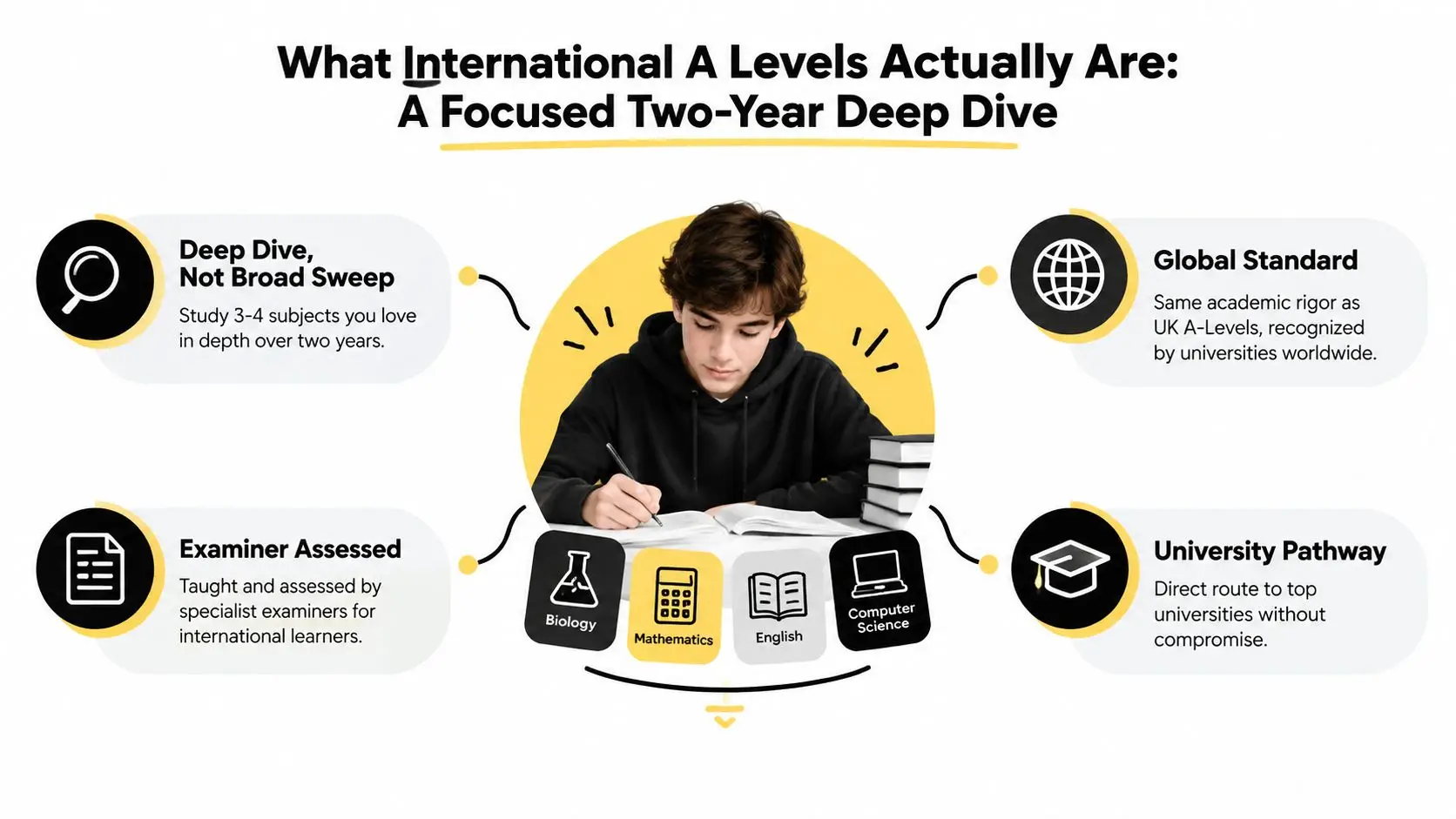
Think of International A Levels as a focused two-year deep dive. Instead of studying a broad programme across many areas, a teenager usually concentrates on three or four subjects that connect with their interests and future plans.
On a Monday morning, that might mean a live Biology lesson, followed by a Maths class and an English Literature seminar. The student isn't trying to maintain a large portfolio of unrelated requirements. They're building detailed subject knowledge, practising examination skills, and learning how to explain complex ideas with precision.
The qualification in simple terms
International A Levels are advanced school qualifications awarded by international examination boards. Cambridge International and Pearson Edexcel are the principal names many families encounter. Their qualifications are taught in schools and online settings around the world, with examination arrangements designed for international learners.
The student studies a defined syllabus, completes lessons and practice work, and sits externally assessed examinations. Specialist examiners mark the papers according to the relevant assessment criteria. That common structure gives universities a consistent academic reference point when they read applications from students educated in different countries.
The qualification may be organised through an AS and A2 structure. In a typical route, the student studies AS content and sits the relevant assessments before progressing to A2-level work. Some International A Levels are modular, which means the course is divided into units that can be assessed in separate examination series. Other subjects follow a more linear pattern, where the principal assessment comes at the end of the course.
What the student experiences
A modular course can reduce the feeling that everything depends on one examination season. A student may complete one set of units, receive feedback, and use later preparation to strengthen a particular area. That doesn't make the work easy. It can make the route more manageable for a student who benefits from clear stages and opportunities to review progress.
The international examination calendar also differs from the domestic UK timetable. Pearson offers January, May/June, and October examination series for many International A Level subjects, although availability varies by subject. Families should check the exact subject timetable before assuming that a retake or accelerated plan will fit their school year. Pearson's International Advanced Levels overview provides the appropriate starting point for checking subject availability and assessment arrangements.
UCAS tariff points may be used when universities compare qualifications and offers, but admissions teams also examine subject combinations, grades, personal suitability, and course prerequisites. The qualification isn't a shortcut around academic effort. It's a structured route that can travel more easily with a family whose life doesn't fit one fixed national timetable.
International A Levels vs UK A Levels vs the IB
Parents often try to compare the three routes by asking which one is “hardest”. That question usually leads to more confusion than clarity. The better comparison considers breadth, depth, assessment style, subject flexibility, and the child's preferred way of working.
UK A levels and International A Levels both use the A-level subject model, but their administration, availability, and examination arrangements differ. UK A levels are governed through domestic awarding and regulatory structures. International A Levels are designed for centres outside the UK and may provide different examination windows or modular arrangements.
The IB takes a different approach. Students study across a broader range of subject groups and complete its programme requirements alongside their subjects. That breadth can suit a student who enjoys variety and wants to keep several academic directions open. It can feel demanding for a teenager who works best when they can devote sustained attention to a small number of disciplines.
| Feature | International A Levels | UK A levels | International Baccalaureate |
|---|---|---|---|
| Main academic shape | Focused study in a smaller number of subjects | Focused study in a smaller number of subjects | Broad study across subject groups with additional core requirements |
| Assessment style | Subject examinations, often with modular options depending on the subject | Assessment arrangements set within the UK qualification structure | A mixture of examinations and programme requirements, depending on the subject |
| Specialisation | Strong choice for depth in selected subjects | Strong choice for depth in selected subjects | Greater breadth across disciplines |
| International use | Designed for international centres and globally mobile learners | Primarily associated with the UK system, though taught internationally | Designed as an internationally portable programme |
| Best fit may include | Students needing subject depth, international exam arrangements, or flexible delivery | Students settled in the UK system and comfortable with its timetable | Students who value breadth, interdisciplinary learning, and a common global framework |
| University recognition | Recognised by universities subject to their published requirements | Widely recognised by UK and international universities | Widely recognised by UK and international universities |
Families comparing the IB with A levels may find this International Baccalaureate versus A levels guide useful for looking beyond labels and considering the actual workload.
Exam style and the child's confidence
A student who performs strongly in formal written examinations may prefer the A-level structure. Another may benefit from a programme that spreads evidence of learning across different forms of assessment. Neither preference is a character judgement. It's an observation about how a child demonstrates knowledge when the pressure rises.
University recognition is broad for all three routes, but the details still matter. A university may require particular subjects for Medicine, Engineering, or Computer Science. Admissions teams may also state their preferred grades or tariff profile. Families should read the exact course page rather than relying on a general claim that one qualification “opens every door”.
Subject Choices, Exam Structure, and University Pathways
Subject selection should begin with the intended university direction, then move backwards to the child's interests, strengths, and realistic workload. Cambridge International offers more than 55 subject options, giving families substantial choice, but a large menu doesn't mean every combination is sensible for every learner.
A student considering Engineering might choose Mathematics and Physics, perhaps adding Chemistry or Further Mathematics where the university course requests or recommends it. A prospective medical student will usually need to examine the requirements carefully, with Biology and Chemistry commonly central to the application. Those prerequisites aren't replaced by a strong overall result in unrelated subjects.
How the assessment rhythm works
Many International A Level subjects use a modular design. The student may sit AS papers after the first stage of study, then complete A2 papers during the following stage. Depending on the subject and awarding body, results from different examination series may be carried forward and combined.
That structure can help a student who has one uneven unit. Instead of treating a disappointing paper as proof that the entire course has failed, the school can identify the specific knowledge gap, revise it, and plan an eligible future sitting. Families must still check the board's rules and the deadlines for entries, because not every subject offers the same windows.
For a clear example of how subject syllabuses are presented in an international context, families considering German can consult the A-Level syllabus Hong Kong resource from German Cultural Association Hong Kong, GCA. It's particularly helpful when a student's language background or location affects how parents think about subject provision.
Translating grades into applications
UCAS tariff points may help universities compare qualifications, but an offer is rarely based on tariff points alone. The university may ask for a specific grade in Mathematics, Chemistry, or another essential subject. US and other international universities may look at the overall academic profile, the level of examination challenge, school references, and additional application materials.
| Grade | UCAS Tariff Points | Typical UK Offer | Typical US/International Expectation |
|---|---|---|---|
| A* | 56 | Often requested for the most competitive courses | Strong advanced subject result, considered alongside the full application |
| A | 48 | Commonly part of competitive offers | Strong subject achievement |
| B | 40 | May form part of an offer, depending on the course | Solid advanced result, considered with other evidence |
| C | 32 | Accepted for some courses and pathways | May support an application where the wider profile is strong |
| D | 24 | More limited direct-entry options | Usually requires careful review of the institution's policy |
| E | 16 | A passing grade, but rarely enough for selective offers on its own | Institution-specific consideration |
The points in the table follow the UCAS tariff information, while actual offers vary by university and course. Families should also review current UK university entry requirements before finalising subjects.
Consider a student targeting a Russell Group STEM course. They might choose Mathematics, Physics, and Chemistry, then compare the course's published requirements with their predicted grades. The school's role is to monitor subject mastery, not to promise a headline outcome. If the student is struggling with Mechanics, for example, targeted teaching should begin well before the entry deadline and not wait for a final mock examination.
What Results Data Tells Parents and Students
Results statistics can inform a decision, but they can't predict an individual child's grade. A table showing outcomes across an international examination series includes students with different schools, languages, preparation time, prior qualifications, subject combinations, and learning support.
Cambridge International publishes subject-by-subject results statistics for International AS and A Level examinations. The June 2025 report records outcomes across grade bands, including the proportion achieving E or above and the proportion recorded as ungraded. In that series, International A Level English Language had 67.3% of candidates at E or above and 29.6% ungraded, while Mathematics had 95.3% at E or above and 4.3% ungraded. Cambridge International's results statistics presents the subject and series context needed to read those figures responsibly.
Reading the figures without false reassurance
The contrast between subjects is important. It shows why a family shouldn't use one overall percentage as a forecast for a child choosing English Language, Mathematics, Biology, or another subject. A student's outcome depends on their preparation and performance in the papers they sit, not on a general impression that the qualification is easy or difficult.
Cambridge's March 2026 Biology reporting recorded 90.1% at E or above and 9.3% ungraded, again demonstrating why subject and examination series need to remain visible when parents interpret results. The figures describe a cohort. They don't describe your child.
| Grade Band | % of Entries | What It Means for Applicants |
|---|---|---|
| E or above | Varies by subject and series | Indicates a pass-level outcome, but doesn't establish suitability for a selective course |
| A or above | Varies by subject and series | Suggests stronger performance, subject to the course's published requirements |
| A* or above | Varies by subject and series | Indicates the highest grade band where available, but must be considered with the full subject profile |
| Ungraded | Varies by subject and series | Signals that the candidate didn't meet the required standard for a graded result |
For a child, the practical meaning of an A* is sustained control of the syllabus. They need to recall knowledge, apply it to unfamiliar questions, communicate accurately under time pressure, and respond to the demands of each paper. Where a subject includes coursework or practical components, those elements also require consistent attention.
A school should use results data alongside cohort-specific forecast bands, internal assessment, teacher judgement, and prior performance. Ofqual's outcomes analytics cover results in England from 2008 to 2026 and separately track 18-year-old outcomes from 2017 to 2026, while JCQ releases aggregate results across the main UK awarding bodies. Ofqual's A-level outcomes analytics shows how national outcomes can support comparison, but it shouldn't replace close knowledge of an individual learner.
Why International A Levels Work So Well Online
International A Levels translate naturally into online teaching because much of the qualification depends on structured subject learning and formal written assessment. A student can attend a live lesson, ask a teacher to model a difficult method, revisit a recorded explanation, and complete a timed paper under controlled conditions.
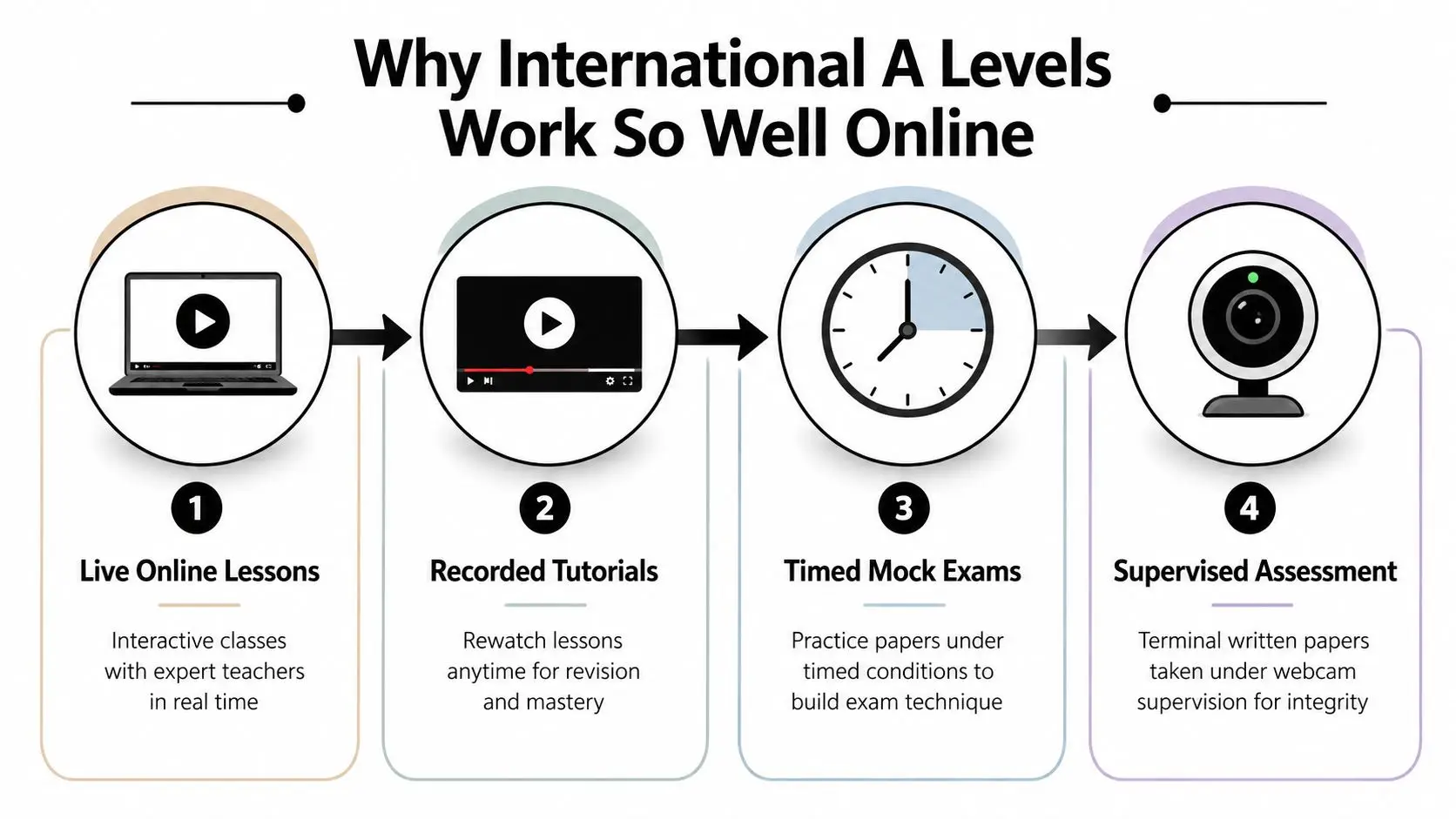
For a family that relocates, online delivery removes the need to restart a sixth-form timetable every time the household moves. It can also support a student who needs a quieter learning environment, provided the provider has real teachers, reliable safeguarding procedures, clear attendance expectations, and an approved route for examinations.
Small routines can change the experience
A learner with dyslexia may need more processing time and materials presented in a clear, uncluttered format. A student with ADHD may work better when the teacher breaks a long task into visible stages. A teenager with autism or social anxiety may contribute more confidently through a predictable lesson structure, a chat function, or a small tutorial group before speaking to the whole class.
In England, the Department for Education defines SEN support as help that is additional to or different from what is normally provided for pupils of the same age. A student receiving SEN support doesn't necessarily have an education, health and care plan. In practice, that might mean extra exam processing time, a modified teaching approach, or targeted support in Maths while the student continues to follow the same syllabus. The Department for Education's SEN statistics explains the framework schools use.
England identified 1.7 million pupils with special educational needs in 2024, representing 18.4% of all pupils, according to the government's SEN and disability data analysis. More recent school census reporting records 538,547 pupils with an EHC plan and 1.32 million receiving SEN support, with the figures summarised by nasen's latest SEN statistics. Those figures reinforce a simple point: support shouldn't be treated as an unusual add-on.
A student can also use recorded lessons for revision or adopt carefully designed self-paced microlearning strategies, such as revisiting one concept before attempting a full practice paper. That flexibility only works when the child has regular teacher contact and a clear plan, rather than being left alone with a library of recordings.
A flexible timetable should create steadier learning, not invisible learning.
Online providers must also plan for practical subjects. Biology and Chemistry may require practical preparation, demonstrations, or arrangements through an examination centre. Families should ask who supervises assessments, how safeguarding works across time zones, how mock examinations are invigilated, and whether the school can support the relevant practical requirements.
The following video offers another way to visualise how lessons, tutorials, examination practice, and supervised assessment can fit together.
Parents comparing providers should look for online high-school provision for international students that combines live teaching with pastoral care, not a purely self-directed course.
Two Students, Two Journeys to Top Universities
Maria's family moves between Madrid and Singapore as her parents' work changes. She knows she wants Medicine, but changing schools has already made continuity difficult. Each move means new teachers, new routines, and the worry that an important topic may have been taught differently.
She chooses Biology, Chemistry, and Mathematics through a live online International A Level programme. Her teachers keep a shared record of completed content, use regular retrieval tasks, and help her prepare for the examination windows available for her subjects. After earning an A in one paper, Maria retakes it when eligible because she wants to strengthen her overall grade profile. Her eventual offer from a Russell Group university reflects the combination of required subjects, grades, references, and application timing.
The useful lesson isn't that every student should retake a paper. It's that a modular route can give a carefully planned second opportunity without forcing a child to abandon an entire academic year. Maria's family still has to check board rules, deadlines, university policies, and whether the retake fits the UCAS timetable.
Tom's situation is different. He leaves a mainstream sixth form after Year 12 because ADHD and anxiety have made the environment increasingly difficult. He's capable, but he struggles to begin work in noisy rooms and loses confidence when every question must be answered publicly.
Recorded lessons let Tom pause and revisit explanations. Small breakout tutorials give him a less intimidating way to ask questions, while scheduled check-ins prevent him from disappearing behind the screen. He completes English Literature, Psychology, and History, achieves AAB, and accepts an offer from a Dutch university.
Tom's progress depends on more than flexible access. Teachers notice when work is late, help him plan manageable tasks, and treat wellbeing as part of academic readiness. The qualification stays demanding, but the route into it becomes more humane.
Choosing the Right Path for Your Child
Start with the child, not the brochure. A qualification is a vehicle for learning and progression. It shouldn't become a verdict on intelligence, maturity, or future potential.
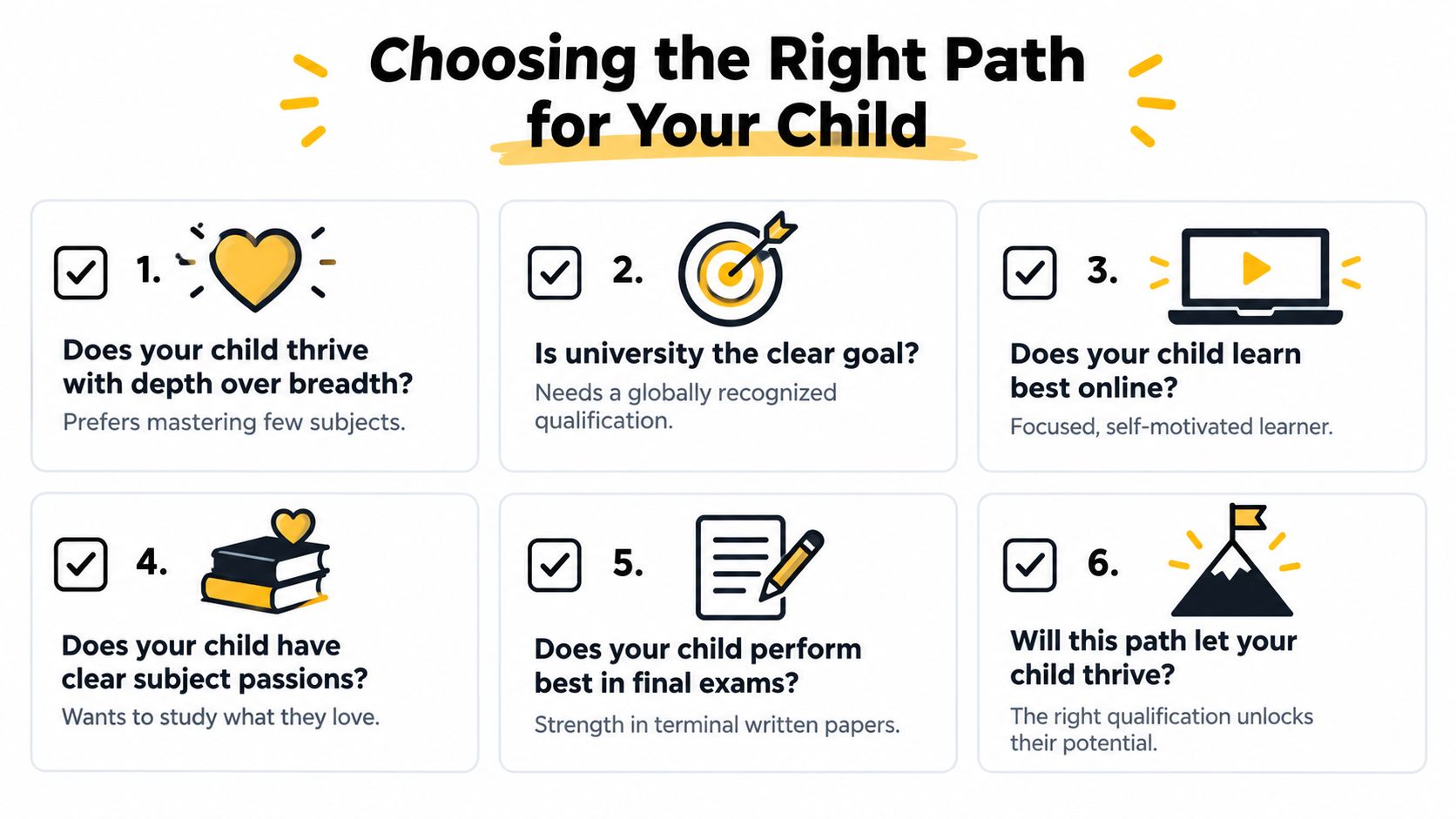
Ask these questions:
- Does your child prefer depth or breadth? A teenager who loves mastering a few subjects may feel more comfortable with International A Levels or UK A levels. A student who enjoys moving between disciplines may prefer the IB.
- How does your child handle assessment? If they work steadily towards formal examinations, an A-level route may suit them. If one examination season creates overwhelming pressure, investigate modular options and the exact subject rules.
- Where might university applications lead? Check requirements in the UK, Europe, the US, or Asia before selecting subjects. A university's course page matters more than a general statement about recognition.
- Does family life require mobility? Relocation, travel, health needs, or living outside a sixth-form catchment area may make live online teaching a practical choice.
- What support does the learner need? Ask about dyslexia, ADHD, autism, anxiety, attendance difficulties, or other SEN and SEMH considerations. Find out how adjustments are identified and communicated.
- Who will teach and assess the child? Look for live subject-specialist lessons, meaningful feedback, a recognised examination centre, safeguarding procedures, and a clear plan for practical subjects where relevant.
A settled student who enjoys broad study may thrive in a conventional sixth form or the IB. A student who wants subject depth and an international timetable may find International A Levels more suitable. A child who needs both a British curriculum and a carefully adapted online environment may benefit from International A Levels delivered through a school that can provide consistent teaching and pastoral contact.
The right choice is the one that makes Monday morning possible. Your teenager should know where to log in, who will greet them, what they're learning, and how to ask for help. Queens Online School offers live online British curriculum teaching, subject-specialist support, and International A Level pathways through an approved Pearson examination centre, with provision designed to support learners with SEN and SEMH needs.
If your family is weighing International A Levels, arrange a conversation with Queens Online School about your child's subjects, learning needs, examination route, and university ambitions. Visit Queens Online School to explore the available online pathway and decide whether its live, supported model fits your child's next step.