

Your child may be bright, curious, funny, and full of potential, yet school can still feel wrong for them.
You might be seeing it already. Mornings that begin with stomach aches. Homework that ends in tears. A teacher's report that says your child is “capable” while you watch their confidence slip week by week. For some families, the problem is pace. For others, it's noise, bullying, exhaustion, anxiety, unmet SEN needs, or the simple fact that a standard classroom doesn't fit the child sitting in it.
That's often when parents start asking a question they never expected to ask. What is virtual school, really? Is it a proper school? Is it homeschooling? Is it only for children who can't cope elsewhere? And could it give your child a calmer, safer, more successful path?
Those are sensible questions. They deserve clear answers.
Is Traditional Schooling the Only Path to Success
A parent once described their son to me as “sparkling at home and shrinking at school”. I've heard versions of that many times. At home, the child talks endlessly about space, animals, coding, art, history, football, or books. In school, they go quiet. They stop putting their hand up. They begin to believe they're the problem.
That can happen to many kinds of children. A pupil with dyslexia who needs more processing time. A teenager with SEMH needs who finds the school day overwhelming. A high-attaining learner who's bored and restless. A child who has moved countries and needs continuity. A kind, sensitive pupil who dreads the corridor more than the lesson.
Parents often feel pulled in two directions. One part says, “Keep going, maybe next term will be better.” The other says, “My child needs something different now.”
Sometimes the strongest educational decision a parent makes is not to force a child to fit the environment, but to find an environment that fits the child.
Traditional school works well for many children. It offers routine, face-to-face friendships, and a familiar structure. But it isn't the only path to a happy, successful future. Children don't all learn, regulate emotions, socialise, or recover from stress in the same way. Treating one model as the only respectable option can leave families feeling trapped.
You may already have explored different educational approaches to understand what kind of environment suits your child. If you're weighing structure against independence, classroom routine against child-led learning, it may help to compare Montessori and traditional schools as part of that wider thinking.
What matters most isn't whether a school looks conventional from the outside. It's whether your child can learn there, feel safe there, and grow there.
Understanding the Virtual School Landscape
The phrase virtual school causes a lot of confusion in the UK because it can mean very different things. Parents sometimes hear the term from a local authority, then search online and find full-time online schools, recorded courses, tutors, and homeschooling groups all using similar language.
That muddle matters. If you're trying to help your child, you need to know what each option does.
Three very different meanings
In the UK, the term “virtual school” has a specific statutory meaning established by the Children and Families Act 2014. Each local authority has a “virtual school head” to advocate for children in care, managing Pupil Premium Plus funding to support their education within traditional schools. This is distinct from commercial online schools that provide direct teaching, as outlined in the University of Oxford report on the effectiveness of virtual schools.
So when people say “virtual school”, they may mean one of three things:
| Type | What it is | Who teaches the child |
|---|---|---|
| Statutory Virtual School | A local authority support service for children in care | The child usually remains in a traditional school or another placement |
| Comprehensive online school | A school delivering live lessons, teachers, timetable, curriculum, and assessment online | The online school's teachers |
| Homeschooling with online resources | Parent-led education using websites, tutors, videos, or course platforms | Mostly the parent, sometimes tutors or course providers |
A simple way to picture it
I often compare these options to forms of transport.
A statutory Virtual School is like a support vehicle travelling alongside your child's education. It doesn't replace the main journey. It helps guide, advocate, and keep things on track for children in care.
A complete online school is like a bus service with a fixed route, qualified driver, timetable, and destination. Your child joins a full educational programme, attends lessons, and works towards recognised qualifications.
Homeschooling with online resources is more like driving your own car with a satnav. You choose the route, speed, and stops. That freedom can suit some families very well, but it also means the parent carries far more responsibility.
Why parents get stuck
Many parents aren't looking for jargon. They're looking for relief. They want to know whether their child can have teachers, classmates, proper lessons, and recognised exams without attending a physical school every day.
That's why clear language matters. If your child needs full-time teaching online, you're not looking for the statutory local authority service alone. You're looking at a complete online school model.
Once that distinction is clear, your choices become far easier to judge.
A Day in the Life of a Virtual School Student
The best way to answer what is virtual school is often to stop defining it and show it.
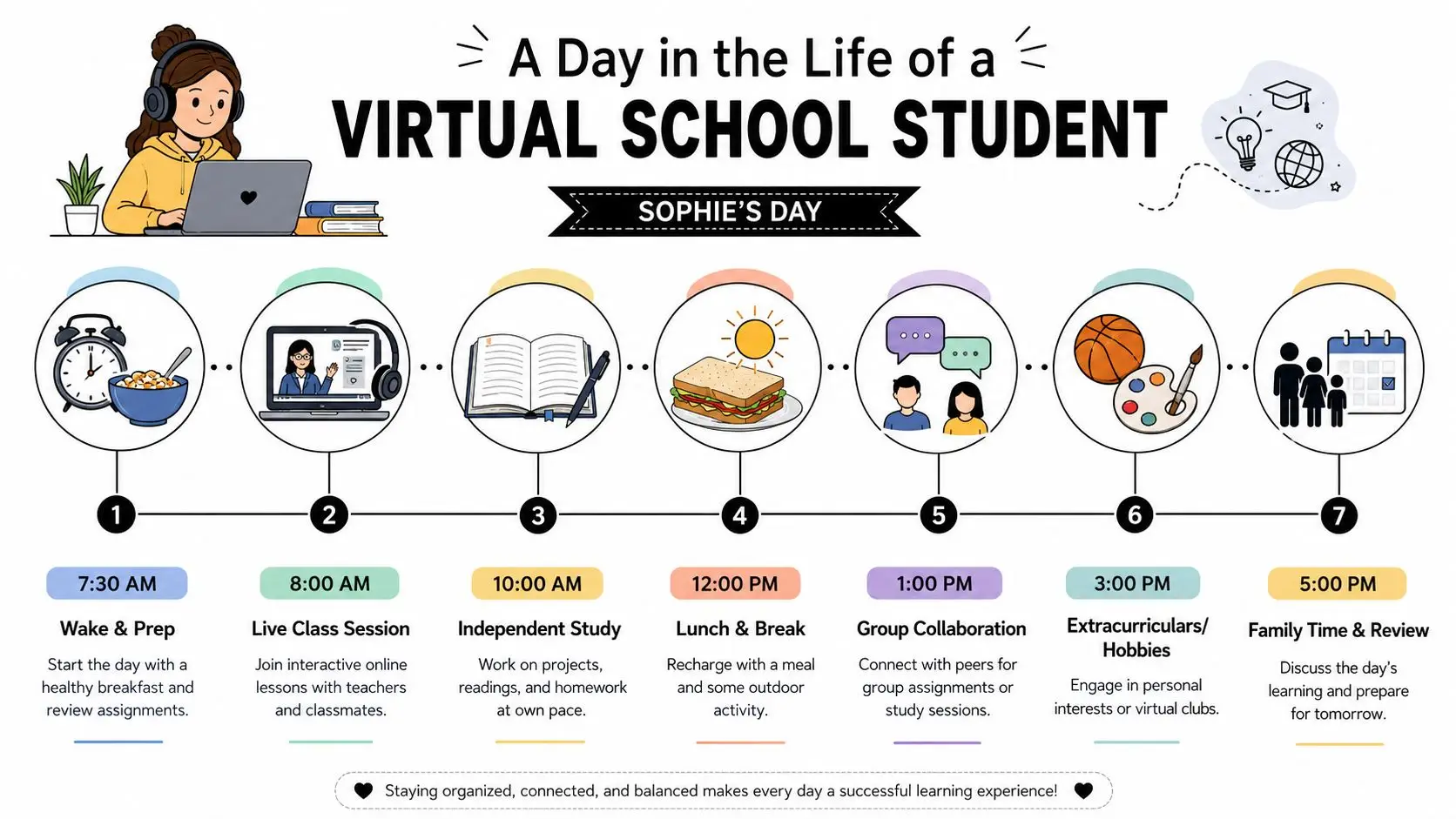
Take Sophie, a Year 9 pupil who found a busy school site draining. In her old setting, the noise between lessons unsettled her before she even reached the classroom. In a virtual school routine, her day begins more calmly. She has breakfast, checks her timetable, and logs in ready to learn, not ready to brace herself.
The morning rhythm
At 8:00 AM, Sophie joins a live maths lesson. Her teacher explains algebra on screen, asks questions, and checks understanding in real time. Sophie uses the chat when she doesn't want to speak immediately, then answers aloud once she feels ready.
Later, she moves into independent study. This doesn't mean being left alone without support. It means she can revisit lesson notes, complete a short task, or watch part of a recorded explanation again if she needs a second pass.
Practical rule: If a child learns well with a mixture of live teaching and quiet consolidation time, virtual school can feel less chaotic and more manageable than a packed physical timetable.
For families wanting to understand the systems behind this, a look at virtual classroom technology helps make the day-to-day setup easier to picture.
Learning with structure and flexibility
At lunchtime, Sophie steps away from the screen. A good virtual school day includes breaks, movement, food, and ordinary family life. That pause matters, especially for pupils who become overloaded easily.
In the afternoon, she works with peers on a science activity. One of the surprises for many parents is that online learners don't always work in isolation. They can collaborate in breakout rooms, group chats, shared documents, and clubs. For organisation, older students often benefit from digital planning tools, and parents comparing options may find it useful to compare student productivity software to see what helps with deadlines and routines.
A realistic virtual school day also depends on suitable equipment. To ensure smooth participation in live classes and use of GCSE and A-Level software, families should budget for a device with at least an Intel i5 processor and 8GB RAM, and a fibre broadband connection of at least 50 Mbps, according to this guide on technology requirements for online schooling in the UK.
Here's a short introduction to the rhythm many families are looking for:
What the day feels like
By late afternoon, Sophie joins an art club, then finishes with family time and a quick check of tomorrow's tasks. The day has structure, but not the kind that crushes her. She still has teachers, peers, deadlines, and accountability. She also has breathing room.
For the right child, that combination can change everything.
Comparing Your Options for Your Child
When parents compare education choices, they often get given a list of features. That's rarely enough. The better question is this. Where is your child most likely to feel secure, engaged, and able to make progress?
Looking at the child, not the label
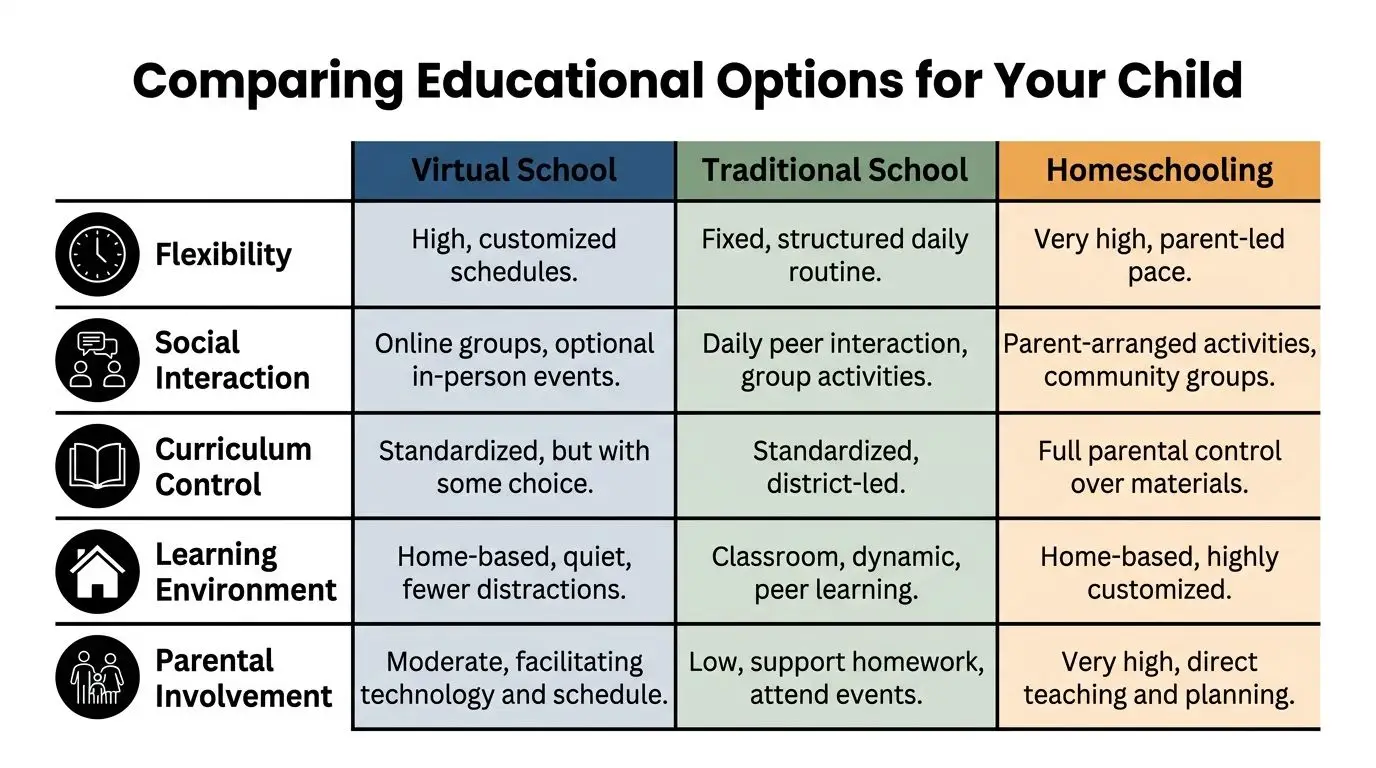
A traditional school may suit a child who likes in-person routine, quick social contact, and a clear separation between home and study. A virtual school may suit a child who needs calmer surroundings, more flexibility, or access to learning that isn't tied to a local postcode. Homeschooling may suit a family that wants maximum control and is ready to take direct responsibility for planning and teaching.
The differences become clearer when you place your child at the centre.
| Area | Virtual school | Traditional school | Homeschooling |
|---|---|---|---|
| Learning pace | Often more adaptable within a structured programme | Usually set by class pace | Fully parent-directed |
| Social experience | Online peer groups, clubs, shared projects | Daily in-person contact | Depends on what families arrange |
| Teacher access | Direct online contact during lessons and support times | Varies by class size and school setting | Parent-led, with tutors if chosen |
| Environment | Home-based and potentially calmer | Busy, shared, and externally structured | Home-based and highly customised |
| Parent role | Supportive and supervisory | Usually lighter day-to-day | Intensive and ongoing |
Questions that matter more than trends
Some children need the energy of a physical classroom. Others need fewer transitions, less sensory pressure, or more emotional safety. A child who masks anxiety all day may appear to be coping in traditional school while using all their energy to get through it.
A child with strong independence might enjoy the responsibility of online learning. Another may need tighter scaffolding and more adult prompting. That doesn't rule virtual school in or out. It indicates what support must be in place.
Ask not “Which model is best?” but “Which model helps my child stay well enough to learn?”
If you're reviewing structured online pathways, it helps to look at online school programmes so you can see how different stages and subjects are delivered.
An honest comparison
Virtual school is not a magic answer. It won't suit every personality or every household. Traditional school is not automatically wrong because a child is struggling. Homeschooling is not automatically more nurturing because it happens at home.
The right choice is the one that gives your child the best chance to learn steadily, feel known, and build confidence over time. Sometimes that means staying put with better support. Sometimes it means making a brave change.
The Heart of the Matter Benefits and Concerns
A parent usually reaches this point with a knot in the stomach. Relief is one possibility. Regret is the fear. Both are understandable, especially if your child has already spent months trying to cope in a setting that asks too much of their nervous system.
The fairest way to judge virtual schooling is to ask a simple question. Does this model help my child feel safe enough, steady enough, and supported enough to learn?
Where virtual school can help
For some children, the first change is not academic. It is physical and emotional. The school day becomes quieter. There is less rushing, less corridor noise, less uncertainty about what the next hour will feel like. For a child with SEN or SEMH needs, that reduction in pressure can work like taking a heavy school bag off sore shoulders. Energy that once went into coping can start to return to learning.
This matters for many families. According to the official SEN statistics for England 2025 to 2026, a large proportion of pupils in England have identified special educational needs. As summarised by Mencap's children and SEN statistics page, only a minority attend special schools. Many are therefore educated in settings that may not fit their sensory, social, or emotional profile particularly well.
A well-run virtual school can help by offering:
- Calmer learning conditions with fewer sensory triggers and social flashpoints.
- Live teaching and quick feedback so a child does not sit with confusion until it turns into distress.
- Clear routines that make the day more predictable.
- Teaching that can flex more easily when a pupil needs repetition, extension, or a different pace.
Parents often ask how to judge quality between providers. A practical starting point is to review independent-style indicators such as these online school rankings for UK families alongside each school's teaching model, safeguarding, and support for additional needs.
One area often confused by parents deserves plain English. In the UK, a statutory Virtual School usually refers to the local authority service that supports children in care and certain previously looked-after children. That is not the same as an online school where lessons are taught remotely day to day. If your child needs actual teaching, routine, and pastoral support delivered online, it is important to check which type of service you are being offered.
The concerns parents raise most
The first concern is usually social development. That concern is sensible. Children do need friendship, practice with conversation, and a sense of belonging. The key question is not whether learning happens through a screen, but whether the school creates regular human connection through live lessons, discussion, group work, clubs, and trusted adults who know the child well.
Screen time comes next. Here, balance matters more than panic. A healthy online school day should include direct teaching, independent written work, reading, short breaks, movement, and time away from the device. The screen is the classroom door, not the whole education.
Families also worry about attendance, resilience, and long-term stability, especially where anxiety, trauma, or school-based distress are already present. The County Councils Network discussion of virtual schools helps clarify the statutory role of Virtual Schools for children in care, but it does not provide recent UK evidence about attendance outcomes for pupils with SEMH needs in fee-paying online schools. Honest schools should say so plainly. Parents do not need sales language. They need clear answers about what happens on a hard day, not only on a good one.
If mental well-being is central in your decision, this article on children's mental health and online education offers a useful starting point for thinking through possible benefits and risks.
The heart of the matter is simple. A suitable school model should help your child learn without asking them to break themselves in the process.
Finding the Right Fit for Your Family
A parent often reaches this point feeling pulled in two directions. You want your child to learn well, but you also want them to feel safe enough to keep learning tomorrow. That is why the right choice usually becomes clearer when you stop asking, “Which school sounds impressive?” and start asking, “Which setting understands my child best?”
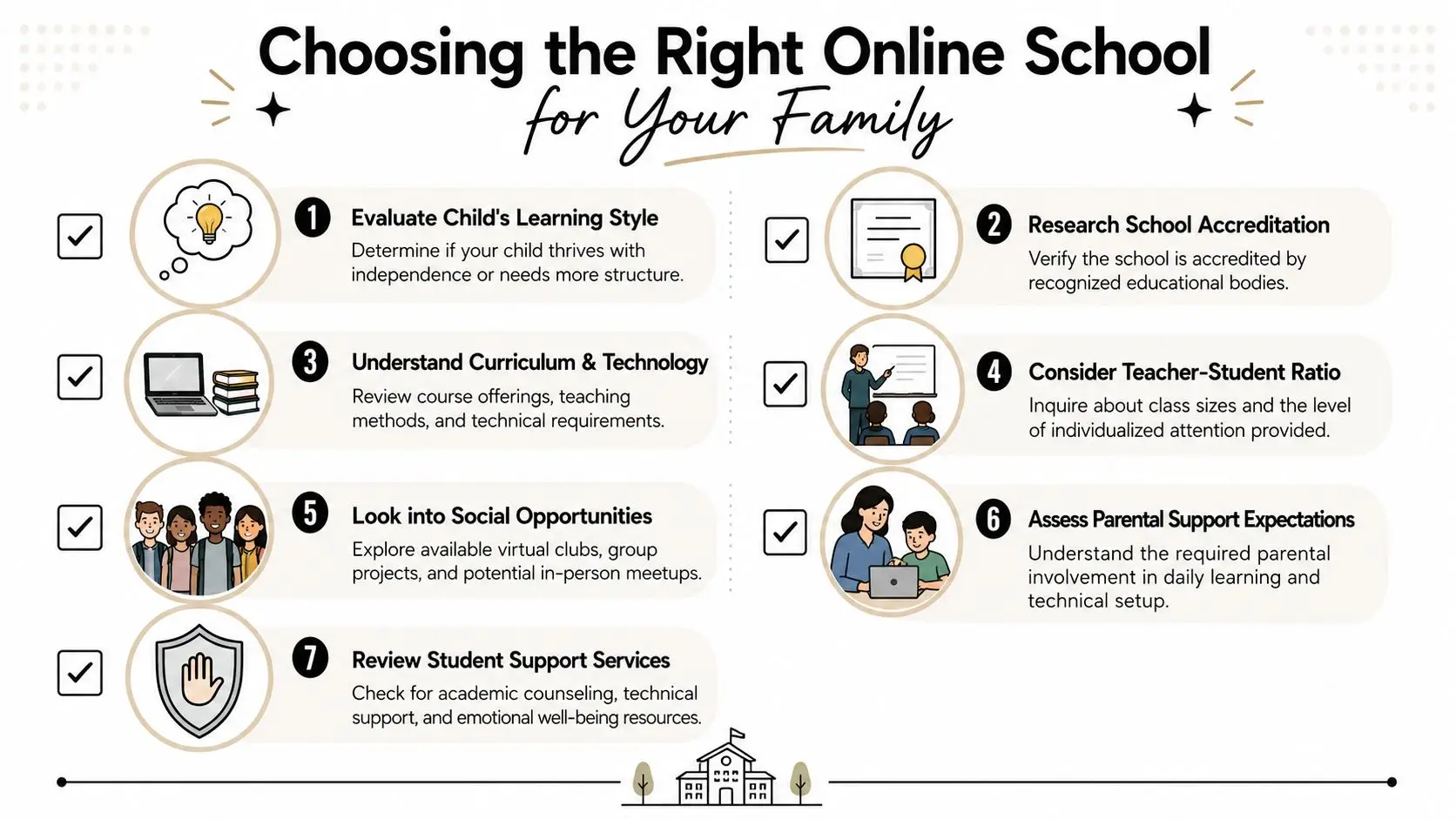
For some families, the first point of confusion is the name itself. In the UK, a statutory Virtual School supports the education of children in care and certain previously looked-after children. That is different from an online school, where pupils attend lessons remotely as their main form of schooling. If you are comparing options for your own child, especially a child with SEN or SEMH needs, it helps to keep that distinction clear from the start.
What to check first
Begin with the parts that shape daily life, because that is where a child either settles or struggles.
- Exams and recognition. Ask where students sit GCSEs and A-Levels, who manages entries, and how the school prepares pupils for that process.
- Teaching model. Find out how much learning happens in live lessons, how much is independent, and how teachers check understanding during the week.
- Pastoral care. Ask who notices when your child goes quiet, misses work, or starts to wobble emotionally.
- Support for SEN and SEMH. Ask for a real example. What happens if your child cannot enter a lesson calmly, shuts down after a difficult morning, or needs instructions broken into smaller steps?
A school's brochure can sound polished. Daily practice matters more. A good answer should feel concrete, like a teacher showing you the timetable, the support route, and the people involved, not just offering reassurance.
Questions worth asking in an admissions call
A short conversation can tell you a great deal if you ask questions that bring the school to life.
How big are your classes?
Smaller classes can make it easier for anxious pupils to speak, ask for help, and feel known.What happens on a hard day?
This question often reveals more than asking about success stories. You are listening for a calm, practical process.How do teachers adapt for different learners?
A strong school should describe how it adjusts pace, instructions, feedback, and expectations for individual children.How much support is expected from home?
Some models work best with a parent nearby for parts of the day. Others are designed for greater independence.How do children build relationships?
Ask about tutor time, group tasks, clubs, and informal chances to talk. Community rarely appears by accident.
If you are weighing several providers, a comparison resource such as these online school rankings for parents researching options can help you organise your thinking, alongside open events and direct questions.
The right school usually feels less like a sales pitch and more like a clear plan for your particular child.
Trust what the school shows you
Try to see the school in action if you can. A sample lesson, an open event, or a conversation with staff can reveal whether the school notices children as individuals or speaks about them as a system to manage.
This matters even more for a child who has become wary of education. Trust grows slowly. It grows when expectations are clear, adults are steady, and support is built around the child in front of them.
In the end, families are not choosing between a “traditional” future and an “online” one. They are choosing the environment in which their child is most likely to learn, recover confidence, and keep moving forward.
Frequently Asked Questions from Parents
How do virtual school students take official GCSE and A-Level exams
Families should ask this early. A strong online school will explain clearly where exams are taken, how entries are managed, and what support is provided. Schools with recognised exam-centre arrangements offer more reassurance than schools that leave families to organise everything alone.
Can my child keep studying if our family moves often
Yes, that's one of the practical strengths of online schooling. For families who relocate because of work, travel, or international moves, a virtual school can provide continuity of teachers, curriculum, and routine. That stability can be especially valuable for children who find repeated transitions unsettling.
Will my child miss out on friendships
They can, if the school treats learning as a solitary screen-based task. They're less likely to if the school builds regular live interaction, clubs, group work, and pastoral contact into everyday life. The question isn't whether friendships are possible online. It's whether the school actively creates the conditions for them.
What technology costs should we plan for beyond tuition
Beyond tuition, families should budget for essential technology. A suitable mid-range laptop can cost £600 to £900, with monthly fibre broadband at £30 to £50. Additional costs such as a headset at £40 to £120 and annual security software at £40 to £70 are also important, according to the UK government's guidance on laptops, desktops and tablets for schools and colleges.
Is virtual school only for children who are struggling
No. Some children move online because they are struggling. Others do so because they are thriving in the wrong environment. Families choose virtual school for many reasons, including flexibility, health, travel, emotional well-being, and the need for a more personalised academic pace.
How do I know if my child is suited to virtual school
Look at your child's real daily experience. Are they drained by the school environment itself? Do they need more flexibility, more individual attention, or a calmer setting? The strongest sign is not whether they are perfect at working independently today. It's whether the online model removes barriers that are currently blocking their learning and confidence.
If you're exploring a full British online education for your child, Queens Online School is one option to review carefully. Look at the curriculum, teaching model, pastoral support, exam arrangements, and SEN or SEMH provision with your child's needs in mind. The right choice is the one that helps your child feel safe enough to learn, and supported enough to believe in their future again.