

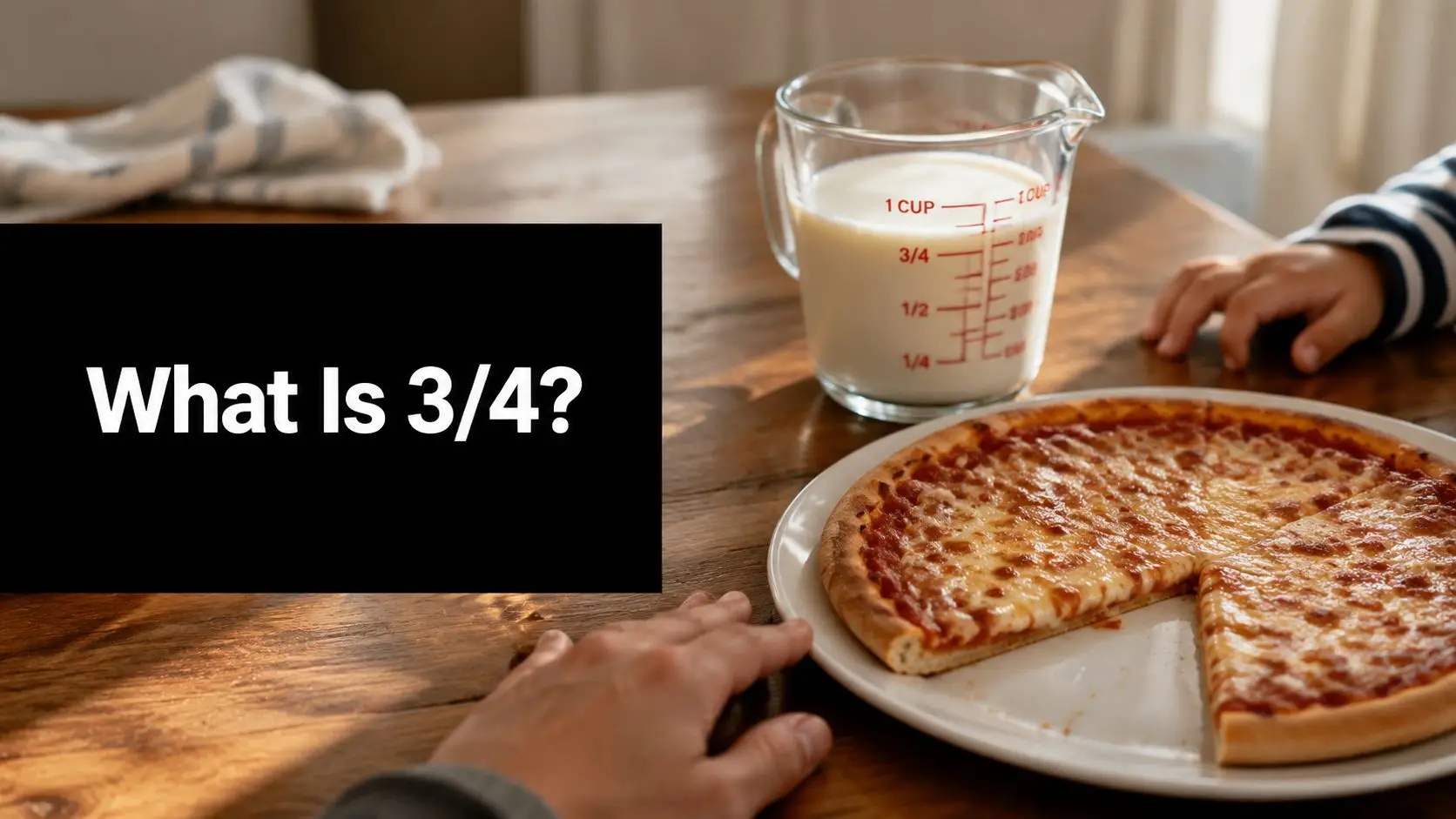
You might be sitting at the kitchen table right now with a worksheet, a rubbed-out answer, and a child who's gone very quiet. Fractions can do that. One minute everyone's fine, and the next minute 3/4 looks like a secret code.
If that's where you are, take a breath. This isn't a sign that your child “isn't a maths person”, and it doesn't mean you've explained it badly. Fractions often feel slippery at first, especially when a child can copy a method but still not feel what the number means.
That Uh-Oh Feeling with Fractions
A parent points to the page. A child frowns and says, “I just don't get it.” Then comes the guessing, the tension, and that sinking feeling that something small has suddenly become huge.
That reaction is more common than many families realise. Research on children's learning difficulties shows that many pupils struggle to understand fractions like 3/4 as a number, often applying procedures without true understanding, which makes it a common point of confusion.
When maths feels bigger than the page
For some children, especially those with SEN or SEMH needs, the hardest part isn't the fraction itself. It's the feeling of being rushed, corrected, or afraid of getting it wrong. A child who can talk happily about pizza, Lego, or pocket money may freeze the moment the numbers appear.
Fractions make more sense when a child can touch them, see them, and talk about them before they try to calculate them.
That's why a gentle approach matters. If your child needs extra reassurance with secondary maths later on, this guide to Keybaki high school math help gives practical support without making the subject feel harsh or intimidating.
If you're supporting a younger learner, a parent-friendly look at the Year 6 maths curriculum can help you see where fractions fit into the bigger picture.
A friendlier way to see 3/4
Before rules, before worksheets, before crossing things out, it helps to say one simple thing. 3/4 is just three equal parts out of four equal parts.
That's all.
Once a child feels that idea in a calm, concrete way, a lot of the fear starts to loosen. The “uh-oh” feeling doesn't vanish in a second, but it can turn into an “ohhh” moment. That's where real learning starts.
Unpacking What 3/4 Really Means
The clearest way to answer what is 3/4 is to start with something a child can picture. Use a pizza, a chocolate bar, or even four identical crackers on a plate.
Think about one whole pizza. If you cut it into four equal slices, each slice is one quarter. If you take three of those slices, you have three quarters, written as 3/4.
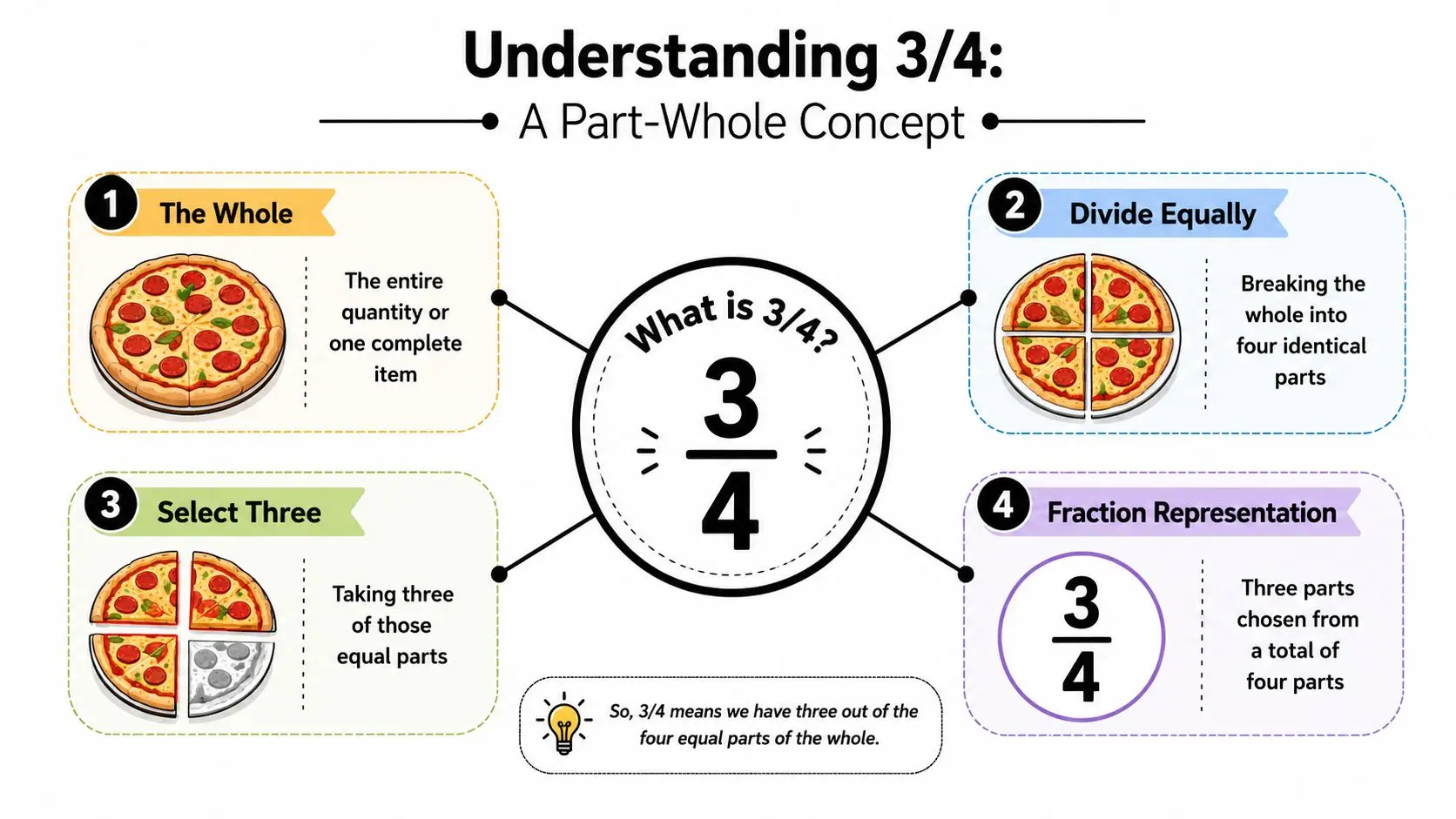
In the UK National Curriculum for Key Stage 2, pupils are explicitly taught to recognise, find, name, and write the fraction 3/4 of a length, shape, or set of objects, linking it to fundamental multiplication and division.
The bottom number first
Children often do better when you explain the denominator first. That's the bottom number.
In 3/4, the 4 tells us how many equal parts the whole has been split into. Not just any four parts. Equal parts. That word matters.
If a pizza is cut into one giant slice and three tiny slices, that isn't a fair model of quarters. Fractions only work properly when the whole is divided evenly.
Then the top number
The numerator is the top number. In 3/4, the 3 tells us how many of those equal parts we're talking about.
So you can say it like this:
- The 4 means the whole is cut into four equal parts.
- The 3 means we have three of those parts.
That simple order helps many children stay grounded.
Practical rule: Say the denominator as “how many equal parts altogether” and the numerator as “how many parts we have”.
Try it with objects
You don't need fancy resources. Use anything you already have.
- Put out 4 grapes.
- Ask your child to move 3 grapes to one side.
- Say, “You've moved 3 out of 4. That's 3/4.”
Then try it again with toy cars, buttons, or building bricks. The more a child sees the same idea in different forms, the less it feels like a one-off trick.
If you'd like another simple explanation from a different angle, this guide on understanding fractions for Texas test is useful for reinforcing the part-whole idea. If your child is also starting to compare fractions, this explanation of common denominators can help once the basics feel secure.
Seeing 3/4 in Its Different Disguises
A lovely moment in maths happens when a child realises that 3/4, 0.75, and 75% are not three separate things. They're the same value written in different ways.
That can feel surprisingly comforting. The number hasn't changed its meaning. It has only changed its outfit.
Three ways to write the same amount
| Form | Representation | What it means |
|---|---|---|
| Fraction | 3/4 | Three equal parts out of four |
| Decimal | 0.75 | Seventy-five hundredths |
| Percentage | 75% | Seventy-five out of one hundred |
Money often makes the decimal form click. If something costs £0.75, that's seventy-five pence, which is three quarters of a pound.
The percentage form works the same way. 75% means 75 out of 100. UK maths guidance for Key Stages 1 and 2 says pupils should automatically recall that 75 is a bond to 100 with 25, and that bond helps children grasp 3/4 as 75% in a way that reduces cognitive load, as set out in the Key Stages 1 and 2 maths guidance.
Put it on a number line
A number line can calm a child who feels lost with symbols.
Draw a line from 0 to 1. Mark the halfway point as 1/2. Then split the whole line into four equal jumps:
- 1/4
- 2/4
- 3/4
- 4/4 or 1
Now your child can see that 3/4 is more than 1/2 and less than 1.
Some children stop worrying when they realise fractions live on the number line just like whole numbers do.
A useful little bridge
If your child already knows quarters in money or time, use that. You might say:
- “A quarter of a pound is 25p.”
- “Three quarters of a pound is 75p.”
- “A quarter of an hour is 15 minutes.”
- “Three quarters of an hour is 45 minutes.”
That bridge from something familiar to something abstract can create a fast, satisfying aha moment.
Finding 3/4 in Your Everyday Life
Fractions feel less scary when they stop living only on worksheets. 3/4 shows up in ordinary family life all the time, often without anyone naming it.
A Saturday morning is full of examples. You're baking, someone's watching the clock, and someone else is deciding whether a shop discount is worth it.
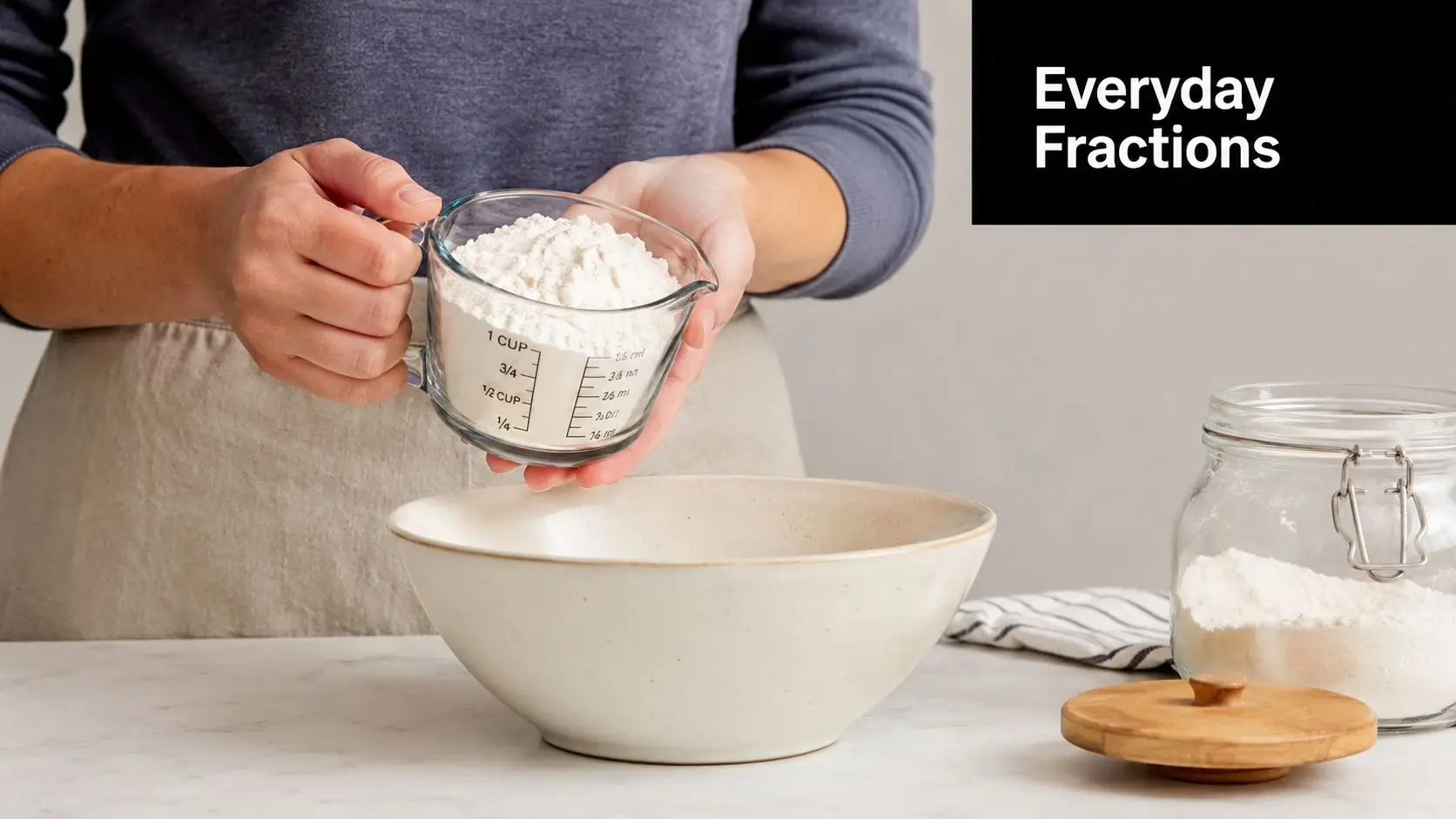
At home and out and about
In the kitchen, a recipe might ask for 3/4 of a cup of flour. A measuring cup makes the fraction visible. It's not just a written symbol. It's an amount you can pour.
Later, you glance at the clock. If 45 minutes have passed in an hour, that's 3/4 of an hour gone. If a concert or school activity uses a three-quarter rhythm, children may hear the pattern before they fully explain it.
At the shops, a reduction can reveal the same idea in a different costume. If 25% is taken off, the amount you pay is 75%, which is another way of thinking about 3/4 of the original price.
Why schools keep returning to it
By Key Stage 3, students are expected to use 3/4 as a benchmark for expressing one quantity as a fraction of another and linking it to ideas like linear functions and compound units such as speed or density, according to the UK Secondary Curriculum for mathematics.
That might sound advanced, but the root idea stays simple. A child who understands three equal parts out of four is building a foundation that later supports much bigger topics.
A short visual explanation can help if your child learns best by watching someone else work through it:
A family noticing game
Try this for one day. Ask your child to spot every time your family meets 3/4.
- Cooking: “We need 3/4 of a cup.”
- Time: “It's 45 minutes past.”
- Shopping: “We're paying 75%.”
- Sharing: “You ate 3 of the 4 orange slices.”
Children often relax when maths becomes something they notice, not something done to them.
Gentle Tips for Teaching and Learning
The child's emotional state matters as much as the method. If a child feels safe, seen, and unhurried, they can usually think more clearly. If they feel embarrassed or pushed, even a simple question can feel impossible.
That's especially important for children with SEN or SEMH needs. A calm voice, a slower pace, and hands-on materials can make the difference between shutdown and success.
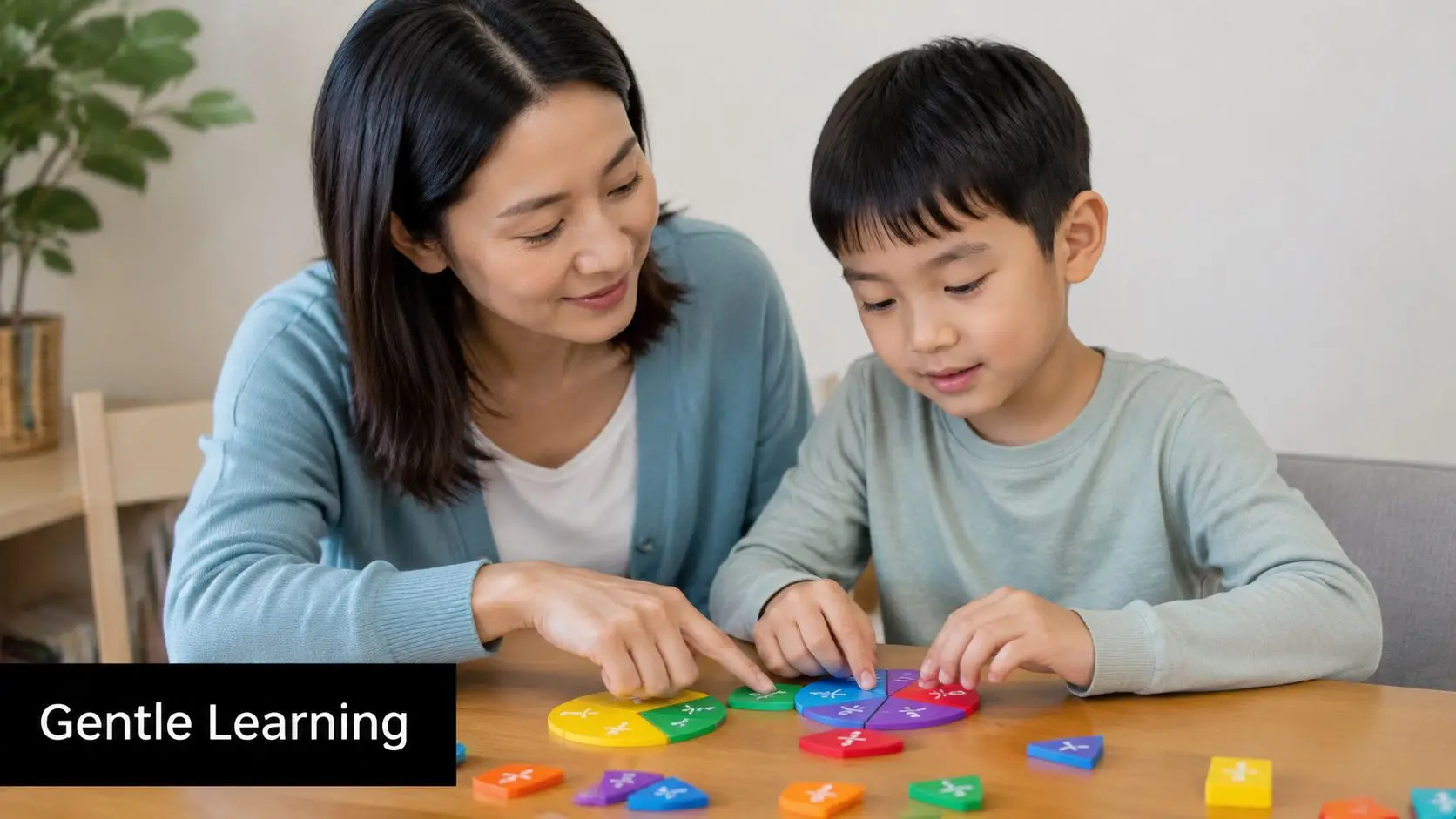
Start with comfort, not speed
Try these simple habits at the table:
- Use real objects: Lego bricks, raisins, toy animals, or coloured counters work better than abstract worksheets when a child feels unsure.
- Keep the language gentle: “Let's test it together” feels safer than “No, that's wrong.”
- Remove the race: Some children know the idea but need extra time to process it.
- Follow interests: If your child loves football, use four football cards and pick three. If they love baking, use measuring spoons.
“No rush” can be one of the most powerful teaching tools in maths.
If you've noticed a child consistently struggling with number sense, memory for maths facts, or heavy anxiety around basic quantities, it may help to read about the symptoms of dyscalculia.
A simple way to find 3/4 of a number
Once the meaning of the fraction feels secure, you can show how to find 3/4 of a quantity.
Use 12 as an example.
- Look at the bottom number, 4. Divide 12 by 4. You get 3.
- Look at the top number, 3. Multiply 3 by 3. You get 9.
So 3/4 of 12 is 9.
Some children remember it as: divide by the bottom, times by the top.
Small wins matter
You don't need instant perfection. You're looking for signs such as:
- Recognition: Your child spots that 3/4 means three of four equal parts.
- Connection: They notice that 75p matches 3/4.
- Confidence: They try again instead of giving up.
In the UK, approximately 84% of adults aged 19 to 64 have achieved a qualification level equivalent to a GCSE grade 4 or higher, which includes this kind of core mathematical mastery, according to education and training statistics for the UK. That's a helpful reminder that this understanding grows over time. Children don't need to know everything today.
From Fraction Fear to Fraction Fun
So, what is 3/4?
It's three equal parts out of four. It can be written as 3/4, 0.75, or 75%. It appears in pizza slices, measuring cups, money, time, and everyday choices. Most of all, it becomes easier when a child feels calm enough to explore it instead of defend themselves from it.
If your child has been anxious around fractions, this is your reminder that slow progress still counts. Touching four counters and moving three. Spotting 75p in a purse. Realising that 3/4 sits between 1/2 and 1. Those are real steps forward.
Here are a few no-pressure practice questions:
What is 3/4 of a pizza cut into 4 equal slices?
Answer: 3 slicesWhich is the same as 3/4, 0.25 or 0.75?
Answer: 0.75What is 3/4 of 8?
Split 8 into 4 equal parts to get 2, then take 3 parts.
Answer: 6
Fractions often become fun at the exact moment a child realises they already understand more than they thought.
If you want a supportive British curriculum environment where children can learn at their own pace, Queens Online School offers live online teaching, personalised support, and an inclusive approach that helps learners build confidence as well as academic skill.