

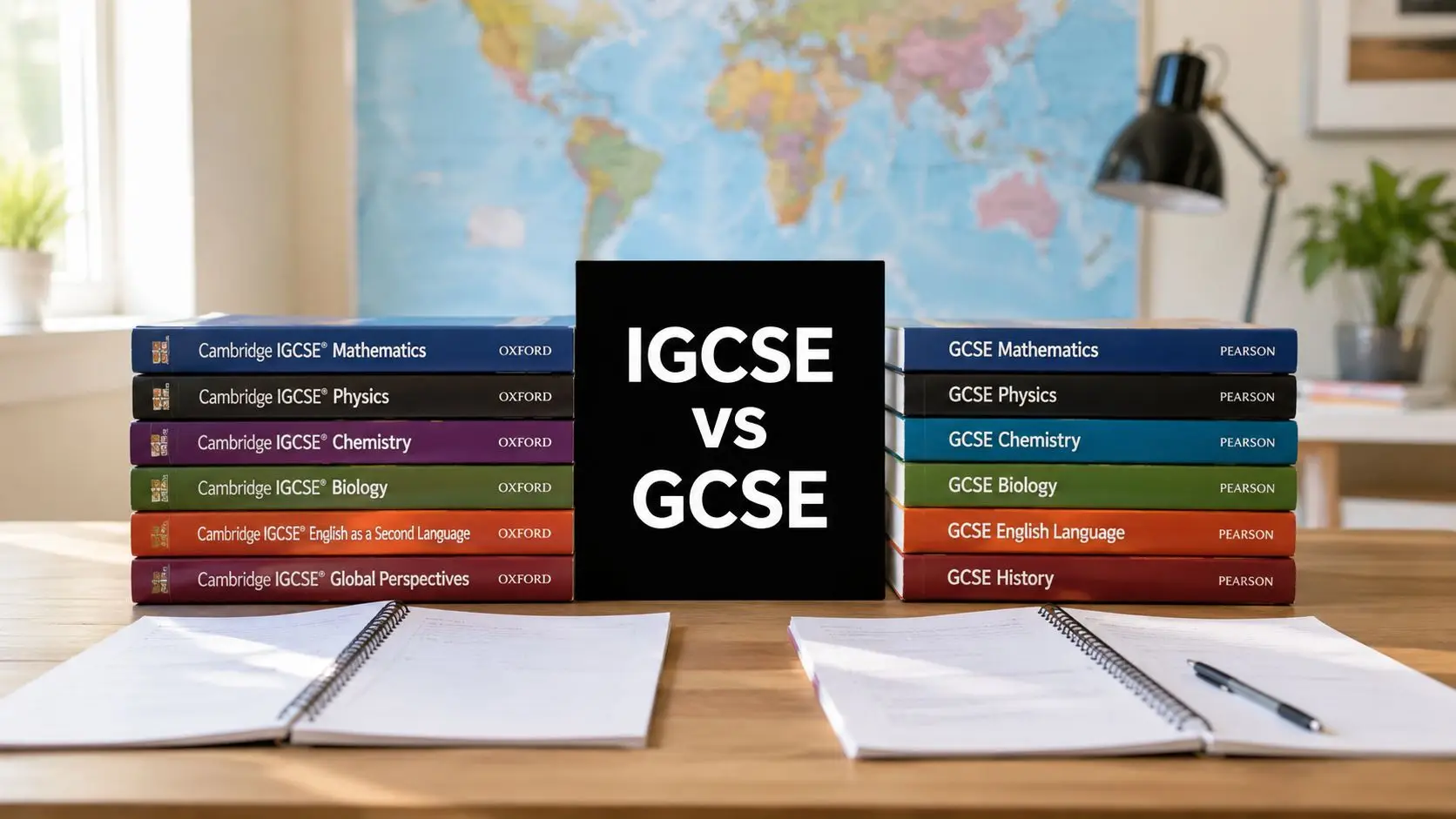
Your child is in Year 9. The options form is open on the kitchen table. One school mentions GCSEs. Another offers IGCSEs. An online option sounds flexible, but now you’re wondering whether “international” means different, harder, or somehow less accepted.
We meet many families at exactly this point. The worry usually isn’t about acronyms. It’s about consequences. Will this choice affect sixth form entry, university plans, confidence, wellbeing, or the practical rhythm of the next two years?
The good news is that this decision becomes much clearer when we stop treating it as a contest and start treating it as a fit question. The issue isn’t “which qualification sounds better?” It’s which route will help your child learn well, sit exams confidently, and move forward with options intact.
The Crossroads at Age 14 Choosing Your Child’s Path
A parent recently described this stage to us in a way that felt exactly right. “It feels like a small form with very large consequences.” That’s often how Key Stage 4 decisions feel. Your child is still growing up, still changing, still discovering who they are, and yet the language around these choices can sound final and intimidating.
For some families, the dilemma is practical. You may be relocating. Your child may already be learning online. They may need a timetable that works around sport, health needs, or anxiety. For others, the tension is emotional. One child thrives with structure and clear exam goals. Another needs breathing room, gentle pacing, and fewer moving parts.
If you’re still getting your bearings, it helps to understand what Key Stage 4 includes in the British system. Once parents see where Years 10 and 11 sit in the wider journey, the decision usually feels less abstract and more manageable.
When the choice feels bigger than the paperwork
We’ve seen families compare prospectuses late into the evening, trying to decode whether IGCSE and GCSE are equivalent or whether one opens more doors. We’ve also seen parents look past the document entirely and ask the better question: “What sort of learning environment will help my child stay engaged for two important years?”
That question matters.
A child who is bright but easily overwhelmed may need a course structure that reduces unnecessary pressure. A child who moves between countries may need a qualification that travels well. A child who has fallen behind may need flexibility in exam timing more than they need tradition.
The strongest decisions at this age usually come from matching the course to the child, not from chasing whichever label feels more familiar.
For parents weighing the broader high school decision as well as the qualification itself, Mrs. College Counselor offers a useful parent-facing guide to choosing the right high school. It’s a helpful reminder that the school context and the qualification choice often need to be considered together.
GCSE and IGCSE An Overview
A parent often reaches this stage with a very practical question in mind. “Are these two qualifications different, or are they different names for a similar route?” In most cases, the honest answer is that they are closely related qualifications with different design priorities.
GCSE stands for General Certificate of Secondary Education. It is the standard qualification followed by most pupils in the UK system at this stage. IGCSE stands for International General Certificate of Secondary Education. It was created to work well for students studying in international settings, including those learning outside a traditional UK school.
A simple overview helps before the finer comparison.
| Area | GCSE | IGCSE |
|---|---|---|
| Main setting | Standard route in the UK | Designed for international learners |
| Availability | Primarily in the UK and a limited number of other countries | Offered widely through international schools and exam centres |
| Typical learner context | UK schools, especially state schools | International schools, online learners, mobile families |
| UK state school tables | Counted in official school performance data | Treated differently in England’s state school accountability system |
The biggest difference is the setting each qualification is designed for
GCSE is built around the domestic UK school system. IGCSE is built to travel more easily across countries, school models, and exam centres. We often explain it to families this way. GCSE usually fits the school your child attends. IGCSE often fits the life your child leads.
That distinction matters more than many parents expect.
If your child is settled in a conventional UK school and likely to remain there, GCSE is usually the familiar route. If your child studies online, relocates between countries, or needs a qualification that works more smoothly across international centres, IGCSE often makes practical sense. The choice is not only about subject content. It is also about where and how your child will learn over the next two years.
Families also worry that “international” might mean less respected. In practice, the better question is whether the course structure suits the student. If that concern is on your mind, our guide on whether IGCSE is harder than GCSE can help separate reputation from reality.
Why school league tables can confuse this decision
One point is easy to miss if you are comparing schools rather than qualifications. IGCSEs sit differently within England’s state school performance table system, as noted earlier. For parents, that can create a false impression that one route has more value because it appears more clearly in published school data.
For your child, those league table mechanics may matter far less than families first assume.
We encourage parents to read school results with care. A qualification can be strong for an individual student and still be treated differently in official reporting. That is one reason school comparisons sometimes feel oddly unhelpful, especially for online learners, international families, or parents considering independent schools alongside state options.
A useful question to ask is: “Which course gives my child the best chance of steady progress, sensible assessment timing, and a qualification that fits our family’s circumstances?”
That usually leads to a better decision than focusing only on which label appears more often in school statistics.
A Detailed Comparison of IGCSE vs GCSE
A family can read two course outlines, compare subject names, and still miss the part that will shape the next two years most: how the qualification will feel to study week by week.
The quick comparison
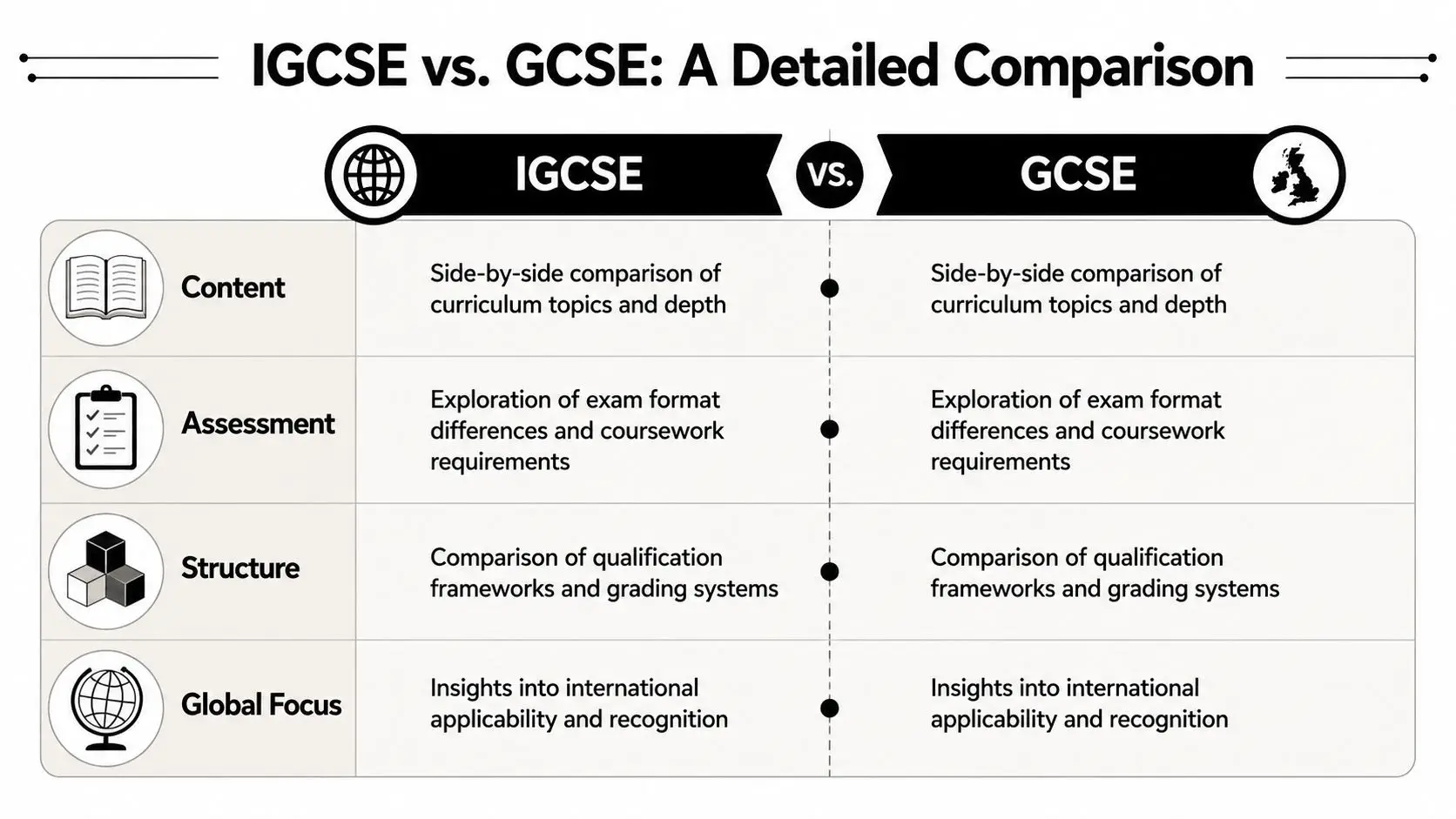
| Feature | IGCSE | GCSE |
|---|---|---|
| Assessment style | Often little or no coursework, depending on subject and board | Mostly final exams in many subjects after reforms in England |
| Flexibility | More common exam session flexibility with some boards | Usually one main summer exam season, with limited resit options in some cases |
| January exams | Available in some subjects with some boards | Generally not part of the standard GCSE pattern |
| Grading | Often A* to G, though some boards also offer 9 to 1 | 9 to 1 in England |
Assessment and coursework
Many parents still picture GCSE as the coursework route and IGCSE as the exam-only route. That picture is outdated.
GCSE reforms in England moved many subjects toward final exams, so the gap is smaller than it once was. Even so, IGCSE often remains easier to organise for online and internationally mobile families because coursework is less common in many subjects, as noted by Kings Education.
The practical effect is simple. Coursework works like a series of checkpoints spread across the year. Final exams place more weight on performance at the end. Neither model is automatically better. The better model is the one your child can manage steadily and confidently.
We often ask parents to consider daily school life, not just the final certificate. A student who is settled in one school, likes regular teacher feedback, and benefits from ongoing assessed work may be perfectly well served by GCSE. A student learning online, living abroad, travelling between countries, or coping with disrupted schooling may find a lower coursework load much easier to keep on track.
That difference can remove a surprising amount of stress.
Exam timing can shape family decisions
This point is often overlooked, yet for some families it matters more than the wording of the syllabus.
Some IGCSE boards offer more than one exam session in a year, while GCSEs usually follow one main summer timetable. For a child in a traditional school setting, that may feel entirely normal. For an online learner or an international family, it can affect everything from revision planning to relocation dates.
A second exam window works like having another well-placed departure time rather than only one flight all year. If a student is ill, moving country, rebuilding confidence after a difficult term, or managing support needs, timing flexibility can make the route feel far more workable.
For example:
- A student recovering from illness may benefit from sitting a subject later, rather than forcing everything into one compressed season.
- An online learner studying subjects at slightly different speeds may cope better if assessments can be spread out.
- A student with special educational needs may perform more strongly when the exam calendar allows calmer planning for access arrangements.
A strong qualification can still be the wrong choice if the assessment timetable repeatedly puts the student under avoidable pressure.
Some children prefer one clear exam season and a familiar school rhythm. Others do better with more room to pace themselves. Families often underestimate how much this affects motivation, confidence, and household stress.
Grading can look confusing before it becomes clear
Grades are another source of worry, mostly because the labels look different before parents see how schools interpret them.
GCSEs in England use the 9 to 1 scale. Many IGCSEs still use A* to G, although some boards also offer 9 to 1. That can make reports from different schools look harder to compare than they really are.
The helpful question is not, “Which grading system sounds stricter?” It is, “Will the next school understand what this result means?” In our experience, the answer is usually yes. Admissions teams and sixth forms are used to reading both.
If your child has one set of predicted grades in GCSE language and another in IGCSE language, ask the school to translate them plainly. Good schools do this all the time. It is similar to converting temperatures from Celsius to Fahrenheit. The numbers change, but the underlying meaning does not disappear.
Parents who are still trying to separate perception from reality may find our guide on whether IGCSE is harder than GCSE helpful.
What families should take from the comparison
The biggest differences are not always the ones that appear first in a specification document. Assessment style, exam timing, and grading language all affect how manageable the course feels at home.
That is why we encourage parents to judge these qualifications by fit. A calm, well-paced two years usually lead to stronger outcomes than choosing the acronym that sounds safer on paper.
Global Recognition and University Pathways
This is the part that keeps many parents awake. If we choose IGCSE, will universities think it is second best? If we choose GCSE, will an international move become harder later?
In practice, families can take a breath here. Universities focus on the student’s subjects, grades, and later qualifications. They are used to seeing both routes.

What matters more than the label
When parents ask us which route is “better” for university, we usually reframe the question. The stronger question is this: which route will allow your child to build a secure academic record and move successfully into sixth form, A Levels, or another post-16 pathway?
That is what admissions teams care about. A student with well-chosen subjects and strong attainment is in a far better position than a student who picked an ill-fitting pathway because the acronym felt safer.
Universities don’t reward panic. They reward preparation, consistency, and the right subject choices for the next stage.
If your family is thinking ahead to sixth form and degree options, it helps to review UK university entry requirements early. Doing that often reduces stress because you can see which GCSE or IGCSE subjects matter most for later study.
Recognition is not the real source of confusion
The actual source of confusion is usually not recognition. It is translation and context.
An admissions team may need to read an A* to G profile alongside a 9 to 1 profile. That is normal. A sixth form may care especially about English and Maths. A university course may later care more about your child’s A Levels than whether they took GCSE or IGCSE at 16. Parents sometimes pour energy into the wrong layer of the decision.
The calmer approach is to ask:
- Will this qualification work in the country where my child may study next?
- Will the subject choices support future plans?
- Will my child be able to perform well within this format?
If the answer to those questions is yes, the pathway is usually sound.
Which Qualification Suits Which Learner
At 14, many families feel they are being asked to choose a road before they can see very far ahead. One route looks familiar. The other looks more flexible. What usually helps is to stop asking, “Which qualification sounds better?” and ask, “Which setup will help our child learn well, stay steady, and keep sensible options open?”
The internationally mobile learner
For families who may relocate, continuity matters. A child who starts one course in Hong Kong, moves to Dubai, and later applies to a sixth form in the UK needs a qualification that travels well and does not create unnecessary disruption.
In those cases, IGCSE often fits more comfortably because it was designed with international use in mind. The practical benefit is not prestige. It is stability. Your child can keep building knowledge without having to keep adjusting to a new local system every time the family moves.
We often tell parents to treat this like choosing luggage for a long journey. The label matters less than whether it is built to be carried from place to place without causing problems.
The online or home-educated learner
Online and home-educated students often need a course that works sensibly with remote teaching, independent study, and exam-centre planning. That is why IGCSE is frequently a good match for these learners.
A common reason is assessment design. In many subjects, IGCSE options can be easier to organise from a distance because they rely less on school-managed coursework and more on final examinations. For a family arranging education across time zones, travel commitments, or local exam-centre availability, that difference can reduce stress.
Exam timing also deserves more attention than it usually gets. Some families focus so heavily on the qualification name that they miss the calendar. If your child is learning online, ask early when exams are offered, where they can sit them, and how that fits with your family’s location and plans.
The child in a UK state-funded school
If your child is settled in a UK state school and likely to remain there, GCSE is often the more straightforward route. That is partly because it matches the standard system around them, including school routines, subject delivery, and accountability measures.
One detail parents are not always told clearly is that school incentives and family priorities are not always the same. Schools may prefer qualifications that count neatly within performance measures. Families usually care more about fit, results, and what happens next. Those aims overlap, but they are not identical.
That helps explain why league tables can mislead. A school’s preference for GCSE over IGCSE does not automatically mean GCSE is better for every child. It may primarily fit the school’s structure more neatly. If you are in a state-funded setting, ask the school why it recommends a route and whether the answer is based on your child’s needs, the school’s reporting framework, or both.
The child who needs flexibility
Some pupils are capable and motivated, but a rigid timetable wears them down. They may be training seriously in sport, managing anxiety, recovering from illness, or balancing music, travel, or family movement between countries.
For these children, the question is often less about academic difficulty and more about manageability. A qualification can be perfectly respected and still be the wrong fit if the surrounding system keeps tipping the child into stress. We see strong students do better when the course structure, exam arrangements, and teaching rhythm match real life.
Queens Online School offers British curriculum teaching online and supports internationally recognised exam pathways, including GCSE-level study, within a live and structured online environment. For some families, that provides consistency without the daily demands of a physical school commute.
Where a language subject is part of the picture, practical revision habits matter just as much as the specification. This guide on German exam strategy for teens is a useful example of the kind of preparation that helps students stay calm and organised.
A clear filter for families
We encourage parents to look at fit in four layers.
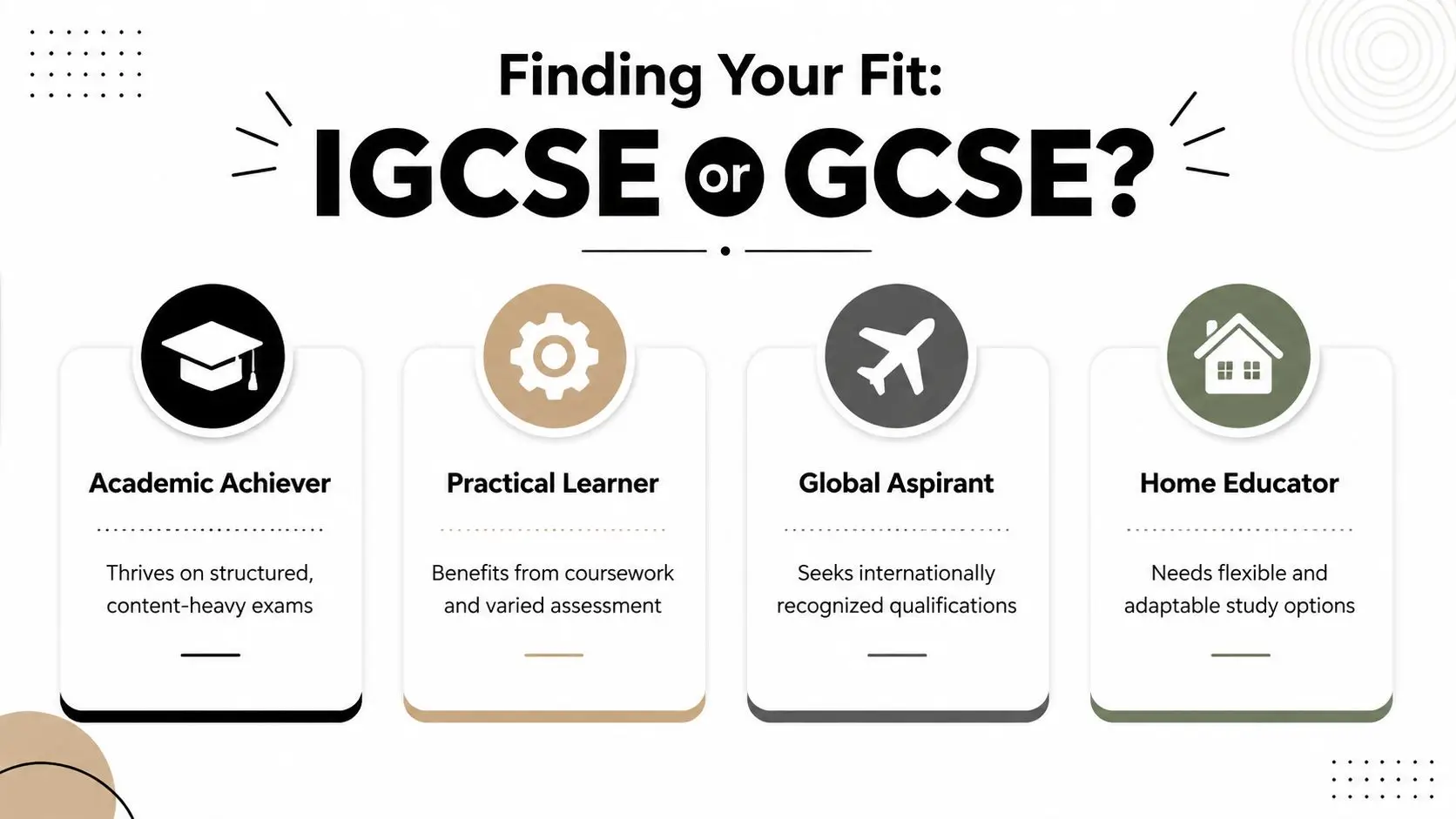
- Choose GCSE if your child is well settled in the UK system, expects to stay in it, and benefits from a familiar national route.
- Consider IGCSE if your child is learning online, moving internationally, home educating, or likely to need more practical flexibility around assessment and exam access.
- Look closely at school advice if league tables or school reporting seem to be driving the conversation more than your child’s day-to-day learning needs.
- Listen for patterns, not just preferences. A child may not say, “I need a different structure,” but their stress levels, consistency, and confidence often say it for them.
A good choice usually feels calmer after you make it. That is often the best sign that the qualification fits the learner.
Making the Right Choice for Your Familys Future
By this point, most parents realise there isn’t a universal winner. There is only the qualification that fits the child in front of you.
If your son or daughter is settled in a UK school, comfortable with the standard path, and likely to remain in that system, GCSE may be the cleanest choice. If your child is learning online, living internationally, moving between countries, or needing more flexibility around exams, IGCSE may be the more sensible route.
The questions worth asking at home
A useful family conversation often starts with questions like these:
- Where will our child most likely study next?
- Do they need flexibility in how and when they are assessed?
- Are they energised by structure, or do they shut down under rigid systems?
- Are we choosing for our child’s wellbeing, or for the comfort of a familiar label?
Those questions usually produce better decisions than endless comparison charts.
One more point matters. Subject choice and study habits will shape your child’s future more than the letters in the qualification title. A student who feels secure, supported, and appropriately challenged is far more likely to do well than one who is constantly trying to adapt to the wrong educational environment.
For families supporting language study alongside core subjects, practical revision guidance can help make the workload feel less overwhelming. The advice in this piece on German exam strategy for teens is a good example of the kind of subject-specific planning that often matters more than headline qualification debates.
Frequently Asked Questions
A FAQ section should answer the questions families ask late at night, once the comparison charts are closed. In our experience, these concerns are usually less about exam labels and more about disruption, confidence, and whether a choice made at 14 will close doors later. In most cases, it will not, provided the programme fits the child and is planned carefully.
Can a student switch between GCSE and IGCSE
Sometimes, yes, but timing matters more than many parents expect.
A switch early in the course is often manageable if the subject content is broadly similar and the school can map the gaps clearly. A switch close to the exam year is harder. The challenge is rarely the title of the qualification. It is the missing pieces: a text your child has not studied in English, a different practical requirement in science, or a topic sequence that leaves them revising unfamiliar material under pressure.
We usually advise families to treat a switch like changing train lines partway through a journey. You may still reach the same destination, but only if you know exactly where the routes diverge. Before agreeing to any change, ask the school or exam centre what content has already been covered, what would need to be caught up, and whether the child has enough time to do that without losing confidence.
Is IGCSE a good option for students with SEN
It can be a very sensible option for some students with SEN, but only if the format suits the way that child learns and demonstrates understanding.
For example, a student with processing speed difficulties may cope much better with a course that places less weight on ongoing coursework deadlines and gives the family more flexibility about exam sessions. A child with anxiety may also benefit from a timetable that avoids several high-pressure assessments being crowded into one short period. On the other hand, some students do better when marks are built up across the course rather than resting heavily on final exams.
This is why we encourage parents to look beyond the broad SEN label. Dyslexia, ADHD, autism, medical needs, fatigue, and school-based anxiety can affect assessment in very different ways. The useful question is not “Is IGCSE better for SEN?” The useful question is “Under which system can my child show what they know, with the right access arrangements and a realistic pace?”
Can a student take a mixture of GCSE and IGCSE subjects
Yes, in many cases they can, and for some families that is the most practical solution.
We see this most often with online and international learners. A child might take one route in core subjects because that is what their teaching provider offers, then choose the other in a subject where the exam schedule, content style, or local exam-centre availability works better. That can be perfectly sensible.
The caution is coherence. If a mixed programme creates clashing exam dates, different assessment habits in every subject, or confusion about which exam board is doing what, the child carries the cost. A mixed pathway works best when there is a clear reason for each choice and an adult is overseeing the whole plan, rather than treating each subject as a separate decision.
Does one qualification look better to universities
For most universities, no. What matters more is whether the student has strong grades, appropriate subjects, and a convincing academic profile for the next stage.
Where families can get misled is by school marketing, league-table language, or the assumption that the more familiar name must carry more weight. Universities are used to seeing both qualifications. They are far more interested in what the student studied and how well they performed than in whether the certificate says GCSE or IGCSE.
We often tell parents to focus on the transcript the child is likely to achieve, not the label that feels safest. A calmer student on the right course usually presents a stronger application than a stressed student on the “more standard” one.
If your family is weighing GCSE and IGCSE options and wants a calm, personalised discussion, Queens Online School offers guidance on British curriculum pathways for online and international learners. We help parents think through fit, flexibility, and future progression so the decision feels clearer and more child-centred.