

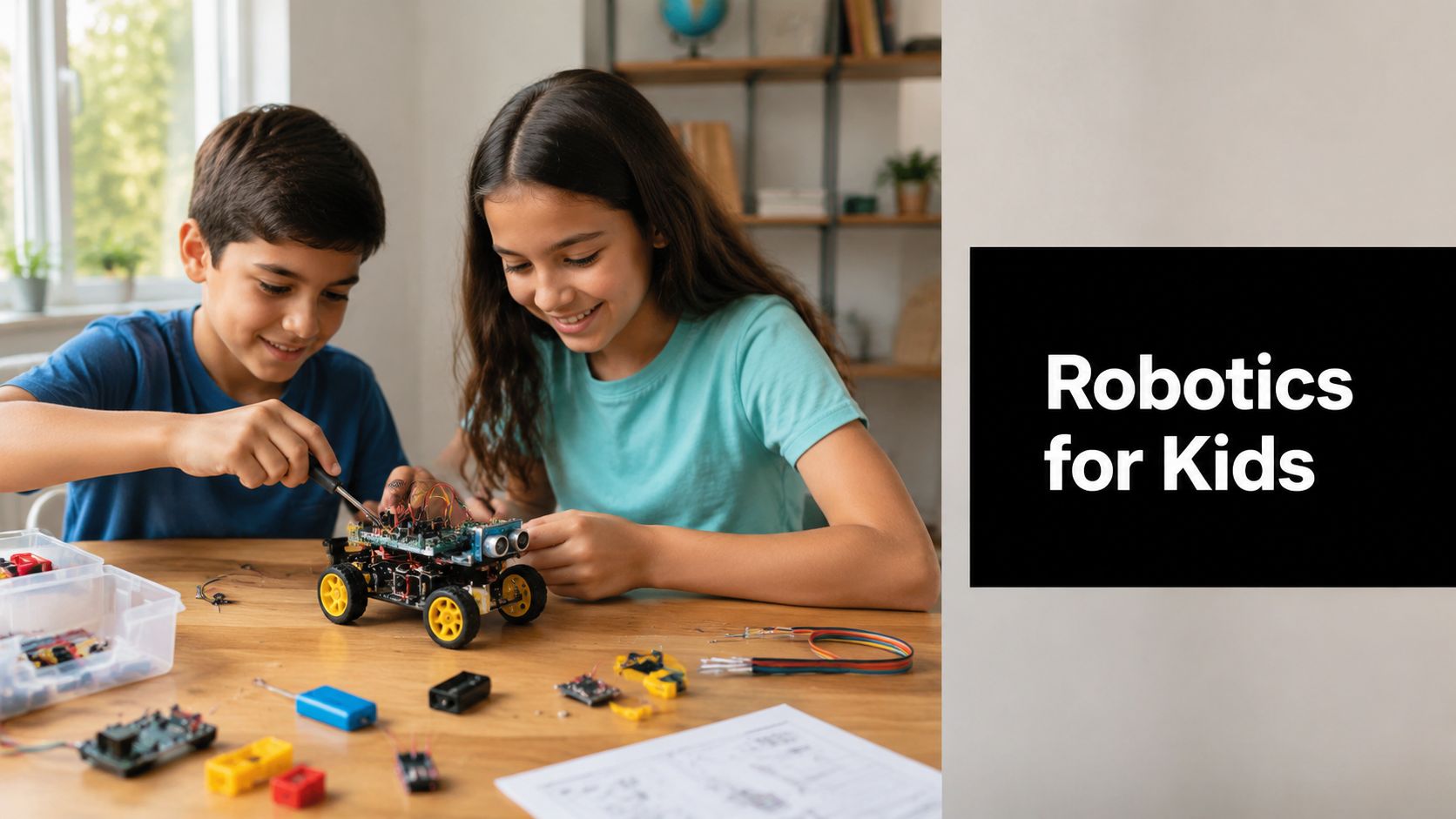
Your child is fascinated by robots. Perhaps they love taking things apart, watching machines move, or asking endless questions about how technology works. At the same time, you may be wondering whether robotics is just another screen-based hobby, another expensive kit that ends up in a cupboard, or something that could help them grow.
As a STEM educator, I understand that hesitation. Parents want activities that feel worthwhile, calm some of the noise around “future skills”, and still respect the reality of childhood. Children need play, movement, confidence, and room to make mistakes. Good robotics for kids can support all of that when it's chosen well and introduced in a child-centred way.
Why Robotics Is More Than Just a Toy
A robot kit can look like a toy at first glance. Bright colours, moving wheels, flashing lights. That surface can be misleading. In practice, robotics gives children a way to build, test, adjust, and think through real problems with their own hands.

When a child builds even a simple robot, they aren't just “playing with tech”. They're learning how instructions create actions, how parts connect, and what to do when something doesn't work the first time. That's why robotics sits so naturally alongside experiential learning in education. Children remember more when they can touch, test, notice, and improve.
There's also a wider reason this matters in the UK. The UK industrial robotics market was valued at about USD 1.14 billion in 2023 and is forecast to grow to around USD 1.96 billion by 2030, according to Robotics Academy's overview of why robotics matters. For families, that doesn't mean every child needs to become an engineer. It does mean that skills linked to robotics, such as coding, control systems, and problem-solving, connect to a growing part of the economy.
What parents often worry about
Most parents I speak to have three concerns:
- Too much screen time: They want enrichment, not passive device use.
- Too technical too soon: They worry robotics will frustrate rather than inspire.
- Too narrow: They fear it only suits “science-minded” children.
Those concerns are valid. But well-chosen robotics for kids doesn't begin with complex coding or abstract theory. It begins with simple cause and effect. Press a button, the robot turns. Change the sequence, it takes a different path. Add a sensor, it reacts to the room around it.
Robotics works best when it feels like purposeful play, not a miniature engineering degree.
A child who enjoys stories can design a rescue robot. A child who likes building can focus on structure and movement. A child who struggles with written work may shine when they can show understanding physically. That's why robotics is more than a toy. It gives children a practical language for logic, creativity, and persistence.
The Core Skills Your Child Develops with Robotics
Parents often hear broad phrases like “STEM skills” or “future readiness”. Those terms can feel vague. In the classroom, I see robotics develop three much clearer abilities: computational thinking, mechanical understanding, and iterative problem-solving.
Computational thinking in plain English
Programming can sound intimidating, but the basic idea is simple. A robot only does what it has been told to do. If the instructions are unclear, incomplete, or in the wrong order, the robot won't get the result your child expected.
A helpful way to think about this is a recipe. If you tell a person to “make a sandwich”, they can fill in the gaps. A robot can't. It needs every step in order. Pick up bread. Put it down. Add filling. Close sandwich. Stop.
That's the foundation of coding.
Children learn to:
- Sequence actions: deciding what must happen first, second, and next
- Spot errors: noticing where instructions went wrong
- Use logic: changing behaviour based on conditions
- Break down tasks: turning a big goal into smaller manageable steps
If you want a broader picture of how these abilities support school learning, this guide to key skills developed through computing is a useful companion.
Engineering happens in the hands
Robotics also teaches children that movement doesn't happen by magic. Wheels need support. Parts need to fit. A design that looks clever on paper may wobble, drag, or collapse when built.
That practical side matters, especially for children who learn best by doing. They begin to understand balance, structure, direction, friction, and how motors create movement. Even very simple kits introduce the idea that design choices affect performance.
The moment a robot starts to “respond”
Many children become thoroughly engaged. A robot that only moves forward is interesting. A robot that reacts feels alive.
A core pattern in children's robotics is sensor-feedback control. As explained in STEMpedia's beginner guide to robotics for kids, beginner kits often teach a robot to react to a light or touch sensor. That introduces closed-loop control and clear cause-and-effect thinking.
Here's what that might look like:
- Touch sensor: the robot bumps into a box and stops
- Light sensor: the robot changes behaviour when the room gets darker
- Simple challenge: “Can you make the robot stop before it hits the chair?”
That may sound modest, but educationally it's rich. Your child is learning that machines can take in information, process it, and act on it.
Practical rule: If your child can explain why the robot changed its behaviour, they're learning far more than “how to make a toy move”.
Problem-solving that builds resilience
Robotics is rarely perfect on the first try. A code block may be in the wrong place. A wire may be loose. A wheel may be misaligned. Children learn to test one idea, observe the outcome, then adjust calmly.
That cycle matters beyond computing. It teaches them that mistakes are not proof that they “aren't good at it”. They're part of the process. For many children, especially those who are used to wanting the right answer immediately, that lesson is one of the most valuable parts of robotics for kids.
Your Child's Robotics Journey by Age and Stage
Parents often ask the same sensible question. “When should my child start?” The answer isn't a single age. It depends on the child's attention, confidence with following steps, motor skills, and interest in building or coding.
What matters most is choosing a stage that fits your child now, not the stage you hope they'll grow into later.

A UK government evidence review, summarised by Kids Explore Robotics, found that robotics and coding interventions can improve problem-solving and engagement. It also points parents toward an important balance. Robotics should sit alongside offline play and movement, not replace them.
Early years and younger primary
For younger children, robotics should feel physical, playful, and short. At this stage, the goal isn't “learning programming” in the formal sense. It's understanding that actions follow instructions and that changing an instruction changes the outcome.
Good early activities include:
- Screen-free floor robots: children press buttons to move a robot forward, back, left, or right
- Build-and-move toys: larger pieces that snap together without fiddly tools
- Obstacle games: guiding a robot around cushions, books, or taped pathways
Children in this age group often need frequent movement breaks. Many benefit from setting up the task on the floor rather than at a desk.
Later in primary, children are often ready for simple block coding, more detailed builds, and basic sensors. At this point, many families first see a child move from “that's fun” to “I made that happen”.
A short visual overview can help if your child likes seeing how things fit together:
Secondary and beyond
By Key Stage 3, many children can handle longer projects and more abstract thinking. They can begin moving from drag-and-drop commands toward text-based coding, more advanced sensors, and clearer design goals.
By GCSE and A-Level stage, robotics can connect naturally to programming, design, electronics, data handling, mechanics, and project work. Not every teenager wants a “robotics kit”, but many enjoy robotics through coding, physical computing, or engineering challenges with a real-world purpose.
Robotics progression through UK school stages
| School Stage (Age) | Core Concepts | Example Activities & Kits | Skills Developed |
|---|---|---|---|
| Early years to lower primary | Cause and effect, sequencing, directional language | Screen-free floor robots, large-part build kits, simple path games | Listening, turn-taking, early logic, spatial awareness |
| KS2 | Block coding, basic mechanisms, simple sensors | Entry-level programmable robots, guided build projects, light or touch sensor tasks | Sequencing, debugging, prediction, fine motor control |
| KS3 | Algorithms, mechanical design, sensor response, text-code transition | More open-ended kits, Scratch-based projects, simple microcontroller activities | Problem-solving, persistence, design thinking, coding confidence |
| GCSE and A-Level pathway | Programming depth, electronics, system design, project planning | Physical computing, Python-based projects, advanced design-and-build tasks | Analytical thinking, technical communication, engineering habits, independent project work |
A simple way to judge readiness
Look for these signs:
- They enjoy building or arranging things in order
- They can tolerate trial and error without shutting down quickly
- They like solving practical puzzles
- They're curious about how things work
If your child isn't showing those signs yet, that doesn't mean robotics isn't for them. It may mean they need a gentler starting point, shorter sessions, or a different style of kit.
Start with success. A child who enjoys one simple robotics challenge is far more likely to stay curious than a child overwhelmed by an ambitious kit.
How Robotics Supports the British Curriculum
Many parents rightly ask, “How does this help at school?” The answer is reassuring. Robotics isn't separate from learning. It gives children a concrete way to practise knowledge and habits that appear across the British curriculum.

Since September 2014, England's computing curriculum has required pupils in Key Stages 1 to 4 to use logical reasoning, design programs, and understand how digital systems work. The same policy context also includes the UK's National Robotics Strategy launched in 2022, showing that robotics sits within both school expectations and longer-term national priorities, as discussed in this curriculum and robotics policy overview.
In KS2 and KS3
At primary and lower secondary level, robotics makes abstract computing ideas visible.
A child who builds a small robot and writes commands for it is practising curriculum-relevant habits such as:
- Designing programs: deciding what the robot should do
- Using logical reasoning: predicting outcomes before testing
- Debugging: finding out why a result wasn't correct
- Understanding systems: seeing how hardware and code work together
Many children struggle when computing stays purely on screen. Robotics gives them something to observe. If the robot turns the wrong way, the mistake becomes concrete. That often helps children who need a more tangible route into logic.
How it supports GCSE subjects
By GCSE stage, robotics can strengthen learning in more than one subject at once.
| Subject | How robotics helps |
|---|---|
| Computer Science | Builds fluency with algorithms, logic, testing, and debugging |
| Design and Technology | Supports prototyping, evaluating, improving, and working within design constraints |
| Physics | Reinforces forces, motion, energy transfer, and systems thinking |
| Mathematics | Applies measurement, angles, coordinates, patterns, and logical structure |
| English | Encourages explanation, presentation, and writing clear instructions |
A student doesn't need a formal robotics qualification for these benefits to appear. The advantage often comes from repeated experience of planning, testing, and explaining.
Why A-Level students benefit too
At Sixth Form, the value of robotics often becomes more strategic. A student studying A-Level Computer Science gains from prior coding habits. A student taking Physics or Maths benefits from the confidence to model systems and analyse behaviour. A student interested in engineering starts to see how different disciplines combine in one project.
Robotics teaches children that knowledge isn't boxed into separate subjects. Real problems ask for maths, science, design, communication, and patience all at once.
That interdisciplinary quality is one reason robotics for kids can be so powerful. It doesn't just help children score marks in one area. It helps them connect ideas across the curriculum, which is often what more advanced study demands.
Choosing the Right Robotics Kits and Online Courses
The market can feel noisy. One box promises coding genius. Another promises engineering confidence. A third looks impressive but may not suit your child's age, attention span, or interests at all.
The best choice is rarely the biggest kit or the one with the most pieces. It's the one your child can enter successfully.
Match the kit to the child
Some children love step-by-step instructions. Others want to tinker, swap parts, and see what happens. Start there.
Use this quick framework when comparing options:
- Instruction-followers: choose kits with clear guided builds, visual instructions, and predictable outcomes
- Curious tinkerers: look for open-ended systems that allow redesign and experimentation
- Story-led learners: choose robots that can act out missions, mazes, or character-based tasks
- Children who tire easily: pick projects that can be completed in short bursts
A very young child may do best with a screen-free robot. An older primary pupil may enjoy block-based coding and simple sensors. A secondary pupil may be ready for physical computing and text-based coding.
Types of options you'll see
Some of the most useful categories are:
| Type | Best for | Watch out for |
|---|---|---|
| All-in-one beginner kits | Children who want a quick win and clear structure | Can feel limiting once the first projects are complete |
| Open-ended construction systems | Children who like inventing and rebuilding | May need more adult support at the start |
| Physical computing tools | Older learners ready for coding plus hardware | Setup can feel daunting if the learner is brand new |
| Subscription project boxes | Families who want regular prompts and variety | Quality and pacing vary widely |
For families exploring physical computing, the Raspberry Pi Foundation points learners toward beginner pathways such as Scratch plus Raspberry Pi for electronics, and the Raspberry Pi Pico with MicroPython for older children. That progression is outlined in their guide on how to make a robot with Raspberry Pi tools.
Don't ignore the emotional fit
A good robotics choice respects confidence as much as ability. If your child is already anxious about “getting things wrong”, a kit with too many moving parts can feel defeating. If they're highly curious and independent, an overly scripted kit may bore them.
A practical test is to ask:
- Will this child enjoy the process, not just the finished result?
- Can they make progress without constant adult rescue?
- Does the kit leave room for their own ideas?
For some children, a themed project can be the doorway in. If your child prefers imaginative play over traditional STEM branding, you could engage kids with a dinosaur robot activity rather than starting with a more technical-looking set.
Courses versus self-led learning
Online courses can help when a child needs structure, explanation, and regular pacing. Self-led kits work well for children who like experimenting independently and don't need much prompting.
If your family is weighing enrichment choices more broadly, it helps to compare robotics with other after-school activities for children. Robotics doesn't have to be the only activity. In many families, it works best as one part of a wider weekly rhythm that also includes reading, sport, outdoor play, or music.
Making Robotics Accessible and Inclusive for Every Child
Some children walk into robotics and thrive immediately. Others need the activity reshaped around sensory needs, pacing, language load, or confidence. That isn't a problem to “fix”. It's a reminder that inclusion starts with the child, not the kit.
With the UK SEND system under severe pressure and many families facing long waits for support, inclusive enrichment can be hard to find. As highlighted in this discussion of the gap in support for families seeking practical adaptation, many robotics resources still fail to address sensory load, pacing, or accessibility for children with SEN and SEMH needs.

What inclusion can look like in practice
I've seen robotics work beautifully for children who struggle in more traditional academic settings. A child who finds writing demanding may excel when they can show logic through movement and build. A child who feels anxious in unpredictable group tasks may benefit from a robotics challenge with clear steps and immediate feedback.
Practical adaptations often make the difference:
- Reduce sensory load: choose quieter kits, softer lighting, and uncluttered workspaces
- Simplify instructions: give one step at a time rather than a full page at once
- Use larger components: these help children with fine motor difficulties
- Build in breaks: short sessions are often better than pushing through fatigue
- Offer visual supports: checklists, symbols, and model examples reduce cognitive strain
For children with SEMH needs
Children with social, emotional, and mental health needs often respond well to activities that are structured but not overly exposing. Robotics can offer exactly that. There's a task, a goal, and a result. The child can test ideas without feeling judged every second.
This can help with:
- Managing frustration: errors become part of debugging rather than personal failure
- Developing self-regulation: pausing, checking, and trying again
- Practising collaboration: working with a partner on a shared build
- Building confidence: success is visible and immediate
A child who says very little in a group discussion may say a great deal through a robot they've designed and explained.
Pacing matters more than polish
Many parents feel pressure to buy the “right” product, as though the perfect kit will solve everything. In truth, pacing matters more than polish. A simple activity done calmly and successfully is often more valuable than an advanced project that leaves a child distressed.
For learners who need flexible pacing, recorded access, specialist teaching, and a personalised British curriculum route, Queen's Online School offers online study from Key Stage 2 through A-Level, including STEM-focused learning and support for pupils with SEN and SEMH needs.
A few gentle rules for home
If your child has additional needs, keep these principles close:
- Start small: one task, one success, then stop
- Keep the environment predictable: same table, same order, same routine
- Celebrate effort visibly: “You kept testing until it worked”
- Let the child lead the theme: rescue mission, animal robot, race track, delivery robot
Robotics for kids becomes inclusive when adults stop asking, “Can this child fit the activity?” and start asking, “How can the activity fit this child?”
Your Next Step into the World of Robotics
If you've read this far, you probably aren't looking for hype. You're looking for something useful, grounded, and worthwhile for your child. That's exactly how I'd encourage you to think about robotics.
Robotics for kids isn't about raising a future engineer at age seven. It's about helping a child become more confident with challenge, more thoughtful about how things work, and more willing to keep going when the first attempt fails. Those qualities matter in school, in work, and in everyday life.
Keep the first step simple
You don't need a perfect long-term plan. You need a gentle starting point that matches your child's current stage.
That might be:
- A screen-free robot for a younger child who needs hands-on learning
- A simple programmable kit for a KS2 child who enjoys puzzles
- A physical computing project for a teenager ready for coding depth
- A structured course or club for a child who benefits from routine and teaching support
What matters is that the child feels capable, not overwhelmed.
Watch what your child is telling you
Children often show readiness before they can explain it. They repeat a challenge. They ask why the robot turned left instead of right. They want to rebuild, not just watch. Those are powerful signs.
Follow that curiosity. Keep sessions manageable. Balance robotics with outdoor play, movement, rest, and other interests. Let it be one part of a healthy learning life rather than the whole thing.
The goal isn't to build a perfect robot. It's to help your child build patience, logic, imagination, and belief in their own ability to figure things out.
A small project on a kitchen table can become much more than an afternoon activity. It can become the moment a child realises, “I can make something work.”
If you're exploring a more structured path for your child's learning, Queens Online School offers a full British curriculum from Primary through Sixth Form with live teaching, personalised pacing, and support for learners who want flexible access to STEM, computing, and wider enrichment in an inclusive online environment.