
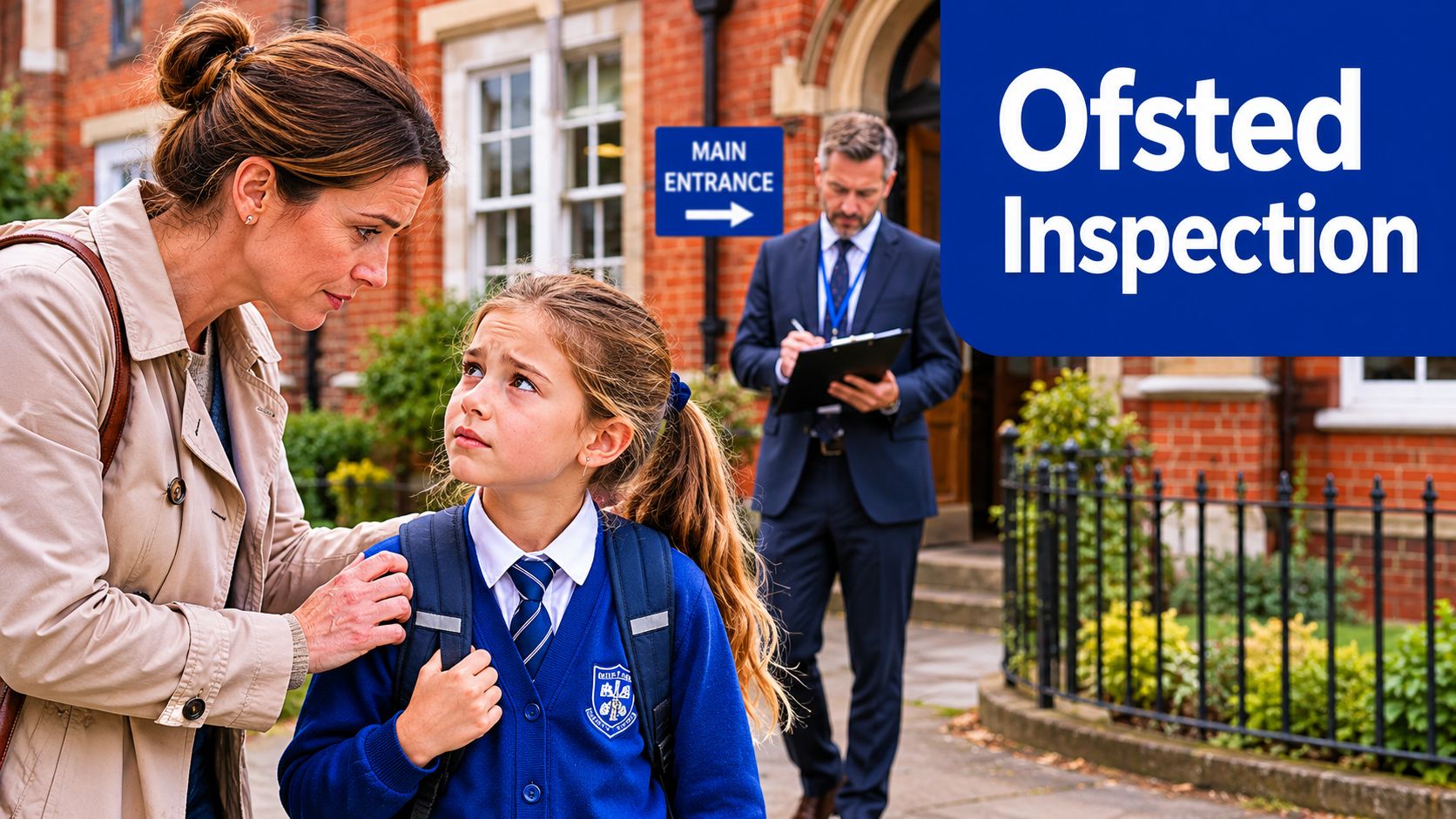
You may have heard that your child's school is “due Ofsted” and felt your stomach drop a little. That reaction is common. Parents often worry that inspection week means pressure, disruption, or a school being judged by strangers who can't possibly know their child.
The calmer truth is that Ofsted inspection is meant to give families a clearer picture of what a school is like day to day. If you're trying to understand what Ofsted inspection is, it helps to stop thinking of it as a one-off drama and start thinking of it as a structured quality check. Not perfect. Not simple. But designed to ask a very parent-centred question: is this school helping children learn well and stay safe?
That question matters even more when your child doesn't fit the “standard” mould. If they have SEN, SEMH needs, thrive in smaller classes, or need a more flexible learning arrangement, the headline grade alone rarely tells the full story. You need to know how inspectors look at inclusion, support, safeguarding, and whether a setting works for children like yours.
Who Are Ofsted and Why Do They Visit Schools
When parents ask me what Ofsted is, I usually avoid the official wording first. I start with an analogy.
Think of Ofsted a bit like a food hygiene rating for education. It gives families a shared reference point. You still might visit the restaurant, read reviews, and decide whether it suits your family. But the rating gives you one common signal to work from.
Ofsted's job in plain English
Ofsted is the official inspectorate for education and care in England. Its role is large in scale, not niche. The National Audit Office says that around 21,500 state-funded schools in England are subject to Ofsted inspection and together educate about 8 million pupils, which is why Ofsted reports act as a national accountability system for parents and the public (National Audit Office on Ofsted's inspection of schools).
That matters because when parents compare schools, they often want a fair basis for comparison. Ofsted reports were designed to provide that shared language.
Why schools are inspected at all
A school isn't inspected to hand out labels. Inspectors look at whether children are being educated in a safe, organised, well-led environment. They consider broad areas such as:
Quality of education
Is the curriculum well planned, and are children learning what they should?Behaviour and attitudes
Do pupils feel settled, ready to learn, and supported to behave well?Personal development
Is the school helping children grow in confidence, character, and wider life skills?Leadership and management
Are leaders creating the right conditions for staff and pupils to thrive?
For a parent, this means the inspection isn't just about exam outcomes or polished displays on walls. It's about whether the school works in the round for real children.
A strong Ofsted report should help you ask better questions, not stop you asking them.
Why the word makes families anxious
Parents often hear “Ofsted” and imagine a school under attack. Children can pick up on that mood as well. In most cases, though, an inspection is not a performance staged for inspectors. The whole point is for inspectors to see the school as it normally is.
That's especially important if your child needs consistency. You want inspectors to see the actual experience. Not an artificial one.
If your child is happy, safe, included, and learning at the right pace, those things matter. A good inspection process should notice them. If they're missing, parents need to know that too.
Graded vs Monitoring Inspections Explained
Not every Ofsted visit means the same thing. This is one of the biggest sources of confusion for families.
A helpful way to remember it is this. A section 5 inspection is more like a full service. A section 8 inspection is more like a check-in to see whether things are staying on track.
Section 5 and section 8 in simple terms
Ofsted inspections are typically structured as either section 5 full inspections or section 8 monitoring inspections. The usual cycle is four years for schools previously judged good or outstanding, and a section 8 visit can be escalated into a full section 5 inspection if inspectors identify significant change (overview of section 5 and section 8 inspections).
Here's the practical difference.
| Inspection type | What it usually feels like | What it can lead to |
|---|---|---|
| Section 5 | A full inspection with deeper evidence gathering | A graded judgement |
| Section 8 | A monitoring visit or check-in | It may stay as monitoring, or become a full inspection if concerns or major improvements are identified |
What this means for parents
If you hear your child's school is having a section 8 visit, that doesn't automatically mean something is wrong. It may mean the school is being reviewed within its inspection pattern.
If a school moves into a full inspection, that usually means inspectors need a more complete picture. That could be because standards seem to have shifted. Sometimes that shift is positive. Sometimes it raises concern.
A parent example
Say your child is in a school that has been steady for some time. A monitoring inspection may focus on whether that steadiness is real in classrooms, leadership, and pupils' experience.
Now imagine a different situation. Parents have noticed changes in staffing, behaviour routines feel less settled, or the curriculum seems inconsistent. If inspectors identify signs of decline, a monitoring visit may turn into a fuller inspection.
Practical rule: Don't panic at the inspection type. Ask what the visit is designed to check, and how that relates to your child's day-to-day experience.
The question behind both types
Whether it is section 5 or section 8, the heart of the process is similar. Inspectors are asking whether pupils are getting the education and care they should.
For families of children in specialist, therapeutic, or flexible settings, that question becomes even more important. You're not just asking whether a school looks orderly. You're asking whether it fits your child.
A Parents Guide to the Inspection Process
Most parents feel better once they know what happens during an inspection. The unknown is often the most worrying part.
Inspections today are shaped by the framework introduced in 2019. Under that framework, inspections place strong focus on quality of education and safeguarding, and schools or early years settings are often inspected with very little notice, sometimes just one day, so inspectors can see an ordinary day rather than a rehearsed one (research discussion of the 2019 inspection framework).

What your child is likely to notice
For most children, inspection day doesn't feel like an exam. There may be unfamiliar adults walking through the school, visiting lessons, looking at work, and talking to staff and pupils.
A pupil might say, “Someone came into our lesson and watched for a bit.” That's usually the scale of it from a child's point of view.
Inspectors want to understand the lived experience of the school. They'll look at what children are learning, how lessons are organised, whether behaviour routines are working, and how safe and supported pupils seem.
What inspectors actually do
A typical process often includes things like these:
Short-notice contact with the school
The school is informed that inspection is happening.Time in lessons and around school
Inspectors observe teaching, transitions, routines, and classroom culture.Looking at pupils' work
They review what pupils are producing over time, not just what happens in one lesson.Talking to people
This can include leaders, teachers, pupils, and sometimes parents' views through feedback routes.Drafting and publishing the report
The school checks the draft for factual accuracy before publication.
Questions parents often ask
Parents often wonder whether inspectors are trying to catch teachers out. That's usually the wrong picture. The process is better understood as evidence gathering. Inspectors are not meant to judge a school from one shiny display board or one awkward moment.
They also don't just look at academic work. They consider the wider school experience, including care and support. That's one reason many parents also pay close attention to a school's pastoral systems. If you want to understand that side of school life more clearly, this guide to pastoral care in schools is useful alongside any Ofsted report.
If your child says inspectors visited their class, the most helpful response is usually calm and simple. “They're there to see how the school helps children learn and stay safe.”
For children who find change hard
This matters a great deal for pupils with anxiety, autism, SEMH needs, or sensory sensitivities. A good school will prepare children in a measured way. Not by creating alarm, but by explaining that visitors may come into lessons and that normal routines still apply.
In many cases, the less dramatic the build-up, the better the day goes.
Decoding Ofsted Ratings and What They Mean for Your Child
Parents often focus on the headline rating first. That's understandable. A short label feels easier to process than a full report.
But the label is only a summary. What matters most is what that judgement means for your child's actual school day.

The four familiar grades
Historically, parents have usually seen four headline descriptions for overall effectiveness:
- Outstanding
- Good
- Requires Improvement
- Inadequate
These words can sound stark, but they need translating into lived experience.
| Rating | What parents often hear | What it may mean in practice |
|---|---|---|
| Outstanding | “Top school” | Strong systems, confidence in leadership, and a consistently effective experience for many pupils |
| Good | “Solid choice” | A school doing its job well, with effective teaching and a positive environment |
| Requires Improvement | “Something is wrong” | Some important aspects need to improve, but the picture may be mixed rather than uniformly poor |
| Inadequate | “Avoid at all costs” | Serious weaknesses need addressing, particularly where pupils' experience or safety may be affected |
A “good” school can still be a wonderful fit for one child and the wrong fit for another. An “outstanding” school can still struggle to meet a particular pupil's needs if its environment is too pressured, too noisy, or too rigid.
Looking beyond the one-word label
This short video can help parents understand the grading idea in a more visual way.
Now for the important recent change. Ofsted has signalled a move towards a new school report card approach, potentially using a 5-point grading scale and more detailed summaries, which means parents may need to read reports more carefully rather than relying on one headline judgement alone (Ofsted discussion of the new report card approach).
What parents should do with that information
If reports become more detailed, that's not a burden. It is helpful. More detail gives families a better chance of spotting the difference between a school that is broadly effective and one that is truly right for their child.
For example, one school may look strong on academic structure but weaker on personal development. Another may have warm relationships and inclusive practice but still be improving consistency in the curriculum. Those differences matter.
Don't ask only, “Is this school highly rated?” Ask, “Would my child feel secure, known, and able to learn here?”
That question becomes even more valuable when your child learns differently.
How Ofsted Judges Support for Every Child
Many generic guides fall short; parents of children with SEN, SEMH needs, uneven attendance histories, or alternative learning pathways often need more than a basic explanation of grades.
They want to know whether inspection can see the child they know.

What inspectors are looking for
Ofsted's framework explicitly assesses how a school adapts for different starting points and needs, including for pupils with SEN. It also treats safeguarding as a basic foundation, judged on a met / not met basis rather than as a sliding scale (parent-facing explanation of adaptation for SEN and safeguarding).
That's important because it means a school cannot make up for weak safeguarding by being lovely in other ways. Safety is not optional.
It also means inspectors should look beyond a one-size-fits-all model of teaching. They should ask whether the school is adapting well enough for the children in front of it.
What that can look like in real life
For a child with dyslexia, inspectors might consider whether teaching materials and classroom approaches help them access the curriculum rather than exposing their difficulty.
For a child with autism, the key questions may include whether routines are predictable, whether staff understand sensory or communication needs, and whether behaviour is interpreted thoughtfully rather than punitively.
For a child with SEMH needs, inspectors should be interested in whether support is organised, relational, and safe. Not just whether sanctions are written down in a policy.
Inclusion is more than kindness
A school can be caring and still not be effective. Equally, a school can be orderly but not inclusive.
Inspectors may build a picture through evidence such as:
Curriculum adaptation
Does the school adjust learning for different starting points?Pupil voice
Do children feel heard, safe, and understood?Work scrutiny
Does the work show progress and suitable challenge over time?Safeguarding practice
Are systems clear, reliable, and followed consistently?Leadership decisions
Have leaders organised support in a way that helps vulnerable pupils?
What about online or non-traditional settings
Parents should be especially alert. If your child is in a flexible or non-traditional arrangement, the question isn't just whether the setting looks different from a mainstream school. The better question is whether it can show high-quality education, appropriate support, and safe systems in the format it uses.
That may include live teaching, communication with families, attendance routines, pastoral check-ins, adapted materials, and clear safeguarding arrangements suited to online learning.
If you're weighing up what effective additional provision should look like, this guide to SEN support can help you form sharper questions.
A child who learns differently doesn't need lower expectations. They need the right support, in the right environment, delivered consistently.
The phrase parents should remember
Inspectors are expected to judge using a secure fit approach rather than a casual best-fit impression. In simple terms, that means the school needs to meet the expected standard securely, not just show isolated good moments.
For families, that's reassuring. It means a school should be judged on what it does consistently for children, not on polished promises.
Reading Reports to Find the Best School for Your Child
Once a report is published, many parents skim the grade, glance at a few phrases, and stop there. That's understandable, but it can hide the details that matter most.
A report is more useful when you read it like a detective. You're looking for clues about your child's likely experience.

Where to look first
Start with the wording around your biggest concern.
If your child is shy or anxious, pay close attention to comments about behaviour and attitudes and personal development. Those sections may reveal whether pupils feel safe, settled, and included.
If your child needs stretch or strong subject teaching, read the language around quality of education carefully. Look for signs of coherent planning, subject knowledge, and whether learning builds over time.
How to read between the lines
Certain phrases can be especially revealing:
- “Pupils feel safe” often points to culture, relationships, and trust.
- Comments on leadership can tell you whether improvement is likely to stick.
- Mentions of adaptation or support matter hugely if your child has additional needs.
- References to consistency can tell you whether good practice happens across the school or only in pockets.
For online, independent, or unusual routes
Some parents are comparing mainstream schools with online or flexible alternatives. In those cases, you may also need to combine inspection reading with other evidence, because not every educational route sits neatly within the same system.
That's why it helps to pair formal reports with careful review-reading and direct questions. This guide to decoding UK online school reviews for 2026 is useful if you're weighing a more flexible pathway.
A simple parent checklist
When reading a report, ask:
- Would my child feel safe here?
- Would my child be understood here?
- Would my child be stretched without being overwhelmed?
- If my child struggled, would this school notice early and respond well?
Those questions bring the report back to the right centre. Your child.
The best school on paper isn't always the best school for your son or daughter. Fit matters.
Common Ofsted Questions from Parents
Some questions keep coming up in school corridors and parent WhatsApp groups. Here are the short, practical answers.
Quick answers that parents actually need
| Question | Answer |
|---|---|
| Can I speak to inspectors myself? | Parents don't usually join the inspection process in the same way staff do, but inspectors do consider parents' views through the feedback routes available during inspection. If your school shares information about how parent feedback can be given, it's worth responding clearly and calmly. Focus on your child's lived experience rather than rumour. |
| What if my child is in an online or non-traditional setting? | Start by checking what sort of provider it is and what oversight applies. Then look beyond labels. Ask how teaching is delivered, how support works, how safeguarding is handled, and how progress is reviewed. For children with SEN or SEMH needs, the practical quality of support matters more than whether the setting looks conventional. |
| How long does an Ofsted rating last? | A report remains part of the public picture until a later inspection updates it. That doesn't mean the school is frozen in time. Staff changes, leadership changes, and shifts in pupil needs can alter the real experience between inspections. Always pair the report with current conversations, visits, and recent evidence. |
One final reassurance
Parents sometimes think they must become experts in inspection language to make a good decision. You don't. You just need to know what questions to ask.
If a report sounds impressive but your child would be miserable there, that matters. If a setting is less traditional but offers safety, inclusion, and a better fit for how your child learns, that matters too.
The point of understanding what Ofsted inspection is isn't to make you more anxious. It's to help you make choices with clearer eyes and more confidence.
If you're exploring a flexible British education with live teaching, personalised support, and a strong focus on pupil wellbeing, Queens Online School is worth a closer look. For families seeking an alternative to traditional schooling, especially where SEN, SEMH, or timetable flexibility matters, it offers a clear picture of how online learning can still be rigorous, nurturing, and child-centred.