

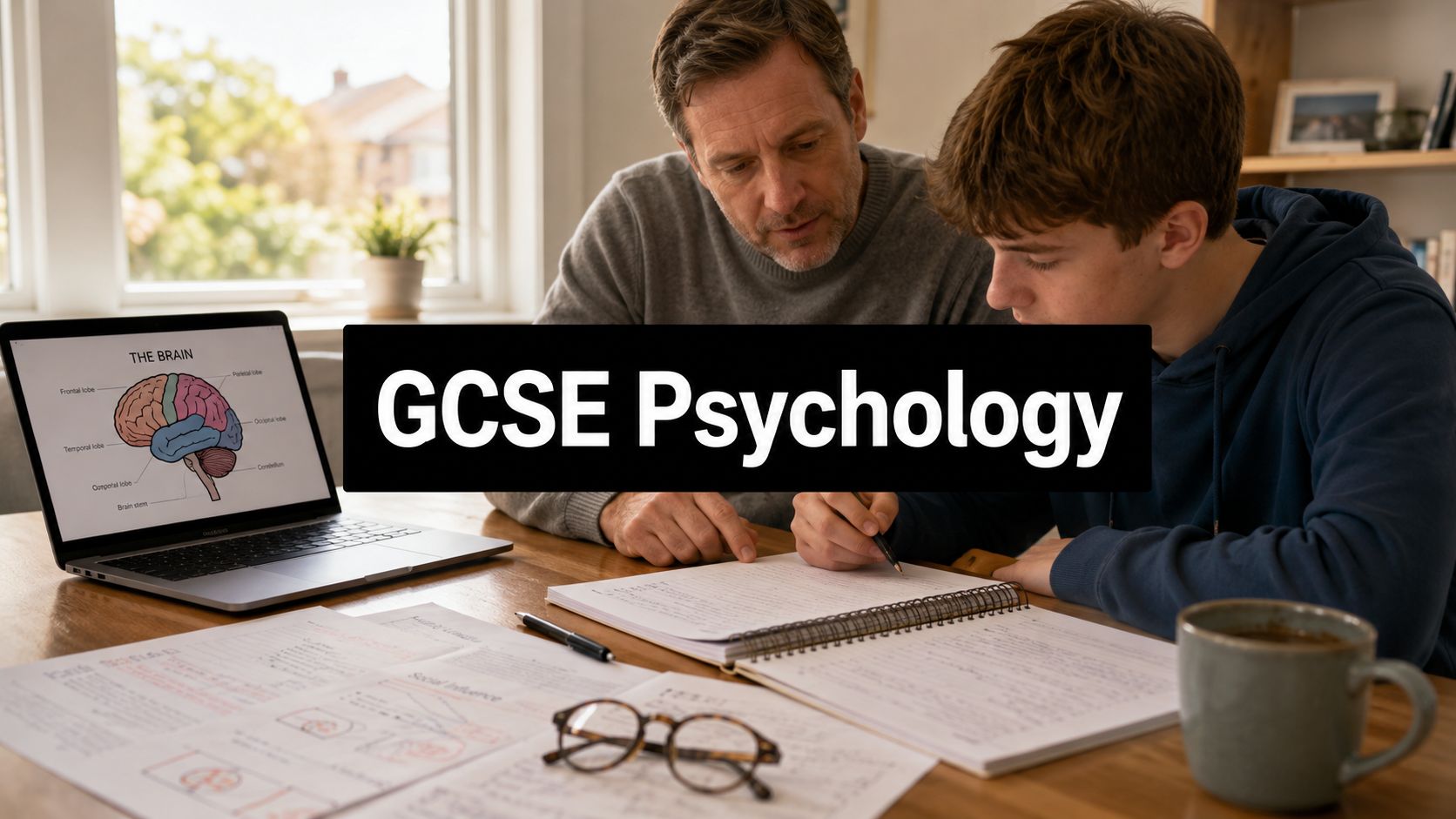
You may be here because your child keeps asking questions most adults brush off. Why do people follow the crowd when they know the crowd is wrong? Why does one bad memory stay vivid while yesterday's revision disappears? Why does stress change how someone behaves?
That kind of curiosity matters. It often signals more than academic ability. It can point to a child who's trying to understand people, themselves, and a world that can feel confusing or overwhelming.
For the right student, online GCSE Psychology courses can be a very good choice. But families often make the wrong decision for the right reason. They see a child's interest in psychology and rush to buy a course. They don't stop to ask the harder questions first. Does this child need live teaching or flexible study? Do they need GCSE or IGCSE? Will they cope with independent work? Will the provider support them when motivation drops, not just when enrolment opens?
Those questions matter more than glossy marketing. If you get the fit right, psychology can become a subject your child enjoys and succeeds in. If you get it wrong, even an interested student can end up isolated, anxious, or stuck with a qualification route that doesn't suit them.
Is Your Child Curious About the Human Mind?
A lot of parents notice the same pattern before they ever search for a course. Their child isn't just “interested in psychology”. They're the one who analyses arguments at the dinner table, spots changes in a friend's mood, or asks why people act one way in public and another in private.
That child often doesn't need pushing. They need channeling.

GCSE Psychology can give that curiosity shape. It turns scattered interest into structured understanding. A teenager who watches body-language videos online or talks endlessly about memory, behaviour, relationships, stress, or mental health can finally study those ideas properly instead of picking up half-understood fragments from social media.
When online study makes sense
For some children, a mainstream classroom works well. For others, it doesn't.
A child may thrive online if they are:
- Distracted by busy classrooms and think more clearly in a calmer setting
- Emotionally drained by school routines and need a learning model with less social pressure
- Academically strong but under-stimulated and ready for a subject that feels more grown-up
- Managing SEN or SEMH needs and benefit from more predictable teaching and support
Psychology can be especially powerful for students who want to understand themselves as much as they want to pass an exam. That doesn't make it therapy, and parents shouldn't treat it as therapy. But it can help a young person put language around memory, development, behaviour, relationships, and emotional responses.
Some children engage with psychology because they want top grades. Others engage because they want to make sense of people. Both reasons are valid.
What parents often feel, and rarely say out loud
Many parents worry about making the wrong call. They don't want to overreact to a passing interest. They also don't want to ignore a genuine strength.
My advice is simple. If your child returns to these questions again and again, pay attention. Repeated curiosity is not random. It often points to a subject that can hold their attention when others don't.
And attention matters. A child who feels seen by a subject is far more likely to stick with it.
What Your Child Will Learn in GCSE Psychology
GCSE Psychology sounds abstract until you translate it into the questions teenagers already ask.
This subject isn't just “learning theories”. It's asking why memory fails under pressure, why people copy the group, how children develop into adults, and how researchers decide what counts as real evidence.
The syllabus in real language
A good online course should make the content feel relevant, not remote. Your child will usually meet topics such as:
- Memory. Why can they remember song lyrics from years ago but forget what they revised last night?
- Social influence. Why do people conform, obey authority, or change behaviour in a group?
- Development. How do early experiences shape later behaviour?
- Research methods. How do psychologists test ideas properly instead of guessing?
- Psychological problems. How do psychologists think about mental health difficulties and treatment approaches?
- The brain and neuropsychology. What happens when brain function affects behaviour, memory, or decision-making?
These topics matter because they connect to a teenager's real life. Friendship groups. Pressure. Stress. Identity. Habits. Confidence. Family relationships. Revision. Sleep. Anxiety.
If your child has ever said, “Why do I know this at home and forget it in the exam?” then psychology gives them a framework for that question.
What the exam structure means for your child
Parents need clarity here. The AQA GCSE Psychology qualification is assessed by two written papers worth 50% each, and one example of how an online provider structures preparation is Oxford Open Learning's course, which is arranged into 8 modules with 8 tutor-marked assignments, including 1 mock exam as outlined on Oxford Open Learning's GCSE Psychology course page.
That matters for one reason. This is not a casual enrichment course. It is exam-led academic study.
A strong provider helps your child build towards those written papers through regular tasks, feedback, and exam practice. Without that, students often think they understand the content but struggle to express it under timed conditions.
Look for emotional relevance, not just content coverage
Psychology attracts reflective students. Some are fascinated by behaviour. Some are trying to understand their own stress. If that sounds like your child, support their interest carefully. Academic psychology can complement wellbeing habits, but it shouldn't carry the whole load.
If your child is dealing with anxious thinking, practical routines such as sleep, breathing, movement, and mindfulness for anxiety reduction can sit alongside their studies and help them stay steady.
Practical rule: choose a course that teaches students how to answer exam questions, not just one that gives them notes to read.
Live Lessons or Self-Paced Study What Suits Your Child Best
Many families make mistakes here.
They choose the learning model they find convenient, not the one their child can succeed in. Convenience matters, but fit matters more.

Live teaching suits some children far better
Live lessons work well for students who think out loud, ask questions in the moment, and benefit from a timetable they can't endlessly postpone.
These children often need:
- Real-time explanation when a concept becomes confusing
- Visible accountability because deadlines alone won't move them
- Discussion to deepen understanding of topics like conformity or attachment
- Routine that stops work sliding into evenings and weekends
If your child says, “I get it when someone explains it to me,” don't ignore that. They probably need live teaching.
A live online class can feel more like a real school rhythm. A teacher sets the pace. The student contributes. Misunderstandings get corrected before they harden into bad habits.
Self-paced study suits a different child
Self-paced learning can work very well, but only for the right student. It suits the teenager who likes independence, manages time reasonably well, and prefers to pause, replay, and revisit material privately.
That child often values:
- Flexibility around sport, health needs, travel, or energy levels
- Control of pace when some topics click quickly and others need slower work
- Less social pressure than a live group lesson
- Space to reflect before responding
But be honest. Self-paced learning isn't automatically easier. In many homes, it's harder. It demands self-management. If your child already avoids work they find difficult, a fully asynchronous model may give them too many places to hide.
Families who are comparing formats often find it useful to read about asynchronous learning in online education before deciding.
Use your child's actual behaviour, not their ideal self
Don't ask, “Could my child do this?” Ask, “What do they usually do when no one is watching?”
If they need external structure, choose live teaching.
If they are independent and consistent, self-paced may suit them.
If they need flexibility but not isolation, look for a hybrid model.
A simple comparison helps:
| Learning model | Often suits | Watch out for |
|---|---|---|
| Live lessons | Students who need discussion, rhythm, and quick teacher feedback | Fatigue if the timetable is too rigid |
| Self-paced study | Students who are disciplined and like control over timing | Drift, procrastination, and shallow understanding |
| Hybrid approach | Students who need both flexibility and regular teaching contact | Patchy delivery if the provider isn't organised |
Many students also need help building better online habits. Practical guidance like these Vivora online study tips can help families set expectations around focus, routine, and digital learning behaviour.
How to Choose the Right Online Psychology Provider
Choosing a provider is not like buying a textbook. It's closer to choosing a long-term educational partner. The right one will support your child when they're motivated, confused, behind, anxious, or stuck. The wrong one will look polished at enrolment and disappear when things get messy.

Ask harder questions than most parents ask
Start with the basics, but don't stop there.
- Who teaches the subject? You want subject-specialist teachers, not generic course supervisors.
- How does feedback work? Fast, specific feedback matters in an essay-based subject.
- What happens if my child falls behind? Good schools have a recovery process. Weak ones just send reminders.
- How is exam preparation handled? Psychology needs written technique, not just topic knowledge.
- What support exists for SEN or SEMH needs? Ask for concrete examples, not broad reassurance.
A provider should be able to explain, plainly, how they support different learners. If they hide behind vague language like “personalised learning” without describing what that means in practice, be cautious.
GCSE or IGCSE is not a small detail
This is the question too many families miss.
Some providers offer GCSE Psychology. Others focus on International GCSE or IGCSE routes in other subjects, and families assume the difference is minor. It isn't always minor. Qualification route can affect exam-board fit, exam-centre planning, and how confident you feel about progression later on.
Don't ask only, “Does this course look good?” Ask, “Why this qualification route for my child, specifically?”
That practical comparison is often underexplained on course pages. Parents are left trying to work out which route is safest, most manageable, and most recognised for their own child's next step.
Look beyond price and convenience
A cheap course that leaves your child unsupported is expensive in the ways that matter. Lost confidence. Re-sits. Family conflict. A subject they once loved becoming one they avoid.
You should also compare the wider school environment if your child may need more than one subject online. A broader view of GCSE online courses in the UK can help you judge whether a provider has a serious academic structure or is selling isolated courses.
One factual example is Queens Online School, which offers online GCSE courses within a full British curriculum setting and is described by its publisher as using live classes, subject-specialist teachers, and support for learners including those with SEN and SEMH needs. That may suit families who want a school model rather than a standalone correspondence-style course.
What a serious provider should be willing to show you
Ask for evidence in plain sight:
- Sample lesson access
- A clear explanation of teaching format
- How parents are updated
- How mock exam practice is handled
- How exam entry and centres are managed
- Who to contact when your child is struggling
This is also worth watching before you commit:
If a provider resists basic questions, move on. You are not being demanding. You are doing your job.
A Typical Week Studying GCSE Psychology Online
Parents often fear that online learning means their child will drift through the week in pyjamas, half-working and half-scrolling. A good course should look nothing like that.
Online GCSE Psychology usually works best when the week has shape. Not a punishing timetable. Not chaos either. Just a clear rhythm your child can trust.
Independent UK distance-learning providers present GCSE Psychology as a medium-length course rather than a quick certificate. For example, Wolsey Hall Oxford says the course needs approximately 150 hours of study time plus assignment work, while NEC offers support for up to 24 months from enrolment and Association of Learning says students have 2 years to complete, as noted on Wolsey Hall Oxford's GCSE course information. That tells families something important. This is sustained study over time.
A sample week for a motivated student
Below is a practical example of what a manageable week might look like for a student combining teaching, independent work, and rest.
| Time | Monday | Tuesday | Wednesday | Thursday | Friday |
|---|---|---|---|---|---|
| Morning | Review notes on memory | Independent reading on social influence | Live or recorded lesson on research methods | Revision quiz and flashcards | Essay planning |
| Late morning | Written practice question | Tutor feedback review | Assignment drafting | Case study reading | Timed exam practice |
| Afternoon | Break or another subject | Psychology notes tidy-up | Break or club activity | Catch-up session | Weekly recap |
| Later afternoon | Short walk and reset | Optional discussion with parent | Debate or enrichment activity | Assignment edits | Finish unfinished tasks |
This isn't a rigid blueprint. It's a reassurance. Your child doesn't need to “do psychology all day” to make progress. They need a repeatable pattern.
What students actually do during the week
A normal week might include:
- Reading and note-making from the course materials
- Watching or attending lessons on a set topic
- Answering exam-style questions
- Completing a tutor-marked assignment
- Reviewing feedback and improving weak answers
- Using memory tools such as flashcards, blurting, or retrieval practice
For students in live or recorded lessons, a solid note-capture system makes a real difference. Some families find tools in WhisperAI's lecture recording app guide useful when students need to revisit explanations carefully and turn spoken teaching into usable revision notes.
A successful online week is not the busiest week. It's the week your child can repeat without burning out.
What parents should watch for
A healthy study week usually includes effort, breaks, and visible output. You should be able to see notes, practice answers, corrections, or assignment progress. If all the work seems to happen “in their head”, step in early.
Online learning becomes sustainable when the family can answer one simple question at the end of each week. What did the child learn, produce, and understand better than last week?
Understanding the Costs and Enrolment Steps
Cost matters. Every family has a limit, and pretending otherwise helps no one. But parents often focus on the headline fee and miss the more important issue. What is included, and what support will your child receive for that money?
What you're really paying for
With online GCSE Psychology, fees may cover different things depending on the provider:
- Teaching or course access
- Tutor support and marked work
- Digital resources
- Mock exam support
- Administrative guidance
- Exam entry help
Some providers separate tuition from exam-related costs. Others package more together. Ask for a written breakdown. If a school can't explain charges clearly, that's a warning sign.
Before comparing options, it also helps to understand the wider picture of private school costs and fee structures so you can judge value more sensibly.
A calm way to approach enrolment
Good enrolment should feel guided, not rushed.
A sensible process often looks like this:
- Initial enquiry. You explain your child's age, goals, and current situation.
- Academic conversation. The provider checks whether the course and learning model fit.
- Taster lesson or sample access. Many families use this to spot whether the format feels right.
- Decision and paperwork. You confirm subjects, teaching model, and support needs.
- Welcome and onboarding. Your child should know how to access lessons, materials, and help.
Don't enrol until these answers are clear
Before you pay, make sure you know:
- Which qualification route your child is taking
- How teaching is delivered
- How feedback works
- What happens if your child struggles
- How exam arrangements are handled
If a provider gives you pressure instead of clarity, step back. A confident school doesn't need to rush a family into a decision.
Frequently Asked Questions about Online Psychology GCSEs
Will my child still sit formal exams?
Yes. GCSE Psychology is an exam-based qualification, so families need a clear plan for the final written papers. Ask the provider early how exam entry works, where students typically sit exams, and how much support the school gives with that process. Don't leave this until late in the course.
Is online psychology respected for sixth form progression?
It can be, provided your child is studying a recognised qualification and the provider handles delivery seriously. Psychology can support progression into subjects such as Psychology, Sociology, Biology, Health and Social Care, and other essay-based or people-focused pathways. What matters most is qualification fit and performance, not whether revision happened at the kitchen table or in a school building.
How do research methods work online?
Perfectly well if taught properly. Students don't need a physical lab to understand variables, hypotheses, sampling, bias, data handling, and evaluation. They need clear explanation, worked examples, and repeated practice applying those ideas to exam questions.
Should we choose GCSE or IGCSE?
This is the question more parents should ask. Existing guidance often leaves families to work it out alone, even though practical issues such as exam-board fit, exam-centre access, and progression can vary by route, as discussed in Oxford Online School's overview of online GCSE Psychology choices. If a provider can't explain why one route is better for your child's situation, keep looking.
What if my child is interested in psychology but lacks confidence?
That's common. Interest and confidence don't always arrive together. The right provider should support both. Your child doesn't need to sound like a future therapist on day one. They need clear teaching, structured expectations, and adults who notice when they're slipping before they shut down.
If you're weighing online GCSE Psychology courses and want a school-based option with a full British curriculum, live teaching, and a clear academic pathway, Queens Online School is worth exploring. The key is not choosing the flashiest course. It's choosing the setting where your child can stay engaged, feel supported, and build a qualification that effectively serves their future.