
Deciding on the right path for your child’s education, especially for a subject as important as A Level Maths, is a big decision. You want to find an environment where they don’t just learn, but truly thrive, building the confidence and skills they need for the future. This guide is here to explore how online A Level Maths offers a powerful and effective alternative to traditional schooling, designed to put your child's individual needs right at the heart of their learning.
Is Online A Level Maths the Right Choice for Your Child?
The real question isn't just about convenience; it's about finding the best possible environment for your child to succeed. For many parents, the idea of moving away from a traditional classroom can feel a little unnerving. Will the quality be the same? Will my child feel connected? Will they get the support they need to tackle one of the most demanding A Levels?
These are all valid concerns, and they come from a place of deep care. The truth is, what works brilliantly for one child might not work for another. The bustling, one-size-fits-all nature of a large classroom can sometimes leave bright students feeling overlooked or even overwhelmed.
When the Classroom Fades into the Background
Think of a student like Ben. He understood the concepts in class but was often too hesitant to put his hand up in a room of thirty other students. The pace was relentless, and if he missed one crucial step in a complex equation, the rest of the lesson became a blur. His confidence started to dip, not because he wasn't capable, but because the environment wasn't set up for him to ask the small questions that make a big difference.
This is a story many parents will recognise. For students who need a moment to process, who benefit from a calmer setting, or who simply learn better at their own pace, the traditional model can create unintentional barriers to success.
Online learning dismantles these barriers. It offers a focused, distraction-free space where your child is seen and heard. It allows them to engage directly with their teacher and build a genuine understanding without the social pressures of a crowded classroom.

A Pathway to Confidence and Success
For Ben, switching to an online A Level Maths course was a turning point. In a small, live online class, he felt comfortable unmuting his microphone to ask for clarification. If he needed to review a difficult topic like integration by parts, he could simply re-watch the recorded lesson that evening. His teacher knew him by name, understood his learning style, and provided personalised feedback that helped him move forward.
The subject's popularity really underscores its importance. In 2023, A Level Mathematics was the most popular A Level subject in the UK, with 112,138 entries. An impressive 41.7% of these students achieved an A* or A grade, highlighting both the subject's rigour and the incredible impact of dedicated, specialist teaching. You can read more about the latest A-level mathematics trends to understand just why this qualification is so highly valued.
Ultimately, choosing an online A Level in Maths is about more than just a qualification. It’s about giving your child an environment where they can build unstoppable confidence and discover what they're truly capable of. It’s about turning "I can't do this" into "I finally understand."
What the Online A Level Maths Curriculum Covers
One of the first questions parents ask is, "Is the online curriculum as good as the one in a traditional school?" It's a fair question. When it comes to a subject as important as A Level Maths, you need to know your child is getting the absolute best.
Let me put your mind at ease. The online A Level Maths curriculum is identical in depth and difficulty to what’s taught in the UK's leading grammar and independent schools. It leads to the exact same prestigious qualification that universities around the world know and respect.
The course is cleverly designed around three core pillars. Each one teaches a different way of thinking and problem-solving, building a powerful and truly well-rounded mathematical skillset. This isn’t about just memorising formulas; it’s about understanding why they work and how to apply them.
Pillar 1: Pure Maths – The Grammar of the Universe
Pure Maths is the absolute heart of the A Level. The best way to think of it is as the fundamental grammar of the universe—the rules, patterns, and structures that underpin everything else. It’s where your child will get to grips with abstract concepts that are both beautiful in their logic and incredibly powerful.
Here, they’ll move far beyond GCSE, diving into much deeper territory. Instead of just using algebra, they’ll master advanced techniques like calculus, which is essentially the mathematics of change.
- Practical Example: Picture a rocket launching into space. Calculus is what allows scientists to calculate its exact speed at any given moment, even as it accelerates, and to map its trajectory perfectly into orbit. It’s the language NASA scientists use every single day.
Pure Maths provides the essential toolkit for the rest of the A Level and for any future STEM degree. More than that, it builds the kind of logical reasoning and problem-solving muscle that employers in every field are desperate for.
Pillar 2: Statistics – The Art of Telling Stories with Data
If Pure Maths is the grammar, then Statistics is the art of telling true stories with numbers. We live in a world overflowing with data and information. Being able to interpret that data, spot genuine trends, and question dubious headlines is a crucial life skill. This part of the course turns your child into a critical thinker who sees the world through evidence.
They’ll learn how to collect, analyse, interpret, and present data responsibly. This covers everything from probability and distributions to testing a hypothesis to see if a claim actually holds up.
It’s the difference between blindly accepting a newspaper headline that says, "Eating Chocolate Helps You Lose Weight!" and having the skills to ask: "What was the sample size? Was the study properly controlled? Does the evidence really support this conclusion?" That’s statistical literacy.
- Practical Example: Imagine your child is passionate about climate change. Statistics gives them the tools to analyse real-world temperature data, identify significant warming trends, and build a compelling, evidence-based argument for their cause. It empowers them to become a changemaker.
Pillar 3: Mechanics – The Science of Motion
Mechanics is where maths gets physical. It’s the science of motion and forces—why things move the way they do, how they stop, and the paths they travel. For many students, this is the most tangible part of the course, because they can see the principles they’re learning in action all around them.
This pillar forges a direct link between mathematical theory and the real, physical world. It's all about applying concepts like forces, acceleration, and momentum to understand and predict how objects will behave.
- Practical Example: Imagine your child shooting a basketball. Their brain is instinctively performing a whole series of complex calculations. Mechanics just gives them the language to describe it. A student learning Mechanics could calculate the exact angle and force needed to sink the ball from anywhere on the court, even accounting for gravity and air resistance.
By mastering these three distinct but interconnected pillars, your child develops a complete and robust mathematical education. A quality online A Level Maths course guarantees they cover every one of these areas in depth, preparing them not just for their exams, but equipping them with skills for life.
How Does Online Learning Bring A-Level Maths to Life?
It’s one thing to know what your child will study in A-Level Maths, but it’s quite another to picture how such a complex subject actually works in a virtual classroom. The magic isn't just about moving lessons onto a screen; it's about using the digital space to create a more focused, engaging, and supportive learning experience than many traditional schools can offer.
Imagine your child logging into their maths lesson. Instead of being one face in a sea of thirty, they’re in a small group of maybe eight to ten peers. Their specialist teacher knows them by name, understands their individual strengths, and actively encourages them to speak up. There’s no fear of "looking silly" for asking a question because the environment is built on mutual respect and a shared goal of figuring things out together.
Making Abstract Concepts Tangible
Specialist maths teachers use a whole host of digital tools to make abstract ideas feel concrete and manageable. The interactive whiteboard becomes a dynamic canvas where complex graphs can be drawn, manipulated, and annotated in real-time. Teachers can visually break down a multi-step calculus problem, colour-coding each stage to make the logic crystal clear for everyone.
This visual and interactive approach is a complete game-changer for a subject like maths. To truly bring online A-Level Maths to life and get the most out of it, it helps to be aware of the best tools for distance learning that top online schools use for engaging virtual lessons.
The screenshot above captures the essence of a modern online classroom, showing a live, teacher-led session where students can interact directly. This setup ensures that your child is an active participant in their learning journey, not just a passive observer.
Learning That Fits Your Child, Not the Timetable
One of the most powerful aspects of online learning is its flexibility. Has your child ever been stumped by a specific topic, like trigonometric identities, and wished they could just hit rewind on the teacher? With recorded lessons, they can do exactly that.
This feature is so much more than a simple convenience; it's a profound educational tool that puts your child firmly in control.
- Revisit with Purpose: They can pause, rewind, and re-watch explanations until the concept clicks, all without the pressure of the class moving on without them.
- Build Real Confidence: Mastering a tricky area at their own pace builds immense confidence and stops small gaps in knowledge from snowballing into bigger problems down the line.
- Effective Revision: Before an exam, they have an entire library of their actual lessons to review, guided by the very teacher they know and trust.
This level of control and repetition is absolutely crucial for deep understanding in a subject as layered as A-Level Maths. You can learn more about the unique advantages of this model in our guide to learning in virtual environments.
In a structured online environment, the focus shifts entirely from classroom management to pure learning. Every tool and every feature is designed to help your child connect with the material and their teacher more effectively.
A Safe Haven for Focused Learning
For some children, especially those with Special Educational Needs (SEN) or Social, Emotional, and Mental Health (SEMH) needs, the social dynamics of a traditional school can be a huge source of anxiety. A calm, structured, and bully-free online setting removes these pressures, allowing them to dedicate all their energy to their studies.
This inclusive environment helps to break down old barriers. For instance, female engagement in UK A-Level Mathematics reached new heights in 2023, with 41,883 girls taking the subject—the first time ever surpassing 40,000. This shift shows how personalised learning paths, common in online schooling, can support all students, including those with SEN/SEMH needs, to succeed right alongside their peers. By putting a child's emotional well-being first, we create the perfect conditions for academic success to follow.
Choosing the Right Online A Level Maths Provider
Finding the perfect online school for your child can feel like searching for a needle in a haystack. With so many options out there, how do you see past the glossy websites and find a provider that will genuinely nurture your child’s potential? It’s a decision that goes far beyond just academics; it’s about finding a place where they feel supported, understood, and truly seen.
The key is to ask the right questions—not just about exam results, but about the heart and soul of the school. You're not just looking for an online A Level Maths course; you're searching for a community that fits your family's values and your child's unique way of learning.
Accreditation and Teaching Style
First things first, check for official recognition. Any provider worth their salt must be accredited by major UK exam bodies like Pearson Edexcel or AQA. Think of this as your guarantee that the qualification is legitimate and respected by universities across the globe. It's a non-negotiable mark of quality.
Once that’s sorted, you need to dig into how they actually teach. There's a world of difference between a self-study platform that just hands over pre-recorded videos and a school that provides live, interactive lessons.
- Live, Interactive Classes: These create a genuine classroom buzz. Your child can ask questions in the moment, wrestle with tricky problems alongside their peers, and get instant feedback from their teacher. This kind of active engagement is vital for a subject as layered as maths.
- Self-Study Platforms: While these offer flexibility, they often lack the direct support and human connection that a dedicated teacher provides. For A Level Maths, where concepts stack on top of each other, a self-study model can leave a student feeling lost and isolated if they hit a wall.
For most students, the energy and accountability of a live classroom are what make the difference between just scraping by and genuinely excelling. If you're weighing up different options, our guide on the best online learning platforms digs deeper into these different models.
This simple flowchart can help you visualise whether an online approach is the right fit for your child's needs.
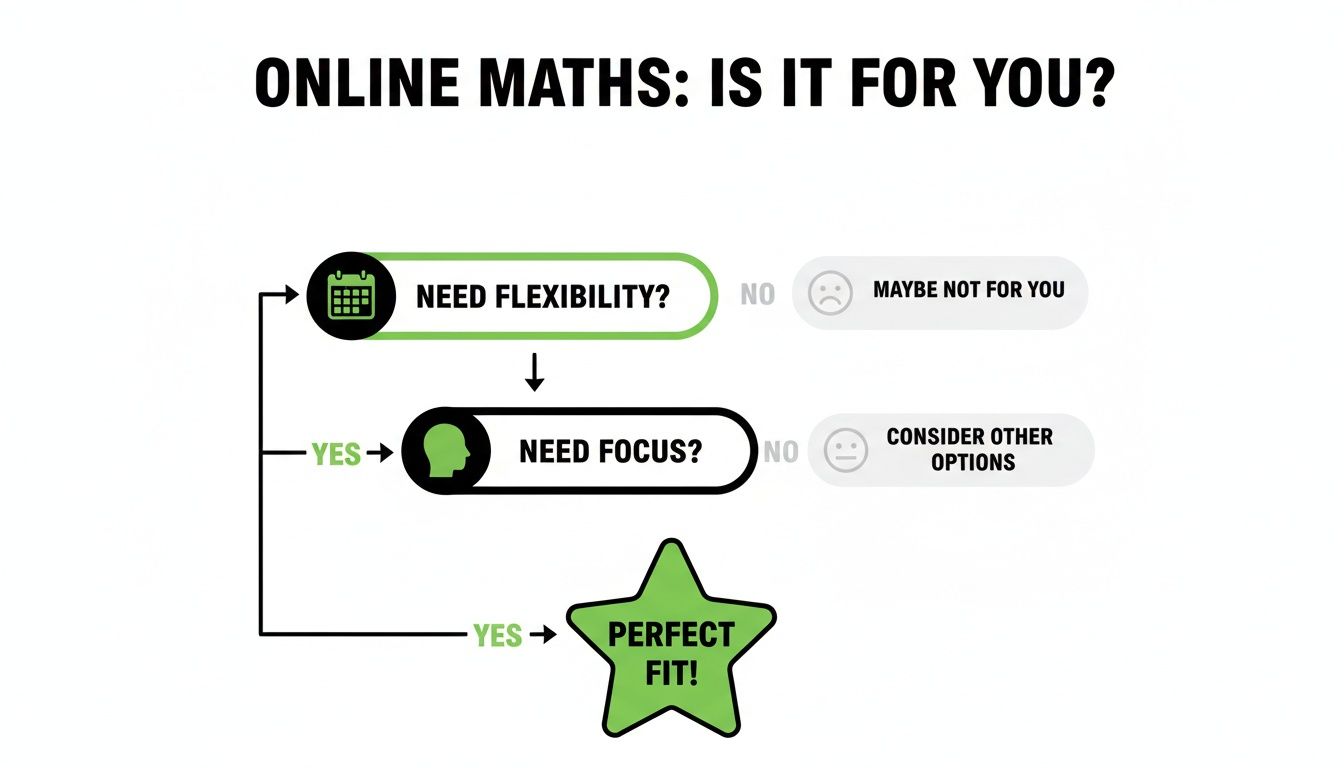
As you can see, when a child needs both a flexible schedule and a focused environment, online learning often emerges as the perfect solution.
To help you cut through the noise, we've put together a table outlining the key features to look for when comparing different online schools.
Comparing Online A Level Maths Providers
| Feature | What to Look For | Why It Matters for Your Child |
|---|---|---|
| Accreditation | Official recognition from UK exam bodies like Pearson Edexcel or AQA. | This is your proof that the qualification is legitimate and recognised by universities worldwide. It’s a fundamental quality check. |
| Teaching Method | Are lessons live and interactive, or pre-recorded for self-study? | Live lessons provide immediate feedback, peer collaboration, and a real connection with the teacher, which is crucial for tackling complex maths concepts. |
| Class Sizes | Ask for the maximum number of students per class. Ideally, it should be 8-10 students. | Small classes ensure your child gets individual attention. The teacher knows their name, their strengths, and exactly where they need a bit of extra help. |
| Teacher Qualifications | Are teachers subject specialists with UK teaching qualifications (like QTS)? | An expert teacher doesn't just deliver a curriculum; they inspire a genuine passion for the subject and know how to explain tough ideas in different ways. |
| Pastoral Care | Is there a dedicated system for well-being, like mentors or heads of year? | A Levels can be stressful. Strong pastoral care shows the school cares about your child's mental health and overall happiness, not just their grades. |
| Community & Socials | Do they offer virtual clubs, common rooms, or social events? | These are vital for building friendships and a sense of belonging. School is about more than just lessons; it’s about being part of a community. |
This table should give you a solid framework for your research, helping you ask the right questions to find a school that's a true partner in your child's education.
The Importance of Community and Support
A great online school is so much more than its academic programme. A Levels are demanding, and knowing there's a strong support network in place is incredibly reassuring for both you and your child. This is where you need to look beyond the curriculum and investigate the pastoral care and sense of community.
When you speak to a provider, ask direct, heartfelt questions that get to the core of what matters.
Will my child feel supported here? Who can they turn to if they are struggling, not just with maths, but with stress or confidence? Is there a real sense of community, or is it just a collection of disconnected students logging on for lessons?
Their answers will tell you everything you need to know. Look for schools that offer:
- Small Class Sizes: This is arguably the most critical factor. In a class of eight, a teacher knows each child’s name, their strengths, and where they need extra help. It’s impossible for anyone to get lost at the back of a virtual classroom.
- Dedicated Pastoral Support: Find out if there are mentors, form tutors, or heads of year responsible for your child’s overall well-being. This shows the school is invested in the whole person, not just their exam results.
- A Vibrant School Life: Do they run virtual clubs, social events, or collaborative projects? These opportunities are absolutely essential for building friendships and making sure your child feels like they belong.
Ultimately, choosing the right provider is an emotional decision as much as it is a practical one. Trust your gut. The best school isn't always the one with the flashiest website, but the one that feels like a genuine partner in your child’s educational journey.
Navigating Exams, Costs, and University Pathways
As a parent, you’re naturally focused on two things: the practical cost of your child's education and the real-world opportunities that investment will open up for them. It’s crucial to know that an online A Level Maths qualification won’t just deliver fantastic teaching, but will also provide a clear, simple route to sitting official exams and getting into their dream university.
You need confidence that this path is straightforward and well-supported. So, let’s break down exactly how it works, from the nuts and bolts of exam logistics to the incredible future that awaits.
How Do Online Students Actually Sit Their Exams?
This is one of the first questions parents ask, and thankfully, the answer is much simpler than you might think. "If my child is learning from home, where do they physically go to take their exams?" Reputable online schools have this process down to a fine art.
Many accredited providers, particularly those recognised as an official Pearson Edexcel or AQA exam centre, can host exams at their own physical locations. This is a brilliant option, as it means your child takes their papers in a familiar, supportive environment, surrounded by staff they already know and trust.
If travelling to the school’s own centre isn’t feasible, don’t worry. A dedicated team will step in to help you find and register with a private exam centre closer to home. They handle the admin and guide you through every step, taking that burden completely off your shoulders so you and your child can focus on revision.
Understanding the Investment
Clarity on costs is essential for any family. When you choose a quality online school, the tuition fees are designed to cover the entire educational experience, giving you a clear picture of the main investment from day one.
Typically, your tuition fees will include:
- Live, interactive lessons with genuine subject-specialist teachers.
- Genuinely small class sizes that ensure your child gets personalised attention.
- All learning materials and full access to the online learning platform.
- Recorded lessons for easy revision and catching up on missed classes.
- Constant teacher support and regular, detailed progress reports.
The main extra cost you’ll need to budget for is the final exam entry fees, which are paid directly to whichever exam centre you use. These fees can vary depending on the centre and location, but a good online school will always give you a clear estimate upfront. This transparency means no nasty surprises, allowing you to plan your finances with complete confidence.
Investing in a top-tier online A Level Maths course isn't just paying for lessons. It's securing a qualification that acts as a powerful key, unlocking doors to the most competitive and rewarding university courses and careers.
Unlocking Doors to Top Universities and Careers
This is where you see the real return on your investment. A strong grade in A Level Maths is so much more than a number on a certificate. It’s one of the most respected qualifications a student can achieve and is often called a "facilitating subject" precisely because it keeps so many doors open.
Top universities value it so highly because it’s irrefutable proof of advanced analytical thinking, logic, and problem-solving skills—abilities that are critical for success in any demanding degree.
- Here’s a practical example: A student hoping to study Computer Science at a Russell Group university will find that A Level Maths is almost always a non-negotiable entry requirement. The course gives them the foundational logic behind algorithms and data structures, putting them miles ahead before they even set foot on campus.
It’s the same story for an aspiring Engineer. A Level Maths is absolutely essential. The Mechanics module, for instance, directly teaches the principles of forces and motion that underpin every single branch of engineering, from civil to aeronautical.
A strong A Level in Maths is a gateway to a huge range of prestigious and high-demand fields, including:
- Medicine and Dentistry
- Economics and Finance
- Data Science and Artificial Intelligence
- Architecture and Actuarial Science
- Physics and Chemistry
By choosing a high-quality online A Level Maths course, you’re giving your child more than a qualification. You’re equipping them with the confidence and competence to step onto the world stage and chase their biggest ambitions. It's a true investment in their future, their potential, and their self-belief.
Practical Tips for Success in Online A Level Maths
Success in an online school isn't something that just happens; it’s a genuine partnership between your child, their teachers, and your family. Thriving isn't just about logging on for lessons. It’s about creating a supportive ecosystem at home that gives your child the tools and confidence they need to truly excel. These practical tips are designed specifically for the unique demands of studying online A Level Maths.

This journey is about more than just mastering calculus; it's about building confidence, getting comfortable with digital tools, and developing crucial life skills that will serve them well beyond the maths curriculum. Your support can make all the difference in turning a good experience into a great one.
Create a Dedicated Learning Space
The first step is to carve out a physical space dedicated solely to learning. It doesn’t have to be a separate office, but it absolutely should be a quiet, consistent, and distraction-free zone. Having a dedicated area helps your child mentally switch into "school mode."
- Practical Example: Think of a designated desk in the corner of a quiet room, with their textbooks, notebooks, and calculator all organised and ready to go. This simple setup sends a clear signal to their brain: when they sit here, it’s time to focus on maths, not social media.
This small act of creating a physical boundary can have a huge impact on focus and productivity, helping to separate home life from school life.
Master the Digital Toolkit
Online learning comes with a powerful set of digital tools. Take the time to encourage your child to get comfortable with the school's virtual learning environment, interactive whiteboards, and any collaborative software they use. Feeling confident with the technology removes a huge potential barrier to participation and lets them focus on the actual learning.
Building confidence in the virtual classroom is key. Encourage your child to unmute and ask questions during live lessons. Reassure them that their voice is valued and that asking for clarification is a sign of strength, not weakness.
For any student tackling online A Level Maths, learning how to study smarter, not harder is a game-changer. It’s not just about understanding the material, but also about learning how to manage their time and energy effectively in a digital setting.
Develop Strong Time Management Habits
Without the rigid bell schedule of a traditional school, self-discipline becomes a vital skill. Work with your child to create a weekly schedule that balances live lessons with independent study, revision, and—just as importantly—downtime.
Using a digital calendar or even a physical planner can help them visualise their commitments and start taking real ownership of their learning. As they get closer to exams, this structured approach is invaluable. If you're looking for more ways to help, our comprehensive guide on effective revision for A Levels offers targeted strategies that are perfect for online learners.
Encourage Social Connection
One of the biggest myths about online school is that it’s isolating. In reality, a great online school provides countless opportunities for students to connect and socialise. The key is to encourage your child to get involved.
- Join Virtual Clubs: Whether it’s a coding club, a debate society, or a creative writing group, these are fantastic ways to make friends who share similar interests.
- Participate in School Events: Nudge them to attend virtual assemblies, guest speaker events, or online social gatherings organised by the school.
- Form Study Groups: Suggest they connect with a few classmates to form a virtual study group. It’s a great way to tackle challenging problems together and learn from each other.
These connections build a genuine sense of community and belonging, reinforcing that they are part of a vibrant, supportive school family. This social network is just as critical to their well-being and academic success as any textbook.
Still Have Questions About Online A-Level Maths?
Choosing the right educational path for your child is a huge decision, and of course, you're going to have questions. You need to feel completely confident that you’re making the best choice for their future. Let's tackle some of the most common queries we hear from parents thinking about an online A-Level in Maths.
Our goal here is to give you those final pieces of the puzzle, offering both practical clarity and a bit of reassurance as you figure this all out.
Can My Child Really Get the Same Qualification Online?
Yes, absolutely. An A-Level qualification earned through an accredited online school is identical to one from a traditional sixth form or college. There is no difference.
Reputable providers are approved by official UK exam bodies like Pearson Edexcel, which means the curriculum, the exams, and the final certificate carry the exact same weight. They are recognised and respected by top universities worldwide. Your child’s certificate doesn’t mention ‘online’ or ‘in-person’ – it simply proves their academic achievement.
Is My Child Too Distracted to Learn at Home?
This is a worry we hear a lot, but what we often see is that online learning creates a more focused environment, not less. Think about it: in a small, live online class, the teacher can engage directly with every single student. It’s much harder to hide or get lost in the crowd than in a busy classroom of 30.
The structure of live lessons, combined with a dedicated study space at home, removes the social pressures and classroom disruptions that can throw a student off track. For many, this allows them to concentrate far more deeply on complex subjects like maths.
How Will They Make Friends and Socialise?
A great online school is so much more than just lessons; it’s a proper community. We know how important the social side of school is, so students are always encouraged to connect and build genuine friendships.
- Virtual Common Rooms: These are relaxed online spaces where students can just hang out and chat between classes, much like they would in a physical common room.
- School Clubs and Societies: From coding and debating to art and gaming, our clubs let your child bond with peers who share their passions and interests.
- Collaborative Projects: Working on group assignments, especially in a subject like maths, is a brilliant way to build teamwork skills and form strong friendships.
These opportunities ensure your child develops crucial social skills and feels a true sense of belonging. The friendships they build online can be just as strong and meaningful as any they'd make in a traditional school.
At Queens Online School, we understand that you're not just choosing a course. You're choosing a community where your child will feel supported, confident, and ready to succeed. Discover how we create a thriving educational environment for every student.