

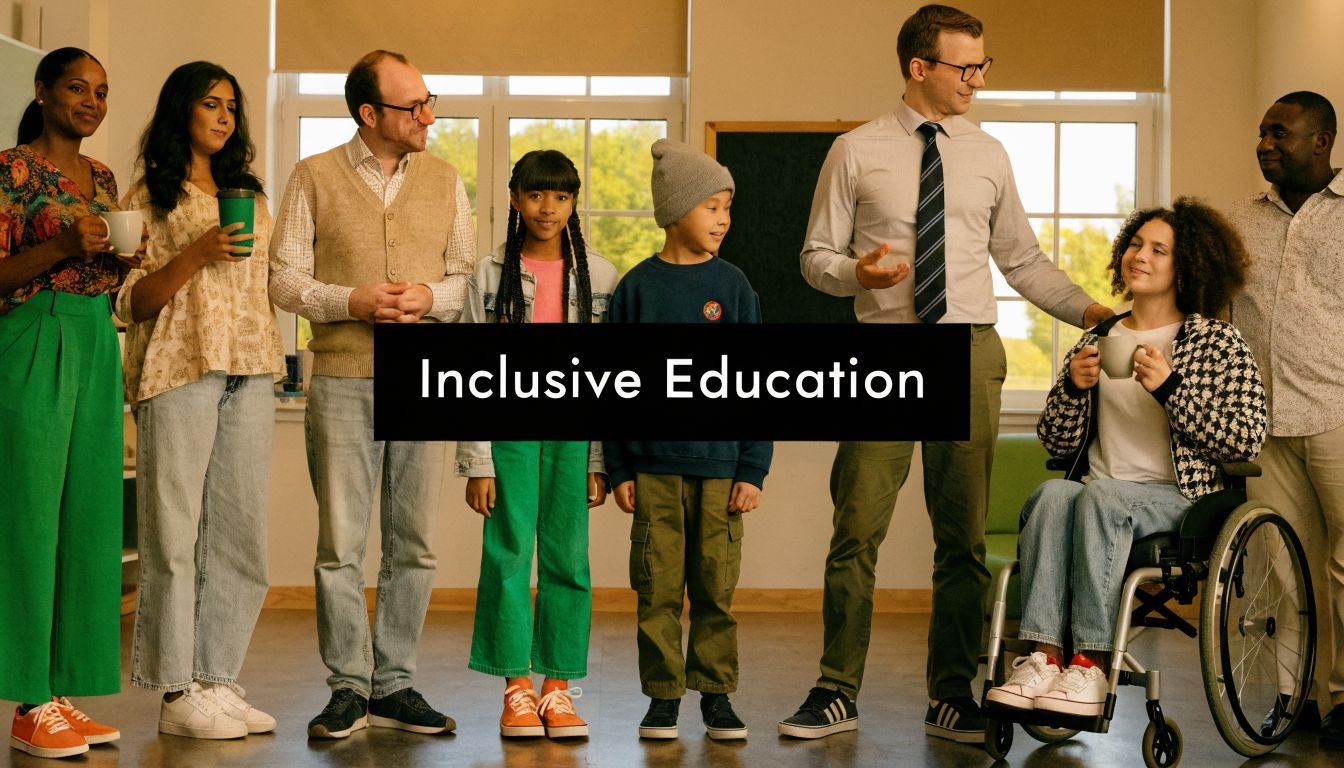
You may be reading this while weighing up a difficult choice. Your child may be bright, funny, curious, and capable, yet school hasn’t always felt simple. Perhaps they need extra help with attention, anxiety, communication, sensory regulation, or confidence. Perhaps your family moves between countries, lives far from specialist services, or needs a school day that fits real life better.
A lot of parents worry that online education could feel distant. They wonder whether their child will be known well enough, noticed quickly enough, and supported warmly enough. That concern is understandable.
What often reassures families is this. A good education is never built by one teacher alone. It’s built by a network of people who notice patterns, share strategies, and keep the child at the centre. That’s where inclusive education and community partnership matters most. It turns schooling from a set of lessons into a safety net.
When this is done well, your child isn’t left to “fit in” on their own. Adults adapt the environment. Peers are included thoughtfully. Parents are treated as partners, not spectators. Support becomes organised, calm, and joined up.
That’s what many parents are looking for in the end. Not perfection. Not empty promises. A team.
Every Child Deserves a Team
Parents rarely ask for anything extravagant. Most are asking for something very human. They want their child to be understood without having to explain everything from the beginning, every single term, to every single adult.
If your child has SEN or SEMH needs, that wish becomes even sharper. You want the maths teacher to know what helps when your child freezes under pressure. You want pastoral staff to notice when your child goes quiet. You want the school to see strengths as clearly as needs.
Belonging has to be built on purpose
Inclusion isn’t just allowing a child to join the class. It means the class, the routines, the communication, and the support all make room for that child to participate meaningfully.
That matters in any setting, but it matters especially online. A child can log in and still feel alone if no one is checking whether they can access the lesson socially, emotionally, and academically. They can attend every class and still feel that school is happening around them rather than with them.
A child feels safe when the adults around them are connected, consistent, and calm.
A strong partnership changes that experience. It makes sure the parent’s insight, the teacher’s observations, the specialist’s advice, and the child’s own voice all feed into the same picture.
What this looks like in daily life
A team around your child might mean:
- A class teacher notices that your child answers better in chat before speaking aloud.
- A parent shares that transitions after lunch are hard.
- A learning support lead suggests a visual routine and a check-in message before afternoon lessons.
- A peer group welcomes your child through a club built around a shared interest, not just academic performance.
None of these actions is dramatic on its own. Together, they can change how a child feels about school.
Inclusive education and community partnership works best when it feels personal. Not theoretical. Not bureaucratic. Personal. Your child is not a case to process. They’re a young person growing in confidence, skills, and self-belief. The right support network helps them feel that they belong first, and from that foundation, learning becomes far more possible.
What Is Inclusive Education and Community Partnership
Some educational terms sound more complicated than they need to be. This one doesn’t have to be.
Think of inclusive education as the blueprint for a home where every child can move around comfortably. Doors are wide enough. Lighting is thoughtful. People can enter, participate, rest, and contribute without being made to feel like a problem.
A community partnership is the group of people who help build and maintain that home. Teachers, parents, specialists, school leaders, health professionals, and community organisations all bring different tools. One person can’t do every job well. A partnership makes support more realistic and more reliable.

Inclusion is not about fixing the child
In an inclusive model, many families feel relief. The first question isn’t, “How do we make this child cope with our system?” It’s, “How do we shape the environment so this child can learn, participate, and feel secure?”
That shift matters. It changes tone as much as practice.
A child who struggles with live verbal responses might be offered typed participation. A child with SEMH needs might need predictable routines, private encouragement, and carefully paced expectations. A child with sensory overload might need screen breaks, visual structure, or recorded lessons to revisit calmly.
These adjustments are not special favours. They are part of making education accessible.
The UK foundation matters to many families
For families choosing a British curriculum, it helps to know this approach has deep roots. In the UK, a major milestone came with the Education Act 1981, which required local authorities to assess children with SEN and support integration into mainstream schools. That built on the Warnock Report of 1978, which reframed disability in terms of educational need rather than fixed medical labels. By 2019, 84% of pupils with SEN in England were educated in mainstream schools, up from 68% in 2006, showing a long-term direction towards inclusion, according to DfE SEND statistics and the Warnock framework.
A useful parent test: if support depends on your child acting like everyone else, it isn’t inclusion. If support helps your child access learning as themselves, you’re much closer.
Community partnership turns values into action
Schools can say they are inclusive. Partnerships show whether that claim works in practice.
Here’s a simple way to think about the difference:
| Element | What it means for your child |
|---|---|
| Inclusive education | The school adapts teaching, routines, and expectations so your child can participate |
| Community partnership | The adults and peers around your child communicate and work together consistently |
| Real inclusion | Your child feels known, supported, and able to make progress without losing dignity |
When parents understand this, the phrase stops sounding abstract. It becomes a promise that support won’t sit in one inbox, one report, or one meeting. It will be shared and acted on.
The Transformative Benefits of a Strong Partnership
Parents usually notice the effects of good partnership before they know the theory behind it. Their child logs off smiling. Homework causes fewer battles. A teacher emails with a practical adjustment before a small wobble becomes a large one.
That’s the power of joined-up support. It doesn’t only improve outcomes on paper. It changes how a child experiences the school day.

Confidence grows when adults act consistently
A child with SEN or SEMH needs can spend a lot of energy trying to decode expectations. If one adult allows movement breaks, another discourages them, and a third doesn’t know they help, school feels unstable.
Partnership reduces that friction. It gives your child a steadier experience.
You might see:
- Less emotional build-up because staff already know helpful strategies
- Better participation because the child isn’t starting from scratch in every lesson
- More willingness to try because mistakes feel safer
- Stronger self-image because support is normalised rather than stigmatised
Those changes are often the beginning of academic progress, not separate from it.
The academic gains are real too
Strong family and community engagement doesn’t just feel supportive. It is linked with measurable academic benefit. A 2020 Sutton Trust report found that schools with strong family and community engagement saw disadvantaged students gain 4 months’ additional progress in GCSEs. Data also showed that reciprocal partnerships correlated with a 12% rise in SEN pupils meeting expected standards in the Sutton Trust findings and related DfE 2022 to 2023 data.
That matters because parents are often pushed to choose between compassion and standards. They shouldn’t have to. The evidence points in the opposite direction. When support is coordinated, children are more able to engage with ambitious learning.
Belonging changes the atmosphere of learning
A child learns best when they’re not bracing themselves all day.
One child may join a virtual art club and finally find a friend who shares their interest. Another may begin answering in class because a teacher and parent have agreed on a lower-pressure routine. Another may stop dreading group work once the expectations are made explicit.
This short video captures why belonging and access matter in inclusive practice.
What parents often notice first: not a dramatic leap, but a calmer child, fewer battles, and a growing sense that school is becoming possible.
Partnership works because it joins the emotional and the academic. Children don’t split themselves into neat categories. Their confidence affects their learning. Their learning affects their confidence. A strong network supports both at once.
The Key Pillars of Your Child’s Support Network
When parents hear the word “partnership”, they sometimes picture a formal meeting full of acronyms. In reality, the best support networks feel more like a circle around the child than a hierarchy above them.
The child remains at the centre. Everyone else has a role, but nobody replaces the child’s identity, voice, or dignity.

The people who make the network work
The UK’s 2014 SEND Code of Practice formally recognised this multi-agency approach by requiring Local Authority SEND Partnerships to produce Local Offers describing available support through schools, health services, and community organisations. You can read that framework in the SEND Code of Practice guidance. The principle is simple. Support works better when people coordinate.
Here are the main pillars in practical terms:
- Your child brings preferences, strengths, worries, and goals. Even younger children can show adults what helps and what overwhelms them.
- Parents and guardians often hold the most complete picture. You know what happens before school, after school, and during the moments no teacher sees.
- Teachers translate support into daily lesson practice. They notice patterns in participation, understanding, and confidence.
- SEN or SEMH specialists help turn observations into strategies. They often spot barriers that are easy to miss in a busy school day.
- Peers matter more than adults sometimes realise. Friendship, collaboration, and shared interests can foster confidence quickly.
- School leaders protect the culture. They shape whether inclusion is treated as everybody’s job or left to one department.
- External professionals and community resources add expertise that schools and families may need at certain points.
What good collaboration sounds like
Support becomes stronger when each person contributes a different kind of knowledge.
| Person | What they often know best |
|---|---|
| Parent | Triggers, routines, recovery time, and what your child says at home |
| Teacher | Learning patterns, lesson access, and classroom participation |
| Specialist | Targeted strategies and ways to monitor progress |
| Peer community | Social belonging and informal encouragement |
| Leadership | Systems, consistency, and whole-school follow-through |
A parent might say, “My child copes in class but crashes afterwards.” A teacher might add, “They seem confident in written tasks but avoid live discussion.” A specialist can then help shape a plan that fits both pictures.
That kind of joined-up thinking is also why some families find outside support useful alongside school. For example, resources such as Ben’s neurodiverse counselling in Cheltenham can help parents understand affirming support for autistic and neurodivergent young people. In school terms, families often also benefit from clear explanations of what SEN support can look like in practice.
When the adults compare notes early, children don’t have to keep proving they need help.
The parent’s role is not secondary
Some parents worry about being “that parent”. They don’t want to overstep. In inclusive education and community partnership, thoughtful parental involvement isn’t interference. It’s part of the support structure.
You’re not expected to do the school’s job. But your insight can help the school do its job more precisely.
Building Community in a Global Online School
The question many parents ask is direct. If there is no physical playground, corridor, or school gate, can there still be real community?
Yes, but it has to be designed deliberately.
In an online setting, connection won’t happen by accident through proximity. It grows through planned routines, warm communication, and repeated opportunities for children and adults to know one another in meaningful ways.

What virtual community looks like in practice
A strong online community might include live lessons, small group support, student clubs, tutor check-ins, parent communication channels, and opportunities for quieter pupils to connect without the pressure of a crowded physical setting.
For some children, this feels safer from the start. They can participate from a familiar environment. They can use chat before voice. They can revisit recorded material. They can build friendships around shared interests with pupils in other countries who understand the same curriculum.
One useful way to picture this is as a digital village. The classroom is only one building in that village.
A realistic family example
Consider a family living in a remote area for work. Their child needs academic stretch in English, patient support with anxiety, and more consistent peer contact than the local options can offer.
In a well-designed online model, that child might start the day with a live British curriculum lesson, receive a quiet check-in from a pastoral adult before a presentation task, join a lunchtime coding club with students in different time zones, and end the week with parents receiving practical feedback rather than vague reassurance. The family gains structure. The child gains continuity. The adults gain a shared plan.
For families in remote areas, this isn’t only convenient. It can close real gaps. A 2025 NASEN pilot indicated that virtual community hubs within online platforms reduced SEN attainment gaps by 22% for rural students through remote mentorship and specialist access, as described in the NASEN 2025 pilot data.
The systems behind that community
Online inclusion needs both heart and infrastructure. Families often look for practical signs such as:
- Clear lesson access with live and recorded options
- Consistent communication so parents know who to contact and when
- Pastoral visibility so emotional wellbeing is not treated as separate from learning
- Specialist pathways when a child needs more than general classroom support
- Social spaces where connection is structured, not left to chance
For parents comparing options, it also helps to understand how digital learning is meant to function day to day. This guide to learning in virtual environments is useful because it focuses on the practical habits and structures that make online study workable for children. Behind the scenes, schools and educational organisations also need good operational systems if they want support services to remain stable over time. That’s one reason resources on fund accounting for educational nonprofits can be relevant to families who want to understand how student support is sustained responsibly.
A global online school cannot copy a physical school exactly. It doesn’t need to. It can create a different kind of closeness, one built on access, consistency, and thoughtful design.
Practical Frameworks That Make Inclusion Work
Parents don’t need a long list of technical terms. They do need to know whether a school’s support model is organised, evidence-based, and visible in daily life.
The most helpful frameworks share one big idea. Support should be woven into the child’s main learning experience, not bolted on awkwardly at the edges.
Braided support instead of separate support
The Schoolwide Integrated Framework for Transformation, often shortened to SWIFT, describes inclusion as “braided” delivery. That means academic, behavioural, and therapeutic supports are interwoven with general education rather than isolated from it. The framework also highlights the importance of strong leadership, an inclusive culture, and collaborative communication, as explained in the SWIFT framework paper.
For a parent, braided support looks like this:
- The class teacher knows the learning goal and the access strategy
- The specialist teacher feeds into lesson planning rather than only responding afterwards
- The school system tracks whether the child can effectively use the environment, not merely whether they attended
- The family understands how home and school approaches connect
That’s often far more effective than pulling a child out repeatedly without linking the support back to the main curriculum.
What this can look like online
In a virtual setting, braided support might mean a student receives real-time feedback during mainstream lessons, uses visual prompts inside the learning platform, and has parents updated on the exact strategy being reinforced at home.
An option like Queen’s Online School provides an example of an online British curriculum setting that explains individualised planning in practical terms. The value for parents is not the label itself. It’s whether the support plan is specific, shared, and usable.
A simple check for families: if support only appears in a document and not in your child’s daily experience, the framework isn’t being implemented well enough.
Data-informed support for SEMH and behaviour
Another useful approach comes from Applied Behavior Analysis, often paired with social-pragmatic support. In plain language, this means adults observe carefully, identify what is happening before and after a difficulty, agree small target behaviours or coping skills, and train parents alongside school staff so the child receives consistent support.
In an online setting, that can include:
-
Observation and baseline understanding
Adults note patterns such as shutdown during open-ended tasks, distress when routines shift, or stronger participation through typed responses. -
Individual targets
The child may work on self-regulation, task initiation, communication, or help-seeking in a defined and manageable way. -
Parent partnership
Strategies are shared so the child encounters similar cues and responses across home, school, and community settings.
What matters most is that inclusion decisions are based on individual need, not on labels alone. When a school uses practical frameworks well, parents can feel the difference. Support becomes less reactive, more coherent, and easier for the child to trust.
A Future Built on Belonging and Excellence
Parents often come to this topic carrying two fears at once. They worry that if they prioritise support, their child’s academic future may narrow. They also worry that if they prioritise academic challenge, their child may be left emotionally exposed.
Inclusive education and community partnership offers a better answer than that false choice. A child can be stretched and supported. They can be held to high expectations and met with compassion. In fact, those things often depend on one another.
When a child feels known, learning becomes more available. When adults communicate well, problems are noticed earlier. When peers are included in the culture of support, belonging stops being an afterthought. That is how excellence becomes reachable, not intimidating.
For families exploring online options, clarity matters. It can help to use tools such as AI-powered virtual tours for education to get a better feel for how a digital learning environment is presented and organised before making a decision. The details matter. So does the atmosphere.
Your child doesn’t need a perfect system. They need a school community that listens carefully, adapts intelligently, and stays connected when things are easy and when they are hard.
That kind of education is not out of reach for international families, for children with SEN or SEMH needs, or for parents who have felt they must compromise. It is possible to choose a learning environment built on both belonging and ambition.
If you’re looking for a British curriculum option that combines live online teaching with personalised support for a wide range of learners, Queens Online School is worth exploring. Families can look at how the school approaches inclusive learning, pastoral care, and flexible study, then decide whether that support network fits their child’s needs.