


An effective A-Level revision timetable template isn't some rigid document you just download and follow. Think of it as a flexible, personal plan you build around your child's unique needs and wellbeing. The best ones are those you can twist and shape to fit their energy levels, their learning style, and the specific demands of their subjects. It’s about turning a simple schedule into their most powerful tool for exam success, one that feels supportive rather than punishing.
Why Most Revision Timetables Fail A-Level Students

The pressure of A-Levels is immense, and it's heartbreaking to see your child struggling. In that frantic search for structure, many students grab the first revision timetable they find online. It feels productive, like they're finally taking control.
But this one-size-fits-all approach is often the very reason revision plans collapse within weeks. It can leave your child feeling more stressed and defeated than when they started.
These generic schedules rarely account for the human element of studying. They treat students like machines, expecting the same output day in, day out, which simply isn't how young people work. A-Levels demand a level of deep thinking and stamina that a rigid, cookie-cutter plan just can't support.
The Problem with Rigid Planning
Imagine a student, let's call her Chloe. She’s studying Maths, History, and Chemistry. She downloads a colourful weekly planner that allocates neat, two-hour blocks for each subject, every single day. On paper, it looks perfect.
But then Tuesday rolls around. After a draining double Maths lesson on complex numbers, her brain is completely fried. Her timetable says she must now spend two hours on Tudor rebellions. She stares at the textbook, but nothing is going in. That rigid block of time becomes a source of guilt, not guidance. The feeling of failure starts to creep in.
This is an incredibly common story. The plan fails because it ignores her fluctuating energy levels and the cognitive load of different tasks.
A revision timetable should serve your child, not the other way around. If their plan makes them feel guilty or anxious when life gets in the way, it's the plan that's broken, not them.
Chloe's experience highlights a critical flaw: generic templates don't differentiate between types of revision. A two-hour slot for Maths might involve intense problem-solving, which is mentally taxing. In contrast, a History session might involve reading and note-taking, which uses a completely different kind of energy. A good plan has to respect these differences.
Putting Your Child's Needs at the Centre
The secret to a successful A-Level revision timetable is personalisation. It has to be built around your child's life, their subjects, and their wellbeing. Instead of forcing them into a pre-made box, the goal is to create a framework that actually supports them.
Think about these essential factors that most generic templates miss:
- Their Personal Rhythms: Is your child a morning person who can smash through difficult topics at 8 AM, or do they hit their stride in the evening? The plan should honour their natural energy patterns.
- Subject Intensity: A dense topic in Chemistry might need shorter, more frequent sessions than memorising quotes for English Literature.
- Wellbeing Breaks: A schedule packed only with study is a one-way ticket to burnout. Time for friends, hobbies, and rest isn't a luxury; it's a necessity for effective learning.
- Flexibility for Life: Unexpected homework, a family commitment, or simply a day where they feel unwell shouldn't derail their entire week. A good plan has wiggle room.
By shifting your perspective, you can see a timetable not as a rigid set of rules, but as a compassionate guide. The rest of this article will walk you through exactly how to find, adapt, and use a template to create a revision plan that truly works for your child.
Laying the Groundwork for Your Revision Strategy

Before a single minute gets scheduled, the most important work has to happen. A blank a level revision timetable template is just paper; its real power comes from the honest, thoughtful prep work you do before filling it in. This is where you turn an empty grid into a proper strategic plan, built around your child’s unique academic landscape.
This foundational stage is all about creating clarity and facing reality head-on, which can feel daunting for your child. But remember, the goal isn’t to create a perfect, rigid document. It’s about building a compassionate and realistic guide that understands what truly needs attention, rather than just guessing.
To lay a solid foundation, it’s vital to establish clear objectives. Thinking about setting SMART goals can really help structure the study plan, turning what feels like an overwhelming mountain of work into small, achievable steps.
Creating the Master Topic List
First things first, gather every bit of information you can. Sit down with your child and make a master list for each of their A-Level subjects. This isn’t just about scribbling down broad subject titles; it's about digging deep into every individual topic, sub-topic, and module that could possibly show up on the exam paper.
For example, a student taking Biology, Chemistry, and English Literature wouldn't just write those three words down. They'd break it down properly:
- Biology: Instead of just "Biology," the list would have specific modules like Biological Molecules, Cells, Gas Exchange, Genetics, and Homeostasis.
- Chemistry: This would be broken down into Atomic Structure, Organic Chemistry (Alkanes, Alkenes), Redox Reactions, and Thermodynamics.
- English Literature: Here, you’d list each core text (e.g., Hamlet, The Handmaid's Tale), key poets, and thematic areas like Tragedy or Post-Modernism.
This detailed breakdown does something incredibly powerful: it makes the monumental task of "revising" feel finite and manageable. It transforms a vague, scary mountain into a series of smaller, climbable hills. This process alone can massively reduce that feeling of being completely overwhelmed.
The Power of the 'Red, Amber, Green' System
Once you have your master topic list, the next step is an honest self-assessment. This is where you and your child can really start to personalise the plan, shifting from guesswork towards targeted, effective revision. A simple traffic light system is perfect for this—just colour-code each topic on your list.
- Red: These are the topics that cause that sinking feeling. They're confusing, poorly understood, or have been actively avoided. These are your child's absolute top priority.
- Amber: These are the 'okay' topics. Your child gets the main concepts but might trip up on specific details or exam-style questions. They just need practice and reinforcement.
- Green: These are the strong suits. Your child feels confident here and consistently scores well. They still need a quick review to stay fresh, but they require the least amount of time.
This visual map instantly shows where the real work lies. It ensures that precious revision time is funnelled into the red areas that will make the biggest difference to their final grade, rather than being wasted on green topics they already know inside out.
This isn't just an organisational task; it's an emotional one. Acknowledging the 'red' topics without judgement is the first step to conquering them. It’s about saying, "I find this difficult right now, and that’s okay. Now I have a plan to change that."
This whole process is about creating a plan based on reality, not wishful thinking. With a clear and honest picture of their strengths and weaknesses, your child is far better equipped to tackle their A-Levels with confidence. For more in-depth strategies, you can explore our comprehensive guide on revision for A-Levels. The groundwork you lay now will determine whether the timetable becomes a source of stress or a genuine tool for success.
Choosing the Right A Level Revision Timetable Template
Finding the perfect a level revision timetable template can feel a bit like falling down a rabbit hole. A quick search brings up a dizzying array of options, from sleek digital spreadsheets to beautifully designed printable planners. While the choice is great, it can quickly become another source of stress in itself.
Here’s the thing: the goal isn’t to find the single “best” template out there. It’s about finding the one that genuinely fits your child’s personality and how they learn. This is as much an emotional decision as a practical one. You're looking for a structure that feels supportive and calming, not restrictive and overwhelming. The right template can transform a huge mountain of revision into a clear, visible, and, most importantly, achievable path forward.
Which Revision Timetable Format Is Best for You?
So, how do you decide? The best format is the one that reduces friction and feels natural to use. A beautiful paper planner is useless if it just gathers dust, and a high-tech spreadsheet won't help if it feels too complicated. Let's break down the most common options to see which one might be the best fit for your child.
| Template Format | Best for Students Who… | Key Advantages | Potential Drawbacks |
|---|---|---|---|
| Printable PDF Planners | Are tactile or visual learners who love stationery, colour-coding, and the satisfaction of physically ticking things off. | Tangible sense of accomplishment; easy to see the whole week at a glance on a desk or wall; great for visual planning. | Inflexible. Changes can get messy, requiring crossing out or reprinting, which can feel disheartening. |
| Digital Templates (Sheets/Excel) | Have fluctuating schedules due to work, sports, or other commitments and need to reschedule revision sessions easily. | Supremely flexible; easy to drag-and-drop sessions, adjust timings, and duplicate weekly plans without starting from scratch. | Can feel less tangible; requires a device to access; potential for digital distractions. |
| Minimalist Daily Planners | Get easily overwhelmed by seeing a whole week or month planned out and prefer to focus on one day at a time. | Reduces anxiety by focusing only on today's tasks; helps build momentum with small, daily wins; feels much more manageable. | Lacks a long-term overview, making it harder to balance subjects over a week or month. |
Ultimately, the best tool is the one your child will actually use consistently. Don't be afraid to try one format and switch if it isn't working. The aim is progress, not perfection.
Printable Planners for Tactile Learners
For some students, nothing beats the physical act of writing things down and striking a line through a completed task. It’s incredibly satisfying. Printable PDF planners are made for these tactile learners.
There's a real psychological boost that comes from printing out a fresh weekly sheet, filling it in with colourful pens, and physically crossing off a revision session. That tangible sense of accomplishment is something a digital click often can't replicate.
This format is a great choice for students who:
- Feel more organised when they can see their plan laid out on a desk or stuck to the wall.
- Are visual thinkers who benefit from colour-coding subjects and priorities.
- Get a real motivational kick from the concrete act of marking a task as done.
The main drawback, however, is its rigidity. If an unexpected guitar lesson or a family commitment pops up, amending a paper timetable can get messy. To get a feel for this style, you could explore something like a free printable student planner and adapt it for A-Level subjects.
Digital Templates for Ultimate Flexibility
On the other end of the spectrum, you have digital templates, usually built in Google Sheets or Excel. These are the champions of adaptability.
For a student whose schedule is constantly shifting with extracurriculars, a part-time job, or just fluctuating energy levels, a digital planner is a lifesaver.
A revision session for Chemistry clashing with a last-minute study group? No problem—just drag and drop it to another slot. Realised you've allocated way too little time for a tough History topic? It takes seconds to adjust the entire week’s plan without any scribbling or starting over. This is crucial for maintaining momentum without the guilt of a "ruined" paper plan.
The best tool is the one that reduces friction. If your child finds constant rescheduling stressful, a digital template’s flexibility can be a huge relief. It allows the plan to bend with life, rather than break against it.
Minimalist Daily Planners for a Focused View
Let's be honest, for some students, looking at an entire week packed with revision blocks is the definition of overwhelming. It can trigger real anxiety and make the whole A-Level journey feel impossible before it's even begun.
This is where minimalist daily planners shine.
These templates focus on just one day at a time, presenting a short, manageable list of tasks. This approach helps students concentrate on what needs to be done today without being crushed by the weight of the rest of the week.
A daily planner is perfect for a student who:
- Is easily overwhelmed by long-term schedules.
- Thrives on breaking down huge goals into small, daily wins.
- Needs to build confidence and momentum one day at a time.
For instance, instead of a weekly view showing ten hours of Maths revision, their daily plan might simply say: "1. Complete trigonometry past paper (1 hour)" and "2. Create flashcards for redox reactions (45 mins)." This feels far more achievable and helps build a positive, consistent revision habit without the initial panic. Taking the time to match the format to your child’s temperament is one of the most supportive things you can do.
Building Your Timetable for Effective Revision
Right, you’ve got your blueprint and you’ve picked a template that feels like a good fit. Now for the crucial part: bringing that revision plan to life. This is where the abstract ideas become a concrete, day-by-day guide that will get your child through the exam season.
The aim here is to fill your a level revision timetable template with real intention. We’re creating a schedule that feels supportive and empowering, not like a punishment.
We're moving beyond just blocking out time. Think of it as designing a smart revision system. That means using proven techniques like time-blocking for deep focus and organising subjects based on those 'red, amber, green' ratings you’ve already worked out. This way, every single revision session has a clear purpose from the get-go.
From Vague Goals to Specific Actions
One of the biggest mistakes students make is creating a timetable with fuzzy entries like 'Revise Biology' or 'Do History'. What does that even mean? These goals are far too broad and give them no clear starting point, which is a classic recipe for procrastination.
The secret is to get incredibly specific.
Instead of a generic task, each slot on the timetable needs to be an active, manageable instruction. It’s a small change, but it makes a massive emotional difference. A daunting two-hour block suddenly becomes a series of clear, achievable steps.
-
Instead of: 'Revise Photosynthesis'
-
Try: 'Mind Map: Light-Dependent Reactions (45 mins)'
-
Instead of: 'Physics Revision'
-
Try: 'Complete 5 past paper questions on Mechanics (60 mins)'
This level of detail completely removes decision fatigue. When it’s time to study, your child knows exactly what needs to be done, making it so much easier to just sit down and start. For more ideas on how to break down your study time, have a look at our guide on time management for students.
Integrating Active Recall and Spaced Repetition
To make revision actually stick, it has to be active, not passive. Simply re-reading notes is one of the least effective ways to learn anything. Your child's timetable should be built around two powerhouse concepts: active recall and spaced repetition.
- Active Recall: This is the simple act of pulling information out of their brain. Think flashcards, practice quizzes without notes, or explaining a concept out loud to a pet.
- Spaced Repetition: This means reviewing information at increasing intervals over time. It’s light-years more effective than last-minute cramming.
You can design your timetable to do this automatically. For instance, after creating that photosynthesis mind map on Monday, you can schedule a specific follow-up task a few days later.
Here’s what that looks like in practice:
Monday, 6:00 PM: Biology – Mind Map: Light-Dependent Reactions (45 mins)
Wednesday, 7:00 PM: Biology – Flashcards: Key Photosynthesis Terms (25 mins)
Following Tuesday, 5:30 PM: Biology – Past Paper Qs: Photosynthesis (30 mins)
This method embeds learning into long-term memory. Your child's timetable becomes a smart revision tool that does the strategic thinking for them.
Balancing Different Subject Demands
A-Levels force students to switch between completely different ways of thinking. A content-heavy subject like History needs a different kind of mental energy than a problem-solving one like Physics. The timetable has to respect that.
Let’s imagine a child is tackling History (a 'red' subject) and Physics (an 'amber' subject). Here’s a smart way to balance them in an evening:
- Hit the Priority First: Start with the tougher subject when energy and focus are at their peak. A solid 50-minute block on a difficult History essay plan is far more productive than trying to do it when they're already tired.
- Switch Cognitive Gears: Follow that up with a different type of task. After the deep analytical thinking for History, switching to the logical problem-solving of Physics for a 45-minute block can feel genuinely refreshing for the brain.
- End with Lighter Work: Finish the evening with something less intense. This could be creating flashcards for History key dates or reviewing Physics formulae for 25 minutes.
This approach prevents mental burnout by mixing up the cognitive load throughout a study session. The infographic below shows the simple process of choosing a format that supports your planning style.
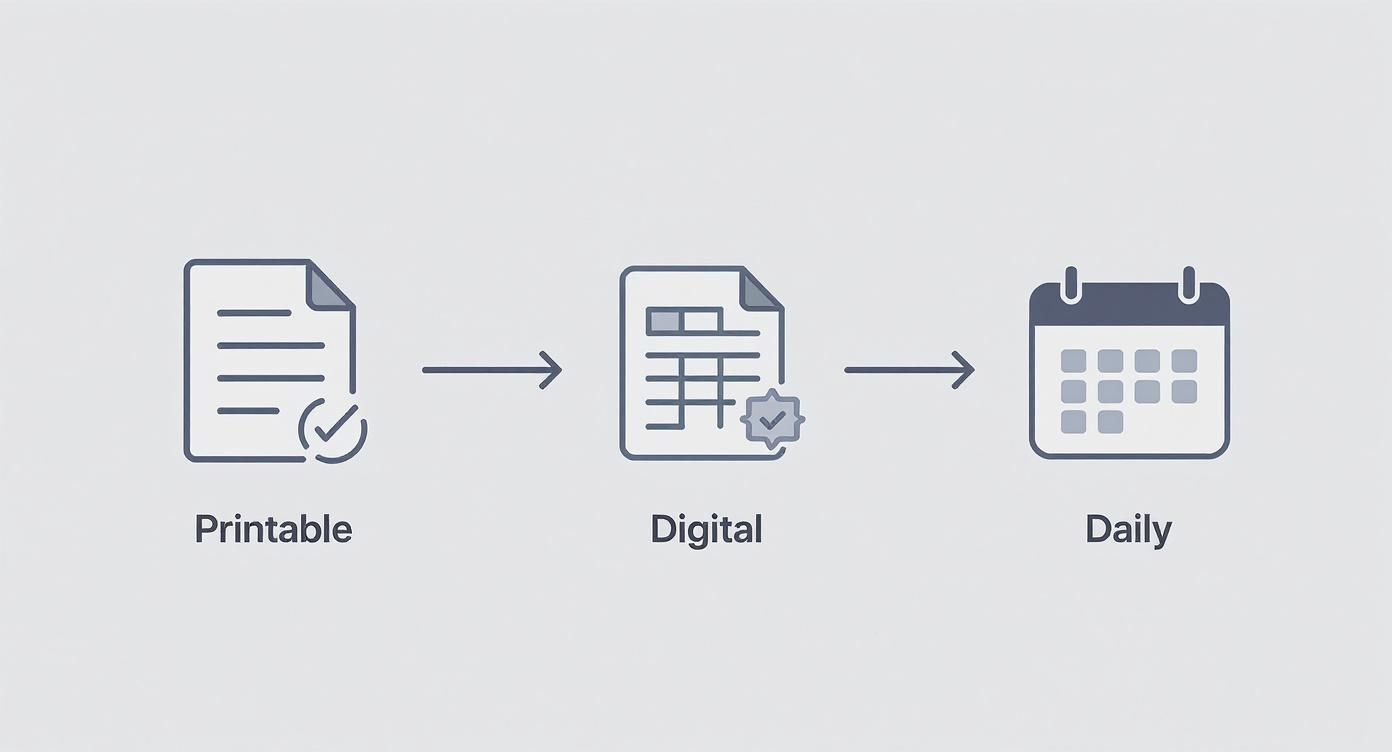
This visual flow shows how you can move from a tangible paper plan to a flexible digital one, or even a hyper-focused daily schedule, depending on what works best for your child.
When you build their timetable this way—with sharp specifics, active learning techniques, and a smart balance of subjects—it stops being a chore. It becomes a powerful, compassionate, and realistic tool for success.
How to Adapt Your Timetable for Real Life
Let's be honest: a perfectly crafted revision timetable is a thing of beauty, but a plan that can't bend will eventually break. A-Level life is rarely predictable. Some days, your child will wake up sick, exhausted, or just completely unable to stare at another textbook.
When the timetable is too rigid, these perfectly normal moments can trigger a spiral of guilt and anxiety, making them feel like a failure. The most compassionate and effective a level revision timetable template is one built with real life in mind. It needs to be a human-centred plan that expects bad days and gives your child the tools to navigate them. This is all about building in that flexibility, ensuring the plan supports their wellbeing just as much as their academic goals.
Building in a Safety Net
The secret to a resilient schedule is to plan for disruptions before they happen. Instead of panicking when a day goes off-plan, you build in mechanisms to absorb the impact. This small step transforms the timetable from a source of pressure into a genuine support system.
A brilliant way to do this is by scheduling ‘buffer slots’ or ‘flex days’.
- Buffer Slots: These are simply empty 60-90 minute blocks scattered throughout the week. If a planned History session gets derailed by a headache, your child can use a buffer slot the next day to catch up on the most critical parts without sacrificing another subject.
- Flex Days: Designate one afternoon a week (Saturday afternoon works well) as a dedicated catch-up zone. If the week goes smoothly, it becomes a well-deserved reward—extra free time. If not, it’s a guilt-free space to tackle anything that was missed.
This approach completely removes that awful feeling of 'falling behind' and replaces it with a calm sense of control.
Making Wellbeing Non-Negotiable
For a revision plan to actually work long-term, wellbeing can't be an afterthought squeezed in "if there's time." It has to be a core, scheduled component. This means booking in time for friends, hobbies, exercise, and—crucially—sleep with the same importance as a Maths past paper.
When these activities are physically on the timetable, it sends a powerful message: resting is just as productive as revising. In a competitive academic environment, small, consistent gains are what make the difference. UK data shows the average A-Level point score rose slightly to 35.94 in 2024/25, highlighting how well-managed, sustainable revision contributes to these improvements. Building a timetable that prevents burnout is essential for getting those crucial marks.
A tired brain can't learn effectively. Scheduling a full night's sleep isn't lazy; it's a strategic revision technique that helps consolidate memory and improve focus for the next day.
Compassionate Adaptations for SEN and SEMH Needs
For students with Special Educational Needs (SEN) or Social, Emotional, and Mental Health (SEMH) challenges, a standard timetable can be incredibly daunting. The need for a flexible, compassionate plan is even more critical here. It’s all about creating a structure that reduces anxiety, not one that adds to it.
Consider these adaptations to build a more supportive revision environment:
- Shorter, More Frequent Sessions: Instead of a marathon 60-minute block, plan for 25-minute focused bursts followed by a 10-minute sensory break. For students who struggle with concentration, this can be a game-changer.
- Visual Timers: Using a visual countdown timer can make study blocks feel less abstract and more manageable, taking the edge off any anxiety about how much time is left.
- 'Low-Demand' Options: For days when anxiety is high or energy is low, have pre-planned, low-effort revision tasks ready. This could be watching a documentary on a History topic, listening to a relevant podcast, or simply organising flashcards. It keeps the momentum going without the pressure of high-intensity work.
By adapting the template to work with your child's needs, you create a tool that genuinely empowers them. The goal is a plan that supports their mental health above all else. For a deeper dive, check out our guide on powerful techniques for A Levels revision.
Common A Level Revision Questions Answered
Even with the perfect A Level revision timetable template in hand, it’s completely normal for questions and worries to pop up. The journey through A Levels is full of uncertainties, and it’s natural for your child to wonder if they're doing things the ‘right’ way.
Think of these answers not as strict rules, but as guidance from someone who has seen countless students navigate these exact same hurdles. The goal here is to give you and your child the confidence to trust the plan, know when to adapt, and feel in control of the whole process.
How Many Hours a Day Should My Child Revise for A Levels?
This is the big one, the question every parent and student asks. But honestly, there’s no magic number. The focus must always be on the quality of revision, not the sheer quantity of hours.
Three hours of focused, active work—like smashing out a past paper with no distractions—is infinitely more valuable than six hours of passively reading a textbook with their phone buzzing next to them. A good starting point is often 2-3 focused hours on a school day and maybe 4-5 hours on a weekend day, but this can vary hugely.
The most important part of this equation? Breaks. The timetable must include them.
- Try the Pomodoro Technique: Work for 25 minutes, then take a 5-minute break. After four rounds, take a longer 15-30 minute break. It’s brilliant for preventing mental fatigue and keeping focus sharp.
- Listen to their body: If your child is truly exhausted, a proper break or even an early night is always more productive than forcing them to stare at a book. Burnout is the real enemy of effective revision.
A sustainable routine is one that works with your child’s energy levels, not against them.
What Should We Do If My Child Falls Behind on Their Timetable?
First things first: breathe. It happens to literally everyone. A revision timetable is a guide, not an unbreakable contract. The absolute worst thing you can do is let them panic and give up entirely.
Instead, see it as a signal. The timetable is trying to tell you something. Take a moment to figure out why they fell behind.
- Was the plan a bit too ambitious from the start?
- Did an unexpected school commitment or family event throw things off?
- Were the study blocks too long, leading to procrastination?
Use a pre-planned 'flex' or 'catch-up' slot in their week to cover the most critical missed topics. If you find they are always falling behind, then the timetable needs adjusting. Re-evaluate it, adapt it, and be kind to them. Progress, not perfection, is the goal.
A timetable that causes constant guilt is a broken tool. Don't be afraid to fix it. The plan is there to serve your child's needs, not the other way around.
How Do I Help My Child Revise a Subject They Find Difficult or Boring?
Ah, the dreaded 'red' subject. This is a tough one, but facing these head-on is where the biggest grade improvements come from. The trick is to outsmart their brain's reluctance to get started.
It's so tempting to push aside the subjects that feel like a chore, but that only makes the anxiety around them grow. Instead of letting dread build up, try a few strategic approaches to make them feel more manageable.
- Eat the Frog: Encourage them to tackle the most dreaded subject first thing in their revision session when their willpower and energy are at their peak. Getting it done and dusted provides a huge sense of relief and momentum for the rest of the day.
- Make it Active: Passive reading will never work for a boring subject. They have to engage with it. Create colourful mind maps, use an app like Anki for digital flashcards, or try teaching the concept to someone else (even the dog counts!).
- Use Short Bursts: Schedule shorter, more frequent sessions. Two focused 25-minute blocks on different days are far less intimidating than one long, dreaded 90-minute slot.
- Reward Them: Help them build a positive association by offering a small, immediate reward after completing a session. This could be watching an episode of their favourite show or spending 15 minutes on a hobby.
By changing the approach, you can help them slowly turn these difficult subjects from major obstacles into conquerable challenges.
At Queens Online School, we understand that a successful academic journey is built on personalised support and flexible structures that put the student first. Our live, interactive classes and expert teachers are here to guide your child through their A-Levels with a plan that adapts to their unique needs. Discover a more supportive way to learn at https://queensonlineschool.com.