
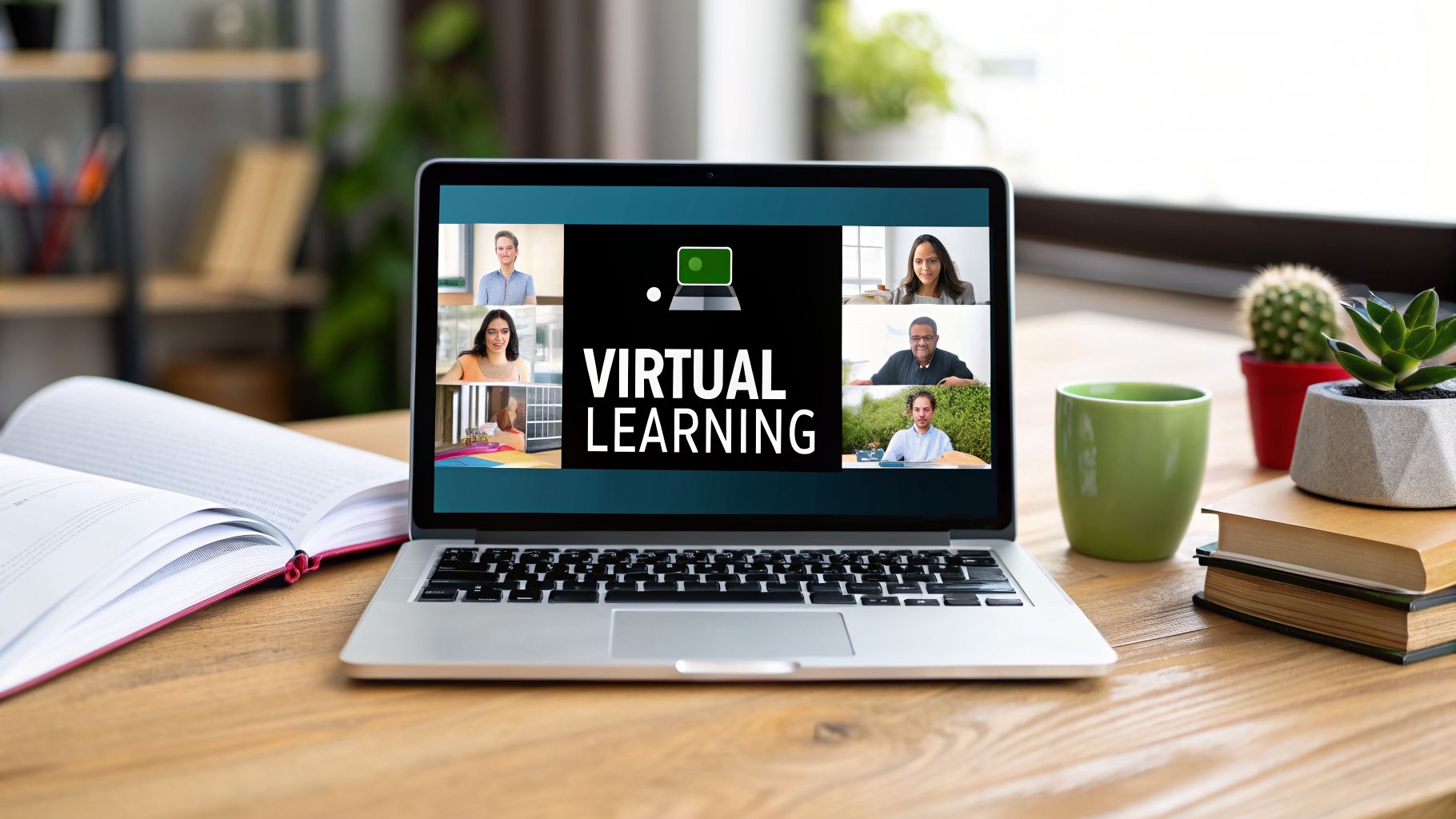
When you hear the term ‘virtual learning environment’, what comes to mind? For many parents, it’s easy to picture a child simply sitting in front of a laptop on a video call. But a true virtual learning environment, or VLE, is so much more than that. It’s a complete online ecosystem designed to feel like a real school—a secure, organised digital campus where your child can learn, connect with teachers, and build friendships from the safety and comfort of home.
What Is a Virtual Learning Environment?

Imagine a school that isn't made of bricks and mortar but exists entirely online. While that might sound a little strange at first, a well-designed VLE brings the very best parts of traditional school—structure, community, and support—directly into your home, but without the common pressures of a physical school building. It’s a feeling of relief for many families.
This isn’t about leaving your child to fend for themselves with pre-recorded videos. A proper VLE is a vibrant, active community built to put your child’s needs first. When your child logs in, they aren't just opening a website; they are stepping into their own digital campus, a place designed to make them feel safe and ready to learn.
A Day in a Digital School
So, what does this actually look like for your child on a typical day? It’s far more structured and interactive than you might think. Your child starts their morning by logging into their school portal, where a clear timetable is laid out for them, just like in a physical school, providing a sense of comforting routine.
- Morning Assembly: The day might begin with a live assembly, joining the head teacher and fellow students to build a sense of community before lessons start. This helps your child feel part of something bigger.
- Live Lessons: Their first class, maybe Maths, is a live, interactive session with a subject-specialist teacher and a small group of classmates. For a child who might feel lost in a class of 30, this small setting means they can ask questions in real-time and get immediate, gentle help if they’re stuck on a problem.
- Submitting Work: After the lesson, they upload their assignment straight to the VLE. This is where their teacher will provide personalised, encouraging feedback—like a note saying "I can see how hard you worked on this!"—to help them improve without feeling criticised.
- Revision and Support: Later on, they might need to prepare for a test. They can easily re-watch a recording of that tricky science lesson from last week, pausing and rewinding as many times as they need until a concept finally clicks.
A virtual learning environment provides the structure and routine of a traditional school day but with the flexibility and safety of learning from home. It creates a space where a child can feel seen, heard, and supported on their educational journey.
The move towards high-quality online education is growing fast. In the UK, the online education and training industry has seen incredible expansion, with revenue projected to hit £5 billion by 2026. This is driven by the clear benefits of virtual learning, including significant time savings and unmatched flexibility for learners of all ages.
This all-in-one digital ecosystem supports every aspect of your child's education, creating a strong sense of belonging and making learning an empowering, positive experience. For a deeper look, you can read more about our specific approach to learning in virtual environments.
The Core Features That Make an Online School Feel Like Home

A great online school should feel less like a website and more like a real, buzzing school building. It’s a feeling that’s carefully built, brick by brick, using specific features designed to place your child right at the heart of their own learning journey. These pillars are what transform a simple online platform into a place where students truly feel they belong.
The most important of these is the live, interactive class. This is where the magic really happens. In small groups, teachers can actually get to know each student—learning their name, understanding their personality, and spotting when they need a little extra encouragement. That personal connection is what builds confidence and makes learning feel exciting, not isolating.
Passionate Teachers and Personalised Support
A huge part of this experience is having access to subject-specialist teachers. We’re talking about educators whose passion for their subject is absolutely infectious. When a teacher genuinely loves what they do—like a history teacher who acts out battles to explain a war—they can make even the most complex topics feel engaging and accessible, sparking a curiosity in your child that lasts long after the lesson ends.
Of course, not every concept clicks the first time around. This is where on-demand lesson recordings become such a powerful tool. Imagine your child is wrestling with a tricky algebra formula or a dense historical timeline.
- They can revisit the lesson in their own time, without the pressure of keeping up with the class.
- They can pause, rewind, and re-watch key explanations until they feel confident.
- This empowers them to take control of their revision, building self-reliance and dialling down study-related anxiety.
Think of a student like Leo, who felt overwhelmed by the noise and pace of a traditional classroom of 30. His anxiety often meant he was too afraid to ask for help. In a small online class, his teacher noticed he was struggling and could gently encourage him. By using the lesson recordings, Leo could review topics at his own speed, and soon, he wasn't just catching up—he was actively participating and making real friends.
Feedback That Builds Confidence
Finally, a truly supportive online environment changes the whole dynamic of feedback. It moves beyond just red marks and corrections. Instead, personalised feedback focuses on building a child's self-esteem. Teachers provide constructive comments that celebrate progress while guiding improvement, helping students see mistakes not as failures, but as opportunities to grow. For example, instead of just saying "wrong", a teacher might write, "You've got the first step perfect! Let's look at the second part together."
Choosing the right programme is vital, and our guide to the best online learning platforms can help you identify these critical features. Ultimately, this focus on nurturing confidence is what helps a child rediscover their love for learning.
Could an Online School Be the Answer for Your Child?
Choosing the right educational path for your child is one of the most emotional decisions a parent can make. It’s not just about grades; it’s about their happiness, their confidence, and their future. If you’re exploring what a virtual learning environment is, you're likely wondering if it could be the supportive space your child needs to truly flourish.
The answer, more often than not, lies in putting your child’s specific needs at the very centre of the conversation. For some children, the rigid structure of a traditional school just doesn’t fit. The fast pace can leave a thoughtful child feeling rushed and left behind, while a quick learner might feel bored and disengaged. A VLE offers the flexibility to break free from this one-size-fits-all model.
A Safe Haven to Learn and Grow
Imagine the relief for a child facing school-related anxiety or the pain of bullying. A well-designed online school offers a secure, controlled, and monitored environment where they can finally lower their guard. It’s a space where their focus can shift from social survival to academic discovery, allowing them to engage with teachers and peers without fear.
This is especially true for children with Special Educational Needs (SEN) or Social, Emotional, and Mental Health (SEMH) needs. The constant stimulation of a busy classroom can be overwhelming. A VLE provides a calmer, more focused setting where distractions are minimised. This allows for:
- Tailored Support: Teachers in small online classes can provide the personalised, one-on-one attention needed to understand and support specific learning styles.
- Reduced Sensory Overload: Learning from the quiet, familiar environment of home can significantly lower anxiety and improve concentration.
- Empowered Learning: Children can use tools like lesson recordings to review material at their own pace, building mastery and confidence without the usual pressure.
For many families, discovering a VLE is like finding a key that finally unlocks their child’s potential. It proves that when a child feels safe, seen, and supported, their natural love for learning can shine.
Fostering Independence and Community
Of course, online learning isn't without its challenges. It requires a degree of self-motivation, and parents often worry about social development. However, great online schools are built to address these concerns directly. They don’t just teach subjects; they teach students how to become independent learners—a skill that is vital for university and beyond.
This shift towards flexible, student-centred learning is reflected in broader trends. A recent study revealed that a staggering 87% of UK students frequently use online resources for their studies, and 71% find online learning more effective for exam preparation. The flexibility to learn at one's own pace is a key benefit for 51% of students, a preference met by the personalised structure of modern online schools. You can explore more about these online learning effectiveness statistics and how they align with student needs.
To combat isolation, these schools create vibrant communities through virtual clubs, group projects, and supervised social events, allowing children to build genuine friendships with peers from around the world. As you consider this option, learning more about the structure of online home education can provide valuable clarity.
VLE vs LMS vs Virtual Classroom: A Parent's Guide to the Jargon
When you start exploring online education, you’re suddenly hit with a wave of confusing acronyms. VLE, LMS, virtual classroom… what does it all mean? As a parent, you just want to know what’s going to work best for your child, but the technical jargon can feel like a real barrier.
So, let's cut through the noise and get straight to what matters for your child's happiness.
Think of it like this: these terms aren't interchangeable. They represent entirely different parts of a school experience. Getting to grips with the difference is vital because it directly affects how connected, supported, and happy your child will feel at their online school.
The Tools vs The Community
A Virtual Classroom is just the digital room where a single lesson takes place. It’s the video call—like a Zoom session—where your child sees their teacher and classmates. It's a crucial tool, of course, but it’s just one isolated event in the school day. Think of it as one room in a large school building.
A Learning Management System (LMS) is more like the school's administrative office or a big digital filing cabinet. It’s a practical but often impersonal piece of software used for storing course materials, submitting homework, and tracking grades. It's functional, but on its own, it doesn’t create a community where your child feels they belong.
A Virtual Learning Environment (VLE), on the other hand, is the entire school campus, brought to life online. It’s the classrooms, the library, the common room where students socialise, and the head teacher’s office all rolled into one integrated, supportive space. It’s where real learning, friendship, and pastoral care happen.
This distinction is everything. Your child deserves more than just a collection of disconnected software tools; they deserve a complete, nurturing school community where they feel safe, understood, and ready to learn.
To help clarify these often-confused terms, we’ve put together a simple comparison table.
VLE vs LMS vs Virtual Classroom: A Simple Comparison
| Term | Main Purpose | Analogy | Best For |
|---|---|---|---|
| Virtual Classroom | Live, real-time teaching for a single lesson. | The Classroom. A specific room where a lesson happens. | Delivering individual live lessons. |
| LMS | Storing content, submitting assignments, and tracking grades. | The School Office & Filing Cabinet. An administrative tool. | Managing course logistics and resources. |
| VLE | Creating a complete, integrated online school community. | The Entire School Campus. A holistic environment for learning and socialising. | Providing a comprehensive, supportive, and engaging educational experience. |
As you can see, while virtual classrooms and LMS platforms are components, a VLE is the whole package. It’s about building an entire ecosystem designed for a child's success.
This diagram really brings home how a VLE puts a child’s well-being right at the centre of everything, by seamlessly integrating flexibility, safety, and support.

The key insight here is that a true VLE isn’t an accident. It’s intentionally designed to nurture the whole child, making them feel secure and valued. That feeling of safety and belonging is the bedrock of successful learning. It's a world away from just using a video call app or a file-sharing website and calling it a "school."
A Look Inside an Empowering Online School Environment

It’s one thing to understand the theory behind what a virtual learning environment is, but it’s another thing entirely to see how it actually feels for a child day-to-day. So, let’s step inside a top-tier online school like Queen’s Online School to see how these digital elements come together to create a space where children feel they belong and can truly achieve their best.
At the very heart of this environment is the live, small-group class. Imagine a lesson where your child isn’t just another face in a crowd of thirty. Here, teachers know their name, notice when they’re struggling, and can gently encourage them to share their ideas. It’s this personal connection that transforms a computer screen into a genuinely supportive and engaging classroom.
Mastering Learning and Building Confidence
One of the most powerful features for any child is the library of lesson recordings. This isn't just about catching up after a doctor's appointment; it's an empowerment tool. For example, if a student like Emily finds a concept in chemistry particularly tricky, she can re-watch that specific part of the lesson as many times as she needs to, at her own pace, without any of the pressure she'd feel in a physical classroom.
This sense of control builds immense confidence. It’s matched by the feedback our teachers provide—always constructive and focused on progress, not just on pointing out mistakes. A simple comment like, “This is a great start! Let’s work on strengthening your conclusion together,” helps a child see learning as a journey of improvement, not a test of perfection. To further cultivate an empowering online school environment, educators can also use innovative tools, such as AI voice over for videos, to create compelling and accessible learning materials.
At its core, a strong VLE is built on a foundation of safety and belonging. At Queen's Online School, this is paramount, with robust safeguarding measures and a zero-tolerance policy for bullying, ensuring every child feels secure enough to be themselves and participate fully.
The Assurance of Recognised Success
This supportive atmosphere is absolutely crucial for academic success. Research with UK university students shows that while 80% rated their online learning quality as above average, only 49% found it fully engaging. This engagement gap is precisely what schools like Queen's address head-on with interactive classes and holistic programmes.
Finally, a key pillar is accreditation. When an online school is an approved examination centre, it means the qualifications your child earns—such as GCSEs and A-Levels—are internationally recognised. This gives parents profound peace of mind, knowing that their child's hard work is opening doors to top universities and future opportunities all over the world.
Your Checklist for Choosing the Right Online School
Choosing an online school is a huge decision. You’re looking for a place where your child won’t just learn, but will feel happy, safe, and truly seen. To feel confident in your choice, you need to look past the glossy marketing and ask direct questions that put your child’s emotional and academic needs first.
This checklist is designed to empower you. Think of it as a set of practical, heartfelt questions to help you figure out if a school’s virtual learning environment is genuinely built to support your child's well-being and future success.
Teaching and Learning
The quality of teaching is the bedrock of any great school, online or otherwise. But teaching online demands a very specific skill set that goes far beyond just knowing a subject inside and out.
- Teacher Experience: "Are your teachers qualified subject experts and specifically trained in online teaching methods? How do you ensure they can actually engage a child through a screen?"
- Curriculum and Pace: "How flexible is the curriculum? If my child is struggling with a topic, or excelling, how does the learning path adapt to their individual pace?"
- SEN/SEMH Support: "What specific training do your teachers have to support children with SEN or SEMH needs? Can you give me an example of how you've helped a child with anxiety feel comfortable in class?"
Student Wellbeing and Safety
A virtual learning environment must be a safe haven. It’s absolutely critical to understand the systems in place that protect and nurture your child's mental and emotional health.
Your most important question should always centre on belonging. Ask: "Beyond the lessons, how will my child make genuine friends and feel like they are part of a real community?"
- Anti-Bullying Policy: "What is your anti-bullying policy, and how is it enforced in a digital space? What are the immediate steps you take if an incident occurs?"
- Pastoral Care: "Who is the dedicated person my child can talk to if they are feeling overwhelmed or just having a bad day? How accessible are they?"
Community and Accreditation
Finally, a school is so much more than just lessons; it’s a community that prepares your child for the future.
- Social Interaction: "What opportunities are there for socialising outside of class time? Are there clubs, group projects, or virtual events that encourage friendships to form?"
- Accreditation: "Are you an approved examination centre? Are the qualifications my child earns (like GCSEs and A-Levels) internationally recognised for university entry?"
Common Questions Parents Ask About Online Learning
Stepping into the world of online education can feel like a big leap, filled with both hope and questions. It's completely natural to have worries when considering a different path for your child's schooling. This section is here to give you clear, reassuring answers to some of the most common questions we hear from parents just like you.
Our goal is to tackle your concerns head-on, always putting your child’s happiness and well-being first. We want you to feel confident and empowered as you make this important decision for your family.
How Will My Child Make Real Friends?
This is often the biggest worry for parents, and it’s a valid one. A good online school is designed to foster community, not isolation. It’s not just about academics; it’s about creating the right conditions for genuine connections to form.
- Live, Interactive Classes: In small groups, children work together, share ideas, and get to know each other's personalities. This is where the foundations for friendship are built.
- Virtual Clubs and Events: From a chess club or art workshop to a school-wide talent show, these shared interests are where friendships truly blossom.
- Supervised Social Spaces: We provide dedicated and monitored channels where students can chat about homework or shared hobbies in a safe, moderated environment.
It’s incredibly moving to see a child, who was once shy and withdrawn in a large school, light up as they lead a project with their online friends from three different countries. They learn global citizenship without even realising it.
Isn’t It Just Too Much Screen Time?
We absolutely understand the concern around screen time. In a quality online school, however, screen time is active, not passive. Your child isn’t zoning out watching videos; they are actively participating, problem-solving, and creating.
Think of it less like watching television and more like being in an engaging, interactive workshop. Structured timetables with regular breaks, offline activities, and project-based assignments all ensure a healthy balance. The focus is on the quality of engagement that stimulates their mind, rather than just the quantity of time spent online.
Ready to see how Queen’s Online School creates an environment where your child can thrive academically and socially?