
Formative assessment isn't just another bit of educational jargon; it's a supportive, ongoing conversation between a teacher and your child. At its core, it’s all about checking for understanding in the moment to guide learning as it happens. Imagine the feeling of a supportive co-pilot making gentle adjustments to keep a flight on course, ensuring a smooth and successful journey for your child.
What Formative Assessment Means for Your Child
Picture a chef carefully creating a new soup. They don’t wait until it’s served to the customer to find out if it’s delicious. Instead, they taste it as they cook, adding a pinch of salt here or a bit more thyme there. This constant tasting and adjusting is exactly what formative assessment is in a classroom. It’s not the final exam; it’s the series of small, supportive 'taste tests' that happen every day.
This approach puts your child's immediate needs and feelings right at the heart of the learning process. The goal isn't to slap a grade on their work but to understand what your child knows right now and where they might need a little extra help. This real-time feedback loop is incredibly powerful.
Fostering a Love for Learning
When a teacher uses formative assessment, they create a safe, nurturing environment where mistakes are seen as opportunities to grow. Instead of feeling the constant pressure of a big test looming, your child feels seen and heard. This transforms the classroom from a place of judgement into a space for exploration.
For example, imagine your child is struggling to grasp a new science concept. A teacher might use:
- Quick 'exit tickets' at the end of a lesson. Your child jots down one thing they learned and one question they still have. This gives the teacher instant insight for the next day's plan, ensuring your child's specific point of confusion is addressed.
- Mini whiteboards for students to show their answers to a maths problem. This lets the teacher spot and address misconceptions immediately, perhaps noticing your child is reversing a step. They can offer gentle guidance without singling anyone out.
- 'Think-Pair-Share' activities where children first discuss an idea with a partner before sharing with the whole class. This allows your child to test their idea in a low-pressure setting, building their confidence before speaking to a larger group.
This continuous dialogue helps teachers adapt their methods on the spot, ensuring no child is left feeling confused or overwhelmed. To understand the bigger picture of how your child's learning and development are evaluated, you might consider exploring resources on comprehensive assessment services for children that look at the whole child.
The true magic of formative assessment lies in its ability to build confidence. When children receive constant, gentle guidance, they learn to see challenges not as roadblocks, but as puzzles they are equipped to solve.
Ultimately, this process helps your child become an active participant in their own education. They start to understand their own progress and feel empowered to ask questions, knowing their teacher is there to support them, not just to test them. This is a fundamental part of the modern approach to assessment for education. This supportive partnership fosters a genuine and lasting love of learning, which is the greatest gift any education can offer.
When you hear the word ‘assessment’, it’s easy to feel a jolt of anxiety. For many parents and children, it brings back memories of silent exam halls, ticking clocks, and the heavy weight of expectation. But what if assessment could be a source of confidence instead of stress for your child?
The secret lies in understanding the difference between two very different approaches to checking a child's progress.
Formative vs Summative: What Parents Need to Know
At its heart, the distinction is simple. Formative assessment is assessment for learning, while summative assessment is assessment of learning. This isn’t just a clever play on words; it’s a fundamental shift in how we support a child's educational journey. One guides the process, while the other measures the final outcome.
A Tale of Two Assessments
Let’s use an analogy to make this feel real for your child. Imagine they are learning to ride a bike.
The gentle hand on their back, the encouraging words to keep pedalling, and the quick tips on how to balance—that’s formative assessment. It’s the real-time feedback that helps them find their footing, wobble less, and build confidence. It’s the feeling of being supported, not judged. The final, triumphant ride to the end of the street without any help? That’s the summative assessment.
In the classroom, this looks like:
- Formative Example: A teacher asks students to solve a maths problem on mini-whiteboards. A quick scan of the room reveals several children, including yours, have reversed a crucial step. The teacher can pause, re-explain that one concept, and let them try again. Your child’s small misunderstanding is fixed before it becomes a major learning gap.
- Summative Example: At the end of a six-week unit on fractions, students sit a final test. This exam measures their overall mastery of everything covered and gives them a final mark for the topic.
This diagram shows how formative assessment creates a continuous cycle of learning, building confidence and allowing teachers to adapt their instruction on the fly.
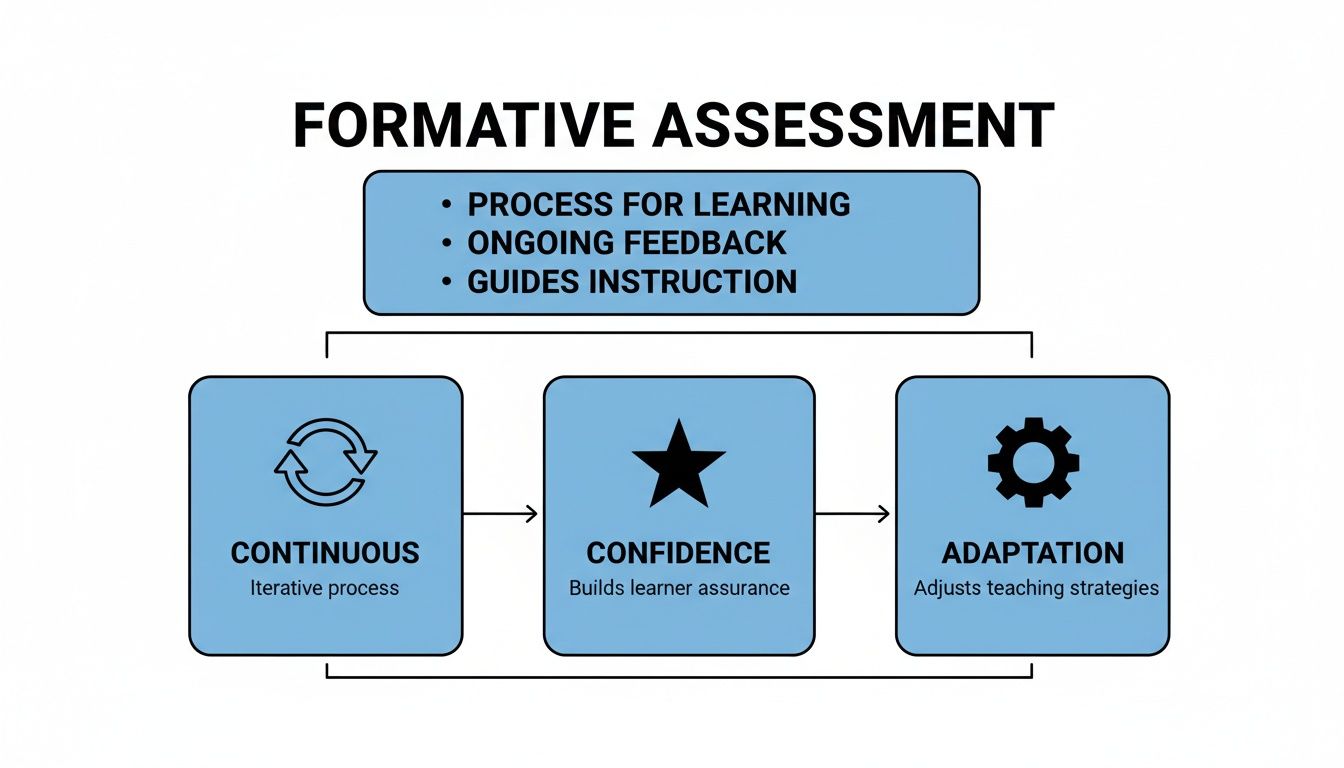
As you can see, the goal isn’t a single point of judgement but an ongoing conversation that empowers both the teacher and the child.
To make this even clearer, let's break down the key differences.
Formative vs Summative Assessment at a Glance
| Aspect | Formative Assessment (Assessment for Learning) | Summative Assessment (Assessment of Learning) |
|---|---|---|
| Purpose | To monitor and improve learning during the process. | To evaluate learning at the end of a unit or course. |
| When It Happens | Ongoing, frequent, throughout the lesson. | At the end of a topic, term, or year. |
| Stakes | Low-stakes, often informal and not graded. | High-stakes, formal, and usually graded. |
| Feedback | Immediate, specific, and focused on improvement. | Delayed, often just a score or grade. |
| Impact on Child | Builds confidence, reduces anxiety, encourages a growth mindset. | Can cause stress, focuses on performance. |
| Analogy | A chef tasting the soup while cooking to adjust the seasoning. | A customer tasting the finished soup to judge it. |
This table shows that both types of assessment have a role, but they serve very different purposes in your child’s education.
Why This Difference Matters for Your Child
The emotional impact is perhaps the most critical difference. Formative checks are low-stakes and collaborative. They whisper to your child, "It's okay not to know yet. Let's figure this out together." This approach builds resilience and a growth mindset, where challenges are seen as normal parts of learning, not as failures.
Summative assessments, while necessary to measure overall progress, can feel final. A single mark can feel like a label, which is why a healthy balance is crucial. When a school prioritises formative practices, it ensures children feel prepared and confident when it's time for those bigger evaluations.
This isn’t just a new trend; it’s a foundational part of modern teaching. A key Department for Education review confirmed that formative assessment’s main purpose is to inform teaching and pinpoint where to improve. Although early trials had their issues, schools that successfully embedded these practices saw their students' scores significantly surpass initial baselines. You can read more about these findings on classroom assessment directly from the source.
Formative assessment is the coach’s feedback during training; summative assessment is the final score of the championship game. Both are important, but only one builds the skills needed to win.
By understanding this distinction, you can better support your child. You can celebrate the small steps, praise their effort during the 'practice sessions,' and help them see that learning is a journey—not just a destination marked by a final grade.
Formative Assessment Strategies in the Classroom
So, what does this supportive approach actually look and feel like for your child during their school day? Far from being a complex theory, formative assessment comes to life through simple, powerful strategies that teachers use every day. These are the small moments of connection and insight that build a powerful feedback loop, improving both skills and confidence.
These strategies turn the classroom into a dynamic space where learning is a conversation. They give every child a voice and assure them that their understanding matters, moment by moment. It’s all about creating a sense of safety, where asking a question is a sign of curiosity, not a sign of failure.
Low-Pressure Checks for Understanding
Imagine the relief a child feels when they can share an idea without the fear of getting it wrong. Many formative assessment strategies are deliberately low-stakes, designed to encourage participation from even the most hesitant learners. They are quick, often ungraded, and focused entirely on feedback.
Here are a few common examples your child might experience:
- Mini-Whiteboards: The teacher poses a question—perhaps a maths problem or a spelling word. Every child writes their answer on a small whiteboard and holds it up. In a single glance, the teacher can see who’s on track and who needs a bit more support, allowing for immediate help without singling anyone out. Your child feels part of a team, not under a spotlight.
- Fist to Five: This is a simple hand signal check. The teacher might say, "Show me with your fingers how well you understand this topic." A fist means "I'm lost," while five fingers means "I could teach this to a friend!" This gives your child a silent, safe way to communicate their feelings of confusion or confidence.
These methods are brilliant because they make thinking visible. They give instant data to the teacher and a pressure-free way for your child to communicate their needs.
Collaborative Learning Strategies
Formative assessment isn’t just about a teacher checking in with a student; it also empowers students to learn from each other. Collaborative strategies create a safe space for children to test out their ideas and build understanding together. They learn that talking through a problem is often the best way to solve it.
One of the most rewarding moments in teaching is hearing a child say, 'Oh, I get it now!' after a classmate explains it in a slightly different way. Peer learning validates their understanding and builds a truly supportive classroom community.
A fantastic example of this in action is the Think-Pair-Share method.
- Think: The teacher asks a thought-provoking question, and each child takes a quiet moment to think about their own answer.
- Pair: Students turn to a partner and discuss their thoughts. This is a crucial step—a low-risk opportunity for your child to voice an idea, hear another perspective, and refine their thinking.
- Share: Finally, pairs share their combined ideas with the rest of the class. By this point, your child feels more confident in their response because it has already been tested and discussed with a peer.
This process helps children articulate their thoughts and learn from one another, all while the teacher listens in to gauge the overall level of comprehension in the room.
Capturing Learning at the End of a Lesson
How does a teacher know what really stuck with your child after a lesson ends? Formative assessment provides the perfect tools for this, too. These strategies help consolidate learning and give the teacher invaluable information for planning what comes next.
An incredibly effective tool for this is the Exit Ticket. Just before the lesson finishes, students are given a small piece of paper or a sticky note and asked to respond to a simple prompt, such as:
- "Write down one thing you learned today."
- "What is one question you still have?"
- "Solve this one problem to show what you know."
This isn't a test. It's a quick snapshot that helps the teacher understand the key takeaways and any lingering confusion from the lesson. It’s the feeling of relief your child gets when their teacher starts the next day by saying, “Some of you had a great question yesterday, so let’s start there.” It shows your child they were heard.
These methods are closely related to the educational concept of instructional scaffolding, which you can learn more about in our guide on what is scaffolding in education. To implement effective formative assessment, educators and parents can utilise strategies like understanding scaffolding in child development, which provides tailored support as a child learns.
How Formative Assessment Builds Confidence and Academic Success
So, why is this approach to teaching so effective? The answer isn't just about grades; it’s about the profound shift it creates in a child's heart and mind. Formative assessment is far more than a classroom technique—it’s a way of showing every child that their learning journey is seen, their effort matters, and their potential has no ceiling. It nurtures not only academic skills but the emotional resilience needed to thrive.
The real magic happens when consistent, positive feedback helps a child move from an "I can't do it" mindset to an empowered "I can't do it yet" attitude. This small change in language represents a monumental shift in self-belief, turning moments of struggle into powerful opportunities for growth.
A Safe Harbour for All Kinds of Learners
For many children, the classroom can feel like a place of constant judgement, where the fear of getting an answer wrong is paralysing. This is especially true for learners with Special Educational Needs (SEN), who may already be carrying the weight of past difficulties. Formative assessment dismantles this fear by creating a genuinely safe, low-stakes environment.
When a teacher uses a quick check-in or a fun collaborative task, the pressure just melts away. Suddenly, it’s not about a final mark; it's about the process of discovery. For a child who has always felt 'behind', this can be life-changing.
- It reduces anxiety: Frequent, informal checks feel more like conversations, not tests. This lowers the stakes and helps a child who feels anxious feel more comfortable taking part.
- It provides tailored support: Teachers can spot a misunderstanding instantly and offer immediate, personalised help without drawing unwanted attention to a child.
- It builds self-esteem: Every small step forward gets noticed and acknowledged. This consistent encouragement helps a child see themselves as a capable learner, sometimes for the very first time.
This approach makes learning feel accessible and achievable for everyone. It replaces the dread of the red pen with the comfort of a guiding hand, allowing every child to make mistakes, ask questions, and grow without fear.
Formative assessment tells a child, "Your progress matters more than perfection." It creates a space where vulnerability is met with support, building a foundation of trust that empowers students to take academic risks.
Turning Small Steps into Big Achievements
This supportive environment isn't just about making children feel good—it directly translates into better academic outcomes. When students feel safe and confident, they are more engaged, more willing to persevere through challenges, and far better able to retain information. The focus on process over performance cultivates a deep, genuine understanding of subjects rather than just memorising facts for a test.
This impact isn't just anecdotal; it’s backed by solid research in UK schools. A landmark large-scale randomised controlled trial across 140 secondary schools in England quantified the effect of formative assessment on student results. The analysis found a significant positive impact on general academic attainment in national GCSE examinations at age 16. This evidence confirms that this low-cost, supportive approach plays a measurable role in boosting overall GCSE performance. You can discover more insights from this UCL study on how these practices lead to success.
Ultimately, the power of what is formative assessment lies in its humanity. It honours the individual journey of each child, recognising that learning isn’t a linear race but a winding path filled with progress and setbacks. By boosting both confidence and competence, it equips children with the self-belief and academic skills they need to succeed not just in exams, but in life.
Embedding Formative Assessment in an Online School
The theory behind formative assessment is powerful, but its real magic happens when it’s woven into the very fabric of a school’s culture. At Queens Online School, this supportive, child-centric approach isn’t just an add-on; it’s our foundation. Our entire philosophy is built on the belief that learning thrives in an environment of real-time connection, immediate feedback, and genuine support.

The online classroom, especially with our small, live, and interactive classes, becomes the perfect setting for this. Here, digital tools aren't gimmicks; they are powerful instruments for understanding and connection. They allow our teachers to see and respond to each child’s needs in ways that are often more immediate than in a traditional, crowded classroom.
Bringing Formative Assessment to Life Online
Imagine your child is in a Year 7 science lesson on ecosystems. The teacher doesn't just deliver a lecture; they use a real-time poll to ask, "Which of these is a producer?" In seconds, they can see exactly who understands and who is hesitating. If a few students choose the wrong answer, there's no need to wait for a test weeks later to correct the misunderstanding.
Instead, the teacher can instantly adapt. This is the heart of what is formative assessment in our virtual setting.
Our teachers use a variety of tools to create this constant feedback loop:
- Interactive Whiteboards: Your child can collaborate on solving a problem with a classmate, allowing the teacher to see their thought processes unfold in real time and offer gentle guidance.
- Real-Time Polls and Quizzes: These give a quick, pressure-free snapshot of comprehension across the entire class, helping teachers adjust the lesson's pace or focus on the spot.
- Private Chat Functions: If your child feels too shy to ask a question in front of their peers, they can send a private message directly to the teacher. This opens a direct line for personalised support, ensuring no question goes unasked.
This instant connection is where true personalisation happens. It's the moment a teacher notices a student’s hesitation through a poll response and immediately sends a supportive private message saying, "Great try! Let's look at this part again together."
This proactive approach stops small points of confusion from snowballing into significant learning gaps. It’s a nurturing method that shows each child they are seen and that their understanding truly matters.
Building Confidence Through Guided Support
The structure of online learning also allows for more targeted support, mirroring proven educational strategies. Research has shown that providing structured, guided tasks before a bigger assignment can make a huge difference to a child's success.
For example, a study from the University of Birmingham revealed that when students in difficult quantitative subjects were given scaffolded formative tasks before coursework, failure rates were dramatically reduced. Even more telling, the students' own belief in their understanding of the material jumped from 57% to 100%. This shows how explicit guidance not only improves outcomes but also builds immense confidence and engagement. You can read the full research on scaffolded formative assessment to see the data for yourself.
At Queens Online School, this is our daily practice. We use formative tasks to build skills step-by-step, ensuring every child feels prepared and capable before they face a more formal assessment. This model provides tangible proof that our school is designed for deep, supportive, and truly personalised learning, where every child has the space and support they need to succeed.
How Parents Can Support Formative Learning at Home
As a parent, your role in your child's learning journey is invaluable. The supportive spirit of formative assessment doesn't have to stop when the school day ends. By bringing its principles into your home, you can build a powerful bridge between school and family, helping to nurture a resilient, curious, and confident learner.
This isn’t about becoming another teacher or grading homework. It's about shifting the focus from performance to progress, and from simply getting the right answers to truly understanding the 'why' behind them. It’s about creating a safe space where your child feels comfortable enough to wonder, to struggle, and to grow without the fear of judgement.
Shifting the Conversation
One of the simplest yet most powerful changes you can make is in the questions you ask after school. It's completely natural to ask, "What grade did you get?" But this question immediately centres the conversation on a final score, often overlooking the rich learning process that happened along the way.
Instead, try opening up a dialogue with questions that focus on the experience of learning itself.
- "What was the most interesting thing you discovered in your history topic today?"
- "Tell me about something that felt a bit tricky in maths. What did you try?"
- "What's one question you still have after your science lesson?"
These kinds of conversation starters show your child that you value their effort, their curiosity, and even their moments of confusion. They signal that learning is a journey, not just a destination marked by a test score. This approach helps them develop into more independent thinkers, a key aspect of building skills for self-directed learning.
By framing mistakes as powerful learning opportunities, you teach your child that a stumble is not a failure—it's simply a sign that they are trying something challenging and new.
Praising Effort Over Perfection
Another key strategy is to celebrate the process, not just the final result. When your child brings home a piece of work, resist the initial urge to focus only on the mark at the top of the page. Instead, praise the effort you saw them put in, the strategy they used, and the progress you can see.
You could try saying things like:
- "I can see you worked really hard on this; you didn't give up even when it got tough."
- "I love how you thought about this problem from a completely different angle."
- "Look how much your handwriting has improved since the start of term!"
This type of language fosters a growth mindset—the belief that our abilities can be developed through dedication and hard work. When children believe their effort matters more than innate talent, they become far more willing to take on challenges and persevere through setbacks.
By becoming a partner in the feedback process, you reinforce the core message of what is formative assessment: that learning is a continuous, supportive journey. You help nurture a child who isn't afraid of a challenge because they know they are supported every single step of the way.
Got Questions About Formative Assessment? You're Not Alone.
Navigating the world of education can feel like learning a new language, especially with terms like 'formative assessment' becoming more common. Many parents share the same questions and concerns, so let's clear things up, always putting your child's well-being and confidence first.
Does Formative Assessment Mean My Child Won't Get Grades Anymore?
Not at all. Think of formative assessment as the coaching and practice sessions that happen during the learning process, not the final match. Your child will still have summative assessments—like end-of-unit tests or final exams—which give a clear grade on their overall understanding.
The beauty of the formative approach is how it prepares them for those bigger moments. By receiving constant, gentle feedback along the way, they walk into graded assignments feeling more confident and capable. It helps turn potential anxiety into a feeling of genuine readiness.
How Can This Actually Work in an Online School?
This is an area where online schools can really shine. In small, live classes like ours at Queens Online School, teachers use digital tools like instant polls, private chat, and interactive whiteboards to get real-time feedback from every single student. Honestly, this is often faster and more direct than in a large, busy physical classroom.
A teacher can spot a misunderstanding the moment it pops up and offer personalised support right away, either through a private message or in a breakout room. It ensures no child's quiet confusion goes unnoticed, making the online space a truly supportive and attentive learning environment.
My Child Really Struggles With Test Anxiety. How Does This Help?
Formative assessment is a game-changer for children who get anxious about tests. Because these checks are frequent, low-stakes, and often ungraded, they completely normalise the act of showing what you know. The emotional weight shifts from a high-pressure performance to a collaborative process of simply learning and improving together.
This creates a safe space where your child can make mistakes, ask questions, and ask for help without any fear of failure. Over time, this builds their academic confidence and steadily chips away at the anxiety they feel about more formal tests.
It's a kinder, more effective way to learn. It reassures them that their worth isn’t tied to a single score, but to their journey of growth, helping to build resilient, happy learners.
At Queens Online School, we believe that understanding and supporting each child's individual learning journey is the key to their success. Our use of formative assessment is central to creating a nurturing environment where students feel seen, heard, and empowered. Explore our personalised online learning programmes and discover how we can help your child thrive.