

Navigating the world of UK university entry requirements can feel overwhelming, like learning a new language just when your child is facing one of the biggest moments of their life. At its heart, though, it’s all about helping your child show universities they have the academic ability for degree-level study and, more importantly, a genuine spark for the subject they want to build their future on. This usually means achieving certain grades in qualifications like A-levels or the International Baccalaureate, picking subjects that fuel their passion, and telling their unique story through a compelling UCAS application.
Starting Your UK University Application Journey

The journey to university is a massive milestone, and it’s natural for it to be filled with a mix of excitement and nerves—for your child, and for you too. It’s all too easy to feel like you’re drowning in a sea of acronyms, deadlines, and grade boundaries. Our job is to be your family’s compass, turning that confusion into the quiet confidence your child needs to shine.
Think of this process less as a series of daunting hurdles and more as your child’s first real opportunity to tell their own story. It's a chance for them to showcase not just what they've learned, but who they are, what they’ve worked so hard for, and what truly makes them tick.
Building Blocks for the Future
Each part of the application is a building block, creating a complete picture of your child’s potential. Universities don’t just zoom in on one thing; they look at how all the different pieces fit together to show that a student is ready, willing, and eager to thrive in higher education.
Here are the key components we'll walk through together:
- Academic Foundations: This is all about GCSEs and A-levels (or their equivalents). These qualifications are the bedrock, proving your child has the core knowledge to handle degree-level work.
- The UCAS Application: This is the central hub where almost all UK university applications are managed. Getting to grips with how it works is a crucial first step.
- The Personal Statement: This is where your child’s personality leaps off the page. It’s their chance to speak directly to admissions tutors and let their passion shine through.
- Specific Course Needs: Some degrees, like medicine or engineering, have extra hoops to jump through, such as admissions tests or relevant work experience.
This journey is fundamentally about empowerment. It’s about giving your child the tools and understanding to present their unique strengths, ambitions, and character in the most authentic way possible.
Making this whole process feel manageable is the key. By breaking it down into smaller, clearer steps, we can help your child feel prepared and supported, ready to tackle this exciting new chapter with confidence. For a detailed guide on the practical steps, you can learn more about how to apply to UK universities. This is the start of a wonderful adventure, and with the right preparation, it can be a positive and rewarding experience for the whole family.
Understanding the Academic Building Blocks

When universities assess your child's application, they’re not just looking at a list of grades. They’re piecing together an academic story, looking for proof that a student is genuinely ready for the rigours and rewards of higher education. This isn't just a box-ticking exercise; it's about showing knowledge, skill, and a real passion for learning that will see them through late-night study sessions and challenging coursework.
The two main pillars supporting almost every UK university application are GCSEs and A-levels. Each tells a different, but equally important, part of your child's story.
The GCSE Foundation
Think of GCSEs as the foundations of a house. Without a solid base, the whole structure becomes wobbly. These qualifications, especially in English Language and Maths, are the first thing admissions tutors look for to see if a student has the core literacy and numeracy skills to cope with degree-level work.
A strong pass—usually a grade 4 or 5, though top courses often ask for more—is frequently non-negotiable. It proves your child can write a coherent essay, analyse complex texts, and work with data. For example, even an aspiring artist needs to write critical essays about their work, and a future historian needs to be comfortable with statistical data. These are the absolute essentials that give your child the tools to succeed, no matter what they plan to study.
A-Levels: The Specialist Structure
If GCSEs are the foundation, then A-levels are the walls and rooms built on top. This is where your child demonstrates specialist knowledge and intellectual curiosity, moving beyond general learning to dive deep into subjects that fascinate them. It’s their chance to prove they can handle the demanding academic workload of a degree.
Universities scrutinise not just the grades but also the choice of subjects. For a child dreaming of becoming an engineer, taking A-levels in Maths and Physics isn't just a requirement—it's a sign of their genuine commitment and aptitude. It shows they're already on the right path. To get a better handle on this crucial stage, you can explore our detailed guide on how do A levels work.
The combination of broad foundational skills from GCSEs and specialised knowledge from A-levels gives universities a powerful insight. It shows them a student who is not only capable but also genuinely engaged with their chosen field of study.
As you get to grips with the academic world, it's also worth understanding core principles like what is academic integrity in the Age of AI, a concept that underpins all university-level work and is more important than ever.
Decoding the UCAS Tariff System
The UCAS Tariff system can look a bit daunting at first, but it’s actually quite simple. Think of it like a currency exchange that converts different qualifications—A-levels, BTECs, the International Baccalaureate—into a single points value. This allows universities to compare applicants from different educational backgrounds on a more level playing field.
For A-levels, each grade has a specific points value:
- A* = 56 points
- A = 48 points
- B = 40 points
- C = 32 points
- D = 24 points
So, if a university offers 136 points, your child could achieve this with grades of AAB (48 + 48 + 40) or A*AC (56 + 48 + 32). This flexibility can sometimes reduce the pressure on a single subject, which can be a huge relief for a student feeling the weight of expectation.
It’s worth noting that many of the most competitive universities (like those in the Russell Group) tend to make offers based on specific A-level grades rather than Tariff points. They're more interested in high achievement in relevant subjects than a points total gathered from a mix of qualifications. The Tariff is more commonly used by universities that have a wider range of entry requirements.
The table below gives a rough idea of what to expect for different types of courses and universities.
Typical A-Level Grade Offers for Different University Courses
| Degree Subject Area | Highly Selective University (e.g., Russell Group) | Competitive University | Accessible University |
|---|---|---|---|
| Medicine/Dentistry | A*AA – AAA (with specific sciences) | N/A | N/A |
| Engineering | A*AA – AAB (Maths and Physics required) | ABB | BCC |
| Law | A*AA – AAB (essay subjects preferred) | AAB – ABB | BBB – BBC |
| Psychology | AAB | ABB – BBB | BBC – CCC |
| Business Studies | AAB | ABB – BBB | BCC – CCC |
| History | AAA (History required) | AAB – ABB | BBB – BCC |
| Creative Arts/Design | AAB (Portfolio required) | ABB – BBB | CCC (Portfolio is key) |
This is just a general guide, of course. Always check the specific requirements for the course and university your child is interested in. It's so important for your child to feel their goals are realistic and achievable, which is why matching their aspirations with the right university is a key part of this journey.
Navigating High-Demand Course Requirements
When your child sets their sights on a career as a doctor, veterinarian, lawyer, or engineer, the university application journey has a few extra, crucial milestones. These fields aren’t just academically tough; they’re vocational. Universities are looking for more than just top grades—they need to see real commitment, resilience, and a genuine understanding of what the profession actually involves.
This isn't about piling on pressure. It’s about helping your child build a story that shows who they are and why they’re a perfect fit for these incredibly rewarding careers. The extra hoops they have to jump through are there for a reason: to find the candidates with the right blend of intellect, empathy, and practical insight.
Non-Negotiable Subject Combinations
For many of these top-tier courses, A-level subject choices aren't just a preference—they're a prerequisite. Think of them as the specific keys needed to unlock a particular door. Without them, even the best grades in other subjects just won’t fit the lock.
It’s all about having the right foundational knowledge to cope from day one. For instance, a student hoping to study medicine without A-level Chemistry and Biology would feel completely overwhelmed from the start, as these subjects form the bedrock of the entire degree.
Here are some practical examples:
- Medicine & Dentistry: Chemistry is almost always essential, usually with Biology right alongside it. A third science or Maths is often the preferred choice to round out the application.
- Engineering: Maths and Physics are the non-negotiables here. For top universities like Cambridge or Imperial, Further Maths can give a serious competitive edge.
- Veterinary Science: Biology and Chemistry are vital. Just as important, though, is hands-on experience with animals.
- Law: While no subjects are strictly required, A-levels like History, English Literature, or Politics are highly respected. They show admissions tutors that your child can build an argument, think critically, and write well—all essential skills for a lawyer.
Tackling Admissions Tests with Confidence
On top of A-levels, many of these courses require an admissions test. This can feel like a huge source of anxiety for your child, but it’s helpful to reframe it. These tests aren't just about what your child knows; they're about how they think.
They’re designed to assess skills like critical analysis, problem-solving under pressure, and ethical judgement—qualities that a standard exam can’t really measure. The focus shouldn't be on rote learning, but on building these underlying thinking skills.
These tests are a chance for your child to show their aptitude in a way that goes beyond the curriculum. They give universities a glimpse into how they approach new challenges, a key indicator of their potential to succeed.
Some key tests to be aware of include:
- UCAT (University Clinical Aptitude Test): Used by most medical and dental schools to assess cognitive abilities and situational judgement.
- LNAT (National Admissions Test for Law): Measures verbal reasoning and the ability to dissect arguments, crucial for a future in law.
- BMAT (BioMedical Admissions Test): A subject-specific test used by a smaller group of medical, veterinary, and biomedical science courses.
The Power of Meaningful Experience
For vocational degrees, what your child does outside the classroom is just as important as their academic work. Universities want to see that their passion is rooted in the real world. This doesn’t mean they need to shadow a top surgeon for a week; it’s about showing genuine interest and empathy.
For an aspiring vet, for example, consistently volunteering at a local animal rescue centre shows far more dedication and compassion than a one-off visit to a clinic. It demonstrates they understand the less glamorous side of animal care—cleaning out cages, walking dogs in the rain—and are still committed. This kind of experience tells a powerful story about your child's character.
The personal statement is where this all comes together. It’s the space for your child to connect the dots between their grades, their real-world experience, and what drives them. It’s their opportunity to explain the why behind their ambition, showing the empathy and resilience that grades alone can’t.
For those aiming for the most competitive courses, specialised guidance can be invaluable. For example, you can find specific advice on preparing for the Oxford University Medical Sciences interview, which gives a real sense of the depth required.
A Guide for International Students
The thought of your child studying in the UK is thrilling, isn't it? It conjures up images of world-class teaching, new friendships, and a cultural experience that will shape their future. But it can also feel like staring at a complex puzzle, especially when you’re trying to figure out how qualifications from your home country translate into the UK system.
Let’s clear away some of that fog. This section is here to act as a friendly guide, making the journey feel less like a bureaucratic maze and more like the exciting adventure it should be. UK universities are genuinely global communities, enriched by students from every corner of the world. They are experts at assessing a huge range of international qualifications, seeing them not as hurdles, but as proof of your child’s unique academic journey and potential.
How International Qualifications Are Valued
First things first: universities don’t expect every applicant to have A-levels. They have well-established ways of evaluating qualifications from across the globe, ensuring your child's hard work gets the recognition it deserves. Think of it as a translation service, where different academic achievements are converted into a language that UK admissions tutors instantly understand.
This welcoming approach is why the UK remains a top destination for students worldwide. In fact, recent UCAS figures show that international undergraduate applications have grown by 2.2%. We’ve seen a record 33,870 applicants from China, a 23% increase from Nigeria, and a 14% rise from the USA. You can read more about these trends on the UCAS website, which really highlights just how global UK higher education has become.
Some practical examples of accepted qualifications include:
- International Baccalaureate (IB) Diploma: The IB is known for its academic rigour and is highly respected. A child aiming for a competitive course might be asked for 38 points, with a 7, 6, 6 in their Higher Level subjects.
- US Qualifications (APs and SATs): A combination of Advanced Placement (AP) tests and SAT or ACT scores is the standard path. For example, a university might ask for an SAT score of 1400 alongside scores of 5 in three relevant AP tests.
- National School-Leaving Certificates: Qualifications like the French Baccalauréat, German Abitur, or the Indian Standard XII are all routinely assessed. A top UK university might ask for an overall score of 16/20 in the Baccalauréat, for instance.
Proving English Language Proficiency
For students whose first language isn’t English, demonstrating their language skills is a crucial step. This isn't about testing their intelligence; it’s about making sure they have the tools to get the most out of their studies—to follow lectures, write essays with confidence, and thrive socially. It sets them up for success, not stress.
The two most common tests are:
- IELTS (International English Language Testing System): This is the most widely recognised test in the UK. Most universities look for an overall score of 6.0-7.0, often with minimum scores required in each of the four components (reading, writing, listening, and speaking).
- TOEFL (Test of English as a Foreign Language): Another popular option, particularly for students applying from North America.
“Seeing my daughter’s confidence grow as she prepared for her IELTS test was amazing. It wasn’t just an exam; it was the moment she started to truly believe she could succeed in a new country. The university’s international office was so helpful, guiding us through every step.”
A Home Away From Home
Beyond the paperwork and qualifications, the emotional journey is just as important. The thought of your child being so far from home can be daunting, for them and for you. But UK universities are brilliant at creating supportive, welcoming environments.
They have dedicated international student support teams, welcome weeks packed with events, and countless cultural societies designed to help students build friendships and feel a sense of belonging from day one. This is all about ensuring your child doesn't just study in the UK—they flourish there.
What if the Straight Path to Uni Isn't for My Child?
It’s a belief many of us grew up with: the only way to get a degree is a straight line from GCSEs to A-levels. So when your child’s journey takes a different turn, it can be a huge source of anxiety for the whole family. But here’s the wonderful truth: UK universities are full of students from all sorts of backgrounds, and there is more than one road to a degree.
This isn’t about settling for second-best. It's about finding the right path for your child. These alternative routes are specifically designed to build confidence, fill knowledge gaps, and open doors that might have seemed firmly shut. They’re a powerful reminder that potential isn’t just measured by A-level results.
Foundation Years: The Perfect Bridge to a Degree
Imagine a bridge that connects where your child is now to the degree course they’re dreaming of. That’s exactly what a Foundation Year is. It’s a one-year preparatory course, often taught right on the university campus, for students who have the passion and drive but don't quite meet the direct entry requirements for a full degree.
There are a few reasons this might be the perfect fit for your child. Perhaps their A-level subjects don’t quite line up with their chosen degree, or maybe their final grades were just a fraction shy of the offer. A foundation year gives them the specific subject knowledge and academic skills they need to step confidently into the first year of their chosen honours degree.
Here’s a practical example:
A student has their heart set on Computer Science but took A-levels in History, English, and Art. A university might offer them a place on a 'Computer Science with a Foundation Year' course. During that initial year, they’d get stuck into essential maths and programming, building the confidence and know-how to join the main degree course the following year, ready to fly. This isn't a setback; it's a smart stepping stone.
Access to HE Diplomas: A Respected Route for Mature Students
For adults thinking about returning to education, the idea of sitting A-levels can feel incredibly daunting. This is where the Access to Higher Education (HE) Diploma comes in. It’s a powerful and highly respected qualification created specifically for this purpose, offering a focused, one-year route back into learning and preparing students for the rigours of university study.
These diplomas are available in a massive range of subjects, from Nursing and Social Work to Law and Business. Universities across the country recognise them as a valid alternative to A-levels, valuing the life experience and sheer determination that mature students bring to the table. It’s a pathway that truly celebrates a fresh start.
Real Support for Students with Additional Learning Needs
Navigating the university application process can feel especially tough when your child has additional learning needs. The most important thing to know is that you are not on your own. Universities are committed to providing the right support to help every single student thrive.
The whole approach is about empowerment and creating an inclusive environment where your child has the tools they need to shine and succeed on their own terms.
Universities have both a legal and a moral duty to support students with disabilities. This includes those with specific learning differences like dyslexia or dyspraxia, as well as mental health conditions. Disclosing a need is never a disadvantage—it’s the first step to getting the right support in place from day one.
Here’s how you can make sure your child gets the help they’re entitled to:
- Disclosing through UCAS: The UCAS form has a dedicated section where your child can share information about a disability or learning difference. It’s completely confidential and allows the university's support team to get in touch proactively with help.
- Disabled Students' Allowance (DSA): This is a grant, not a loan, designed to cover any extra study-related costs your child might have. For example, it could fund a laptop with text-to-speech software for a dyslexic student or a specialist mentor to help a student with anxiety manage their workload.
- University Disability Services: Every university has a dedicated team ready to help. They are the experts in arranging adjustments like extra time in exams, providing assistive technology, and offering specialist mentoring.
Reassuring your child that asking for help is a sign of strength is one of the most powerful things you can do. It helps ensure they begin their university journey feeling supported, understood, and ready to show the world what they can do.
Your University Application Timeline and Checklist
The whole university application process can feel like a huge, overwhelming mountain to climb. But what if you had a map? Breaking it down into a simple, step-by-step timeline transforms that mountain into a series of manageable hills, making the entire journey feel much calmer and more achievable for your child.
Think of this as your family’s practical action plan. It’s a roadmap you can return to again and again, ensuring your child feels organised and in control, not rushed or pressured. As a parent, your role is to be a supportive guide, and this timeline will help you do that with confidence.
Kicking Off in Year 12
The journey really begins long before that final UCAS deadline. Year 12 is all about exploration and preparation, giving your child the chance to lay a strong foundation without the last-minute stress.
- September – December: The adventure starts with research. This is the perfect time for your child to explore different universities and courses, thinking about what truly excites them. Encourage them to look at prospectuses and dig into the course modules.
- January – April: Now it's time to start attending university open days, whether they're virtual or in person. This is where a course comes to life, moving from a page on a website to a real, tangible possibility.
- May – July: This is the ideal moment to start drafting the personal statement. It won't be perfect at first, and that’s completely okay. Our guide on how to write a UCAS personal statement can offer some invaluable support here.
The diagram below shows just how varied the routes into university can be.
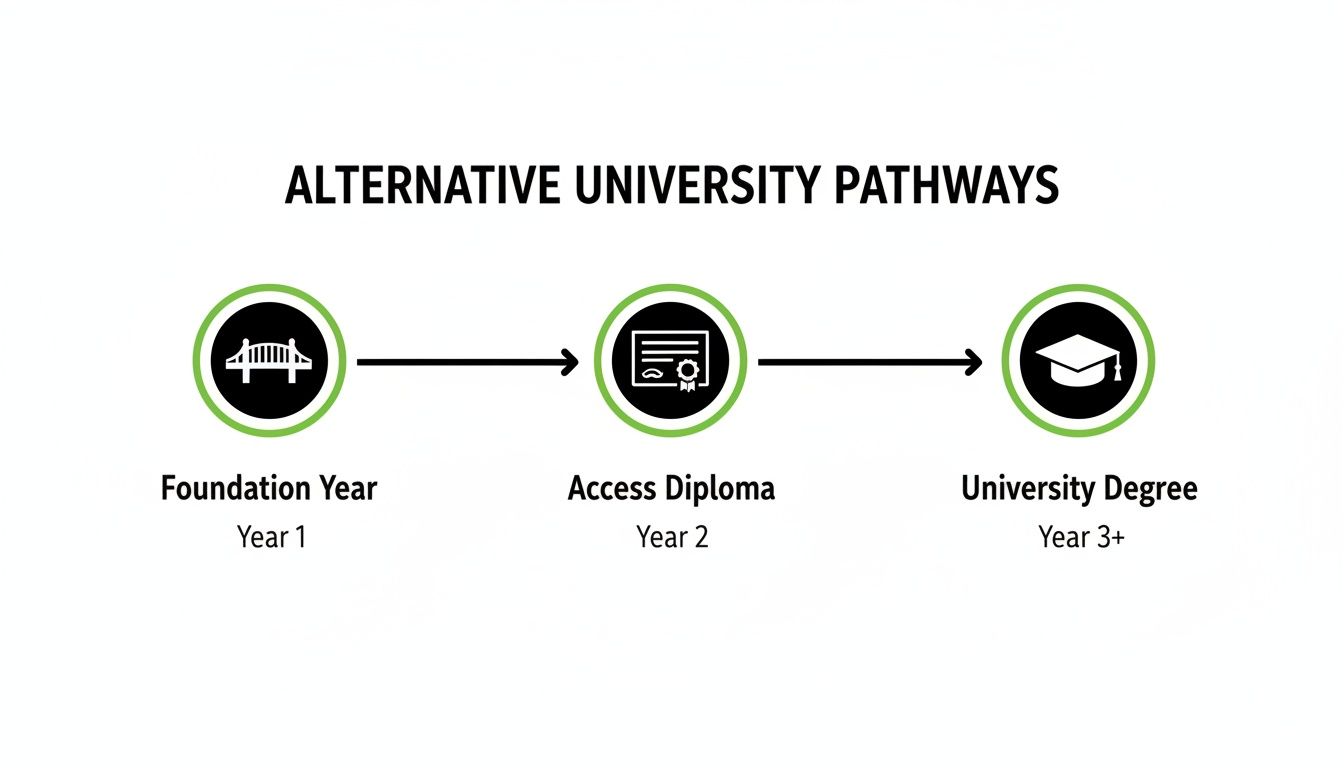
As you can see, paths like Foundation Years and Access Diplomas are valid and respected bridges to higher education—not second-best options.
Navigating the Final Year 13 Push
Year 13 is when everything comes together. With competition for places growing every year, being organised is more important than ever. The UK higher education sector recently saw a record 323,360 UK 18-year-olds applying by the January deadline, a 2.1% increase on the previous year.
Your child's final year should be about showcasing their potential, not about last-minute panic. A clear timeline ensures they have the space to do their best work on their application while still focusing on their A-level studies.
Here are the key deadlines to get marked on your calendar:
- September: The UCAS application portal opens. Your child can now officially start filling in all their details.
- Mid-October: The early application deadline hits for Oxford, Cambridge, and most Medicine, Dentistry, and Veterinary Science courses.
- Late January: This is the main 'equal consideration' deadline for the majority of undergraduate courses. Submitting by this date guarantees the application will be looked at.
- May – June: It's A-level exam season. Time for focused revision.
- August: A-level results day arrives, and the UCAS Clearing process opens for those who need it.
Your Essential Document Checklist
To avoid any last-minute scrambling, it’s a great idea to help your child gather these key documents and bits of information well in advance:
- Academic Transcripts: A full record of their GCSE results.
- Predicted Grades: These will be provided by their school or college for their A-levels or equivalent qualifications.
- Personal Statement: The final, polished version of their essay.
- Reference: A supportive academic reference, usually written by a teacher who knows them well and can speak to their strengths.
- Course Choices: The final five university courses they have decided to apply for.
Frequently Asked Questions
Navigating the world of university applications can bring up a lot of questions, often at 3 a.m. Here are some clear, direct answers to the most common queries we hear from parents, putting your child’s wellbeing at the heart of every response.
What Happens If My Child Does Not Get Their Predicted Grades?
The moment results come in can feel incredibly intense. If the grades aren't what you hoped for, the first step is simple: stay calm and reassure your child. This is far from the end of the road; their future is just as bright as it was yesterday.
The main option is UCAS Clearing, a fantastic system where universities advertise courses that still have places. A great practical step is to have a list of alternative universities and their phone numbers ready before results day. It transforms Clearing from a panic into a proactive plan. Many students find a course they love even more this way.
There are other brilliant options too:
- Resitting A-levels to improve their grades for the next application cycle.
- Exploring a foundation year, which acts as a bridge to get them onto their desired degree.
- Considering a different but related course that might have lower entry requirements.
The key is to have an open, loving conversation about what feels right for them. This can turn a moment of panic into a positive new plan.
How Important Is the Personal Statement Compared to Grades?
This is a question that causes a lot of worry, but it’s best to see grades and the personal statement as a powerful partnership. Think of it like this: good grades get your child’s application through the first door, but it’s their personal statement that makes the admissions tutor want to invite them in.
For the most competitive courses, grades are the initial filter. There's no getting around that. However, when admissions tutors are faced with a pile of applications from students with identical top grades, the personal statement often becomes the deciding factor.
It is your child’s only chance to speak directly to the university, to let their passion for the subject leap off the page, and to show the resilience and curiosity that grades alone can never capture. For example, writing about a science project that failed but taught them perseverance can be more powerful than just listing achievements. It shows their character.
Can My Child Apply to Both Oxford and Cambridge?
This is a common question with a very straightforward answer. For undergraduate degrees, a student cannot apply to both Oxford and Cambridge in the same application year. They have to choose one.
This rule exists because both universities have a very similar, intensive interview process. Rather than seeing it as a restriction, encourage your child to view it as an opportunity. It forces them to really research which university—and, just as importantly, which specific college within that university—is the absolute best fit for their academic interests, learning style, and personality. It’s all about finding that one special place where they will truly belong and thrive.
At Queens Online School, we believe in nurturing every child's unique potential, providing the academic rigour and personalised support they need to confidently pursue their university dreams. Explore our online A-level programmes and see how we can support your family's journey.