

The command to 'just focus' can feel like being asked to catch mist, leaving your child feeling misunderstood and defeated. For a student with ADHD, the world of studying isn't a straight path but a vibrant, chaotic, and often overwhelming maze. It’s filled with distractions that sing siren songs, deadlines that appear out of nowhere, and a relentless feeling of being five steps behind.
This struggle isn't about a lack of effort or willpower; it's about a brain wired for curiosity, creativity, and connection—a brain that thrives when the rules are different. Traditional study methods can feel like a punishment, clashing with this neurotype and leading to frustration and a sense of failure. Recognising that your child's unique wiring requires a different, more compassionate approach is the first step towards building their confidence and helping them achieve their academic goals, from primary school projects to GCSE and A-Level exams.
This guide isn't another list of generic advice. It’s a collection of practical, actionable tips for studying with ADHD, built on the understanding that your child’s needs and feelings are the true north. We will explore strategies that don't just manage symptoms but empower students to harness their unique cognitive style. This transforms frustration into confidence and chaos into a personalised system for success. While many principles overlap, mastering effective time management strategies for adults with ADHD often requires different nuances, making it crucial to focus on techniques tailored for younger learners.
Each tip is designed to be a practical tool, a small adjustment that can make a world of difference. From optimising a study space to integrating movement and gamifying revision, these strategies put your child firmly back in control of their learning journey. They are crafted to be adaptable, ensuring you can find what works best for your child, honouring their strengths and supporting their challenges with empathy.
1. The Pomodoro Technique with ADHD Modifications
The Pomodoro Technique is a powerful time-management method that breaks study sessions into short, focused intervals, separated by brief breaks. For a student with ADHD who feels overwhelmed by a mountain of homework, this structured approach can be a game-changer. Instead of facing a daunting three-hour revision block that feels impossible, the task is broken into manageable sprints. This helps sustain focus, prevents the exhaustion that comes from hyperfocus, and provides much-needed mental resets. It directly addresses the emotional hurdle of getting started (task initiation) by making the first step feel small and achievable.

The standard technique uses 25-minute work intervals, but this is often too long for a brain wired for novelty. The key is to adapt it to your child’s unique rhythm, making them feel successful from the start.
How to Implement an ADHD-Friendly Pomodoro
The goal is to create a rhythm that feels supportive and empowering, not restrictive. Start by helping your child choose one specific task they feel they can manage, like ‘read three pages of the history textbook’. Then, follow these steps together:
- Choose Your Interval: Start with a shorter time that feels doable, such as 15 or 20 minutes. This length is often more aligned with the natural attention span of many ADHD learners and sets them up for a win.
- Set a Visual Timer: Use a tool like the Time Timer app or a physical cube timer. A visual countdown is less jarring than a sudden alarm and helps the brain process the passage of time more concretely, reducing anxiety about how much time is left.
- Work Undistracted: During the interval, agree to focus only on the chosen task. Put their phone away (unless using it for the timer) and close irrelevant tabs. This creates a safe, focused bubble.
- Take a Real Break: When the timer goes off, stop working immediately. The break should be 3-5 minutes and involve movement to release energy. Encourage them to stand up, stretch, get a glass of water, or do a few star jumps. Avoid letting them scroll on their phone, as this can easily derail their focus.
- Repeat and Reward: After completing four ‘pomodoros’, celebrate this achievement with a longer break of 15-30 minutes. This is their time to relax and recharge.
Why It Works for ADHD Learners
This method provides an external structure that helps regulate focus, something that can feel chaotic internally. Seeing a small, achievable goal (just 15 minutes of work) reduces the emotional barrier to starting. For a child preparing for GCSEs or A-Levels, this can be one of the most effective tips for studying with ADHD, as it builds stamina and confidence over time. A student might start with three 15-minute pomodoros for chemistry revision and, feeling successful, gradually increase the duration or number of cycles as their focus improves. To further refine your focus and break down study periods effectively, consider exploring these 10 Actionable Time Management Tips for Students, which elaborates on techniques like Pomodoro and Time Blocking.
2. Environmental Optimization and Distraction Management
For a student with ADHD, their study environment is not just a backdrop; it's an active participant in their ability to focus. Their brain is highly sensitive to external stimuli, meaning a phone notification, a cluttered desk, or a conversation in the next room can feel like a personal interruption, instantly derailing their study session. Environmental optimisation is the practice of intentionally designing a study space to minimise these distractions. This reduces the cognitive load needed to stay on task, freeing up their mental energy for what truly matters: learning.
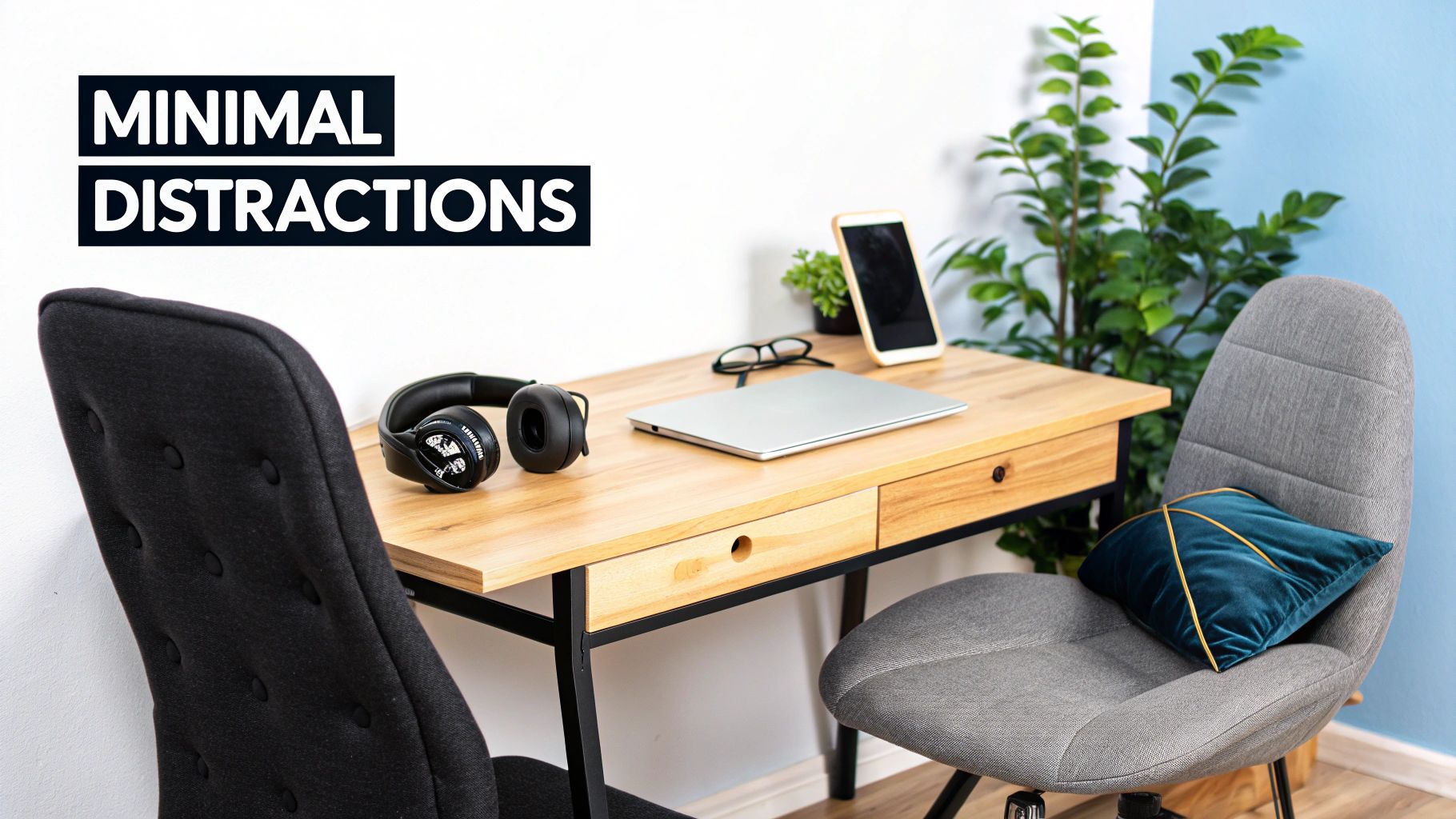
This strategy isn't about creating a sterile, boring space. It's about consciously and lovingly removing the barriers to concentration so that your child’s mental energy is spent on learning, not on fighting a losing battle with distractions.
How to Create a Focus-Friendly Environment
The goal is to build a predictable, low-stimulus "focus zone" that lovingly signals to the brain that it's time to learn. This starts with identifying your child's biggest distractors and systematically removing them.
- Declutter the Workspace: Before starting, gently clear the desk of everything not essential for the immediate task. If your child is revising a maths textbook, they only need that book, a notebook, a pen, and a calculator. Everything else should be put away to create a sense of calm.
- Manage Digital Distractions: Use website and app blockers like Freedom or Cold Turkey to prevent access to social media during study hours. The most effective tactic is often the simplest: place their phone in another room or in a locked box, removing the temptation entirely.
- Control Auditory Input: For some children, silence is golden. For others, it can feel deafening and make their thoughts race. Experiment together with noise-cancelling headphones, white noise apps (like A Soft Murmur), or instrumental study music to find what feels most calming and focusing for them.
- Minimise Visual Noise: Position their desk facing a wall rather than a window or a busy area of the house. A tidy, organised space with minimal visual clutter helps keep their attention directed towards the study materials, reducing that feeling of being pulled in a million directions.
- Set Clear Boundaries: Use a 'do not disturb' sign on the door to signal to family members that it is dedicated focus time. This protects their concentration and shows respect for their efforts.
Why It Works for ADHD Learners
This approach works by externalising executive functions. Instead of relying purely on a child's internal willpower to ignore distractions (which can be exhausting), you are changing the environment to make focus the path of least resistance. Creating this structure provides a powerful sense of control and predictability, which can be incredibly calming for a child who often feels overwhelmed. For a student tackling complex A-Level subjects, knowing their study space is a reliable sanctuary free from temptation can significantly reduce the anxiety associated with starting a difficult task. To go deeper into this, you can explore further strategies on how to focus on your studies and build an even more resilient study routine.
3. Multi-Sensory and Active Learning Methods
Passive learning, like rereading notes or listening to a long lecture, often fails to hold the attention of a student with ADHD, leaving them feeling bored and frustrated. Their brain craves novelty, engagement, and interaction. Multi-sensory and active learning methods meet this need by transforming studying from a passive activity into an engaging, hands-on experience. This approach involves using multiple senses (sight, sound, touch, movement) to process information, which strengthens neural pathways and dramatically improves retention.

Instead of just reading about the Battle of Hastings, a student could draw a comic strip of the events, build a model of the battlefield, or act it out. This active engagement makes learning feel like play, making it more memorable and less of a chore.
How to Implement Active and Multi-Sensory Learning
The key is to turn studying into a "full-body" activity that feels exciting. Rather than forcing your child to sit still and read, encourage methods that align with their natural energy and creativity. Here are some practical examples:
- Colour-Code Everything: Give them different coloured highlighters or pens to categorise information. For a science lesson, they could use yellow for key terms, green for processes, and blue for formulas. This visual organisation helps their brain chunk information and makes notes feel less intimidating.
- Teach It to Learn It: Encourage your child to explain a concept out loud to you, a pet, or even their favourite stuffed animal. The act of teaching forces them to organise their thoughts and identify what they truly understand, boosting their confidence.
- Get Moving: Incorporate physical movement into revision. They can pace around the room while reciting scientific formulas, use a standing desk, or squeeze a stress ball while reading. Movement helps regulate the ADHD nervous system, calming their body so their mind can focus.
- Make It Visual: Move beyond linear notes. Suggest they create mind maps, diagrams, flowcharts, or storyboards to connect ideas visually. For example, when studying Macbeth, they could draw a character relationship map instead of just writing notes.
- Use Technology Wisely: Leverage educational videos with animations and clear explanations, like those from Khan Academy or Crash Course. The combination of auditory and visual input can be highly effective and feel more like entertainment than work.
Why It Works for ADHD Learners
This approach directly combats the understimulation that often leads to distraction and a feeling of restlessness. By making learning more interesting and varied, it taps into the ADHD brain's dopamine-seeking reward system. Each colour-coded note or successfully explained concept provides a small hit of satisfaction, fuelling motivation and a sense of accomplishment. These techniques are a core component of personalised education; you can learn more about how teachers adapt lessons to fit individual student needs by exploring what differentiated learning is.
4. Gamification and Reward Systems
The ADHD brain is powerfully driven by the dopamine system, which responds to immediate rewards and feedback. This is why a video game can hold their attention for hours, while a textbook cannot. Gamification leverages this by turning monotonous study tasks into an engaging game. By adding elements like points, levels, and achievements to learning, it transforms revision from a dreaded chore into a fun challenge, directly tapping into the brain's natural reward-seeking behaviour.
Instead of staring at a wall of text, your child can earn points for each paragraph summarised or unlock a ‘level’ by completing a practice paper. This reframes the entire experience, making it feel less overwhelming and more intrinsically rewarding. The immediate feedback loop of earning a point provides the dopamine hit that helps them stay focused and motivated, turning feelings of frustration into feelings of achievement.
How to Implement a Gamified Study System
The key is to co-create a system that is fun and motivating for your child. A one-size-fits-all approach won't work; the rewards and game mechanics must be personally meaningful to them.
- Create a Personal Points System: Together, assign points to specific study tasks. For instance, 10 points for 20 minutes of reading, 25 points for completing a maths worksheet, and 50 points for finishing a practice essay. Let them help decide the values.
- Define Your Rewards: Let your child create a 'menu' of rewards they can 'buy' with their points. This gives them agency and something to look forward to. Rewards could range from 30 minutes of video game time (100 points) to choosing the film for family movie night (500 points).
- Use Gamified Apps: Leverage technology that already has these systems built-in. Apps like Duolingo for languages, Quizlet with its games, and Habitica (which turns your to-do list into a role-playing game) are excellent tools that feel like play.
- Incorporate Friendly Competition: For group study, turn revision into a quiz show using platforms like Kahoot!. A small, fun prize for the winner can add an extra layer of excitement and motivation.
- Track Progress Visually: Create a progress bar, a habit-tracking chart, or a 'level-up' poster on the wall. Seeing their progress visually is a powerful motivator and provides a tangible sense of accomplishment that they can be proud of.
Why It Works for ADHD Learners
Gamification provides the external structure and instant gratification that the ADHD brain craves. It breaks down daunting long-term goals (like passing GCSEs) into small, achievable, and rewarding steps. Each point earned is a small victory that releases dopamine, reinforcing the study behaviour.
This method transforms the emotional experience of studying from one of dread to one of excitement and agency. When a child feels in control and is regularly rewarded for their effort, their self-esteem and academic confidence can soar. To build on this, understanding what drives your child is crucial; you can explore our detailed guide on how to find motivation to study for more strategies.
5. Body Doubling and Accountability Partnerships
For a child with ADHD, sitting down to study alone can feel incredibly isolating and overwhelming. Body doubling is the practice of working alongside another person, either physically or virtually, often in silence. The simple, calm presence of another person acts as a powerful anchor for a wandering mind. It provides gentle social pressure that helps calm the executive function storm, making it easier to start and stick with a study session. It’s not about collaboration; it’s about sharing a quiet, focused space together.

This technique transforms studying from an isolating battle against distraction into a shared, manageable experience. The presence of a "body double" can feel reassuring and normalising, reducing the anxiety that often surrounds difficult tasks like revision and reminding your child they aren't alone in their efforts.
How to Implement Body Doubling
The key is finding a partner or setting that provides presence without creating distraction. It’s about quiet companionship, not conversation.
- Find a Partner: This could be a classmate, a friend, or even you. The ideal partner understands the goal is quiet, parallel work. A parent simply sitting in the same room reading a book while their child does homework is a perfect example of supportive body doubling.
- Go Virtual: Use platforms like Focusmate, which pairs you with a stranger for a timed, focused work session via video. ADHD-focused communities on platforms like Discord often have dedicated "study-with-me" channels where your child can feel connected to others with similar experiences.
- Set Clear Expectations: Before starting, agree on the rules. For example: "We will work silently for 45 minutes, then we can have a 10-minute chat break." This prevents the session from turning into a distraction and respects everyone's goals.
- Schedule It: Consistency is vital. Treat body doubling sessions like appointments. Scheduling regular sessions, such as every Tuesday and Thursday afternoon for GCSE maths revision, helps build a sustainable and predictable study routine that your child can rely on.
Why It Works for ADHD Learners
Body doubling provides external motivation and structure that many with ADHD find difficult to generate internally. The mirror neurons in our brain are activated by seeing someone else focused, which gently encourages our own brain to focus too. It essentially lets your child "borrow" the executive function of the other person, making it one of the most effective and emotionally supportive tips for studying with ADHD. It acknowledges their need for external support without judgement, turning a solitary struggle into a shared effort.
6. Movement Integration and Exercise Before Study
For many students with ADHD, the urge to move isn't a distraction; it's a fundamental need for their brain to focus. Telling them to "sit still" can be counterproductive and frustrating for them. Integrating physical activity before and during study sessions is a powerful strategy that works with, not against, this need. Exercise boosts the production of key neurotransmitters like dopamine and norepinephrine—the very same chemicals targeted by ADHD medication—which are crucial for attention, mood regulation, and executive function.
This approach reframes restlessness as a signal that their brain needs fuel. A short burst of activity can prime the brain for learning, making it feel more settled and ready to engage. It’s a natural and empowering way to help your child feel good before they tackle challenging work.
How to Implement Movement for Focus
The key is to make movement an intentional and positive part of the study routine. It doesn't have to be a full workout; even small, consistent actions can make a significant difference in how your child feels.
- Schedule a Pre-Study 'Brain Warm-Up': Encourage 20-30 minutes of moderate aerobic exercise before sitting down to study. This could be a brisk walk with the dog, a bike ride, dancing to a few favourite songs, or kicking a football around.
- Incorporate 'Movement Snacks': Set a timer for every 25-30 minutes. When it goes off, it's time for a 3-5 minute break to do something physical. They could do star jumps, stretch, run up and down the stairs, or even just have a good wiggle.
- Combine Learning with Motion: For tasks like memorising vocabulary or reviewing flashcards, let them walk or pace. For example, they can throw a soft ball back and forth with you while you quiz them on history dates. This kinesthetic learning can significantly improve retention.
- Optimise Their Study Space: If possible, consider a standing desk or an ergonomic stool that allows for subtle movement. Simply allowing them to change positions from sitting to standing can help maintain alertness and reduce fidgeting.
Why It Works for ADHD Learners
This strategy directly addresses the biological underpinnings of ADHD. Dr. John Ratey, in his book "Spark," highlights how exercise reorganises the brain to improve focus and impulse control. For a GCSE student feeling overwhelmed by exam revision, a 20-minute run before tackling a past paper can reduce fidgeting and improve their ability to sustain concentration. The physical outlet discharges excess energy, freeing up mental resources. This makes the child feel more in control and less frustrated, transforming study from a battle against their own body into a more harmonious process.
7. Structured Note-Taking Systems with Personal Organisation
For many students with ADHD, notes can quickly become a chaotic jumble of disconnected facts, making revision feel like trying to solve an impossible puzzle. This can be deeply discouraging. A structured note-taking system provides a predictable framework that organises information as it's being learned. This external structure reduces cognitive load, allowing their brain to focus on understanding and connecting ideas rather than just trying to keep up.
Systems like Cornell Notes or mind mapping aren’t just about neatness; they're about actively processing information. This active engagement is crucial for memory encoding and retrieval, which can be challenging areas for ADHD learners, and gives them a sense of mastery over their material.
How to Implement a Personalised Note-Taking System
The best system is one that your child enjoys and finds easy to use consistently. The goal is to create a reliable resource that they can trust and feel proud of during exam season.
- Choose a Core Structure: Experiment with established methods together. The Cornell Note-Taking System divides a page into three sections: a main area for notes, a smaller column for key questions, and a summary section at the bottom. Mind mapping is excellent for visual thinkers, letting them start with a central concept and creatively branch out with related ideas.
- Create a Personal Key: This is where personalisation makes all the difference. Let your child assign specific meanings to colours, symbols, or highlighters. For a student revising for GCSE History, they might decide that blue is for key dates, green for significant figures, and a star symbol is for things they found really interesting.
- Incorporate Visual Elements: Encourage them to do more than just write text. They can use simple diagrams, flowcharts, or even small sketches to represent complex ideas. This caters to the visual strengths of many ADHD brains and makes their notes more memorable and engaging.
- Review and Refine: Schedule a brief, low-pressure time to review their notes, ideally within 24 hours. They can tidy them up, add summary questions, and fill in any gaps. This short review session drastically improves long-term retention and builds confidence.
- Be Consistent: Whether they use a physical notebook or a digital tool like Notion or OneNote, help them stick to their chosen format. Consistency builds a habit and makes their notes a dependable study asset they can rely on.
Why It Works for ADHD Learners
Structured note-taking combats the feeling of being disorganised and overwhelmed. It provides a clear, predictable process that helps manage working memory and improves focus. By turning passive listening into an active, multi-sensory process of organising, colour-coding, and questioning, it keeps the ADHD brain engaged. This method is incredibly empowering because it helps your child build a personalised library of knowledge that is easy to navigate and review, boosting confidence and reducing exam-related anxiety.
8. Time Blocking and External Structure with Buffer Time
A simple to-do list can feel like a mountain of undefined tasks for an ADHD brain, often leading to overwhelm and shutdown. Time blocking transforms this ambiguity into a concrete, visual plan they can trust. By assigning specific time slots for each study task, you are creating an external structure that their brain can rely on. This reduces the mental energy spent on the stressful task of deciding what to do next, freeing them up to just do it.
Unlike a rigid, unforgiving schedule, an ADHD-friendly time block plan includes built-in flexibility. The secret ingredient is buffer time—a compassionate space between tasks that prevents one delay from derailing their entire day and causing a spiral of frustration.
How to Implement Time Blocking with Buffers
The aim is to build a predictable rhythm that guides your child's focus without feeling restrictive. It’s about gently telling their time where to go, instead of wondering where it went. Here’s how to start together:
- Choose Your Tool: Use a visual calendar like Google Calendar, a physical planner, or a whiteboard. Let your child choose the colours for each subject (e.g., blue for Maths, green for Biology) to give them ownership.
- Block Their Priorities First: Schedule their most challenging subjects during their peak energy hours. If your child is sharpest in the morning, block a 90-minute A-Level Physics session then, not late in the afternoon when they're tired.
- Be Realistic with Timings: Don’t just schedule the task; have an honest chat about how long it will actually take. A single GCSE History essay might need a 75-minute block, not just 30. This avoids setting them up for failure.
- Add Buffer Blocks: This is crucial for their emotional well-being. Schedule 15-20 minute buffer periods between main study blocks. This time is for transitions, grabbing a snack, or absorbing a task that takes longer than expected. It’s a safety net for their schedule.
- Schedule Everything (Even Breaks): Explicitly block out time for lunch, short breaks, and downtime. Seeing ‘30-Minute Walk’ on their schedule makes it a legitimate and necessary part of their day, validating their need for rest.
- Set Transition Alarms: Use a phone or smart device to set reminders 5 minutes before a block is due to end. This helps them mentally prepare to switch gears, which can be a significant hurdle and source of stress.
Why It Works for ADHD Learners
This strategy externalises time management, which is a core challenge of ADHD. It provides clear start and end points, which minimises procrastination and decision fatigue. For a child feeling overwhelmed by GCSE revision, seeing a plan with manageable chunks like ‘60 mins: English Literature Practice Paper’ followed by a ‘15 min Buffer’ feels far more achievable than a vague goal to ‘study English’. It creates a predictable structure that reduces the anxiety of the unknown, making your child feel safe, supported, and capable.
8-Point Comparison of ADHD Study Strategies
| Item | 🔄 Implementation complexity | ⚡ Resources & efficiency | 📊 Expected outcomes | Ideal use cases | ⭐ Key advantages | 💡 Quick tip |
|---|---|---|---|---|---|---|
| The Pomodoro Technique with ADHD Modifications | Low — simple routines and timers, customizable intervals | Low resource; high efficiency for short bursts | Improved focus, reduced overwhelm, trackable productivity | Short study sessions, task initiation, preventing procrastination | Provides clear structure and regular mental resets | Start with 15–18 min intervals and use a visual timer |
| Environmental Optimization and Distraction Management | Medium — requires deliberate setup and periodic adjustments | Medium — may need investment (headphones, furniture) but efficient in removing friction | Longer uninterrupted focus periods; reduced sensory overload | Home study, shared living spaces, exam prep needing deep focus | Minimizes external stimuli and creates ritual cues for focus | Use website blockers and keep phone in another room |
| Multi-Sensory and Active Learning Methods | Medium — requires planning varied activities and materials | Medium — needs materials/apps and more time, but boosts engagement | Better retention and encoding; higher engagement, risk of overstimulation | Concept learning, long-term retention, kinesthetic learners | Engages multiple pathways for memory and maintains dopamine | Combine color-coding, teach aloud, and use tactile flashcards |
| Gamification and Reward Systems | Medium — design or adopt game mechanics and tracking | Low–Medium — apps or simple trackers; efficient for motivation | Increased short-term motivation and consistent practice; potential focus on points over content | Habit-building, repetitive practice, low-intrinsic-motivation tasks | Immediate feedback and visible progress increase task initiation | Pair points with real rewards and review learning quality regularly |
| Body Doubling and Accountability Partnerships | Low — simple to implement but requires scheduling with others | Low — mainly time and a partner/platform (e.g., Focusmate) | Strong reduction in procrastination and increased on-task time | Tasks prone to avoidance, solitary work times, habit formation | Social presence creates gentle accountability without micromanaging | Use brief pre-session check-ins and choose reliable partners |
| Movement Integration and Exercise Before Study | Low–Medium — schedule and vary exercise routines | Low — minimal equipment needed; time cost but high cognitive payoff | Natural neurotransmitter boost, reduced restlessness, improved focus | Before major study sessions or when restless; learners needing physical outlet | Increases dopamine/norepinephrine and improves cognition | Do 20–30 minutes of cardio before study; take short movement breaks |
| Structured Note-Taking Systems with Personal Organization | Medium — learning and maintaining a consistent system | Low–Medium — stationery or digital tools; efficient long-term retrieval | Better organization, memory encoding, and reduced anxiety about forgetting | Information-heavy courses, exam prep, long-term study projects | Acts as an external memory and supports active recall | Use Cornell or templates, review within 24 hours, color-code |
| Time Blocking and External Structure with Buffer Time | Medium — requires planning weekly/daily blocks and buffers | Low — calendar tools; time investment upfront yields efficiency | Reduces decision fatigue, prevents hyperfocus imbalance, improves time management | Multi-subject schedules, project work, remote work with many tasks | Provides concrete external structure and protects against schedule overruns | Add 15–30 minute buffers and schedule hardest tasks at peak energy |
Building a Brighter Path Forward, One Step at a Time
Navigating academics with ADHD can feel like an uphill battle, but it is a journey that no student or parent has to walk alone. The strategies in this article offer more than just advice; they provide a customisable toolkit designed to work with your child's brain, not against it. By embracing these tips for studying with ADHD, you are making a powerful statement: that your child’s unique way of thinking is not a deficit to be corrected, but a different cognitive style to be understood, nurtured, and supported.
The journey is one of continuous discovery. Some days, the structured rhythm of a modified Pomodoro Technique will bring focus and clarity. On others, the sheer energy of ADHD might only be channelled through active learning, like building a model of a cell or acting out a scene from a Shakespeare play. The key is to approach each day with curiosity and compassion, celebrating the small wins and learning from the moments that don’t go as planned. It’s about building a system that is as flexible and dynamic as the wonderful mind it’s meant to serve.
Your Role as a Co-Pilot on the Learning Journey
The most profound takeaway is that creating an effective study environment is a collaborative process. It involves listening to your child, observing what truly captures their interest, and being willing to pivot when a strategy stops working. This partnership, built on trust and understanding, is the foundation of their success and well-being.
Remember the core principles we've discussed:
- Externalise Structure: ADHD affects internal executive functions, so creating external systems is paramount. Time-blocking, visual timers, and structured note-taking methods provide the external scaffolding needed to organise thoughts and manage time effectively.
- Harness Dopamine: Gamification, reward systems, and accountability through body doubling are not just fun extras; they are scientifically-backed ways to boost motivation by tapping into the brain's reward pathways and making your child feel successful.
- Embrace Movement: Integrating physical activity isn't a break from learning; it is an essential part of the learning process for an ADHD mind. A quick burst of exercise can reset focus and improve information retention more than forcing another ten minutes of static reading.
- Optimise the Environment: A dedicated, distraction-minimised study space is non-negotiable. By consciously curating their surroundings, you help reduce the cognitive load of constantly fighting off interruptions, freeing up their mental energy for schoolwork.
The goal is not to force a student with ADHD into a neurotypical mould of studying. Instead, it is to empower them with a set of personalised tools that honour their neurology, build their confidence, and unlock their immense potential.
Ultimately, mastering these tips for studying with ADHD is about more than just better grades. It's about equipping your child with lifelong self-management skills. You are teaching them how to understand their own brain, advocate for their needs, and build systems that will support them long after they leave the classroom. This empowerment is the greatest gift you can give them, laying the groundwork for a future where they don’t just cope with their ADHD, but truly thrive. Every small adjustment, every patient conversation, and every celebrated success is a crucial step on this brighter path forward.
If you're looking for an educational environment designed from the ground up to support learners with diverse needs, discover how Queens Online School can help. Our small, live classes and personalised approach provide the structure and focused attention that empower students with ADHD to excel academically. Explore our specialised programmes at Queens Online School to see how we build success stories, one student at a time.