
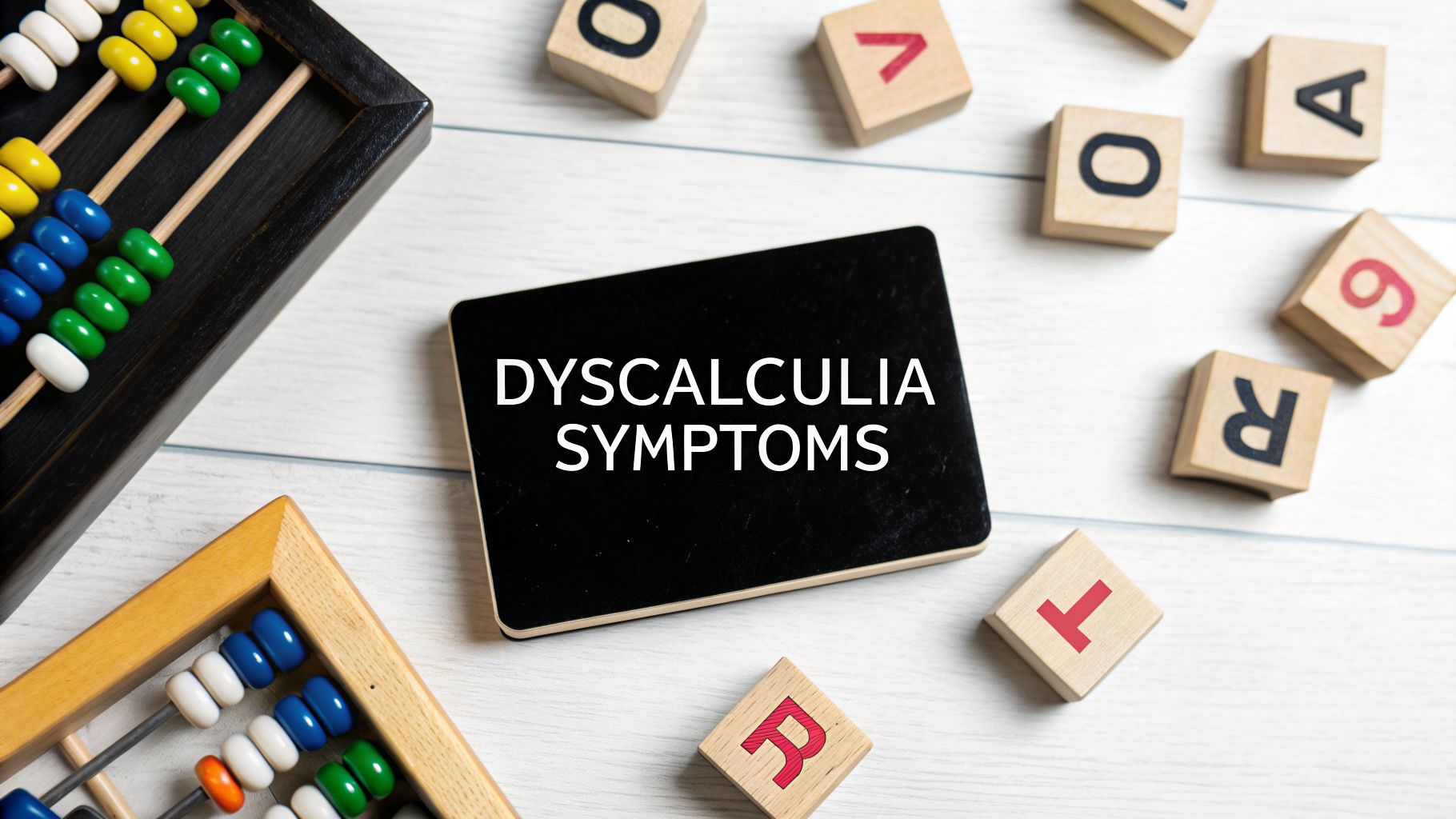
The core signs of dyscalculia nearly always circle back to a persistent struggle with three things: number sense, mathematical reasoning, and recalling basic numerical facts. For your child, this isn't just about finding homework a bit tricky; it's a deeply confusing and often upsetting daily experience where numbers feel like an unsolvable, secret code that everyone else seems to understand.
What Is Dyscalculia and How Does It Feel for a Child?
Imagine trying to read a book where the letters constantly swap places or change shape. You sound out a word on one page, but on the next, the same letters mean something completely different. This is how deeply disorienting numbers can feel for a child with dyscalculia. It’s a specific and persistent learning difference that gets in the way of a person’s ability to pick up arithmetic skills.
For your child, this has nothing to do with being lazy or not trying hard enough. It's a fundamental difference in how their brain processes numerical information. While their friends seem to just know that '8' is bigger than '5', your child might still be anxiously counting on their fingers, feeling a rising sense of panic as they fall behind.
The Emotional Weight of Numbers
This constant struggle creates a heavy emotional burden. A simple request like, "Can you pop upstairs and get your sister's two favourite books?" can trigger real anxiety. They might grab a random armful, hoping it's the right amount, terrified of being wrong yet again. In the classroom, this anxiety can grow into a genuine fear of maths, leading them to avoid it at all costs and cementing a heartbreaking belief that they are simply "bad at school."
The most painful part for many children is the feeling of being misunderstood. They see their peers getting it right and start to internalise their struggles as a personal failing, which can take a serious toll on their self-esteem and joy for learning.
Dyscalculia is so much more than a difficulty with maths; it's an invisible barrier that can make a child feel isolated and anxious in a world that runs on numbers. Their effort is immense, but the translation from a concept to the right answer gets lost along the way.
From Confusion to Clarity
This confusion shows up in tangible, everyday situations that go far beyond the classroom. Picture a secondary school student fumbling with her lunch money, not quite sure if £5.00 covers a £4.50 sandwich because the concept of place value just doesn't click. This difficulty with money is a classic symptom of dyscalculia, impacting the daily lives of roughly 6% of Brits. In the UK, where financial literacy is pushed from Key Stage 3, this can lead to real-world problems.
Recognising this early is crucial. You can find out more about the widespread impact of dyscalculia and how it is diagnosed by visiting Kalmer Counselling.
Understanding dyscalculia from your child’s perspective is the first, most important step. It shifts the focus from, "Why can't you get this?" to "How can I help you see this differently?" By recognising their frustration and validating their feelings, you create a safe space for them to learn and build confidence, one number at a time.
When you see your child struggle with maths, it’s easy to feel a mix of frustration and worry. But the tears and anxiety are just the tip of the iceberg. Underneath the surface, the challenges of dyscalculia aren't random mistakes—they’re consistent patterns that reveal how your child’s brain is wired to process numbers.
Think of it as trying to read a map where the landmarks keep moving. For a child with dyscalculia, the world of numbers can feel just as unstable and confusing. These difficulties aren’t just about homework; they ripple out into everyday life, affecting their confidence and their sense of belonging.

As the image shows, this constant struggle isn’t just an academic problem. It’s an emotional one that can chip away at a child's confidence and sense of self-worth. By understanding the core symptoms, we can start to see their world through their eyes and find better ways to help.
Let’s break down the three main challenges.
1. A Weak "Number Sense"
At the very heart of dyscalculia is often a weak number sense. This isn't about counting; it's the brain's intuitive grasp of quantity. It’s that instant feeling you get when you look at two piles of coins and just know which one has more, without counting.
For a child with dyscalculia, that inner "number-dar" is missing. They can’t eyeball quantities or make quick estimations, which can be incredibly disorienting.
- Here's what it looks like in real life: Imagine asking your child to grab enough apples for everyone in the family. Another child might quickly grab four or five, but a child with dyscalculia might have no concept of what "five" looks like as a group. They might have to count them out one by one, or grab a random amount, completely unsure if it’s too many or too few. The simple task becomes a source of stress.
This fundamental difficulty makes comparing numbers, understanding concepts like 'greater than' or 'less than', and estimating anything incredibly difficult.
2. Struggles with Mathematical Reasoning
The second key symptom is a persistent struggle with mathematical reasoning. This is about understanding the ‘why’ behind the numbers, not just memorising a set of steps to get an answer. For a child with dyscalculia, it can feel like they are being given a list of random rules that don't connect to each other.
The connections between mathematical ideas just don't click into place. They might not see that addition and subtraction are two sides of the same coin, or that multiplication is just a shortcut for adding.
- Here's what it looks like in real life: You're at the shop, and a comic costs £3. Your child has a £5 note. You ask, "How much change will you get?" Even if they know how to subtract 3 from 5 on paper, they may not realise this real-world situation is a subtraction problem. Translating life into maths is a huge hurdle, which can leave them feeling confused and powerless in everyday situations.
3. Poor Memory for Numerical Facts
Finally, a huge challenge for many children with dyscalculia is a poor working memory for numbers. This is why memorising basic maths facts—like times tables, number bonds to 10, or even their own phone number—can feel like trying to catch water in a sieve.
No matter how many times they practise, the information just doesn’t stick. This isn’t a sign of laziness; their brain genuinely struggles to store and retrieve these specific facts on demand. It can be heartbreaking for them to try so hard and feel like they are getting nowhere.
While their classmates instantly recall that 8 + 4 = 12, a child with dyscalculia is often stuck at square one, laboriously counting on their fingers every single time. This isn't a choice; it's a necessity.
This slow, effortful process is mentally draining. It turns even simple maths tasks into a long and frustrating ordeal. Recognising these foundational symptoms of dyscalculia is the first, most important step toward getting your child the compassionate support they truly need.
Recognising Symptoms Across Different Age Groups
The signs of dyscalculia aren’t static; they shift and change as a child grows and the mathematical demands on them get tougher. A subtle difficulty in nursery can become a significant hurdle in secondary school. Understanding these age-specific symptoms of dyscalculia is vital for parents, as it helps you spot the patterns behind the struggles and offer the right support at the right time.
For a child with dyscalculia, each new school year can feel like the rulebook for numbers has been completely rewritten, leaving them feeling perpetually behind and full of dread. By knowing what to look for, you can become their most powerful advocate.

Preschool Years: Ages 4 to 6
In the early years, maths is all about laying down the very first foundations. For most children, this is a playful time of discovery with counting rhymes and building blocks. For a preschooler with dyscalculia, however, this foundational stage can already be a source of deep confusion and frustration.
Often, the disconnect is between a number as a word and a number as a quantity. They might be able to recite “one, two, three” in order but have no real sense of what "three" actually means.
Here are some common signs to watch for:
- Trouble learning to count: They may frequently skip numbers, especially when counting objects, and lose their place easily.
- Difficulty linking a number to an object: If you ask them to get "four" crayons, they might grab a random handful because the concept of "fourness" hasn't clicked. It's not defiance; it's a genuine disconnect.
- Struggles with number recognition: They may find it hard to recognise and name simple number symbols like 2, 5, or 8.
A practical example is seeing your child count their fingers, saying "one, two, four, seven," showing that the sequence isn't yet stable in their mind. This isn’t just a memory slip; it points to a shaky understanding of numerical order that can make them feel out of step with their friends.
Primary School Years: Ages 7 to 11
As children enter primary school, the pace of maths learning picks up dramatically. The focus shifts from simple counting to performing calculations, telling time, and using numbers in more complex ways. This is often when the symptoms of dyscalculia become more obvious and start to impact their schoolwork and confidence.
Imagine your child, Alex, in Year 3, staring blankly at a simple worksheet asking him to count backwards from 20. For most kids, it's a breeze, but for Alex, it feels impossible, like trying to remember the words to a song he's never heard. This difficulty with sequencing numbers is surprisingly common, affecting an estimated 6% of the UK population. With maths forming the backbone of the National Curriculum from Key Stage 1, this can make even everyday tasks feel like a struggle. You can find more details from National Numeracy about how dyscalculia affects learning.
The persistent need to use fingers for simple sums like 7 + 3, long after their peers have memorised the answer, is a classic indicator. For your child, this isn't a bad habit; it's a vital tool they rely on to make sense of a confusing world.
Key signs in this age group include:
- Difficulty recalling basic maths facts: They struggle to remember number bonds (e.g., 4 + 6 = 10) or times tables, despite hours of practice.
- Trouble with concepts like 'greater than' or 'less than': They may not instinctively know that 9 is bigger than 6.
- Challenges with telling time: Reading an analogue clock is particularly tricky because it involves sequencing, direction, and understanding units of 60. This can lead to anxiety about being late or missing activities.
- Problems with money: They may find it hard to work out change or understand the value of different coins, making them feel nervous about buying things on their own.
Teenage Years: Ages 12 and Up
In secondary school, maths becomes much more abstract. Students are expected to understand complex concepts, work with variables, and solve problems with multiple steps. For teenagers with dyscalculia, this leap from concrete to abstract maths can feel like hitting a brick wall.
The challenges now extend far beyond basic arithmetic and start affecting their ability to manage everyday life and their self-perception as a capable young adult. The focus is less on calculation speed and more on mathematical reasoning and application—areas where they may deeply struggle.
Look for these signs in your teenager:
- Difficulties with abstract concepts: Algebra, with its use of letters and variables, can be especially baffling and feel like an entirely foreign language.
- Struggles with interpreting graphs and charts: They may find it hard to understand data presented visually in science or geography class, making them feel like they're falling behind in multiple subjects.
- Challenges with managing a budget: Concepts like saving, budgeting pocket money, or understanding a phone contract can be overwhelming and a source of real-world anxiety.
- Problems with multi-step word problems: They often get lost trying to figure out which operations to use and in what order, which can feel deeply frustrating when they know they're capable in other areas.
A common scenario is a teenager who excels in English or history but finds themselves unable to grasp the formulas needed for their GCSE Physics exam. It’s not about intelligence; it’s about a specific difficulty in processing and applying numerical and spatial information. This can be especially confusing and damaging to their self-esteem.
Untangling Dyscalculia, Dyslexia, and Maths Anxiety
When your child’s maths homework ends in tears yet again, it’s easy to feel lost and heartbroken for them. Is this a genuine learning difference, or is it stress getting the better of them? Could it even be connected to their struggles with reading? Getting to the bottom of whether you’re dealing with dyscalculia, dyslexia, or maths anxiety is one of the most important first steps you can take for your child.
Understanding the root cause is the key to finding the right support. Each of these challenges requires a completely different approach, and misinterpreting the signs can lead to a cycle of frustration for everyone involved. Let's clear up the confusion and focus on what your child is experiencing.
Dyscalculia vs Maths Anxiety
First things first: dyscalculia and maths anxiety are not the same thing, although they often show up together, like a painful partnership. One is about how the brain processes numbers, while the other is a powerful emotional response.
Maths anxiety is that feeling of panic, tension, or outright fear that sabotages performance. A child might have perfectly good number sense, but they become so overwhelmed by the fear of getting it wrong that their mind goes blank. This emotional reaction can paralyse them, making it impossible to recall information they actually know.
Dyscalculia, on the other hand, is a foundational difficulty with number sense itself. The anxiety a child with dyscalculia feels is often a result of their persistent struggles, not the cause of them.
A child with only maths anxiety might panic during a test but can often solve the problem later in a calm, low-pressure environment. A child with dyscalculia struggles with the calculation itself—whether they are anxious or not—because the underlying concept is a mystery.
Dyscalculia vs Dyslexia
Many people refer to dyscalculia as "maths dyslexia," but this can be misleading. While they can and do co-occur, they are distinct learning differences. In fact, research shows a significant overlap, with somewhere between 20-60% of individuals with dyscalculia also having another learning difference like dyslexia or ADHD.
Put simply, dyslexia primarily affects a child's ability to process language—reading, writing, and spelling. Dyscalculia affects their ability to process numbers. The confusion often comes to a head in subjects like maths, where both skills are needed.
Here’s a practical way to tell the difference, centred on your child's experience:
-
A child with dyslexia looking at a word problem might struggle to read the sentences. They might stumble over words or lose their place entirely. However, if you read the problem aloud to them, they can often grasp the question and solve the calculation without an issue. The barrier was the text, not the numbers.
-
A child with dyscalculia can read that same word problem perfectly. They understand every word, but they get completely stuck when trying to figure out which numbers to use or what operation (add, subtract, etc.) is needed. The language is clear, but the maths concept is not, leaving them feeling helpless.
The challenge deepens when you look at core symptoms. For instance, have you ever seen a child guess that a jar with 12 sweets in it contains 50? This difficulty with basic estimation is a classic sign of dyscalculia. It points to a weak grasp of what numbers actually represent, affecting an estimated 6% of the UK population. For more on this, you can explore the findings from the British Dyslexia Association for Dyscalculia Awareness Day.
If you’re trying to better understand the link between these learning differences, you might find our guide on how to help a child with dyslexia useful.
By carefully observing where your child’s struggle begins—with the words on the page or with the numbers themselves—you can start to untangle these conditions and advocate for the specific support they need to thrive.
How Personalised Online Learning Can Be a Game-Changer
After you’ve started to spot the persistent and often distressing symptoms of dyscalculia, the next question is always, "What now?" The answer isn't about finding a 'cure', but about finding an environment where your child can finally learn in a way that actually makes sense to them. For many families, this is where a personalised online school can make all the difference.
A traditional classroom, with its one-size-fits-all pace and social pressures, can be a source of constant anxiety for a child who sees numbers differently. Every timed test or question in front of the class can feel like another spotlight on their struggle. A flexible online environment strips away these barriers, giving them back a sense of control, safety, and the emotional space to learn without fear.

It’s about meeting your child exactly where they are, not where a curriculum says they ought to be.
Tailoring the Learning Experience
One of the biggest wins for online schooling is the power to truly personalise education, putting your child's needs first. In small, interactive classes, teachers who are properly trained in special educational needs (SEN) can give your child the focused, one-on-one attention they need to get to grips with tricky concepts.
Instead of being lost in a crowd, your child becomes the centre of their own learning journey. If a concept doesn't click the first time, the lesson can be adapted on the spot. They can also re-watch lesson recordings as many times as they need to, absorbing information at their own speed without any fear of holding up the class. This kind of repetition is absolutely vital for building the neural pathways that help numerical facts stick.
This individual support turns moments of pure frustration into opportunities for a breakthrough. To see how this works in practice, it's useful to understand the tools involved, like specialised personalized learning software.
Making Maths Visual and Hands-On
For a child with dyscalculia, abstract numbers on a page can feel like a foreign language. Personalised online learning makes maths tangible and visual using interactive digital tools, which can feel like a huge relief.
An online teacher can use virtual manipulatives—like digital blocks or interactive number lines—to show that '5' is a real, concrete quantity, not just a symbol on a screen. This multi-sensory approach connects abstract ideas to something a child can see and 'touch', making them far easier to understand and remember.
This method transforms maths from something that just happens to them into an active, hands-on experience. A student can drag, drop, and build with numbers, turning a source of anxiety into a playful puzzle they can actually solve.
Rebuilding Confidence and Nurturing Independence
Perhaps the most important benefit of all is the impact on a child's confidence. When they are no longer defined by what they can't do in a traditional maths class, they start to see what they can achieve. Working at their own pace, free from the judgement of their peers, allows them to take risks and make mistakes without shame.
This supportive setting empowers them to figure out their own effective strategies and become advocates for their own learning needs. At Queen’s Online School, we are committed to providing exactly this kind of empowering education. You can learn more about our dedicated online courses for students with SEN and discover how we can help your child unlock their true potential.
By putting the child's needs at the heart of their education, we can help them move beyond their struggles with dyscalculia and build a foundation for lifelong success and self-belief.
Your Action Plan for Supporting Your Child
Realising your child might have dyscalculia is a huge step forward, but it can also leave you feeling a bit lost and wondering, "What do I do now?" The good news is that taking action doesn't have to be complicated. With a clear, compassionate plan, you can move from a place of worry to one of empowerment and become your child's most effective advocate.
This simple, four-step approach is designed to put your child's wellbeing right at the centre of everything.
Step 1: Observe and Document
First, become a gentle observer. For the next week or two, keep a simple, judgement-free log of the specific moments where your child gets stuck with numbers.
Instead of just writing "bad at maths," try to capture the details. For example: "Took ten minutes to work out 9 + 3, using fingers the whole time and seemed very distressed," or "Couldn't figure out how much change to expect from a £5 note for a £3.50 item and got flustered." Jotting down these concrete examples creates a clear pattern of evidence, which is far more powerful than a general feeling of concern when you eventually speak to their school.
Step 2: Talk with Your Child
Find a quiet, relaxed moment to chat with your child about how they feel about maths. Your goal is to create a safe space for them to be honest, without fear of disappointment.
You could ask something like, "I've noticed maths seems a bit frustrating for you sometimes. What does it feel like inside when you're in maths class?" Their answers can be incredibly revealing, helping you understand the emotional toll of their struggles, from anxiety to a real knock in their self-esteem. Simply listening and validating their feelings can be a powerful first step in rebuilding their confidence.
Step 3: Collaborate with Their School
Armed with your notes and insights, schedule a meeting with your child's teacher or the school’s Special Educational Needs Coordinator (SENCO). Share what you've seen and, just as importantly, what your child has told you. For more information, you might want to learn about what SEN support at school involves.
The goal here is to build a team around your child. You are the expert on your child, and the school are the experts on education. Working together, you can map out a plan for in-class support and helpful accommodations that make them feel seen and supported.
Step 4: Consider a Formal Assessment
If your child's difficulties continue despite the extra support at school, it might be time to think about a formal assessment. When putting together an action plan, consulting with an educational psychologist can provide tailored strategies and support designed for your child's specific needs.
An assessment isn’t about labelling your child. It's about achieving clarity for their benefit. A formal diagnosis can unlock access to more targeted support and interventions, giving everyone a definitive roadmap to help your child succeed.
Ultimately, your proactive support is the most critical ingredient. By taking these steps, you can help your child move beyond their struggles with the symptoms of dyscalculia and build a future filled with confidence.
Frequently Asked Questions
When you first start exploring dyscalculia, it’s completely normal to have a lot of questions. The road ahead might seem a bit uncertain, but getting clear, straightforward answers is the first step toward feeling empowered and finding the right path for your child.
Here, we’ll tackle some of the most common concerns we hear from parents, putting your child’s needs and future at the centre of the conversation.
Can Dyscalculia Be Cured or Outgrown?
This is often one of the first questions parents ask, filled with hope and concern. Dyscalculia isn't a disease that can be cured or a phase a child will simply "grow out of." Think of it more like eye colour or being left-handed; it’s a lifelong, fundamental difference in how the brain is wired to understand numbers.
But here’s the crucial, hopeful part: this absolutely does not mean your child can't lead a happy and successful life. With the right strategies, multi-sensory teaching methods, and consistent support, children can develop incredibly effective ways to navigate their challenges. They can learn to manage their difficulties so well that they go on to achieve great things academically and personally.
How Do I Get an Official Diagnosis in the UK?
If you suspect your child is showing symptoms of dyscalculia, getting an official diagnosis is a game-changer for them. It provides real clarity and unlocks the door to specialised support. In the UK, a diagnosis is typically made by a qualified educational psychologist or a specialist teacher who holds an assessing practising certificate.
Your journey will likely start with a conversation with your child's school SENCO (Special Educational Needs Coordinator). They are your best first port of call and can help initiate an in-school assessment or guide you towards trusted private specialists who can carry out a full diagnostic evaluation.
An official diagnosis isn’t about sticking a label on your child. It's about deeply understanding their unique learning profile so that you, their teachers, and they themselves have the best tools to help them thrive.
What Are Some Simple Ways to Help at Home?
Supporting your child at home shouldn’t feel like a second, stressful maths lesson. The real goal is to create positive, low-pressure experiences around numbers in everyday life. This can gently help to heal any maths anxiety that might have started to build up.
- Play games: Board games with dice, counting spaces, and play money are brilliant for building number sense without them even realising it. A game of Monopoly can be a fun way to practice handling money and making calculations.
- Cook together: Measuring out ingredients for a favourite recipe is a fantastic, hands-on way to get comfortable with fractions, volume, and following a sequence.
- Talk about numbers in daily life: When you’re out shopping, chat about prices, estimate the total bill, or figure out how much change you should get back. Keep it light and casual, making it a normal part of conversation, not a test.
It’s all about showing them that numbers are just a normal, useful part of the world, not something to be feared.
Will Dyscalculia Limit My Child's Future Career Options?
Absolutely not. It’s so important for your child to know that a difficulty in one area never defines their entire potential. There are countless successful, brilliant adults with dyscalculia in every field imaginable.
The key is that by understanding their learning difference early, your child can focus on and pour energy into their incredible strengths—whether that’s in the creative arts, humanities, sciences, or hands-on trades. So many careers don’t rely on advanced mathematical skills. With the right support and a focus on what they are passionate about, there is truly no limit to what your child can achieve.
At Queen's Online School, we believe every child deserves an education that sees their strengths first and supports their challenges with expertise and care. Our specialist SEN-trained teachers create a nurturing online environment where students with dyscalculia can finally build their confidence and unlock their true academic potential.
Discover how our personalised approach can make a difference for your child by visiting Queen's Online School.