
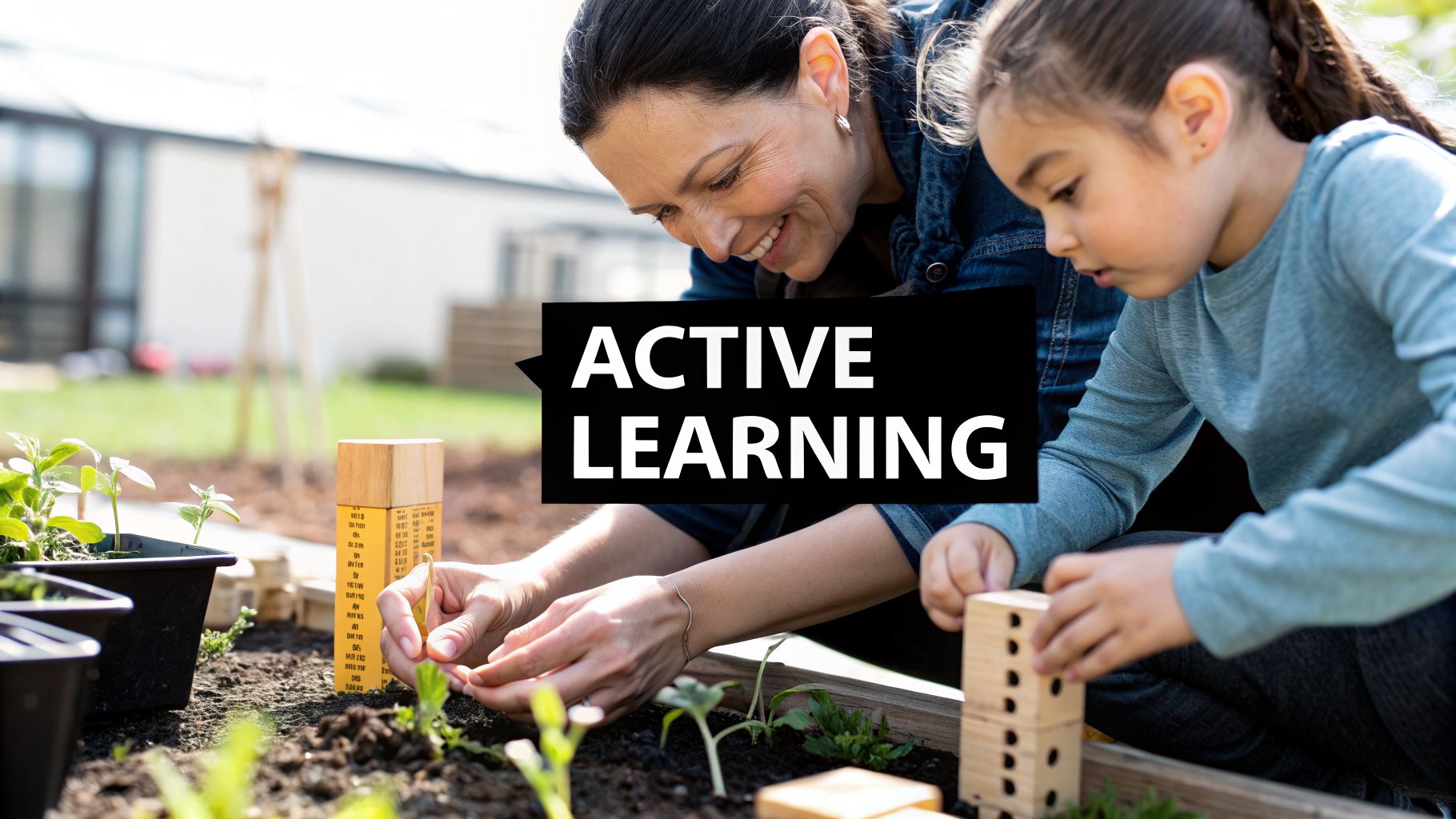
Does homework time feel like a constant battle to keep your child in their seat? It’s a familiar scene for many parents: you’re trying to go over a new concept, but your child is fidgeting, tapping their feet, or finding any excuse to get up and move. It’s a moment that can leave you feeling worried and even a little heartbroken.
It’s easy to feel frustrated and mistake this constant motion for a lack of focus. But what if that restless energy isn't a distraction at all? What if it’s the very key to how their brain makes sense of the world?
This is the reality for a kinesthetic learner. These are the children who learn by doing, not just by seeing or hearing. For them, learning isn’t a passive activity; it’s an active, full-body experience. They connect abstract ideas to physical action. It's how they feel truly understood.
Is Your Child Always on the Move?
A kinesthetic learner doesn't just want to hear about the solar system; they want to build a model of it with their own hands. They grasp fractions best not from a worksheet, but by measuring out ingredients for a cake. Their need to move isn't defiance—it's their brain's beautiful and unique way of processing information.
For kinesthetic learners, movement is memory. Physical action helps them forge the neural pathways needed to store and recall new information. It's not a distraction from learning; it's an essential part of it.
Once we shift our perspective, we stop seeing a "fidgety" child and start seeing a "hands-on" explorer. That simple change is the first step in turning what feels like a daily struggle into a remarkable strength, bringing a sense of relief and hope.
Why This Matters for Parents and Educators
Recognising and working with your child's kinesthetic nature can feel like finding the missing piece of the puzzle. It helps you understand that their need for movement isn’t a behavioural issue to be corrected, but a fundamental learning need to be met. It’s a profound moment of clarity for any parent.
This understanding is widely shared among educators. In a revealing survey, a staggering 93% of UK school teachers agreed that individuals learn better when taught in their preferred learning style. This highlights just how deeply the idea of adapting to a child’s needs is valued, especially for those who thrive on physical engagement. You can explore the findings of this study to see how educators view these personalised approaches.
Supporting your kinesthetic learner means creating opportunities for them to engage their bodies and minds at the same time. This guide will move beyond labels to give you relatable insights and clear strategies. You'll learn that this isn't a problem to be managed, but a powerful asset to be nurtured, helping your child not just to cope, but to feel seen, valued, and ready to truly excel.
How to Spot a Kinesthetic Learner
Have you ever watched your child struggle to sit still during homework and felt a pang of worry? It’s a common experience that tugs at the heart of so many parents. You see them fidgeting, pacing, or tapping their feet, and it’s easy to assume they’re distracted or not paying attention.
But what if that movement isn't a sign of distraction at all? What if it’s actually the key to unlocking their focus? Often, what we label as "restless" behaviour is simply your child’s instinctive attempt to learn. Recognising these physical cues is the first step toward understanding and supporting your child in a way that makes them feel safe and capable.
This concept map helps to illustrate the connection between movement and achievement for these hands-on learners.

It shows that when we allow these children to engage their bodies, they don’t just cope—they excel. At its heart, this style is defined by a deep-seated need to physically interact with the world, a method often called hands-on learning.
Common Traits of a Kinesthetic Learner
Does your child seem to think best while pacing the room? Do they talk with their hands, using big, expressive gestures to get their point across? These are classic signs of the kinesthetic learning style.
Keep an eye out for these common characteristics:
- A preference for action over observation: They’d much rather build a model of a volcano with clay and baking soda than simply read a chapter about one.
- High energy levels: They might seem restless during passive activities like story time but can focus for hours on a physical project, like building a complex LEGO city.
- Excellent 'muscle memory': They pick up new physical skills, like a dance routine or riding a bike, with remarkable speed and rarely forget them.
- A tendency to fidget: That pen-clicking, foot-tapping, or doodling isn’t necessarily boredom. It’s often an attempt to create the micro-movements their brain needs to concentrate.
This calls for a profound shift in our thinking: the fidgeting isn't a distraction from the learning; it's a tool for the learning. They are creating the physical input their brain requires to process information effectively.
An At-A-Glance Comparison
Seeing these traits in your child is the first step. The next is understanding how their needs differ from other learning preferences. For busy parents, this quick comparison table can help you pinpoint your child's dominant style based on everyday behaviours.
Kinesthetic vs Visual vs Auditory Learning Cues
| Learning Cue | Kinesthetic Learner | Visual Learner | Auditory Learner |
|---|---|---|---|
| During a Story | Wants to act out the scenes or use props. | Prefers books with lots of colourful pictures. | Loves listening intently and may close their eyes to focus. |
| Solving a Puzzle | Jumps right in, trying to fit pieces together. | Looks at the box picture to guide them. | Might talk through the process out loud. |
| Learning New Info | Needs to write it down or physically try it. | Likes to see diagrams, charts, and demonstrations. | Remembers what was said in a lecture or conversation. |
| Expressing Ideas | Uses hands and body language to explain. | Often draws or sketches to show their thoughts. | Is articulate and enjoys discussing their ideas. |
This table isn’t about putting your child into a rigid box. In truth, most children (and adults!) benefit from a mix of teaching methods.
However, understanding your child's primary preference—whether it's one of the main styles of learning, kinesthetic or otherwise—gives you a powerful starting point. It’s about meeting them where they are and giving them the tools they need to make sense of the world, celebrating the unique way their brilliant mind works.
Adapting Online Lessons for Kinesthetic Learners
When parents hear the words ‘online school’, many feel a wave of apprehension. A single, nagging question often surfaces: ‘How can my active child possibly learn while sitting in front of a screen all day?’ It’s a genuine concern, particularly for parents of kinesthetic learners whose entire being is geared towards moving.
This fear usually stems from a specific picture of online learning—one that looks a lot like a passive, one-way lecture, just delivered through a screen. But what if we thought about screen time differently? What if, instead of being a barrier to movement, the screen became a portal to active, hands-on discovery that lights up your child’s world?
That’s exactly how modern online schooling is designed to work. It uses technology not to pin your child to a chair, but to guide them through physical activities that bring abstract concepts to life. The home itself transforms into a dynamic, exciting classroom.
Turning Screen Time into Active Time
Picture your primary-aged child in a live online science class. Instead of just passively watching a video of an experiment, their teacher is guiding them, step-by-step, as they create their own erupting volcano right there on the kitchen table using simple things like bicarbonate of soda and vinegar. They get to see the fizz and feel the reaction for themselves. The look of wonder on their face is priceless.
This is the real power of blending digital guidance with real-world action. The lesson isn't just on the screen; it’s happening in their hands, right in front of them. This approach truly respects the styles of learning kinesthetic children need to thrive.
Here are just a few ways online lessons can be adapted for hands-on learning:
- Interactive Science Labs: Students follow their teachers in real-time to conduct safe experiments, build models of cells with craft supplies, or test out physics principles with toys they already own.
- Embodied Maths: Why just look at shapes on a screen? A great teacher might ask students to stand up and form a triangle with their arms, or to walk the perimeter of the room to truly feel the concept of measurement.
- Historical Role-Playing: For older students, a history lesson on a pivotal debate can become an interactive drama where they’re assigned roles and get to act out the different arguments, feeling the passion and conviction of the historical figures.
The goal isn’t to get rid of screen time, but to make it a springboard for action. The screen becomes the ‘mission control’ that directs the hands-on exploration happening in the real world, putting the child’s need for movement right at the centre of the experience.
The Power of the Pause Button
One of the most effective tools in online education for a kinesthetic learner is also one of the most overlooked: the simple pause button. Unlike a traditional classroom, where the lesson moves on regardless, recorded lessons give your child total control over the pace, empowering them to learn in their own way.
If the teacher starts explaining a complex biological concept, a GCSE student can simply pause the video, grab some play-dough, and build a quick model of the cell structure being discussed. That physical act of creating cements the idea in their mind far more effectively than just re-watching the segment.
This method allows your child to weave physical tasks seamlessly into their learning. They can:
- Watch a short part of the lesson.
- Pause the video to complete a related hands-on activity.
- Resume the lesson when they’re ready, having physically engaged with the material.
This cycle of watch-do-reflect is perfectly suited to those who learn by doing. It takes away the pressure to "keep up" and replaces it with the freedom to explore. When we embrace these methods, it becomes clear that a well-designed online curriculum isn't a hurdle for a kinesthetic learner—it’s an incredible opportunity to finally feel successful.
To support your child even further, it helps to understand the bigger picture of how to keep them focused and motivated. For more ideas, you might find our guide on student engagement strategies useful. It’s all about ensuring that every child, no matter their learning preference, can find joy and success in their education.
Practical Activities to Support Kinesthetic Learning at Home

Realising your child needs to move to learn is the first big step. Now for the fun part: putting that insight into practice. For parents of kinesthetic learners, the home isn't just a home—it’s a playground of learning opportunities where everyday objects and routines can become brilliant educational tools.
It’s all about shifting the focus, making learning feel less like a chore and more like an exciting adventure. When you connect academic concepts to physical experiences, you’re not just accommodating a preference; you're speaking your child's native language. The goal is to bring joy and meaning back into education by tapping into their natural energy.
This section is your toolkit. We’ll walk through some simple, subject-specific activities you can try at home to help your kinesthetic learner finally connect with schoolwork in a way that feels natural, engaging, and genuinely fun.
Making Maths Move
Maths often feels abstract and rigid, which is why it’s a common point of friction for children who need to do things to understand them. By bringing numbers and concepts off the page and into the real world, you can transform maths into a hands-on experience your child will actually enjoy.
Think about the frustration of a child staring at fractions on a worksheet. Now, imagine them in the kitchen, measuring out flour and sugar. Suddenly, a half cup isn't just a number; it's something they can see, hold, and pour. That physical connection makes the abstract concept stick.
Here are a few ideas to get you started:
- Kitchen Calculations: Baking is a fantastic way to teach fractions, measurements, and sequencing. Put your child in charge of reading the recipe and measuring the ingredients.
- LEGO Brick Multiplication: Use LEGO bricks to build multiplication problems. A
2x4brick is a perfect visual representation of 2 * 4 = 8, making equations tangible. - Body Shapes for Geometry: Ask your child to use their body to create different shapes. "Can you make a triangle with your arms?" or "Can you walk in a perfect square?" This links geometric terms directly to physical movement.
The secret is to reframe Maths not as a silent, seated subject, but as a series of real-world problems to be physically solved. For a kinesthetic learner, this shift from passive observation to active participation changes everything.
Bringing English to Life
For a child who is always on the move, the idea of sitting quietly with a book can feel like a punishment. But you can infuse English with the action they crave, turning reading and writing from static tasks into dynamic, immersive activities.
Instead of just reading a story, what if your child got to become the main character? Acting out a scene from a book helps them connect with the plot and emotions on a much deeper level. It turns reading comprehension from a test into an experience.
Try these simple yet powerful activities:
- Fridge Magnet Poetry: Use magnetic letters on the fridge. Ask your child to build their spelling words, create short sentences, or even write a simple poem. The act of physically moving the letters reinforces learning.
- Story Scene Skits: After reading a chapter, pick a key scene and act it out together. This not only sharpens comprehension but also helps your child grasp character perspectives and plot.
- Sensory Writing Trays: Fill a shallow tray with sand, salt, or even shaving foam. Let your child practise writing letters and words with their finger. This tactile feedback is incredibly effective for cementing letter formation.
These methods honour the different styles of learning; kinesthetic children, in particular, will thrive with this kind of multi-sensory approach.
Hands-On Science Experiments
Science is naturally suited to kinesthetic learners because it’s all about exploration, discovery, and asking "what if?". The world becomes their laboratory, and every question is an invitation to investigate. Instead of just reading about scientific principles, give your child the chance to see them in action.
Consider the difference between reading about botany in a textbook and actually planting a seed. Watching that tiny sprout push through the soil after weeks of watering creates a connection that no diagram can ever replicate. That's the feeling you want to inspire.
Here are some engaging science activities to try at home:
- Start a Small Garden: Plant some quick-growing seeds like cress or beans. This is a brilliant lesson in plant life cycles, responsibility, and the patience required for real scientific observation.
- Build a Simple Circuit: With a battery, some wires, and a small bulb, you can teach the basic principles of electricity. The moment the bulb lights up because of something they built is a powerful and unforgettable learning experience.
- Sink or Float: Fill a basin with water and gather various household objects. Let your child predict whether each item will sink or float, then test their hypothesis. This playfully introduces concepts like density and buoyancy.
By embracing these hands-on activities, you aren't just helping your child with their homework. You are showing them that learning isn’t confined to a desk—and that their need to move, touch, and explore isn't a weakness but their greatest strength.
Kinesthetic Strategies for Children with SEN Needs

For a child with Special Educational Needs (SEN), the drive to move is often much more than a simple learning preference. It can be a vital tool for self-regulation, focus, and emotional balance. When we see a child with ADHD who just can’t stay still, or a child with Dyspraxia feeling hesitant on the sidelines, our instinct is to find a way to make their world feel more supportive and manageable.
This is where truly understanding the styles of learning kinesthetic children respond to becomes so powerful. For these learners, physical engagement isn't just an add-on; it’s a lifeline. It provides the very sensory input their nervous system craves to feel grounded, organised, and ultimately, ready to learn. Embracing movement isn't just a teaching strategy—it’s an act of deep empathy that puts your child's needs first.
Supporting Focus for Children with ADHD
For a child with Attention-Deficit/Hyperactivity Disorder (ADHD), being forced to sit still for extended periods can feel genuinely uncomfortable, almost like being told to hold their breath. Their brain is wired for stimulation, and movement is one of the quickest and most effective ways to get it. So, instead of fighting this natural impulse, we can work with it.
Frequent movement breaks aren’t a treat; they are a necessity. An online school day is perfectly suited to this. Think about scheduling a five-minute ‘brain break’ every 25 minutes. This is a chance for your child to do star jumps, have a quick run around the garden, or bounce on a mini-trampoline.
This isn't a break from learning; it's a reset for learning. It helps their brain release that build-up of energy, which paradoxically allows them to come back to the screen with far better focus.
‘Fidget-friendly’ tools can also be absolute game-changers. Simple items like stress balls, wobble cushions for their chair, or resistance bands tied around the chair legs can provide quiet, non-disruptive sensory input. This gives your child just enough physical feedback to stay regulated without pulling their attention away from the lesson.
Building Confidence for Children with Dyspraxia
Children with Dyspraxia, a condition that affects motor coordination, often carry a heavy weight of anxiety around physical tasks, especially in group situations. The fear of being slower, appearing clumsy, or facing judgement from their peers can be completely overwhelming. A supportive home learning environment removes that social pressure, creating a safe space for your child to build skills at their own pace.
Hands-on, kinesthetic activities are brilliant for developing both fine and gross motor skills in a low-stakes way.
- Building with clay or play-dough strengthens hand muscles and improves coordination.
- Threading beads onto a string helps to refine their pincer grasp and hand-eye coordination.
- Following a simple yoga video can improve balance, body awareness, and the ability to plan movements.
Every small success is a huge boost to their confidence. When your child starts to realise they can master a physical task without fear, that newfound self-belief flows into every area of their academic work. To learn more about creating this kind of supportive framework, you can explore what SEN support entails in our detailed guide.
For any child with special educational needs, integrating these kinesthetic strategies often aligns perfectly with recommended IEP accommodations and modifications. The goal is always to create a learning space that is personalised, patient, and deeply supportive. By honouring their fundamental need to move, we empower them to thrive—not just in their studies, but emotionally and socially too.
How We Nurture Every Child's Learning Style
After looking at the different sides of kinesthetic learning—from how to spot the signs to using hands-on strategies—it's pretty obvious that a one-size-fits-all approach just doesn't work. Great education isn’t about trying to fit your child into a mould. It’s about creating a flexible, supportive space that embraces how they naturally think, move, and learn.
At its core, this is what we believe in. We’re all about a personalised education that sees each child as an individual. It’s a way of thinking that goes way beyond just ticking a box for different styles of learning; kinesthetic learners, for example, aren’t just put up with—they’re actively celebrated with methods designed just for them. It all comes down to creating a place where every single student feels seen, heard, and truly understood.
Our specialist teachers are masters of this. They don't just teach subjects; they teach children. In our live, interactive classes, they expertly blend a whole range of teaching methods together.
A Balanced and Blended Approach
A lesson might kick off with a powerful visual slide to grab the attention of visual learners, then move into a clear, spoken explanation for those who learn by listening. Then, and this is the important part, it shifts into a hands-on activity. You might see a primary class using building blocks to get to grips with geometry, or a GCSE group creating a physical timeline to understand historical events.
This blended method means that every child gets a moment in the lesson that clicks with them. It tells them their way of learning is valid and keeps them switched on and part of the action.
A school’s real job is about more than just hitting academic targets. It’s about creating a true sense of belonging, where a child feels safe enough to be themselves, to ask questions, and even to make mistakes without being afraid.
More Than Just Academics
We know that a child’s well-being is the bedrock for all academic success. This is why we weave mindfulness practices into our school day, helping students manage their emotions and sharpen their focus. It's also why we have a buzzing community of clubs and social events, giving children the chance to connect with others who share their interests.
By mixing rigorous academics with a real focus on community and well-being, we build an environment where every child feels empowered. Our goal is simple: to meet each student exactly where they are—whether they’re a kinesthetic, visual, or auditory learner—and give them the support they need to fly, from their first day in primary to their final A-Level exam.
For a deeper dive into how these preferences are understood and applied, you can explore more about learning styles in our guide. We are dedicated to nurturing every child’s potential and helping them thrive.
Common Questions from Parents
When you realise your child learns best by doing, it can bring up a lot of questions. How do you support a child who needs to move in a world that often asks them to sit still? Here are some of the most common concerns we hear from parents about kinesthetic learners.
Can a Hands-On Learner Do Well in a Traditional School?
Yes, they absolutely can. The key isn't changing who your child is, but changing how they access information. Kinesthetic learners shine when schools connect abstract academic ideas to physical, tangible experiences.
Think projects, science experiments, model-building, and even just opportunities to get up and move. When a school integrates hands-on learning into its curriculum, your child isn't just passively receiving information—they're actively constructing it. That’s when they truly excel.
Is This the Same Thing as ADHD?
This is a crucial distinction to make, both for your child’s confidence and for getting them the right support. The answer is no, they are not the same thing.
Being a kinesthetic learner is simply a learning preference. It means your child’s brain processes information most effectively through movement, touch, and action. While many children with ADHD find kinesthetic strategies incredibly helpful for focus and self-regulation, it is a medical diagnosis, not a learning style.
Seeing your child’s need to move as a learning style rather than a disorder can be a powerful emotional shift. It validates their experience and helps you become their best advocate.
How Can I Get My Child's Teacher to Use More Kinesthetic Activities?
The best approach is to start a warm, collaborative conversation. Frame yourself as a partner in your child’s education by sharing what you’ve seen work at home. Teachers genuinely appreciate these insights.
You could try saying something like, "I've noticed my child learns spelling words so much faster when they can write them on a small whiteboard or build them with magnetic letters. Is there a way we could bring more of that into their day?" This kind of gentle, solutions-focused approach is nearly always welcomed and often leads to great results.
At Queens Online School, we don’t believe in a one-size-fits-all education. Our specialist teachers design live, interactive lessons that blend visual, auditory, and kinesthetic methods to ensure every student feels seen and engaged. Discover how we can personalise your child's education by exploring our programmes.