

Studying with ADHD isn't about forcing a child to try harder with the usual advice. It’s about understanding their unique brain and finding strategies that work with it, not against it. This means creating a supportive, emotionally safe environment, using visual tools to make time feel real, and building the confidence to turn a stressful daily battle into an achievable, and even rewarding, challenge.
The Emotional World of Studying with ADHD

It’s heartbreaking to watch a bright, creative child crumble under the weight of schoolwork. The crumpled papers, the tears of frustration, and the nightly battles aren’t signs of laziness or defiance. They are the outward expression of a massive internal struggle—trying to navigate a world that wasn't built for their incredible, fast-moving brain.
For parents, this is a painful mix of worry and deep empathy. You see their immense potential, their unique way of seeing the world, and their brilliant ideas. Yet, you also witness how the simple act of sitting down to study can feel like climbing an insurmountable mountain. This guide is for you. It’s a space to move beyond the common misconceptions and explore the real neurological hurdles that ADHD presents, putting your child's emotional well-being at the heart of every strategy.
Reframing the Challenge
Our goal isn't to 'fix' a problem; it's to empower your child with understanding and the right tools. When we reframe how we approach studying with ADHD, we can shift the focus from deficits to strengths. This starts with acknowledging the emotional toll that academic struggles take and creating a foundation of support and patience at home.
The challenges are very real. In the UK, children with ADHD face substantial academic hurdles. According to an independent ADHD Taskforce report from NHS England, they experience elevated rates of academic failure, bullying, and mental health issues tied directly to educational stress. These difficulties are especially tough during the transitions between primary, secondary, and further education.
It’s vital to remember that your child’s worth is not measured by their report card. Their value lies in their creativity, their passion, and their unique perspective. Our role is to help them build a bridge between their brilliant mind and the demands of the classroom.
Building a Path Forward
Creating this bridge involves understanding both the practical and emotional sides of learning. This guide will provide actionable strategies, but the first and most crucial step is connection. It's about letting your child know you are on their team, ready to work together to find what clicks for them.
- Acknowledge the Effort: It takes a monumental amount of energy for a child with ADHD to focus, organise their thoughts, and manage time. Make a point of praising the effort, not just the result. For example, instead of just saying "Good job on your homework," try, "I saw how hard you worked to stay focused on that maths problem, even when you got frustrated. That was amazing." This builds real, lasting confidence.
- Embrace Imperfection: Schoolwork won't always be perfect, and that's completely okay. The goal is progress, not perfection. This mindset lowers performance anxiety and makes it feel safer for them to try without fear of failure. Let them see you make mistakes and handle them with grace.
- Find the Spark: Motivation is everything. When a topic is genuinely interesting, the ADHD brain can achieve an incredible, sustained focus. Exploring how to find motivation to study can offer powerful insights into connecting school subjects with your child’s passions. If they love video games, connect a history project to the lore of their favourite game.
Together, we can forge a positive path where studying becomes manageable, and success—on their own terms—feels entirely within reach.
Designing an ADHD-Friendly Study Space
For a child with ADHD, their study environment isn't just a backdrop; it's an active player in their ability to learn. A typical bedroom packed with toys, posters, and half-finished Lego projects can feel like a loud, distracting party to a brain that already struggles to filter things out. It’s like trying to have a quiet conversation in the middle of a carnival.
Transforming that space from a daily battleground into a supportive sanctuary is one of the most powerful things you can do. This isn’t about creating a sterile, boring room. It's about intentionally designing an area that lowers the mental effort required just to get started. Think of it as clearing a cluttered path so your child can walk forward without tripping over something every few steps. The goal is to make focus the easiest choice in the room.
Minimise the Visual Noise
The ADHD brain is often described as having a faulty filter, meaning it takes in far more sensory information than a neurotypical one. Every colourful toy, every stack of books, and every vibrant poster on the wall is competing for attention. That makes it incredibly difficult to focus on a single page of a textbook. Decluttering is your first and most effective tool here.
-
Clear the Desk, Clear the Mind: The desk should only hold the absolute essentials for the task at hand. If it's maths homework, only the maths book, a pencil, and a calculator should be on the surface. Everything else—pens from yesterday, art supplies, other textbooks—needs a designated home off the desk. This isn't about being tidy for tidiness's sake; it's about removing the temptations that derail focus before it even begins.
-
Strategic Storage: Use closed storage like drawers, cupboards, or fabric bins. The principle of 'out of sight, out of mind' is a powerful ally. This keeps necessary supplies accessible but stops them from being a constant visual distraction. For a child, this can feel like putting their fun things "to sleep" while their "work brain" is awake.
-
Calm the Walls: Consider moving the study desk to face a plain wall. It might feel a bit uninspiring to you, but for a child with ADHD, a blank wall can be a calming visual anchor. It frees up mental energy that would otherwise be spent processing posters, photos, or busy wallpaper, allowing that precious energy to be directed at their schoolwork instead.
A well-organised space reduces the sheer number of decisions your child has to make before they can even begin their work. This proactive approach helps build momentum, which is absolutely crucial when tackling schoolwork.
Create Sensory-Aware Zones
An ADHD-friendly study space acknowledges that the need for focus exists right alongside a need for sensory regulation. You can build this directly into the environment, giving your child the tools to manage their own energy and attention. It's about providing outlets that help rather than hinder their efforts.
Your child’s wiggling and fidgeting isn’t a sign of inattention; it’s their brain’s way of trying to achieve attention. By providing appropriate outlets for this physical energy, you help them stay seated and engaged for longer.
Imagine a dedicated homework station where everything is within arm's reach, eliminating the constant temptation to get up and wander off. You can also incorporate sensory tools that channel that restless energy into something productive.
-
A 'Fidget-Friendly' Area: This doesn't mean bringing distracting toys to the desk. Think about subtle, quiet options. A wobble cushion on their chair provides vestibular input, while a simple resistance band tied around the front legs of the chair gives them a way to bounce their feet silently. This gives their body the movement it craves without derailing their mind.
-
Manage Auditory Input: Noise-cancelling headphones can be a complete game-changer. They create a "bubble" of quiet that blocks out household sounds like the telly, siblings playing, or the dog barking. For some children, instrumental music or white noise played through the headphones can improve concentration even more. This simple tool can feel like a superpower, giving them control over their environment.
For a deeper dive into attention-boosting strategies, you might be interested in our guide on how to focus in studies, which explores additional techniques that complement an optimised environment. Creating this personalised space tells your child that their needs are understood and that you are there to help them build a foundation for success.
Time Management That Works for the ADHD Brain
Have you ever bought your child a pristine, grid-lined planner, filled with hope, only to find it abandoned by the second week of January? If so, you’re not alone. This isn't a failure of willpower; it’s a fundamental mismatch between the tool and the brain it’s meant to serve. For a child with ADHD, effective time management means tossing out the conventional rulebook and embracing strategies that actually align with how their mind processes time, tasks, and priorities.
Here’s the thing: instead of seeing time as a long, linear path, the ADHD brain often experiences it as a binary choice: now or not now. This simple distinction explains why a project due in three weeks feels impossibly distant (definitely not now), right up until the night before it’s due, when it becomes terrifyingly, overwhelmingly immediate (NOW!).
Our job as parents and educators is to help them bridge that gap. We need to make the 'not now' feel concrete and manageable, which means explicitly teaching the very executive function skills that present a challenge.
Breaking Down the Overwhelm
The secret to helping a child with ADHD start—and finish—their work is to dismantle overwhelming tasks until they are no longer threatening. A single line on a to-do list like "Work on History Project" is a recipe for procrastination. It's too big, too vague, and the brain has no idea where to even begin. It just triggers anxiety and avoidance.
We have to do the breaking down with them, essentially acting as their temporary frontal lobe until they can internalise the process for themselves.
Let's take that daunting history project on the Roman Empire:
- The Original Task: Write a 1,000-word essay on Roman aqueducts. (This feels impossible to your child and triggers instant shutdown.)
- A Better Breakdown:
- Research Roman aqueducts.
- Write an outline.
- Write the essay.
- Find pictures.
- Proofread. (Better, but the steps are still too big and feel like work.)
- An ADHD-Friendly Breakdown (Micro-Steps):
- Open Google and type "Roman aqueducts for kids."
- Read one website and write down 3 cool facts. (Let's find the weirdest one!)
- Watch one 5-minute YouTube video on how aqueducts were built.
- Open a document and create a title page. (You've officially started!)
- Write the three facts from earlier as bullet points.
See the difference? Each micro-step is a small, achievable win that takes only a few minutes. This builds momentum and provides the little dopamine hit the ADHD brain craves, making it so much easier to move on to the next tiny task.
Before any of this can happen, though, the physical environment needs to be right. This simple three-step process is the foundation for any effective study session.
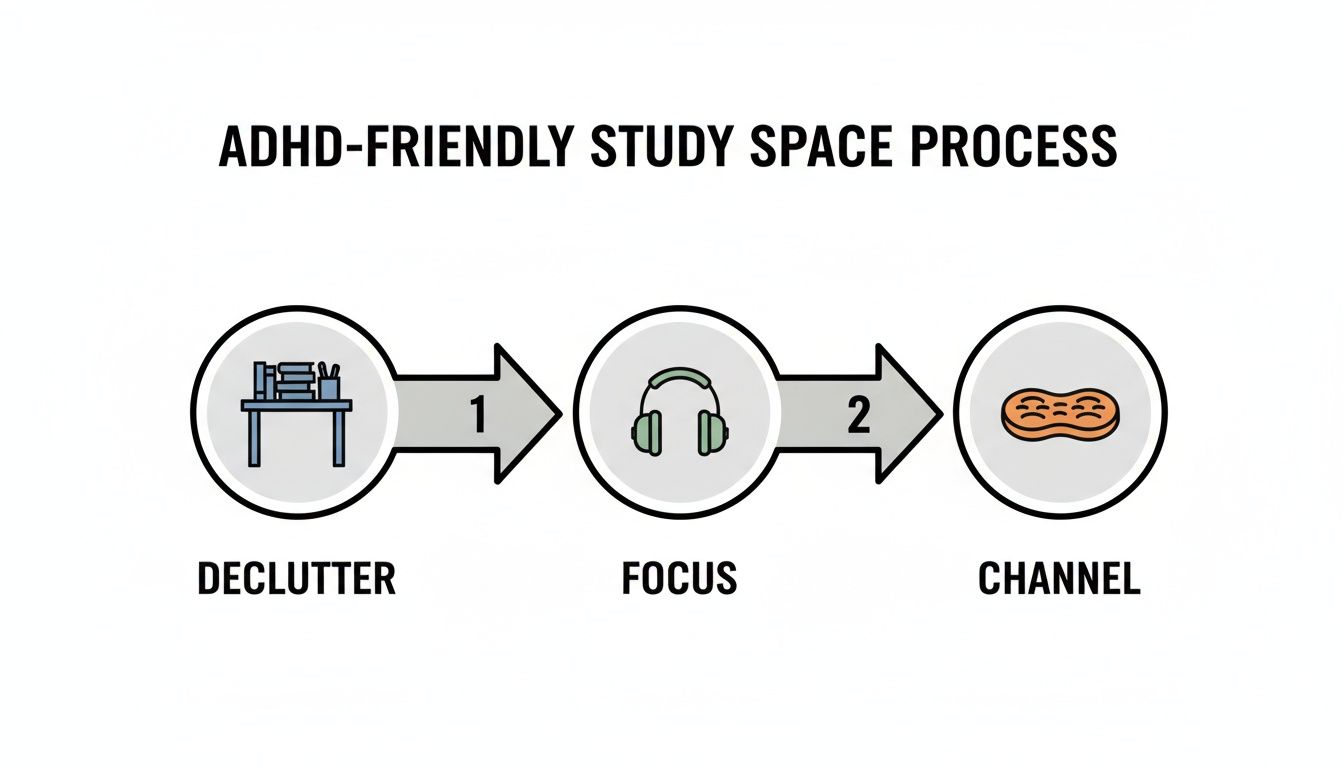
By decluttering their space, providing tools to aid focus, and finding ways to channel excess energy, you create an environment where these time management strategies can actually take root and succeed.
Choosing the Right Tools and Techniques
Once tasks are broken down into bite-sized pieces, we need a way to manage the actual work intervals. Forget long, uninterrupted study sessions; they're completely counterproductive for a brain that thrives on novelty and short bursts of intense focus.
Many popular time management techniques can be adapted to work beautifully for kids with ADHD. The key is to be flexible and find what clicks for your child, rather than sticking rigidly to a system.
Here’s a look at some common methods and how to make them ADHD-friendly.
| Technique | Core Concept | How to Adapt for ADHD | Best For |
|---|---|---|---|
| The Pomodoro Technique | Work in focused intervals (traditionally 25 mins) separated by short breaks (5 mins). | Shorten the intervals. Try 15 minutes of work followed by a 5-minute active break (star jumps, run outside). Use a visual timer. | Kids who need frequent brain breaks and struggle with sustained focus. |
| Eat the Frog | Tackle the most difficult or dreaded task first thing to get it out of the way. | Break the "frog" into tiny "tadpole" steps. The first task might just be "open the textbook to the right page." Celebrate finishing it! | Procrastinators who avoid big tasks and then run out of energy for them later. |
| Time Blocking | Schedule specific blocks of time for each task in a calendar or planner. | Use colours to represent different subjects or activities. Be realistic and schedule in plenty of buffer time and breaks. Keep blocks short. | Visual thinkers who benefit from structure but need flexibility within their day. |
| Body Doubling | Having another person present (working quietly) to help maintain focus and motivation. | You can be the body double! Simply sit in the same room doing your own quiet work (reading, paying bills). Your calm presence is a powerful anchor. | Students who get easily distracted when left alone and need an external anchor for their attention. |
The Pomodoro Technique is a classic for a reason, but the standard 25-minute block is often too long.
Try a 'Micro-Pomodoro': 15 minutes of focused work, followed by a 5-minute active break. During that break, they need to get up and move. Do some star jumps, shoot a basketball, or have a quick dance party. This physical release helps reset the brain for the next focus block.
Another surprisingly powerful strategy is body doubling. This is the simple phenomenon where someone finds it easier to concentrate just by having another person quietly present. You don't have to help them; your calm, focused presence acts as an external anchor for their wandering attention, making them feel supported without being watched.
Since challenges with executive functions are at the heart of ADHD, learning how to improve executive function can make a profound difference. These methods aren't just clever tricks; they are powerful ways to scaffold the brain's ability to plan, organise, and execute tasks.
For more ideas tailored specifically to learning, explore our guide on ADHD study techniques to build a complete toolkit. Remember, the goal is always to find what feels good and reduces stress, turning the panic of 'now' into the calm confidence of 'I can do this next small step'.
Building Emotional Resilience and Confidence
The academic struggle is often just the tip of the iceberg for a child with ADHD. Beneath the surface of missed deadlines and messy handwriting lies a deep emotional current. School can feel like a daily reminder of everything they can't do, which slowly chips away at their self-worth. It’s a constant feeling of letting people down, no matter how hard they try.
Nurturing their mental health through these ups and downs isn't just a 'nice to have'—it's the foundation upon which all other study strategies are built. This is about creating a safe harbour at home, a place where your child knows their value isn't tied to their report card.
It’s about building a connection so secure that they can face academic challenges without feeling like a personal failure. Their confidence is a delicate thing, and we can protect and grow it with intention and empathy.
Starting Gentle Conversations
When a child is overwhelmed, their frustration often comes out as anger or completely shutting down. Asking "How was school?" can be met with a brick wall because the question feels too big to answer. The key is to open a door for them to voice their feelings without fear of judgement or an immediate lecture on what they should have done differently.
Instead of broad questions, try specific, gentle conversation starters that show you're on their side:
- "What was the most frustrating part of your day today?"
- "Did any part of school feel really loud or chaotic for you?"
- "I know that history project feels huge. What's the one part that seems the most annoying to start?"
These questions validate their struggle and signal that you're ready to listen to the hard stuff. It moves the conversation from "Why didn't you do your homework?" to "Let's figure out what's getting in the way, together."
Celebrating the Small Wins
The ADHD brain is wired for immediate feedback. It can struggle to stay motivated for long-term goals that feel miles away. Celebrating small, incremental progress provides the dopamine hits needed to keep going. A ‘win jar’ is a fantastic, visual way to do this.
Find a simple jar and some marbles or colourful beads. Every time your child achieves a small victory, they get to put one in the jar. These aren't just for big things like getting a good grade.
Celebrate the process, not just the outcome. A 'win' could be remembering to bring the right book home, starting homework without a 20-minute argument, or using a planner to write down one deadline. When the jar is full, celebrate with a shared experience, like a special movie night or a trip to their favourite park.
This simple act makes progress tangible and shifts the focus to consistent effort. It helps rewire their brain to see that their hard work is noticed and valued, building a powerful sense of accomplishment one marble at a time.
Reframing Mistakes as Data
For many children with ADHD, a mistake feels catastrophic—proof that they are "bad" at school. We have the power to help them reframe these moments not as failures, but as valuable data.
A forgotten assignment isn't a moral failing; it's data telling us that the current reminder system isn't working. A low test score is information: "Okay, the data shows I struggled with the essay questions, so next time we'll focus on practicing those."
This shift in mindset is crucial for their long-term resilience because it removes the shame and turns a setback into a strategy session. It's vital, especially when you consider that 20-34% of NEET youth (not in education, employment, or training) in England have ADHD, which highlights how academic struggles can lead to long-term disengagement. You can read the full research about these ADHD statistics to understand the scale of the challenge.
This approach builds problem-solving skills and the emotional sturdiness to try again after a stumble—a skill that will serve them for life.
Becoming Your Child's Best Advocate at School

Navigating the school system can feel like learning a new language, filled with acronyms and processes that are confusing, if not downright intimidating. It’s easy to feel overwhelmed, but I want you to hold onto one simple truth: you are your child's most powerful and knowledgeable advocate. You see their daily struggles and their incredible strengths in a way no one else possibly can.
This role has never been more critical. The transition from school to employment often falters for young adults with ADHD, as the barriers they face are made worse by mental health challenges and poverty.
With assessment waiting lists now exceeding 549,000 nationwide and diagnoses appearing on just 0.32% of GP records, it's estimated that a staggering eight in nine individuals with ADHD miss out on crucial support. You can discover more insights about how these numbers impact UK families on ADHDUK.co.uk. This is why parental advocacy is so urgent.
Empowering yourself with the right tools and confidence is the first step toward securing the support your child needs to thrive—not just survive—in an educational setting.
Demystifying the EHCP and School Support
In the UK, when you hear about formal support, the conversation often turns to an Education, Health and Care Plan (EHCP). This is a legally binding document that outlines a child's special educational needs and the support the local authority absolutely must provide to meet them.
But here’s something important to remember: an EHCP isn't the only way to get support. Many of the most effective adjustments can be put in place through simple, collaborative conversations with the school's Special Educational Needs Coordinator (SENCo) and your child's teachers. The real key is to start that dialogue long before problems escalate.
Your goal is to build a collaborative partnership with the school. Frame your conversations around working together as a team to unlock your child’s potential, rather than approaching it as a confrontation. You both want the same thing: for your child to succeed.
Crafting a Collaborative Parent-Teacher Meeting
The way you approach these meetings can make all the difference. Instead of walking in with a list of demands, try coming with a list of observations and collaborative questions. This immediately positions you as a partner in problem-solving, not an adversary.
Let's imagine a real-world scenario: Your son, Leo, is constantly losing marks for "careless mistakes" in maths and forgetting to hand in his English homework.
A confrontational approach might sound like this: "Leo is failing because you're not doing enough to help him. He needs more support." This immediately puts the teacher on the defensive.
A collaborative approach sounds very different: "I've noticed Leo is really struggling to get his thoughts down on paper for his English homework, even though he understands the stories. At home, we've found that letting him talk through his ideas first helps. I was wondering if there's a way we could try something similar at school?"
See the difference? This small shift in language invites the teacher into the problem-solving process with you. It shows you respect their professional expertise while also providing valuable insight into what really works for your child.
A Checklist of Effective Classroom Accommodations
When you meet with the school, having specific, practical suggestions ready can be incredibly helpful. These aren't about giving your child an unfair advantage; they're about levelling the playing field so they can show what they truly know.
Here are some effective accommodations worth discussing:
- Preferential Seating: A simple request for a seat at the front of the classroom, away from distracting windows or doorways, can make a world of difference for focus.
- Movement Breaks: Ask if your child can have permission for short, discreet movement breaks. This could be anything from delivering a message to the office to handing out books. For a child desperate to move, this is a lifeline.
- Visual Timers: A small visual timer on their desk for independent work can be a game-changer for time perception and getting started on a task.
- Chunked Instructions: Ask teachers to provide instructions one or two steps at a time, rather than all at once, and to quickly check for understanding afterwards. This prevents the overwhelm of a long list of directions.
- Extra Time for Tests: This is a common and highly effective accommodation. It gives the ADHD brain the time it needs to process information without the added pressure of a ticking clock.
- Use of Technology: Could they use a laptop for note-taking if their handwriting is slow and laborious? Is text-to-speech software an option for reading-heavy tasks?
By advocating with empathy, preparation, and a collaborative spirit, you transform from a worried parent into an empowered agent of change for your child.
Frequently Asked Questions About Studying with ADHD
Navigating the world of studying with ADHD can bring up a whirlwind of questions, especially when you're in the middle of a homework battle or staring at yet another missed deadline. If you're feeling this way, you're not alone. Here are some of the most pressing questions parents ask, with direct answers and practical advice you can start using today.
My Child Refuses to Do Homework. What Can I Do?
That feeling of dread when homework time rolls around is familiar to so many families. It’s crucial to remember that homework refusal is rarely about defiance; it's almost always a sign of being completely overwhelmed.
Your child isn't trying to be difficult—they're stuck. Their brain is screaming that the task is too big, too boring, or too confusing to even know where to start. Instead of letting it escalate into a power struggle, try getting curious about the "why" behind the refusal. Is the assignment genuinely too hard? Are they simply exhausted after a long day of masking their ADHD symptoms at school?
A practical tip: Try sitting with your child not as a supervisor, but as a supportive "body double." Break the very first task into a tiny, non-threatening step. Instead of saying, "Do your maths homework," try, "Let's just get out your maths book and find the right page." Then, use a timer for a 10-minute work session, followed by a fun, active break. This collaborative approach takes the pressure off and focuses on building momentum—something the ADHD brain thrives on.
How Can I Help My Child Remember Deadlines?
The ADHD brain often struggles with working memory and what's known as "time blindness," making it incredibly difficult to keep track of future dates. Just expecting your child to "remember" is a recipe for frustration on both sides.
The solution is to externalise everything. You need to create a physical, visual system that does the remembering for them.
Set up a central "command station," like a large whiteboard in the kitchen. Together, map out the week's assignments, due dates, and activities. Use different coloured markers for each subject to make it more engaging and easier to scan. This visual reminder is always there, unlike a planner that can get lost at the bottom of a school bag.
You can also back this up with shared digital calendars. Set multiple reminders that ping both their phone and yours. The goal isn't to nag; it's to build a reliable external system that frees up their mental energy and reduces anxiety for the whole family.
Should I Consider Online Schooling for My Child?
For many students with ADHD, online schooling can be a game-changer. A traditional classroom is often a minefield of sensory and social distractions. Online learning provides a personalised environment that immediately cuts down on that "noise," allowing many children to focus on their lessons in a way they never could before.
The flexibility is another huge plus. It allows for essential movement breaks whenever your child's brain needs a reset and lets them work at a pace that matches their own energy levels. This can drastically reduce the anxiety of constantly trying to keep up with their peers.
Of course, this path requires a strong support system at home to provide structure and motivation, as the lack of a physical classroom routine can be a challenge for some.
Are Rewards and Punishments Effective for ADHD?
This is a critical question. The ADHD brain is wired for immediate feedback, which makes frequent, positive reinforcement far more powerful than punishment. Punishments often backfire because the challenging behaviour—like forgetting a book or making careless mistakes—stems from deficits in executive function, not a wilful choice to misbehave.
Instead of punishing the mistake, reward the process. Praise the effort of using their planner. Celebrate the act of starting homework on time. A simple token system, where they earn points for small positive actions that can be traded for a desired reward (like 30 minutes of screen time), can be highly motivating. The key is to keep the rewards small, frequent, and immediate to build positive, lasting habits.
If you're just starting this journey and have concerns about a diagnosis, it can feel overwhelming to know where to begin. For guidance on the initial steps, you can find a complete guide to ADHD assessment in the UK which offers valuable information.
For families seeking an educational environment designed to support diverse learning needs, Queens Online School provides a personalised approach to the British curriculum. Our live, interactive classes and small group sizes ensure that students with ADHD receive the individual attention and tailored support they need to not just keep up, but to truly flourish. Discover how we create a calm, focused, and empowering learning experience by visiting us at https://queensonlineschool.com.