

In the dynamic world of online education, a student isn't just a participant in a virtual classroom; they are a unique individual with hopes, curiosities, and a deep-seated need to feel seen and valued. True engagement isn't about silent compliance or merely completing tasks. It's about sparking a genuine connection, fostering a sense of belonging, and transforming learning into a deeply personal and emotional journey. When a child feels that their voice matters and their learning path reflects their own interests, the screen becomes a window to a world of possibilities rather than a barrier.
This article moves beyond generic tips to provide a comprehensive, actionable toolkit. We will explore 10 powerful, child-centred student engagement strategies specifically tailored for learners within the online British curriculum, from Primary through to Sixth Form. These methods are designed to be practical and adaptable, with a strong focus on supporting students with Special Educational Needs (SEN) and Social, Emotional, and Mental Health (SEMH) needs. The goal is to create vibrant, supportive, and truly engaging learning environments where every child can thrive emotionally and academically. For a comprehensive list of actionable approaches specifically tailored for online environments, delve into these 10 Student Engagement Strategies for Online Courses.
Here, you will find concrete examples, sample lesson ideas, and specific techniques covering:
- Active Learning and Gamification
- Personalised Learning and Peer Collaboration
- Real-World Projects and Formative Feedback
- Student Voice, Technology, and SEL
- Inclusive and Differentiated Instruction
Let's delve into how we can transform passive screen time into active, meaningful learning experiences that resonate long after the lesson ends.
1. Active Learning Techniques
Active learning shifts the educational dynamic from passive listening to active participation. Instead of a teacher simply lecturing, students are immersed in activities that require them to solve problems, engage in discussions, and apply concepts directly. This method is one of the most powerful student engagement strategies because it places the learner at the centre of their own educational journey, fostering deeper comprehension and the emotional satisfaction of discovery.
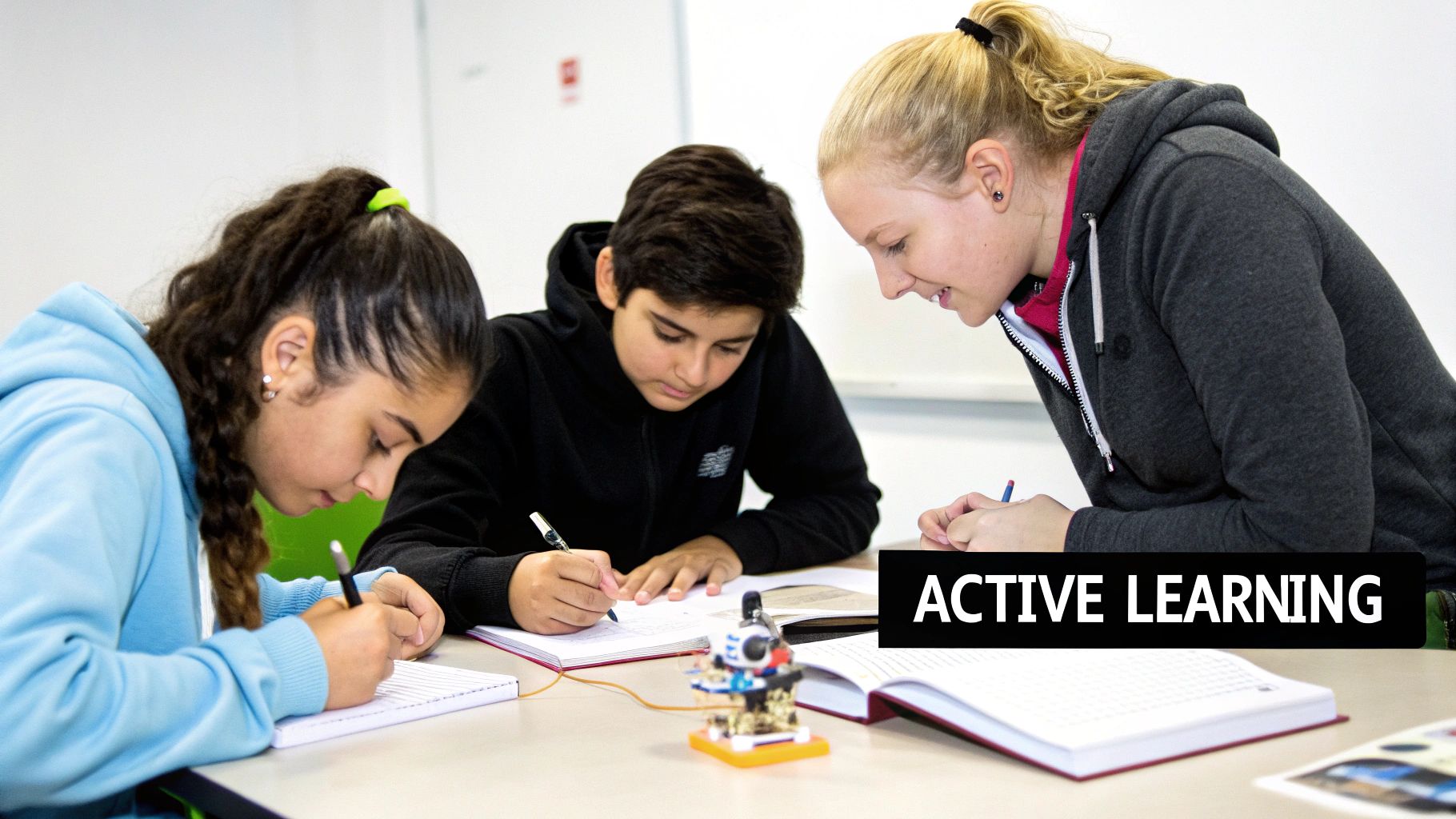
This approach respects a child's natural curiosity and desire to "do." When a Year 7 student builds a simple circuit in an online physics simulation rather than just reading about one, the concept of electrical flow becomes tangible and memorable. The small thrill of seeing the virtual bulb light up creates a positive emotional anchor to the learning. Similarly, a Sixth Form business student analysing a real-world case study on a struggling company feels the weight and complexity of decision-making, transforming abstract theory into a compelling challenge.
How to Implement Active Learning
The key is to integrate activities that demand cognitive and emotional engagement. Begin with low-stakes tasks to build confidence before progressing to more complex challenges.
- Think-Pair-Share: Pose a thought-provoking question, like "What would our world be like without gravity?" Give students a quiet moment to imagine, then have them discuss their ideas with a partner in a breakout room before sharing with the class. This validates their individual creativity.
- Problem-Based Learning: Present a real-world problem for a group to solve. For example, a primary class could be tasked with designing a "buddy bench" for their community playground to combat loneliness, requiring empathy and practical planning.
- Interactive Quizzing: Use tools like Kahoot! or Mentimeter to turn revision into a fun, competitive game. The excitement of the countdown and the joy of a correct answer makes learning feel less like a test and more like a shared experience.
- Peer Instruction: Inspired by Dr. Eric Mazur's work at Harvard, this involves students explaining concepts to one another, which solidifies their own understanding and builds their confidence as capable teachers.
Key Insight: Active learning is particularly effective for students with SEN, as it provides multiple modalities for engagement beyond traditional auditory learning. For a child who struggles with long lectures, a hands-on, kinaesthetic task can be a moment of relief and unlock a feeling of success.
Creating a psychologically safe online environment where it's okay to make mistakes is paramount. By providing clear instructions and immediate, constructive feedback, you empower students to take intellectual risks, building not just knowledge, but also the confidence and resilience essential for lifelong success.
2. Gamification
Gamification applies game mechanics and design principles to educational contexts, transforming learning from a task into a compelling quest. It leverages elements like points, badges, leaderboards, and narrative-driven challenges to boost motivation and participation. This approach is a cornerstone of modern student engagement strategies because it taps into a child's innate desire for achievement, competition, and reward, making the learning process itself feel enjoyable and exciting.

This strategy speaks directly to a child's love of play and their need for visible progress. Imagine a Year 5 student learning multiplication tables not through rote memorisation, but by competing in a timed, colourful quiz on a platform like Kahoot!, feeling the rush of excitement as they race against classmates to reach the top. Similarly, a GCSE computer science student could use Minecraft: Education Edition to build virtual logic gates, turning an abstract concept into an interactive, creative construction project and feeling a surge of pride in what they’ve built.
How to Implement Gamification
The goal is to seamlessly integrate game-like elements that support, rather than distract from, the learning objectives. The focus should be on celebrating effort and progress for every child.
- Create Learning Quests: Frame a unit of study as a quest or mission. A history topic on Ancient Egypt could become a "Tomb Raider's Challenge," where students earn "experience points" for completing assignments, "unlocking" the next stage of the topic with a sense of adventure.
- Award Badges for Skills: Use digital badges to recognise specific achievements, such as "Grammar Guru" for mastering punctuation or "History Detective" for using primary sources well. This provides a tangible sense of accomplishment and pride.
- Use Points and Leaderboards: Implement a points system for participation and homework completion. A leaderboard can foster friendly competition, but ensure it's balanced with collaborative "team goals" so every child feels they can contribute to success.
- Incorporate Narrative: Weave a story around the learning material. A primary science lesson on ecosystems could become a mission to help a virtual animal find the right habitat, creating an emotional connection to the learning objective.
Key Insight: For students with SEMH needs, particularly those who struggle with motivation or have anxiety around failure, gamification can be transformative. It reframes mistakes as opportunities to "try again" or "level up," lowering the stakes and building a more positive, resilient relationship with learning.
Success with gamification depends on aligning the "game" with meaningful educational outcomes. When a reward is directly tied to mastering a concept, it provides powerful intrinsic motivation that goes far beyond just winning points, fostering a genuine love for the subject and a drive for personal growth.
3. Personalized Learning Paths
Personalized learning moves beyond a one-size-fits-all approach, tailoring educational content and pacing to meet each student's unique needs, strengths, and interests. It leverages technology and data to create a flexible, individualised journey where learners can progress at their own speed. This is a crucial student engagement strategy because it honours the individual, making education feel relevant, respectful, and achievable rather than prescriptive and overwhelming.
This method respects that every child learns differently and values their unique pace. Imagine a Year 9 student who excels in algebra but struggles with geometry. Instead of feeling held back or left behind, an adaptive platform provides her with challenging algebra problems while offering foundational support in geometry. This prevents the boredom that can lead to disengagement and the frustration that can crush confidence, empowering her to feel competent and in control of her learning.
How to Implement Personalized Learning Paths
The focus is on providing choice and adapting to individual progress. This requires a blend of technology and attentive teacher guidance to ensure no child feels left behind or isolated.
- Diagnostic Assessments: Begin with low-stakes quizzes to identify each student's starting point. Frame this not as a test, but as a way to "build the perfect learning map just for you," making the child feel seen from day one.
- Student Goal-Setting: Involve students in setting their own learning targets. A simple conversation—"What are you most curious about in this topic?"—gives them a sense of ownership and makes their emotional investment in the outcome personal.
- Use Adaptive Technology: Employ platforms like DreamBox or IXL that automatically adjust the difficulty of questions based on a student's responses, providing real-time support without the student ever feeling singled out.
- Flexible Content Formats: Offer resources in various formats, such as videos for visual learners, articles for readers, and interactive simulations for kinesthetic learners. This respects their individual preferences and supports the move towards self-directed learning.
Key Insight: For students with SEMH needs, personalization is transformative. By removing the constant, stressful pressure of keeping up with the class and allowing them to work at a comfortable pace, you reduce anxiety and create a psychologically safe space for learning to flourish.
The teacher's role shifts from a lecturer to a facilitator and guide, monitoring progress, providing one-to-one encouragement, and celebrating individual milestones. This responsive, supportive approach ensures that while the path is personal, the destination of deep understanding is shared.
4. Peer Teaching and Collaborative Learning
Peer teaching and collaborative learning transform students from passive recipients of information into active creators of knowledge. This strategy harnesses the power of social interaction, allowing learners to teach and learn from one another in a structured environment. It’s one of the most effective student engagement strategies because it reinforces understanding through explanation and builds a supportive, student-led learning community where every child feels they belong.
This approach capitalises on the idea that to teach something is to truly understand it. When a GCSE Chemistry student explains the concept of covalent bonding to a classmate in a breakout room, they feel a sense of responsibility and pride in their own knowledge. Similarly, when a group of Year 8 students work together to script and record a short historical drama about the Norman Conquest, they feel the shared joy of creation and build friendships, making the learning memorable and emotionally resonant.
How to Implement Peer Teaching and Collaborative Learning
The goal is to create structured tasks where every student has a meaningful role and feels valued. Begin with clear guidelines and scaffolds to ensure interactions are productive and inclusive.
- Jigsaw Method: Divide a complex topic into smaller parts. Assign each student in a "home group" one part to become an "expert" on. This gives each child a special role and a sense of importance before they return to teach their home group.
- Reciprocal Peer Tutoring: Pair students to take turns as tutor and tutee. For instance, one student could summarise a poem while the other asks clarifying questions. This builds empathy as they experience both sides of the learning process.
- Think-Pair-Share: A classic for a reason, this simple structure ensures every voice is heard. A primary student can think about their favourite character in a book, share with a partner in a safe, low-pressure environment, and then feel more confident presenting their idea to the whole class.
- Peer-Led Team Learning (PLTL): Organise small groups to work through challenging A-Level STEM problems, guided by a peer who has already mastered the material. This creates a supportive, less intimidating learning dynamic.
Key Insight: For a student with SEMH needs who feels anxious speaking to an authority figure, explaining a concept to a peer can feel much less intimidating. This builds their confidence and communication skills in a low-stakes, supportive setting, helping them find their voice.
Success hinges on fostering a culture of mutual respect where students feel safe to ask questions and make mistakes. By carefully structuring group activities, providing clear roles, and celebrating collaborative achievements, you empower students to take ownership of their learning, developing vital teamwork and leadership skills for their future.
5. Real-World Applications and Project-Based Learning
Connecting classroom concepts to tangible, real-world outcomes is a cornerstone of deep and lasting student engagement strategies. Project-based learning (PBL) moves beyond theoretical knowledge by challenging students to investigate and respond to an authentic, engaging, and complex question or challenge. This approach makes learning feel relevant and purposeful, answering the age-old student question, "Why do I need to learn this?" with a powerful, emotionally satisfying "Because it matters."
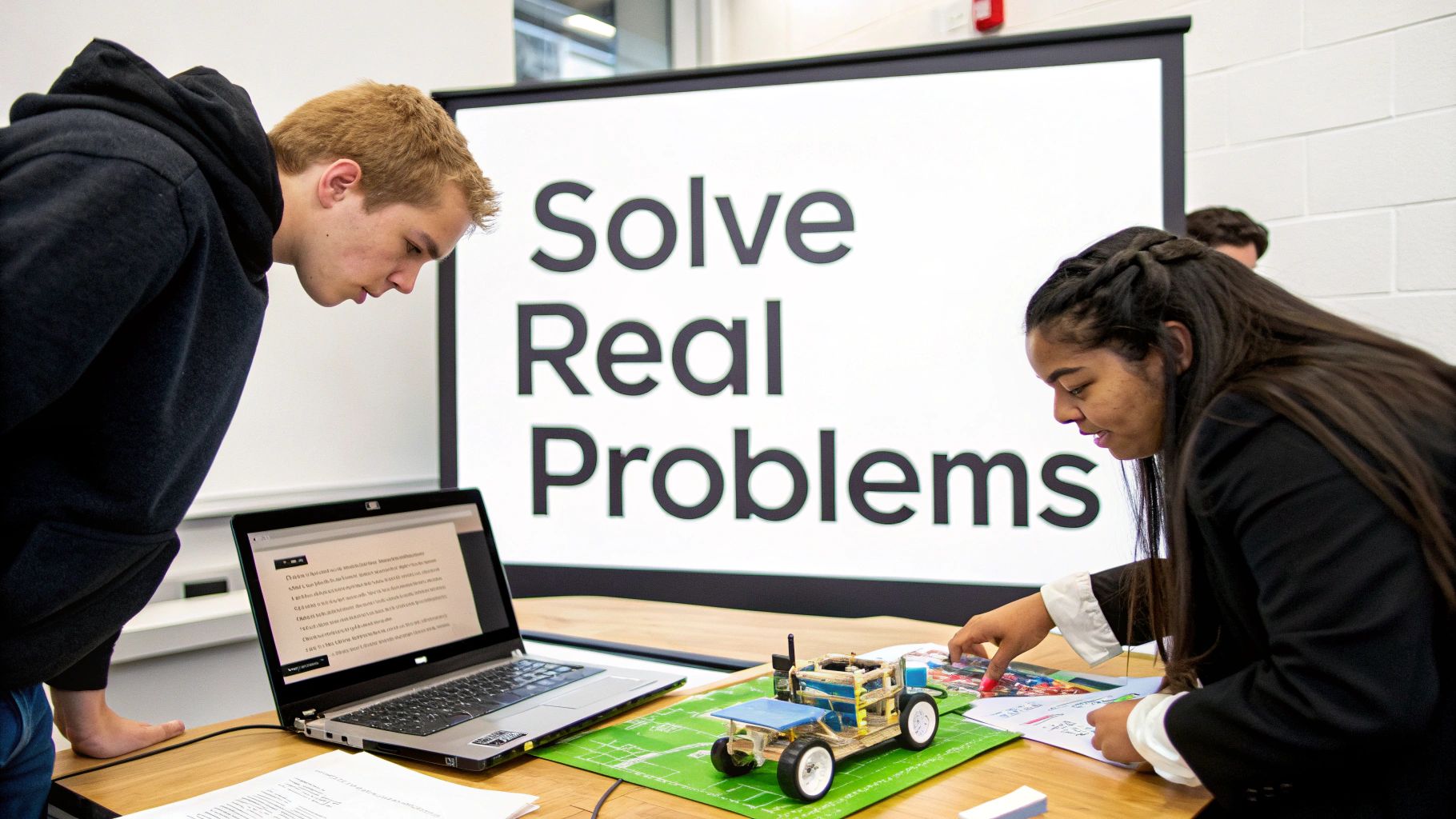
This method taps into a child's innate desire to create, solve, and make an impact. Imagine a GCSE Geography group not just learning about coastal erosion, but designing a public awareness campaign for a specific local community, feeling a sense of purpose as they use real data to create something that could help people. Or consider a group of primary students tasked with planning a sustainable school garden; the joy they feel in calculating costs, researching native plants, and imagining the flowers they will grow makes learning a mission, not just a subject.
How to Implement Project-Based Learning
The goal is to design projects that require inquiry, application of knowledge, and creation of a public product. Start with a compelling "driving question" that sparks a child's natural curiosity.
- Balance Structure and Choice: Provide clear project milestones, rubrics, and deadlines, but allow students significant voice and choice. Letting them choose how to present their work—a video, a report, a model—respects their individual talents and builds ownership.
- Teach Project Management Skills: Explicitly teach students how to collaborate in an online setting, manage timelines, and delegate tasks. Using shared documents and digital tools helps them feel organised and in control.
- Integrate Checkpoints and Feedback: Build in regular checkpoints for students to share their progress and receive encouraging feedback. This prevents last-minute stress and reinforces the feeling that their work is valued throughout the process.
- Incorporate a Public Audience: Have students present their work to an audience beyond the teacher—such as another class or their parents. This raises the stakes and gives them the profound satisfaction of sharing their creation with others.
Key Insight: For learners with SEMH needs, PBL can be transformative. The sense of agency and ownership over a meaningful project can significantly boost self-esteem. A student who feels disengaged from traditional lessons might thrive when given the responsibility to lead a part of a project they truly care about.
By framing learning around real-world challenges, you empower students to see themselves as capable problem-solvers. This not only builds academic knowledge but also develops critical life skills and the deep-seated confidence that they can make a positive difference in the world.
6. Feedback and Formative Assessment
Effective feedback and formative assessment transform learning from a one-way broadcast into a responsive, caring conversation. Instead of waiting for a summative exam, this approach uses regular, low-stakes checks to understand where a child is in their learning journey. This continuous loop of information is one of the most crucial student engagement strategies, as it helps students see exactly where they are and what their next steps should be, making learning feel like a supported, navigable path rather than a series of hurdles.
This process demystifies learning and builds a child's confidence. When a GCSE Chemistry student uses a quick poll to answer a question and receives instant, targeted feedback, they can correct their misunderstanding immediately without feeling embarrassed. Similarly, a primary student who receives a specific comment on their story about using more "powerful verbs"—"I loved how you described the storm! How could you make the lightning sound even more exciting?"—feels encouraged and empowered with a clear, achievable goal, rather than feeling criticised.
How to Implement Feedback and Formative Assessment
The goal is to make assessment an ongoing, supportive part of the learning process, not a final judgement. The tone should always be encouraging, focusing on growth.
- Exit Tickets: At the end of a lesson, ask a simple question like, "What was the most interesting thing you learned today?" or "What are you still curious about?" This values their personal experience and provides a snapshot of their engagement.
- Interactive Platforms: Use tools like Peardeck or Formative to embed questions directly into lesson slides. This allows you to see responses in real-time and offer gentle guidance on the spot.
- Structured Peer Review: Provide students with a clear, kind rubric ("What is one thing your partner did really well? What is one suggestion you can offer?"). This teaches them how to be supportive critics and builds community.
- "Two Stars and a Wish": A simple and effective feedback model where you highlight two things the student did well (stars) and one specific area for improvement (a wish). This frames feedback positively and focuses on future growth.
Key Insight: For a student with SEMH needs, timely and positive feedback can be a powerful tool for building self-esteem. Focusing on their effort and progress—"I can see how hard you worked on this!"—helps create a secure learning environment where they feel valued for who they are, not just what they produce.
Providing feedback that is specific, actionable, and kind is essential. By sharing assessment criteria upfront and involving students in the process, you shift the dynamic from being "judged" to being "guided," fostering a profound sense of trust and ownership over their academic growth.
7. Student Voice and Choice
Giving students a voice and a choice in their learning journey transforms them from passive recipients of information into active partners in their own education. This strategy centres on incorporating their input into what and how they learn, fostering a powerful sense of ownership, relevance, and autonomy. It is one of the most validating student engagement strategies as it sends a clear emotional message to a learner: "You matter here. Your ideas are important."
This approach respects the student as an individual with unique interests and passions. When a Year 9 history student is given the choice to research a historical figure they personally admire, the task becomes an exciting personal quest instead of a chore. Similarly, allowing a Sixth Form English student to choose their essay format—a traditional paper, a podcast script, or a creative presentation—empowers them to showcase their knowledge in a way that feels authentic to them, boosting their confidence and pride in their work.
How to Implement Student Voice and Choice
The key is to create authentic opportunities for student input without overwhelming them. Start with structured choices and expand as students become more confident in their decision-making.
- Choice Boards: Create a grid of activities for a topic. A primary student might choose three tasks from nine options to show their understanding of plant life, allowing them to gravitate towards activities they enjoy, such as drawing, building, or writing.
- Student-Led Discussions: Facilitate forums where students can propose topics for discussion. Asking, "What part of this chapter was most confusing or interesting to you?" puts their needs and curiosities at the heart of the lesson.
- Feedback Loops: Regularly use simple surveys to ask students, "What helps you learn best in our class?" and "What makes learning feel difficult?" Crucially, act on this feedback and tell them, "I heard you, and here's a change we're making together."
- Co-created Rubrics: Involve older students in defining the success criteria for an assignment. This demystifies expectations and increases their emotional investment in the quality of their work because they helped build the standard.
Key Insight: For students with SEMH needs, providing choice can be a powerful tool for reducing anxiety and restoring a sense of control. Offering a simple choice, such as "Would you like to work on this in a breakout room or on your own?" can de-escalate stress and re-engage a child who is feeling overwhelmed.
Building a classroom culture where student input is genuinely valued is essential. By transparently showing learners how their feedback shapes their educational environment, you foster not only engagement but also critical thinking, self-advocacy, and a deep sense of belonging.
8. Technology-Enhanced Learning
Technology-enhanced learning (TEL) strategically integrates digital tools to create dynamic, multimedia-rich educational experiences. Far more than just using a computer, this approach transforms the learning environment, making it more interactive, personalised, and accessible. As one of the most versatile student engagement strategies, TEL can unlock new ways for learners to explore concepts, collaborate, and express their understanding, making learning feel exciting and modern.
This approach places powerful tools directly into students' hands, empowering them to take ownership of their learning. Imagine the wonder a primary student feels while exploring ancient Rome using a virtual reality headset, walking its streets instead of just seeing pictures. Consider a GCSE history group collaborating on a shared digital timeline, adding notes and sources simultaneously, feeling the collective energy of building knowledge together in a way that feels like a shared creative project.
How to Implement Technology-Enhanced Learning
The goal is to use technology as a purposeful tool that amplifies learning and sparks curiosity, not as a distraction. The child's learning need should always drive the choice of tool.
- Gamify Revision: Use platforms like Classcraft or Kahoot! to turn revision sessions into exciting quests, tapping into students' natural love for play and friendly competition, making studying feel less like a chore.
- Create Digital Escape Rooms: Design curriculum-based puzzles that require critical thinking and teamwork for students to "escape." The shared thrill of solving the final clue together builds camaraderie and positive memories.
- Leverage Collaborative Platforms: Use Google Classroom or Microsoft Teams to facilitate group projects and peer feedback sessions. This creates a connected learning community where students can support each other's work.
- Explore Immersive Worlds: For complex subjects like biology, an immersive VR experience of travelling through the human bloodstream can make abstract concepts tangible and unforgettable, sparking genuine awe.
Key Insight: For students with SEN, particularly those with dysgraphia, TEL is a game-changer. Tools like speech-to-text software allow them to express their complex ideas without the frustrating barrier of handwriting, building their confidence and allowing them to feel truly heard.
Ultimately, successful TEL is about thoughtful integration. By ensuring all students have equitable access and providing clear guidance on digital citizenship, you can create a learning environment that is not just engaging, but also prepares students with the essential skills and confidence they need for the future.
9. Social-Emotional Learning (SEL)
Social-Emotional Learning (SEL) is the process of developing the self-awareness, self-management, and interpersonal skills vital for school, work, and life success. It acknowledges that a child's emotional state is intrinsically linked to their ability to learn. As a core student engagement strategy, SEL moves beyond academics to build the whole child, equipping them with the tools to understand their feelings, show empathy for others, and navigate life's challenges with resilience.
When an online educator starts a lesson by asking students to share one word about how they are feeling, it normalises emotional expression and builds a connected, trusting community. A Year 9 student learning to identify their anxiety before a big presentation can then use a calming technique, allowing them to focus on the task rather than being overwhelmed by fear. This focus on emotional intelligence creates resilient, self-aware learners who feel safe enough to engage with academic challenges.
How to Implement Social-Emotional Learning
Integrating SEL means making it a consistent part of the classroom culture, not just an occasional activity. The goal is to create a safe, supportive environment where every child feels seen, heard, and valued.
- Daily Check-ins: Begin lessons with a quick emotional check-in. A simple "mood meter" poll where students can privately share how they're feeling allows the teacher to offer quiet support to a child who is having a tough day.
- Integrate into Curriculum: Use literature to discuss a character's motivations and feelings, building empathy. A primary class reading Charlotte's Web can talk about friendship, loss, and courage, connecting the story to their own lives.
- Teach Mindfulness: Introduce short, guided breathing exercises to help students manage stress before an assessment. This gives them a practical tool to feel calm and in control.
- Role-Playing Scenarios: Present students with relatable social dilemmas, like disagreeing respectfully with a friend. Practising these skills in a safe space builds their confidence for real-life situations.
Key Insight: For students with SEMH needs, a predictable SEL routine can be incredibly grounding. Explicitly teaching emotional vocabulary and coping strategies provides a vital toolkit that empowers them to manage their feelings and access their learning more effectively, reducing classroom anxiety.
By embedding SEL into the fabric of online education, you foster a climate of trust and respect. When students feel emotionally secure, their capacity for academic engagement and intellectual curiosity expands dramatically, allowing their true potential to shine.
10. Inclusive and Differentiated Instruction
Inclusive and differentiated instruction is a teaching philosophy that recognises and honours the unique learning profile of every child. It tailors the content, process, and products of learning to meet individual needs, ensuring that every student has an equal opportunity to thrive. This approach moves beyond a one-size-fits-all model, making it one of the most fundamental student engagement strategies for creating an equitable and deeply caring online classroom where every child feels they belong.
This method places the child's needs at the centre of all educational decisions. For a Year 9 student with dyslexia, differentiation might mean providing an audio version of a history text, removing the barrier of reading so they can engage with the ideas. For a gifted Sixth Form mathematician, it could involve providing complex, open-ended problems that ignite their passion. The goal is to provide the "just right" level of challenge to keep every learner progressing and feeling a sense of pride and accomplishment. You can find out more by reading our guide on what differentiated learning is.
How to Implement Inclusive and Differentiated Instruction
Effective differentiation is proactive and thoughtful. It involves planning for variety from the outset and using ongoing assessment to make adjustments with the child's wellbeing in mind.
- Use the Universal Design for Learning (UDL) Framework: Offer multiple ways for students to take in information (e.g., text, audio, video) and multiple ways for them to show what they know (e.g., writing, drawing, speaking). This built-in flexibility respects their strengths.
- Offer Tiered Activities: Design tasks that address the same learning objective but at different levels of complexity. This allows every child to feel successful and appropriately challenged.
- Provide Choice: Allow students to choose how they learn a concept or demonstrate their understanding. A primary student could choose between creating a poster, writing a report, or recording a video to show their knowledge of the solar system, empowering them to use their talents.
- Create Flexible Groupings: Use a mix of individual work, pairs, and small groups that change based on the task. This ensures students aren't permanently labelled and can learn from all of their peers.
Key Insight: To truly foster engagement for all learners, implementing effective ADHD classroom accommodations is paramount. Simple adjustments, like providing clear, step-by-step instructions or allowing for movement breaks, can make a child feel understood and set up for success.
By consistently adapting to the diverse learners in your classroom, you send a powerful message: every student belongs, and every student can succeed. This builds a foundation of trust and psychological safety, empowering children to fully engage with their education and reach their unique potential.
Student Engagement Strategies: 10-Point Comparison
| Strategy | Implementation complexity 🔄 | Resource requirements ⚡ | Expected outcomes 📊 | Ideal use cases 💡 | Key advantages ⭐ |
|---|---|---|---|---|---|
| Active Learning Techniques | Moderate–high prep; needs classroom management 🔄 | Low–moderate (materials, space, instructor time) ⚡ | Higher retention (↑50–70%); deeper understanding 📊 | Small–medium classes; STEM labs; discussion-led courses 💡 | Strong engagement; peer learning; critical thinking ⭐ |
| Gamification | High design & maintenance effort; iterative updates 🔄 | Moderate–high (platforms, design, analytics) ⚡ | Increased motivation & practice engagement; measurable progress 📊 | Repetitive practice, language learning, large online courses 💡 | Boosts motivation; instant feedback; progress visibility ⭐ |
| Personalized Learning Paths | High (algorithms, data integration) 🔄 | High (adaptive tech, data systems, maintenance) ⚡ | Improved outcomes for diverse learners; gap reduction 📊 | Remediation/acceleration, blended learning, adaptive platforms 💡 | Tailored pacing; targeted support; student agency ⭐ |
| Peer Teaching & Collaborative Learning | Moderate (training, group structure) 🔄 | Low–moderate (time, coordination, basic materials) ⚡ | Better retention via teaching; improved communication skills 📊 | Study groups, peer tutoring, discussion-heavy classes 💡 | Relatable explanations; community building; reduces teacher load ⭐ |
| Real-World Applications / PBL | High (planning, partnerships, assessment design) 🔄 | High (materials, time, external partners) ⚡ | Strong application skills; 21st‑century competencies; tangible outputs 📊 | Interdisciplinary projects, capstones, career-connected learning 💡 | Relevance; problem-solving; student ownership ⭐ |
| Feedback & Formative Assessment | Moderate (rubrics, frequent checks) 🔄 | Low–moderate (tools, teacher time) ⚡ | Actionable improvement; better summative performance; metacognition 📊 | Any course needing continuous monitoring; writing/workshops 💡 | Timely guidance; reduces high‑stakes anxiety; informs instruction ⭐ |
| Student Voice & Choice | Moderate (facilitation, boundaries) 🔄 | Low (meeting time, planning) ⚡ | Increased ownership & relevance; improved attendance/behavior 📊 | Project-based classes, electives, advisory periods 💡 | Autonomy; inclusivity; higher engagement ⭐ |
| Technology-Enhanced Learning | Moderate–high (integration, training) 🔄 | High (infrastructure, licenses, support) ⚡ | Greater access, multimedia learning, scalable delivery 📊 | Remote/hybrid, large-scale courses, adaptive learning 💡 | Personalization at scale; diverse resources; collaboration tools ⭐ |
| Social-Emotional Learning (SEL) | Moderate (ongoing integration) 🔄 | Moderate (training, curricula, time) ⚡ | Improved wellbeing; modest academic gains (4–11%); fewer behavior issues 📊 | K–12 settings, counseling programs, whole-school initiatives 💡 | Mental health support; social skills; school connectedness ⭐ |
| Inclusive & Differentiated Instruction | High (planning, continuous assessment) 🔄 | Moderate–high (specialists, materials, assistive tech) ⚡ | Improved access & outcomes; reduced achievement gaps 📊 | Diverse classrooms; mixed‑ability groups; inclusive settings 💡 | Equity-focused; supports all learners; UDL alignment ⭐ |
Creating a Culture of Engagement, One Child at a Time
Navigating the landscape of online education requires more than simply replicating a physical classroom on a screen. As we have explored, the most effective student engagement strategies are not about finding a single magic formula. Instead, they involve weaving together a rich tapestry of techniques that place the child at the very centre of their learning journey. This journey is about moving from passive reception to active participation, transforming education from a monologue into a dynamic, ongoing dialogue.
From the vibrant competition of gamification to the deep, meaningful connections forged through peer teaching, each strategy offers a unique pathway to unlocking a student's potential. The key is not to implement every idea at once, but to thoughtfully select and adapt approaches that resonate with each learner's individual needs, interests, and developmental stage. This is the essence of building a truly inclusive and responsive learning environment.
The Core Thread: Connection and Ownership
A common thread running through all these powerful methods is the cultivation of connection and ownership. When students see the real-world relevance of their studies through project-based learning, or when their unique voice is heard and valued through choice-based assignments, they begin to see education as something that belongs to them, not something that is done to them.
This sense of ownership is the catalyst for intrinsic motivation. It shifts the focus from external rewards to the internal satisfaction of understanding, creating, and contributing.
"True engagement is not just about a student paying attention. It's about a student investing a part of themselves in the learning process because they feel seen, heard, and respected as an individual."
By integrating social-emotional learning and providing consistent, constructive feedback, we build the psychological safety net that allows students, especially those with SEN or SEMH needs, to take intellectual risks. They learn that making a mistake is not a failure but a crucial step towards mastery.
Your Actionable Next Steps
Mastering these concepts transforms your role from a mere observer to an active partner in your child's education. It empowers you to advocate for their needs and to create a supportive home environment that complements their online schooling. The ultimate value lies in fostering a lifelong love of learning, a skill that will serve them far beyond their GCSEs and A-Levels.
To put these insights into practice, consider these immediate steps:
- Review and Reflect: Look back at the ten strategies discussed. Identify one or two that you feel would most benefit your child right now. Is it introducing more real-world connections to their maths homework? Or perhaps finding a collaborative project they can work on with a peer?
- Open a Dialogue: Talk to your child about their learning. Ask them which lessons they find most exciting and why. Their answers are a valuable roadmap, pointing directly towards the student engagement strategies that already resonate with them.
- Partner with Their School: Share your observations and ideas with their teachers. A collaborative approach between home and school is the most powerful way to create a consistent, engaging educational experience that adapts to your child’s evolving needs.
Ultimately, fostering engagement is an act of empathy and intention. It is about understanding that behind every screen is a unique young person with their own hopes, challenges, and boundless potential. By intentionally applying these diverse and dynamic student engagement strategies, we do more than prepare them for exams. We equip them with the curiosity, confidence, and resilience to thrive in a complex world, ensuring they become not just successful students, but engaged, inquisitive, and joyful lifelong learners.
At Queens Online School, we build our entire educational philosophy around these principles, using small class sizes and specialist teachers to implement personalised and engaging learning experiences every day. Discover how our child-centred approach can unlock your child's full potential by visiting us at Queens Online School.