
Choosing a sixth form in the UK is a huge moment, not just for your child, but for you too. It's the two-year bridge between the familiar, structured world of secondary school and the exciting independence of university or a career. This is where your child, now a young adult aged 16 to 18, gets to dive deep into the subjects that truly spark their curiosity and start building the foundations for the future they dream of.
Navigating Your Child's Next Big Step
Let’s be honest: this decision can feel monumental, because it is. As a parent, you're likely feeling a mix of immense pride for how far they've come and a knot of anxiety about helping them make the 'right' choice. This is about so much more than just picking subjects; it’s about finding an environment where they will feel seen, valued, and that they truly belong.
This guide is designed to walk with you through this journey, turning that uncertainty into confidence. We'll explore everything from what a sixth form in the UK actually feels like day-to-day, to how you can match an environment to your child’s unique personality, hopes, and dreams. The goal isn’t just to find a place that looks good on paper. It’s to find a community where your child will be supported, challenged, and ultimately, feel happy and thrive.
Why This Choice Matters So Much
The leap from the highly timetabled GCSE years to the greater freedom of sixth form can be a shock to the system. Suddenly, your child will have 'free periods' and be expected to manage their own study time—a skill that is absolutely essential for what comes next. It’s about understanding who your child is right now. For example, a student who thrived with constant teacher direction and encouragement might need a sixth form with strong pastoral support to help them build confidence. On the other hand, a real self-starter who is itching for independence might flourish in a college setting that feels more like a university campus from day one.
"At university… studying becomes much more independent, and it is up to you how you want to spend your free time. [Sixth form] is the preparation for that." – Hanna Khalil, University of Birmingham Student Content Shaper.
This period isn’t just academic; it’s a crucial time for personal growth. The right setting can boost your child's confidence, help them discover new passions, and build the resilience they'll need for whatever life throws at them. So, let's make this journey a positive and empowering experience for your family.
Understanding the Different Sixth Form Environments
The term 'sixth form' isn't a one-size-fits-all label. It actually covers a whole range of educational settings, each with its own unique feel, culture, and heartbeat. The key is to find the right match for your child's personality and how they learn best. Are they someone who feels most confident surrounded by familiar faces and routines, or are they itching for a new challenge and a taste of independence?
Let’s dig into what these different options really mean for your child, going beyond the glossy brochures to get to the heart of what makes each one tick.
School Sixth Forms: The Comfort of Continuity
For many students, the most natural next step is simply staying on at their current secondary school’s sixth form. The biggest draw here is familiarity—a feeling of safety and security. Your child already knows the teachers who have supported them, the layout of the buildings, and the unwritten social rules. This sense of continuity can be a massive relief, taking the emotional weight off the anxiety that often comes with big life changes.
This stability is a real advantage for students who do well in a structured, predictable environment. Imagine a teenager who is a bit shy or finds big changes overwhelming; staying put allows them to pour all their energy into their new, more challenging A-Level or BTEC courses without the extra stress of navigating a new social scene or a different school culture.
And the numbers back this up. It's a hugely popular choice. In 2020, 217,000 students stayed on in school sixth forms across the UK. What's more, of those finishing their studies at state-funded schools that have a sixth form, 47% chose to remain at the same place for their post-16 education. That really highlights the strong appeal of staying in a place that feels like home.
Sixth Form Colleges: A Taste of University Life
On the other end of the spectrum, you have dedicated sixth form colleges, which often feel like a mini-university. These places are typically much larger, pulling in students from all sorts of secondary schools across a wider region. The atmosphere is buzzing, diverse, and has a distinctly more grown-up vibe.
This environment is perfect for the student who is ready to stretch their wings. Perhaps your child is the one who organises everything themselves, who is always curious about the world outside their town. Here, they’ll likely be on a first-name basis with their tutors, be responsible for managing their own ‘free periods’ for independent study, and get to mix with a much broader group of people who share their passions.
A key difference lies in specialisation. Sixth form colleges are laser-focused on post-16 education. This means every single resource, from the specialist tutors to the careers advisors, is geared towards the needs of 16-18 year olds who are getting ready for their next big step.
This kind of setting really encourages self-reliance and good time management—skills that are absolutely invaluable for the jump to university or the world of work. It’s a fantastic choice for a young person who is ready to take more ownership of their education and carve out their own path.
Independent Schools and Online Alternatives
Beyond the state sector, independent (or private) schools offer another pathway. These often come with the promise of smaller class sizes, impressive facilities, and a heavy focus on academic achievement, though this is balanced by significant tuition fees.
A more recent and incredibly flexible option is the rise of the online sixth form. This model is perfectly suited for a child who needs a different kind of approach. For example, a student dealing with anxiety that makes a busy school overwhelming, an elite athlete whose training schedule is demanding, or simply a quiet learner who thrives in a focused home environment.
Online schools provide a fully structured curriculum with live, interactive lessons led by subject-specialist teachers. They deliver a high-quality British education that can be accessed from anywhere. For families looking for a modern, adaptable way to learn, you can learn more about how online A-Level courses can be tailored to fit your child's unique needs. It's a brilliant way to get a top-tier education with unparalleled flexibility.
Choosing Subjects That Ignite Passion and Open Doors
The qualifications your child chooses now will echo for years to come, shaping everything from their university applications to their future career. It’s a moment that feels heavy with importance, but it's also a fantastic opportunity for them to finally focus on the subjects that genuinely make them light up.
Let’s break down the two main pathways they'll encounter at a sixth form in the UK: A-Levels and BTECs.
Thinking about these qualifications isn't about deciding which is 'better' or 'worse'—it’s all about finding the 'best fit' for your child. The goal is to help them find that sweet spot where their genuine interests overlap with subjects that keep their future options wide open. This conversation, full of hopes and dreams, is really the heart of the sixth form journey.
A-Levels: The Academic Deep Dive
A-Levels are the traditional academic route, perfect for a student who loves getting lost in ideas, enjoys critical analysis, and wants to explore subjects in immense detail. You can think of them as specialised apprenticeships for the mind. Students typically pick three (or sometimes four) subjects to study over two years, leading up to a series of final exams.
This pathway is ideal for a young person with a clear passion for academic subjects who is likely aiming for a traditional university course. A-Levels are highly regarded by all universities, especially for degrees that require specific prior knowledge.
For example:
- An aspiring doctor, driven by a desire to help people, will need A-Levels in Chemistry and Biology.
- A future engineer, who has loved building things since they were small, will be expected to have Maths and Physics.
- A budding historian, fascinated by the stories of the past, will build a strong foundation with History, English Literature, and perhaps Politics.
The biggest challenge with A-Levels is the depth required. The jump from GCSEs is significant, demanding much more independent study and a real curiosity for the material. It's a route that rewards a child who genuinely loves learning for its own sake.
BTECs: The Practical Pathway to a Career
In contrast, BTECs (Business and Technology Education Council qualifications) are career-focused courses designed for students who learn best by doing. These are vocational qualifications that blend practical skills with theoretical knowledge. Think of them as a direct bridge into a specific industry or a more hands-on university degree.
The assessment style is completely different from A-Levels. Instead of all the pressure being on final exams, BTECs are often assessed through a mix of coursework, practical projects, and some external tests. This can be a huge relief for a talented student who finds the pressure of high-stakes exams overwhelming and doesn't feel they show what they can really do.
For instance:
- A teenager dreaming of becoming a paramedic, who is naturally caring and practical, would thrive with a BTEC in Health & Social Care.
- A creative student with a flair for visual art could take a BTEC in Art and Design to build a professional portfolio that truly showcases their talent.
- An aspiring entrepreneur who is full of ideas might choose a BTEC in Business to learn practical skills in marketing and finance.
This infographic can help you visualise which type of sixth form environment might best support your child's chosen path and learning style.
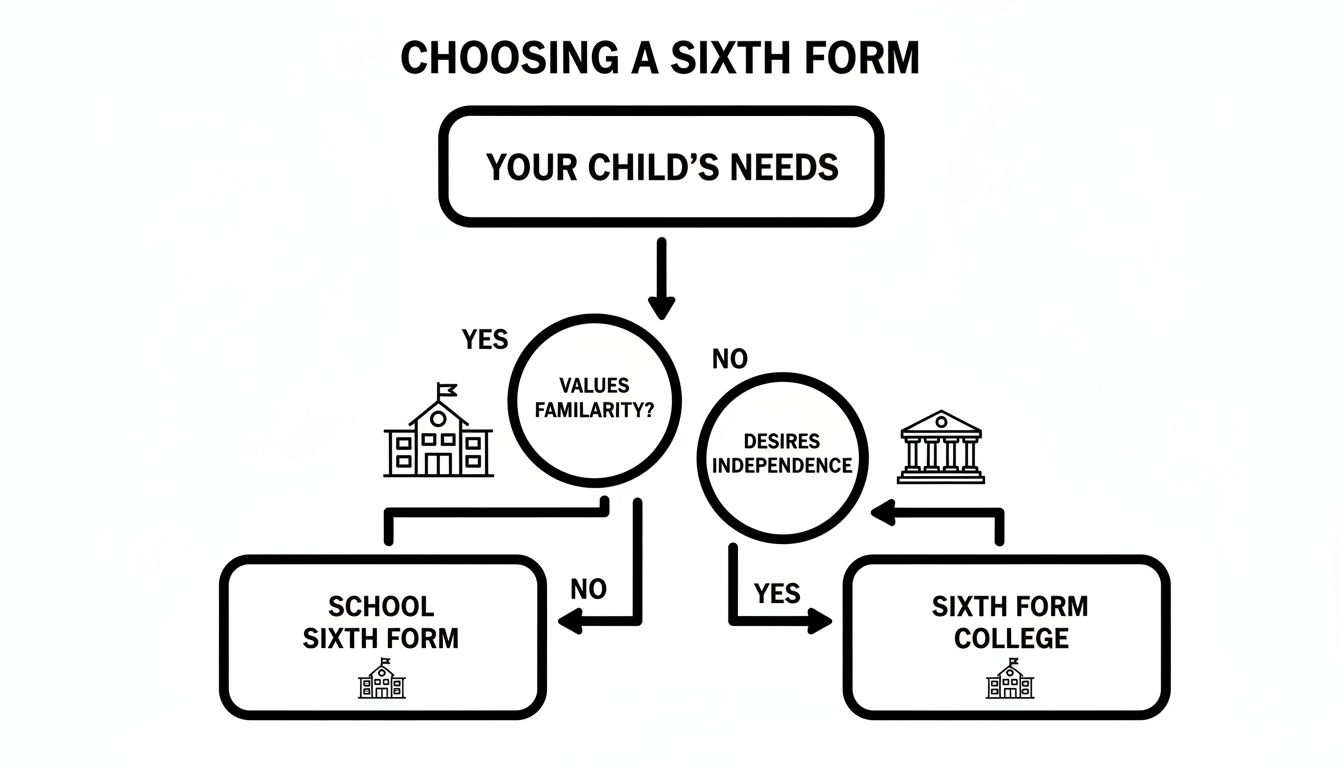
As the flowchart shows, thinking about whether your child feels more secure in a familiar school setting or is ready to embrace a more independent, college-like atmosphere is a great starting point for making a decision together.
A-Levels vs BTECs: Which Path Is Right for Your Child?
To make the choice clearer, it helps to see the key differences side-by-side. Both are respected Level 3 qualifications, but they suit different learning styles and goals. It’s all about what will make your child feel successful.
| Feature | A-Levels | BTECs (Vocational Qualifications) |
|---|---|---|
| Focus | Deeply academic and theoretical. | Practical, hands-on, and career-focused. |
| Structure | Students typically study 3-4 separate subjects. | Students focus on one broad subject area (e.g., Business, Health). |
| Assessment | Mainly assessed through final exams at the end of two years. | Continuous assessment through coursework, projects, and some exams. |
| Best For | Students who enjoy theory and research, aiming for traditional university degrees. | Students who prefer learning by doing, have a clear career path in mind, or want to build a portfolio of work. |
| University Progression | Accepted by all universities; sometimes required for specific courses. | Widely accepted by universities (UCAS points), particularly for related degrees. |
Ultimately, both paths can lead to university and successful careers. The right choice depends entirely on your child's strengths, what makes them feel passionate, and how they learn best.
Striking the Right Balance
The decision isn't always a straight choice between one or the other. Many sixth forms now offer mixed programmes where a student can combine one or two A-Levels with a BTEC, getting the best of both worlds. For example, a student who loves both Art (A-Level) and the idea of digital media production (BTEC) could create a powerful, personalised curriculum.
It's a popular landscape with many paths. Currently, around 1.6 million young people in England are in further education. While A-level participation has remained a strong choice for 43% to 47% of students for decades, a significant 19% pursue other Level 3 qualifications like BTECs, showing just how valued these vocational routes have become.
The most important goal is to help your child build a combination of subjects that feels both authentic to them and strategically sound. It's about translating their passions—whether for science, art, or sport—into a set of qualifications that will make them feel proud and prepared for what’s next.
Productive conversations often start with open questions that get to the heart of who they are. Ask your child what lessons they look forward to most, what topics they read about in their spare time, and what problems in the world they'd love to solve. Their answers are the clues that will lead you to the right subject choices together. Getting this right is a huge confidence booster, and our guide on picking strong A-Level subject combinations can provide even more clarity.
Making Sense of the Application Process
For many families, the whole process of applying to a sixth form in the UK can feel like a mad dash. It’s a blur of paperwork, deadlines, and the nail-biting wait for offers to land. But it doesn’t have to be that way. With a bit of planning and open communication, you can turn a stressful time into a really empowering experience for your child.
Think of this section as your family’s roadmap. We’ll walk through the typical timeline, from the buzz of open days in the autumn of Year 11 to the tense wait for offers in the spring. Our aim is to demystify the whole thing, lower the anxiety levels, and help your child feel confident and in control.
Your Step-by-Step Timeline
Getting your head around the application journey is much easier when you know what’s coming and when. While the exact dates might differ a little from place to place, the rhythm of the process is pretty consistent across the country. Breaking it down makes it far less daunting for everyone involved.
Here’s a rough guide to what a Year 11 student and their family can expect when applying to a sixth form in the UK:
- Autumn Term (September – December): This is prime research time. You’ll be going to open days and evenings together, collecting prospectuses, and drawing up a shortlist of potential schools and colleges. Applications usually open now, with deadlines often set between October and January.
- Spring Term (January – April): The focus now shifts to interviews and conditional offers. After the applications are in, your child might be invited for an interview or a taster day. This is a great chance for them to see if it really feels right. Soon after, sixth forms will start sending out conditional offers, which all hinge on them getting specific GCSE grades.
- Summer Term (May – August): It’s all about the exams. Once the hard work of GCSEs is done, the long, anxious wait for results day in August begins. This is a time for support and reassurance.
- Results Day (Late August): This is the big one. If your child has met the conditions of their offer, their place is officially confirmed. If things don’t go to plan, take a deep breath—it’s time to get on the phone to the schools and talk through the options. There is always a way forward.
"Managing the jump from sixth form to university… studying becomes much more independent, and it is up to you how you want to spend your free time. [Sixth form] is the preparation for that." – Hanna Khalil, University of Birmingham Student Content Shaper.
Decoding the Entry Requirements
At the end of the day, any sixth form offer comes down to your child's GCSE results. Every school or college has its own entry requirements, which are the minimum grades a student needs to get a place on their chosen courses. It’s so important to check these carefully for every single place and subject to avoid any heartbreak later on.
For example, a very academic sixth form might be looking for:
- A minimum of five GCSEs at grade 6 or above, including English and Maths.
- A grade 7 or higher in the specific subjects a student wants to take at A-Level.
On the other hand, some colleges might be more flexible, perhaps asking for five GCSEs at grade 4 or above. This is exactly why going to open days and reading the prospectus is non-negotiable—it ensures your child is applying to places where they have a realistic chance of being happy and successful.
Crafting a Personal Statement That Shines
Grades are one thing, but the personal statement is where your child really gets to tell their story. It’s a short piece of writing where they can let their unique personality, passions, and dreams shine through. This is your chance to help them go beyond just listing their accomplishments.
Encourage them to think about their experiences and link them to what they want to do next. Instead of just writing, "I enjoy History," they need to bring it to life with their own voice.
For instance, a child who loves animals could talk about how volunteering at a local shelter taught them responsibility and confirmed their desire to study A-Level Biology. Or they could write about how building a computer with a parent sparked a fascination with technology that now leads them to a BTEC in IT. This storytelling approach is far more compelling and shows the genuine, heartfelt interest that admissions tutors are always looking for.
Finding a Sixth Form That Supports Every Learner
Every child deserves to feel seen, understood, and supported as they navigate their education. The move to a sixth form in the UK is a huge step, and for many students, finding an environment that genuinely embraces their unique needs isn’t just important—it’s the key to them unlocking their full potential.
This is about looking beyond the league tables and exam results. It's about asking, "Will my child be happy here? Will they be cared for?" Whether your child has Special Educational Needs (SEN), requires support for their Social, Emotional, and Mental Health (SEMH), or is joining the UK system from abroad, the right sixth form will have solid, compassionate support structures in place. It’s the difference between a place they simply attend, and a place they truly belong.

Support for Students with SEN and SEMH Needs
For parents of children with additional needs, the biggest worry is often whether the new environment will be inclusive and properly equipped to help their child flourish. The good news is that awareness and provision are growing. Recent data shows that A-level cohorts now include 0.6% of students with Education, Health and Care (EHC) plans and 4.6% receiving SEN support, with both figures on the rise.
When you visit a potential sixth form, your focus should be on the people and the culture. Look for a dedicated Special Educational Needs Coordinator (SENCO) and a strong pastoral team. These are the individuals who will be your child's champions. For a deeper understanding of the provisions available, you can check out our guide on what SEN support involves. For families with autistic children, detailed guidance on how to support someone with autism can also offer crucial insights.
The most powerful question you can ask is: "Can you give me an example of how you've supported a student with similar needs to my child?" Their answer—the detail, the tone, the compassion—will reveal more about their true commitment than any policy document ever could.
Key Questions to Ask on an Open Day
To really get a feel for the level of support, you need to ask specific, practical questions. Don’t be afraid to dig a little deeper to understand their day-to-day approach to caring for students.
- Who is the main point of contact for SEN/SEMH support? (You want to feel they have a clear, warm, and organised system.)
- What training does your teaching staff receive on supporting diverse learning needs?
- How do you manage exam access arrangements, like extra time or a quiet space, to ensure students feel calm and prepared?
- What mental health and well-being services are available to all students? (e.g., counsellors, quiet rooms, well-being workshops.)
- How do you communicate with parents about a student's progress and well-being? (Look for a partnership approach.)
Options for International Students
For families moving to the UK, finding a sixth form that understands the international admissions process is key. But physically relocating isn't the only route to a British education. Online sixth forms offer a world-class experience without anyone having to pack a suitcase.
These virtual schools provide live, interactive A-Level classes taught by subject specialists, leading to the exact same globally recognised qualifications. This model allows a student to join a diverse, global classroom right from the comfort and security of their own home, ensuring a seamless and high-quality educational journey.
Your Action Plan for a Successful Transition
Right, let's turn all this information into a proper plan. This journey is a partnership between you and your child, and having a clear roadmap can transform what feels like a stressful process into something you can tackle together with excitement. The goal isn't just finding any sixth form; it's about finding the right one for your child.
Think of the next few months as a shared project. This checklist breaks down the key milestones to make sure you’ve got all your bases covered, helping you both move forward with confidence and feel ready for this brilliant next chapter.
Phase 1: The Research Stage (Autumn Term, Year 11)
This is all about exploration and discovery. The idea is to go from a huge, overwhelming list of options to a solid shortlist of places that genuinely feel like a great fit for your child's personality, how they learn, and what they dream of doing next.
- Create a Longlist: Sit down together with a cup of tea and start browsing the websites of all the local possibilities—school sixth forms, standalone colleges, and don't forget online providers.
- Book Open Days: These are non-negotiable. Nothing gives you a better sense of a place's soul than walking around the campus, chatting with current students, and meeting the teachers who might be guiding your child.
- Draft a Shortlist: After you've done the rounds, it's time to narrow it down to 3-5 serious contenders. Talk through the pros and cons of each one. What did they love? Where did they feel they could see themselves? What just didn't feel right?
Remember, this choice is deeply personal. A sixth form that’s perfect for their best friend might not be the right environment for your child. Trust their instincts and focus on finding a community where they can truly be themselves and feel happy.
Phase 2: The Application Stage (Winter and Spring Term)
With a clear shortlist in hand, the focus now shifts to the practical side of things. This is where you come in as a supportive guide, helping your child put their best foot forward without taking over the process.
- Check Deadlines and Requirements: Whip up a simple spreadsheet with the application deadlines and the specific GCSE grade requirements for each of your shortlisted sixth forms.
- Craft the Personal Statement: Help your child brainstorm ideas that really show off their passion. Instead of just saying "I like science," encourage them to write about the specific experiment that first sparked their curiosity and made them feel excited to learn more.
- Prepare for Interviews: If interviews are part of the process, run through a few practice questions. The aim isn't to create a rehearsed performance, but simply to help them feel more comfortable and confident talking about their interests and goals.
Phase 3: The Final Hurdles (Summer Term and Results Day)
The final leg of the journey is all about preparation and a bit of patience. The hard work of exams is the main event, followed by that nail-biting wait for results day.
To give them the best possible chance of success, encourage your child to master effective study techniques for exams that go beyond last-minute cramming. This will not only build their confidence for GCSEs but also set them up for the more independent style of study that A-Levels demand.
Finally, have a frank and reassuring conversation about Plan B. What happens if the grades aren't what they hoped for? Knowing there are always other options and that you’ll figure it out together takes a huge amount of pressure off, freeing them up to just focus on doing their best.
Common Questions About Sixth Form in the UK
Navigating the move to sixth form in the UK is a big deal, and it's bound to bring up questions and a few worries. It’s a huge step for your child, and feeling a little uncertain is completely normal for everyone involved. Here are some straightforward answers to the common concerns we hear from parents, designed to give you the practical information you need to feel confident and prepared.
What Happens If My Child Doesn't Get Their Predicted Grades?
This is probably the biggest fear for many families, but please don’t panic—it’s very rarely the end of the road. On results day, the absolute first thing to do is call the sixth form your child was hoping to join. Many will be compassionate and flexible, sometimes offering a place on a similar but slightly different course.
For instance, if your child missed a grade 7 in Maths needed for A-Level Physics but still did well overall, the school might suggest an alternative like a BTEC in Applied Science, which plays to their strengths in a different way. Some students also choose to resit their GCSE Maths or English alongside their new sixth form subjects. There are always options to explore.
The most important thing to remember on results day is that grades don't define your child's potential or their worth. It's a moment for a calm conversation with the school or college to find a new path forward—and there is always a path.
Can My Child Change Subjects If They've Made a Mistake?
Yes, in most cases, they can, and it's more common than you think. Nearly every sixth form has a grace period, usually lasting between two and four weeks, that allows students to switch courses. This is a crucial safety net because a subject that looks brilliant on paper can feel completely different in the classroom.
Imagine your child chose A-Level Economics but quickly realises it’s far more mathematical than they expected and the joy just isn't there. The best thing they can do is speak to their tutor or head of sixth form right away. As long as there's space in another subject (like Sociology or Business Studies) and they meet the entry requirements, a switch is often straightforward. It's much better to change early than to struggle for two years.
How Much Independence Should I Expect?
The leap in independence is one of the biggest changes, for both of you. Students are no longer spoon-fed information; they're expected to manage their own time, especially during 'free periods'. These aren't really breaks—they are scheduled hours for independent study, research, and getting homework done.
This shift is entirely intentional. It’s designed to prepare them for the self-discipline they'll need at university or in the workplace. Your role gently shifts from manager to mentor. It's about encouraging them to build good habits—like using a planner or starting assignments early—without controlling their every move.
Should They Stay or Should They Go?
Deciding between staying at their current school's sixth form or moving to a new college is a deeply personal choice. There’s no single "better" option; it all comes down to what fits your child's personality and goals.
- Staying Put: This offers the comfort of familiarity, established friendships, and teachers who already know their strengths and weaknesses. It's a great choice for a student who thrives on stability and security.
- Moving On: This provides a fresh start, a chance to meet new people, and often a wider variety of subject choices. It can be incredibly invigorating for a student who is ready to step out of their comfort zone and reinvent themselves a little.
The best way forward is to talk it through openly. Ask them which scenario makes their heart beat a little faster with excitement, and which one fills them with dread. Their gut feeling is often the most reliable guide.
At Queen's Online School, we offer a supportive and flexible A-Level education that adapts to your child's individual needs, providing a world-class British curriculum from anywhere in the world. Find out more at https://queensonlineschool.com.