
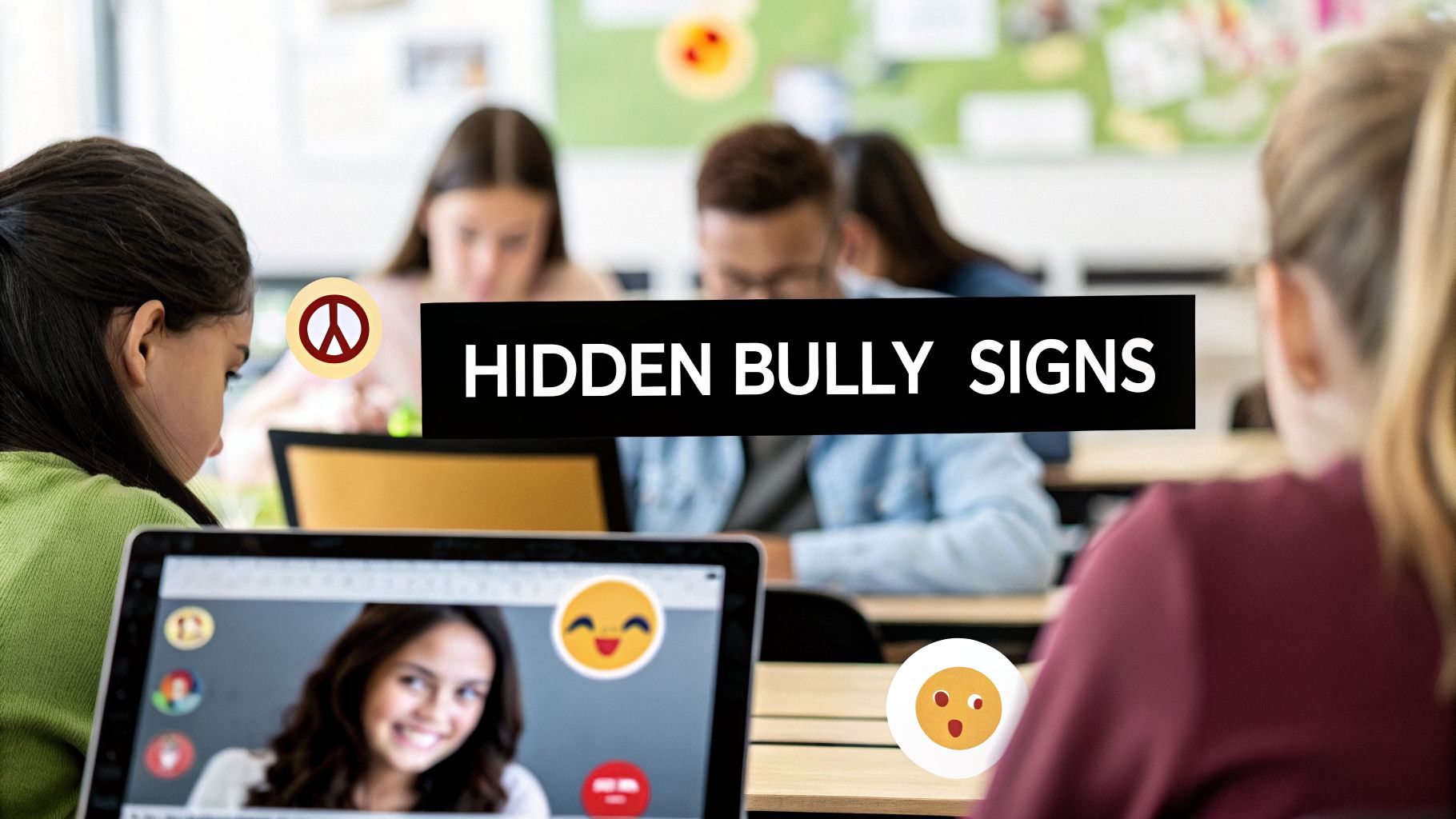
The lines between typical teenage drama and genuine harm can feel incredibly blurry, especially within the complex social dynamics of online learning. As a parent, a deep, instinctual need to protect your child can make you question every interaction. Was that a harmless joke in the group chat, or was it a comment designed to wound? Is your child being purposefully left out of a project group, or are they just finding their own circle of friends? It’s heartbreaking to see your child hurt, and this guide is here to bring clarity to those grey areas.
Our goal isn't to label children but to put your child's emotional safety at the centre of our focus by identifying specific, harmful behaviours. Distinguishing between a simple conflict and a pattern of targeted cruelty is the critical first step. Often, this requires looking beyond the surface-level words to interpret what someone meant and understand the underlying intent and impact.
In the sections that follow, we will break down seven specific behaviours that signal bullying. We'll move beyond generic advice to provide practical, real-world examples drawn from online school settings, so you know exactly what to look for. You will gain a clear understanding of what these behaviours feel like for your child and receive concrete, actionable steps to support them and foster a safer, more compassionate digital community.
1. Deliberate Social Exclusion and Isolation
One of the most subtle yet painful signs of a bully is the deliberate exclusion of a peer. This isn’t just about not being invited to a party; it’s a calculated effort to make a child feel invisible, unwanted, and completely alone. For your child, this can feel like a silent scream for connection that no one seems to hear. This behaviour is particularly damaging in online learning environments where digital connections form the backbone of a student's entire school community.

The feeling of being intentionally left out can shatter a child’s self-esteem. In a digital school like Queen's Online School, where students rely on virtual interaction for both learning and friendship, being ostracised can feel like being locked out of the entire school building. Understanding what this looks like is the first step for you to intervene effectively and remind your child they are not invisible.
How Exclusion Manifests in Online Learning
In a virtual classroom, social exclusion is the digital equivalent of being left alone in the playground, but it can be much harder to spot. It’s what your child experiences when:
- They are removed from a group chat: Suddenly and without explanation, your child is kicked out of the class WhatsApp group. They lose access to homework discussions and the inside jokes that bond their classmates, making them feel like an outcast.
- They are 'ghosted' in projects: During a group project, your child's messages are ignored. The other members create a separate chat to work without them, leaving your child to either do the work alone or have their name left off the final submission.
- They are snubbed from virtual events: A classmate organises an online study session or a gaming night for everyone in the class, but your child is intentionally not sent the invitation link.
- They see exclusive social media groups: Peers create a private Instagram group for the "cool kids" in the class, and your child discovers they are the only one not included.
Key Insight: Digital exclusion is insidious because the "proof" is in the absence of interaction. It’s incredibly difficult for your child to explain the deep hurt of being ignored, making them feel like their pain isn’t valid.
Actionable Steps for Parents and Educators
Identifying these signs of a bully requires proactive observation and creating a space where your child feels safe to share their pain. If you suspect your child is being isolated, here are steps you can take:
- Initiate Gentle Conversations: Ask about their online school life with genuine curiosity. Instead of "Are you being bullied?", try "It sounds like that project group was tough. How did everyone work together?" or "What are the class group chats like these days?" This opens the door for them to talk.
- Watch for Emotional Clues: Notice if your child becomes withdrawn, anxious, or suddenly loses interest in school. A change in their mood after being online is a significant red flag that something is wrong.
- Validate Their Feelings and Encourage Reporting: If your child confides in you, listen without judgment. Reassure them that their feelings are valid and that being excluded is not okay. Emphasise that they are brave for telling you and that you will support them.
- Promote Inclusivity: Educators can regularly change group assignments to ensure no student is consistently left out. This not only prevents exclusion but is also crucial for building strong social-emotional skills. For more information on this holistic approach to education, you can learn about the importance of social and emotional learning.
2. Aggressive or Threatening Language Online
One of the most direct signs of a bully is the use of aggressive or threatening language. The screen can make a bully feel invincible, leading them to use harsh, intimidating, or demeaning words they would never say in person. For your child, this turns their learning environment—their own bedroom or study space—into a source of anxiety and fear.

This digital aggression can feel inescapable, following your child from the live classroom into their private messages, leaving them with no safe space to retreat to. Imagine your child trying to focus on a math problem while their phone buzzes with hateful messages. The impact on their confidence and mental wellbeing can be devastating.
How Aggressive Language Manifests in Online Learning
In a virtual school, aggressive language is designed to make your child feel small, worthless, and scared. It might look like:
- Public Shaming in Live Chats: During a live lesson, a student posts cruel comments like, "No one cares what you think," or publicly mocks your child’s answer with "That's the dumbest thing I've ever heard."
- Direct Threats via Messaging: A bully sends a private message with an explicit threat like, "If you tell the teacher, you'll regret it," creating a climate of fear that silences your child.
- Insults in Collaborative Spaces: In a shared Google Doc for a project, a bully repeatedly deletes your child's contributions and leaves insulting comments like, "This is useless," in the margins.
- Hate Speech and Targeted Abuse: This can include the use of racial slurs, homophobic language, or cruel comments targeting your child's disability, accent, or family background.
Key Insight: The digital nature of this bullying creates a permanent, painful record. Your child can re-read these hurtful words over and over, making the emotional wound deeper each time.
Actionable Steps for Parents and Educators
Tackling online aggression requires a swift, coordinated response. Your child needs to know you are their unwavering protector.
- Teach the 'Screenshot and Report' Rule: The first rule is never to reply. Instruct your child to immediately screenshot any aggressive messages. This screenshot is their power—it’s the evidence needed to make the bullying stop.
- Create a Safe Harbour: Have ongoing conversations about online safety. Make it a family rule that any message that makes them feel uncomfortable, sad, or scared is a signal to come to you immediately, without fear of losing their devices.
- Know Your Tools and Use Them: Familiarise yourself with the reporting features within your child's online school platform and social media apps. Show your child how to block and report, empowering them to take control.
- Demand a Zero-Tolerance Policy: Schools must actively monitor live chats and enforce clear consequences. At Queen's Online School, immediate intervention and disciplinary action reinforce that our community is a place of respect, not fear.
3. Spreading Rumours and Cyberstalking Through Digital Platforms
One of the most devastating signs of a bully is the deliberate spreading of lies and persistent online harassment. This behaviour, which can escalate to cyberstalking, weaponises social media to dismantle your child’s reputation and create a constant state of anxiety. It’s a calculated attack that follows them from the classroom into their personal life, making them feel like there is no escape.

For a young person, their online identity is deeply connected to their sense of self. When their digital world is flooded with lies and mockery, the damage to their self-worth can be profound. Imagine your child seeing a cruel rumour about themselves spreading through their entire year group. This form of bullying can poison friendships and destroy their academic confidence.
How Rumours and Cyberstalking Manifest Online
In a virtual learning environment, these damaging behaviours can spread like wildfire. The bully can hide behind a screen, making their attacks feel relentless and inescapable for your child. It looks like:
- Mockery in Private Groups: A classmate creates a private WhatsApp group named "We Hate [Your Child's Name]" and invites others to share embarrassing photos or make fun of them.
- Weaponising Class Moments: Someone takes an awkward screenshot of your child during a live lesson and turns it into a cruel meme, which is then shared across social media.
- Fabricating Personal Stories: A bully starts a false rumour that your child cheated on a test or lied about being sick, spreading it through direct messages until it becomes "common knowledge."
- Persistent Harassment (Cyberstalking): The bully relentlessly comments on every one of your child’s social media posts, or creates fake accounts to continue harassing them after being blocked.
Key Insight: Digital rumours erase the boundary between school and home. The harassment is constant, popping up on the very phone your child uses to talk to their friends, making them feel perpetually unsafe and exposed.
Actionable Steps for Parents and Educators
Tackling this covert form of bullying requires vigilance and a firm, supportive response. Your child needs to feel you are in their corner, fighting for them.
- Teach Digital Permanence: Talk to your child about the fact that anything shared online—even in a "private" chat—can be saved and shared. This helps them be mindful of their own digital footprint and to think critically before believing or sharing rumours about others.
- Save Everything, Report Immediately: Instruct your child not to engage but to save all evidence—screenshots of messages, posts, and fake profiles. This is their proof. Report this immediately to the school's designated safeguarding lead and to the social media platforms.
- Promote Digital Citizenship: Discuss the real-world pain that online actions can cause. Help them understand that behind every profile is a person with feelings. Schools like Queen's Online School integrate digital citizenship into the curriculum to build a respectful online community.
- Be a Safe Confidant: Regularly check in on your child's online life. Ask about the group chats they are in. Create a space where they can show you a cruel message or a fake profile without fear of you overreacting or taking away their phone.
4. Deliberate Mockery of Academic Struggles or Learning Differences
One of the cruelest signs of a bully is the deliberate ridicule of a peer’s academic struggles. This type of bullying targets a child’s vulnerability in the one place they should feel safe to learn and make mistakes. It’s a tactic designed to create deep shame around the very act of trying, destroying a child's academic confidence and their love of learning.
This behaviour is particularly heartbreaking in a supportive environment like Queen's Online School, which is dedicated to helping students with diverse needs, including SEN (Special Educational Needs). When a bully mocks a student for asking for help or using accommodations, they are attacking the core of what makes a school a true community. For your child, this can make them feel like their brain is "wrong" or that they don't belong.
How Academic Mockery Manifests in Online Learning
In a virtual classroom, this form of bullying can be devastating, turning the learning environment from a place of curiosity into one of fear. It happens when:
- A student is shamed in the chat: Your child asks the teacher a clarifying question, and another student types "Are you serious? That's so easy" into the public chatbox for everyone to see.
- Accommodations are targeted: A bully makes fun of your child for using text-to-speech software ("Can't you read by yourself?") or for getting extra time on a test ("That's not fair, you're just getting a cheat code").
- They are mimicked and mocked: Your child, who may have a stutter or a unique accent, is cruelly imitated by a classmate during a live video lesson, and other students laugh.
- Private struggles are made public: A peer finds out your child has a tutor and shares this information in a group chat to embarrass them, framing it as a sign of being "stupid."
Key Insight: Academic mockery makes your child feel intellectually inferior. This can cause them to shut down, stop raising their hand, and internalise the false and damaging belief that they are not smart enough.
Actionable Steps for Parents and Educators
Addressing this behaviour means creating a culture where asking for help is seen as a strength. Your child needs to hear from you that their unique way of learning is something to be proud of.
- Create a Shame-Free Zone at Home: Talk openly and positively about challenges. Share stories of your own struggles and triumphs. Reassure your child that everyone learns differently and celebrate their effort, not just their grades. Make home a safe haven from judgment.
- Ask Direct, Gentle Questions: Check in about their classroom interactions. Try asking, "Did you feel comfortable asking questions in science class today?" or "Does everyone in your class seem supportive when someone is struggling with a topic?"
- Report Incidents Immediately: Academic mockery is not a joke; it is a serious form of bullying. Report any instances to the school. A supportive school like Queen's Online School has robust systems to handle this, as it goes against their core mission.
- Educate and Empower: Educators must proactively discuss different learning styles and frame accommodations as tools for success. For parents, learning how to advocate for your child’s needs can empower both you and them.
5. Deliberate Humiliation Through Public Embarrassment
One of the most potent signs of a bully is their use of public humiliation. This tactic involves intentionally creating situations to embarrass a peer in front of an audience, amplifying their distress and shame. Unlike a private insult, this is a performance designed to destroy the target's social standing while elevating the bully's. For your child, it feels like being trapped under a spotlight with everyone pointing and laughing.

In an online school, the "public" space is the virtual classroom, a group chat, or a social media feed. The emotional impact can be devastating, making your child dread logging on for school. Recognising these calculated acts of cruelty is crucial to protecting your child's mental wellbeing and sense of safety.
How Public Humiliation Manifests in Online Learning
In a virtual school, the audience is digital, but the humiliation feels intensely real and permanent. These actions are often disguised as "just a joke," making them harder for your child to challenge. It looks like:
- Weaponising the Live Classroom: A student asks your child a difficult question they know they can't answer and then says, "I knew you wouldn't get it." Or they make a cruel comment about your child's home or appearance on camera for everyone to hear.
- Recording and Sharing Awkward Moments: Someone takes a screenshot of your child's frozen screen in an unflattering pose or screen-grabs a typo they made in the chat, then shares it in a group for others to ridicule.
- Engineered Embarrassment: A bully deliberately calls on your shy or anxious child to answer a question, knowing it will cause them immense discomfort, just to watch them squirm.
- Malicious Use of Platform Features: Students use the annotation tool to draw something insulting on your child's shared screen during a presentation or use the chat function to make fun of their answer in real-time.
Key Insight: Public humiliation online feels permanent. A cruel comment in a chat or a shared screenshot can be looked at again and again, creating a recurring cycle of shame that haunts your child long after the class has ended.
Actionable Steps for Parents and Educators
Addressing public humiliation requires a swift and supportive response to restore your child’s sense of safety and dignity.
- Document and Report Immediately: The public nature of this bullying often means there is digital evidence. Take screenshots of chat messages or note the time of verbal comments in a live class. Report it to the school immediately.
- Help Your Child Regain Control: Help your child practise strategies to avoid giving the bully the reaction they crave. This could be calmly ignoring a comment, using a neutral phrase like "Let's stay focused on the lesson," or privately messaging the teacher. This empowers them.
- Distinguish Humour from Harm: Talk with your child about the difference between a good-natured joke that everyone laughs at together and targeted "banter" designed to make one person feel small. Reinforce the rule: if a joke hurts someone, it’s not funny.
- Rebuild Their Self-Esteem: Public humiliation can shatter a child’s confidence. Spend time focusing on their strengths and passions. Remind them of all the things that make them wonderful, outside of the classroom context. For more guidance on this, you can read about how to build children's confidence.
6. Deliberate Physical Intimidation or Threats of Physical Harm
One of the most terrifying signs of a bully is the use of intimidation and threats of physical violence. Even in a remote learning environment, this creates a profound sense of fear, shattering your child's feeling of safety in their own home. This tactic moves beyond hurtful words and crosses a line into threats that can make a child genuinely fear for their physical safety.
This form of bullying leverages raw fear as its primary weapon. For your child, a threat of harm doesn't just disappear when the laptop is closed; it lingers, causing immense emotional distress and making it impossible to focus on school. As a parent, your primary instinct is to keep your child safe, and recognising these threats is the first critical step.
How Intimidation Manifests in Online Learning
Physical threats made online can feel even more potent because they breach the sanctity of your child's home, making the bully’s reach feel inescapable. It might look like:
- Direct Digital Threats: Sending a private message through the school platform or social media saying, "I know where you live, and I'm going to find you," or "Wait until we have the in-person school trip, you're going to get it."
- On-Camera Aggression: During a live lesson, a bully might use intimidating body language directed at your child. This could be clenching their fists, making punching motions towards the camera, or holding up an object in a threatening way.
- Implied Violence: Using menacing but vague language like, "You'd better watch your back," or "People who talk to the teacher like that get hurt," which is designed to create fear without being explicit.
- Threats Against Loved Ones: A particularly cruel tactic is threatening to harm something your child loves, like a pet, or threatening to hurt a younger sibling.
- Bringing the Threat Offline: The bully uses information shared online to show up at a local park or event your child is attending, making their threatening presence felt in the physical world.
Key Insight: Threats made online feel incredibly real because they destroy the boundary between the virtual and physical worlds. The fear of what could happen can be just as damaging to your child's mental health as a physical altercation itself.
Actionable Steps for Parents and Educators
All threats of physical harm must be taken with the utmost seriousness. An immediate and firm response is essential to ensure your child's safety.
- Document Everything, Immediately: Take screenshots of any threatening messages, images, or videos. Record the date, time, and platform. This evidence is non-negotiable proof.
- Report to the School Without Delay: Contact the school's administration immediately. Do not try to handle it by contacting the other parent directly. Allow the school to follow its formal safeguarding procedures.
- Reassure and Protect Your Child: Hold your child and tell them how brave they were to tell you. Let them know you believe them and that you will do everything in your power to keep them safe. Their emotional and physical security is the only priority.
- Involve Law Enforcement if Necessary: If a threat is specific, credible, and makes you fear for your child's immediate safety, do not hesitate to contact your local police. Online threats of violence are a criminal offence.
- Develop a Safety Plan: Work with the school to create a plan that helps your child feel secure again. This might involve ensuring they are not placed in virtual breakout rooms with the bully or changing their online schedule until the situation is fully resolved.
7. Persistent Exclusion from Collaborative Learning and Group Opportunities
Beyond social cliques, one of the most undermining signs of a bully is the systematic exclusion of a peer from academic projects. This behaviour deliberately prevents your child from participating in group work, study partnerships, and other collaborative learning. This isn't an accident; it's a repeated, intentional act designed to isolate and sabotage a student's academic progress and social development.
The impact is devastating: it directly harms your child’s ability to learn and can negatively affect their grades, while also feeding feelings of rejection and intellectual inadequacy. It sends the painful message, "You're not good enough to work with us." In an environment like Queen’s Online School, where collaborative projects are essential for learning, being persistently locked out can make a student feel like a complete failure.
How Academic Exclusion Manifests in Online Learning
In a virtual school, this form of bullying is insidious because it happens during official class activities, making it seem almost legitimate. It’s the digital version of everyone picking a team until your child is the last one left standing, alone. It looks like:
- Breakout Room Rejection: During a live class, students are sent to breakout rooms. Your child enters, and the other students immediately ask the teacher to move them, or they all turn off their cameras and ignore your child.
- Strategic Group Formation: When students are allowed to choose their own project groups, a specific peer is consistently and deliberately left out, time after time.
- Assigning Useless Tasks: Even if forced to include your child, the group gives them a trivial task like "proofreading the title page," effectively shutting them out of the meaningful collaborative work and discussion.
- Ignoring All Contributions: In a shared Google Doc or project chat, the group pointedly ignores every idea, question, and contribution your child makes, rendering them completely invisible within the team.
Key Insight: Academic exclusion weaponises learning. The bully uses the classroom structure itself to isolate their target, making your child feel that their exclusion is their own fault—that they are not smart enough or liked enough to be included.
Actionable Steps for Parents and Educators
Addressing this requires a partnership between you and the school. If you notice your child is always working alone on group assignments, it’s a signal that something is wrong.
- Discuss Group Dynamics with Curiosity: Ask your child specific, gentle questions about their collaborative work. Try, "Tell me about who was in your breakout room for History today," or "How did your group decide to split up the work for the science project?" Listen for patterns of isolation.
- Advocate for Structured Grouping: If peer selection consistently leads to your child's exclusion, speak with their teacher. Request that the teacher assign the groups to ensure fair and varied collaboration for all students.
- Build Your Child’s Collaborative Skills at Home: Help your child practise skills that build confidence for group work. Role-play how to share an idea clearly or how to ask a question if they are being ignored. This can boost their self-esteem and make them feel more prepared.
- Communicate with the School: Schedule a meeting to discuss your concerns. Frame it as a pattern you’ve observed that is impacting your child's learning and emotional well-being. A good school will want to address this immediately to ensure an inclusive environment for all.
Comparison of 7 Signs of Bullying
| Behavior | 🔄 Detection / Implementation Complexity | ⚡ Resource Requirements / Intervention Effort | 📊 Expected Outcomes / Impact | 💡 Ideal Use Cases / Recommended Actions | ⭐ Key Advantages |
|---|---|---|---|---|---|
| Deliberate Social Exclusion and Isolation | High — often subtle or in private groups | Moderate — review group membership, audit logs, staff time | High — reduced belonging, disengagement, emotional harm | Establish inclusion protocols, regular check‑ins, anonymous reporting | Digital records can corroborate exclusion; aligns with community values |
| Aggressive or Threatening Language Online | Medium — written evidence exists but can be deleted | Moderate — active chat monitoring, teacher oversight, evidence collection | High — immediate emotional harm; potential escalation | Enforce screenshot/reporting rules, monitor live chat, train staff & students | Written records support clear disciplinary action |
| Spreading Rumors & Cyberstalking Through Digital Platforms | High — multichannel, often anonymous and rapid | High — cross‑platform tracing, sustained support, platform cooperation | High — lasting reputational damage and prolonged distress | Teach digital permanence, preserve evidence, coordinate with platforms | Public visibility yields corroborating witnesses and traces |
| Deliberate Mockery of Academic Struggles or Learning Differences | Medium — often visible in live sessions but may be subtle | Moderate — teacher intervention, targeted pastoral support, accommodations | High — reduced participation, shame, lower achievement | Set classroom norms, model respectful language, explain accommodations | Teachers can intervene in real time and support vulnerable learners |
| Deliberate Humiliation Through Public Embarrassment | Medium‑High — public/recorded incidents are visible but can be shared | High — review recordings, class remediation, counselling | High — long‑lasting anxiety, avoidance of participation | Immediate instructor intervention, repair with class, support victim, remove shares if possible | Recordings and witnesses aid accountability and redress |
| Deliberate Physical Intimidation or Threats of Physical Harm | Medium — explicit threats are clear; veiled threats harder to detect | High — safety planning, parental/authority involvement, legal processes | Very High — acute safety risk, severe fear, possible real‑world harm | Report immediately, preserve evidence, involve authorities & guardians as needed | Explicit threats justify swift protective and legal action |
| Persistent Exclusion from Collaborative Learning & Group Opportunities | Medium — pattern emerges over time; requires longitudinal review | Moderate — structured grouping, monitor participation, teacher facilitation | High — measurable academic disadvantage and social isolation | Use teacher‑assigned groups, track participation, meet with parents when pattern appears | Academic records and participation logs make impact measurable and actionable |
From Awareness to Action: Creating a Culture of Kindness
Navigating the complex and often painful social world of childhood is a profound challenge, and your role as a parent is more critical than ever. We’ve unpacked the subtle and overt signs of a bully, moving beyond stereotypes to understand the specific behaviours that wound our children. These actions—from the silent pain of social exclusion to the loud fear of online threats—are not just "kids being kids." They are deeply damaging and demand our immediate, compassionate attention.
Recognising these behaviours is the first, most crucial step. Your awareness is a shield for your child. By identifying these patterns, you are empowered to intervene effectively. The goal is not just to stop negative actions but to cultivate a foundation of empathy and respect that makes bullying unthinkable. This requires a strong partnership between families and schools, built on a shared commitment to every child's well-being.
Key Takeaways: From Observation to Intervention
Mastering the ability to spot these signs is vital because bullying thrives in silence. The key takeaways from our exploration are clear:
- Context is Crucial: A single unkind comment might be a mistake, but a pattern of behaviour, such as persistent exclusion or repeated mockery, points to a deeper issue. Always look for recurring actions.
- Digital and Real-World Behaviours Intersect: Cyberbullying is not a separate entity. Aggressive language online often translates to social isolation during live lessons. Treat both with equal seriousness.
- Vulnerability Can Be a Target: Bullying often targets perceived differences, whether they are academic struggles, neurodiversity, or cultural background. Creating an inclusive environment means actively celebrating these differences. For creating a truly supportive environment, it's vital to learn how to recognise, report, and prevent bias, which often underpins bullying behaviors.
Trust your parental instincts. If a situation feels wrong, or if your child's spirit seems dimmer, it warrants a conversation. You are their most powerful advocate.
Your Actionable Next Steps
Awareness must be followed by decisive, compassionate action. The journey from identifying the signs of a bully to fostering a positive environment involves concrete steps:
- Initiate Open Dialogue: Create a safe space for your child to talk without fear of judgement. Use open-ended questions like, "I've noticed you seem quiet after your online classes lately. How are you feeling about them?" This invites them to share their heart with you.
- Document Everything: Keep a record of incidents, including dates, times, and screenshots. This provides clear, undeniable evidence when you approach the school.
- Engage with the School as a Partner: Contact your child's teacher or a safeguarding lead. Present your concerns calmly and provide your documentation. A collaborative approach is always the most effective.
- Teach and Model Empathy: Use everyday moments to discuss the impact of words. Ask questions like, "How do you think it would feel to be left out like that?" Fostering empathy is the most powerful long-term antidote to bullying.
Ultimately, addressing bullying is about building a community where every child feels seen, valued, and safe. It's about empowering young people to become upstanders who actively create a kinder world. Your vigilance and love can change the course of your child's experience, giving them the secure foundation they need to thrive.
At Queens Online School, we believe a safe and supportive community is the bedrock of academic excellence. Our zero-tolerance policy on bullying is embedded in a culture of pastoral care, where every student's well-being is our priority. Discover how our live, interactive classes and dedicated support systems create an environment where learners feel safe, respected, and ready to achieve their full potential at Queens Online School.