
When school mornings become a battleground of tears and stomach aches, and you see your once-bright child shrinking under the weight of an invisible fear, it's a deeply lonely and confusing experience. The phrase "schools for anxiety" isn’t about a formal list of institutions you can just look up. Instead, it’s about your courageous search for an educational home where your child's emotional safety is the foundation upon which all learning is built.
When School Becomes the Source of Fear
It’s heartbreaking to watch the place your child is meant to learn and grow become the very source of their distress. That constant knot in their stomach, the sudden avoidance of friends, or the dread that settles over your home every Sunday evening—these aren’t signs of defiance. They are distress signals from a child who is completely overwhelmed.
As a parent, your instinct is to protect them, but the path forward can feel incredibly unclear. You might question yourself, wondering if you're overreacting or if this is "just a phase." Please know this: trusting your gut is not a failure. It is a profound act of love and advocacy for your child's well-being.
Redefining the Goal of Schooling
Looking for a different school isn't about giving up on the current one; it's about finding a much better fit. The right environment can completely transform a child's relationship with learning, turning it from something to be endured into something that can actually be enjoyed. The goal shifts from simply getting your child through the day to helping them genuinely thrive.
What does this kind of supportive place look like?
- Emotional Safety First: A school where teachers understand that a child simply cannot learn if they feel constantly on edge. For example, a teacher might notice a child seems withdrawn and quietly check in with them, rather than calling them out in front of the class.
- Flexible Pacing: An approach that lets students learn at a speed that builds confidence, not anxiety. Imagine a maths lesson where a child can take extra time to grasp a concept without the fear of being left behind.
- Positive Social Interactions: A community that actively prevents bullying and helps foster genuine, low-pressure connections. This could be a lunchtime club for Lego or coding, where friendships can form around a shared interest instead of in a chaotic playground.
Finding a Place of Belonging
This guide is built on a simple but powerful idea: every child deserves to feel safe, seen, and supported at school. Searching for "schools for anxiety" is really about finding a place where your child can finally take a deep breath and let their guard down.
It’s about finding an institution that understands the deep connection between emotional well-being and academic success. You can explore this link further by understanding the principles of social emotional learning and how they are applied in forward-thinking educational settings.
The journey to find the right school is more than a logistical challenge; it's a mission to restore your child's confidence and help them rediscover their love for learning. It's about reminding them that school can be a place of curiosity and joy, not fear.
Throughout this guide, we'll walk you through the practical steps, from spotting the subtle signs that a change is needed to exploring the different types of schools that can offer a true sanctuary for learning. You are not alone in this, and hopeful solutions are well within reach.
Trusting Your Gut: When to Recognise the Need for a Change
Sometimes, the signs that a school is no longer the right place for your child aren't loud or dramatic. They’re the quiet, subtle shifts that only a parent, tuned into the rhythm of their child's heart, can truly feel. It’s that little flicker of light in their eyes that has gone out, or the way they retreat into themselves after a long school day.
This isn't always about outright school refusal, though that can certainly be part of it. It’s about the dread that creeps in on a Sunday night, stealing the last precious hours of the weekend. It's the recurring headaches or stomach aches that have no medical cause but are very, very real to your child.
Think of a child who once loved their weekly football club but now makes excuses not to go. Or the budding artist who leaves their sketchbook to gather dust. These aren't just behavioural quirks; they are often the outward signs of an internal struggle—a silent cry for help from a child who feels utterly overwhelmed by their environment.
Listening to the Unspoken Language of Anxiety
Children, especially younger ones, often lack the vocabulary to say, "The noise in the hallway makes my heart race," or "I feel invisible in my classroom." Instead, they communicate their distress through their bodies and their behaviour. Recognising these signs is the first, crucial step toward finding a solution.
Common indicators that the current school fit is causing harm include:
- Physical Symptoms: Frequent, unexplained stomach aches, headaches, or a constant sense of fatigue that isn’t linked to illness. This could be your child feeling sick every morning, but only on school days.
- Emotional Changes: Increased irritability, tearfulness, new fears (like being alone), or a general flatness where joy used to be. For example, they might snap at a younger sibling over something tiny, which is completely out of character.
- Social Withdrawal: Avoiding friends, dropping out of extracurricular activities, or preferring to stay in their room rather than engage with family. You might notice they stop talking about their friends or ignore their messages.
- Academic Shifts: A sudden drop in grades, a loss of interest in subjects they once enjoyed, or an inability to focus on homework. The teacher might report that they "zone out" in class or repeatedly fail to hand in work.
Trusting your intuition as a parent is one of the most powerful tools you have. If you sense that your child's struggles are more than just "a phase," you are almost certainly right. These are not signs of a "problem child," but of a child in a problem environment.
Acknowledging the Systemic Challenge
This struggle is becoming alarmingly common. In the UK, anxiety has become a major driver of school absences. Recent research showed that nearly half of secondary pupils missed school due to anxious feelings in the past year. Disturbingly, over a third of these pupils felt their teachers rarely or never understood what they were going through, pointing to a system under immense strain. You can learn more about the growing impact of anxiety on UK school attendance.
This data validates what so many parents feel in their gut: the issue is often bigger than just one child's experience.
When a school's culture, size, or structure creates constant stress, it can chip away at even the most resilient child's well-being. Recognising this isn't about placing blame; it's about acknowledging that a different kind of educational setting might be necessary for your child to flourish. The search for schools for anxiety begins with this courageous acknowledgement.
Exploring Different Paths to a Better Education
When you first realise your child needs a different kind of school environment to truly thrive, the next question can feel enormous: where on earth do you begin? The search for the right school isn’t about finding a single, perfect solution. It's about discovering the path that best fits your child's unique emotional and educational needs.
Each option offers a different flavour of support, and getting to grips with them is the first step towards making a choice you can feel confident about.
It's worth knowing that there isn't a single type of institution officially called a "school for anxiety." Instead, it's a term parents use to describe mainstream, specialist, or alternative provisions that have the right culture, structure, and support systems baked in.
This infographic breaks down how anxiety can show up in children, splitting the signs into physical, emotional, and academic categories.
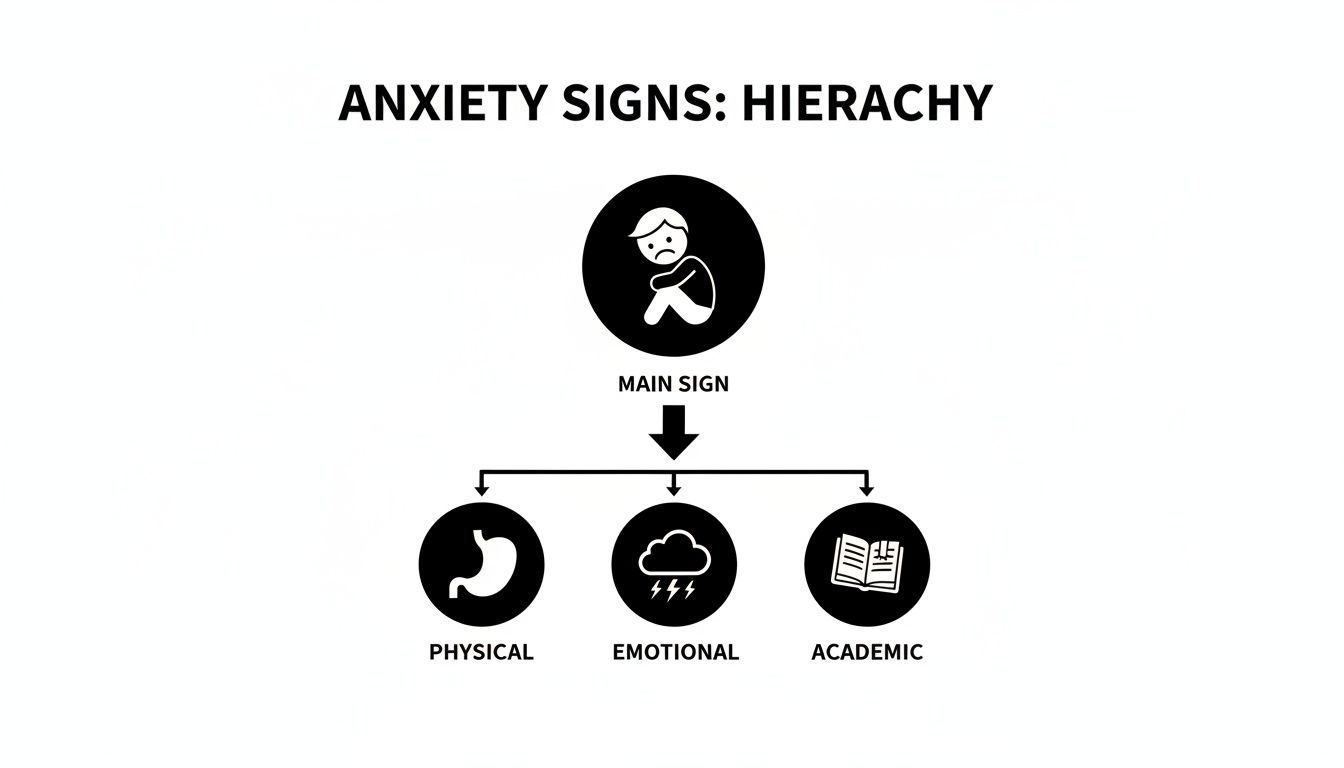
Realising that recurring stomach aches or a sudden drop in effort on homework can be direct signals of anxiety helps you focus your search. You can start looking for an environment that tackles these root causes, not just the symptoms you see on the surface.
Mainstream Schools with Strong SEN Support
For some children, staying in a mainstream school is not only possible but preferable, as long as the right support is in place. This is often the first avenue parents explore.
The secret is finding a school with a deeply committed Special Educational Needs (SEN) department and a genuine, lived-in understanding of Social, Emotional, and Mental Health (SEMH) needs.
In these schools, support isn't an afterthought. It might look like:
- A dedicated pastoral team: Staff who are trained to spot and support emotional distress before it escalates. For example, a pastoral lead might have a daily check-in with your child for the first few minutes of the day.
- An on-site counsellor: Providing easy-to-access mental health support during the school day, removing barriers. This means your child can get help without having to wait months for an external referral.
- Quiet spaces or 'nurture rooms': Safe havens where a child can go to decompress without feeling singled out or judged. A child could be given a pass to use this room for 10 minutes when they feel overwhelmed.
An Education, Health and Care Plan (EHCP) can be a game-changer here. This is a legally binding document that outlines your child's specific needs and the support the school must provide. It ensures resources like a one-to-one teaching assistant or specific therapeutic interventions are formally locked in.
Specialist Therapeutic Schools
When anxiety is more severe, complex, or persistent, a specialist therapeutic school might be the most effective choice. In these settings, mental health support isn't just an add-on; it's woven into the very fabric of the school day.
Think of it as an environment where education and therapy work in perfect harmony. Class sizes are typically very small, and the curriculum is delivered by teachers who are also trained in understanding trauma and anxiety. The entire school culture is designed to be low-arousal and predictable, reducing the daily triggers that can feel so overwhelming in a large, bustling mainstream school.
These schools prioritise creating a sense of psychological safety above all else. They understand a fundamental truth: a child has to feel safe and regulated before they can even begin to learn.
Alternative Provision and Online Schools
For many children, the physical environment of a traditional school is the primary source of their anxiety. The crowded hallways, the deafening dining hall, the rigid, bell-driven timetable—it can all be too much. This is where alternative provision (AP) and, increasingly, online schools, offer a powerful lifeline.
APs are set up for students who can't attend mainstream school for various reasons, including medical or mental health needs. They offer education in a different setting, often with a far more flexible and individualised approach.
The rise of accredited online schools like Queen's Online School, however, has created a structured yet nurturing alternative that removes those environmental triggers completely. For a child with crippling social anxiety, school refusal, or sensory sensitivities, learning from the safety and comfort of home can be life-changing.
A Case Study in Finding a Safe Haven
Consider the story of Leo, a bright Year 9 student whose anxiety made walking into his large comprehensive school feel like climbing a mountain every single day. The fear of social judgement in a class of 30, the sensory overload of the bell, and the unstructured chaos of break times left him exhausted and unable to learn.
His parents decided to make the switch to an online school, and the change was remarkable.
- The environment was controlled: Learning from his quiet desk at home removed the constant background stress that had been draining his energy.
- Classes were small and interactive: In live lessons with only a handful of other students, Leo felt seen. He was no longer afraid to ask questions.
- The pace was flexible: If he had a difficult morning, he could watch a recorded lesson later that day, completely removing the pressure of "falling behind."
For Leo, the online school wasn't a lesser option; it was the right option. It dismantled the specific triggers fuelling his anxiety, allowing his natural curiosity and intelligence to flourish once more. His story shows how the right schools for anxiety are simply the schools that put a child's well-being at the very centre of their educational model.
How to Find a School That Truly Understands Your Child
Turning a long, overwhelming list of potential schools into a single, confident decision is the next big step. This is where your research moves from the screen into the real world. Your mission is to look beyond the glossy prospectus and get a real feel for the emotional culture of a school, finding the one that feels like a safe harbour for your child.
The key is to ask the right questions and, just as importantly, to observe the unspoken atmosphere. You can learn more from the way teachers interact with pupils in a busy corridor than from any mission statement. When you start your search for an environment that puts your child's well-being first, it’s a good idea to seek out schools supporting students with mental health issues, as these places often have the right experience and support systems already in place.
What to Ask During Your Visit
Whether you’re visiting in person or joining a virtual tour, having a list of targeted questions ready will help you cut through the sales pitch. These questions should focus less on league tables and more on the day-to-day emotional reality for students.
Think of yourself as an emotional detective, gathering clues about the school's heart.
Here are a few essential questions to get you started:
- "How do you help a new student settle into the school community?" Listen for concrete, practical steps. Are they talking about a buddy system, a phased start, or a named key person your child can check in with?
- "What’s your policy for communicating with parents about a child's wellbeing?" A vague answer here is a red flag. You want to hear about a clear, proactive approach, not just reactive phone calls when there’s a problem.
- "Can you give me an example of your anti-bullying policy in action?" A policy on paper is one thing; a real-world example of how they’ve handled a situation tells you everything about their true commitment to creating a safe space.
- "What training do your staff receive on mental health and anxiety?" This question quickly reveals whether they see emotional support as a core responsibility or just an optional extra. To dig deeper, it can be helpful to understand what proper SEN support looks like in practice.
What to Look For Beyond the Answers
The ‘feel’ of a school is often the most powerful indicator of whether it will be the right fit. While you’re touring, pay close attention to the environment itself.
Does the atmosphere feel calm and purposeful, or is it chaotic and overwhelming? Notice how students and staff speak to each other. Can you see warmth and mutual respect, or does it feel tense and hurried? These small details paint a huge picture of the school’s underlying culture.
The goal is to find a place where kindness is a core value, not just a word on a poster. You're searching for an environment that instinctively understands that a child's emotional state directly impacts their ability to learn and thrive.
The need for this focus is more urgent than ever. Recent data shows that one in five UK children aged 8-16 now has a probable mental health disorder, a figure that has nearly doubled since 2017. This means in an average classroom of 30, around six students are quietly struggling with anxiety or depression, making the school's ability to provide support absolutely critical.
School Visit Checklist: Key Questions to Ask
Going into a school visit prepared with specific questions can help you gather the information you truly need. This checklist is designed to help you look past the surface and understand the school's deeper culture of support.
| Category | Question to Ask | What to Listen For |
|---|---|---|
| Pastoral Care | "Who is the main point of contact for pastoral concerns, and how accessible are they?" | A clear system with named individuals (e.g., Head of Year, school counsellor). Vague answers like "any teacher" can be a red flag. |
| Communication | "How and how often do you communicate with parents about a child’s emotional well-being?" | Proactive communication (e.g., regular check-ins) rather than only reactive contact when a problem arises. |
| Environment | "Where can a student go if they feel overwhelmed during the school day?" | The existence of a dedicated quiet space, sensory room, or pastoral office that is genuinely accessible to students. |
| Staff Training | "What specific training has your staff had in supporting students with anxiety or SEMH needs?" | Mention of recent, relevant training (e.g., Mental Health First Aid, trauma-informed practices), not just general safeguarding. |
| Peer Culture | "How do you actively foster a culture of kindness and inclusion among students?" | Concrete examples like peer mentoring programs, restorative justice practices, or student-led wellbeing initiatives. |
Asking these questions helps you build a detailed picture of daily life at the school and demonstrates that you are an informed and engaged parent. It’s not about catching them out; it’s about finding the perfect partner for your child's education.
Putting Your Child at the Centre of the Decision
This whole process is about and for your child. Involving them in an age-appropriate way isn’t just a nice idea; it’s essential for a successful transition. When children feel they have a voice, it gives them a sense of agency and control, which can be a powerful antidote to anxiety.
After a visit, ask simple, open-ended questions like, "What did you think of the library?" or "How did the playground feel to you?" Their answers, even the small ones, are valuable pieces of the puzzle. Their gut feeling matters every bit as much as yours. This collaborative approach makes it clear that you are a team, working together to find a place where they can finally feel happy, safe, and ready to learn.
The Online School: A Genuine Safe Haven for Learning
For some children, the search for the right school isn’t just about finding a better version of the same model. It’s about realising the model itself is the problem. When the physical school environment—the crowded corridors, the jarring bell, the exhausting social politics—is the main source of distress, the most powerful solution is often to remove those triggers entirely.
This is where accredited online schools are providing a true safe haven. The most common worry we hear from parents is about isolation, but it’s so important to reframe what that means. For a child drowning in anxiety, the "socialisation" of a big mainstream school often feels like a daily trial, which is the loneliest feeling in the world.
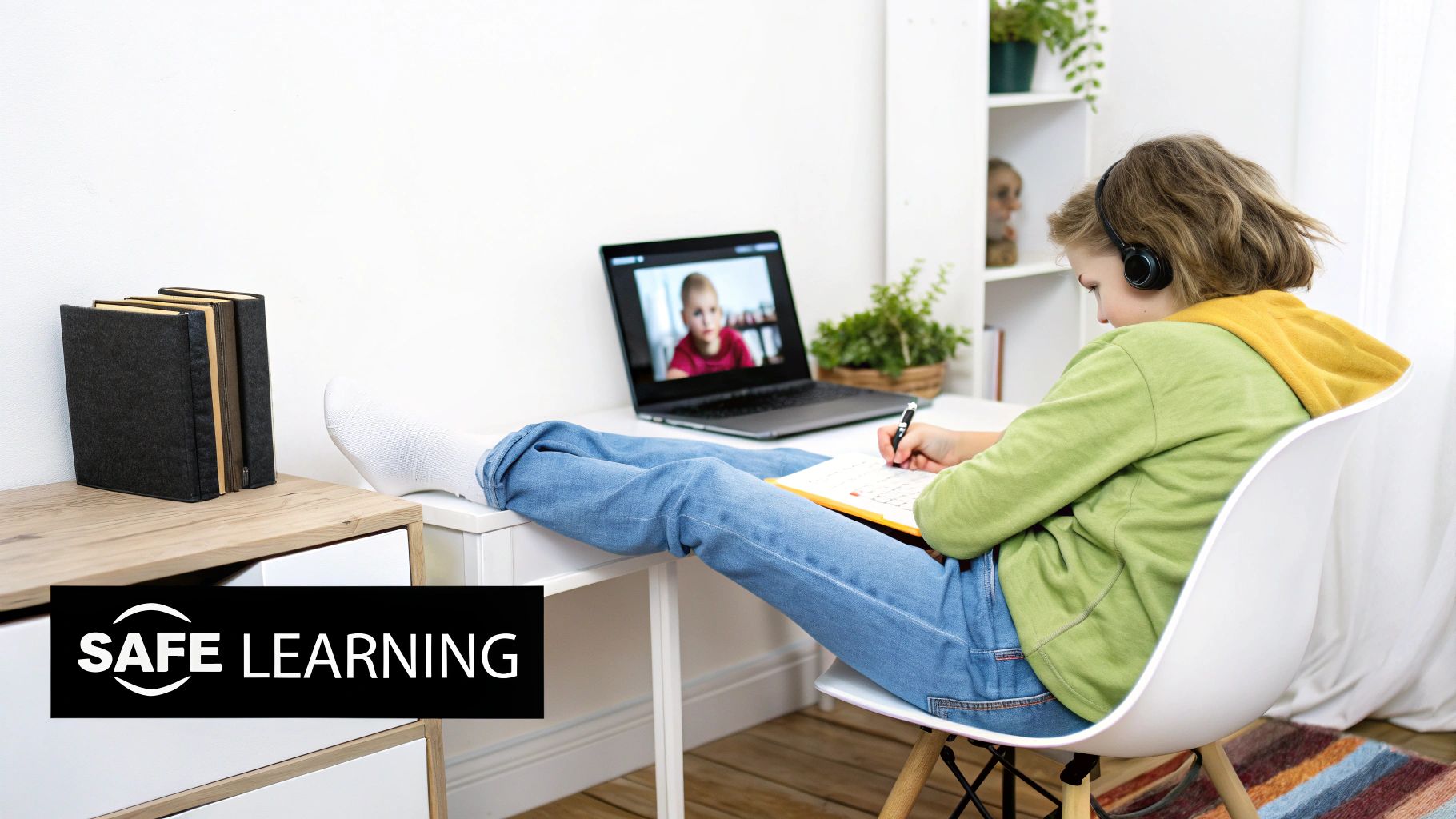
Imagine a school day that starts not with a stressful commute and a stomach full of dread, but with a calm morning at home. Picture your child logging into a live, interactive class with just a few other students, where they feel seen by their teacher and can contribute through their mic or the chat, free from the glare of 30 pairs of eyes.
Dismantling the Triggers of School Anxiety
Online learning fundamentally reshapes the school day for an anxious child, giving them back control over their environment and their energy. It works by methodically dismantling the core triggers that make a physical school feel so overwhelming.
The benefits are often immediate and profound:
- No Overwhelming Social Pressure: Without the constant need to navigate large, unstructured social groups at break or lunchtime, a child can reserve their mental energy for what matters: learning.
- A Genuinely Bully-Free Space: With robust moderation in live classes and a zero-tolerance culture, the sort of meanness and exclusion that thrives in the corners of a playground simply can’t take root.
- A Calm Sensory Environment: The learning space is predictable and quiet. It's free from loud bells, echoing hallways, and the general chaos that can be intensely dysregulating for a child with anxiety or sensory sensitivities.
This shift couldn't be more critical, especially as children's mental health services are stretched to their limits. In the UK, youth anxiety referrals have more than doubled since pre-pandemic levels, with an incredible 204,526 new referrals in 2023-24 for under-17s where anxiety was the primary issue. For these learners, an online school isn’t just an alternative; it can be an immediate and effective lifeline.
Building Confidence and Community on Their Own Terms
Far from being isolating, a well-designed online school fosters connection in a way that feels manageable and authentic. Socialising happens, but it’s intentional and based on shared interests, not forced proximity.
An online school community allows a child to build social confidence from behind a screen. That little buffer empowers them to engage more freely, letting them lead with their personality and ideas, not with their anxieties.
This could mean joining a virtual chess club, working on a project in a small breakout room, or just chatting with friends during an online social. These are low-pressure, high-reward interactions that allow genuine friendships to form naturally. The flexibility of asynchronous learning is also a huge relief, giving students the option to watch recorded lessons if they’re having a particularly tough day, which removes that constant fear of falling behind.
This unique structure, combined with the academic rigour of a full curriculum, creates an environment where students don't have to choose between their education and their well-being. If you're curious, you can explore the details of how online home education works in practice. For so many families, it's the compassionate, effective, and forward-thinking solution that finally allows their child’s spark to return.
Navigating the Transition to a New School
Choosing a new school is a monumental victory. It's a moment filled with hope for a calmer, brighter future for your child. Now, the focus shifts to the next crucial step: making sure this new chapter begins as gently and supportively as possible. This is where patience comes in, as small, reassuring steps build the strongest foundations.
The transition process is a partnership, plain and simple. It kicks off with you and the new school co-creating a plan that revolves entirely around your child's specific needs and fears. Open, honest conversations with your child are the heartbeat of this process; talking through their hopes and worries makes them feel seen, heard, and in control.
Building a Bridge to the New Beginning
A successful transition is built on two things: predictability and reassurance. Together, they work to shrink the anxiety of the great unknown. By establishing new routines before the first day, you can create a comforting sense of familiarity in what can feel like a sea of change.
For a physical school, this might look like:
- A Phased Start: Ask if your child can begin with half-days. Or perhaps visit the school during a quiet time to meet a key teacher without the overwhelming pressure of a full classroom.
- Mapping the Journey: Do a few practice runs of the school commute at the exact time you’d normally travel. This makes the route itself feel familiar and safe before day one.
- Comforting Routines: Start the new morning and evening schedules a week or two in advance. Predictability is a powerful antidote to anxiety.
For children moving to an online school, the focus is a little different—it’s about creating a secure and empowering learning environment right at home.
The goal isn’t to erase all nervousness—that’s a normal part of any big change. It’s to show your child, through actions and reassurance, that they have the strength to face this new challenge and that you and their new school are right there beside them, every step of the way.
Creating a Safe Space for Online Learning
If you’ve chosen an online school, the transition involves carefully designing their new educational world. This is a brilliant opportunity to give your child a sense of ownership and control, which can be incredibly empowering for a young person feeling anxious.
Here are a few practical tips for a smooth start:
- Design Their Learning Zone Together: Let them choose where their desk will be and how to organise their supplies. This helps create a dedicated space that truly feels like theirs.
- Attend Virtual Orientations: These sessions are invaluable. They’re a chance to meet teachers and see how the online platform actually works, demystifying the technology before lessons even begin.
- Encourage Early Connections: Gently nudge them to join an online club or social event in the first couple of weeks. Finding just one friend with a shared interest is a fantastic way to start building that all-important sense of belonging.
Common Questions About Schools for Anxiety
Searching for the right school can feel like navigating a maze in the dark. It’s completely normal to have a head full of questions and a heart full of hope and worry. Let's walk through some of the most common concerns parents share with us, hopefully bringing some clarity to your journey.
Remember, your child's well-being is the only thing that matters here. Every question you ask and every option you explore is a step towards finding a place where they can finally feel safe enough to learn, grow, and just be.
How Can an Online School Possibly Provide Socialisation?
This is, without a doubt, the question we hear most. And it’s a vital one. For a child whose anxiety is triggered by the loud, unpredictable social landscape of a mainstream school, "socialisation" can feel less like a benefit and more like a daily ordeal.
An online school doesn't try to replicate that environment. Instead, it completely reframes what connection looks like.
We move away from forced, chaotic interactions and focus on connection that is small, structured, and intentional. Think of it as quality over quantity. This happens in a few key ways:
- Live, small-group classes where every child is seen and actually has a chance to speak. It’s a conversation, not a crowd.
- Interest-based clubs focused on things like coding, art, or debating. This is where friendships form organically over a shared passion, not just proximity in a corridor.
- Collaborative projects in virtual breakout rooms, which teach teamwork and communication in a calm, low-pressure setting.
It’s all about building a child’s confidence to engage on their own terms, in a way that feels safe and manageable.
How Do I Know I'm Making the Right Choice?
This is where you need to trust your intuition, but back it up with the evidence you’ve gathered. The “right” choice is simply the one that directly addresses the specific things causing your child’s distress. If crowded hallways and a noisy canteen are the problem, a school with much smaller numbers or a well-structured online option is a perfectly logical solution.
You'll know you're on the right path when you see your child's shoulders relax, even just a little. The right school should feel like a deep, calming breath of fresh air after they’ve been holding their breath for far too long.
Pay close attention to your child's reaction. If you see a flicker of interest or a slight lessening of dread when you discuss a new possibility, that’s a powerful sign. This is a journey, not a single, irreversible decision. You can—and should—always adjust as you learn more about what works for them.
At Queen’s Online School, we create a supportive and academically rigorous environment where anxious learners can thrive from the safety and comfort of home. Our small, live classes and dedicated pastoral care ensure every child feels seen, heard, and valued. Discover a different way to learn by exploring Queen’s Online School.