
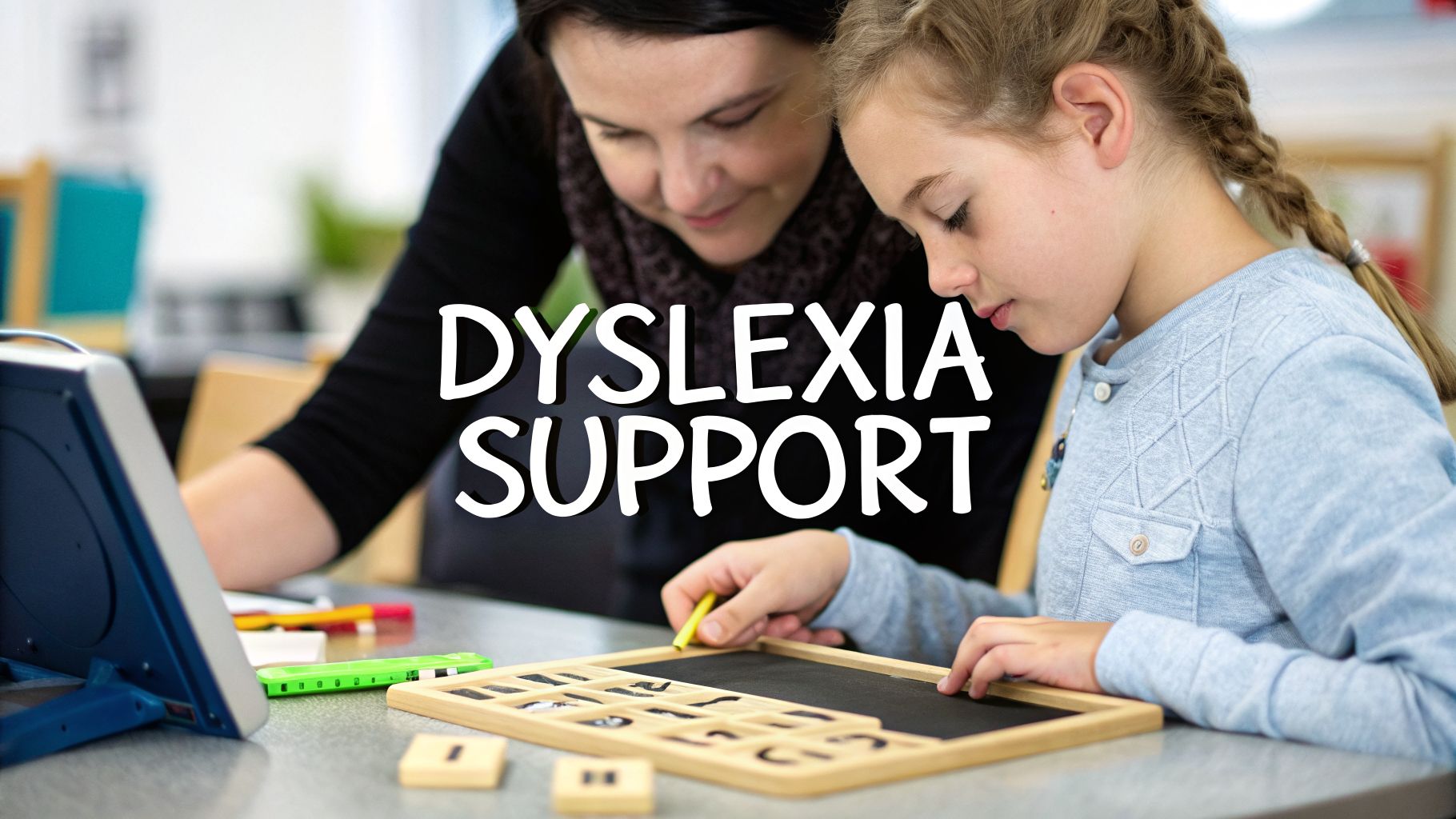
It often starts with a quiet, nagging worry. You see your bright, imaginative child struggle with things that seem to come easily to their friends. The gap between their brilliant ideas and what they can put on paper just seems to get wider, and you don't know why. That knot in your stomach tightens every time you see their light dim a little more after a tough day at school.
A specialised school for dyslexic learners is more than just an academic institution; it’s an entire ecosystem designed to understand this very struggle and transform it into strength. Crucially, it places your child's emotional well-being right at the centre of their education, because a happy, confident child is a child who is ready to learn.
From Worry to Empowerment: Your Child's Journey

This journey often begins not in a classroom, but in your own heart. It’s that feeling you get watching your child’s confidence dip when they're asked to read aloud, or seeing the frustration in their eyes after hours spent on homework that should have taken minutes. This emotional path, from concern to true understanding, is one many, many parents walk.
Realising your child might have dyslexia isn't about discovering a deficit. It’s about finally getting the instruction manual for their unique and brilliant mind—a brain that often excels at big-picture thinking, problem-solving, and creativity, but just happens to process written language differently. It’s like having a powerful computer that runs on a different operating system; it isn't broken, it just needs the right software and someone who knows how to use it.
Nurturing Confidence Before Curriculum
The most profound shift happens when we stop asking, "Why can't my child keep up?" and start asking, "What environment will help my child truly thrive?" A traditional school, with its one-size-fits-all approach, can feel like asking a fish to climb a tree. For a dyslexic child, this mismatch can lead to feelings of failure and anxiety, which quickly become enormous barriers to learning.
A school for dyslexic learners flips this script entirely. Its first and most important job is to rebuild the self-esteem that a rigid system may have chipped away at.
The core mission is to show your child that their way of thinking is a strength, not a weakness. By creating a safe space where they are understood and valued, these schools unlock a child’s natural curiosity and restore their love for learning.
Imagine your child, who once dreaded writing, suddenly animatedly contributing to a group project. This is what happens when the pressure is off. They can use speech-to-text software to get their ideas down, allowing their creativity to flow without being bottlenecked by spelling and grammar. For the first time, their classmates see the brilliant storyteller, not the hesitant writer.
An Ecosystem of Support
This supportive setting is about much more than just specialised teaching methods; it's a complete ecosystem built for their success.
This includes:
- Teachers who 'get it': Educators trained to see the world through a dyslexic lens, who know to celebrate a breakthrough in understanding just as much as a perfect test score.
- A community of peers: Suddenly, your child is no longer the "only one." They are surrounded by friends who understand the frustration of words blurring on a page, fostering a powerful sense of belonging.
- A focus on strengths: The education goes beyond simply decoding text. It actively nurtures their incredible talents, whether that’s building complex Lego models, composing music, or debating complex ideas.
Ultimately, finding the right school for a dyslexic child is a proactive step toward empowerment. It’s about choosing an environment that sees their potential and provides the specific tools, understanding, and encouragement they need to flourish—not just academically, but as confident, resilient individuals ready for the world.
Recognising the Signs of Dyslexia in Your Child

Before you can find the right support, like a specialised school for dyslexic learners, you first need to know what to look for. And let’s be clear: dyslexia is so much more than the old myth about just ‘reversing letters’. It’s a completely different way of processing the world—one often marked by astounding creativity and big-picture thinking that simply doesn't fit neatly onto the lines of a page.
Imagine the dyslexic mind as a powerful, creative engine. It sees the world in vibrant pictures, 3D models, and sprawling, interconnected webs of ideas. This is a profound strength, but it can make the task of decoding the flat, linear world of black-and-white text feel incredibly frustrating.
Spotting the signs isn’t about diagnosing a problem. It’s about understanding your child’s unique cognitive wiring so you can give them the tools they need to truly flourish.
Early Years and Primary School Signs
In the early school years, the signals of dyslexia can be subtle. It’s easy to dismiss them, thinking your child is just a “late bloomer.” But a parent’s intuition is a powerful thing. You might sense that your child's struggle goes deeper than just typical development.
Many of these early indicators centre on phonological awareness—the ability to hear, identify, and play with the individual sounds in language.
- Difficulty with Rhyming: While their friends are having fun with rhyming songs, your child may genuinely not hear that 'cat' and 'hat' sound alike. You might ask them for a word that rhymes with 'ball', and they suggest 'throw'—thinking about the concept, not the sound.
- Trouble Learning the Alphabet: This goes beyond simply singing the song. It’s a persistent difficulty in connecting letter shapes to their names or, crucially, their sounds. The letter 'b' and 'd' might seem identical to them, no matter how many times you review it.
- Mispronouncing Words: You might hear “pasghetti” for spaghetti or “aminal” for animal long after their peers have mastered these words. This can point to a deeper issue with processing and sequencing sounds.
- Struggles with Following Directions: A simple two-step instruction like, “Go to your room and get your blue jumper,” might feel like an impossible puzzle. By the time they get to their room, they’ve forgotten what they were sent for, not out of defiance, but because their working memory is overloaded.
Perhaps you have a child who can tell the most fantastically imaginative stories but freezes up when asked to write a single sentence. This gap between their verbal brilliance and their written output is a classic hallmark of dyslexia. If this sounds familiar, you’re not alone, and it’s a perfectly valid reason to find out more.
Signs in Secondary School
As children get older and the academic pressure mounts, the signs of dyslexia can shift and become more obvious. The coping strategies that might have just about worked in primary school often begin to crumble under the weight of more complex reading and writing.
At this stage, the emotional toll can become more visible, too. A bright, funny teenager might become withdrawn, anxious, or unfairly labelled as ‘lazy’ or ‘unmotivated’. The reality is that they are often working twice as hard as their classmates just to keep their head above water.
The sheer effort a dyslexic student puts into a 'simple' reading task can be immense. It’s like trying to run a marathon in boots filled with sand—they are exhausted before they even get to the part where they have to think about what the text actually means.
Common signs you might notice in a teenager include:
- Painfully Slow Reading: They can read, but it takes them an agonising amount of time to get through a chapter, turning homework into a nightly battle that ends in tears.
- Poor Spelling and Disorganised Writing: Their essays may be riddled with spelling mistakes (even with common words) and lack a clear structure, despite them knowing the subject inside and out. They might hand in a history paper with brilliant insights but an almost unreadable structure.
- Avoiding Reading Aloud: That sudden stomach ache right before it's their turn to read in English class is a huge red flag. It’s often rooted in a deep-seated fear of being embarrassed.
- Difficulty with Foreign Languages: Learning a new set of phonetic and grammatical rules can be exceptionally difficult and frustrating, feeling like an impossible, abstract puzzle.
If you’re seeing these challenges and want to organise your thoughts, a tool like this Is My Child Dyslexic Quiz can be a helpful first step.
These signs are not failures; they are signals. They are your child's way of showing you that the standard approach isn't working for them. Recognising them is the first, most important step toward finding an educational path that will. For more practical strategies, you can also explore our guide on how to help your child with dyslexia.
What Makes a Dyslexia-Friendly School Different?
Stepping into a specialist school for dyslexic learners can feel like a world of difference, but what exactly sets these environments apart? It isn't magic; it’s a deliberate, evidence-based approach that puts your child's unique way of thinking at the very heart of the learning process.
Think of a traditional classroom as a one-size-fits-all model. A school designed for dyslexic learners, on the other hand, is more like a bespoke workshop. Every tool and technique is carefully chosen to fit the individual child. The entire philosophy shifts from forcing a child to fit a rigid system to building an educational journey that adapts to them.
This creates a space where your child can finally breathe, knowing they are understood, supported, and valued for who they are.
To show this contrast more clearly, let's compare the two environments side-by-side.
Comparing a Standard vs Dyslexia-Focused School Environment
| Feature | Standard School Approach | Specialised School for Dyslexic Approach |
|---|---|---|
| Teaching Method | Primarily lecture-based; relies heavily on reading and writing. | Multisensory; engages touch, hearing, movement, and sight. Learning spelling words by building them with clay. |
| Pace of Learning | Standardised pace for the entire class. | Flexible and individualised, allowing for mastery of concepts before moving on. |
| Teacher Training | General teaching qualifications. | Specialist training in evidence-based dyslexia interventions (e.g., Orton-Gillingham). |
| Class Size | Often large, with 25-30+ students. | Small class sizes for personalised, one-to-one attention. |
| Assessment | Timed, written exams and tests. | Varied assessment methods, like projects, oral presentations, or creating a video to show understanding. |
| Technology | Used as a general classroom tool. | Assistive technology is integrated to remove barriers and empower students. |
| Student Mindset | May feel "behind" or "less than" peers. | Builds confidence and self-esteem by focusing on strengths and celebrating progress. |
As the table shows, the difference isn't just about small adjustments; it's a fundamental shift in educational philosophy. Let's delve into what these specialised approaches look like in practice.
Teaching to All the Senses
One of the most powerful strategies you'll find in a dyslexia-focused school is multisensory instruction. This is built on a simple but profound idea: when we learn by engaging multiple senses at once, the information sticks. It helps the brain build stronger, more diverse neural pathways to store and retrieve information.
For a dyslexic child, this isn't just a fun extra. It’s a lifeline. It bypasses the parts of the brain that can get stuck on purely text-based information and instead plays to their strengths.
Let's take a practical example. Learning the letter 'd' in a typical classroom might just mean looking at it on a worksheet and writing it down. In a multisensory setting, it becomes a rich, physical experience:
- Touch: The child traces the shape of 'd' in a sand tray or with shaving foam, feeling the curve and the straight line.
- Hearing: As they trace, they repeat the letter's sound—"duh, duh, duh"—connecting the physical movement to the sound.
- Movement: The student might use their whole arm to "air write" a giant 'd', physically embedding the motor plan for its shape.
- Sight: They might build the letter with colourful blocks or watch an animation showing how it’s formed, reinforcing its visual structure.
This approach turns a potential point of frustration into a moment of successful, memorable learning. It's a cornerstone of what makes education in a specialist setting feel so different—and work so well.
Teachers Who Are Experts, Not Just Educators
It’s one thing to be a patient teacher. It’s another entirely to be an expert in the science of reading and dyslexia. In a dedicated school for dyslexic learners, teachers aren't just given a weekend course; they are deeply trained in specific, evidence-based instructional methods.
A key difference lies in the expertise of the educators. They are trained in structured, explicit programmes like the Orton-Gillingham approach, which breaks down language into its smallest components and teaches it in a logical, systematic way. This is not the standard for all schools.
This level of expertise means teachers understand the 'why' behind a child's struggles. They see a spelling mistake not as carelessness, but as a clue to how that child's brain is processing sounds. This deep understanding allows for precise, targeted support that truly moves the needle. A classroom built on this foundation is a key part of an inclusive education, which you can read more about in our guide on what inclusive education means.
Assistive Technology as a Ramp, Not a Crutch
Many parents worry that technology will make their child lazy or stop them from learning essential skills. In a dyslexia-friendly school, assistive technology is seen through a completely different lens. It’s not a crutch; it’s a ramp.
Think of it this way: you wouldn't tell someone in a wheelchair that using a ramp is 'cheating'. The ramp simply removes a barrier, allowing them to get into the building like everyone else. Assistive technology does the same for a dyslexic student.
Here’s how it works in practice:
- Text-to-Speech Software: A brilliant 14-year-old might have the intellect to understand complex GCSE Biology concepts but struggles to decode the textbook. Text-to-speech software reads the text aloud, removing the reading barrier and letting them engage with the material at their true intellectual level.
- Speech-to-Text Software: A child with incredible stories in their head might freeze when trying to write them down. Speech-to-text tools let them dictate their essay, capturing their creative flow without the bottleneck of spelling and handwriting. They can finally get their epic adventure story onto the page.
This technology empowers students. It frees up their mental energy to focus on the important stuff—critical thinking, analysis, and creativity—instead of getting bogged down by the mechanics of reading and writing. It levels the playing field and allows their true abilities to shine through.
Choosing the Right Educational Path
Once you have a clearer picture of your child’s needs, the path forward can seem both full of promise and incredibly daunting. The good news is that as understanding of dyslexia grows, so do the educational choices available to families. This is no longer about just finding any school, but about discovering the right environment for your child's unique way of thinking and learning.
For most families, this decision boils down to three main avenues: a dedicated specialist school, a mainstream school with SEN (Special Educational Needs) support, or the growing option of a specialist online school. Each path has its own distinct culture and set of trade-offs, and the best fit will always come down to your child’s personality, their specific needs, and your family’s circumstances.
Dedicated Specialist Schools
A dedicated school for dyslexic learners promises total immersion. Think about it: an environment where every teacher is a trained specialist, the entire curriculum is built from the ground up for dyslexic minds, and your child is surrounded by peers who simply ‘get it’. For a child who has felt lost or behind in a mainstream classroom, this kind of belonging can be utterly life-changing.
But this level of expertise often comes with significant practical challenges. These schools are few and far between. This could mean a long daily commute that leaves your child exhausted, or even relocating the entire family—a huge commitment. For many, however, the reward of seeing their child come home from school happy and understood for the first time is worth any sacrifice.
Mainstream Schools with SEN Support
This is the most common route for a reason. Attending a local mainstream school allows your child to stay with their friends and remain part of their community—a vital anchor for their social wellbeing and sense of self.
The challenge, as countless parents will tell you, is that the quality of support can be a postcode lottery. Even with the very best intentions from staff, SEN coordinators are often stretched incredibly thin. Your child might only get a few hours of focused, specialist help each week, leaving them to navigate a system not designed for their brain for the rest of the time. It can be exhausting and deeply demoralising for them to feel like they're constantly playing catch-up.
The Rise of Specialist Online Schooling
This is where a powerful, modern alternative enters the picture. Specialist online schools offer a compelling blend of expert, targeted support with the flexibility that families need. They effectively bridge the gap between the intensive focus of a specialist school and the convenience of learning from home.
Platforms like Queen’s Online School aren’t just about putting standard lessons onto a screen. They are about delivering highly personalised, expert teaching from SEN-trained instructors in very small, interactive groups. For a child who feels anxious or overlooked in a bustling classroom of 30, learning in a calm, focused group of just a few peers can be a complete game-changer. They receive the direct, individualised attention they need without the social pressures that can make school a place of dread.
The real power of this model is that it combines the best of both worlds: you get the deep, specialist instruction of a top-tier school for dyslexic learners, but with the comfort, safety, and flexibility of learning from home.
This model completely removes geography from the equation. It no longer matters if the UK's best dyslexia-trained teacher lives 300 miles away; they can be in your child’s virtual classroom every single day. This approach gives children back a sense of control over their learning environment, empowering them to flourish both academically and emotionally.
This decision tree shows the essential criteria to look for when evaluating a school's approach to dyslexia.

The key takeaway is that a truly dyslexia-friendly school actively embraces adapted methods and expert teachers, rather than sticking to rigid, one-size-fits-all teaching.
How to Evaluate a School for Your Child

Choosing the right school for your dyslexic child can feel like the single most important decision you’ll ever make. It is. But you don’t have to face this journey armed with just a glossy prospectus and a hopeful heart. You can, and should, step into this process as a knowledgeable advocate for your child, ready to ask the specific, probing questions that reveal what truly happens behind the classroom walls.
Think of this as your game plan. It’s about looking past the polished mission statements and digging into the daily reality for a student just like yours. Remember, you are the world’s leading expert on your child, and your questions carry immense weight.
Questions That Go Beyond the Prospectus
When you meet with school leaders, your job is to understand how their educational philosophy actually translates into practice. Any school can say they support dyslexic students; you need to see the proof. It’s time to move beyond generic queries and ask for specifics.
These questions are designed to uncover the real depth of a school's expertise and commitment to your child's well-being:
- On Teacher Expertise: "What specific, evidence-based dyslexia training have your teachers completed, and how do you ensure this training is kept up-to-date?" An answer like, "Our lead teachers are Orton-Gillingham certified," is far more compelling than a vague mention of "regular professional development."
- On Classroom Adaptation: "Could you walk me through how a typical History or Science lesson is adapted for a student who finds reading a major barrier?" You want to hear them describe using videos, class discussions, mind-mapping software, and hands-on projects, not just "extra time on tests."
- On Measuring What Matters: "Beyond academic scores, how do you track and nurture growth in a student's confidence and self-esteem?" This powerful question puts your child’s emotional well-being at the centre of the conversation, showing that you value their happiness as much as their grades.
- On Individual Support: "If my child is struggling with a specific concept, what does your support process look like in practice?" A good answer involves immediate, targeted intervention in a small group or one-to-one, not just waiting for the next report card.
A school that embraces these detailed questions is a school that is confident in its practice. If they can offer clear, passionate answers with real-world examples, it’s a brilliant sign they are genuinely equipped to help your child flourish.
Your School Visit Checklist
A school visit is your opportunity to feel the culture and atmosphere first-hand. As you walk the corridors, be an observer. You’re looking for tangible evidence of a learning environment that feels inclusive, supportive, and alive with curiosity.
Here’s what to look for on the ground:
- Technology in Action: Is assistive technology, like text-to-speech software, a natural and visible part of the classroom? It should be as common and unremarkable as a pencil case.
- The Classroom Vibe: Do students seem genuinely engaged and comfortable asking questions? Look for hands-on, interactive activities. For many dyslexic learners, a quiet classroom isn't always a productive one.
- Displays of Work: What kind of achievement is celebrated on the walls? Look for a variety of formats: mind maps, project models, and QR codes linking to audio recordings alongside the traditional written work. This shows the school values all forms of expression.
- Student Interactions: Watch how students and teachers speak to one another. Is there a feeling of mutual respect and psychological safety? A happy, confident child is one who feels safe enough to take intellectual risks.
Ultimately, evaluating a school is as much an emotional process as it is a logical one. The right place will not only have the right programmes but will also give you a profound sense of hope and relief. Trust your instincts—they’ve guided you this far.
Navigating the Support Gap in UK Schools
For so many parents in the UK, trying to find the right educational support for a dyslexic child feels like an exhausting, uphill battle. You know your child is bright and full of potential, but you see them wilting in a system that doesn't seem to understand them. This isn't just a feeling; it's a documented reality for families up and down the country.
If this sounds familiar, please know you are not alone. There's a heartbreaking gap between the number of children thought to have dyslexia and the very few who actually get the targeted support they need to truly thrive.
The Sobering Statistics Behind the Struggle
The scale of this issue is, frankly, staggering. It’s estimated that out of 8.7 million schoolchildren in England, roughly 870,000 have dyslexia. But here’s the shocking part: fewer than 150,000 of these children have a formal diagnosis. This means a vast majority—around 82% of dyslexic students—are sitting in classrooms right now, unidentified and unsupported. These aren't just statistics; they are children whose confidence is being chipped away with every single lesson. You can learn more about why dyslexia remains so hidden by reading the full research on this issue.
This "diagnostic crisis" often comes down to systemic problems. Crippling funding cuts and not enough specialist teacher training mean that even schools with the very best intentions simply can't provide the help that’s needed. In fact, some research suggests that around 43% of UK schools don't fully grasp the real challenges of dyslexia, which leaves countless children falling through the cracks.
This gap takes a heavy emotional toll. Watching your child work twice as hard for half the results, seeing their love of learning fade, and feeling like you’re not being heard by an overwhelmed system is a heavy weight for any parent to carry.
A Bridge Over Troubled Waters
This is precisely where specialist providers, particularly online schools, have stepped in to offer a genuine lifeline. They aren't just another option on the table; for many families, they have become a direct and necessary solution to this support gap. Because they operate outside the tight constraints of the traditional system, they can deliver what is so desperately needed.
Here’s what a specialised online school for dyslexic learners can provide for your child:
- Individualised Assessments: They can carry out their own in-depth assessments to build a clear picture of your child's unique learning profile. This bypasses the long, often stressful wait for a formal NHS or school-based diagnosis.
- Immediate, Expert Support: Your child can start getting targeted, evidence-based instruction from SEN-trained teachers almost straight away. This is crucial for halting the cycle of frustration and failure before it becomes entrenched.
- Freedom from Systemic Constraints: Unburdened by the same funding and resource limitations that plague mainstream schools, they can guarantee small class sizes and the one-to-one attention your child deserves.
This approach offers a vital bridge for families who feel they are slipping through the cracks of the mainstream system. It provides immediate, expert help that is built entirely around your child’s needs. As you explore your options, you might also find this guide on Neurodiversity and Mental Health Support in the UK a valuable resource for your journey. Understanding the different kinds of SEN support available can also empower you to make the best possible choice for your family.
Frequently Asked Questions About Dyslexia Schools
When you start looking into specialist schools for dyslexia, the questions come thick and fast. It’s a journey filled with hope, but it’s completely natural for it to be coupled with practical concerns about what such a significant change means for your child and your family. We've walked this road with countless families, so we want to address the questions we know are top of your mind, offering clear, straightforward answers to give you confidence in the path ahead.
How Much Does a Specialist Dyslexia School Cost?
Let's start with the question that’s often the most pressing. The truth is, costs for specialist education can vary dramatically across the UK, and it's wise to understand the landscape.
- Independent Specialist Schools: For a day school placement, you can expect fees to range anywhere from £18,000 to £35,000+ per academic year. Boarding schools will, of course, come at a higher cost.
- Funding Support: It is possible for some families to secure funding from their local authority. This is done through an Education, Health and Care Plan (EHCP), which can cover the costs of a specialist placement if it's proven to be a necessity for your child's education.
- Online Schools: A high-quality specialist online school can be a more financially accessible option. By removing the significant overheads of maintaining a physical campus, these schools can channel resources directly into what matters: expert teaching in small groups, offered at a more manageable price point.
Does My Child Need an Official Diagnosis for Support?
This is a great question, and the answer really depends on the path you're taking. If you're aiming to secure a funded place at a specialist school via an EHCP, then yes, a formal diagnosis of dyslexia is a critical piece of evidence. The local authority will require this documentation to properly assess your child’s needs and approve the funding.
However, many independent and online schools have more leeway. They can often start providing the right support based on their own in-house assessments or a detailed report from a qualified educational psychologist. This is a huge advantage, as it means your child can begin getting the help they need right away, rather than waiting for a long and often stressful official process to play out.
The most important thing is for your child to feel understood and to start thriving. Don't let the pursuit of a perfect diagnosis stand in the way of finding an environment that celebrates their strengths and supports their challenges right now.
Will My Child Be Socially Isolated?
This is a fear we hear from so many loving parents. You're trying to solve their academic struggles, and the last thing you want is to inadvertently create social ones. But in our experience, the reality is usually the exact opposite of what you fear.
Think about it: in a mainstream school, a child with dyslexia can often feel alone, singled out, and "different." This constant struggle just to keep up can be incredibly damaging to their social confidence. When they move to a specialist school, they are suddenly in a community of peers who just get it. They share similar experiences and understand each other’s challenges. That sense of belonging can be transformative, dissolving anxiety and allowing their true personality to finally shine through.
This focus on community is something that quality online schools take very seriously. They actively build it through:
- Live, interactive group projects where students must collaborate to solve problems.
- Virtual common rooms and social clubs built around shared passions, from coding to creative writing.
- School-wide assemblies and events that foster a genuine sense of school spirit.
In these supportive settings, children often forge stronger, more meaningful friendships than ever before, precisely because they feel safe enough to be themselves.
What Is an EHCP and How Do I Get One?
An Education, Health and Care Plan (EHCP) is a legally binding document in the UK. It outlines a child's special educational needs and, crucially, the specific support they are legally entitled to receive to meet them.
The demand for this level of support is growing. As of 2026, there are over 1.7 million pupils in England with special educational needs. The number of pupils holding an EHC plan has soared by 89% since 2016. Despite this, a staggering four out of five UK schools report they don’t have adequate funding for SEN support. This paints a clear picture of a system under immense pressure and the uphill battle many families face. You can learn more about the latest SEN statistics in England.
To apply for an EHCP, you need to request a formal needs assessment from your local authority. This process can be lengthy and complex. Our advice is to start early, gathering all possible evidence—school reports, letters, medical assessments, and your own detailed observations—and to get in touch with invaluable charities like the British Dyslexia Association for guidance.
At Queen's Online School, we understand these challenges intimately. We offer a nurturing and academically rigorous environment where SEN-trained teachers provide personalised support in small, live classes. If you're looking for an educational path that adapts to your child's needs, we invite you to learn more about our approach.
Discover how Queen's Online School can help your child thrive.