

In a world of evolving educational landscapes, from bustling classrooms to the focused environment of online schooling, the methods we use to motivate children are more critical than ever. It's time to move beyond generic praise and explore the profound emotional and psychological impact of meaningful positive reinforcement. This guide is built around a central, heartfelt principle: putting the child's needs at the centre of everything we do.
This article offers more than just a list; it provides a strategic toolkit. We will delve into 10 powerful, practical positive reinforcements examples, offering not just the 'what' but the crucial 'why' and 'how.' You'll find specific strategies tailored for different age groups, learners with SEN or SEMH needs, and the unique dynamics of both home and virtual school settings. To truly understand the impact, it's essential for parents and educators to grasp the fundamental distinction between intrinsic vs extrinsic motivation.
Our focus is on actionable insights that help build genuine self-esteem and a lifelong love of learning. We will unpack the emotional core of each example, tapping into the feelings that drive engagement and build a foundation of trust and confidence. Prepare to discover how to create a supportive environment where every child feels seen, valued, and empowered to thrive.
1. Immediate Verbal Praise and Recognition
Immediate verbal praise is the act of acknowledging a child's effort or achievement in real-time. This is one of the most powerful and accessible positive reinforcements examples because it creates an instant link between a specific action and positive recognition, fulfilling a child's deep need to feel seen and understood in the moment. The immediacy reinforces the desired behaviour while the memory is fresh, making the emotional connection strong and meaningful.

This method taps directly into a child's need for validation and connection, boosting their self-esteem and motivating them to repeat the behaviour. For example, in a live online class, a teacher saying, "Fantastic point, Leo. You’ve analysed that character’s motivation perfectly," does more than just praise; it tells Leo exactly what he did well, making him feel intelligent and insightful, thus encouraging deeper critical thinking in the future.
Strategic Application
- When to Use: Use it to reinforce a newly developing skill, to encourage a hesitant child to participate, or to acknowledge resilience after a difficult task. It is particularly effective for learners with SEMH needs, as frequent, immediate feedback builds a crucial sense of psychological safety and confirms they are on the right track.
- Why It Works: Based on the principles of operant conditioning and popularised by Carol Dweck's growth mindset research, this technique works because it focuses on process and effort, not just innate talent. This nurtures a child's belief that their abilities can be developed through dedication and hard work.
Actionable Tips for Implementation
- Be Specific: Move beyond a generic "good job." Instead, say, "I noticed how carefully you organised your notes for that history project; that's excellent planning." This shows the child you are paying attention to their specific actions.
- Praise Effort: Focus on the process and the feeling behind it. "You worked so hard to solve that maths problem, even when it was tricky. Your persistence is brilliant and you should feel so proud of yourself for not giving up."
- Personalise It: Using the child's name, especially in a group setting, makes the recognition feel more personal and significant, cutting through the noise to make them feel individually valued.
- Balance Public and Private: Acknowledge successes publicly to build a positive classroom culture, but offer quiet, one-to-one praise for shy children or for more personal achievements, respecting their emotional comfort zone.
2. Point and Reward Systems
Point and reward systems create a structured framework where students earn tokens or points for demonstrating desired behaviours or academic achievements. These are powerful positive reinforcements examples because they make progress tangible and provide clear, measurable targets that a child can see and feel proud of. The points can then be exchanged for meaningful rewards, turning abstract goals into exciting, concrete incentives.
This method provides a consistent and predictable environment, which is highly motivating and calming for many learners. For example, a child earning ‘Participation Points’ for active engagement in live online classes can redeem them for a reward they truly care about, like choosing the next class break-out room topic. This not only rewards participation but also builds a visible record of achievement, boosting their confidence and sense of belonging within the school community.
Strategic Application
- When to Use: Ideal for long-term projects, behaviour modification, or encouraging consistent habits like timely assignment submission. It is particularly effective for students with SEN who thrive on clear expectations and visual progress trackers that reduce anxiety.
- Why It Works: Based on B.F. Skinner's token economy principles, this system uses secondary reinforcers (points) that acquire value by being linked to primary rewards. This gamified approach taps into a child’s intrinsic desire for achievement and progress, making learning feel more like a fun challenge.
Actionable Tips for Implementation
- Co-create the System: Involve the child in deciding which behaviours earn points and what the rewards should be. This gives them ownership and ensures the rewards are genuinely motivating for them.
- Offer Varied Rewards: Include a mix of tangible (e.g., a new book) and experiential rewards (e.g., 15 extra minutes of screen time, choosing the family movie), catering to the child's unique interests.
- Ensure Achievability: Set reward thresholds that are attainable for all students. For a child who struggles, offer bonus points for excellent effort or improvement, so they feel success is always within reach.
- Communicate Progress with Heart: Regularly update students and parents on point totals not just as a number, but as a celebration of their hard work and progress. Frame it as, "Look how all your effort is adding up!"
3. Progress Tracking and Visualization
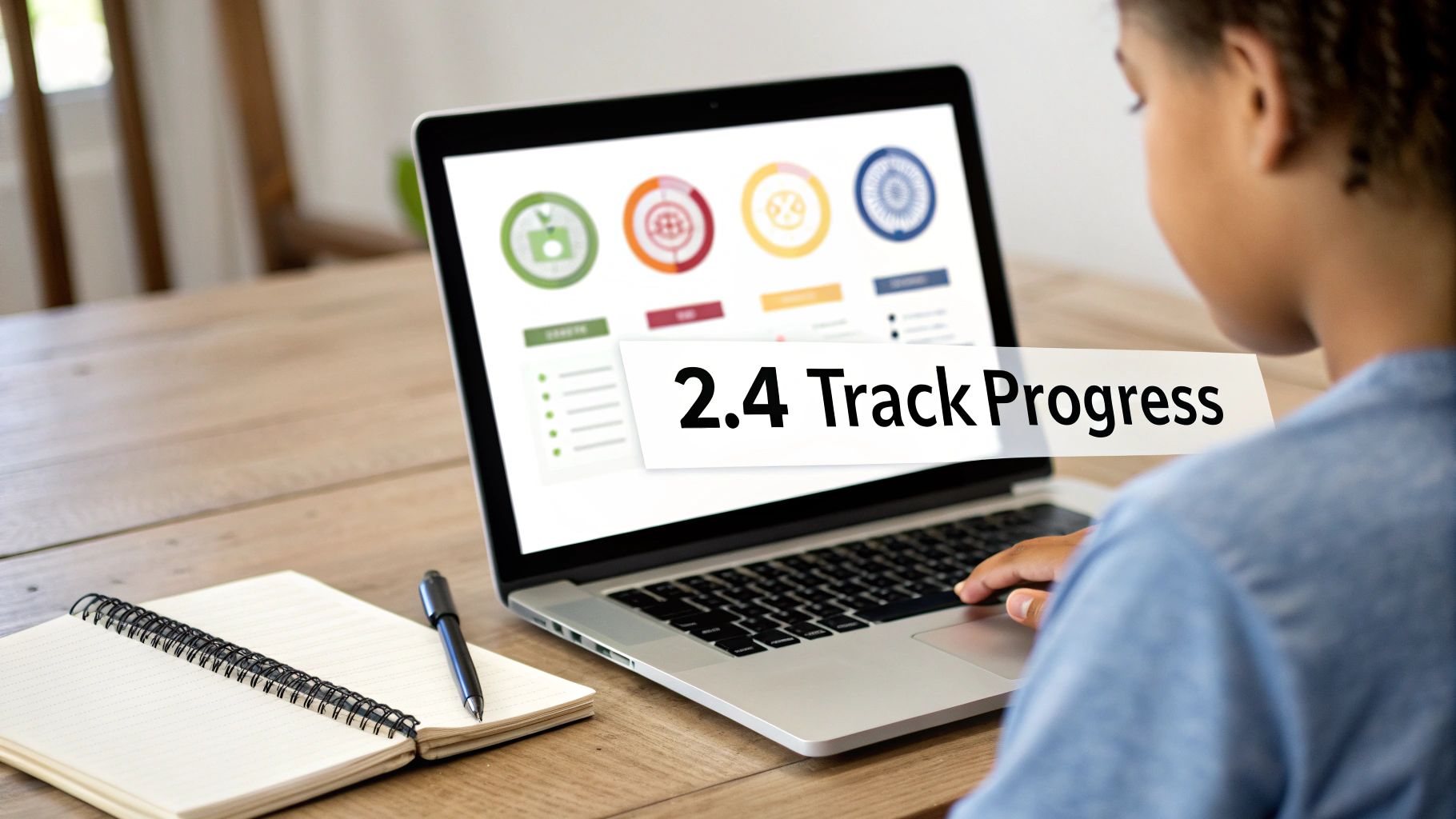
Progress tracking and visualisation are systems that display a student's advancement through clear, visual representations. This method is one of the most effective positive reinforcements examples because it makes learning tangible and speaks directly to a child's need to see the results of their hard work. When a child can physically see how far they have come, it builds momentum and a powerful sense of personal accomplishment.
This approach transforms abstract goals into visible milestones, filling a child with pride. For instance, an online school's digital dashboard showing a student’s GCSE topic mastery creeping from 60% to 75% provides a powerful, intrinsic reward. It visually confirms their hard work is paying off, which is far more motivating than just a grade on a single test. This helps children connect effort directly to outcomes, fostering a robust sense of personal agency and control over their own success.
Strategic Application
- When to Use: Ideal for long-term projects, exam revision periods (like A-Levels), or skill development that requires sustained practice. It is especially beneficial for learners with SEN who may need concrete, visual evidence of their progress to stay motivated and reduce the anxiety of feeling like they aren't improving.
- Why It Works: Popularised by Carol Dweck's growth mindset research and modern learning platforms, this works by shifting the focus from a single endpoint to the journey of improvement. Seeing a progress bar fill up or a new skill badge unlocked triggers a dopamine release, making the learning process itself feel rewarding and exciting.
Actionable Tips for Implementation
- Make It Collaborative: Involve the child in setting the milestones. Ask, "What does finishing this module look like to you? Let's draw out the steps together!" This gives them ownership over their learning path.
- Visualise Small Wins: Use a sticker chart on the wall, a "levelling up" system, or a digital portfolio to celebrate incremental progress, not just the final goal. For a child, every small step forward is a huge victory worth celebrating.
- Keep It Simple and Positive: Ensure any dashboard or tracker is intuitive and focuses on growth. A complicated system can become a source of stress. The goal is to make them feel good about their progress, not overwhelmed by data.
- Integrate Well-being: Include trackers for non-academic goals, such as taking regular breaks or practising mindfulness, to show the child that their well-being is just as important as their academic success.
4. Personalised Learning Pathways and Autonomy
Granting students ownership over their learning journey by offering choices in what, how, or when they study is a profound form of intrinsic reinforcement. This approach is one of the most empowering positive reinforcements examples because it honours the child's individuality and taps directly into their fundamental need for autonomy. When a child has a say in their learning, they feel respected and trusted, transforming education from a passive chore into an active, personal adventure.
This method boosts engagement by connecting curriculum goals with a child's natural interests and learning preferences. For instance, allowing an A-Level student to choose between writing a traditional essay, creating a detailed presentation, or producing a short documentary to demonstrate their understanding gives them control. This allows them to express their knowledge in a way that feels authentic and exciting, which deepens their engagement and the quality of their final work.
Strategic Application
- When to Use: Ideal for project-based learning, revision periods, or any task where multiple formats can demonstrate mastery. It is especially effective for older students developing independent study skills and for learners with SEN who benefit from choosing pacing options that suit their unique learning rhythm.
- Why It Works: Rooted in Self-Determination Theory (Deci & Ryan), this strategy works because it satisfies the core psychological needs for autonomy and competence. By making meaningful choices, children become more invested in the outcome and develop crucial decision-making skills, empowering them to become a successful self-directed learner.
Actionable Tips for Implementation
- Offer Structured Choice: Provide 3-4 well-defined options rather than unlimited freedom, which can be overwhelming for a child. For example, "You can show your understanding of the water cycle by making a poster, building a model, or writing a story. Which sounds most fun to you?"
- Scaffold Autonomy: Introduce choices gradually. For younger primary learners, this might be choosing between two reading books. For secondary students, it could be selecting their research topic for a history project.
- Connect Choices to their World: Help the child see how their choices align with their interests and future dreams. "Since you love making videos, why not create a video report for your science project? It could be a great first step towards being a YouTuber!"
- Review and Adapt with Empathy: Regularly check in with the child about their choices. If they feel stuck, help them adjust without judgement. This teaches them that it's okay to change course and that you are there to support them.
5. Peer Recognition and Collaborative Learning Celebrations
Peer recognition harnesses the power of social connection, allowing children to celebrate each other's contributions and achievements. This is one of the most emotionally resonant positive reinforcements examples for building a supportive community, especially in an online environment. It shifts the focus from purely teacher-led praise to a collaborative culture where every child’s effort is seen and valued by their classmates, fulfilling their need to belong.
This approach taps into a child's deep desire for social validation and friendship. For instance, a weekly 'Peer Spotlight' on a school's community platform, where students nominate classmates for anything from academic breakthroughs to acts of kindness, fosters a sense of shared success and warmth. It shows a child that their positive actions are noticed and appreciated by the people whose opinions often matter most: their peers.
Strategic Application
- When to Use: Use this to strengthen group cohesion during collaborative projects, to build a positive and kind classroom culture at the start of the year, or to encourage empathy. It is especially beneficial for teenagers who are highly influenced by their social groups and for learners who may be hesitant to accept praise from adults but open to it from friends.
- Why It Works: Drawing on principles from Barbara Fredrickson’s research on positivity and social connection, this method works because it builds genuine bonds and a sense of collective identity. When children learn to give and receive meaningful praise, they develop crucial social and emotional skills, and the reinforcement feels more authentic and impactful.
Actionable Tips for Implementation
- Establish Inclusive Criteria: Create nomination processes that recognise diverse achievements beyond top grades, such as creativity, resilience, or being a great friend. This ensures every child feels they have a chance to be celebrated for their unique strengths.
- Model How to Give Good Praise: Teach children how to provide specific and heartfelt appreciation. Instead of "You did well," guide them to say, "I really appreciated how you explained that hard maths problem to me; you made me feel less confused."
- Offer Private Options: Create channels for private recognition, like a "kindness box" or a direct message to the teacher, for children who may be too shy to praise others publicly but still want to share positive feelings.
- Rotate the Spotlight: Ensure the recognition is distributed fairly over time, giving every child an opportunity to be celebrated. This prevents cliques and reinforces the idea that everyone in the community has value.
6. Mastery-Based Progression and Skill Badges
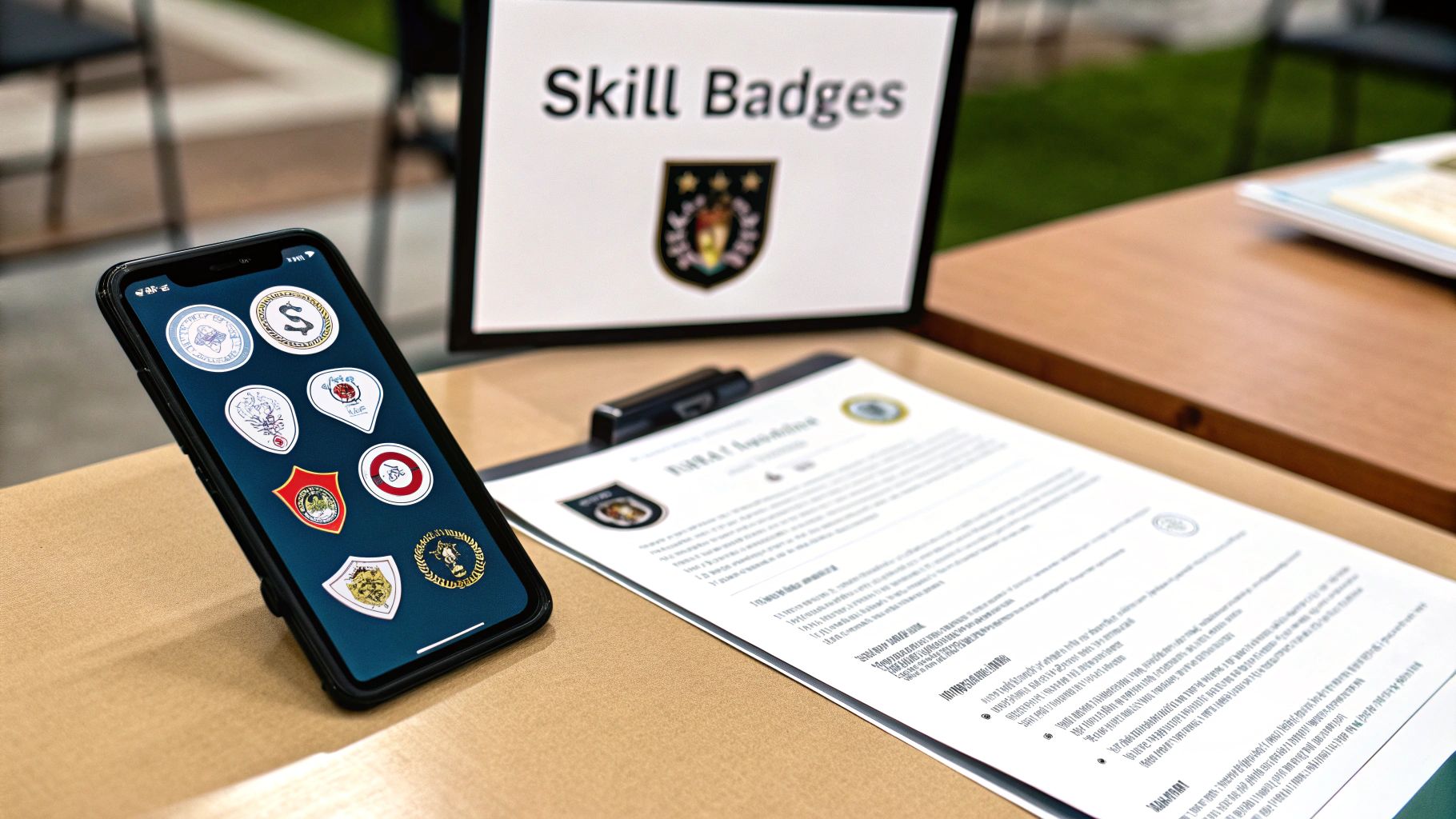
Mastery-based progression is a system where learners advance by demonstrating genuine understanding of a topic, not just by spending time on it. Earning digital or physical skill badges for these achievements provides tangible recognition, making it one of the most effective positive reinforcements examples for building a child's long-term confidence. This method celebrates competence and gives children a clear, visual map of their learning journey, showing them exactly what they are capable of.
This approach taps into a child’s intrinsic need for achievement and autonomy, making them feel smart and in control. For instance, a secondary student earning an 'Essay Structure Expert' badge for their GCSE English preparation feels a powerful sense of ownership over their skills. It shifts the focus from the anxiety of grades to the pride of growth, empowering them to see themselves as capable learners who can conquer complex challenges step-by-step.
Strategic Application
- When to Use: Ideal for breaking down complex subjects like A-Level Biology or foundational maths skills. It is especially beneficial for learners with SEN, as it allows them to progress at their own pace without the pressure of a fixed timeline, focusing on building solid understanding before moving on and reducing feelings of being "behind."
- Why It Works: Rooted in Benjamin Bloom's Mastery Learning theory, this technique works because it ensures every learner builds a strong foundation. The badges act as visible milestones, creating a feedback loop that boosts confidence and makes the learning process feel like a rewarding game of levelling up.
Actionable Tips for Implementation
- Define Clear, Child-Friendly Criteria: Ensure mastery thresholds are well-defined. For a child, a 'Numeracy Master' badge could mean "I can solve 10 multiplication problems all by myself!" This makes the goal understandable and achievable.
- Create a Visual Adventure: Show learners how smaller badges stack up to achieve larger goals, like a treasure map leading to subject mastery. This visual journey keeps them motivated and excited for the next step.
- Celebrate the Moment of Achievement: Acknowledge and celebrate when a badge is earned with genuine excitement. This amplifies the child's sense of accomplishment and makes them feel truly proud of their hard work.
- Design Fun and Meaningful Badges: Make the badges visually appealing and give them names that a child would find cool, reflecting the real-world skill they represent, such as 'Creative Storyteller' or 'Digital Wizard'.
7. Parent Involvement and Home-School Partnership Recognition
Recognising and involving parents is a powerful, indirect form of positive reinforcement for a child. This approach extends reinforcement beyond the classroom, honouring the family's vital role in a child's learning journey. When parents feel valued and see their engagement making a difference, it creates a consistent and loving environment that reinforces the child’s efforts both at home and at school, making them feel supported from all sides.
This strategy taps into a child’s deep-seated need for family approval and the comforting feeling of having a united team cheering them on. For instance, a teacher sending a quick, positive email home—"I wanted to share that Sarah was incredibly brave today and shared her wonderful story with the class. You must be so proud!"—makes both the child and parent feel a surge of pride. This shared celebration is one of the most holistic positive reinforcements examples, strengthening the entire support network around the learner.
Strategic Application
- When to Use: Ideal for fostering a long-term positive learning culture, improving communication, or aligning home and school expectations. It is especially beneficial for online learners, where a strong parent-teacher partnership is key to maintaining structure and motivation.
- Why It Works: Based on the frameworks of Joyce Epstein and Henderson & Mapp, this method works because it creates a positive feedback loop. When parents are recognised, they become more engaged; this engagement directly supports the child, who feels the love and encouragement from both home and school, boosting their motivation and happiness.
Actionable Tips for Implementation
- Share Specific, Heartfelt Praise: Instead of generic updates, send a specific note: "Thank you for helping Noah organise his project timeline. It made a huge difference to his confidence and the final result was fantastic."
- Create Accessible Opportunities: Offer varied ways for parents to be involved that suit different skills and schedules, from being a "mystery reader" via video call to sharing a family recipe for a culture day project.
- Share Success Stories: In newsletters or parent portals, feature examples of effective home-school partnerships. Seeing other families succeed can be inspiring and provides practical ideas.
- Provide Simple, Actionable Guidance: Equip parents with clear strategies they can use to support their child. For example: "This week we are learning about fractions. A great way to help at home is to bake a cake together and talk about the measurements!"
8. Mindfulness and Well-being Recognition
Mindfulness and well-being recognition is the practice of acknowledging a child’s efforts in emotional regulation, resilience, and self-care. This is one of the most vital positive reinforcements examples for modern learners, as it validates the quiet, internal work that underpins academic success. It tells a child that their feelings matter and that their emotional health is just as important as their grades.
This approach celebrates the process, not just the outcome, making a child feel safe and understood. For instance, acknowledging a student who uses a breathing technique before a stressful exam ("I saw you take a moment to calm yourself, that was a really smart and strong thing to do"), or praising another for bravely asking for help, reinforces that their emotional well-being is a priority. This builds trust and psychological safety, creating an environment where children feel supported in their holistic development.
Strategic Application
- When to Use: Use this to support children with anxiety, to build resilience after a setback, or to foster a compassionate classroom culture. It is particularly effective for learners with SEMH needs who need to have their emotional self-management efforts seen and valued to build self-worth.
- Why It Works: Popularised by the work of Jon Kabat-Zinn and Daniel Goleman, this method works because it connects emotional intelligence to overall success. Recognising these skills teaches children that managing their feelings is a strength, not a weakness, empowering them to build healthy coping mechanisms for life.
Actionable Tips for Implementation
- Use Destigmatising Language: Frame help-seeking as ‘brave’ or ‘wise’. For example, "It was so strong of you to let me know you were feeling overwhelmed. Now we can figure it out together." This makes the child feel courageous, not needy.
- Acknowledge the Effort to Regulate: Focus on the attempt, regardless of the outcome. "I saw you take a moment to pause when you felt frustrated. That was a brilliant choice, even if it was still hard."
- Create Well-being "Wins": Introduce celebrations for emotional milestones. This could be a "Resilience Rockstar" certificate or a quiet, appreciative nod that says, "I see you, and I'm proud of how you're handling this."
- Connect Feelings to Learning: Explicitly link emotional well-being to academic readiness. "Now that you've taken a few deep breaths, do you feel more ready to tackle this maths problem?" This shows the child the practical benefit of self-care. Learn more about the critical link between emotional and academic growth through social emotional learning.
9. Leadership Opportunities and Student Agency in School Decision-Making
Granting children real responsibility and leadership roles fosters a profound sense of trust and value. This method is one of the most empowering positive reinforcements examples because it moves beyond rewards to deep, intrinsic motivation. When a child leads an initiative or contributes to class rules, they feel their voice truly matters, which reinforces their connection to the community and their own capabilities, making them feel important and respected.
This approach nurtures essential life skills and a sense of purpose. For instance, when a group of students successfully proposes a new recycling programme, the reinforcement is the tangible, positive impact they see in their school. This direct experience of making a difference is a powerful motivator that fills them with pride and encourages continued engagement and responsible citizenship.
Strategic Application
- When to Use: Use this to develop a child's confidence, social skills, and sense of belonging. It is particularly effective for older students and for learners who may feel disengaged, giving them a meaningful stake in their educational environment and a reason to care.
- Why It Works: Rooted in the democratic education principles of thinkers like John Dewey, this strategy works by fulfilling the fundamental human need for autonomy and purpose. It demonstrates trust in a child's abilities, which in turn boosts their self-esteem and encourages them to take ownership of their community.
Actionable Tips for Implementation
- Grant Real Authority: Ensure roles, like "Class Librarian" or "Well-being Ambassador," come with genuine decision-making power. For example, the class librarian gets to choose a new book for the class each month.
- Provide Scaffolding and Support: Offer training and adult mentorship to help student leaders succeed. For a child with SEN, this might mean helping them script their ideas before a meeting, ensuring their voice is heard.
- Ensure Inclusivity: Actively invite different children to take on leadership roles, especially those who might not normally volunteer. This shows every child that you believe in their potential to lead.
- Celebrate their Contributions: Publicly acknowledge the achievements of student leaders. A simple, "Our classroom is so much tidier now thanks to our new 'Organisation Team'. Thank you for your hard work!" validates their effort and its positive impact.
10. Constructive Feedback, Growth-Oriented Assessment, and Celebration of Effort
This approach shifts the focus from simply rewarding correct answers to celebrating the learning process itself. It involves providing feedback that is specific, kind, and framed within a growth mindset, reinforcing a child's belief that their abilities develop through dedication. This is one of the most transformative positive reinforcements examples because it teaches resilience and builds a child’s intrinsic motivation to learn and improve, making them unafraid of challenges.
This method fosters an emotionally safe environment where mistakes are seen as brave opportunities to learn. For example, instead of just pointing out errors on a maths problem, a teacher might say, "You’ve chosen the right formula, which is the trickiest part! Let's now look at the calculation together to see if we can find that sneaky error." This validates the child's effort while guiding them toward a solution, boosting their confidence to tackle future challenges without fear.
Strategic Application
- When to Use: Ideal for all academic subjects and skills development, particularly after assessments, project work, or when a child feels discouraged by a mistake. It is vital for learners who fear failure or have perfectionist tendencies, as it normalises the process of iteration and improvement and protects their self-esteem.
- Why It Works: Drawing on Carol Dweck's research on growth mindset and John Hattie's findings on effective feedback, this technique works by connecting effort directly to progress. It reinforces that learning is a journey, not a test, empowering a child to own their progress and feel proud of their hard work.
Actionable Tips for Implementation
- Use Growth Language: Incorporate encouraging phrases like "not yet," "great effort on this part," and "what’s another strategy we could try?" This language frames challenges as temporary and solvable.
- Sandwich Feedback with Kindness: Start with a positive observation, provide a specific area for improvement, and end with encouragement. For instance, "Your opening paragraph is so engaging! To make it even stronger, let's add more evidence here. You are becoming such a persuasive writer."
- Focus on the Process, Not Just the Result: Praise the strategies used, the persistence shown, or the brave questions asked. "I love the creative way you approached this problem. That was great thinking!"
- Make it a Conversation: Provide feedback as soon as possible after a task, and do it with the child. This practice is a core component of formative assessment, which helps guide ongoing learning in a supportive way.
10 Positive Reinforcement Examples Compared
| Approach | Complexity 🔄 | Resources & Efficiency ⚡ | Expected Outcomes & Impact 📊 ⭐ | Ideal Use Cases & Tips 💡 |
|---|---|---|---|---|
| Immediate Verbal Praise and Recognition | 🔄 Low–Medium — real‑time skill; needs teacher training | ⚡ High efficiency — minimal tech, teacher time per moment | 📊 Boosts engagement, rapport, immediate reinforcement. ⭐⭐⭐⭐ | Live classes, SEN support; be specific, balance public/private |
| Point and Reward Systems | 🔄 Medium — rule design and governance | ⚡ Medium — LMS integration, admin overhead | 📊 Drives goal-oriented behaviour and measurable progress; risk of extrinsic focus. ⭐⭐⭐ | Goal-driven learners; set achievable thresholds, vary rewards |
| Progress Tracking and Visualization | 🔄 Medium–High — data integration & UI design | ⚡ Medium — requires tech/dashboard maintenance | 📊 Increases persistence and parent involvement; may raise anxiety if misused. ⭐⭐⭐⭐ | Personalised pathways; include well‑being metrics; mobile‑friendly |
| Personalised Learning Pathways and Autonomy | 🔄 High — curriculum scaffolding & teacher flexibility | ⚡ Variable — high prep cost, long‑term efficiency gains | 📊 Builds intrinsic motivation, self‑regulation and ownership. ⭐⭐⭐⭐ | Choice-based assessments; scaffold autonomy (3–4 options); monitor curriculum coverage |
| Peer Recognition & Collaborative Celebrations | 🔄 Low–Medium — moderation and criteria needed | ⚡ High — low tech, community‑building benefits | 📊 Strengthens belonging, SEL and prosocial behaviour; risk of exclusion. ⭐⭐⭐ | Community platforms; inclusive criteria; offer private recognition options |
| Mastery-Based Progression & Skill Badges | 🔄 High — assessment redesign and mastery criteria | ⚡ Medium — assessment load high; badges automate signalling | 📊 Promotes competence, paced progression, portable credentials. ⭐⭐⭐⭐ | Competency models, SEN adaptations; define authentic mastery thresholds |
| Parent Involvement & Home‑School Partnership Recognition | 🔄 Medium — sustained communication strategy | ⚡ Medium — ongoing admin; multi-channel outreach | 📊 Strengthens engagement and achievement; reduces parent anxiety when clear. ⭐⭐⭐ | International families; concise updates; avoid overload; provide actionable tips |
| Mindfulness & Well‑being Recognition | 🔄 Medium — staff training, privacy safeguards | ⚡ Medium — integrates with counselling services | 📊 Improves resilience, reduces burnout; must be authentic. ⭐⭐⭐⭐ | SEMH support; private options; train staff in trauma‑informed recognition |
| Leadership Opportunities & Student Agency | 🔄 High — governance structures and mentoring support | ⚡ Variable — time‑intensive but high developmental payoff | 📊 Develops leadership, agency, community investment. ⭐⭐⭐⭐ | Student councils, mentoring; ensure real authority and inclusive recruitment |
| Constructive Feedback & Growth‑Oriented Assessment | 🔄 High — consistent practice and teacher training | ⚡ Low–Medium — time‑intensive but high instructional value | 📊 Fosters growth mindset, deeper learning, and persistence. ⭐⭐⭐⭐ | Formative cycles; timely, specific feedback; train faculty and allow revision |
Putting It All Together: Your Action Plan for Meaningful Motivation
We've journeyed through a comprehensive collection of positive reinforcements examples, from the immediate power of specific verbal praise to the long-term impact of fostering student leadership. The central thread weaving through every strategy is the heartfelt principle of putting the child's emotional and intellectual needs at the very centre of our approach. True, lasting motivation is never about a one-size-fits-all solution; it is a dynamic, responsive process that comes from the heart.
The most profound takeaway is that reinforcement must be authentic and meaningful to the individual child. A reward that excites one child might feel irrelevant to another. A public acknowledgement that one student craves could be a source of anxiety for their peer. Your role as a parent or educator is to become a keen observer, tuning into what genuinely sparks joy, pride, and a sense of accomplishment in your child or student.
Your Actionable Next Steps
To transform these ideas into reality, avoid trying to implement everything at once. Instead, choose one or two strategies that feel most connected to your child's current needs and your home or school environment.
- Start Small and Build Momentum: Begin with a single, manageable change. For instance, for the next week, focus solely on providing highly specific verbal praise that connects effort to outcome. Instead of a generic "Good job," try, "I was so impressed with how you reorganised your notes for your history revision; that structured approach really paid off in your practice essay."
- Prioritise Observation and Adaptation: Pay close attention to the reaction. Does your child light up? Do they repeat the behaviour? Use this feedback to refine your approach. If a visual progress tracker for GCSE revision isn't sparking joy, perhaps shift to a system that grants more autonomy over their study schedule, reinforcing their responsible choices.
- Emphasise the 'Why' Behind the 'What': The ultimate goal is to nurture a child's internal motivation. Frame reinforcement as a celebration of the underlying qualities you want to see grow: resilience, curiosity, kindness, and hard work. Celebrating the courage it took to tackle a difficult A-Level maths problem is more valuable than only celebrating the correct answer.
The Lasting Impact of Positive Reinforcement
Mastering the art of positive reinforcement is about more than just encouraging good behaviour or better grades. It is about building a foundational relationship of trust and understanding. It’s about creating an emotionally safe environment where every child, including those with SEN or SEMH needs, feels empowered to take risks, make mistakes, and grow from them.
By consistently and thoughtfully applying these positive reinforcements examples, you are not just shaping actions; you are nurturing a mindset. You are helping a child build self-esteem, develop a growth-oriented perspective, and cultivate a genuine, lifelong love for learning. This is the cornerstone of a truly supportive education, one that prepares them not just for exams, but for a future filled with confidence and curiosity.
Ready to see how a curriculum built on personalised support and positive reinforcement can unlock your child's potential? Discover how Queens Online School integrates these principles into every live lesson, creating a nurturing and ambitious learning environment for students from Primary to A-Levels. Visit us at Queens Online School to learn more.