
Learning in a virtual environment simply means the classroom comes to your child, rather than the other way around. It’s a flexible and personalised educational space that uses technology to deliver live lessons, interactive resources, and direct access to expert teachers—all from the comfort and safety of home. It’s a world built not just for learning, but for feeling seen, supported, and truly understood.
What Is Learning in Virtual Environments Really Like?
Forget the idea of a child staring blankly at a screen. Instead, picture your child in their own personal learning studio, a vibrant and dynamic space where their unique personality is genuinely the centre of attention. This is a world where their curiosity leads the way. This is the real heart of virtual learning.
Instead of passively listening to a lecture, imagine the look on your child's face as they take a virtual field trip, exploring the pyramids of ancient Egypt alongside their classmates. Picture them laughing and collaborating on a science project in a small breakout room with a new friend from another country. The teacher isn't a distant figure at the front of the room; they are right there, present and accessible, ready to offer immediate, one-on-one support the moment your child feels a flicker of doubt.
A World of Opportunity From Home
This model is built to put your child's academic and emotional needs first. For a child who feels a knot of anxiety tighten in their stomach in crowded school hallways or struggles to focus amid classroom noise, learning from a quiet, familiar space can be a game-changer. It strips away the social pressures that can stifle a young spirit and gives their natural curiosity the space it needs to flourish. Imagine your shy, thoughtful child finally raising their virtual hand, feeling safe enough to ask the question they've been burning to ask all day.
The flexibility is just as empowering. A young athlete can fit their lessons around a demanding training schedule without feeling like they’re falling behind. A family can travel without ever interrupting their child’s education. And because the digital library is open 24/7, homework help and revision materials are always just a click away, building a sense of independence and confidence that will last a lifetime.
For many children, the virtual classroom isn't about isolation; it's about connection. It's where they find their voice, engage with subjects they love on a deeper level, and connect with a diverse community of peers who share their interests.
More Than Just Online Lessons
It’s so important to understand that high-quality virtual learning is carefully structured to nurture the whole child. It is worlds away from the emergency remote schooling many of us experienced a few years ago. Here, the focus is on creating a genuinely engaging and supportive community where your child feels they truly belong.
The key benefits of this approach really boil down to a few core things:
- Personalised Attention: A teacher notices your child is struggling with fractions and can send a private message with a helpful video, ensuring they don't get left behind.
- Global Connections: Your child might work on a project about climate change with peers from Japan and Brazil, broadening their worldview in a way a local school simply can't.
- Future-Ready Skills: Your child naturally develops digital literacy, time management, and self-discipline—all essential skills for the modern world.
The world of education is always moving forward. For a fascinating look at what's next, this piece on how AI will redefine learning offers some incredible insights into the future of virtual education. But at its core, the goal remains simple: create an environment where your child feels seen, supported, and excited to learn every single day. You can discover more about the specific benefits of virtual learning that make this growth possible.
The Pillars of High-Quality Online Education
Every parent knows that feeling in their gut: you want to be certain you’re making the best choice for your child. When it comes to online learning, this means understanding that not all virtual schools are built the same. A truly effective online school is founded on a deep educational philosophy that champions your child, not just shiny technology.
The real difference lies in how these schools put your child at the centre of every decision. It’s about so much more than just logging on; it's about creating a nurturing space where they feel seen, heard, and genuinely excited to learn. This foundation is built on a few essential pillars that work together to create an exceptional educational experience.
Personalised Learning Journeys
Imagine a learning path designed just for your child, one that flexes to their unique pace and passions. This is the heart of personalised learning. Instead of a one-size-fits-all curriculum, the best online schools use technology to understand exactly where your child excels and where they might need a little more support.
For example, a child who grasps algebra quickly can be given extension projects to design a rollercoaster using quadratic equations, fuelling their passion without them having to wait for the rest of the class. On the flip side, a child who needs more time with historical concepts can review interactive timelines and get extra one-on-one guidance from their teacher. This approach prevents both the boredom of being ahead and the frustration of being behind, keeping that precious spark of curiosity alive.
The goal is to nurture a love of learning by honouring each child's individual rhythm. Education shouldn't feel like a race; it should feel like an adventure of discovery tailored just for them.
This personalised model is supported by a rich digital ecosystem. Exploring the best online learning platforms shows how these integrated tools help teachers create such unique educational journeys.
The Magic of Live, Teacher-Led Instruction
While independent study is great for building self-discipline, the real magic happens in the live classroom. This is where your child connects directly with subject-specialist teachers and classmates in real-time. These aren't pre-recorded lectures; they are dynamic, interactive sessions buzzing with questions, discussions, and collaborative discovery.
A great teacher can see the exact moment a concept ‘clicks’ for a student—that little spark in their eyes—or notice the subtle hesitation that signals confusion. This immediate human connection is vital. It allows for spontaneous teachable moments and ensures your child feels like a valued member of a vibrant learning community, not just a passive observer watching a screen. It’s the feeling of being truly seen.
Fostering Collaboration and Community
One of the most common worries parents have about online learning is socialisation. High-quality online schools tackle this head-on by building collaboration directly into the curriculum. Students don't just learn alone; they work together on a daily basis, building bonds and friendships.
This can take many forms:
- Group Projects: Students from different parts of the world might team up to build a website about Shakespeare or design a sustainable city model, learning to navigate different perspectives.
- Breakout Rooms: During a live science lesson, small groups can work together in virtual breakout rooms to solve a problem, experiencing the joy of a shared "aha!" moment before presenting their findings to the whole class.
- Peer Feedback: In a creative writing class, students can share their work and offer constructive feedback in a supportive, teacher-moderated environment, learning to both give and receive praise gracefully.
These activities do more than just teach academic subjects. They build essential life skills like communication, teamwork, and empathy, preparing your child for a future where collaboration is everything. It’s about ensuring that learning online is a shared journey, not a solitary one.
Creating a Supportive Home Learning Environment
When your child starts learning online, it’s a shift for the whole family, not just for them. Creating a home where they can truly thrive is about more than just a decent Wi-Fi signal; it’s about mixing a practical setup with genuine emotional support. Think of yourself as the architect of their new world of learning, the person who builds the safe harbour from which they can explore.
Your job is to build a space that feels calm, inspiring, and ready for discovery. This isn’t about creating a perfect, Pinterest-worthy classroom. It’s about showing your child, through your actions and your presence, that their education matters and that you’re their biggest supporter on this new adventure.
Designing an Inspiring Learning Space
The right physical environment has a huge impact on a child's ability to focus and feel motivated. A dedicated learning space sends a clear message: "This is where the magic of learning happens. This is your space."
This doesn't have to be a separate room. A quiet corner of the living room or their bedroom can work perfectly. The trick is to keep it consistent and as free from distractions as possible. That means keeping it away from the television, busy walkways, and the tempting call of their video games.
A child’s learning space should be a sanctuary for their thoughts, a place where their curiosity is shielded from the noise of the day-to-day. It’s their personal headquarters for exploration and growth.
Once you’ve found a spot, a few simple but powerful touches can make all the difference:
- Comfort is Key: An ergonomic chair and a desk at the right height stop them from fidgeting. This lets your child focus on their history lesson, not an aching back.
- Good Lighting: Natural light is always best, but a good desk lamp can reduce eye strain and help them stay alert, especially during those grey British afternoons.
- Ownership and Personalisation: Let them help set it up! Allowing your child to choose a pot for a plant, pick their own pencil holders, or put up a piece of their artwork makes the space feel truly theirs. It gives them a sense of control and pride.
The Comfort of a Consistent Routine
Children thrive on predictability. It makes them feel safe. A consistent daily routine acts as an emotional anchor, reducing anxiety and helping them switch smoothly between "school time" and "home time." This structure is even more vital in an online school, where the physical cues of a school building are gone.
Start by creating a visual timetable together. This simple act gives your child a sense of control and helps them see the shape of their day. Your routine should clearly map out not just lesson times, but also breaks, lunch, and time for play. Make sure "run around outside" is a scheduled activity!
A solid routine helps build essential self-management skills. When a child knows what's coming next, they're far better equipped to manage their time and energy, preparing them for success both in and out of the classroom.
Nurturing Social and Emotional Wellbeing
One of the most important things you can do is be your child's emotional sounding board. Creating a space for open, non-judgemental chats about their online school day is vital. Put the kettle on, grab some biscuits, and just listen.
Ask open-ended questions like, "What was the most interesting (or frustrating!) thing you talked about in science today?" or "How did you feel working on that group project? Was everyone pulling their weight?" It shows you’re interested in their world beyond just their grades.
It's also crucial to encourage their social connections. High-quality online schools offer plenty of opportunities for this, and your encouragement can make all the difference.
- Encourage Club Participation: Whether it's a coding club, a book group, or a debate team, virtual clubs are fantastic spaces for your child to find their tribe and connect with peers who share their passions.
- Facilitate Project Collaboration: When they have a group project, talk to them about how they're communicating with their teammates. This reinforces the importance of teamwork and social skills.
By actively supporting both the practical and emotional sides of their journey, you create a solid foundation that empowers your child to thrive in their online school.
How Virtual Learning Empowers Every Type of Learner
Every child learns differently. We all know this in our hearts. A bustling classroom, with its rigid structure and constant social pressures, can feel overwhelming for some students. For others, it might not move quickly enough. This is where learning in a virtual environment offers a deeply personal and compassionate alternative, moving beyond a one-size-fits-all model to truly honour each child's unique way of thinking and feeling.
This approach is especially powerful for students who need a little extra flexibility or support. For a child with Special Educational Needs (SEN) or Social, Emotional, and Mental Health (SEMH) challenges, the right online school can turn education from a source of daily anxiety into an experience of genuine empowerment and success.
Tailoring Education to Individual Needs
Imagine a student with dyslexia who once dreaded the moment they'd be asked to read aloud in class. Their heart would pound, their palms would sweat. In a virtual classroom, they can use text-to-speech assistive technology discreetly, allowing them to absorb information and participate in discussions with newfound confidence. Suddenly, their learning is no longer defined by their challenge but by their curiosity and their unique ideas.
This level of personalisation extends to all kinds of learners. A child with ADHD, who might struggle to sit still for long periods, can take short, restorative 'movement breaks' off-camera without disrupting the class. For a student with anxiety, the familiar, quiet setting of home can be a sanctuary, allowing them to focus fully on their studies without the social static of a busy school.
The true strength of virtual learning lies in its ability to bend to the needs of the child, not the other way around. It creates a space where every student has the tools and the emotional safety they need to engage with learning on their own terms.
The Power of Technology and Teacher Support
In a virtual setting, technology is far more than just a delivery method; it’s a toolkit for inclusion. Interactive whiteboards, engaging polls, and collaborative digital spaces allow teachers to present information in multiple ways, catering to visual, auditory, and kinaesthetic learners all at once.
This technology also gives teachers incredible insight. They can see in real-time which students are grasping a concept and who might need a gentle nudge of support in a private message. This immediate, one-on-one attention is something that’s often incredibly difficult to achieve in a traditional class of thirty students.
The infographic below shows the key pillars that help create a successful learning space at home.
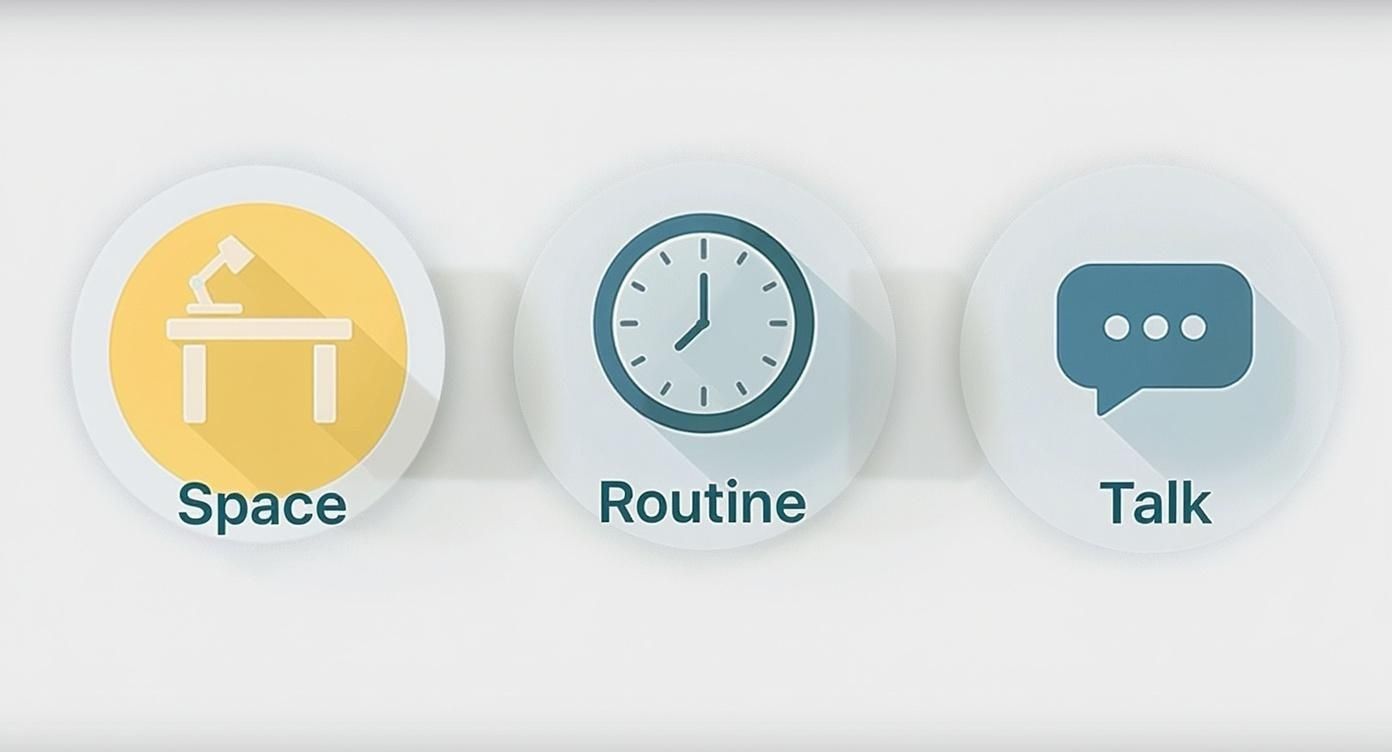
It’s clear that a combination of a dedicated physical space, a predictable daily routine, and open communication forms the foundation for a thriving online learner.
Below, we’ve put together a few practical examples showing how virtual learning can be adapted to support a range of different needs.
Adapting Virtual Learning for Diverse Needs
| Challenge Area | Virtual Environment Adaptation | Benefit for the Child |
|---|---|---|
| Dyslexia/Literacy Difficulties | Use of text-to-speech tools, dyslexic-friendly fonts, and digital highlighters. | Reduces reading anxiety and allows the student to focus on understanding concepts rather than decoding text. |
| ADHD/Attention Difficulties | Shorter lesson segments, interactive polls, and the ability to take 'movement breaks' off-camera. | Helps maintain focus, channels energy productively, and reduces feelings of restlessness. |
| Anxiety/SEMH Needs | Private chat functions to ask questions, a familiar home setting, and smaller group breakout rooms. | Creates a low-pressure environment where students feel safe to participate without social fear. |
| Gifted and Talented | Access to extension materials, self-paced projects, and advanced-level discussion groups. | Keeps the student intellectually stimulated and challenged, preventing boredom and disengagement. |
| Physical Disabilities | Fully accessible digital platform, voice-to-text software for assignments, and recorded lessons for review. | Removes physical barriers to learning, allowing full participation regardless of mobility or other challenges. |
These examples just scratch the surface, but they illustrate how a flexible online environment puts the child's well-being and academic progress first.
Embracing a Future of Accessible Learning
The shift towards digital education in the UK has been significant. Digital learning adoption has soared, with 60% of UK students now using digital apps—the highest rate in Europe. A remarkable 90% of learners prefer it for its flexibility.
But this rapid change has also revealed an accessibility gap. With 46% of teachers warning that students without adequate digital resources risk falling behind, ensuring every child has the tools they need is paramount. This data underscores just how important it is to choose a well-resourced online school.
High-quality virtual education bridges this gap by providing an integrated platform where all necessary tools are built-in and accessible. To explore how technology is fundamentally reshaping the learning landscape, these 10 ways AI is revolutionizing education offer some fascinating insights. By providing the right tools and a supportive framework, we can ensure that every child, regardless of their learning style or personal challenges, has the opportunity to shine.
Navigating Formal Assessments and Qualifications
One of the most natural questions any parent asks is, “Will my child’s hard work lead to real, recognised qualifications?” It’s a concern that comes from a place of love and a desire to see your child build a successful future. Let me reassure you: high-quality online schools are built to provide a clear and legitimate path to formal qualifications like **GCSEs** and **A-Levels**.
This isn't some informal or alternative system. It's a structured educational framework designed to meet the very same rigorous national standards as any physical school. The qualifications earned are identical and hold the exact same weight with universities and employers. The delivery method is different, but the academic credibility is absolute.
From Coursework to Final Exams
In an online school, the assessment process is a continuous and transparent journey, giving you a clear window into your child’s progress. It’s all designed to prepare them for final exams without the last-minute cramming that causes so much stress and sleepless nights.
Coursework and assignments are simply submitted through a secure online portal. For a subject like English Literature, this means your child can upload their essay and receive detailed, typed feedback directly from their teacher—feedback they can read and re-read at their own pace. This creates a digital trail, making it incredibly easy to track their development over the term and see precisely where they're excelling.
The goal is to build confidence and competence step-by-step. By the time formal exams arrive, students feel prepared and empowered, knowing they have a solid foundation of knowledge built through consistent effort and expert guidance.
The Exam Day Experience
When it's time for major exams like GCSEs or A-Levels, the process is straightforward and officially regulated. Online schools partner with approved physical examination centres across the country. Your child will sit their exams in the same formal setting as students from any other school, which ensures the complete integrity and fairness of the process.
This hybrid approach perfectly combines the flexibility of daily online learning with the established structure of national assessments. Your school will provide all the necessary support to find and register with a convenient local centre, handling the administrative side of things so you can focus on being your child’s calm, reassuring presence on exam day.
The growth of virtual learning has made this a well-oiled machine. The UK's online education and training industry is projected to reach a market value of £5.0 billion in 2025, supported by 761 businesses that understand these logistical needs. This expansion, partly driven by shifts during the pandemic, has solidified the infrastructure for online learners. You can read more about the growth of the online education industry to understand just how stable the sector is.
Our comprehensive guide on assessment for education offers even more detail on how we make sure every student is fully prepared. Ultimately, every piece of coursework submitted and every exam sat is a recognised step towards a bright future, giving you peace of mind that your child’s achievements will be officially accredited and celebrated.
Your Questions About Virtual Learning Answered
Deciding on the right educational path for your child is one of the most important choices a parent can make. It's completely natural to have questions, and maybe even a few worries, when you're considering a move to online learning. This is a journey of the heart as much as the head, and your concerns are perfectly valid.
We've gathered some of the most common questions we hear from parents just like you. Our goal is to give you clear, honest answers that put your child’s wellbeing first, helping you feel confident and informed every step of the way.
How Will My Child Make Friends and Develop Social Skills?
This is often the first question on every parent's mind, and it’s a crucial one. It’s easy to picture online learning as a solitary activity, but a high-quality virtual school is designed from the ground up to be deeply social and interactive.
Social skills aren't just things that happen by chance on the playground; they are skills that can be taught and practised. In a well-structured online school, this happens through intentional, teacher-led activities. For example, in live classes, students work in small breakout rooms to solve a science problem, or a history lesson sparks a lively, respectful debate. These are guided social interactions in a safe, moderated space.
Beyond the classroom, virtual clubs are a fantastic way for children to connect over shared interests.
- A student in Manchester who loves creative writing can join a club and bond with a peer in Dubai over a story they're writing together.
- A coding club allows tech-minded students to collaborate on a project, learning the kind of teamwork and communication skills that are vital for their future.
For many children, especially those who find the chaos of a large school overwhelming, this more focused way of socialising can be far less intimidating. It allows them to build deep, meaningful friendships based on common passions, not just geographical proximity.
Is My Child Disciplined Enough for Online Learning?
It's a common worry: without a teacher physically present, will my child just drift off-task? But self-discipline isn't something a child either has or doesn't have—it’s a skill that is nurtured and developed over time. A great online school is specifically designed to build this muscle.
The structure starts with a clear, consistent timetable of live lessons. This daily routine provides a predictable rhythm that helps your child know what’s expected of them. During these lessons, teachers use interactive tools like polls, quizzes, and digital whiteboards to keep every student actively involved. It’s hard to get distracted when a teacher might ask you to solve the next problem on the virtual board.
A supportive virtual environment empowers a child to take ownership of their learning. It’s not about enforcing discipline from the outside, but about inspiring it from within by making learning genuinely engaging.
The blend of live classes and independent study is also key. Your child learns to manage their time to complete assignments—a critical life skill that will serve them well at university and in their future career. The school's platform and the teacher's constant engagement provide the scaffolding that helps your child build the foundations of self-regulation and responsibility.
How Do I Know My Child Is Actually Learning?
This question comes from a place of deep love and responsibility. In a traditional school, you often have to wait for a once-a-term parent-teacher evening to get a real sense of your child's progress. High-quality online schools, however, can offer a level of transparency that is incredibly reassuring for parents.
Most provide a parent portal where you can see your child’s progress in real-time. You can log in at any time and view:
- Attendance records for all live classes.
- Assignment submission status and the grades received.
- Detailed, personalised feedback from teachers on their work.
This creates a powerful partnership between you, your child, and their teachers. If a teacher notices your child struggling with a specific maths concept during a live lesson, they can address it immediately with one-on-one support. You’re not waiting weeks to find out there’s a problem; you are part of a proactive, supportive team from day one.
What Technology Do We Need and Is It Hard to Use?
The thought of managing new technology can feel daunting, but the requirements are usually much simpler than you might imagine. All you typically need is a reliable internet connection and a standard computer or laptop with a working webcam and microphone.
You absolutely do not need to be a tech wizard. The best online schools use platforms that are designed to be intuitive and user-friendly for children and parents alike. The focus is always on the learning, not on fighting with the software.
To make the transition smooth, schools provide comprehensive onboarding sessions to walk you and your child through how everything works. There is also dedicated IT support on hand to help with any technical glitches. The technology is simply the doorway to the classroom—a tool designed to be as seamless and invisible as possible, so your child can focus on what truly matters: discovering their potential.
At Queens Online School, we understand these questions because we've been supporting families on this journey for years. We believe in an education that is as nurturing as it is academically rigorous, putting your child at the heart of everything we do. If you're ready to explore a more personalised and empowering path for your child's education, we invite you to discover the Queens Online School difference.