
The truth is, IGCSEs are not inherently harder than GCSEs—they're just different. As a parent, it's natural to worry about which path will be 'easier' or 'harder' for your child, but the real key to their success lies in their individual learning style. Traditionally, IGCSEs have leaned more heavily on final exams, whereas GCSEs often included a coursework component. The right choice really depends on a simple question: does your child thrive under exam pressure, or do they feel more confident showcasing their knowledge through project-based assessments spread throughout the course?
The Big Question: IGCSE vs GCSE for Your Child
Choosing between IGCSEs and GCSEs can feel like a monumental decision in your child's education, often stirring up worries about making the 'wrong' choice that could impact their future. The question, "Is IGCSE harder than GCSE?" doesn't have a simple yes or no answer. The real task is to find the qualification that best aligns with your child's unique way of learning, their personal strengths, and their future ambitions, ensuring they feel supported and capable.
This guide is designed to cut through the myths and offer a clear, practical comparison. We'll explore the subtle but crucial differences in structure, content, and assessment, helping you understand how each path might feel for your child, both academically and emotionally.
Our goal is simple: to give you the clarity you need to make a confident decision that supports not just their academic journey, but their overall well-being and confidence, too.
IGCSE vs GCSE Key Differences at a Glance
Before we dive into the finer details, this table offers a quick summary of the fundamental differences between IGCSE and GCSE qualifications. Think of it as a cheat sheet to get your bearings on what might suit your child best.
| Feature | IGCSE (International General Certificate of Secondary Education) | GCSE (General Certificate of Secondary Education) |
|---|---|---|
| Global Focus | Content often includes international examples and case studies, designed for a worldwide audience. | Curriculum is based on the UK national framework, with UK-centric content and examples. |
| Assessment Style | Heavily reliant on final examinations, with coursework available in only a few subjects. | Reformed to be more exam-based, but coursework can still be a component in some subjects. |
| Availability | Offered in over 150 countries and widely available to international and UK-based students. | Primarily taken by students in the UK, particularly within the state school system. |
| Flexibility | Exam sittings are often available more frequently throughout the year (e.g., November, January, June). | Main exam period is concentrated in May and June, with limited resit opportunities in November. |
As you can see, the core distinctions lie in their audience, assessment methods, and scheduling. Now, let's unpack what these differences really mean for your child's day-to-day learning experience.
Comparing Curriculum Content and Assessment Styles
When you're trying to figure out if an IGCSE is harder than a GCSE, you need to look past the name and get a feel for what your child will actually experience in their lessons and exams. While both qualifications are academically rigorous, they come from different philosophies. This means one might feel more intuitive—or more challenging—than the other, depending on your child's way of thinking and what sparks their interest.

The biggest difference is their geographical focus. IGCSEs were created for a global audience and deliberately weave in international perspectives.
Imagine your child studying IGCSE Business Studies. One day they could be analysing a tech startup in Singapore, and the next, a coffee cooperative in Brazil. For a child with a naturally curious and global outlook, this can be incredibly exciting, making the content feel expansive and relevant to the world they live in. In contrast, GCSEs are designed around the UK national curriculum, which can feel more grounded and familiar for students who connect better with local context.
Subject Content in Practice
Let’s say your child loves history. The choice between these qualifications could completely change their learning journey:
- IGCSE History: The syllabus might cover 20th-century world conflicts, explore the Cold War from multiple international viewpoints, or trace the history of medicine across different cultures. This wider scope can really spark curiosity in students who love seeing the bigger picture and understanding global connections.
- GCSE History: This will likely have a stronger focus on British history—think the Norman Conquest or Elizabethan England—alongside major world events. For a child fascinated by the history on their doorstep, this localised context can feel much more tangible and engaging.
It’s not about one being harder. It’s about which story will capture your child’s imagination and make them want to learn, turning study from a chore into a passion.
The real question isn't "Which curriculum is more difficult?" but "Which curriculum will my child find more inspiring?" A motivated student will always find a challenging subject more manageable.
How Assessment Shapes the Experience
The way a student is tested can have a massive impact on their stress levels and final grades. Imagine the anxiety building up for a single, final exam that determines everything. After recent UK reforms, both qualifications are now heavily weighted towards final exams, but there's a crucial difference that could be a lifeline for your child.
Certain IGCSE subjects, especially those from exam boards like Cambridge International, still offer coursework or practical assessment options.
For a creative, hard-working child who just doesn't perform well under the intense pressure of a silent exam hall, this is a game-changer. Imagine them being able to secure 20-30% of their final mark through a research project or a practical task they complete in a less stressful environment. It plays to their strengths, validates their hard work throughout the year, and can be the key to unlocking a grade that truly reflects their ability.
Decoding Grades and University Recognition
One of the biggest anxieties for parents is the fear that choosing the 'wrong' qualification could somehow put their child at a disadvantage when applying to university. Will one look 'easier' or less prestigious? It's a valid concern, born from a desire to give your child the very best start.
Let's cut through the noise and look at what the data actually tells us about your child’s future.
Historically, a higher percentage of students have achieved top grades in IGCSEs, which has fuelled the long-running debate over which qualification is 'harder'. The reasons for this are complex and often linked to the different groups of students who typically sit these exams, with IGCSEs being more common in independent and international schools.
A Closer Look at the Grade Gap
When the UK government overhauled GCSEs to the 9-1 grading system in 2017, a noticeable difference in top grades became apparent. Research from FFT Education Datalab revealed that a remarkable 66.7% of pupils taking IGCSEs in maths and English language achieved A*-A grades.
In stark contrast, only about 20% of pupils secured the equivalent 7-9 grades in the new, more demanding GCSEs. While this data highlights a statistical difference in attainment, it doesn't automatically mean IGCSEs are easier. It often reflects differences in the student cohorts and exam structures at the time.
What really matters is how these grades are seen by the people who hold your child's future in their hands: university admissions tutors.
The most important takeaway for any parent is this: Top universities in the UK and worldwide see no difference in value between an IGCSE and a GCSE. They are both recognised as 'gold standard' Level 2 qualifications.
University Recognition: Putting Fears to Rest
Admissions officers at leading institutions are experts at understanding qualifications from all over the globe. They evaluate an application based on the grades achieved, the mix of subjects studied, and the student's personal statement—not on whether the certificate says 'GCSE' or 'IGCSE'.
Put simply, your child will not be disadvantaged for choosing one over the other.
This recognition allows you to focus on what truly counts: selecting the qualification that best fits your child’s learning style and academic interests, rather than chasing statistics. This understanding is a crucial first step as you begin exploring how to apply to UK universities and prepare for the journey ahead. The goal is to choose the path that empowers your child to achieve their best possible grades and feel proud of their accomplishments.
Finding the Best Fit for Your Child's Learning Needs
This is where the decision gets personal and moves beyond simple on-paper comparisons. The ‘best’ qualification isn’t the one with a certain reputation; it’s the one that lets your child feel confident, capable, and genuinely engaged in their own learning. The real question isn't, "is IGCSE harder than GCSE?" but rather, "which one is a better fit for my child?"
To answer that, let’s think about a few common learner profiles. Seeing where your child fits can bring incredible clarity to your choice.
Matching the Qualification to the Learner
First, consider the student who loves structure and clear goals. They might be the kind of child who meticulously organises their revision notes and feels a sense of calm from knowing exactly what’s expected of them. For this child, the straightforward, exam-centric model of most IGCSEs can be a perfect match. It allows them to focus their energy on mastering the content for that final assessment, which can be deeply satisfying for them.
Now, think of a different child—one for whom the pressure of a single, high-stakes exam day feels like a storm cloud on the horizon, causing sleepless nights and overwhelming anxiety.
For a student with Special Educational Needs (SEN), this choice is even more critical. The flexibility of certain IGCSE subjects that still offer coursework can be a lifeline. It eases exam-day anxiety and provides another, often more authentic, way for them to show their deep understanding of a topic, free from the intense pressure of a timed test. With 18.7% of pupils in English state schools receiving SEN support in 2024, finding a curriculum that accommodates your child's needs isn't just helpful—it's essential for their well-being.
The goal is to map your child's unique learning identity onto the qualification that will empower them to succeed on their own terms, turning potential anxiety into a feeling of achievement.
The good news? Universities don't play favourites. This visualisation shows the simple truth about how they view both qualifications.
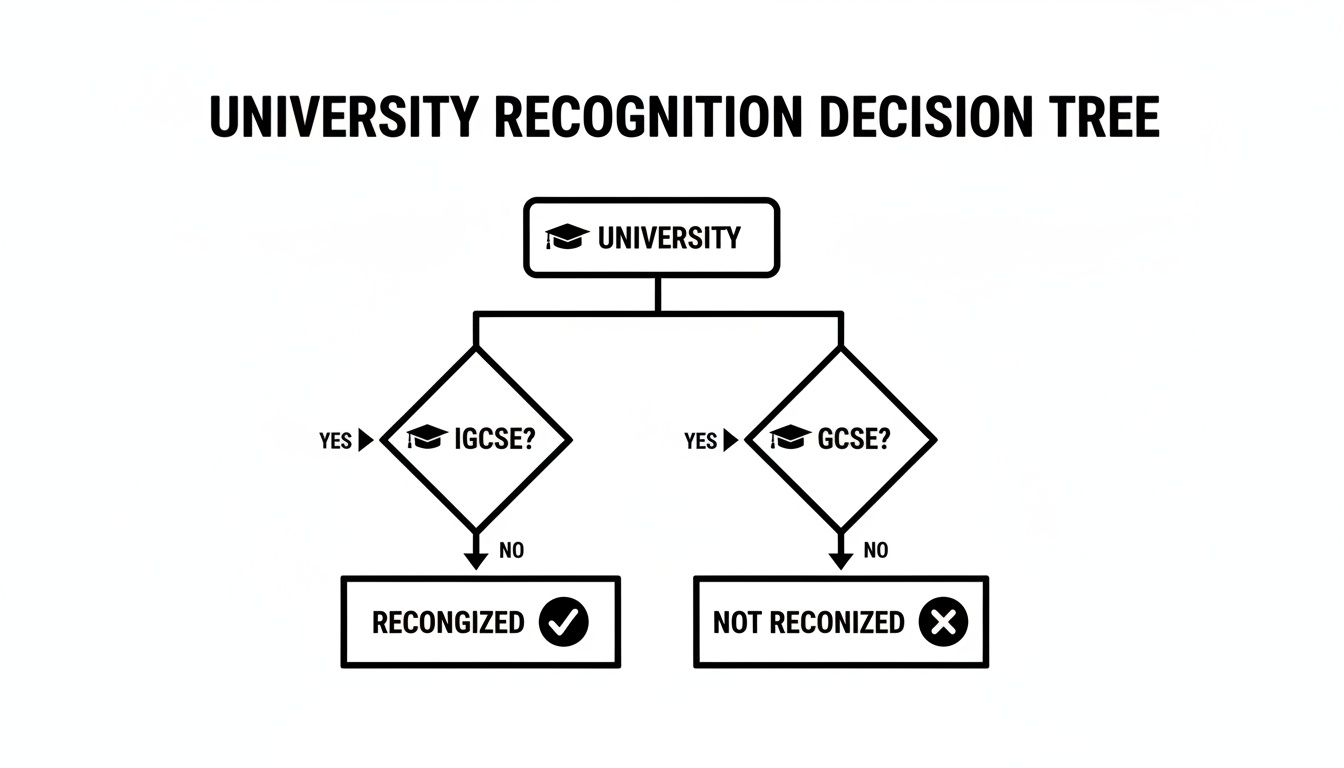
The key insight here is clear: admissions departments value the grades your child achieves, not the qualification's label.
The International Perspective and Attainment
Finally, let’s consider the internationally-minded student. For a child who has lived abroad or is simply curious about the world, the global case studies in IGCSEs can feel far more relevant and exciting than a purely UK-focused curriculum. That connection to the material can be a powerful motivator in itself, making late-night study sessions feel less like a chore.
It's also interesting to look at the historical data, which often shows higher attainment in IGCSEs. While the 2017 reforms levelled the playing field by making GCSEs more exam-focused, IGCSEs still tend to yield more top grades. The structured approach of online IGCSEs, which combines flexible pacing with specialist support, often mirrors the advantages of independent schools, helping students build confidence and achieve their full potential.
Choosing the right curriculum is a significant step, and understanding all your options is key. For families considering homeschooling, a parent's guide to the UK homeschooling curriculum can provide further valuable context for your decision-making process.
How the Right Environment Unlocks Potential
When all’s said and done, the choice between IGCSE and GCSE is just one piece of the puzzle. What truly makes or breaks a child’s success and happiness is the learning environment itself. The right setting doesn’t just deliver a curriculum; it builds confidence, nurtures curiosity, and provides a safety net when things get tough.
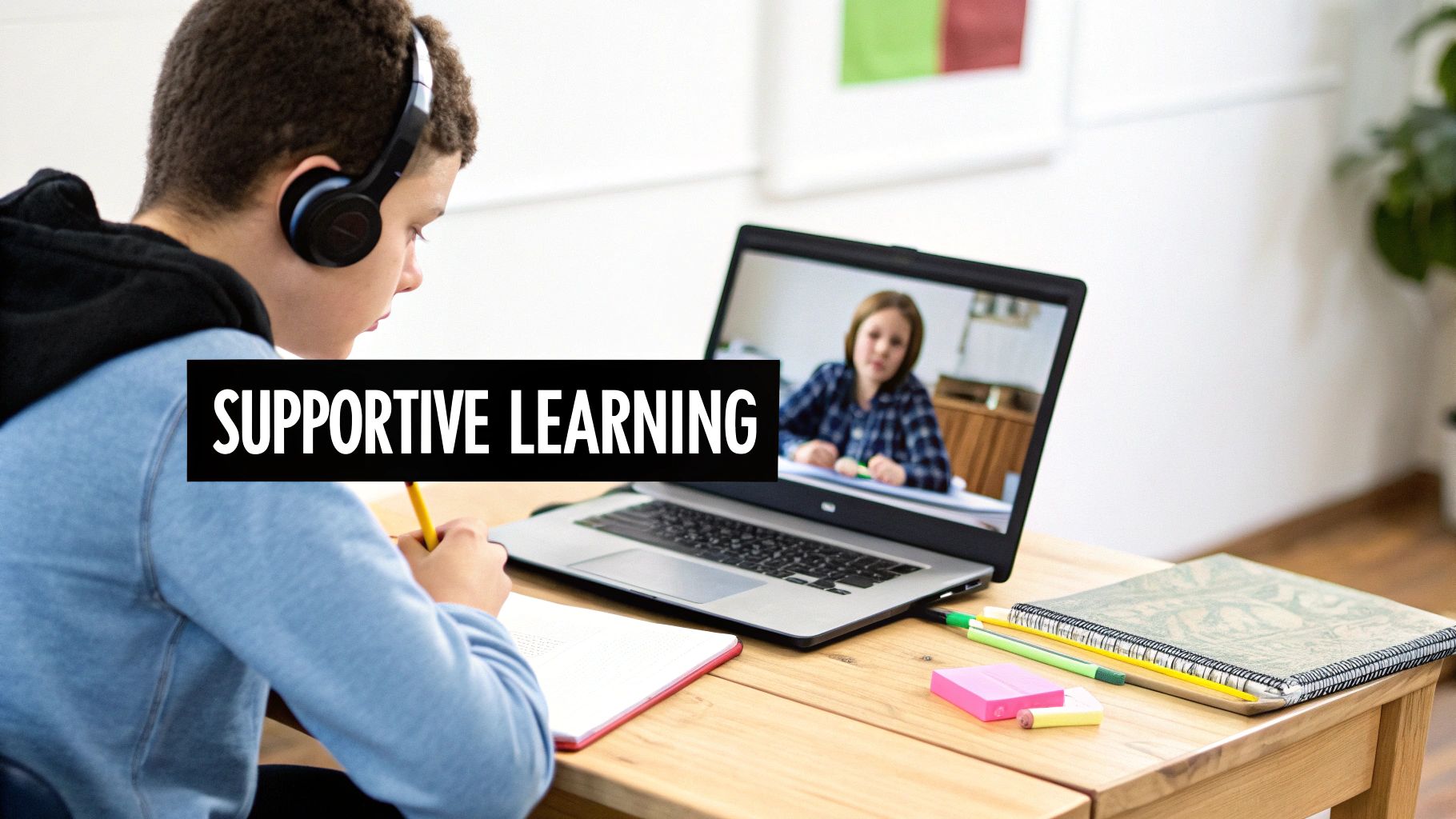
This is where the theoretical debate of "is IGCSE harder than GCSE" meets the practical reality of daily learning. At Queen's Online School, we see first-hand how a supportive, focused structure allows every child to reach their potential, regardless of which qualification they’re working towards.
Personalised Attention in a Focused Setting
Our small, live classes are the heart of this philosophy. Imagine your child in a class where the teacher knows not just their name, but also their unique strengths and where they tend to get stuck.
This means they can push a student who grasps a complex IGCSE literature text quickly, while also offering extra guidance and encouragement to another who’s wrestling with a tricky GCSE science concept. It’s an environment free from the social pressures and distractions of a large classroom, where a shy child might be afraid to speak up. You can explore more about the unique advantages of learning in virtual environments and how they cater to individual needs.
The best environment is one where a child feels seen, heard, and understood. When they feel safe to ask questions without judgement, their academic confidence grows exponentially.
Support Tailored to Every Child
For students with unique learning needs, this tailored approach is even more critical. We provide specialist support, and our recorded lessons allow for stress-free revision, letting students revisit topics at their own pace without the fear of falling behind. Think of a child being able to pause and re-watch an explanation of a tough maths problem as many times as they need, without having to ask the teacher to repeat themselves in front of everyone.
As a Pearson Approved Examination Centre, we also ensure the exam process is as seamless and supportive as the learning journey. By matching the right qualification to the right environment, we help your child not just to pass exams, but to find a genuine love for learning that will set them up for whatever comes next.
Answering Your Key Questions
When you're weighing up IGCSEs and GCSEs, the big-picture differences are one thing, but it’s often the smaller, practical questions that keep you up at night. As a parent, you need absolute clarity to feel confident in your decision.
We get it. We hear these questions from families all the time. So, let's tackle them head-on and clear up any lingering uncertainty, making sure the focus stays right where it should be: on your child's success and well-being.
Can My Child Switch Between GCSE and IGCSE Courses?
Yes, in most cases, they can. It’s a common worry—what if we choose the 'wrong' one and my child starts to struggle? The good news is that the core content for many subjects, especially staples like Maths and English, is very similar. This overlap means that switching between a GCSE and an IGCSE course is often quite manageable, particularly if it happens early on.
The key is to act fast and have a conversation with your child’s teachers. For instance, if your child finds the UK-centric focus of GCSE History isn't inspiring them, moving to the more global IGCSE syllabus in the first term is usually straightforward. If the switch happens later, it might take a bit more focused catch-up work, but with the right support, it's certainly not out of the question.
Do International Universities Prefer One Qualification?
Not at all. This is a myth we can bust right now. Leading universities across the globe—from the Ivy League in the US to top-tier institutions in Europe and Asia—see IGCSEs and GCSEs as equivalent qualifications. They are both highly respected as rigorous preparation for A-Levels.
What really grabs an admissions officer’s attention is the grades achieved and the combination of subjects your child studied, not the specific name of the qualification. The word 'International' in IGCSE doesn't give it some secret handshake for overseas applications. A student holding a string of 9s in their GCSEs, who is proud of what they've accomplished, will always be a stronger candidate than one with lower grades in IGCSEs.
Your child's passion, dedication, and final results are what truly matter to admissions teams—not the exam board's letterhead. The choice should be about empowering them to achieve those top grades, not about perceived prestige.
Are IGCSE Exams More Expensive Than GCSEs?
The costs can vary slightly by subject, exam board, and the specific exam centre you use, but the difference is usually negligible. It honestly shouldn't be a deciding factor in your choice. In many cases, the fee difference for a single subject is less than the price of a new textbook.
Any accredited exam centre will give you a clear, transparent breakdown of all the costs involved. We firmly believe the focus should stay on choosing the academic path that best fits your child's learning style, boosts their confidence, and aligns with their future goals—not on minor differences in exam fees.
How Does the GCSE Tiered System Compare to IGCSEs?
This is a really important difference, and it speaks directly to a student's confidence and mindset. Certain GCSE subjects, most commonly Maths and the Sciences, use a tiered entry system to make the exams more accessible to students of all abilities.
- Foundation Tier: This is for students who might find a subject more challenging. Imagine your child feels very anxious about maths; this tier offers more accessible questions and allows them to secure a strong pass (up to a grade 5) without facing the most complex problems. It can be a huge confidence booster.
- Higher Tier: This is for students who are aiming for the top grades, from a 6 all the way up to a 9.
Most IGCSE subjects don’t have tiers. Every student sits the exact same paper. For a consistently high-achieving child, this can feel straightforward and less complicated. However, for a student whose confidence is fragile, the GCSE Foundation tier can act as a valuable safety net, allowing them to build self-belief and still achieve a respectable grade that they can be proud of.
At Queen's Online School, we guide families through these decisions every day, ensuring that whether your child pursues IGCSEs or GCSEs, they are on a path designed for their success. Our subject-specialist teachers and supportive online environment help students build the confidence and knowledge needed to excel.
Explore how our personalised approach to the British curriculum can unlock your child's potential. Learn more about our online school.