

The secret to effective revision is simple: start early and stay consistent. Short, regular revision sessions are far more powerful than frantic, last-minute cramming because they give your child's brain the time it needs to truly learn and remember information.
Move Beyond Last-Minute Panic
We’ve all seen it. The exam is just days away, and a mountain of textbooks looms over a stressed-out child. Tears, frustration, and a sense of hopelessness fill the room. This cycle of last-minute panic and stressful all-nighters is exhausting for everyone, and worse, it rarely delivers the results a child is capable of. It’s heartbreaking to watch them put in so much frantic effort only to feel like they’ve failed.
This high-pressure approach works against the very way our brains are designed to learn. Think of it like trying to build a brick wall by throwing all the bricks and mortar at it in one go—you’d just get a chaotic mess. Our memory works in a similar way; it needs time to carefully place each 'brick' of information and let it set before adding the next one.
The Science of Steady Learning
Cramming floods the brain, completely overwhelming its short-term memory. A few facts might stick around for a couple of hours, but they rarely make it into long-term memory, which is what’s needed to actually apply knowledge in an exam. This is exactly why a child can revise for eight hours straight and feel like they remember nothing the next day. Their brain simply didn't have a chance to process it all.
This feeling of failure can be incredibly damaging to a child's confidence. They can start to believe they are "bad at exams" or "not smart enough," when in reality, it's the revision method that's letting them down, not their own ability. It’s our job to show them there’s a better, kinder way.
The real goal of revision isn't just to memorise facts for a test. It's about building genuine understanding and the quiet confidence that comes from knowing you've put in the work, little by little. This shift in mindset can transform exam preparation from a source of dread into a manageable, empowering process.
Shifting from Panic to Purposeful Practice
Building a steady revision habit is the perfect antidote to this anxiety. It’s not about magically finding more hours in the day, but about making the time you already have truly count. It's about protecting their mental health and showing them they are in control.
The research backs this up time and time again. A key lesson from the 2025 UK exam season, tracked across over 12 million focused revision sessions, is that consistency always trumps cramming. Students who revised steadily—even for just 20 minutes a day with a clear plan—outperformed those pulling all-nighters. In fact, one study showed that consistent revisers scored, on average, 11% higher than last-minute crammers.
Of course, a calm mind is a focused mind. To effectively move beyond last-minute panic, it can be hugely beneficial to explore mindfulness activities for students. These techniques can significantly enhance focus and reduce stress, creating a much more productive headspace for learning.
Ready to make the change? Here are the first steps.
- Start the Conversation Early: Have a calm, open chat about exams long before they feel like a threat. Acknowledge their feelings. You could start with, "I know exams can feel really stressful. Let's think about how we can tackle this together so you feel in control."
- Focus on 'Little and Often': Introduce the idea of short, 25-minute revision blocks. For a child who feels overwhelmed, you could say, "How about we just try 15 minutes on one topic today? That's it. Then you're done." The goal is to build a routine that feels achievable, not overwhelming.
- Celebrate the Effort, Not Just the Outcome: Praise their commitment to just sitting down and doing the work, regardless of how much they feel they accomplished. Saying, "I'm so proud of you for sticking to the plan today," reinforces the positive habit and detaches their self-worth from a future grade.
Co-Creating a Revision Timetable That Works
The generic, colour-coded revision timetable you download from the internet? It’s probably destined for the bin. Why? Because it ignores the single most important person in this process: your child. A plan that feels imposed is a plan that will be resisted, making them feel powerless.
The goal here is to create something together—a personalised map that feels empowering, not punishing. This isn’t about you dictating terms. It’s a negotiation, a conversation built on trust. The first step is to sit down together, away from distractions, and just talk. Ask them: "Which subjects are worrying you the most? What parts of the day do you feel you have the most energy?"
This process often follows a familiar emotional journey, moving from initial stress to a more structured, confident approach.
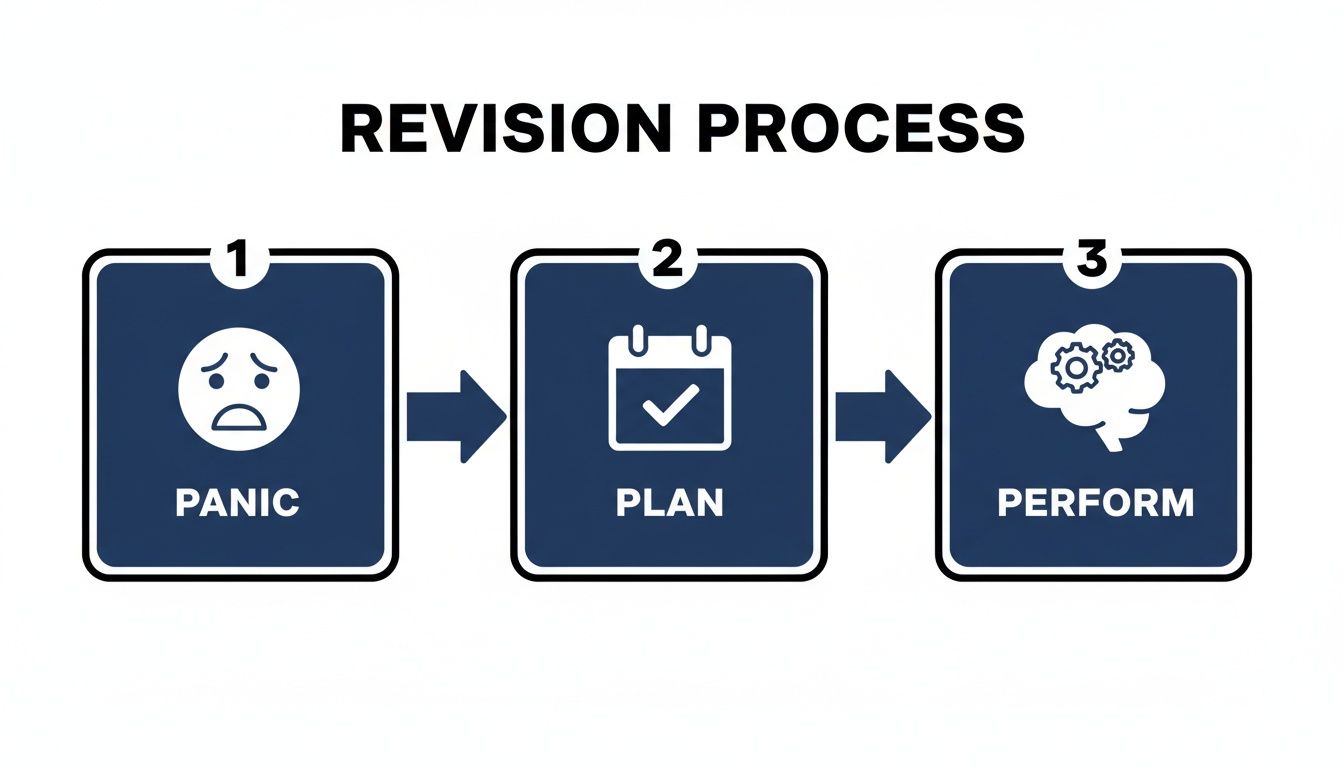
Seeing it laid out like this helps students realise that the initial panic is completely normal and something they can move through. It’s the structured plan that acts as the essential bridge to performing well.
Start with the Non-Negotiables
Before a single revision slot is penned in, block out the essentials. This simple act shows them that you see them as a whole person, not just a student, and that their wellbeing comes first.
- Sleep: Agree on a consistent bedtime and wake-up time. Teenagers need 8-10 hours of sleep a night for their brains to function properly, especially for memory consolidation. Protecting their sleep shows you care more about their health than an extra hour of cramming.
- Downtime and Social Time: Schedule time for friends, hobbies, sports, or simply doing nothing at all. This isn't a reward to be earned; it’s a vital part of preventing burnout. For example, explicitly mark "Friday night – Gaming with friends" on the timetable.
- Family Time: Keep mealtimes or other family rituals sacred. These moments provide stability and a chance to connect about things other than exams, reminding them they are part of a supportive team.
Once these pillars are in place, the revision slots don't feel like they're taking over their entire life. Instead, they just fit into an already balanced week.
Identify Peak Focus Times
Is your child a morning lark or a night owl? Forcing someone who is slow to wake up to revise complex algebra at 7 a.m. is a recipe for frustration and tears. Working with their natural body clock makes revision far more effective and respectful of their needs.
Ask them directly: "When do you feel most alert? When do you have the most energy?" You might find their best time for deep focus is right after school, or perhaps later in the evening after they’ve had a chance to unwind.
The most powerful timetable isn't the one packed with the most hours; it's the one that schedules the hardest tasks during your child's biological prime time. This simple alignment can double the effectiveness of their study sessions and reduce their stress levels.
Use these peak focus windows for the subjects they find most challenging. For instance, if a GCSE student dreads Maths but enjoys History, schedule Maths for their high-energy slot and save History for a time when they might be feeling a bit more tired.
A Real-World Example in Action
Let’s take a Year 11 student, Ben. He has five core GCSE subjects, football training twice a week, and he definitely wants his weekends to feel like weekends. He’s feeling anxious about Maths but confident in English. Here’s what a co-created timetable could look like:
Here is a sample table to give you a better idea of how this could be structured across a typical week.
Sample Weekly Revision Timetable for a GCSE Student
| Time Slot | Monday | Tuesday | Wednesday | Thursday | Friday | Saturday | Sunday |
|---|---|---|---|---|---|---|---|
| 4:30 PM – 5:15 PM | Maths (Tough Subject) | Football Training | Science (Flashcards) | English (Essay Plan) | FREE | FREE | FREE |
| 5:15 PM – 6:00 PM | BREAK | Football Training | BREAK | BREAK | FREE | Past Paper (90 mins) | Weekly Review (1 hr) |
| 6:00 PM – 6:45 PM | English Lit | FREE | History (Notes) | Maths (Practice Qs) | FREE | FREE | FREE |
| Evening | FREE | FREE | FREE | FREE | FREE | FREE | FREE |
This plan respects Ben's commitments, tackles hard subjects when he's fresh, and preserves that crucial downtime. It's realistic and, importantly, adaptable.
If you’re looking for more inspiration, you can find a flexible A-Level revision timetable template here that can be adapted for any age group.
Ultimately, the timetable should be a living document. Stick it on the fridge. Use stickers or different colours to mark off completed sessions. Check in with them and say, "How is this timetable feeling for you? Is there anything we need to change?" By giving them that ownership, you transform a dreaded chore into a tool for their own success.
Powerful Revision Techniques That Actually Stick
We've all seen it: the student surrounded by textbooks, dutifully colouring in every line with a highlighter. It looks like revision, and it certainly feels productive. But this kind of passive learning often creates a dangerous illusion of preparedness. It’s heartbreaking because they think they’re working hard, but the information just isn't sticking.
Real, lasting learning is an active process. It happens when the brain is forced to engage, to struggle a little, and to pull information out from its depths. This is the difference between being a spectator and being a player in the game, and it's the secret to revising effectively. Let’s explore the evidence-based techniques that genuinely cement knowledge.
Embrace Active Recall to Build Stronger Memories
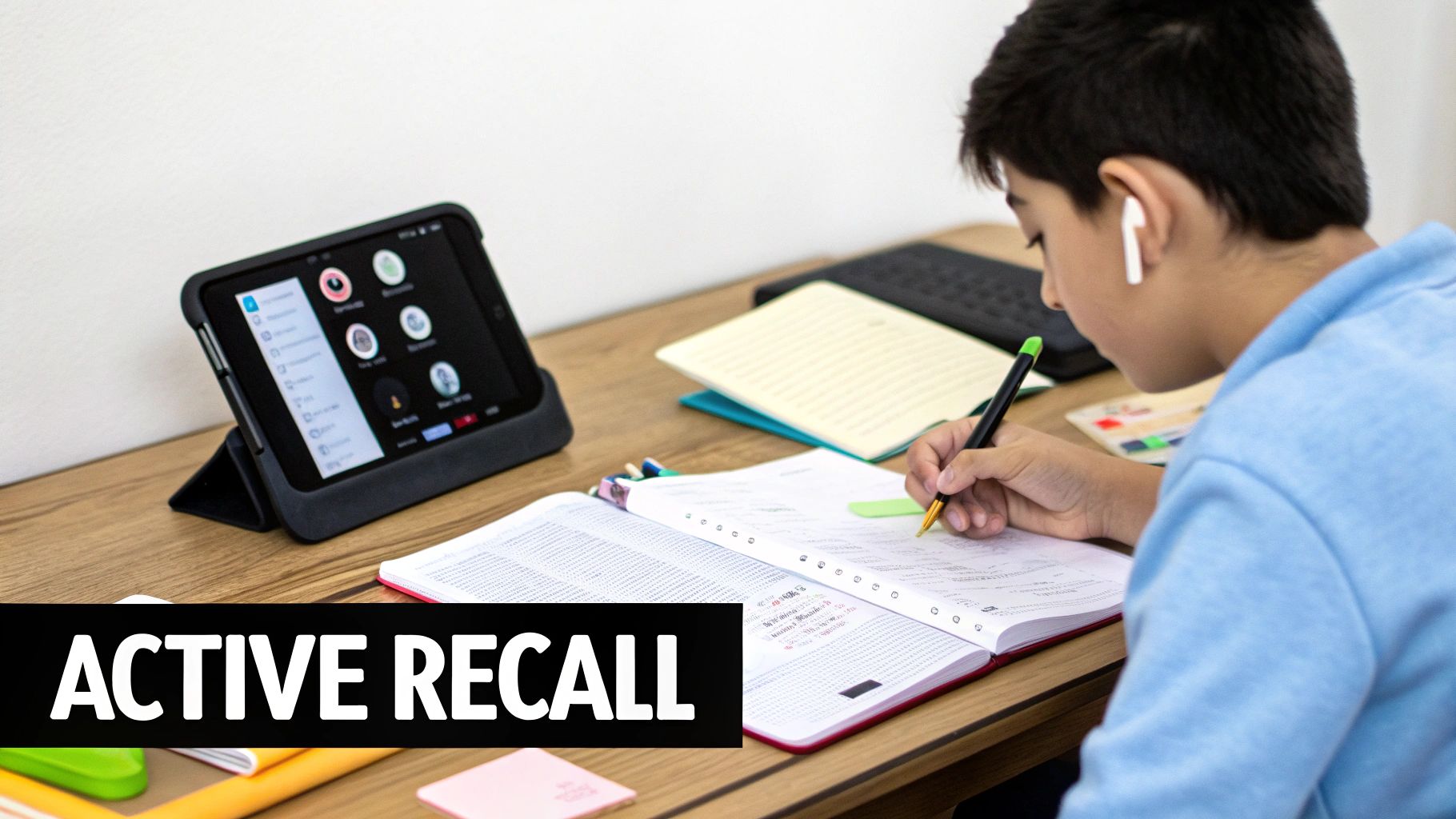
Active Recall is exactly what it sounds like: actively retrieving information from your brain, rather than just passively reading it. Every time your child forces their mind to remember a fact, a formula, or a key quote, they strengthen the neural pathway to that piece of information. This makes it far easier to access under the pressure of an exam.
Think of it like forging a path through a dense forest. The first time you walk it, it’s tough going. But the more you travel that same route, the clearer and easier it becomes to navigate.
There are plenty of simple, low-tech ways to put this into practice.
- The 'Blurting' Method: After studying a topic, get your child to grab a blank piece of paper and write down—or ‘blurt’ out—everything they can remember. For example, after revising the carbon cycle in Biology, they'd spend 10 minutes sketching the diagram and writing key terms from memory. Only after they've completely emptied their brain should they refer back to their notes. This instantly shows them what they truly know, rather than just recognise.
- Create Your Own Questions: Instead of just re-reading a chapter on the causes of World War One, encourage them to write three to five potential exam questions on it. The next day, they can try to answer those questions from memory. This puts them in the examiner's shoes and deepens their understanding.
- Teach it Back: One of the most powerful forms of active recall is teaching. Ask them to explain a tricky concept to you, like how photosynthesis works, as if you know nothing about it. Having to structure their thoughts clearly for someone else is an incredible test of their own knowledge.
Use Spaced Repetition to Learn for the Long Term
Ever watched a student cram for a test, feel confident, and then forget almost everything two weeks later? That's the 'forgetting curve' in action, and it can leave them feeling defeated. Spaced Repetition is a technique designed specifically to combat this natural memory decay by reviewing information at increasing intervals.
The trick is to review a topic just as you’re about to forget it. This act interrupts the forgetting process and pushes the information deeper into long-term memory. It's an incredibly efficient way to revise, as it focuses effort where it's needed most and stops them from wasting time on things they already know inside out.
By strategically spacing out revision, you move knowledge from fragile, short-term memory to robust, long-term memory. This builds the deep understanding needed to answer complex exam questions with confidence, not panic.
While there are great apps like Anki or Quizlet for this, a simple flashcard box system works just as well. Create a set of flashcards and sort them into boxes labelled 'Daily', 'Every 3 Days', and 'Weekly'. When a card is answered correctly, it moves up to the next box. Get one wrong? It goes straight back to 'Daily'. To make these techniques stick, the focus should always be on how to work smarter, not harder.
Turn Past Papers into a Learning Tool
Too many students save past papers for a last-minute knowledge check, which can lead to a confidence-shattering discovery that they don't know as much as they thought. Instead, past papers should be used as a diagnostic and learning tool right from the beginning.
Instead of just completing them under exam conditions, encourage your child to become a detective. They should analyse the papers to figure out:
- Question Patterns: Which topics appear most frequently? Are there certain styles of questions that always come up?
- Command Words: Do they truly understand the difference between 'explain', 'analyse', and 'evaluate'? Each one demands a different kind of answer.
- Mark Schemes: This is the goldmine. Breaking down the mark scheme reveals exactly what examiners are looking for. For instance, they might see that 2 out of 6 marks are awarded for a specific definition, helping them structure future answers.
This approach transforms revision from a passive activity into an active strategy. Our detailed guide offers more insights on effective revision techniques that can help build this strategic mindset. By using these active methods, your child won't just be memorising facts; they'll be building a deep, flexible understanding that will serve them well on exam day and far beyond.
Tailoring Your Strategy for Different Subjects
One of the biggest mistakes families make during revision is treating every subject the same. It can be so frustrating for a child when a technique that worked for History completely fails them in Physics. The skills needed to analyse a poem are worlds away from solving a calculus problem.
Getting this right is the first step towards truly effective revision. It’s about shifting their mindset from a vague goal like ‘revise History’ to something specific and actionable, like ‘create a timeline of key events for the Cold War’. This targeted approach makes revision far more productive and builds your child’s confidence as they see real, tangible progress.
Mastering STEM Subjects Like Maths and Science
For subjects like Maths, Physics, and Chemistry, passively reading a textbook is next to useless. These subjects are all about application—taking a concept or a formula and applying it to solve a brand-new problem. It's about doing, not just reading.
The single best way to revise for STEM subjects is by doing questions. It’s not about mindlessly churning through them; it’s about becoming a detective and spotting patterns.
- Work Through Problems Methodically: Encourage your child not to rush to the answer. They should write out every single step of their working. For a 5-mark question, this ensures they pick up process marks, even if the final answer is wrong.
- Create a 'Mistake Book': When they get a question wrong, they shouldn't just glance at the right answer and move on. Instead, they should write down the question, their mistake, and the correct method in a dedicated notebook. This turns errors from a source of frustration into a powerful learning tool.
- Identify Recurring Question Types: After tackling a few past papers for a subject like A-Level Biology, they'll start to notice that questions on topics like cellular respiration often follow a familiar format. Recognising these patterns helps them anticipate what will be asked and how to structure their answers for maximum marks.
Excelling in Essay-Based Subjects Like English and History
With subjects like English, History, and Sociology, the challenge is different. It’s not just about knowing the facts, but about weaving them into a coherent and persuasive argument under the pressure of the clock. Revision here should focus on building that critical skill.
Feeling overwhelmed by the sheer volume of information is completely normal. The key is to organise all that content around potential essay themes. A powerful technique is to practise planning essays rather than writing them out in full every time.
For essay subjects, the quality of your argument is everything. Revision should be less about memorising every single date and more about understanding the bigger picture—the 'why' and the 'how'—so your child can build a compelling case in their answer.
Practical Steps for Essay Subjects:
- Timed Brainstorming: Give your child a past essay question and set a timer for just five minutes. Their only job is to scribble down a quick plan: a brief introduction, three or four key points with supporting evidence (like quotes or statistics), and a concluding thought. This mirrors exam conditions and builds speed.
- Quote Memorisation with Flashcards: For English Literature, have them create flashcards with a key quote on one side (e.g., from Macbeth) and on the other, 3 bullet points on its meaning and where it could be used. This is far more effective than trying to memorise whole pages.
- Develop a Clear Argument: Before they even start writing, they should be able to state their main argument in a single sentence. This 'thesis statement' acts as a compass, ensuring their entire essay stays focused and directly answers the question.
Succeeding in Modern Foreign Languages
Languages require a consistent, cumulative effort—you simply can’t cram vocabulary for French or Spanish the night before an exam. The focus here should be on daily, bite-sized practice that builds skills across listening, speaking, reading, and writing.
Here’s a look at how different revision techniques match up with different types of subjects.
Effective Revision Techniques by Subject Type
| Subject Type | Primary Technique | Example Application |
|---|---|---|
| STEM (Maths, Sciences) | Active Problem-Solving | Completing past paper questions, focusing on showing full working and analysing mistakes in a 'mistake book'. |
| Essay-Based (Humanities) | Argument Planning & Evidence Synthesis | Using timed brainstorming to plan essay structures for past questions; creating flashcards for key quotes and statistics. |
| Languages (MFL) | Daily Bite-Sized Practice | Using a spaced repetition app like Quizlet or Memrise for 15 minutes of daily vocabulary and listening to short podcasts in the target language. |
| Content-Heavy (Geography, Biology) | Spaced Repetition & Mind Mapping | Using flashcards for key terms and creating visual mind maps to connect different topics and see the bigger picture. |
Breaking revision down this way helps focus your child’s energy where it will have the most impact.
By tailoring the revision strategy to the specific demands of each subject, your child moves away from generic, ineffective habits. They start to work smarter, not just harder, building the specific skills and confidence they need to walk into any exam hall feeling prepared and capable.
How to Build a Supportive Home Environment
Exams don't happen in a vacuum. A child's ability to focus, learn, and perform under pressure is deeply connected to their emotional state and the atmosphere at home. As a parent, your role isn't to become another teacher, but to be their chief ally. It's about creating a space where they feel safe, understood, and capable of weathering this stressful time.
This is the foundation that makes all the revision techniques and timetables actually work.

This support isn't about grand gestures; it's woven into the small, everyday moments. It’s the encouraging word after a tough practice paper, the healthy snack that appears without them asking, and the understanding nod when they admit they just need a break. Your calm presence can be the anchor they need in the often-stormy seas of exam season.
Create a Dedicated Study Nook
A child's brain thrives on routine and association. When their revision space is the same place they game, chat with friends, and relax, it sends mixed signals. This makes it much harder to switch into 'focus mode'. Carving out a dedicated study nook, even a temporary one, can make a huge difference.
It doesn't have to be a separate office. It could simply be a specific corner of the kitchen table that, between 4 PM and 6 PM, is cleared of everything but their books and revision materials.
- Minimise Distractions: Make it a family rule that this space is quiet during study time. This might mean the rest of the family uses headphones to watch TV. This small sacrifice shows them their efforts are respected.
- Ensure Good Lighting: Poor lighting strains the eyes and can cause headaches, quickly derailing a study session. A simple desk lamp is an easy fix.
- Have Supplies Ready: Make sure pens, paper, highlighters, and any other essentials are within arm's reach. This simple step prevents those procrastination-inducing hunts for a lost protractor.
Fuel Their Brain and Body
The link between nutrition, hydration, and cognitive function is undeniable. A brain trying to run on sugar and caffeine is prone to energy crashes and heightened anxiety. You can offer powerful support by simply ensuring they have the fuel they need to learn effectively.
Keep a steady supply of 'brain food' on hand. This could be a bowl of chopped apples and a handful of almonds left on their desk. Similarly, a water bottle on their desk is a simple but effective reminder to stay hydrated—a quiet act of care that supports their concentration.
Your most important role during exam season is to be a source of calm and perspective, not another source of pressure. Celebrate the effort you see them putting in every day, not just the final grade on a piece of paper. This shifts their focus from a fear of failure to a pride in their own resilience.
Champion Effort and Embrace Breaks
In a results-driven world, it’s easy for everyone to get fixated on the final grade. But praising consistent effort builds a much healthier and more resilient mindset. Acknowledge their commitment. Saying, "I can see you've worked really hard on that essay plan," means far more than asking, "Are you going to get a 9?" For more on this, our guide on how to build children's confidence offers some valuable insights.
Just as important as the work is the rest. Mandatory, screen-free breaks should be a non-negotiable part of the revision timetable. A 15-minute walk, playing with a pet, or just chatting over a cup of tea can reset a tired brain far more effectively than scrolling through social media.
Supporting Students With SEN or SEMH Needs
For children with Special Educational Needs (SEN) or Social, Emotional, and Mental Health (SEMH) needs, the pressure of exams can feel particularly intense. Creating a supportive environment for them means being flexible, patient, and proactive. Your partnership with their school is absolutely essential here.
- Adapt the Plan: A standard revision timetable might not work. Break tasks into even smaller, more manageable chunks. For a child with ADHD, a 15-minute revision block followed by a 10-minute movement break could be far more productive than a solid hour.
- Use Assistive Technology: Explore tools that play to their strengths. Text-to-speech software can help a child with dyslexia review their notes, while a visual timer can keep a student with ADHD on track without adding stress.
- Foster Open Communication: Regularly check in with their teachers or the school's SEN coordinator (SENCo). Ask, "What strategies are working best for them at school? How can we mirror that at home?" This teamwork makes a world of difference.
Ultimately, building a supportive home is about showing your child that your love and pride are unconditional. It's about letting them know that, whatever happens on exam day, you are, and always will be, in their corner.
Common Exam Revision Questions Answered
Even with the most detailed plan, revision rarely goes off without a hitch. Questions pop up, worries creep in, and sometimes, the whole process just feels overwhelming. That's completely normal, for both students and parents.
Here, we’ve tackled some of the most common questions we hear from families, offering practical advice that puts your child's wellbeing first.
How Many Hours a Day Should My Child Revise?
There’s no magic number here, and it's vital to remember that quality of focus will always beat quantity of hours. Forcing a tired, unfocused child to stare at a textbook for an extra hour is often worse than useless—it's actively counterproductive and can lead to resentment.
So, what’s a sensible starting point?
- For GCSEs, aim for 1-2 focused hours on weekdays, maybe a little more on weekends if their energy levels allow.
- For A-Levels, this might increase to 2-3 hours a day.
The real key, though, is how that time is structured. Short, sharp bursts are far more effective than long, draining slogs. Encourage them to work in sessions of 30-45 minutes with proper breaks in between. A flexible timetable that respects your child’s natural rhythm is always better than a rigid, arbitrary goal that just leads to burnout.
What Is the Best Thing to Do the Day Before an Exam?
The day before an exam is all about light review and deep relaxation—not last-minute, frantic cramming. Piling on new information at this stage only fuels anxiety and exhausts the brain, making it harder to recall what they already know.
A quick flick through summary notes or a final run-through of flashcards in the morning is perfectly fine. But the afternoon and evening should be dedicated to winding down and getting organised. Maybe watch a movie together, cook their favourite meal, or go for a gentle walk.
The most powerful preparation your child can do the night before an exam is to get a good night's sleep. A well-rested mind is calm, clear, and far more capable of recalling information under pressure than an exhausted one.
Help them pack their bag with everything they'll need: pens, pencils, calculator, water bottle, and any other required equipment. Planning their journey to the exam hall also removes a potential source of morning stress. A calm, organised evening sets the stage for a confident morning.
How Can I Help When They Feel Completely Overwhelmed?
When your child hits a wall and says "I can't do this," your first job isn't to fix it—it's to listen. Give them the space to voice their fears and frustrations without jumping in with solutions. Often, just hearing them say, "I understand this feels impossible right now," is a huge relief.
Once they've talked it through, help them shrink the enormous task into a tiny, manageable first step. The goal of "revise Biology" is terrifying. But "let's just spend 20 minutes making flashcards for one single topic" feels doable.
After they’ve completed that small task, celebrate that little win. A short walk outside, putting on some favourite music, or sharing a cup of tea can act as a powerful mental reset. In these moments, your role is to be a source of calm and perspective, gently reminding them that they are capable and that this feeling will pass.
At Queens Online School, we believe a supportive, personalised approach is key to helping every child achieve their potential. Our live, interactive lessons and dedicated teachers ensure students feel understood and empowered—not just during exam season, but every day. Discover how our online British curriculum can build your child’s confidence and success at https://queensonlineschool.com.