
When it comes to revising for the English Literature GCSE, it boils down to a simple but powerful formula: get to know your texts inside and out, memorise a focused bank of key quotes, and practise exam-style questions until they feel like second nature.
This three-part approach is what separates passive reading from the kind of active, confident analysis that examiners are looking for, turning that feeling of dread into a sense of control.
Your Guide to Conquering GCSE English Literature Revision
The journey through GCSE English Literature revision can feel like a huge mountain to climb for your child. It’s not just about memorising dates or facts; it’s about getting into the heads of complex characters, decoding dense poetic language, and connecting with worlds from centuries ago. Watching them feel overwhelmed is tough, and it's completely normal for both of you.
Think of this guide as your family's companion through the process, designed to break revision down into manageable, confidence-boosting steps. We’ll move beyond generic advice and share strategies that have actually worked in real classrooms—strategies that put your child’s emotional well-being and unique learning style first.
Instead of staring at a massive task like "revise Macbeth", we’ll focus on something small and achievable, like "find three quotes that show Lady Macbeth's ambition in Act 1". This way, we shrink the mountain into a series of small hills, helping to soothe the anxiety and build real, tangible momentum.
Putting Your Child at the Centre of Revision
Every child learns differently, and a revision plan that works for their friend might be completely wrong for them. Acknowledging this is the first, most important step towards building a plan that actually works. Under the immense pressure of exams, it's easy to forget that behind the grades is a young person navigating one of the most stressful times in their life.
This guide is built on the belief that for revision to be effective, it has to be:
- Personalised: A revision plan for a child who thrives on visual learning with mind maps will look completely different from one who prefers recording and listening back to quotes. For instance, if your child is dyslexic, audiobooks and speech-to-text software aren't just helpful—they're essential.
- Empathetic: Some days will be far more productive than others, and that’s okay. We encourage flexibility and self-compassion, not rigid, punishing schedules that can make a child feel like they're failing before they've even begun.
- Collaborative: Revision shouldn't be a lonely battle fought behind a closed bedroom door. It’s about fostering a supportive, low-pressure home environment where you’re working together as a team.
The goal isn't just to pass an exam; it's to build your child's confidence in their own ability to interpret, argue, and express themselves clearly. These are skills for life, not just for the exam hall, and seeing that confidence grow is the real reward.
Together, we’ll explore how to build a revision plan that fits around their life, how to engage with the texts in a way that feels meaningful, and how to turn that fizz of exam anxiety into calm, focused energy. This isn't about creating the "perfect" student; it's about empowering your child to feel prepared, capable, and proud of their efforts—whatever the final result may be.
Building a Revision Plan That Actually Works
Let's be honest, the thought of creating a revision timetable often brings on a wave of dread for both parents and children. Those rigid, colour-coded spreadsheets that map out every hour until the exams? They feel more like a punishment than a plan. Most of them don't even survive the first week because they simply don’t account for real life—for tiredness, a last-minute invite from a friend, or just a day when focusing feels impossible.
So, let's reframe this. We're not building a strict schedule. Instead, we're co-creating a flexible, personalised plan that respects your child’s energy levels, learning style, and life outside of school. This is about giving them the tools to take control, turning a daunting list of texts into a manageable, even empowering, project.
The real focus here is on how to revise for English Literature GCSE in a way that prevents the all-too-common burnout. It’s about building a structure that supports them, rather than confines them.
Finding a Rhythm That Fits
The best revision plans are always the ones built around a student’s natural rhythms. Is your child a morning person who does their best thinking before lunch, or do they only really come alive in the evening? The key is to work with their energy, not against it. Pushing them to revise when they're exhausted will only lead to frustration.
A brilliant starting point is block scheduling. Instead of jumping between subjects every 30 minutes (which can be jarring and unproductive), help them dedicate a solid chunk of time to one text. For example, a 90-minute block on a Saturday morning could be solely for Macbeth. This allows for real, deep focus on a specific act or theme without the mental clutter of switching gears.
For students who find concentration a real battle, the Pomodoro Technique can feel like a lifeline. It’s all about short, intense bursts of work followed by a proper break.
- 25 minutes: Focused revision on the Power and Conflict poetry cluster.
- 5 minutes: A complete break. Stand up, stretch, get a drink – anything but revision.
- Repeat four times: Then take a longer break of 15-30 minutes.
This method smashes the work into less intimidating chunks, making it so much easier to get started and keep the momentum going. To make these sessions stick, it helps to establish good habits. Implementing some proven strategies for staying productive while studying at home can make a world of difference in maintaining focus.
Making the Plan Visual and Manageable
A wall of text on a calendar is just plain uninspiring and can feel overwhelming. A visual plan, on the other hand, can make the whole process feel more concrete and achievable. Grab a large wall planner or use a simple digital calendar to map out the weeks leading up to the exams, slotting in key milestones together.
The process is about more than just scheduling; it's about connecting the dots between planning, analysing the texts, and managing the inevitable anxiety that comes with exams.
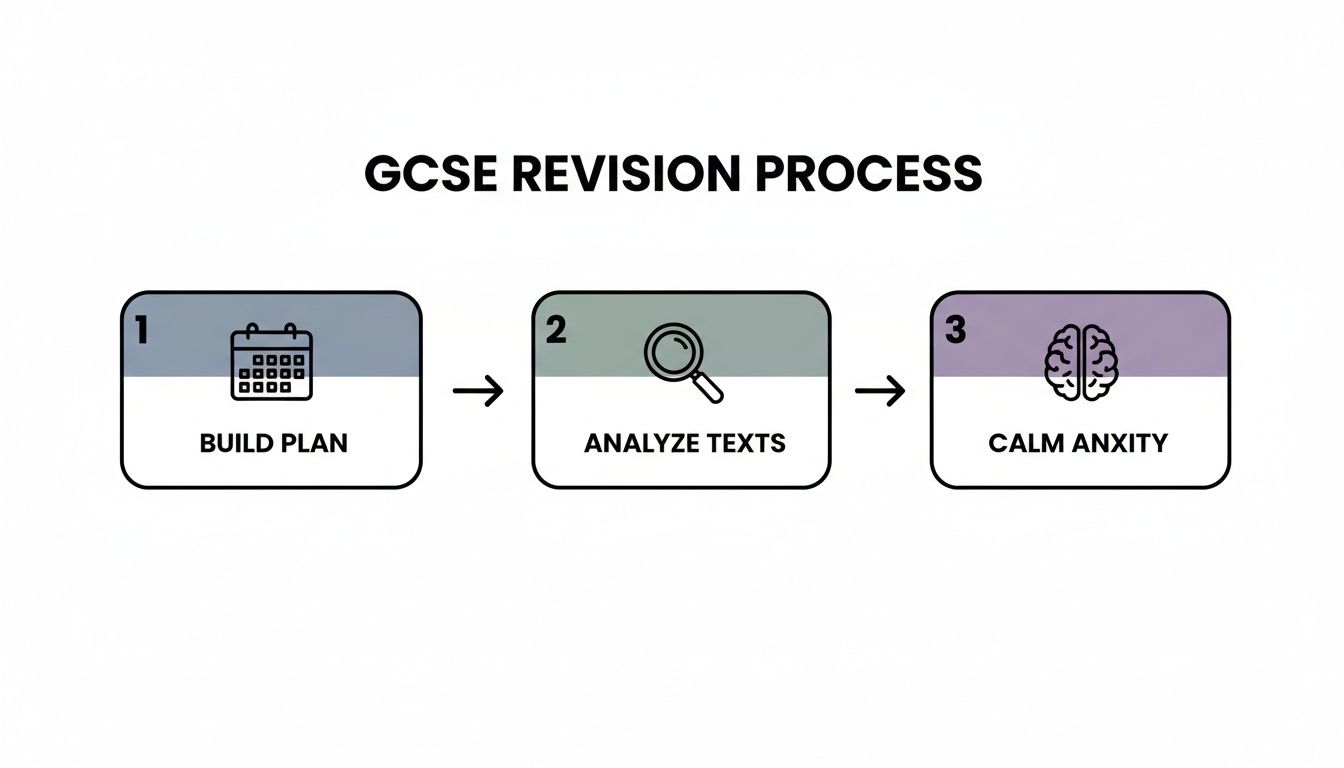
This visual is a great reminder that a good plan is holistic. It’s not just about study time; it has to factor in wellbeing too.
To give you a clearer idea of how this might look, here’s a sample weekly block focused entirely on one text, like Macbeth. The goal is to mix up activities to keep things fresh and target different skills.
Sample Weekly Revision Block for 'Macbeth'
This table illustrates a balanced, multi-faceted approach to revising a single text over one week, incorporating different learning activities to maintain engagement and build skills progressively.
| Day | Focus Activity (45-60 mins) | SEN/SEMH Adaptation | Goal |
|---|---|---|---|
| Monday | Re-read Act 1. Create a mind map of Macbeth's initial character. | Use audio-book version. Use coloured pens for different character traits. | Refresh plot knowledge and character foundations. |
| Tuesday | Choose 5 key quotes about ambition from Act 1. Write them on flashcards. | Focus on just 2-3 quotes. Draw a symbol for 'ambustion' on each card. | Build quote bank and link to a core theme. |
| Wednesday | Watch a 15-minute analysis video on Lady Macbeth (e.g., Mr Bruff). | Watch with subtitles. Pause to jot down 3 key ideas in a notebook. | Gain a different perspective and deepen understanding. |
| Thursday | Write one paragraph analysing a key soliloquy from Act 1. | Use a PEEL paragraph scaffold. Set a timer for just 15 minutes. | Practise analytical writing skills in a low-pressure way. |
| Friday | Plan an essay on the theme of guilt, using quotes from the whole play. | Use a spider diagram for planning. Focus on bullet points, not full sentences. | Develop essay planning and structuring skills. |
| Weekend | Rest. Review flashcards from Tuesday for 10 minutes. | Ensure a full break. Maybe a quick verbal quiz on the quotes with a family member. | Consolidate learning through spaced repetition and recharge. |
Notice how it’s not just about writing essays. It’s a mix of reading, memorising, watching, and planning. This variety is what stops revision from becoming a monotonous chore.
The best revision plan is one that actually gets used. If it’s causing more stress than it relieves, it’s not working. Give your child permission to adapt it, move sessions around, and take unscheduled breaks when they need them. This sense of ownership is the secret ingredient for consistency and can transform their attitude towards revision.
This sense of control is crucial for building confidence, which is just as important as knowing the texts inside out. For more practical advice on building effective study habits, check out our broader guide offering valuable revision tips for GCSE. By creating a plan together, you’re not just organising their time—you’re showing them you trust them to lead their own learning journey.
From Passive Reading to Active Analysis
Simply re-reading An Inspector Calls or a poetry anthology a dozen times might feel like revision, but it’s a classic trap. It’s passive. The words wash over your child, but very little actually sticks, and it does almost nothing to build the analytical skills that secure those top grades. This can lead to a false sense of security, followed by a crushing feeling of panic in the exam hall.
To really get ahead, your child needs to shift from being a passive reader to an active literary detective. This is where the real learning happens. We need to teach them to have a conversation with the text—to question it, challenge it, and uncover the layers of meaning hidden just beneath the surface. This hands-on approach is how they start to form their own unique interpretations, which is exactly what examiners are looking for.
The Power of Asking Questions
Effective annotation isn't about turning a page into a rainbow of highlighter colours. It's about having a targeted, thoughtful dialogue with the author. The margins of the book should become a space for genuine curiosity, not just for underlining things that look important.
Encourage your child to move beyond simple highlighting and start scribbling questions as they read. Instead of just noting a metaphor, they should be asking why it's there.
- When reading Macbeth, instead of just underlining "look like the innocent flower, / But be the serpent under't," they could ask: "Why a serpent? What does this link to (Adam and Eve, deception, evil)? How does this show Lady Macbeth's influence over him?"
- In A Christmas Carol, when Scrooge sees Marley's ghost, they might question: "Why is Marley bound in 'cash-boxes, keys, padlocks'? What is Dickens telling us about the prison of wealth and greed? How would this make a Victorian audience feel?"
This one simple shift changes everything. It moves their focus from merely spotting literary devices to understanding their purpose and effect. This skill is absolutely central to every single mark they will earn in the exam.
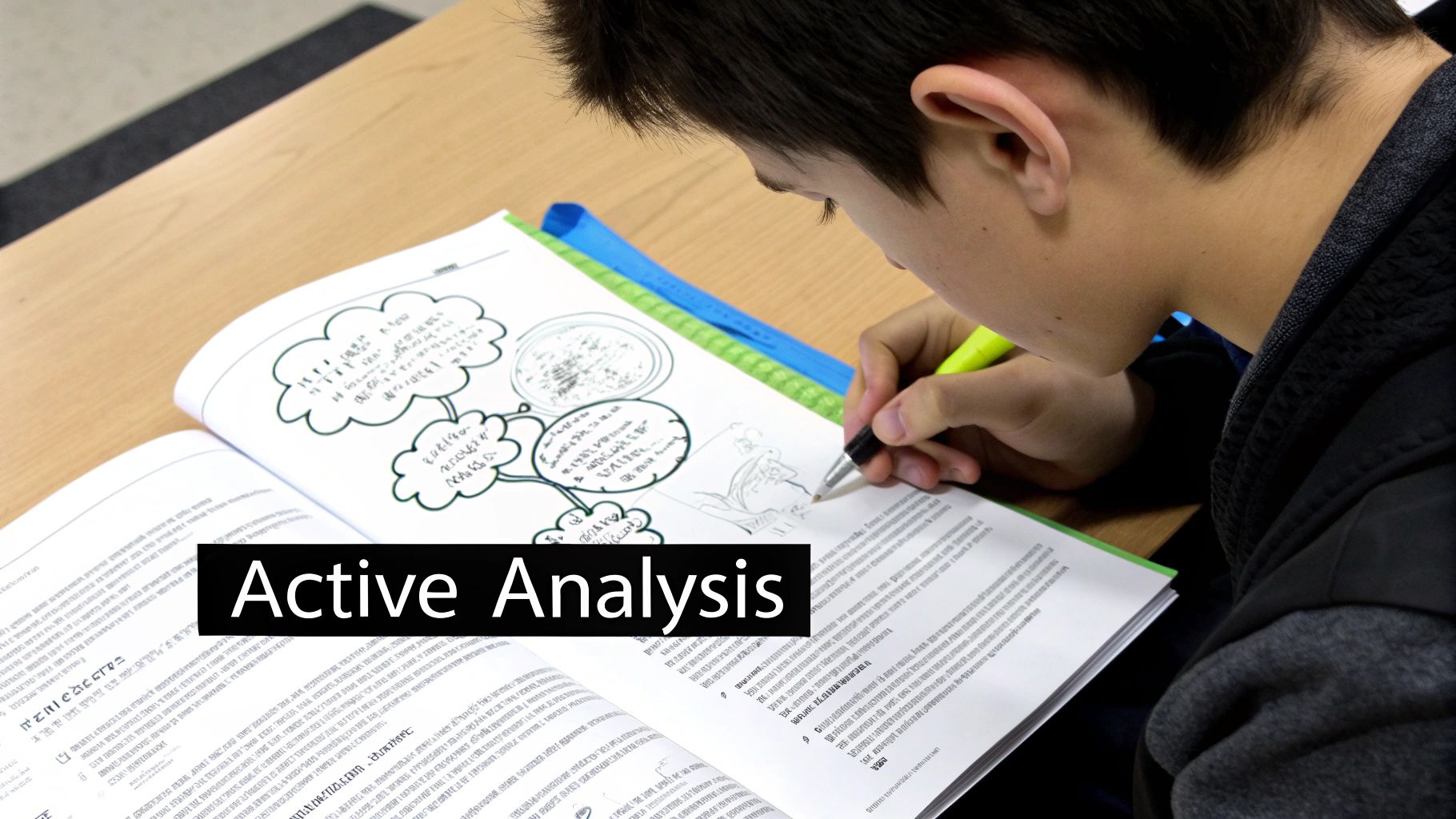
Creating Dynamic Mind Maps
Another powerful tool for active analysis is the mind map. But again, this isn't about just copying out notes in a different format. It's about making connections across an entire text, visually tracing how a theme or character develops from beginning to end.
Let’s take the theme of 'Social Class' in An Inspector Calls as an example.
- Start with 'Social Class' in the centre of a large page.
- Draw main branches for key characters: Mr Birling, Mrs Birling, Sheila, Eric, and Eva Smith.
- On each branch, add key quotes that reveal their attitude to class. For Mr Birling, you might add, "a man has to make his own way."
- From each quote, add smaller branches exploring the effect of these attitudes. How does Mr Birling's view contribute to Eva's death? How does Sheila's view change?
This visual method helps students see the 'big picture', transforming a collection of isolated facts into a web of interconnected ideas they can draw upon in an essay. To move from passive reading to active analysis, it's vital to strengthen the foundational understanding of texts. You can discover some top strategies for developing reading comprehension skills that can help build this essential foundation.
Making Ideas Concrete with Dual Coding
For many students, especially visual learners or those with SEN, abstract concepts like 'guilt' or 'patriarchy' can feel slippery and hard to grasp. Dual coding is a fantastic technique that bridges this gap by pairing words with simple images.
The idea is to make abstract ideas concrete and, therefore, far more memorable. It doesn't require any artistic talent; simple stick figures and symbols are perfect.
| Concept/Quote | Simple Drawing | Why It Works |
|---|---|---|
| "Fair is foul, and foul is fair" | Two masks, one smiling and one frowning, overlapping. | This visually represents the theme of deception and appearance vs. reality in Macbeth. It's an image that's easier to recall under pressure than just words alone. |
| "Unsex me here" | A drawing of a crown with a broken female symbol (♀) next to it. | It connects Lady Macbeth's ambition directly to her rejection of traditional femininity, making the abstract concept of gender roles tangible. |
| "We are members of one body" | A stick figure with puzzle pieces for limbs, all connected. | This provides a simple, powerful image for the Inspector's message of social responsibility, a concept that can otherwise feel quite vague. |
This process forces the brain to process information in two different ways, which significantly boosts memory and recall. Research shows this method can improve learning outcomes by making complex information easier to digest and remember under exam pressure. If you're looking for more ways to support your child, explore our guide on how to improve reading comprehension, which offers further practical techniques.
By becoming an active analyst, your child is no longer just a student memorising information. They become a detective, piecing together clues to build their own case. This sense of discovery is not only more effective for revision; it’s also far more rewarding, building the confidence they need to walk into the exam hall ready to share their own brilliant ideas.
How to Build a Powerful Quote Bank That Sticks
Any good English Literature essay is built on a foundation of well-chosen quotes. But let’s be honest, the very idea of memorising an intimidatingly long list is enough to fill any student with dread and make revision feel like an impossible, joyless task.
The good news? It’s not about brute-force memorisation. It's about building a lean, powerful, and memorable quote bank that actually sticks. The goal is quality over quantity. A short, versatile quote that your child understands inside and out is far more valuable than a long, clunky one they can barely recall under pressure. Think of it as creating a trusted toolkit, ready to be used with confidence when it matters most.

Organise Quotes by Theme, Not Just by Character
One of the most common mistakes students make is filing quotes only by the character who says them. While that has its uses, it’s not the most effective way to prepare for an exam question about a theme like 'power' or 'social responsibility'.
A much smarter approach is to organise quotes thematically. This simple shift helps students see the bigger picture and draw connections across the entire text, which is exactly what examiners are looking for.
Encourage your child to create a simple table or a set of digital flashcards for each of the core themes. For every quote they add, they should also jot down a few brief notes.
Here’s a practical example for the theme of ‘Guilt’ in Macbeth:
| Quote | Who Says It | Key Techniques | My Analysis (The "So What?") |
|---|---|---|---|
| "Out, damned spot!" | Lady Macbeth | Metaphor, fragmented sentence, repetition. | This shows her complete psychological breakdown. The blood is a powerful metaphor for her guilt, something she once mocked Macbeth for but now cannot escape. |
| "Will all great Neptune’s ocean wash this blood / Clean from my hand?" | Macbeth | Hyperbole, rhetorical question, imagery. | He understands the scale of his crime immediately. The hyperbolic image of the ocean turning red shows his guilt is permanent and all-consuming. |
| "Sleep no more! Macbeth does murder sleep" | Macbeth (hearing a voice) | Personification, foreshadowing. | Sleep represents innocence and peace. By killing Duncan, he has destroyed his own peace of mind forever. This is the start of his mental unravelling. |
Suddenly, a simple quote is transformed into a powerful piece of analytical evidence, complete with the literary techniques needed for a top-grade response.
Make Memorisation Active and Engaging
Staring blankly at a list of quotes is passive, boring, and, frankly, useless. To make them actually stick, revision needs to be active. The brain is far better at remembering things when it's actively doing something with the information.
Here are a few strategies that put your child’s needs at the centre:
- Use Flashcard Apps: Apps like Anki or Quizlet use spaced repetition, a clever algorithm that shows your child quotes just before they're about to forget them. It’s a scientifically proven way to embed information into long-term memory.
- Record and Listen: This is a game-changer for auditory learners. Get them to record themselves reading the quotes and their analysis. They can listen on the bus, while walking the dog, or just before bed. Hearing the information in their own voice can feel less intimidating.
- Connect Quotes to Scenes: Link each quote to a powerful visual moment in the play or novel. When they think of "Out, damned spot!", they should picture Lady Macbeth frantically sleepwalking in the dark. This technique, called dual-coding, pairs words with mental images to supercharge recall.
This active approach is what separates the high-achievers. Targeted preparation is everything, and as the latest Ofqual report on GCSE results shows, students who are well-prepared consistently perform better.
A quote bank isn't just a list to be learned; it's a personalised collection of the best evidence your child has gathered. Building it should feel empowering, like an armoury being stocked for the exam, giving them a real sense of readiness.
By focusing on short, meaningful quotes and using active memorisation techniques, you can help turn a task that feels overwhelming into a manageable and even rewarding part of how to revise for English Literature GCSE.
Mastering Exam Technique with Past Papers
Knowing the texts inside and out is a massive achievement, but it’s only half the story. The real challenge, and where the top grades are truly won, is applying all that knowledge under the immense pressure and ticking clock of the exam hall.
This is where mastering exam technique becomes your child's most powerful tool. It’s the bridge between knowing the content and proving you know it. Using past papers isn’t just about drilling; it’s about learning to think, write, and manage time like a top-tier student. While it can feel daunting at first, it's the single most effective way to build unshakable confidence for the big day.
Decoding the Exam Question
Before a single word is written, the first job is to become a question detective. GCSE questions are meticulously crafted, and every single word has a purpose. We need to teach students that command words like 'analyse', 'explore', and 'compare' aren't just suggestions—they are direct instructions on how to structure the entire response.
Let's break down a classic question for An Inspector Calls:
"How does Priestley explore the theme of social responsibility in An Inspector Calls?"
- Command Word: 'How' is the trigger. It’s asking for the methods Priestley uses. This is a direct prompt to discuss his writerly craft: language, structure, characterisation, and dramatic devices. A student might think, "Okay, 'how' means I have to talk about stage directions, character's words, and the Inspector's role."
- Keyword: 'Priestley' is a deliberate nudge to focus on the writer's intentions. Why did he make these choices? What message was he trying to send to a post-war audience?
- Focus: 'the theme of social responsibility' is the heart of the question. Every single point made must link directly back to this idea.
Encourage your child to spend the first five minutes of their allocated time just highlighting these key parts and scribbling down initial ideas. This tiny investment in planning pays huge dividends, preventing the heart-sinking panic of going off-topic and keeping the essay tightly focused from start to finish.
Building an Essay with Confidence
Once the question is clear, the next hurdle is structuring the argument. For students who feel overwhelmed by a blank page, a simple and reliable framework like PEEL (Point, Evidence, Explain, Link) is an absolute game-changer. It provides a comforting structure, so they can focus on their ideas, not on how to write them.
- Point: Start with a clear topic sentence that directly answers the question.
- Evidence: Back it up with a well-chosen, concise quote.
- Explain: This is where the magic happens and where the marks are won. Analyse the quote, zooming in on specific words and literary techniques. What does it reveal? What is the effect on the audience?
- Link: Finally, loop the point back to the original question and, for bonus marks, connect it to the writer's overall message or the historical context.
A well-structured PEEL paragraph is like a mini-essay in itself. It demonstrates clear thinking and analytical depth, which is precisely what examiners are trained to reward. Mastering this provides a comforting safety net, ensuring every paragraph has purpose.
Thinking Like an Examiner
This is the secret weapon of truly effective revision. Instead of just writing practice essays and hoping for the best, students can learn to assess their own work using the official mark schemes. These documents can look intimidating, but they offer an incredible window into an examiner's mind.
Sit down together and look at a mark scheme for a past paper. You’ll see it’s broken down into different levels or bands, each describing the skills required to hit a certain grade.
Decoding the Mark Scheme Levels
Mark schemes aren't just for teachers; they are a roadmap for students. By understanding what skills correspond to each level, your child can self-assess and pinpoint exactly what they need to do to climb up the grade boundaries. Here's a simplified breakdown of what examiners look for.
| Level | Typical Grade | What the Student Does | Example Action |
|---|---|---|---|
| Level 2 | 3/4 | Makes simple, straightforward points. Uses some evidence but the explanation is often more of a summary or paraphrase. | "Mrs Birling is shown to be uncaring when she refuses to help Eva." |
| Level 4 | 5/6 | Develops a clear argument with relevant evidence. Begins to analyse the writer's methods (language, structure) and links ideas to intentions. | "Priestley uses Mrs Birling's cold, formal language, like 'that sort of girl', to expose the hypocrisy and prejudice of the upper classes." |
| Level 6 | 8/9 | Offers a sophisticated, critical argument. Provides perceptive analysis of methods and weaves in a deep understanding of context seamlessly. | "Priestley constructs Mrs Birling as a dramatic embodiment of the pre-war capitalist ideology, her refusal to accept responsibility acting as a microcosm for the societal failures he sought to condemn." |
By comparing their own practice essay to these descriptors, your child can see exactly where they need to improve. Maybe their 'Explain' section is too brief, or they forgot to mention context. This creates a powerful feedback loop that drives targeted, meaningful improvement with every essay they write. It’s a vital step in preparing for formal assessments, and you can learn more about getting the most out of these trial runs by exploring the benefits of GCSE mock exams.
With a staggering 608,215 GCSE English Literature results issued in a recent summer, competition is fierce, and this kind of strategic revision is what sets students apart. Research from UK exam boards consistently shows that practising with past papers helps narrow attainment gaps and builds the resilience needed for success. To get a fuller picture of the national results landscape, you can discover more insights about recent qualification results in England on GOV.UK.
Answering Your Top GCSE English Literature Questions
As the exams get closer, it’s completely normal for questions and worries to pop up. In fact, it’s a good sign—it shows how much you and your child care about doing well. I've spent years helping families navigate this exact period, so let's tackle some of the most common concerns I hear.
How Many Quotes Does My Child Really Need to Memorise?
This question causes a huge amount of anxiety, but the answer is refreshingly simple: quality over quantity, every single time. It's about confidence, not a memory test.
My advice is to aim for around 15-20 powerful, versatile quotes per text. A short, punchy quote that your child can analyse inside and out is far more valuable than a long one they only half-remember.
Take Macbeth, for example. A quote like "Fair is foul, and foul is fair" is perfect. It’s short, memorable, and unlocks major themes like appearance vs reality, deception, and the supernatural right from the opening scene. Focusing on fewer, high-impact quotes not only reduces the feeling of being overwhelmed but also builds the confidence needed to write a genuinely insightful analysis.
How Can We Tackle Unseen Poetry Panic?
Unseen poetry can feel like the scariest part of the exam, purely because it’s a complete unknown. But the secret isn’t to try and read every poem ever written. It's about having a confident, repeatable method that works for any poem they’re given, so they can feel in control.
Help your child develop a simple checklist to use every single time they face a new poem. This simple habit turns a moment of panic into a structured, manageable task. Here’s a process I’ve seen work wonders:
- First read: Just get a feel for it. What’s the mood? Does it feel happy, sad, angry?
- Second read: Now, what’s happening? Try to summarise the 'story' or main feeling in a single sentence. For example: "This poem is about someone remembering a happy childhood memory."
- Zoom in: What interesting words or images jump out? Circle them.
- Look at the shape: Are there stanzas? A rhyme scheme? How does it look on the page?
- Check the title: How does the title connect to everything you’ve just read?
Practising this method, even just for ten minutes with poems you find online, builds the self-assurance they need to walk into the exam knowing they have a tool to handle whatever comes their way.
What Is the Best Way to Revise Historical Context?
Context should never be a list of facts bolted onto an essay. It’s the ‘why’ behind the story, and weaving it in seamlessly is what separates a good answer from a great one. It can be the difference that makes an examiner sit up and take notice.
Instead of just memorising that An Inspector Calls was written in 1945 but set in 1912, the real question to ask is: Why did Priestley do that?
The answer—that he was using the pre-war setting to expose and criticise the social attitudes that led to two world wars—is where the top marks are found. Try creating mind maps with a theme like ‘Social Responsibility’ in the centre. From there, create branches for character actions, key quotes, and relevant contextual points about Priestley's socialist views. This approach makes context a powerful tool for analysis, not just another fact to remember.
By connecting a character’s actions to the author’s message and the world they lived in, your child demonstrates a sophisticated understanding that examiners love to see.
What Strategies Can Help My Child with SEN Write Essays?
For learners with Special Educational Needs, the task of writing a full essay under timed conditions can feel completely overwhelming. The key is to break it down and remove any barriers so their fantastic knowledge of the texts can shine through.
Visual planning tools are a game-changer. Using flowcharts or spider diagrams to map out an essay before a single paragraph is written can provide much-needed structure and reduce cognitive load. It's also incredibly helpful to master a single, clear paragraph structure, like PEEL (Point, Evidence, Explain, Link). This provides a reliable scaffold they can use for every single point they make, reducing the anxiety of the blank page.
Don't forget about assistive technology. Speech-to-text software can be a brilliant way for students to get their ideas down without the added pressure of handwriting or typing. The goal is to find strategies that work for them, empowering them to show the examiner what they truly know and feel proud of what they've produced.
At Queens Online School, we believe in creating personalised learning paths that empower every student to succeed. Our live, interactive classes and specialist teachers provide the tailored support needed to turn revision anxiety into exam confidence. Explore our online GCSE courses and see how we can help your child achieve their full potential.