

Choosing the right A Level subjects often feels like it breaks down into three core pillars: figuring out what your child genuinely enjoys, matching those interests with their future goals, and creating a balanced workload that plays to their strengths. For you and your child, it’s a decision that feels massive, but looking at it through this simple framework can turn overwhelming pressure into a clear, manageable, and even exciting process.
Navigating the A Level Crossroads Together
The conversation around "how to choose A Level subjects" can quickly fill a home with anxiety. It feels like a moment that will define everything that comes next.
For your child, it can seem like they’re being asked to map out their entire life before they’ve even finished their GCSEs. The fear of making the "wrong" choice can be paralysing. But this isn't a test they can fail. It's a journey of discovery you can embark on together.
Instead of seeing it as a hurdle, let's reframe it as an exciting conversation. The goal isn't just to pick subjects that will look good on a university application, but to find a combination that truly ignites their curiosity and builds their confidence. Success at A Level is fuelled by genuine engagement, not just by ticking the right academic boxes. An unhappy student will struggle, no matter how "perfect" their subjects look on paper.
This decision is a unique opportunity to connect with your child, to listen to their hopes and fears, and help them articulate their passions. It’s about moving away from the frantic rush to find the 'perfect' combination and focusing instead on what makes them feel alive and capable.
To simplify the journey ahead, this visual decision tree breaks down the core elements to consider.
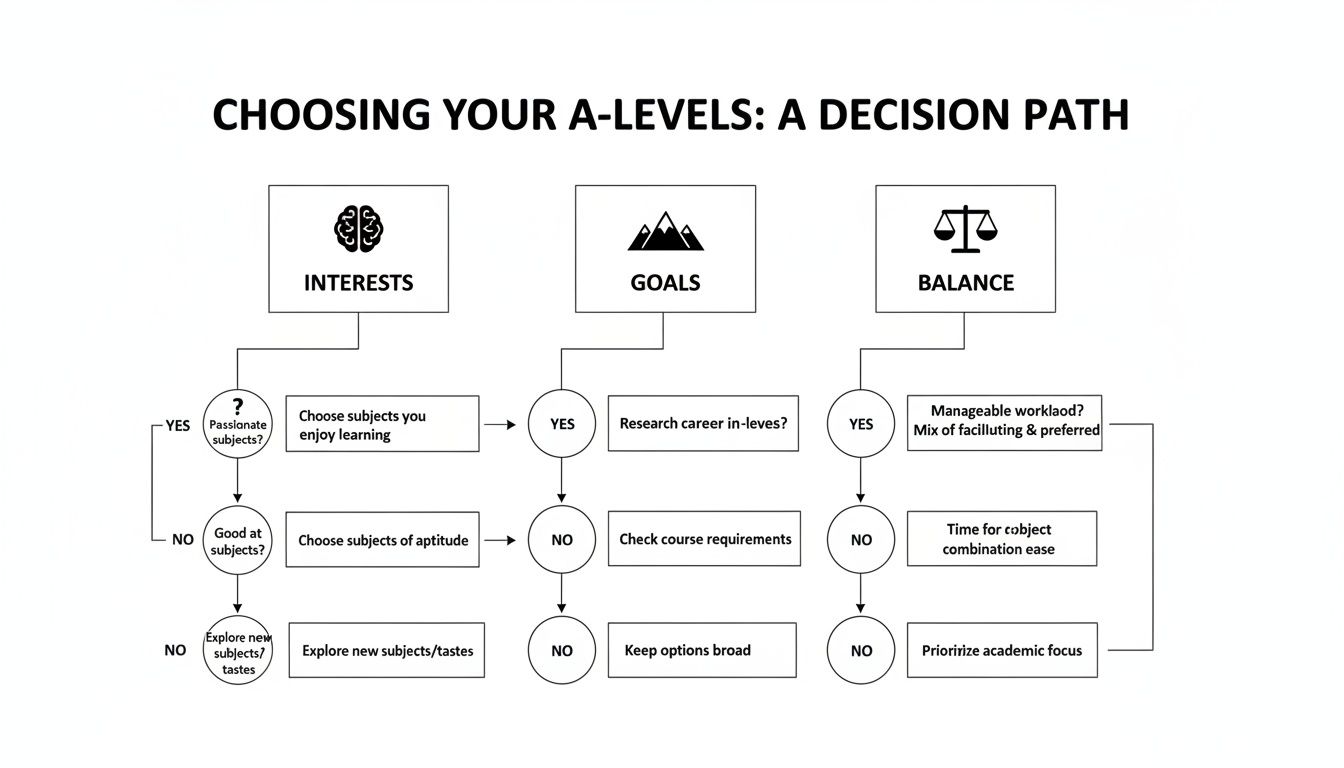
As the flowchart shows, the best choices are found right at the intersection of what your child loves, where they want to go, and what they can realistically manage without burning out.
The Three Pillars of a Great Decision
Putting your child at the centre of this process means valuing their wellbeing just as much as their academic potential. The right subjects are ones that feel both challenging and manageable, inspiring them to do their best without feeling completely overwhelmed.
Throughout this guide, we’ll explore each of these pillars in depth:
- Exploring Genuine Interests: We'll look beyond grades to uncover what truly fascinates them, turning hobbies and quiet curiosities into powerful subject choices that feel authentic to them.
- Aligning with Future Goals: We'll connect those passions to practical university and career pathways, making sure their choices keep all the right doors open for the future they dream of.
- Creating a Balanced Workload: We'll discuss how to build a smart combination of subjects that complements their learning style and protects their mental health by distributing the academic load effectively.
Discovering What Truly Ignites Their Curiosity
The most successful A Level journeys don’t start with a spreadsheet of top grades. They begin with a spark of genuine curiosity.
When we ask our children, "What are your best subjects?" we usually get predictable answers based on test scores. But that question misses the point. It bypasses the emotional core of learning—the very thing that fuels resilience and success when the coursework gets tough. A student who loves a subject will find the energy to push through a difficult topic; a student who feels forced into it may just give up.
Let's try a different approach. The real clues to their ideal subjects are often hiding in plain sight, in what they choose to do when no one is watching. It’s about uncovering the topics that make time fly, the questions that send them down an internet rabbit hole, and the activities they pursue just for the sheer joy of it.
This shift in perspective is crucial. Authentic enthusiasm is the fuel that will sustain them through two demanding years of study. It turns homework from a chore into a challenge and revision from a burden into an exploration.
Looking Beyond the Classroom
A child's passions aren't always neatly contained within the national curriculum. Sometimes, the most powerful indicators of their future path are found in their hobbies, what they watch, and their everyday conversations.
Consider these real-world scenarios I’ve seen time and time again:
- The Gamer's Narrative: A student immersed for hours in video games with intricate storylines isn't just "playing games." They are analysing plot, character development, and world-building. That same critical eye could make them a phenomenal student of English Literature or Film Studies, where deconstructing narratives is a core skill. For them, analysing The Great Gatsby could feel as engaging as unpacking the lore of their favourite game.
- The True-Crime Detective: A teenager hooked on true-crime podcasts and documentaries is already engaging with complex human behaviour, motivation, and societal structures. This natural curiosity is the perfect foundation for studying Psychology, Sociology, or even Law. They aren't just consuming entertainment; they're asking "why," which is the heart of all social sciences.
- The Social Justice Advocate: The student passionate about climate change, who follows global politics and keenly discusses social issues, is already thinking like a social scientist. Subjects like Politics, Geography, or Economics could give them the academic framework for the ideas they care so deeply about, turning their passion into powerful, evidence-based arguments.
These examples show that choosing A Levels is less about an academic track record and more about connecting the dots between what they love and what they can learn. To make informed choices that align with their natural abilities, it helps students to look at resources on how to figure out your strengths and build from there.
The goal is to find the subjects where their natural curiosity and academic requirements overlap. This is the sweet spot where students don't just learn—they thrive.
Actionable Exercise: The Curiosity Journal
To help your child uncover these hidden interests, encourage them to start a 'Curiosity Journal'. This isn't formal homework; it's a simple, low-pressure way for them to notice what truly grabs their attention over a week or two. It puts them in the driver's seat of their own self-discovery.
They can use a notebook or a notes app to jot down answers to prompts like these:
- What did I look up online today just for fun? (e.g., How do black holes work?, History of the Roman Empire, Why do some people have different accents?)
- What was the most interesting video I watched or podcast I listened to? (e.g., A documentary on deep-sea creatures, a podcast about a historical event, a tutorial on digital art.)
- What problem did I try to solve today? (e.g., Fixing a bug in a line of code, organising a meet-up with friends, planning a detailed travel itinerary.)
- Which school lesson made me forget to watch the clock? (e.g., The debate in history class, the practical experiment in chemistry, analysing a poem in English.)
After a couple of weeks, sit down together and look for patterns. You might be surprised by what you find. The journal could reveal a budding scientist, a future historian, or a creative thinker. This exercise isn't about making a final decision right now. It’s about gathering the emotional and intellectual data needed to make a choice that feels right, authentic, and, most importantly, exciting for them.
Connecting Passions to University and Career Pathways
Once you’ve pinned down the subjects your child genuinely loves, the next step can feel both exciting and a little daunting: connecting those passions to their future. This is where we start looking ahead, translating their current interests into real, tangible university and career options. Think of it as building a bridge from who they are now to who they might become.

This process might seem like solving a complex puzzle, but it’s often more straightforward than you’d think. A brilliant way to start is by working backwards. Pick a potential career or university degree, and then trace the path back to see which A Levels are required or recommended.
This simple, practical approach cuts through the guesswork. It grounds the conversation in real-world requirements and gives your child a clear sense of purpose, helping them see how today's choices connect to tomorrow's dreams.
From Ambition to A Levels
For some students, the future is already in sharp focus, which makes choosing A Levels relatively simple. The path is already lit by the prerequisites of their dream course or career.
Let’s look at a few common scenarios:
- The Aspiring Doctor: A child who has dreamed of being a doctor for years will feel a sense of purpose in choosing their sciences. For them, Chemistry isn't just a tough subject; it's the first real step toward their goal. Biology is almost always essential too, and a third A Level in Maths or Physics creates a powerful, highly specialised combination.
- The Future Architect: For a student who spends hours sketching buildings and reimagining city spaces, the subject choices become obvious. Universities will look for a blend of creative flair and technical skill. Maths and Physics are often required for the engineering side of the degree, while an Art A Level allows them to showcase that crucial design talent they already have.
- The Budding Engineer: Much like architecture, engineering degrees demand strong analytical and problem-solving abilities. For the child who loves taking things apart and putting them back together, Maths and Physics are non-negotiable for most engineering courses. A third subject like Further Maths or Chemistry is often recommended to round out their application.
In these cases, passion and pragmatism line up perfectly. The necessary subjects feel like a natural extension of the student’s long-term goals.
Understanding Facilitating Subjects
But what about the student who doesn't have a specific career in mind yet? That’s incredibly common, and it’s okay for them to feel uncertain. The best strategy here is to choose subjects that keep as many doors open as possible. This is where facilitating subjects come into play.
These are the subjects that top universities frequently list as entry requirements for a huge range of degree courses. They are highly respected because they arm students with essential transferable skills like critical thinking, analysis, and research.
Choosing one or two facilitating subjects is one of the smartest moves a student can make if they're unsure about their future. It acts as a safety net, giving them the freedom and flexibility to decide on a university course later without being held back.
The key facilitating subjects include:
- Maths and Further Maths
- English Literature
- Biology, Chemistry, and Physics
- History
- Geography
- Modern Languages
A combination like History, French, and Maths, for example, leaves a massive number of university options on the table, from law and business to international relations and beyond. This allows your child to continue exploring their interests without the pressure of having to commit to a life plan at sixteen.
A Level Subject Pathways for Popular Career Fields
To make this process even clearer, we've created a table mapping common career ambitions to the A Levels that are typically essential or highly recommended for university entry. Use this as a starting point for your research and conversations.
| Career Field | Essential A Level Subjects | Recommended A Level Subjects |
|---|---|---|
| Medicine/Dentistry | Chemistry, Biology | Maths, Physics |
| Engineering | Maths, Physics | Further Maths, Chemistry, Design Technology |
| Law | None specified (essay subjects are key) | History, English Literature, Politics, Economics |
| Computer Science | Maths | Further Maths, Physics, Computing |
| Psychology | Often Biology or another science | Psychology, Sociology, Maths |
| Architecture | Maths, Physics | Art, Design Technology |
| Veterinary Science | Biology, Chemistry | Maths or Physics |
| Economics | Maths | Economics, Further Maths, Politics |
While this table offers a great snapshot, it's absolutely crucial to remember that requirements can and do vary between universities. That brings us to the final, most important step.
The Golden Rule: Check University Requirements
Before you lock in any choices, you must check the specific entry requirements for the courses your child might be interested in. The best place for this is the UCAS website. Each course listing details exactly which subjects and grades are needed.
This simple check can prevent huge disappointment later on. Imagine the heartache of your child working hard for two years, only to find out they can't apply for their dream course because they missed one required subject. For instance, a student might assume Economics A Level is essential for an economics degree, only to discover that some top universities require Maths but don’t specify Economics at all.
Taking ten minutes to verify these details is one of the most important things you can do. For a deeper dive into the application journey itself, our guide on how to apply to UK universities offers more valuable insights.
Building a Balanced and Strategic Subject Combination
Choosing three A Levels isn't just a case of picking subjects from a list; it’s about creating a team. Each subject has its own personality, demands, and workload. The real art is building a combination that works together, creating a manageable—and even enjoyable—experience for your child, rather than a constant uphill battle against stress and burnout.
Thinking strategically about how subjects pair up can make all the difference to your child's wellbeing and academic performance. It’s about being smart with their time and energy, ensuring they have the mental space to excel across the board.
Specialist vs Versatile Approaches
When it comes to combining subjects, there are two main philosophies. The right one depends entirely on your child's goals and how they learn best.
One popular route is the specialist approach. This is perfect for students with a clear university course or career in their sights. They build a powerful, focused combination where the subjects directly support each other.
- Example Scenario: A student aspiring to be an engineer might choose Maths, Further Maths, and Physics. Each subject reinforces the concepts learned in the others, creating a deep, interconnected understanding. For this student, solving a problem in Physics might suddenly make a difficult Maths concept click. That synergy can be incredibly effective and rewarding.
The other route is the versatile approach. This is a fantastic strategy for students who want to keep their options wide open. They select a broader mix of subjects, often including at least one facilitating subject, to create a well-rounded academic profile.
- Example Scenario: A student might pair History, Biology, and a modern language like Spanish. This blend showcases a diverse skill set—analytical writing from History, scientific reasoning from Biology, and communication skills from Spanish. This tells universities they are a flexible, adaptable thinker, making them an attractive candidate for a huge range of courses.
The key takeaway is this: Neither approach is "better." The best combination is the one that aligns with your child's future aspirations while feeling balanced and manageable for them personally.
The Critical Importance of Balancing Workload
This is where many families feel the most pressure. It’s easy to underestimate just how demanding A Levels are, and a poorly balanced subject combination can quickly lead to burnout. The secret isn't just looking at what subjects they choose, but how they are assessed.
Imagine choosing three subjects that are all heavily reliant on essays and extensive reading, like History, English Literature, and Politics. While a fantastic combination academically, the sheer volume of reading and writing can become relentless, especially around exam season. Your child could be facing three huge exams that all require the same kind of intense, last-minute cramming.
A much smarter, and kinder, way to approach this is by mixing different assessment styles.
- Practical Example: A student passionate about English Literature (exam-based) could balance this with a coursework-heavy subject like Art or Drama. This spreads the pressure out over the two years. A significant chunk of their final grade in Art would be secured before they even walk into an exam hall for English, reducing that feeling of all-or-nothing pressure at the end.
Understanding the nuances of potential subjects is vital. For example, considering the differences between O-Level E-Math and A-Math can offer a glimpse into the specific skills needed, helping to build a more informed A-Level portfolio. For a more detailed look at structuring these pairings, check out our dedicated guide on A-Level subject combinations.
The Strategic Value of Popular Subjects
It might sound counterintuitive, but sometimes choosing a more 'mainstream' subject can be a very clever move. Popularity often signals strong support systems within schools and colleges, with experienced teachers and a wealth of readily available revision guides, online videos, and past papers.
This factor is worth considering, particularly in the UK education system. Across the UK, total A-level entries reached 882,509, with Mathematics remaining the most popular subject for the 12th year in a row. It attracted 112,138 entries, making up 12.7% of all choices.
This doesn't mean your child should avoid niche subjects they love. But if they are torn between two options, the one with a larger cohort and more established support might provide a smoother, less stressful academic experience. It's a pragmatic consideration that can have a real impact on their two-year journey.
Thinking Ahead: Subject Growth and Accessibility
Beyond immediate passions and university prerequisites, taking a forward-thinking approach to choosing A Levels can give your child a real advantage. The world of work is always changing, and picking subjects with growing demand is a strategic move that can pay dividends long after the exam results are in.

This doesn't mean forcing them into a subject they dislike. Not at all. It’s about having an open conversation. If your child is torn between two subjects they enjoy equally, looking at which one is becoming more relevant can be a powerful tiebreaker.
Riding the Wave of Growing Subjects
Some subjects are clearly on the rise, reflecting shifts in our economy and society. Computer Science, for instance, has become absolutely vital in almost every field. Another fantastic example is Economics, which offers a critical lens for understanding complex global issues.
In fact, Economics has surged in popularity to become one of the top ten most chosen A Levels in the UK. Entries have jumped by 5.5% to over 42,000, which is especially significant when you consider that overall subject entries have dropped. This tells us that students, universities, and employers all recognise its increasing importance. You can read more about the rise of A Level Economics here.
Choosing subjects like these can give your child a fantastic head start.
But what happens when ambition meets a roadblock? What if the perfect, future-focused subject simply isn't available at their school?
For a parent, there is nothing more heart-wrenching than seeing your child's passion and potential limited by circumstances beyond their control. This is a real and emotional challenge, but it is not the end of the road.
Overcoming Barriers to Accessibility
It's a frustrating reality that subject availability can be a postcode lottery. The same data showing the growth of Economics also highlights a stark disparity: it's offered in only 53% of state schools, compared to 90% of selective schools.
If your child finds themselves in this situation, it’s easy for them to feel disheartened, like their dreams are being cut short. But there are practical, empowering solutions you can explore together to make sure their ambitions aren't held back.
Here are some actionable steps you can take:
- Look into Consortium Agreements: Some schools partner with other local colleges or sixth forms to share resources. Your child might be able to attend their main school while taking one specific A Level at a nearby institution. It’s always worth asking your school’s head of sixth form if this is an option.
- Explore Online A Level Providers: The world of education has expanded far beyond physical classrooms. Reputable online schools offer the full British curriculum, taught by subject-specialist teachers in live, interactive classes. This can be a game-changing solution, giving your child access to any A Level subject they desire, regardless of where you live.
Finding out that a chosen subject isn't on offer can feel like a door slamming shut. But with these alternative pathways, you can help your child find another key, ensuring their journey is defined by their aspirations, not by limitations.
How Subject Choices Impact Grades and University Offers
Ultimately, the best A-Level choices are the ones that give your child the best shot at the grades they need for whatever comes next. While passion is the fuel, a bit of strategic thinking about subject combinations can make a huge difference to their final results—and the university offers that follow.
This isn't about gaming the system. It’s about understanding how certain subjects talk to each other, creating synergies that play to your child’s natural strengths. When one subject reinforces the skills needed for another, it can create a powerful academic advantage, helping tough concepts click into place and lifting grades across the board.
Finding a Strategic Advantage
The data often shows strong links between top grades in certain subjects. A student with a sharp, analytical mind who loves Maths, for example, often finds those skills translate beautifully to Physics and Economics. The logical reasoning required for one subject strengthens their performance in the others, creating a positive feedback loop.
This isn't about pigeonholing a student. It’s about spotting their core talents and building a combination that amplifies them. It's a much more empowering way to tackle the how to choose a level subjects question—by creating a combination where they are most likely to feel confident and thrive.
The goal is to build a subject portfolio that feels less like juggling three separate challenges and more like a single, cohesive project. When subjects complement each other, the workload feels more manageable, and success in one area can fuel motivation in others.
Ofqual’s analytics consistently back this up. For instance, students who nail an A* in Maths often do exceptionally well in Chemistry and Biology. Similarly, those who achieve a C+ in Geography tend to see similar success in History. Looking at these patterns can help you and your child build a genuinely effective combination. You can explore detailed trends in A-level results from 2025 to see this for yourself.
The Stability of Success
It's completely normal to worry about whether some subjects are "harder" to get top grades in than others. All the talk about grading can cause a lot of anxiety, leading some students to second-guess their choices based on perceived difficulty rather than what they actually enjoy.
Thankfully, the data offers a lot of reassurance here. Across most subjects, the proportion of students achieving A*-A grades stays remarkably stable, typically varying by less than 0.5 percentage points from one year to the next.
This stability is a huge relief. It means your child can confidently choose subjects they love without the fear that they’ll be unfairly penalised by harsh grading. For a deeper dive into how these grades are set, our guide explaining A-Level grade boundaries is a great resource.
This consistency drives home the most important message: genuine passion and consistent effort are the true drivers of success. A student who is fascinated by their subjects will always outperform someone who has picked a supposedly "easier" path they find completely uninspiring.
Still Have Questions About Choosing A Levels?
It's completely normal to have a few lingering worries at this final stage. Choosing A Levels feels like a huge decision because it is! Let's walk through some of the most common questions we hear from parents and students, and hopefully put your mind at ease.

What If My Child Has No Idea What Career They Want?
Honestly, this is the most common situation, so please don’t panic. Most 16-year-olds don't have a life plan mapped out, and that’s perfectly fine. It's our job to reassure them that this uncertainty is normal. The best strategy here is to keep their options as open as possible by choosing 'facilitating subjects'.
These are the subjects highly respected by universities that unlock a huge range of degree courses. A combination like Maths, English Literature, and a science (like Biology) or a humanity (like History) is a classic for a reason—it demonstrates a breadth of skills. The focus should be on developing transferable abilities and giving them the gift of time, not locking them into a career path they haven't chosen yet.
Should They Choose a Subject They Love or One That Looks 'Good'?
This one is simple: your child will almost always do better in a subject they genuinely enjoy. Motivation is a massive, often underestimated, factor in A Level success.
Forcing them to grind through a subject they dislike just because it seems more ‘prestigious’ is a recipe for burnout and disappointing grades. Imagine the nightly battles over homework, the stress before exams—it's not worth it. The sweet spot is where their passion meets their ability. If they excel in a subject like Art or Drama and it’s a true strength, it can be a fantastic choice, especially when balanced with other core academic subjects.
A child who is energised and engaged by their work will always outperform one who is simply enduring it. Trust their passion—it's their greatest asset.
How Many A Levels Should My Child Take?
For the vast majority of UK universities, including the most competitive ones, offers are based on three A Levels. Don't fall into the trap of thinking more is always better.
Taking on a fourth A Level is really only a good idea if they're aiming for a hyper-competitive course like Medicine or if they are an exceptional student who can genuinely handle the intense workload without their other grades suffering. The risk is spreading themselves too thin and jeopardising their results across the board. At the end of the day, achieving A*AA in three subjects is far more valuable to a university than AABB in four. Have a very honest conversation about the extra stress before committing.
At Queens Online School, we provide specialist guidance to help every student build a balanced, exciting A Level portfolio that truly opens doors to their future. Explore our flexible online A Levels and discover how we can support your child's unique journey.