

Applying to university through UCAS is a multi-step process, but it's far from unmanageable. The whole thing is handled online via the UCAS Hub, where you’ll register an account, fill in your details, select up to five courses, write a compelling personal statement, and arrange for a reference—all before hitting ‘submit’ ahead of the deadline.
Your UCAS Application Journey Starts Here
Watching your child gear up for university can feel a bit like standing at the foot of a mountain. You can see the peak—their bright future—but the path to get there looks daunting. It's a strange mix of pride and apprehension that nearly every parent goes through. This guide is designed to be your map and compass, walking you both through the entire UCAS process with clarity and confidence.
Let's cut through the jargon and the endless checklists. Our focus is on what actually matters: helping your child translate their years of hard work, passions, and dreams into an application that truly opens doors. This isn't just about filling in forms; it's one of the first big steps they'll take towards their own independence.
UCAS Application Key Milestones at a Glance
To feel in control of the process, it helps to see the entire journey laid out. Think of it as planning a road trip—knowing the key stops makes the drive far less stressful. Here’s a quick look at the main stages you and your child will navigate together.
| Milestone | What It Involves | Typical Timing |
|---|---|---|
| Registration & Research | Creating a UCAS Hub account and exploring universities and courses. This is where dreams take shape. | May – September |
| Personal Statement | Crafting a 4,000-character essay showcasing their skills, ambitions, and passion for the subject. | Summer – Autumn |
| Application Submission | Finalising choices, adding qualifications, securing a reference, and paying the application fee. | September – January |
| Receiving Offers | Universities review the application and send decisions. This is an exciting, nerve-wracking time. | November – May |
| Accepting Offers | Choosing a 'firm' and 'insurance' choice from the offers received, locking in their potential future. | Varies (May – June) |
| Results & Confirmation | A-Level results day in August confirms whether they have met the conditions of their firm or insurance offer. | August |
Seeing the cycle broken down like this makes it feel much more achievable. Each step is a small victory, bringing your child that much closer to their goal. For an even deeper look into the admissions process, you can learn more about how to apply to UK universities in our detailed article.
This whole process is more than just an administrative task; it’s a rite of passage. It’s where your child starts to properly articulate who they are and who they want to become, taking real ownership of their future. Your role is to be their supportive co-pilot—providing encouragement while letting them take the wheel.
Getting the Timing Right: Key Deadlines and Smart Choices
Timing is everything in a successful UCAS application. Understanding the key dates isn’t just about avoiding a last-minute scramble; it’s about giving your child the space to make thoughtful, unhurried decisions that truly reflect who they are and where they want to go.
The entire application cycle has a rhythm, and it starts early.
That first big date to circle on the calendar is the 15 October deadline. This is non-negotiable for any student aiming for the universities of Oxford or Cambridge. It also applies to most medicine, veterinary medicine/science, and dentistry courses across the UK. If these are their goals, starting early isn't just an advantage—it's essential.
Why the January Deadline Matters So Much
For the vast majority of courses, the main event is the January equal consideration deadline. Submitting an application by this date guarantees it will be considered on equal footing with every other application received. It's the point where the admissions world kicks into high gear.
The numbers really tell the story here. While the October deadline is crucial for a specific group, the January cut-off is when the floodgates open. Around 80% of all undergraduate applications land on universities' desks by this point. Just last cycle, the number of UK 18-year-olds applying to the most competitive universities climbed by 6.9% to 247,130.
This timeline breaks down the journey visually, taking it from a daunting list of dates to a clear, manageable process.
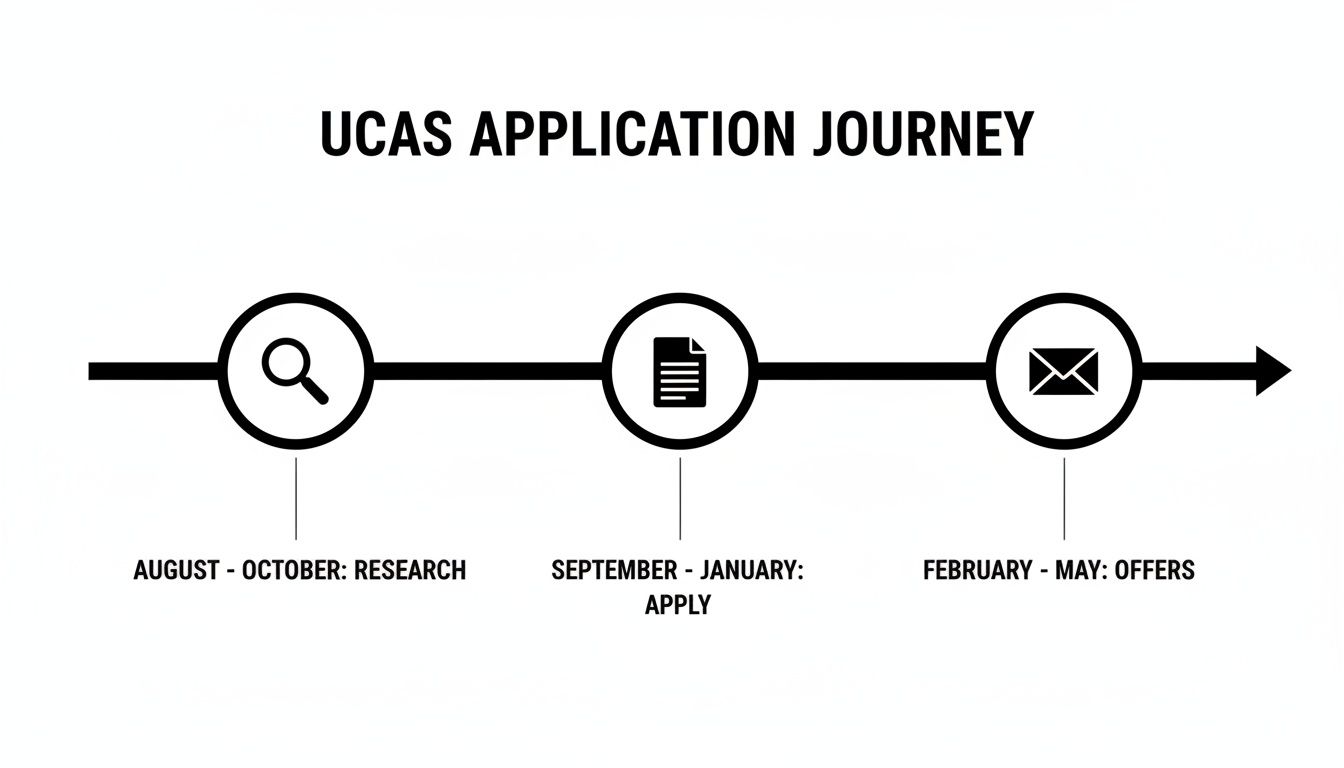
Seeing the stages laid out like this can make the whole thing feel much less overwhelming.
Making Choices That Are Both Strategic and Heartfelt
Beyond the dates, this is where the process becomes deeply personal: helping your child choose their five courses. This is a delicate balancing act between ambition, realism, and genuine passion. The aim is to build a list of five choices that feels both exciting and secure.
A great way to approach this is to map out the options in three distinct categories:
- The Aspirational Choice: This is the 'reach' university. It might ask for slightly higher grades than predicted, but it’s the one that makes their eyes light up.
- The Realistic Choices: These form the core of the application. They align perfectly with your child's predicted grades and academic interests.
- The Safe Choice: This is the safety net. It’s a course with entry requirements comfortably within their grasp, ensuring they have a firm offer no matter what.
Having these dates clearly marked in a calendar can massively reduce stress and help you and your child plan backwards, giving you plenty of time for each stage.
Let’s Look at an Example
Imagine a student named Chloe. She’s passionate about Psychology and is predicted AAB in her A-Levels. Her dream is to study at the University of Bristol, which typically asks for A*AA. This becomes her aspirational choice.
To create a balanced application, Chloe also applies to two universities like Exeter and Leeds, where the standard offer is AAB. These are her realistic choices. The courses align perfectly with her predicted grades, and she’s genuinely excited about the modules they offer.
Finally, for her safe choice, she picks a university like Royal Holloway, where the typical offer is ABB. She loves the campus and knows she'd be happy there. This balanced approach means Chloe can shoot for the stars while feeling secure, turning a potentially anxious process into an empowering one.
This conversation is about far more than just grades. It’s about asking your child, "Where do you see yourself being happy? What course modules make you genuinely excited to learn?" Their well-being and enthusiasm have to be at the heart of every decision.
Proper research goes way beyond league tables. Encourage your child to dig into course content, teaching styles, and what happens to graduates after they leave. It’s also incredibly useful to get to grips with the UCAS Tariff system and understand how different qualifications translate into points. Our guide on how UCAS points are defined can shed more light on this.
This deeper research ensures every choice is a great fit, not just on paper, but for them as a person.
Crafting a Personal Statement That Opens Doors

If the UCAS application is the skeleton, the personal statement is its heart. This is your child’s one and only chance—using just 4,000 characters—to speak directly to the admissions tutors who hold their future in their hands.
It’s the part of the application where they step out from behind their grades and become a real, three-dimensional person with passions, ambitions, and a unique story to tell.
The pressure to get this right can feel immense. Let's be honest, it’s a strange task, asking a teenager to summarise their entire being on a single page. But if you approach it the right way, this challenge becomes an incredible opportunity for them to find their voice and show a university exactly why they belong there.
This isn’t about just listing achievements; it’s about weaving them into a compelling narrative that sticks in the reader’s mind.
Finding the Story, Not Just the Facts
The biggest mistake students make is treating the personal statement like a slightly more detailed CV. They list their A-Levels, mention their part-time job, and state their interest in the subject. It’s factual, but it’s flat.
Admissions tutors read thousands of these every year. What they’re desperately searching for is a spark of genuine intellectual curiosity.
The goal is to move from "telling" to "showing." Instead of simply saying they're passionate, they need to demonstrate that passion through their experiences and reflections.
The most powerful personal statements are built on reflection. They connect the dots between a student's experiences—whether academic, extracurricular, or personal—and their chosen course, explaining not just what they did, but why it matters and what they learned.
Let's look at how to transform a simple statement into something memorable.
Turning Simple Statements into Compelling Narratives
Admissions tutors want to see evidence of engagement beyond the classroom syllabus. It’s about proving that their interest in the subject is a living, breathing part of who they are, not just something they do between 9 a.m. and 3 p.m.
Here's a classic example.
Before:
"I enjoy history and have read many books on the Tudor period. I think it is a very interesting part of British history, which is why I want to study it at university."
This is honest but uninspired. It tells the reader something, but it doesn't make them feel anything. Now, let’s see how we can bring it to life by adding a personal story and a touch of reflection.
After:
"Volunteering at my local museum's Tudor exhibit was a turning point. Cataloguing donated artefacts, I held a worn leather glove from the 16th century and was struck by how tangible history could be. It was no longer just a story in a book; it was a life lived. This experience drove me to explore primary sources beyond my A-Level curriculum, questioning how everyday objects can challenge the grand narratives we're often taught."
See the difference? The second version uses a specific, personal story to demonstrate interest rather than just stating it. It shows curiosity, initiative, and a deeper level of critical thinking—all qualities a top university history department is looking for.
Structuring a Statement for Maximum Impact
While there’s no rigid formula, a good personal statement generally flows through a few key stages. Thinking about it this way can help your child overcome the fear of a blank page and build their story piece by piece.
A strong structure often looks something like this:
- The Hook (Introduction): A compelling opening paragraph that grabs the reader’s attention and clearly states their passion for the subject. This must be personal and authentic—please, no famous quotes!
- Academic Exploration (The Body): This is the core of the statement. Here, they should discuss specific aspects of their A-Level subjects that fascinated them, linking them to the university course. They can mention books, lectures, or projects that took them beyond their schoolwork.
- Relevant Experience (The Bridge): This section connects their academic interests to real-world experiences. This could be anything from work experience or volunteering to personal projects, part-time jobs, or even travel. The key is to reflect on what they learned.
- The Future (Conclusion): A concise final paragraph that summarises their suitability and expresses genuine enthusiasm for studying the course at a higher level. It should leave the reader with a clear sense of their ambition and readiness for university life.
For more detailed guidance and examples, our complete guide on how to write a powerful UCAS personal statement can be an invaluable resource as your child begins drafting.
Overcoming the Emotional Hurdle
Writing about yourself is hard. For many students, it can feel arrogant or awkward, often leading to a nasty case of writer's block. One of the most important roles you can play is to be their cheerleader and help them recognise their own strengths.
Sit down with them and brainstorm. Don't focus on writing, just on talking. Ask them open-ended questions like:
- "What was the moment you realised you loved this subject?"
- "Tell me about a time you solved a really difficult problem."
- "What are you most proud of from the last two years?"
Sometimes, it takes an outside perspective to help them see how their experiences—even the ones that seem small—have shaped them. Your encouragement can give them the confidence to let their genuine personality shine through, which is exactly what admissions tutors want to see. This part of the UCAS application is a true exercise in self-awareness.
Completing the Application and Securing a Strong Reference

Now for the practical, hands-on part of the journey. After all the soul-searching that goes into the personal statement, methodically filling in the UCAS form can feel like a welcome relief. But while it's a straightforward process, accuracy here is absolutely critical.
Think of this stage as building the solid framework around the heart of the application—the personal statement. It's about meticulously entering personal details, confirming course choices, and, most importantly, accurately recording their qualifications. A tiny typo can cause significant delays down the line, so it’s worth taking the time to double-check every single entry with your child.
Detailing Qualifications with Precision
Entering qualifications can be surprisingly fiddly, especially with all the different exam boards and naming conventions out there. The key is to have all the paperwork to hand before you even start. You'll want the certificates for completed qualifications like GCSEs and a clear record of subjects and exam boards for pending ones, like their A-Levels.
For example, a student would need to:
- Enter their GCSEs: List each subject, the exact grade they received (e.g., 9, 8, 7), the year they were awarded, and the specific exam board (like AQA or Edexcel).
- Add their A-Levels: List each subject they are currently studying. For the grade, they will simply select 'Pending'. This is the information universities will cross-reference with their predicted grades.
Accuracy here is non-negotiable. Admissions teams use this section to verify that a candidate meets their minimum entry requirements, so even a small mistake can raise an unnecessary red flag.
Declaring Additional Needs with Confidence
The UCAS form includes a section where students can share information about any disabilities, learning differences, or mental health conditions. As a parent of a child with SEN or SEMH needs, this part can feel particularly sensitive, and it’s natural to worry about how this information might be perceived.
Let me be clear: this information is used for one reason only—to provide support. It is never used to make admissions decisions. By ticking that box and providing details, your child is opening the door to essential resources that will help them succeed at university. This could mean extra time in exams, specialist software, or access to mentoring.
Think of it as empowering your child from day one. Declaring a need isn't about highlighting a weakness; it’s about proactively securing the tools they are entitled to, ensuring they have an equal opportunity to thrive.
Securing a Strong and Personal Reference
The academic reference is the final piece of the puzzle, and it carries a lot of weight. This is an expert assessment of your child’s academic potential and suitability for university, written by someone who knows them well in an educational context—usually a head of sixth form, a trusted teacher, or a personal tutor.
A generic, lukewarm reference can seriously undermine an otherwise stellar application. The goal is to help the referee write something that is personal, detailed, and full of specific examples that back up the claims made in the personal statement. You can make this process much smoother for them.
Encourage your child to put together a clear, concise pack of information for their referee. This isn't about telling them what to write, but about giving them the ammunition they need to write a powerful endorsement.
What to Provide Your Referee:
- A final draft of their personal statement.
- A list of their five chosen universities and courses.
- A reminder of specific achievements they're proud of (e.g., "My Extended Project Qualification on the ethics of AI…").
- Brief details of relevant extracurricular activities or work experience.
- A polite note mentioning the internal school deadline for references.
This simple act of organisation makes the referee’s job much easier and directly contributes to a more compelling, supportive reference—adding a crucial layer of credibility to the whole application.
Understanding Offers, Clearing, and What Comes Next

Hitting ‘submit’ on the UCAS application is a huge moment. There’s a massive sense of relief, pride, and accomplishment for everyone involved. But after the initial celebration, a different feeling often starts to creep in: the quiet, anxious wait for decisions.
The journey now shifts from action to patience. Your child’s new best friend will be the UCAS Hub, where all the decisions from their chosen universities will eventually appear. This part of the process is all about managing expectations—celebrating the good news, navigating the disappointments, and reminding them that their worth isn’t defined by these outcomes.
It’s worth remembering that competition for university places is fierce, reflecting a growing number of young people aspiring to higher education. In a recent cycle, total applicants hit 665,070 by the June deadline, with universities making a record 2.0 million offers. Despite these big numbers, success rates are high, with 577,725 students ultimately being accepted. You can find more details in these UCAS application trends.
Decoding the Different Types of Offers
When those decisions finally start to land in the UCAS Hub, they’ll fall into one of three categories. Knowing what each one means is the key to helping your child plan their next move.
- Unconditional Offer: This is the best-case scenario. It means the university is offering a place with no academic strings attached. They’ve been accepted purely on the strength of their application as it stands.
- Conditional Offer: This is the most common outcome. A university is offering a place on the condition that your child achieves specific grades in their A-Levels or other qualifications (e.g., AAB or 120 UCAS points).
- Unsuccessful Application: This one always stings. It simply means the university has decided not to offer a place this time. It’s a moment for support and reassurance, not criticism. Remind them it’s not a reflection of their ability or potential.
Once all five decisions are in, it’s time for another big step: selecting a Firm Choice (their first preference) and an Insurance Choice (a backup, usually with lower grade requirements). This is a crucial decision, and it’s about more than just grades; it’s about choosing where they genuinely believe they will be happy and thrive.
Turning Disappointment into Opportunity with Clearing
Results Day in August is the climax of this entire journey. If your child meets the conditions of their firm offer, brilliant! It’s time to celebrate.
But what happens if they narrowly miss their grades? That initial drop in the stomach is completely normal, but it is absolutely not the end of the road. This is where UCAS Clearing comes into play.
Clearing is often misunderstood as a last-ditch scramble for leftover places. The reality is very different. It’s a dynamic and incredibly effective system that matches fantastic students with excellent universities that still have vacancies. Think of it as a second chance, not a second-best option.
Let's walk through a real-world scenario. Imagine a student, Liam, who was predicted AAB for his top choice but opens his results to find he’s achieved ABB. His firm choice falls through. After the initial shock wears off, he and his parents take a deep breath and log into the UCAS Hub.
They see his Clearing Number is now available, which is his ticket to the next step. They immediately start searching the Clearing listings for Psychology courses. He finds a course at a university he’d previously considered, with a typical entry requirement of ABB.
He calls their dedicated Clearing hotline, calmly explains his situation, and gives them his grades and UCAS ID. Within minutes, the person on the other end makes him a verbal offer. He then adds this choice in the UCAS Hub, and just like that, a moment of despair is transformed into a new, exciting opportunity.
The key to navigating Clearing is being prepared, staying calm, and acting decisively. By reframing it as a positive alternative path, you can help your child turn a difficult day into a story of resilience and success.
Guidance for International Students and Those with Additional Needs
The UCAS journey isn't a one-size-fits-all process. Every family comes to it with their own unique circumstances and questions. Whether you're navigating the application from overseas or making sure your child with additional needs gets the right support, the goal is always the same: helping them put their best foot forward.
This isn't about jumping through extra hoops. It's about knowing where to find the right information to make the path feel clear and manageable.
For families applying from abroad, the excitement of studying in the UK often comes with a few practical steps. Universities will want to see proof of English language skills, usually through a test like the IELTS. It’s also a good idea to get a head start on understanding the student visa process, as that has its own separate timeline.
The interest in UK universities from around the globe is stronger than ever. In a recent cycle, the number of international undergraduate applicants shot up by 5.1% to a record 124,830. This shows just how vibrant and welcoming the UK is for students from all corners of the world. You can dig deeper into these UCAS applicant trends to see the full picture.
Empowering Students with Additional Needs
If your child has Special Educational Needs (SEN) or Social, Emotional, and Mental Health (SEMH) needs, the UCAS application is a crucial chance for them to advocate for themselves. The 'disability and personal circumstances' section might seem a bit intimidating, but it's a powerful tool.
Sharing information about a condition like dyslexia, autism, or anxiety isn't about getting a label. It's about unlocking support. This information is kept confidential and is passed to the university's student support teams—not the admissions tutors—so they can arrange adjustments that create a level playing field.
Sharing a need is an act of empowerment. It tells the university, "This is who I am, and this is what I need to succeed." It’s the first step in ensuring your child doesn't just get into university, but truly thrives once they are there.
Think about a student with dyslexia. By ticking the box on their UCAS form, they were able to connect with the university's disability service months before the term even began. They sorted out extra time in exams, specialist text-to-speech software, and a study skills mentor. These small adjustments made a world of difference, allowing them to tackle their course with confidence. This is exactly what the system is for—removing barriers so every student can succeed.
Planning Ahead for a Smooth Transition
Once the application is in and the offers start rolling in, the practical planning can really get underway. For international students, this is a good time to look into essentials like health insurance for international students, which is a key part of preparing for life in the UK.
Likewise, students who have shared their additional needs can start applying for Disabled Students' Allowance (DSA). This government grant helps cover the costs of specialist equipment and non-medical support, making sure they have everything they need from day one. By keeping your child's well-being at the centre of the process, you can help them turn their UCAS application into a confident step towards a supportive and successful university experience.
Answering Your Top Questions About the UCAS Process
Stepping into the world of UCAS applications can feel like learning a whole new language, and it’s completely normal for questions to pop up along the way. That feeling of uncertainty is something countless parents and students have been through before. So, let's clear up some of the most common queries we hear, giving you that extra bit of confidence.
After all, putting your child at the centre of this journey means making sure they feel informed and empowered, not overwhelmed by the unknown.
Can My Child Apply to Both Oxford and Cambridge?
This is a classic question, and the answer is a simple no. Students can only apply to either Oxford or Cambridge in a single application cycle—not both. This has been a long-standing agreement between the two universities to keep the admissions process as fair as possible for everyone competing for these highly sought-after places.
What does this mean for your child? It means they’ll need to do some deep research. They should look into the specific colleges, the course structures, and the unique culture of each university to figure out which one is genuinely the right fit for them. It’s a big decision, but it helps to focus their application and personal statement tremendously.
What Happens if My Child Changes Their Mind?
It’s only natural for second thoughts to creep in when you’re making such a huge decision. If your child wants to swap one of their five choices within 14 days of hitting ‘send’, they can do this themselves quite easily through the UCAS Hub.
Once that 14-day window closes, things get a bit trickier. They would need to get in touch with the admissions teams at the universities directly to ask if a change is possible, but there are no guarantees. This really underlines just how important it is to be as sure as possible before submitting the application.
The UCAS application is a snapshot of your child's ambitions at a particular moment in time. While there's some flexibility, encouraging them to be confident in their choices helps avoid a lot of stress and administrative headaches down the line.
How Important Is Work Experience?
The real weight of work experience depends entirely on the course your child is applying for.
For vocational degrees like medicine, veterinary science, or teaching, it’s absolutely essential. Universities need to see solid proof that your child understands the realities of the profession they want to enter. For a medical applicant, for instance, volunteering in a care home isn't just a box-ticking exercise. It provides rich material for their personal statement, allowing them to reflect on a conversation with a resident, which demonstrates empathy and communication skills—qualities you simply can’t learn from a textbook.
For more academic subjects like history or maths, it’s less of a deal-breaker. However, that doesn't mean it’s not valuable. Any experience—from a part-time job to a personal project—can be used to showcase transferable skills like time management, teamwork, or analytical thinking. It’s all about how they connect it back to their chosen degree.
Can My Child Defer Their Entry for a Gap Year?
Yes, absolutely. This is called deferred entry, and it’s a very common path for students to take. The process is exactly the same: your child applies through UCAS on the same timeline as everyone else, but when they fill in their choices, they simply select the later year of entry.
Most universities are more than happy to make deferred offers. They often appreciate the maturity and life experience students bring back from a gap year. Still, it’s always a good idea to double-check the individual university's policy on their website, just to be certain. Taking that simple step ensures their dream university place is waiting for them after their year of adventure or work.