
Choosing to homeschool your child is a decision rooted in hope and a desire for a learning path that truly fits. The idea of a homeschool UK curriculum isn’t about trying to replicate a school classroom at your kitchen table; it’s about the freedom to design a personalised educational journey that celebrates your child’s unique spirit and potential.
Crafting Your Child's Homeschool Journey in the UK

Embarking on this path often brings a mix of excitement and uncertainty. You might be feeling the thrill of possibility alongside a touch of apprehension about where to even start. That’s completely normal. The most important thing to remember is that you are at the beginning of a creative and deeply rewarding process.
This isn't about finding a one-size-fits-all solution. It's about stepping away from rigid structures and building an education that honours your child as an individual. Imagine an education that can adapt to their passions, support their challenges, and move at their perfect pace.
Putting Your Child at the Centre
The foundation of any successful homeschool experience is placing your child's needs, well-being, and interests at its very core. A curriculum should be a tool that serves them, not a system they must serve.
For instance, if your child is a hands-on learner who struggles with sitting still, your "curriculum" might involve more museum visits, nature walks, and science experiments than workbooks. Imagine the joy on their face as they learn about physics by building a catapult in the garden instead of reading a dry textbook. If they are deeply passionate about ancient history, you have the flexibility to dive deep into that topic, connecting it to geography, art, and literature. This child-centred approach ensures learning is not just effective but also joyful.
"Building a 'homeschool UK curriculum' isn't about replicating school. It's about designing a personalized learning experience that honours your child's unique talents, curiosities, and emotional well-being."
This guide is designed to be your roadmap, helping you navigate every step with confidence. We will walk through everything from the legal freedoms you have as a home educator in the UK to the wonderful variety of curriculum options available. Our goal is to empower you, leaving you feeling prepared and inspired.
What This Guide Will Cover
We will explore the practicalities and the creative joys of home education, giving you the tools to build a thriving learning environment. You can expect to learn about:
- Legal Responsibilities: Understanding what the law requires and how to interact confidently with your local authority.
- Curriculum Options: Exploring diverse approaches, from structured online schools to flexible, child-led learning.
- Exam Pathways: A clear guide to navigating GCSEs and A-Levels as a home educator.
- Tailoring for Needs: How to create a supportive curriculum for children with SEN or SEMH needs.
This journey is about more than just academics; it’s about nurturing a lifelong love of learning in a supportive, loving environment. Let's begin.
Understanding the Legal Side of Home Education in the UK
Stepping into the world of home education can feel like a big leap, and it’s natural to worry about the legal side of things. But the reality is often far more straightforward and reassuring than most parents imagine. The UK's approach is built on a foundation of freedom, placing the trust and responsibility for a child's education squarely in your hands.
The law itself is surprisingly simple. Your core duty is to provide an efficient, full-time education that is suitable for your child’s age, ability, aptitude, and any special educational needs they might have. What’s most important is what the law doesn’t say: you are not required to follow the National Curriculum. This single, liberating fact opens up a universe of possibilities for a truly personalised learning journey.
So, What Does a ‘Suitable Education’ Actually Mean?
This is where many new home educators get stuck, but it’s all about focusing on your individual child. ‘Suitable’ has nothing to do with recreating a school classroom at your kitchen table or buying a specific set of textbooks. It’s about crafting a learning experience that meets your child where they are right now and genuinely helps them move forward.
Let's imagine a seven-year-old who is fascinated by the outdoors. A 'suitable' education for them might look like this:
- Learning maths by counting the rings on a fallen log or measuring how quickly their sunflowers grow.
- Building literacy skills by reading wildlife guides and keeping a detailed nature journal.
- Exploring science by building a bug hotel in the garden or learning to identify local bird calls.
This approach is 'efficient' because it’s deeply engaging and effective for that specific child. And it’s 'full-time' because learning is happening consistently, even if it doesn’t fit into a neat 9-to-3 schedule. The goal is progress and connection, not just ticking boxes on a checklist.
A suitable education is one that prepares your child for life within their community, but it doesn't have to look like school. The law respects that parents are best placed to make decisions for their children.
Interacting With Your Local Authority
If your child is currently in a state school in England and Wales, the process begins by sending a formal deregistration letter to the headteacher. Once the school acknowledges this and takes your child off the roll, the legal responsibility for their education officially passes to you. For a step-by-step walkthrough, our guide on how to do homeschooling offers clear, practical advice.
After you've deregistered, your Local Authority (LA) may get in touch to make informal enquiries, typically once a year, just to check that a suitable education is being provided. It's important to know that you are not legally obligated to agree to home visits or hand over detailed lesson plans. Many families find the best approach is to provide a short report, a portfolio of work samples, or even a brief statement explaining their educational philosophy.
The aim is simply to show that you understand your child’s needs and are actively meeting them. For a child with dyslexia, you might show how you’re using audiobooks and mind-mapping software. For a gifted young mathematician, you could mention the advanced online courses they’re taking. You’re not trying to prove you’re a perfect teacher—just that a wonderful, legally sound education is happening, one that is uniquely right for your child.
Exploring Different Homeschool Curriculum Approaches
Once you’ve grasped the legal freedom you have, the real adventure begins. Choosing a homeschool uk curriculum isn’t about just picking a set of textbooks; it’s about finding a philosophy of learning that truly connects with your child. This is your opportunity to step away from the one-size-fits-all classroom model and build something genuinely bespoke.
Forget the notion that there's a single "right" way to homeschool. Instead, start by thinking about your child. Is she a meticulous planner who thrives on structure and clear goals? Or is he a curious explorer who comes alive when chasing a fascination down a rabbit hole? The beauty of home education is that you can honour either path—or anything in between.
The reasons families choose this journey are deeply personal. Recent findings show that 32% of British parents are either considering or would strongly consider homeschooling, often driven by concerns over bullying, mental health, and the lack of individual attention in mainstream schools. You can explore the full findings of the parental motivation survey for more context. This desire for a safer, more nurturing environment is the perfect foundation for choosing an approach that puts your child’s well-being first.
The Structured Path: Curriculum-in-a-Box and Online Schools
For families who value clarity and a well-defined route, a structured approach can feel like a comforting handrail in unfamiliar territory. These options are often called "curriculum-in-a-box" or are delivered through comprehensive online schools. They provide everything you need—lesson plans, materials, and assessments—all organised and ready to go.
Picture a child who feels anxious without a predictable routine. For them, logging into a live lesson at the same time each day provides a calming rhythm. Knowing exactly what’s expected in maths, English, and science can build their confidence and reduce that feeling of being overwhelmed, allowing them to focus entirely on learning. This path offers a clear framework, which can be especially helpful when you’re just starting out or preparing for formal exams like GCSEs.
The Flexible Path: Child-Led and Eclectic Learning
At the other end of the spectrum is a world of freedom and flexibility, where your child's innate curiosity effectively becomes the curriculum. Two popular philosophies here are Unschooling and Eclectic Homeschooling. Unschooling is a profound, trust-based approach where learning happens organically from real-life experiences, driven entirely by what fascinates your child.
Eclectic homeschooling, on the other hand, is more of a creative blend where you pick and choose resources from various approaches to suit your needs. For instance, your child might become completely captivated by marine biology. This single passion could become the centre of your learning for months.
- Science: You'd visit aquariums, maybe even dissect a squid, and study ocean ecosystems.
- Maths: This could involve calculating tank volumes, charting whale migration patterns, or budgeting for a trip to the coast.
- Art: Sketching sea creatures, creating clay models, and studying famous maritime paintings.
- English: You might read classics like Moby Dick or encourage them to write their own stories about deep-sea adventures.
This method weaves learning into the very fabric of life, showing your child that education isn’t a separate activity but a natural way of engaging with the world around them.
Finding a Happy Medium: Thematic Learning
Many families find their sweet spot somewhere in the middle with a semi-structured approach like thematic or project-based learning. This method provides a gentle framework while leaving plenty of room for deep exploration. You might choose a broad theme for a term, such as "Ancient Rome" or "The Rainforest."
Imagine your child is learning about Ancient Rome. You could build a model aqueduct in the garden (engineering), cook a Roman-style feast (history and home economics), and write a play about Julius Caesar (drama and literacy). This approach allows you to cover core subjects in an interconnected and meaningful way, which is often how our brains naturally make sense of the world. It provides direction without sacrificing the magic of discovery.
To help you visualise how these philosophies might look in practice, this table compares some of the most common approaches.
Comparing Homeschool Curriculum Approaches
| Approach | Best For a Child Who… | Parental Involvement | Example Resources |
|---|---|---|---|
| Structured (Online School) | Thrives on routine, needs clear expectations, and is preparing for exams. | High initially (support), then medium as the child adapts. | King's InterHigh, Wolsey Hall Oxford |
| Curriculum-in-a-Box | Benefits from a clear, sequential path but needs flexibility in pacing. | High. Parent acts as the primary teacher, following the provided plan. | Oak Meadow, Sonlight, Calvert Education |
| Thematic/Project-Based | Is curious and enjoys seeing how different subjects connect. | Medium to High. Parent facilitates by finding resources related to the theme. | Twinkl topic webs, library books, documentaries, field trips. |
| Eclectic | Has diverse interests and learns best from a variety of sources and methods. | High. Requires significant research and planning to pull together resources. | A mix of workbooks, online courses, real-world projects, and reading lists. |
| Unschooling | Is highly self-motivated, driven by their own questions and interests. | Low in direct instruction, but high in facilitation and providing a rich environment. | Life itself: museums, conversations, travel, libraries, the internet. |
Ultimately, there is no single "best" method. The goal is to find the rhythm that works for your family and, most importantly, ignites your child's love for learning.
The flowchart below illustrates the core legal factors—age, ability, and aptitude—that must guide your choice to ensure you're providing a suitable education.
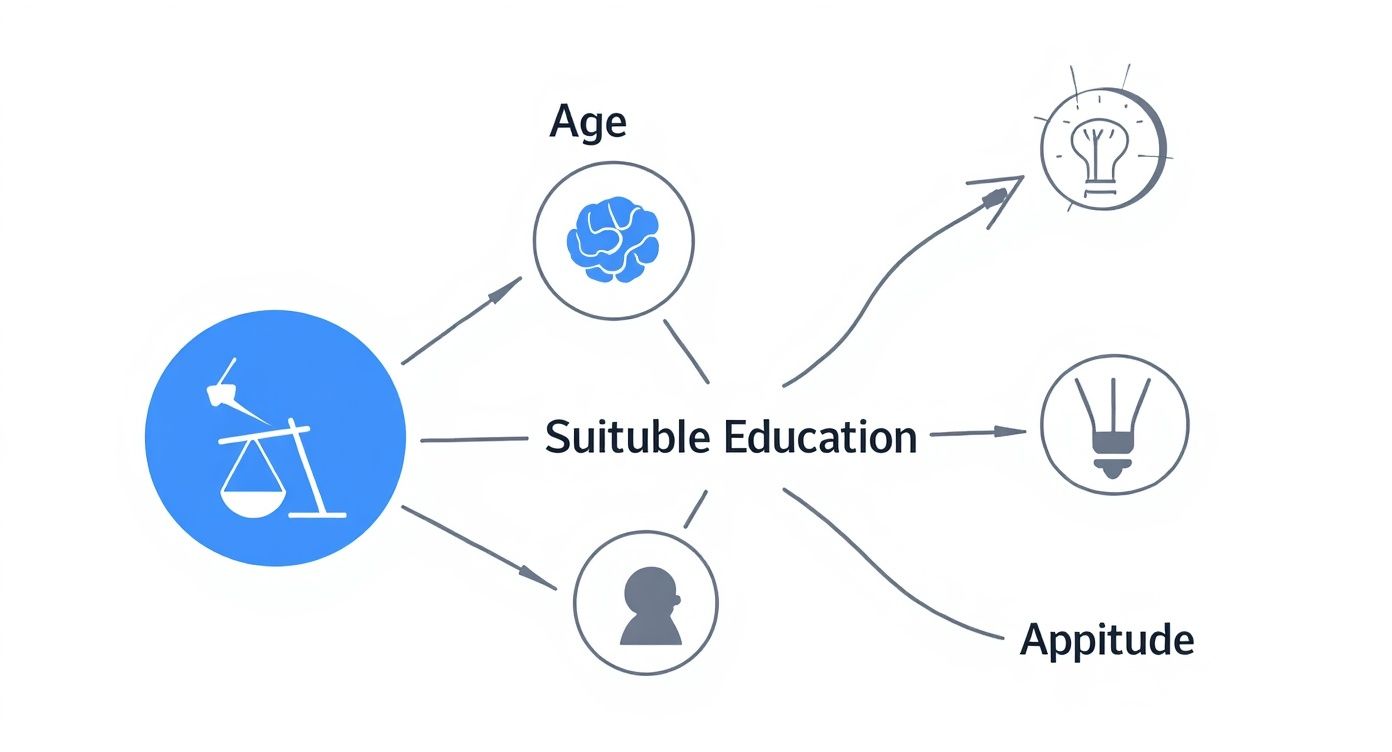
This reminds us that whatever approach you choose, it must be fundamentally tailored to your child’s developmental stage and natural talents. In the end, the best homeschool uk curriculum isn’t one you buy off a shelf, but one you build—a living, breathing educational experience crafted with love, intention, and a deep understanding of the unique child at its centre.
Navigating GCSEs and A-Levels as a Home Educator
For many home-educating families, the moment the letters "GCSE" or "A-Level" enter the conversation, a wave of anxiety can set in. It’s a completely understandable feeling. These qualifications often feel like the high-stakes final chapter of formal education, and the thought of managing them outside the school system can seem intimidating.
But let's pause and reframe this. This isn’t a barrier; it’s an opportunity to approach qualifications in a way that truly serves your child’s strengths and passions. Home education doesn't close doors to university or dream careers. In fact, it can open them wider by allowing for a deeper, more focused, and less stressful way to prepare.
The key is understanding that your child will sit their exams as a private candidate. This simply means you are responsible for organising their exam entry, a process that is far more straightforward than it sounds. You have the freedom to choose subjects they genuinely love, study them at a pace that works, and sidestep the classroom pressures that can stifle genuine learning.
Finding an Exam Centre and Choosing a Syllabus
The first practical step is finding an exam centre that accepts private candidates. These are often schools or dedicated exam centres around the UK that accommodate home-educated students. It's a good idea to start this search early, ideally a full year before the exams are due to take place.
Once you've found a potential centre, you need to choose an exam board and syllabus. The main players in the UK are AQA, Pearson Edexcel, OCR, and WJEC. It's crucial to confirm which boards your chosen centre works with, as this will determine which subject specifications are available to your child.
For example, imagine your child has a deep passion for history. You could explore the different GCSE History syllabuses offered by AQA and Edexcel. One might focus on modern world history, while another explores medieval castles. You get to choose the one that most ignites your child's curiosity, making the entire learning process more engaging and meaningful.
Crafting a Personalised Study Plan
This is where the true beauty of a homeschool UK curriculum for exams really shines. You are not bound by a school timetable. If your child is a gifted writer who finds maths a bit of a slog, you can dedicate more time to algebra while letting their English literature studies flow more independently.
This flexibility is a significant factor in academic outcomes. The performance of homeschooled students in the UK is a topic of growing interest, with studies indicating that they often achieve strong results in key qualifications like GCSEs and A-Levels. Research suggests the freedom of a homeschool curriculum lets children spend more time on subjects they excel in and learn at their own pace, free from the constraints of a traditional classroom.
Choosing to study for exams at home allows a young person to move away from the 'teach to the test' culture. Instead, they can cultivate a genuine, lasting understanding of their subjects, which is the best possible preparation for both the exam and for life beyond it.
Finding the Right Support
You are not alone on this journey. Deciding on the right level of support is a personal choice based on your child's needs and your own confidence in a subject.
Here are a few common ways families structure their support:
- Parent-led Study: For subjects where you feel confident, you can lead the learning yourself using textbooks, online resources, and past papers.
- Private Tutors: For more challenging subjects, a one-to-one tutor can provide targeted help, fill knowledge gaps, and build your child’s confidence.
- Accredited Online Providers: For a more structured approach, online schools offer complete courses with live lessons, expert teachers, and a clear path to exam entry. This can be particularly helpful for complex A-Level subjects.
Many families find success with a hybrid model, perhaps using an online provider for sciences while studying humanities with a parent-led approach. For a detailed look at how to structure this period of study, check out our guide on home education and GCSEs. The goal is to build a support system that empowers your child, reduces stress, and allows their natural talents to flourish, proving that formal qualifications can be a positive and rewarding part of the home education journey.
Creating a Supportive Curriculum for SEN Children
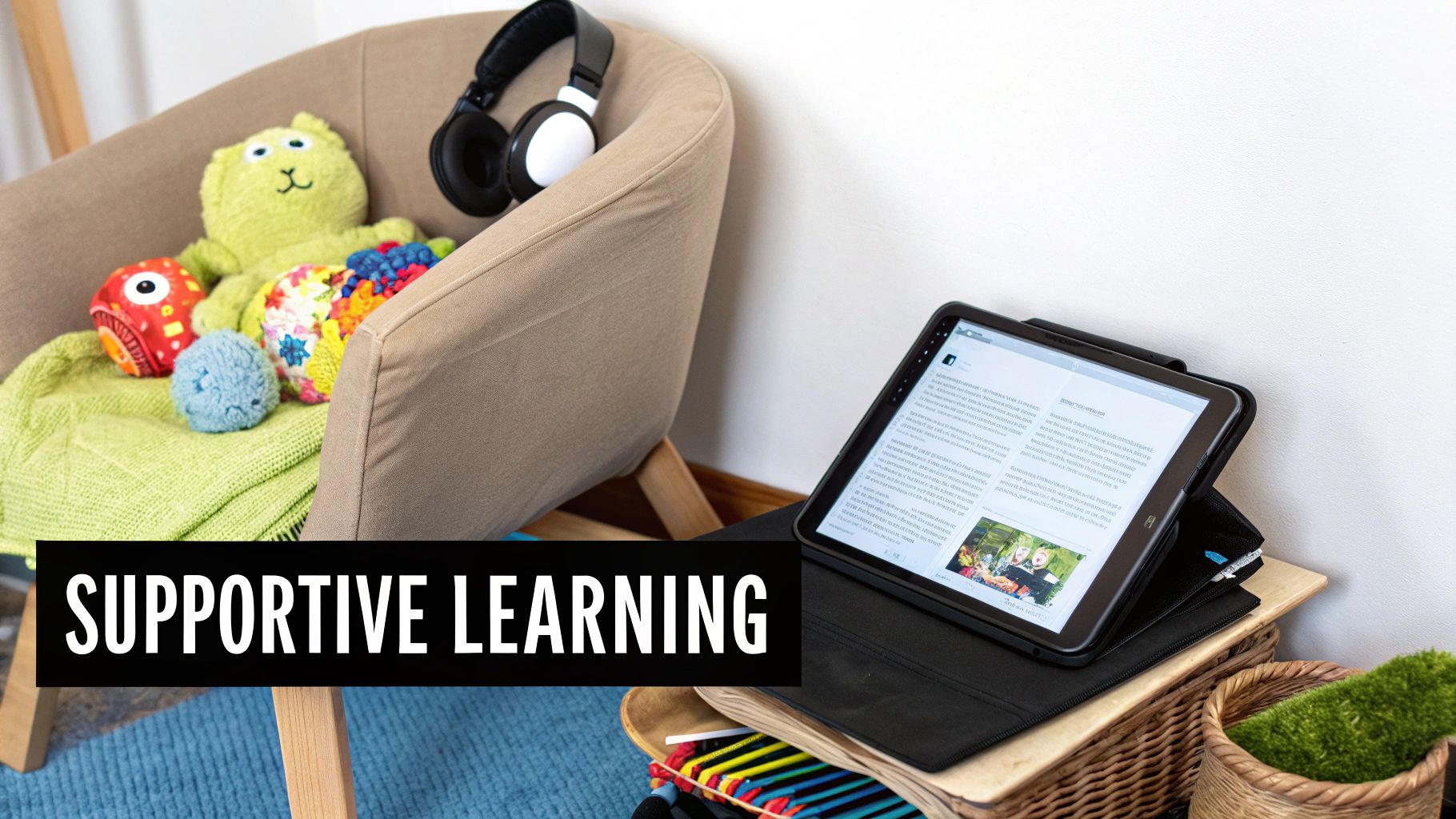
For parents of children with Special Educational Needs (SEN) or Social, Emotional, and Mental Health (SEMH) challenges, the decision to homeschool is often a profound act of love. It’s a brave step away from a system that struggled to see their child’s unique brilliance, and towards a sanctuary where they can finally feel safe, understood, and ready to learn.
This journey is about rebuilding. It’s about swapping the noise and pressure of a busy classroom for an environment of acceptance and calm. A personalised homeschool UK curriculum can be the very tool that helps you do this, giving you a chance to reignite a love of learning that might have dimmed.
Placing Emotional Well-being First
Before a single maths problem is solved or a history date is memorised, a child has to feel secure. For any child, but especially one with SEMH needs, this is the absolute foundation of their education. At home, you have the power to design a rhythm that puts their emotional state first, always.
This might mean starting the day with a calming activity—listening to a story or doing gentle stretches—instead of jumping straight into academics. For an anxious learner, having a 'low-demand' day focused on their interests, like building with LEGO or watching a documentary, can be the most productive thing you do. It recharges their emotional batteries, making them far more receptive to structured learning later.
As you build this supportive curriculum, it helps to know what external support is out there. You can access many essential SEN resources that offer practical tools and guidance for the journey.
Practical Strategies for Different Needs
Adapting your curriculum isn’t about huge, complicated overhauls. It’s about making small, intentional changes that have a massive impact. It’s about watching your child closely, understanding their specific hurdles, and creatively finding ways around them. You can learn more about the different layers of support in our guide explaining what SEN support is and how it can be put into practice.
Here are a few real-world examples of how you can tailor learning:
- For a child with Dyslexia: Use dyslexia-friendly fonts like Comic Sans or Dyslexie in all written materials. Embrace audiobooks for literature and try mind-mapping software for planning essays to take the pressure off writing.
- For a child with ADHD: Weave movement into everything. A wobble cushion can help with focus during quiet work, you could solve maths problems by jumping between numbers on the floor, and plan frequent 'brain breaks' for a quick run around the garden.
- For a child with Autism: A predictable visual timetable for the day can work wonders for reducing anxiety. Use sensory tools like weighted blankets or fidget toys to aid concentration, and always provide clear, literal instructions for tasks.
These aren't just accommodations; they're powerful messages to your child that their needs matter and that you will always find a way to help them succeed.
"Homeschooling a child with SEN isn't about becoming a specialist therapist. It's about becoming an expert in your own child, trusting your instincts, and creating a space where their confidence can finally blossom."
By removing the constant pressure to keep up with thirty other children, you give your child the invaluable gift of time. Time to process, time to explore, and time to learn at a pace that truly works for them. This patient, empathetic approach is often the key that unlocks their true potential, reminding them—and you—of just how capable they have always been.
Bringing Your Homeschool Curriculum to Life
You’ve waded through the legalities, picked an approach, and even have exams on your radar. Now for the best bit: turning those plans into a living, breathing reality. This is where your chosen homeschool UK curriculum comes off the page and becomes the rhythm of your family’s life.
The secret is to think in terms of a flexible ‘rhythm’ rather than a rigid ‘schedule’. A school needs a strict timetable to manage hundreds of children; your family doesn’t. Embracing this freedom is one of the greatest joys of homeschooling.
A rhythm gives you permission to be spontaneous—like ditching a maths lesson that just isn’t landing to spend a sunny afternoon in the garden instead. It respects your child’s energy and emotions, which is the real key to making learning stick.
Finding Your Unique Family Rhythm
Figuring this out is a personal process of trial and error. What works beautifully for one family might feel utterly chaotic to another. The goal is to build a predictable flow that feels comforting without being restrictive.
For example, a gentle daily rhythm might look something like this:
- Morning: Time for focused academic work like maths and English, when minds are often sharpest.
- Midday: A proper break for lunch, outdoor play, and helping with chores to reset and recharge.
- Afternoon: Space for creative projects, hands-on science, reading, or trips to local museums and libraries.
This kind of structure acts as a gentle guide, but it leaves plenty of room to follow a child’s sudden curiosity about a historical documentary or a desire to bake biscuits (which is a brilliant, hands-on lesson in measurement, by the way).
Nurturing a Vibrant Social Life
One of the most persistent myths about homeschooling is the idea of isolation. In reality, the home education community is incredibly well-connected and supportive. Busting this myth is simply a case of knowing where to look.
You’ll find thriving communities in all sorts of places:
- Local Co-ops: Groups of homeschooling families who meet regularly for shared lessons, social events, or group projects.
- Forest Schools: Hugely popular with home educators, these outdoor education programmes give children a fantastic chance to learn and play together in nature.
- Online Groups: Facebook and other platforms host countless UK home education groups, both regional and national. They’re perfect for asking questions and arranging meet-ups.
This sense of community is getting stronger every year. Homeschooling in the UK has seen a dramatic rise recently; in autumn 2024, local authorities reported 111,700 children in elective home education (EHE). That’s an increase of about 21.4% from the previous year, highlighting just how much parental attitudes are shifting.
Remember, it is perfectly okay to have an 'off' day. Some days, the best thing you can do for your child’s education is to put the books away, cuddle up on the sofa, and read a story together. That connection is the curriculum too.
Expanding Your Toolkit of Resources
Bringing your curriculum to life also means gathering a rich collection of tools and resources to support your teaching. Your home is a base, not a boundary—libraries, museums, parks, and even the local supermarket are all extensions of your learning environment.
To enhance the experience and deliver your chosen curriculum well, you might also want to explore the digital platforms and learning aids available. It’s worth investigating the best tools for distance learning to see what could support your child's education.
Ultimately, this journey is about building a sustainable and happy educational life for your entire family, one day at a time.
Common Questions About Homeschooling in the UK
Taking the leap into homeschooling is an exciting decision, but it naturally comes with a flurry of questions. It's a path driven by a deep commitment to your child, so it's completely normal to want clarity and confidence as you get started. Here are a few straightforward answers to the questions we hear most often from parents.
Do I Need to Be a Qualified Teacher?
Absolutely not. You don’t need any formal teaching qualifications to home-educate your child in the UK. What the law actually asks for is a "suitable" education, and frankly, your most powerful qualification is knowing your child inside and out—their curiosities, their struggles, and what makes them light up.
Think of yourself less as a formal teacher standing at a whiteboard and more as a facilitator of learning. For instance, if fractions aren't clicking, your role isn't to deliver a dry lecture. It’s about finding what works for them—maybe that means baking a pizza together and slicing it up, making an abstract concept real, tangible, and (best of all) delicious.
Will My Child Miss Out on Socialisation?
This is probably the number one worry for new homeschooling parents, but the idea of the isolated, lonely homeschooled child is a complete myth. Real socialisation isn't about being stuck in a room with thirty other kids of the exact same age; it's about learning how to connect and communicate with a wide variety of people in real-world situations.
The UK's homeschooling community is incredibly active and connected. A typical week could easily include:
- Collaborating on a science project with a local homeschool group.
- A day out at a museum with a few friends.
- Joining community sports teams, drama clubs, or music lessons.
These kinds of activities offer rich, diverse social experiences that build genuine confidence—often far more effectively than a noisy, overwhelming playground. Your child learns to chat, cooperate, and build relationships in authentic settings.
What if My Child Wants to Go to University?
Homeschooling doesn't shut the door to higher education—in fact, it can open it wider. By following their passions, homeschooled students often develop a much deeper and more authentic love for their subjects. To get to university, you'll guide your child to sit their GCSEs and A-Levels as a private candidate.
This simply means finding an exam centre that accepts private candidates and choosing the exam boards and syllabuses that best align with your child's goals. Many universities actually look very favourably on homeschooled applicants. They see candidates who are self-disciplined, genuinely curious, and driven by a real passion for learning—all brilliant indicators of success at degree level.
At Queens Online School, we know every child’s path is different. We offer a complete online British curriculum from Primary all the way to A-Levels, giving you the structure of live, interactive lessons with the flexibility your family needs. Our subject-specialist teachers and small classes ensure every child, including those with SEN, gets the personal support they need to flourish. Find your supportive, accredited, and engaging learning community at https://queensonlineschool.com.