

Imagine a home education curriculum not as a rigid school timetable, but as a personalised learning adventure, lovingly crafted around your child’s unique spark, their boundless curiosity, and their deepest passions. It’s the heartwarming shift from a one-size-fits-all model to a flexible, meaningful path that grows and adapts right alongside them, honouring who they are at every step.
Understanding Your Home Education Curriculum
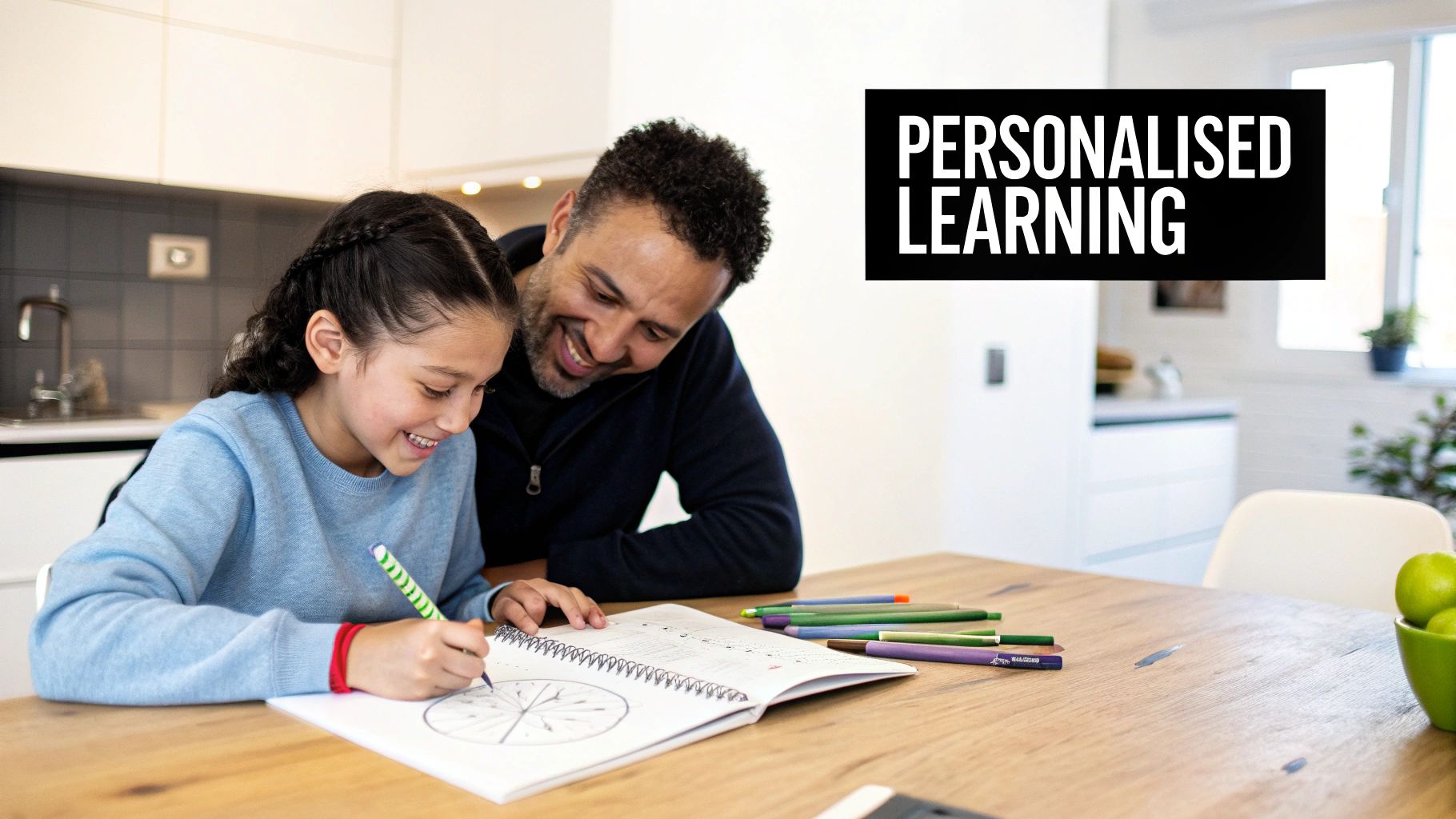
A truly great home education curriculum places your child at the very heart of every lesson. It’s like planning the family holiday of their dreams: instead of dragging them through a stressful, jam-packed itinerary of things you think they should see, you build the entire trip around the places that make their eyes light up with wonder.
It all starts with their natural interests. Does your child’s heart beat faster for dinosaurs, coding, or baking? A home education curriculum takes that spark and builds a world of learning around it, transforming education from a chore into an exciting expedition they can’t wait to embark on each day.
This child-centred philosophy is a key reason why so many families are choosing home education. By autumn 2024, an estimated 111,700 children were in Elective Home Education (EHE)—that’s a 21.4% jump from 92,000. For many parents, this decision comes from a deep-seated concern that their child was getting lost in a mainstream system where 955,000 suspensions and 10,900 permanent exclusions led to 1.8 million lost school days. You can explore these findings in more detail in this report from Genuine Futures.
Key Benefits to Consider
- Embrace Flexibility: Imagine a day that flows with your child’s energy. If they're engrossed in a project, you can let them run with it, free from the tyranny of the bell.
- Foster Deep Engagement: When learning is built around what they love, you don't have to push them to learn—you'll be running to keep up with their curiosity.
- Offer Inclusive Support: For a child with SEN or SEMH, home is a sanctuary. It’s a space where they receive the patient, one-on-one attention they need to not just cope, but truly thrive.
- Create Safe Spaces: It provides a haven of emotional and physical safety, a world away from the anxieties and exclusion risks that can overshadow school life.
Building a curriculum that truly sings to your child's soul means focusing on a few core pillars. These elements ensure their learning journey is balanced, joyful, and supportive of their entire wellbeing.
Core Pillars of a Child-Centred Curriculum
| Pillar | Description | Why It Matters for Your Child |
|---|---|---|
| Personal Interests | Lessons are shaped around their passions, from space to storytelling. | It tells them, "What you love matters." This validation fuels a natural, powerful motivation to learn. |
| Flexible Pacing | They can linger on tricky concepts without shame or speed ahead when inspiration strikes. | This eliminates the anxiety of falling behind and the boredom of being held back, building true confidence. |
| Multi-Sensory Learning | Learning happens through doing, creating, and experiencing—not just reading a book. | Think messy science experiments and historical costume-making. It makes learning stick in their memory and their heart. |
| Real-World Projects | Tasks connect to their life, like budgeting for a pet or planning a family trip. | It answers the "Why do I need to know this?" question by showing them how learning makes their world bigger and better. |
| Wellbeing and Routine | The day is a gentle rhythm of focused learning, creative breaks, and quiet downtime. | It protects their mental and emotional health, preventing the burnout that can extinguish the brightest sparks. |
By weaving these pillars into your planning, you create a holistic educational experience that nurtures the whole child—their mind, their heart, and their spirit.
Why a Child-Centred Approach Works
When you follow a child's curiosity, you're tapping into their natural, unstoppable drive to learn. This leads to a much deeper understanding and knowledge that becomes a part of who they are.
Getting started is simpler than you might imagine. Begin by sitting down with your child and brainstorming all the things they love. Then, together, you can sketch out a loose weekly plan that balances focused work with creative projects and plenty of room for life to happen.
A Real-Life Example
Take nine-year-old Leo, who was struggling with writing but adored Minecraft. Instead of forcing him to write essays, his home education curriculum met him in his world. He started a blog where he wrote detailed tutorials on his Minecraft creations. He learned about sentence structure, persuasive language, and editing—all because he was writing for a real audience about something he was passionate about.
This single project seamlessly blended literacy, digital skills, and creative design. Far more than just a writing exercise, it transformed his relationship with words and gave his confidence a massive boost.
Next Steps to Begin Your Curriculum
- Map a theme to subjects. Pick an interest—like baking—and brainstorm with your child. How is it maths (measuring)? Science (chemical reactions)? History (where does flour come from)?
- Use simple journals. A beautiful notebook can feel like a special invitation to document their adventures, whether it's sketching plants on a nature walk or inventing a superhero.
- Celebrate the effort, not just the outcome. Acknowledge their perseverance on a tricky maths problem or their creativity in a drawing. This builds resilience and keeps learning joyful.
Remember, your curriculum is a living, breathing thing. Revisit and adjust it with your child often. It’s a partnership. With a little time and a lot of heart, you'll co-create a learning journey that is not only effective but also a perfect reflection of your child’s amazing world.
Understanding Home Education Laws in the UK
The legal side of home education can feel like a daunting maze, but the reality for families in the UK is actually wonderfully straightforward and empowering. At its heart, the law trusts you to provide a suitable education, giving you incredible freedom in how you choose to do that.
Your main legal duty is to ensure your child receives an education that is efficient, full-time, and suitable for their age, ability, and aptitude, including any special educational needs they may have. This does not mean you have to recreate a school classroom at your kitchen table. The law is intentionally flexible, designed to put your child’s unique needs first.
Taking the First Step: Deregistering from School
If your child is currently in a mainstream school in England or Wales, the journey begins with a formal letter of deregistration. Sending this letter to the headteacher is a profound, emotional step. It’s a declaration that you are taking your child’s education into your own hands. This is a legal notification, not a request for permission. Once the school receives it, your child’s name is removed from the register, and your home education adventure officially begins.
For a smooth transition, your letter should be clear and confident. Simply state that you are withdrawing your child to begin elective home education from a specific date. You are not required to justify your reasons or present your curriculum. You can find excellent guidance and letter templates on how to homeschool in the UK to help you take this important step with peace of mind.
What Does a ‘Suitable Education’ Actually Mean?
The word ‘suitable’ can cause a flutter of anxiety, but it’s best seen as an invitation to showcase what is uniquely right for your child. Your Local Authority (LA) may make informal enquiries, but this is usually just a supportive check-in. They simply want to be reassured that a positive and appropriate learning experience is happening.
The law values a child-centred approach. A ‘suitable’ education is one that nurtures your child's potential and prepares them for a happy, fulfilled life in their community. It’s about their wellbeing as much as their academics.
You can demonstrate this in countless ways, proving how a personalised home education curriculum beautifully meets the legal standard.
- Example 1: The Nature-Based Learner: Imagine a child who wilts indoors but comes alive outside. Their family's evidence of a 'suitable education' could be a scrapbook filled with pressed flowers (biology), drawings of local landmarks (geography and art), and a log of weather patterns (science). It’s learning that breathes.
- Example 2: The Structured Online Schooler: For a child who thrives with clear goals and expert teaching, a family might use an accredited provider like Queen’s Online School. Their proof is ready-made: a timetable of engaging live lessons, examples of completed assignments, and encouraging progress reports from qualified teachers.
Both approaches are completely valid because they are centred on the child’s needs and provide a rich learning environment. Your role isn't to be a formal teacher, but a facilitator of your child's education. The key is to be ready to share the story of your child's learning if asked, showing the wonderful and effective education taking place in your home.
Designing Your Curriculum by Key Stage
Translating your big, beautiful vision into the day-to-day reality of your child's education is where the magic really happens. This is the heart of crafting a successful home education curriculum. After all, the world of a curious seven-year-old is galaxies away from that of a seventeen-year-old wrestling with A-Levels.
This is your roadmap for mapping out a curriculum that grows with your child, from the foundational years of Key Stage 2 right through to the critical exam stages.
Putting your child at the centre of this process is what turns learning from a checklist into a genuine adventure. Imagine a Key Stage 2 history lesson that ends with building a functional (miniature!) Roman catapult in the garden. Or a Key Stage 3 science experiment that uncovers chemical reactions while baking a favourite cake. This is where a personalised curriculum truly comes alive, making abstract ideas tangible and unforgettable.
Curriculum Focus by Key Stage
To bring this to life, let’s look at how the focus of learning shifts and deepens as your child progresses. Each stage builds on the last, moving from concrete, hands-on discovery to more abstract, analytical thinking.
| Key Stage | Age Range | Primary Focus | Example Learning Activities |
|---|---|---|---|
| KS2 | 7-11 | Building core skills through playful, hands-on exploration. Nurturing a genuine love of learning that will last a lifetime. | Using baking to learn fractions, writing a play and performing it for the family, caring for a pet to learn biology. |
| KS3 | 11-14 | Deepening subject knowledge, sparking critical thinking, and nurturing their growing independence. | Visiting a museum to kickstart a history project, designing a simple website, conducting science experiments based on their own questions. |
| KS4 | 14-16 | Preparing for GCSEs with a structured yet supportive curriculum that aligns with their goals and passions. | Writing timed essays on topics they care about, completing past papers, doing fieldwork for Geography, developing a business plan for an idea they love. |
| A-Level | 16-18 | Mastering advanced subjects, developing scholarly research skills, and preparing them for the next exciting chapter of their life. | Writing an Extended Project Qualification (EPQ) on a passion topic, conducting complex lab experiments, debating advanced ethical questions. |
This table provides a bird's-eye view, but the true beauty of home education is the freedom to tailor these activities to your child's unique spirit at every stage.
Laying the Foundations in Key Stage 2 (Ages 7-11)
During Key Stage 2, the goal is to build strong skills while protecting and nurturing your child’s innate love for learning. This is a time for wonder and discovery. Your curriculum should feel like an exciting game, driven by their endless questions.
Your role is to make learning tangible. For English, this could mean creating a family newspaper about your week's adventures. For maths, perhaps you could plan a fantasy trip, budgeting for flights and hotels. It’s about showing them that skills are tools for exploring the world.
- Core Subjects: English, Maths, and Science are the pillars, but they don't live in separate boxes.
- Creative Integration: Weave subjects together. A project on Ancient Egypt can involve history, geography (the Nile), art (hieroglyphics), and even maths (pyramid geometry).
- Child-Led Exploration: If they suddenly become fascinated by volcanoes, lean into it! This is a gift. Watch documentaries, build a model volcano, and let their passion guide the learning.
Broadening Horizons in Key Stage 3 (Ages 11-14)
As children enter Key Stage 3, they are ready to think more deeply and tackle more complex ideas. This is the perfect time to introduce more structure while holding onto the flexibility that makes home education so powerful for their confidence and self-esteem.
The curriculum should now encourage them to ask bigger questions and seek answers independently. For example, a science project on ecosystems could start with a question they have about your local park, leading to research, observation, and a final presentation of their findings. It’s about empowering them to become active learners, not passive recipients of information.
If you're just beginning to think about how to structure your approach, this fantastic guide on how to create a curriculum from scratch has some brilliant insights for all Key Stages.
This diagram is a great way to visualise the relationship between UK education law, the local authorities, and your family's central role in directing your child's education.
It makes it clear that while the law provides the framework and the Local Authority offers oversight, it's the family that forms the foundation, responsible for delivering a suitable education.
Navigating Qualifications: Key Stage 4 and A-Levels (Ages 14-18)
For many families, the journey towards GCSEs and A-Levels can feel intimidating. This is where a more structured curriculum often becomes essential, especially if your child has dreams of university or a specific career. The curriculum has to align with exam board specifications to ensure all the required content is covered.
This is also the stage where the benefits of a blended approach or full online schooling really shine. An accredited provider like Queen’s Online School delivers the full British curriculum through live lessons with subject-specialist teachers, offering a seamless and supportive route to qualifications. This brings the academic rigour needed for exams while preserving the personalised pace that helps students truly excel, free from classroom pressure. Diving into a detailed homeschooling syllabus in the UK can provide a clear framework for these crucial years.
The demand for this kind of robust support is growing fast. By autumn 2024, an estimated 111,700 children were in elective home education—a huge 21% jump from the previous year. And the results speak for themselves. Home-educated students often achieve top grades and score 15-25% higher on standardised tests, a testament to the power of personalised learning.
A successful curriculum for older students balances exam preparation with their personal interests. It’s about ensuring they have the qualifications they need without losing the passion for learning you’ve worked so hard to cultivate.
For instance, a student passionate about animal welfare could tailor their A-Level Biology and Sociology projects around local conservation efforts. A budding musician could use their EPQ to compose and record an album. This practical application of knowledge is what cements understanding and prepares them for the world beyond exams, marrying academic achievement with real-world skills and personal fulfilment.
Adapting Your Curriculum for SEN Learners
For many parents of children with Special Educational Needs (SEN), the decision to home educate is born from a place of deep love and protection. It’s a conscious move away from a system where their child felt overlooked, misunderstood, or overwhelmed, and towards building an educational sanctuary where they can finally breathe and be themselves.
This journey is about honouring your child’s unique way of seeing and being in the world. It means crafting a home education curriculum where they feel seen, understood, and celebrated. It’s about letting go of what education should look like and creating a world of learning that works for them.
This feeling is echoed in national trends. In autumn 2024, local authorities reported a staggering 111,700 children being electively home-educated. That's a 21.4% increase, with a major driver being parental heartbreak and frustration over inadequate SEND support in schools, as noted by the government's education statistics service.
Practical Strategies for Adaptation
Adapting your curriculum doesn't need to be complicated. It’s about making small, thoughtful adjustments that have a huge emotional and academic impact. The golden rule? Always put your child's wellbeing at the centre of every decision.
Here are a few practical, heart-led strategies to get you started:
- Lead with their strengths: Start the day with something your child loves and feels successful at, whether it's building with LEGO or drawing. This "confidence appetizer" sets a positive, can-do tone for the challenges ahead.
- Break it down: A big task can feel like an unclimbable mountain. Break it into tiny, manageable steps. For a child with ADHD, a multi-page worksheet is overwhelming, but completing one small task and then having a wiggle break feels achievable and rewarding.
- Get moving: Learning isn't meant to be a stationary activity! For a child who needs to move, weave it in. Practise spelling words while jumping on a trampoline or solve maths problems with chalk on the patio.
For a deeper look at building this kind of supportive framework, our guide on what SEN support entails offers more valuable strategies and insights.
Creating a Supportive Learning Environment
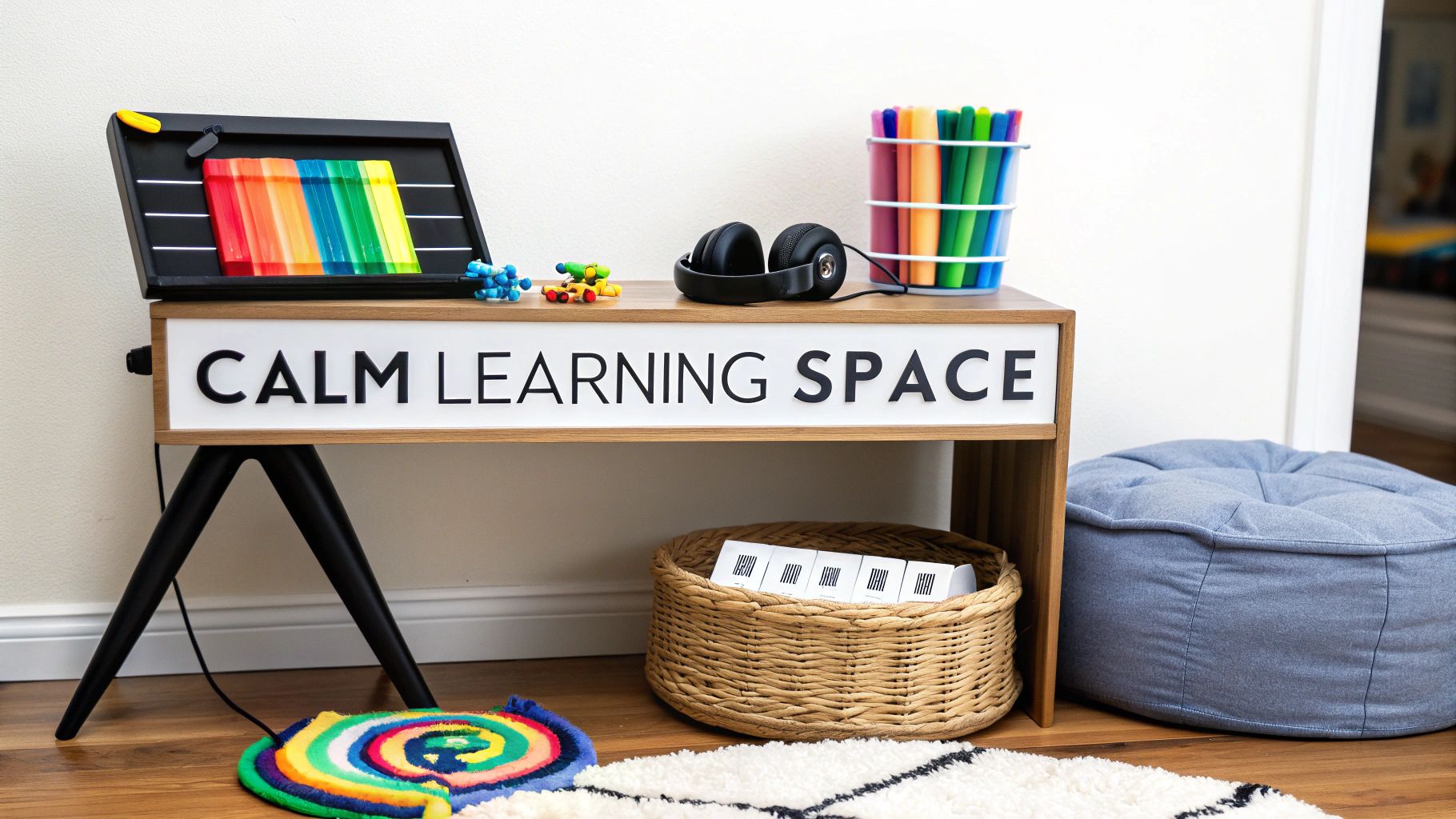
Your child's physical space is an extension of your emotional support. A well-designed environment can reduce anxiety and sensory overload, transforming learning from a battle into a calm and positive experience.
A supportive environment validates a child's needs rather than trying to change them. It silently communicates, "You are safe here. We will learn in a way that feels good to you."
Consider creating a dedicated 'calm-down corner' with soft cushions, a weighted blanket, and noise-cancelling headphones. This isn't a punishment spot; it's a safe retreat your child can choose whenever they feel overwhelmed, empowering them with the tools to self-regulate with dignity.
Real-Life Examples of Adaptation
Let's see what these ideas look like in practice for different learning needs.
Example 1: Supporting a Child with Dyscalculia
A child with dyscalculia can feel deep anxiety around numbers. Instead of forcing them through a standard maths workbook, you could:
- Use tangible objects: Teach multiplication by arranging beads or LEGO bricks into groups, letting them feel the numbers.
- Bake together: Measuring ingredients is a practical, low-pressure way to engage with fractions, connecting maths to a warm, delicious outcome.
- Play board games: Games involving dice and counting are a fun, repetitive way to build number sense without the fear of getting it "wrong".
Example 2: Engaging a Child with Sensory Sensitivities
For a child easily overwhelmed by sensory input, a typical curriculum can be exhausting. To adapt, you could:
- Use a visual timetable: A simple sequence of pictures showing what’s coming next can dramatically reduce anxiety and help them mentally prepare for transitions.
- Offer alternative outputs: If writing is physically painful or stressful, let them show their knowledge by creating a video, building a model, or recording a voice note.
- Embrace project-based learning: Instead of a series of disconnected worksheets, create one large, hands-on project. For a child who loves dinosaurs, they could spend a whole week building a diorama, writing a story about it, and calculating the size of different species.
By making these thoughtful adaptations, you’re not just teaching subjects. You are sending your child the most powerful message of all: that their unique mind is brilliant and their way of experiencing the world is valid. You are laying the foundation for a lifelong love of learning.
Choosing Your Home Education Model
There are so many wonderful ways to deliver a fantastic home education, and the best one has nothing to do with what others are doing—it's about what feels right for your family. Getting this right means taking an honest look at your time, your confidence, and most importantly, your child’s unique personality and learning style.
To help you think through the options, let's use a simple analogy: cooking a family meal. Your approach to building a home education curriculum can be just as varied, and each method produces a wonderful result when it’s the right fit.
The Self-Directed Parent-Led Model
This is the home education equivalent of cooking from scratch with love. You are the head chef, choosing every ingredient, designing the menu, and crafting each dish with your own two hands. It gives you complete creative freedom to follow your child’s interests and adapt your plans at a moment's notice.
This model is perfect for families who crave ultimate flexibility and connection. It allows you to weave learning into the fabric of everyday life. You might spend a morning learning fractions through baking, an afternoon exploring physics at the park, and an evening stargazing to cover astronomy, all guided by your child's "I wonder…" questions.
Best for a child who:
- Is naturally curious and lights up when they can follow their own passions.
- Thrives with a gentle, organic rhythm rather than a rigid schedule.
- Learns best through hands-on, real-world projects and deep conversations.
Be aware, though, that this approach is a huge investment of your own time and emotional energy. You are responsible for all the planning, teaching, and tracking. It can be incredibly rewarding, but it’s important to ensure you have the support you need to avoid burnout.
The Blended Learning Model
Think of this as using a wonderful meal-kit delivery service. You still get the joy of preparing the meal yourself, but the recipe is provided and the ingredients are pre-measured. You get a clear structure but still have plenty of room to add your own creative flair.
In a blended model, you might use a pre-packaged curriculum for a subject you feel less confident in, like Maths, but take a more self-directed approach for topics your family loves, like History or Art. This gives you the best of both worlds: the security of a proven framework and the freedom to personalise the experience.
This model offers a beautiful balance, providing structure where you need it and freedom where you want it. It’s about combining resources to create a curriculum that feels both reliable and inspiring.
Example in action:
A family might use a structured online maths programme to ensure curriculum coverage but teach history through immersive projects. For a unit on the Vikings, they could read sagas together, visit a museum, build a model longship, and cook a historically inspired meal. This combines the rigour of a formal resource with the deep, memorable engagement of parent-led discovery.
The Full Online School Model
This model is like hiring a trusted private chef. A team of experts handles everything from menu planning to delivering a perfectly executed meal, every time. You get to relax and enjoy the experience, confident that your child is receiving a fantastic, well-rounded education.
With a full online school like Queen’s Online School, your child joins live, interactive classes taught by subject-specialist teachers. The entire curriculum is structured, delivered, and assessed for you, providing a seamless and supportive path towards qualifications like GCSEs and A-Levels. This option is a game-changer for parents who worry about teaching advanced subjects or who need a dependable structure that fits around their own work.
It also provides a built-in, moderated social community, allowing your child to connect with peers who share their interests. For a child who thrives on routine, expert guidance, and social connection, this model can be a perfect fit, relieving parental pressure while delivering a first-class education.
Your Practical Curriculum Planning Toolkit
Right, let's turn that heartwarming vision of a child-centred education into a clear, actionable plan. This section is your hands-on toolkit for getting organised without the overwhelm. Creating a thoughtful and effective home education curriculum is entirely within your reach, and these tools will give you the confidence to start mapping it out.
The goal isn't to replicate a rigid school timetable. Instead, it’s about creating a gentle rhythm that works for your family's energy. This means building a schedule that thoughtfully balances focused learning with creative expression, outdoor adventures, and that all-important social time. A predictable routine provides structure and security, which is incredibly comforting for children and teenagers alike.
A Day in the Life: Example for KS3
To give you an idea of how this might look, here’s a sample schedule for a 13-year-old in Key Stage 3. Notice the blend of focused work, practical skills, and proper downtime.
- 9:00 AM – 10:15 AM: Maths. This could be a live online lesson or time spent working on a topic they find interesting, like geometry in architecture, with a short break built-in.
- 10:15 AM – 11:00 AM: Movement & Snack. Time to step away from the desk. A walk with the dog, bouncing on the trampoline, or simply putting on some music and dancing before grabbing a snack.
- 11:00 AM – 12:30 PM: History Project. Diving deep into a project on the Roman Empire, sparked by a favourite movie. This is their time to research, create, and own their learning.
- 12:30 PM – 1:30 PM: Lunch & Free Time. A proper, screen-free break to eat, relax, and recharge is non-negotiable for their wellbeing (and yours!).
- 1:30 PM – 2:30 PM: Science. A hands-on experiment in the kitchen related to chemistry—maybe making slime or sherbet. Learning should be fun and a little bit messy.
- 2:30 PM onwards: Social/Creative Time. This is their time to connect with their passions and their people—meeting friends, attending an art class, or getting lost in a coding project.
From Weekly Rhythms to Termly Goals
While a weekly rhythm keeps the day-to-day calm, a simple term planner helps you see the bigger picture. This is great for mapping out broader topics (like "Rainforests" or "Ancient Greece") and gathering fun resources ahead of time. It prevents that last-minute panic and ensures a smooth, logical flow from one adventure to the next.
A good plan actually empowers you to be flexible. When you know your overarching goals, you can confidently take a detour to follow your child’s sudden fascination with a new topic, knowing you can easily get back on track.
As you set up your learning space, keeping things organised is a gift to your future self. Thinking about the importance of name labels in school supplies might seem small, but simple habits make a huge difference. An organised space creates a calm, productive atmosphere, reducing stress for both you and your child. You've got this.
Answering Your Heart's Biggest Questions
Let's tackle some of the big questions that often weigh on a parent's heart when they're considering home education. It’s a journey filled with incredible opportunities, but it’s completely normal to have a few wobbles. Let's clear up some common concerns so you can feel confident and excited about the path ahead.
But What About Socialisation?
This is the question every home-educating parent hears. The fear is that leaving a classroom of 30 children will lead to isolation. But the truth is, home-educated children often experience a richer, more authentic social life.
True socialisation isn't about being in a room with 29 other people who happen to be the same age. It’s about learning to connect with people from all walks of life. Home education offers endless opportunities for this.
Imagine your child learning alongside toddlers and grandparents at a community garden, collaborating with teens and adults at a local theatre group, or forming deep friendships with other home-educated children who share their passions, not just their date of birth. These real-world interactions build confidence and communication skills in diverse settings—fantastic preparation for a happy, well-adjusted life.
Can My Child Still Get Proper Qualifications?
Absolutely. The path to qualifications like GCSEs and A-Levels is well-trodden and highly successful for home-educated students. The key is to follow a curriculum that meets the exam board requirements and then register as a private candidate at an approved exam centre.
Feeling anxious about navigating the exam system is completely understandable, but please don't let it be a barrier to this wonderful journey. With the right structure and support, your child can achieve all the qualifications they need for their dreams.
This is where many families find that an accredited online school brings enormous peace of mind. It simplifies the entire process. The curriculum is already aligned, specialist teachers provide expert guidance, and the school often helps with the logistics of exam registration. It takes a huge weight off your shoulders, allowing you to focus on supporting your child emotionally, knowing their academic future is in safe hands.
Ready to provide your child with an accredited, supportive, and flexible education? Queen’s Online School offers a complete British curriculum with live lessons from expert teachers. Explore our programmes and see how we make world-class learning accessible from home.