
A GCSE mock test is, quite simply, a practice exam. It’s designed to mirror the real thing, giving your child a crucial dress rehearsal before their final exams. The goal is to build confidence, highlight any tricky areas that need more attention, and get them used to the pressure of an official test environment.
Understanding The GCSE Mock Test Journey
The very words ‘mock test’ can send a ripple of anxiety through any household. For a child, it can feel like a final judgement on everything they’ve learned so far. For a parent, it’s a nerve-wracking glimpse into their future. It’s completely natural to feel the weight of this moment, that familiar mix of hope and worry for your child’s success. But what if we looked at this journey a little differently?
Imagine preparing for a marathon. You wouldn't just show up on race day without ever having run the distance before. You’d do practice runs, test your pace, and figure out where you need to build more stamina. A GCSE mock test is exactly that—a practice run for the main event. It’s a safe, controlled space where making mistakes isn't just allowed; it's encouraged.
From Fear to Opportunity
The pressure to succeed and the fear of failure are completely normal emotions for your child. They might be worried about disappointing you, their teachers, or even themselves. Your role here is to help them reframe this whole experience. This isn't about passing or failing; it's about learning and growing.
Think of a mock test result not as a final verdict, but as a personalised roadmap. It highlights exactly where your child is already strong and confidently cruising, and pinpoints the specific areas where they might need a little more fuel in the tank.
This shift in perspective is incredibly powerful. It transforms the mock from a daunting hurdle into a practical, diagnostic tool. By embracing it as a chance to gather information, you empower your child to take control of their own learning journey.
The Emotional Foundation for Success
By focusing on the emotional side of things, you're building a foundation of resilience and confidence that will serve them long after exam season is over. Here’s how you can support them in turning this experience into a positive one:
- Acknowledge Their Feelings: Start by validating their anxiety. Simply saying, "I can see this is stressful for you," creates an open and supportive atmosphere where they feel safe enough to share their worries. For example, if they say "I'm going to fail," instead of jumping to "No, you won't!", try "It sounds like you're feeling really worried about that. Let's talk about what's making you feel that way."
- Focus on Effort, Not Just Grades: Praise their dedication to revision and their courage in sitting the test, regardless of the outcome. This shows them that you value their hard work more than anything else. A practical example would be saying, "I was so impressed with how you stuck to your revision plan this week, even when you were tired. That's real dedication."
- Share Your Own Experiences: Talk about a time you faced a big challenge or didn't get the result you wanted straight away. This humanises the experience and shows them that setbacks are a normal part of any journey to success. You could share a story about a driving test you failed or a project at work that didn't go to plan, explaining how you felt and what you learned from it.
What Actually Happens During a Mock Test?
To help your child through their GCSE mock tests, it helps to pull back the curtain on what they are, why they happen, and when. Mocks aren't just random hurdles dropped into the school year; they are a carefully structured part of the revision process, designed to give valuable insights to everyone involved—your child, their teachers, and you. Understanding this turns a daunting challenge into a predictable and manageable step.
The timing of these practice exams is no accident. Most schools run two main waves of mock tests for Year 11 students. The first usually lands in the Autumn term (around November/December), giving everyone an early baseline of where things stand. The second, often more formal set, happens in the Spring term (typically February/March). Think of this one as the final dress rehearsal before the real exams kick off in May.
This two-part structure is brilliant because it allows your child to see genuine progress over several months. The Autumn mocks highlight the initial areas needing more work, leaving plenty of time to act on feedback before the final push.
Why Do Schools Even Bother with Mock Tests?
At its core, a GCSE mock test is about so much more than just a grade on a piece of paper. For schools, these exams are a vital tool. They provide the most reliable evidence for predicting final GCSE grades, which is essential information for your child’s applications to sixth form or college.
More importantly, mocks are a powerful diagnostic tool. They show teachers exactly where individual students—and even whole classes—are struggling. This allows them to adjust their teaching in those last crucial months before the summer exams.
For your child, the benefits are even more personal and direct:
- Getting Used to Exam Conditions: Sitting in a silent hall with a clock ticking away is a unique and often nerve-wracking experience. Mocks help normalise this environment, which can seriously reduce anxiety on the real day. It helps them get used to the feel of the desk, the silence, and the sight of the invigilator walking past.
- Practising Time Management: It’s one thing knowing the subject inside and out, but it’s another thing entirely to get it all down on paper under pressure. A practical example is a child realising in a mock that they spent 45 minutes on a 30-minute essay, leaving no time for the final section. This is a lesson best learned when the stakes are low.
- Making Crucial Tiering Decisions: For subjects like Maths and the Sciences, mock results help teachers decide whether your child should be entered for the Higher Tier (grades 9-4) or the Foundation Tier (grades 5-1). This is a critical decision, as it sets the highest possible grade your child can achieve.
It all comes down to mindset. A student can approach their mocks with a sense of dread or see them for what they are: an opportunity.
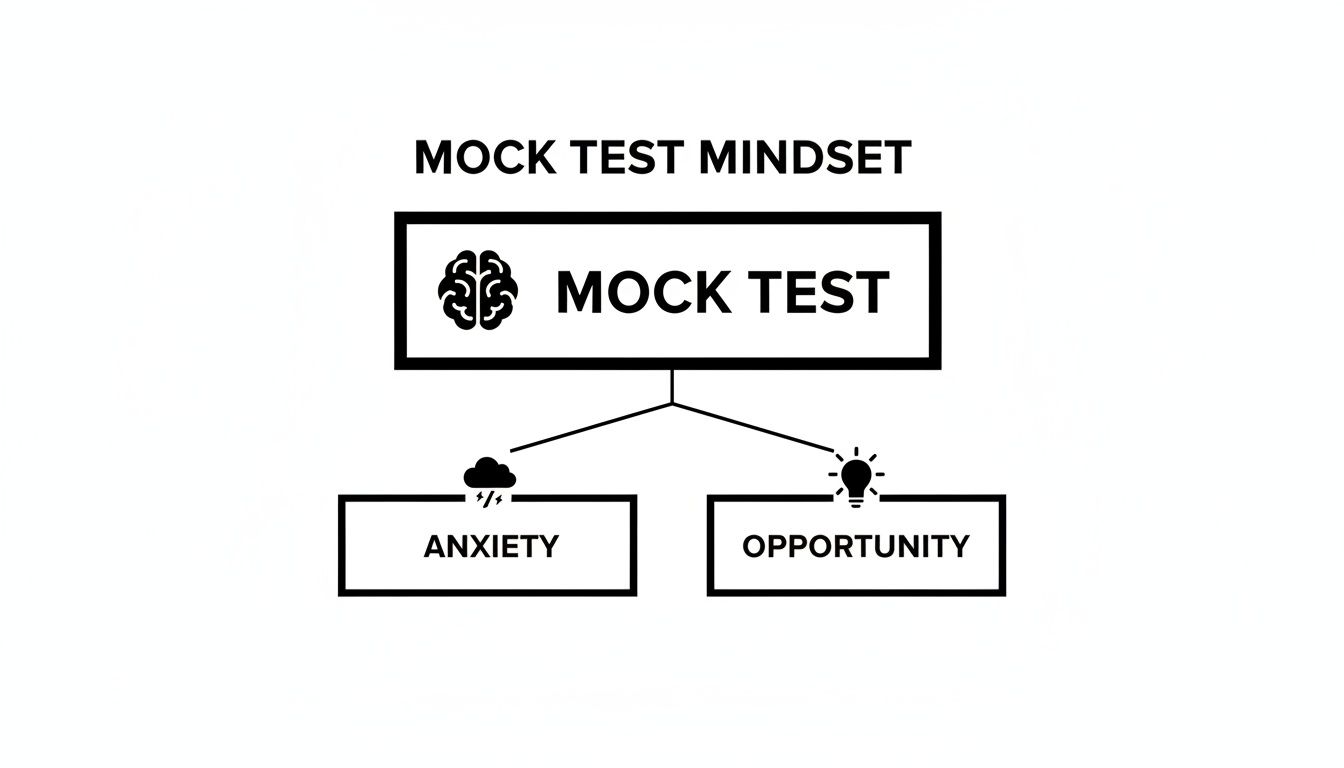
Viewing the mock test as a chance to learn, rather than just a source of stress, can completely change the outcome and the entire experience for your child.
The Different Flavours of Mock Exams
Not all mocks are the same. While the big ones are full-paper simulations, schools use lots of other types of testing to get students ready. Knowing the difference helps you and your child understand the purpose behind each one.
Think of it like training for a marathon. You wouldn't just run the full 26.2 miles every day. You'd do shorter runs, interval training, and strength exercises. Each type of training serves a different purpose, but they all contribute to being ready on race day.
Here's a quick guide to the different formats you'll likely come across, helping you understand the unique purpose each one serves in your child's revision journey.
A Parent's Guide to Different GCSE Mock Tests
| Mock Test Type | Primary Purpose | When It Typically Happens | Key Benefit for Your Child |
|---|---|---|---|
| Full-Paper Simulations | To replicate the real exam experience as closely as possible, testing knowledge, timing, and endurance. | The main mock windows in Autumn (Nov/Dec) and Spring (Feb/Mar). | Builds stamina and familiarity with exam hall conditions, reducing real-day anxiety. |
| Topic-Specific Tests | To check understanding of a specific module or topic before the class moves on. | Throughout the year, at the end of a teaching block. | Pinpoints specific knowledge gaps early on, making revision more targeted and efficient. |
| Walking Talking Mocks | A teacher-led walkthrough of a past paper, explaining question types and strategies. | Often in class, closer to the exam period. | Demystifies complex questions and teaches exam technique in a low-pressure environment. |
Each format plays a unique role in building both your child's knowledge and their confidence.
For more practical tips on how to prepare for these assessments, our guide on how to concentrate when studying is packed with strategies to help your child focus their efforts. By understanding the 'what' and 'why' behind GCSE mocks, you can help them see these tests not as a threat, but as an essential and genuinely helpful part of their path to success.
Turning Mock Results Into Meaningful Progress
When the mock results land, it’s a moment thick with anticipation. It’s all too easy for everyone’s attention to laser-focus on that single letter or number, bringing either a wave of relief or a knot of disappointment. But the real value of a GCSE mock test isn’t in the grade itself; it’s hidden in the feedback, just waiting to be unpacked.
Think of the results less as a final verdict and more as a detailed treasure map. It shows you exactly where the treasure—extra marks and, more importantly, confidence—is buried. Your job as a parent is to help your child become a skilled map-reader, transforming what might feel like a setback into a clear, actionable plan for success.
From Grade to Game Plan
Before you even glance at the paper, the first step is to manage the emotional temperature in the room. If the grade is lower than hoped for, it’s vital to respond with empathy, not frustration. Your child is likely feeling upset or embarrassed, and a disappointed reaction from you can make them shut down. A simple, "Okay, this isn't what you wanted, but it gives us some really useful information to work with," can shift the whole conversation from blame to collaboration.
Once everyone is calm, sit down together with the marked paper, a fresh notebook, and a few different coloured pens. Your goal is to become detectives, looking for clues and spotting patterns. This process turns feedback from something that feels like criticism into constructive guidance, a core principle of effective formative assessment.
Your child's mock paper is the single most valuable revision tool they will ever receive. It’s a personalised report, written just for them, showing exactly how to secure more marks in the real exam.
Ask these questions as you analyse the paper together:
- Knowledge Gaps: Are there specific topics that consistently caused trouble? In a Biology paper, for instance, are all the questions on genetics coming back with red marks? Highlight these in one colour.
- Exam Technique Errors: Did they lose marks for not reading the question properly? A classic example is a student writing a brilliant description when the question asked them to 'evaluate'. Use a different colour for these.
- Timing Issues: Is the end of the paper rushed or completely blank? This is a classic sign of a time management problem that needs a new strategy.
- "Silly" Mistakes: Were marks lost due to simple errors in calculation, spelling, or punctuation? These are often the easiest and most satisfying problems to fix.
Creating a Mistake Journal
After you’ve identified the patterns, the next step is to create a ‘mistake journal’. This isn’t about dwelling on what went wrong; it’s a proactive tool for getting it right next time. For every question where marks were dropped, your child should write down three simple things:
- The Mistake: A quick description of what happened. (e.g., "I misread 'evaluate' and just described the points instead.")
- The Correction: What the right answer or approach should have been. (e.g., "'Evaluate' means I needed to give pros and cons and then make a final judgement.")
- The Future Action: What they will do differently in the exam. (e.g., "I will highlight the command word in every question before I start writing.")
This simple, structured process moves your child from feeling helpless about a disappointing result to feeling empowered with a clear strategy for improvement. It builds resilience and a growth mindset—qualities that are far more valuable than any single grade.
Celebrating Progress and Building Resilience
Crucially, don’t forget to celebrate every bit of progress. Did they manage their time better than in the last practice paper? Did they finally nail a topic they used to struggle with? Acknowledge and praise these wins. This reinforces the idea that effort leads directly to improvement and helps build the momentum they’ll need for the final exams. For example, you could say, "I noticed you used the right formula for every physics question this time, that's a huge improvement and shows your hard work is paying off!"
Mocks are a powerful tool for closing performance gaps. UK statistics show the gender attainment gap for grades 5+ in English and maths recently narrowed to 3.1 percentage points from 4.7, partly due to targeted improvements.
At Queen's Online School, our tailored mock exams are essential, giving SEN and SEMH learners a supportive space to practise without fear and build confidence in our zero-tolerance anti-bullying environment. By using mock results as a tool for targeted improvement, every student gets the chance to reach their full potential.
Building a Practical Mock Test Prep Strategy
Preparing for a GCSE mock test is about working smarter, not just harder. The goal isn’t to create a gruelling, soul-crushing schedule. Instead, it’s about building a supportive and balanced strategy that nurtures your child’s well-being right alongside their academic growth. This is the moment to move beyond simply highlighting textbook pages and start using active, engaging revision methods that actually stick.
Think of it like training for a big match. An athlete doesn't just run endlessly; they do targeted drills, practice specific skills, get proper rest, and eat well. Your child's mock test preparation needs the same thoughtful approach—one that builds stamina without causing burnout.
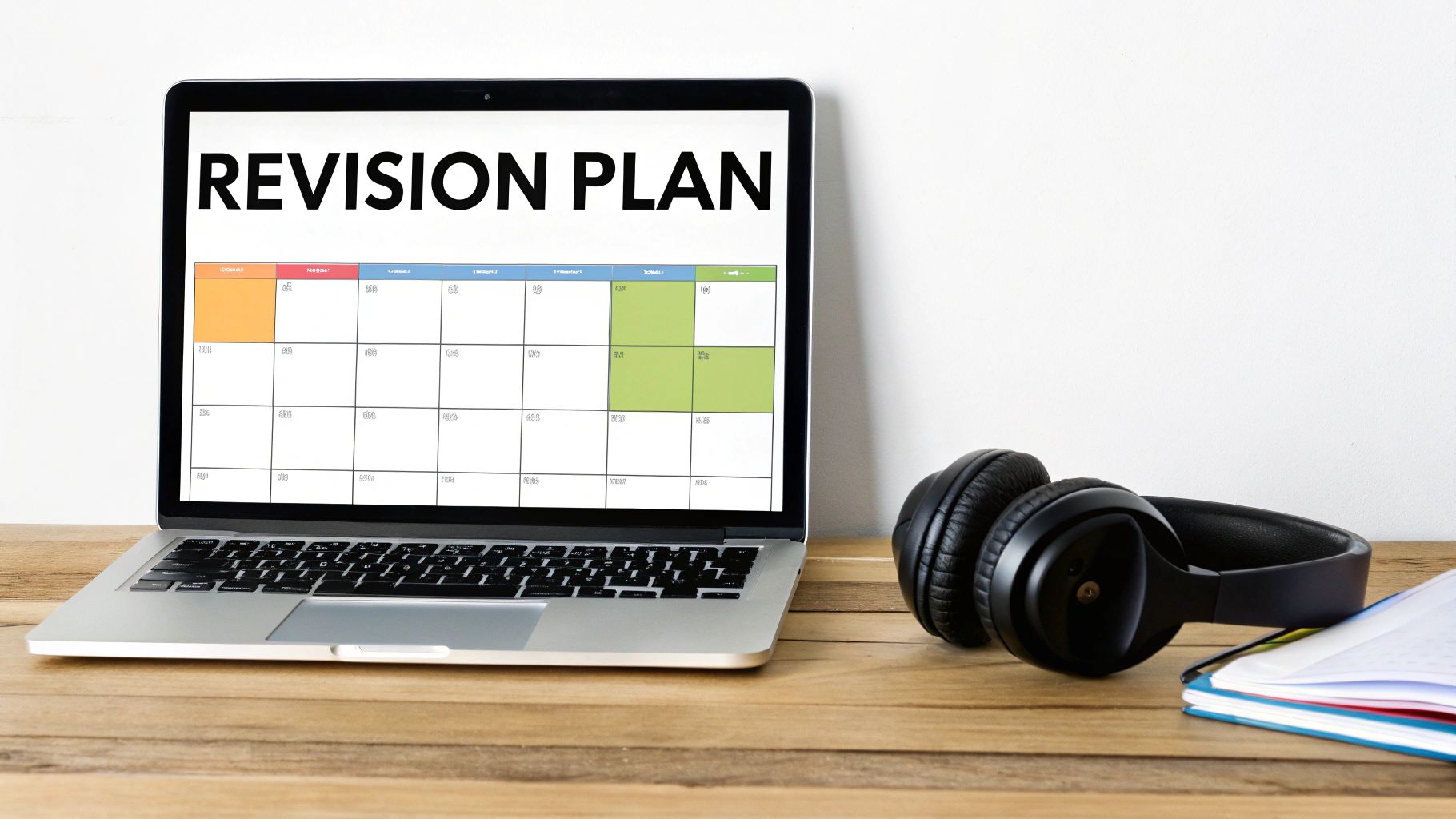
Crafting a Burnout-Proof Revision Timetable
The first step is to map out a realistic revision timetable. This isn't just about blocking out study time; it's about scheduling downtime, hobbies, and family activities with equal importance. A child who is well-rested and happy will always learn more effectively than one who is stressed and exhausted.
Sit down with your child and a weekly planner. Get them to block out their non-negotiables first—school hours, sports practice, time with friends, or even their favourite TV show. Seeing that their entire life won't be consumed by revision helps reduce resistance and anxiety right from the start.
Once those are in, you can identify the available slots for focused revision. Aim for short, manageable bursts of 25-40 minutes, followed by a 5-10 minute break. This approach, often called the Pomodoro Technique, is brilliant for maintaining concentration and preventing mental fatigue.
Here’s what that could look like on a typical weekday evening:
- 4:30 PM – 5:00 PM: Downtime (Grab a snack, chat, relax)
- 5:00 PM – 5:40 PM: Revision Slot 1 (e.g., Maths practice questions)
- 5:40 PM – 5:50 PM: Break (Stretch, get a drink)
- 5:50 PM – 6:30 PM: Revision Slot 2 (e.g., History flashcards)
This structure feels much more achievable than a daunting "two hours of revision". For more guidance, our in-depth article on GCSE revision tips is packed with ideas.
Beyond Reading: Active Revision Techniques
Passive revision, like just re-reading notes or textbooks, is one of the least effective ways to study. The brain needs to be actively engaged to form strong, lasting memories. This is where powerful techniques like active recall and spaced repetition come into play.
- Active Recall: This is all about pulling information out of your brain, rather than just passively putting it in. Instead of reading a chapter on photosynthesis, your child should close the book and try to write down everything they can remember about it. Another practical example: after they've made flashcards for key dates in History, have them put the cards away and try to draw a timeline from memory.
- Spaced Repetition: Our brains learn best when we revisit information at increasing intervals. For example, your child might review a new topic the next day, then three days later, and then again a week after that. This process signals to the brain that the information is important, helping to transfer it from short-term to long-term memory.
As you start to pull a plan together, understanding how to cultivate genuinely effective study habits is key. These methods transform revision from a passive chore into an active, engaging process that yields real results.
Personalising Prep for Every Learner
Every child learns differently, and a one-size-fits-all approach to revision rarely works. It's absolutely vital to tailor these strategies to your child's unique needs, especially for students who require special accommodations.
The most effective preparation strategy is one that honours the individual learner. It adapts to their strengths, supports their challenges, and gives them the specific tools they need to feel confident and capable.
For a student with dyslexia, this might mean using mind maps instead of linear notes or listening to audio recordings of texts. For a child with ADHD, breaking revision into even shorter, more frequent chunks with movement breaks in between can be transformative.
If your child is entitled to accommodations like extra time or the use of a laptop, it is crucial to practise with these conditions in place. Completing a GCSE mock test at home under the exact same rules builds familiarity and ensures they can make the most of their support on the day. By building a supportive, personalised strategy, you give your child the best possible chance to walk into that exam hall feeling prepared and confident.
The Queen’s Online School Approach to Mock Exams
Taking a GCSE mock test can feel like a lonely, high-stakes experience. At Queen’s Online School, we believe it should be the exact opposite—a supportive, collaborative process that builds confidence, not anxiety. We’ve carefully designed an approach that blends the formality of a real exam with the comfort and familiarity of your child’s own home.
Our goal is to demystify the exam process, turning fear into familiarity. We do this by recreating the formal exam environment in a way that feels empowering for your child. It's about providing a serious dress rehearsal that still feels safe, supportive, and deeply focused on personal growth.
For students navigating an online learning environment, helpful online course tips can significantly enhance their mock exam preparation.
Recreating the Exam Experience Online
A mock is only as good as its authenticity. We don’t just send out a paper and hope for the best; our process is structured to mirror the real thing, making sure your child is fully prepared for every part of exam day.
It all starts on our secure online platform, where students access their exam papers at a scheduled time. This isn’t just a passive download; it’s the beginning of a formal, invigilated session.
We believe that true confidence comes from practice. By simulating official exam conditions with live online proctoring, we help students normalise the pressure, manage their time effectively, and focus purely on demonstrating what they know.
Our live invigilation (proctoring) is central to this. Students join a live video session where our trained staff oversee the exam, just as they would in a physical exam hall. This maintains academic integrity and, just as importantly, gets your child used to the focused, quiet atmosphere they will encounter in their final GCSEs.
Feedback That Builds Futures
A grade is just a number. The real learning happens when your child understands why they got that number and exactly what to do to improve it. Our subject-specialist teachers are committed to providing feedback that is detailed, constructive, and genuinely personal.
Instead of a simple "7/10, good effort," your child receives specific, actionable advice.
- For an English Essay: A student might receive feedback like, "Your analysis of the main character was strong, but you missed opportunities to explore the writer's use of imagery. Next time, try to dedicate a full paragraph to how metaphors in the text create a specific mood."
- For a Maths Paper: Feedback could be, "You understand the formula for quadratic equations, but you lost marks on calculations. Let’s schedule a one-to-one session to review your workings and practise checking your answers under timed conditions."
This level of detailed guidance transforms a mock result from a final score into the starting point for a new, focused learning plan.
Pastoral Support for Anxious Minds
We know that for many children, the biggest barrier to success isn't a lack of knowledge, but a wave of anxiety. Our pastoral support isn't an add-on; it's woven right into the fabric of our mock exam process.
Our team works with students to develop practical coping strategies for managing stress. This could involve breathing exercises to calm nerves before the test begins, or mindset coaching to help them see the mock as a helpful challenge, not a terrifying threat.
Because we are a Pearson Approved Examination Centre, you can have complete peace of mind. Our methods, from the papers we use to the feedback we provide, meet the highest standards of the British curriculum. This ensures that the mock experience at Queen's Online School isn't just reassuring—it's a robust and reliable step on your child's journey to exam success.
Your GCSE Mock Test Questions Answered
As a parent navigating the GCSE years, the mock test period can feel like a whirlwind of questions and anxiety. It’s a time filled with uncertainty, and it’s completely natural to worry about how to best support your child. We hear from parents all the time, so we’ve put together clear, practical answers to the most common concerns. Our goal is to help you and your child face this chapter with confidence, not fear.
What Should We Do If My Child Gets a Really Bad Mock Result?
A disappointing mock result can feel like a punch to the gut—for both of you. The first, and most important, step is to manage your own reaction. Take a deep breath and remember: this result is not a final verdict, it’s diagnostic data.
Stay calm and approach your child with empathy, not criticism. An open, non-judgemental conversation is the only way forward.
The single most powerful thing you can do is frame the result as a learning opportunity. Say, "Okay, this isn't what we hoped for, but that’s exactly why we do mocks. Now we have a perfect map showing us exactly where to focus our energy."
Sit down together and go through the paper like detectives. Look for patterns.
- Example: In their Maths paper, did they lose all their marks on algebra but ace the geometry questions? Great. That tells you exactly which topic needs a revision session.
- Example: In History, did they write brilliant paragraphs but run out of time to finish the last question? That points to a time management issue, not a knowledge gap.
This process shifts the focus from the negative feeling of "failure" to the positive action of building a strategy. Remind your child this is exactly why mocks exist—to find the weak spots before they count. At Queen's Online School, our teachers use this precise feedback to tailor future lessons, directly addressing these gaps with personalised support.
How Can I Help My Child Manage Mock Exam Anxiety?
Exam anxiety is incredibly common, and for a young person, it can feel overwhelming. The best way to tackle it is with a mix of practical preparation and genuine emotional reassurance.
Help your child break down their revision into small, manageable chunks. A huge, vague goal like "revise Biology" is terrifying. A specific, achievable task like "spend 25 minutes making flashcards for photosynthesis" feels doable and helps build momentum.
A structured timetable that includes built-in breaks for fun, exercise, and just relaxing is essential. It’s a visual reminder that their entire life won't be consumed by revision.
Talk openly about what they're afraid of and validate their feelings. Reassure them that their worth as a person has absolutely nothing to do with a grade on a mock test. Simple breathing exercises or mindfulness techniques can also be powerful tools for calming a racing mind before a study session or the test itself.
Simulating the exam experience is also a fantastic way to reduce fear of the unknown.
- Practical Example: Set up a quiet space, put their phone in another room, and have them complete a past paper under timed conditions. Doing this a few times makes the real environment feel much less intimidating. At Queen’s Online School, our live, invigilated mock sessions are designed to normalise this environment, while our pastoral team provides students with effective strategies for managing stress.
Do Mock Test Grades Affect Final GCSE Grades?
This is a crucial question, and the direct answer is no. The grade your child gets on a mock paper does not contribute to their final, official GCSE grade. Those are determined solely by how they perform in the summer exams.
However, mock results are highly influential in a few indirect—but very important—ways.
- Tier of Entry: For subjects like Maths and Science, schools use mock results to decide whether a student should be entered for the Higher Tier (grades 9-4) or the Foundation Tier (grades 5-1). This is a critical decision, as it caps the maximum grade a student can achieve.
- Predicted Grades: Mocks are the primary piece of evidence schools use to generate predicted grades. These predictions are vital for applications to sixth forms and colleges.
- Motivation: A strong result can be a huge confidence boost, proving to your child that their hard work is paying off. A poor one, when handled correctly, provides the precise roadmap they need to improve and secure a better final grade.
How Many Mock Tests Should My Child Be Taking?
When it comes to mock exams, quality is far more important than quantity. Burnout from endless testing is a real risk. Most schools will run two full sets of mock exams in Year 11, and that’s generally a sufficient and effective schedule.
Beyond these formal sessions, the focus should shift from completing endless full papers to using individual past papers as a targeted revision tool. It's far more effective to focus on specific questions or sections that target weak areas identified in the last mock result.
- Practical Example: If your child's English mock feedback highlighted issues with essay structure, they should spend their time practising timed essay paragraphs, not necessarily doing another full two-hour paper. They need to spend as much time reviewing their answers against the mark scheme as they did writing them.
The goal isn't just to do the test, but to learn deeply from every single one. This strategic approach ensures their revision time is as productive as possible, building both skill and confidence without causing them to burn out.
At Queen’s Online School, we understand that the GCSE journey is about more than just academic results. Our approach combines rigorous, Pearson-approved mock exams with dedicated pastoral support to ensure every child feels confident, prepared, and empowered to succeed. Discover how our personalised online learning environment can make a difference for your family. Learn more about Queen’s Online School