
It’s a heart-sinking feeling no parent wants: watching your child, the one you know is bright and full of potential, fade at school. It often starts subtly. Maybe it’s the nightly tears over homework, the growing dread in their eyes each morning, or a report card that feels like it’s describing a different child entirely. You see their spark, but you can feel the traditional classroom environment slowly extinguishing it.
When Traditional Schooling No Longer Fits
Does your child feel invisible in a class of thirty, lost in the noise and unable to get the gentle guidance they need to grasp a concept? Perhaps they’re bored, their brilliant mind shackled to a pace that’s too slow, and you see their natural curiosity giving way to apathy. For another child, the relentless social pressure and sensory overload of a bustling school can be a daily storm of anxiety, making it impossible to focus on learning.
These aren't isolated struggles; they are the painful friction points where a rigid, one-size-fits-all system fails the individual child. It’s a structure that can leave a neurodiverse learner feeling broken, overlook a unique talent, or simply fail to provide the emotional safety net a sensitive child needs to thrive.
Shifting the Question
It’s so easy to fall into the trap of asking, "What's wrong with my child?" But what if we asked a more compassionate, more powerful question: "What if the system is the problem?" That small shift in perspective changes everything. It moves the focus from trying to reshape your child to fit a box, and towards finding an educational home built to celebrate them exactly as they are.
This is where flexible learning schools come in, offering a kinder, more effective path forward. They are designed from the ground up to put your child, with all their unique quirks, passions, and needs, at the very heart of their own education.
A flexible learning environment doesn't ask a child to change who they are to fit the school; it changes the school to fit the child. It honours their pace, respects their needs, and builds a learning journey that feels like a relief, not a battle.
Instead of a fixed timetable that leaves a child with ADHD feeling constantly frazzled, imagine a schedule with built-in "brain breaks" that help them reset and focus. For the gifted student wilting with boredom, picture an accelerated path where they can joyfully dive into advanced physics because they’re ready, not because a calendar says it's time.
Ultimately, this is about so much more than just grades. It’s about restoring your child's confidence and reigniting their love for learning. By validating their struggles and offering an educational model that adapts to them, flexible learning schools provide a clear route back to self-worth and a genuine, lasting sense of achievement.
So, What Exactly Are Flexible Learning Schools?
To get a real feel for what flexible learning schools are all about, it helps to step back from the jargon. Think of a traditional school as being a bit like a scheduled tour bus. Everyone gets on at the same time, follows the exact same route, and stops at the same places for the same amount of time. It doesn't matter if your child is utterly fascinated by one particular landmark or feeling overwhelmed and needs a quiet moment—the bus keeps moving at its set pace.
A flexible learning school, on the other hand, is like giving your child a personalised map and a compass. The destination is the same—a brilliant education—but the journey, the pace, and the points of interest are all built around them. This approach acknowledges a simple, emotional truth: every child’s heart and mind works differently. It offers an educational journey that feels empowering and exciting, not restrictive and frustrating.
This isn't just a niche idea anymore. More and more families are feeling that same pull for something different. In the 2022–23 academic year, a huge 126,000 children in England were homeschooled at some point—that's over 10,000 more than the year before. This isn't just a statistic; it's a chorus of parents saying, "There has to be a better way for my child."
This mind map really gets to the heart of why parents are making a change.
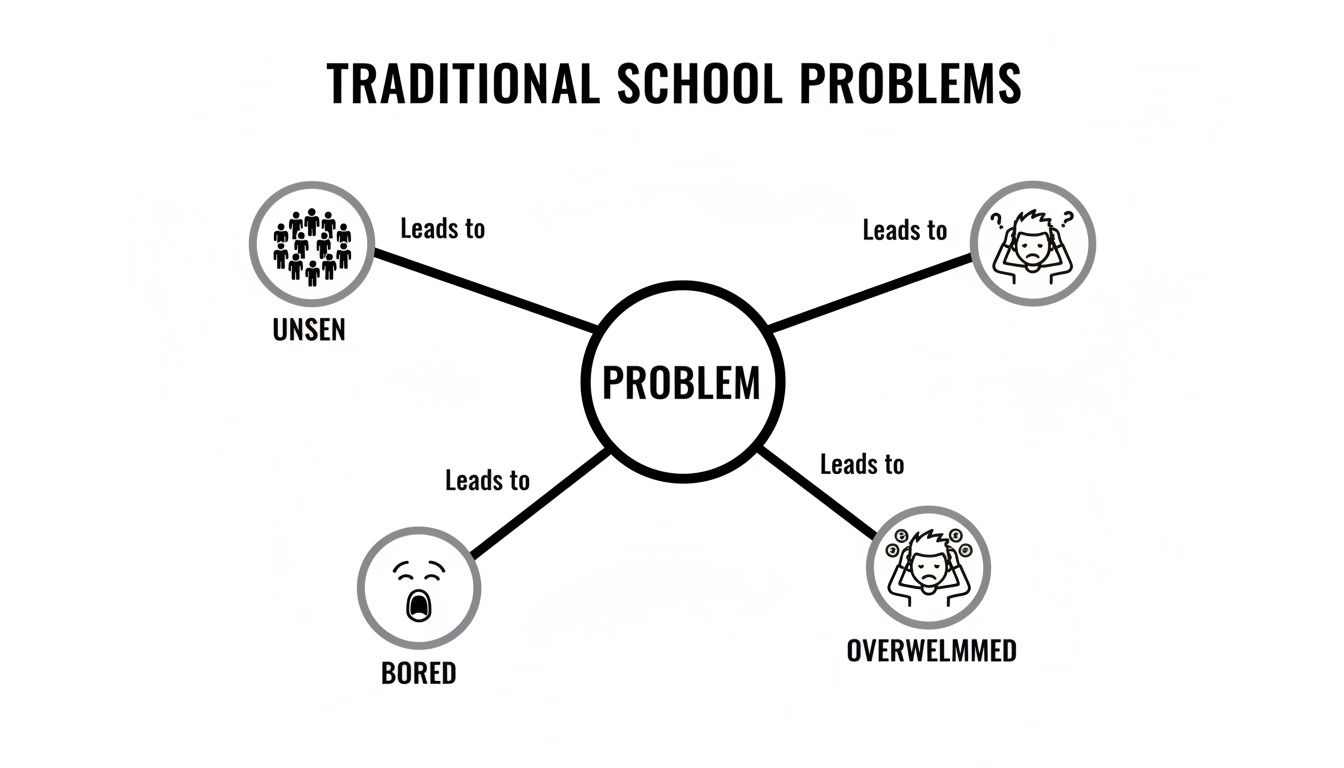
As you can see, feelings of being unseen, bored, or completely overwhelmed are often direct results of a system that struggles to meet every child where they are. Flexible models are designed to fix that.
Fully Online Learning: Education Without Borders
One of the most popular models is the fully online school. This is a perfect solution for families whose lives don't fit into a standard box. For instance, a family living abroad can give their child a top-tier British education, ensuring continuity and quality no matter where they are. Or, for a family that travels for a parent's work, it means the child’s learning is never disrupted by another move; their classroom, teachers, and friends travel with them.
Blended and Hybrid Models: The Best of Both Worlds
For a child who craves the quiet focus of home learning but also blossoms with face-to-face interaction, a blended or hybrid model can be the perfect fit. Imagine your teen completing their core subjects online during the week, then joining a local group for a hands-on science lab or a collaborative art project. Many forward-thinking schools are using dynamic cohort-based course models to create a strong sense of community and encourage students to learn together. We break this down further in our guide on what is blended learning.
At its heart, a flexible model is built on trust—trust that when a child is given the right tools and autonomy, their natural desire to learn will flourish.
Self-Paced Learning: Putting Your Child in Control
This is where the real magic happens for so many children. A self-paced structure puts your child firmly in the driver's seat of their education. For the child who zips through maths problems, it means they can accelerate and start exploring A-level concepts instead of doodling in a notebook for forty minutes, waiting for the class to catch up. The boredom vanishes, replaced by invigorating challenge.
But it’s just as powerful for the child who needs a bit more time to let a tricky subject like Shakespeare or chemistry sink in. A self-paced approach removes all the crushing pressure. They can re-watch a recorded lesson on iambic pentameter as many times as they need, without feeling embarrassed to ask the teacher to explain it again. This builds an unshakeable foundation of knowledge and, just as importantly, a profound sense of "I can do this."
To help you visualise how these models could work for your child, we've put together a simple table.
Comparing Flexible Learning Models
This table offers a quick snapshot of the different models, helping you see which might be the best fit for your child's personality and your family's lifestyle.
| Model | Structure | Best For | Example Scenario |
|---|---|---|---|
| Fully Online | All learning is remote via live classes, recorded lessons, and digital resources. | International families, frequent travellers, or students needing a consistent environment. | A family living in Dubai wants their child to follow the British curriculum without interruption. |
| Blended/Hybrid | A mix of online instruction and scheduled in-person sessions for labs, group work, or social activities. | Students who enjoy social interaction but benefit from the focus of learning from home. | A teen attends online classes four days a week and goes to a local learning hub once a week for science labs. |
| Self-Paced | Students progress through coursework at their own speed using pre-recorded materials, with teacher check-ins. | Highly motivated students, gifted learners, or those who need extra time to master concepts. | An advanced maths student completes their GCSE coursework a year early and moves on to A-Level material. |
It's important to remember that these models aren't always separate. The very best flexible learning schools often weave these elements together. They might offer a structured timetable of live classes alongside a deep library of on-demand lessons and resources. This creates the perfect blend of community, expert guidance, and the personal freedom every child needs to truly thrive.
The Real Pay-Off: How Flexible Learning Helps Real Children Thrive
Theories and educational models are all well and good, but the real value of a flexible learning school is measured in something far more personal. It’s in the tangible, often life-changing, results for actual children. It’s the sigh of relief from a child who no longer gets that Sunday-night dread, or the spark in the eyes of a student who is finally, truly challenged. This is where education stops being a one-size-fits-all system and becomes a personal journey again.
When you put the child back at the centre of their own education, you unlock potential that a rigid system can so often stifle. Let’s look at how this approach really works for different kinds of learners. You might just see your own child’s story in these examples.
For the Anxious Child Seeking a Safe Space
Picture a bright, sensitive child who finds the noise and social pressures of a big school completely overwhelming. The packed corridors, the fear of being called on in a class of 30, the constant worry about fitting in—it can create a state of high alert that makes learning feel impossible.
Now, imagine that same child in a flexible online school. They log into a small, live class from the comfort of their own room, a space where they feel secure. Because class sizes are deliberately small, there’s no place to hide, but also no reason to. The teacher knows their name, understands their learning style, and gently encourages them to join in, building confidence instead of fear. For example, instead of raising a hand in a packed room, they can type a question in a private chat to the teacher, getting the help they need without feeling exposed.
This isn’t about isolating a child. It’s about giving them a safe harbour where they can rebuild their self-esteem and engage with classmates on their own terms, free from the harsh judgment of the playground.
For the Gifted Student Craving a Challenge
We’ve all seen it: the student who blitzes through their work in ten minutes and then spends the next forty-five minutes bored and restless. A traditional classroom, by design, has to teach to the middle. For a child who is ready to soar, this feels incredibly frustrating and can quickly extinguish their passion for a subject.
A flexible curriculum simply removes that ceiling. If a student masters their GCSE Maths coursework early, they aren’t held back. They can move straight into A-Level material, dive deeper into complex ideas with their teacher, or explore related subjects that grab their interest. For example, a Year 10 student with a passion for coding could complete their Computer Science GCSE and start working on a university-level Python course, all with the school’s support. Their curiosity becomes the engine of their education, not a disruption to the lesson plan.
For the Child with SEN/SEMH Needs
For a child with ADHD or other Special Educational Needs (SEN), a standard classroom can be a minefield of triggers. The expectation to sit still for an hour or process information in one specific way can lead to feelings of failure and being misunderstood.
Imagine this instead: your child with ADHD can take a five-minute movement break the moment they feel their focus slipping, without needing to ask permission or feeling singled out. They come back to their live lesson refreshed and ready to learn, instead of being labelled ‘disruptive’. With specialist teachers trained in SEN support, learning strategies are adapted to the child—for instance, using a visual mind-mapping tool during a history lesson instead of just taking linear notes. It's about providing the one-on-one attention they need to thrive.
For the Elite Athlete or Young Performer
What about the dedicated young gymnast who trains for hours every single day? Or the talented musician with a demanding rehearsal schedule? All too often, these children are forced to make an impossible choice between their passion and a first-rate education. Their academic progress suffers because of missed classes and sheer exhaustion.
Flexible learning schools put an end to this conflict. The timetable is built around the child’s training, not the other way around. For example, a tennis prodigy can attend their live morning classes, train all afternoon, and then catch up on a recorded science lesson in the evening after dinner. This empowers them to chase their dreams without having to sacrifice their academic future. For a closer look, many resources outline the specific benefits of online education for K-12 students.
For the International Family on the Move
Finally, think about the family living abroad or one that relocates frequently for work. Changing schools every few years is incredibly disruptive, often leading to learning gaps and the repeated heartbreak of leaving friends behind. Providing a stable, high-quality education can become a major source of stress.
A world-class online school offers the ultimate consistency. Whether your family is in Singapore, Spain, or Canada, your child logs into the same classroom with the same teachers and the same friends, all while following the esteemed British curriculum. It’s a rock-solid foundation that provides a seamless educational journey and a constant, supportive community, no matter where in the world you call home. You can explore more about the advantages of homeschool and the stability it offers in our detailed guide.
How to Choose the Right Flexible Learning School
Deciding to explore flexible learning schools is a massive, hopeful first step. But what comes next—sifting through all the options—can feel overwhelming. How do you know if you're choosing a real educational partner, and not just a digital version of the exact system that wasn’t working for your child?
This isn’t about finding a school with a glossy website. It's about finding an environment where your child feels seen, supported, and genuinely excited to learn. To turn that uncertainty into confidence, you need a clear checklist. It's time to focus on what truly matters for your child’s future.
Look for Official Accreditation First
This is the absolute, non-negotiable foundation of your search. Accreditation is the official seal of approval from recognised examination bodies like Pearson Edexcel or Cambridge International. Think of it as your guarantee that the qualifications your child earns—like GCSEs and A-Levels—are legitimate and will be respected by universities and employers across the globe.
Without it, all of your child’s hard work could amount to nothing. It's the difference between a real diploma and a worthless piece of paper. Always ask a potential school for proof of their accreditation. Any reputable school will be proud to share this information and will likely have it displayed clearly on their website.
Evaluate the Curriculum and Teaching Quality
Not all curricula are created equal. A well-regarded and robust framework, like the British National Curriculum, provides a structured yet deep educational journey from start to finish. But don’t just stop there. Ask how the school actually brings this curriculum to life. For example, in a history lesson, are they just reading from a textbook, or are they using virtual reality to walk through ancient Rome?
Just as important are the people delivering that curriculum. Teacher qualifications are critical, but it goes deeper than that. You should be looking for subject-matter experts who are not just knowledgeable, but are also specifically trained and experienced in teaching online. A fantastic history teacher in a traditional classroom doesn't automatically become a great one in a virtual setting.
The best online teachers are masters of connection. They use technology not as a barrier, but as a bridge to understand each student’s unique learning style, drawing out the quiet child and challenging the confident one.
Look for a school that actively invests in professional development for its teachers, equipping them with the skills to excel in an online environment.
Dig into the Day-to-Day Experience
The daily reality of your child’s education will be shaped by the small details—like class sizes and the support systems in place. These are the factors that determine whether your child will be an active participant who is thriving, or just a passive observer logging in.
- Class Sizes: Don't be afraid to ask for the exact student-to-teacher ratio. In a small class of 8-12 students, your child has a name, not a number. They can ask questions without feeling intimidated, join in discussions, and get the personalised, real-time feedback they need to make genuine progress.
- Pastoral and SEN Support: A school’s commitment to your child's well-being is paramount. Ask specifically: "What systems do you have for mental and emotional health?" Look for dedicated support for students with SEN or SEMH needs, delivered by specialist staff who understand their challenges. A zero-tolerance anti-bullying policy isn't just a bonus; it's essential for your child's safety and happiness.
- Genuine Flexibility: The word 'flexible' gets thrown around a lot. You need to find out what it really means for your child. Does the school truly adapt to your child’s life, or does it just offer a rigid timetable that happens to be online? Look for a smart blend of live, timetabled lessons that provide structure and a sense of community, alongside a library of recorded sessions so your child never has to fall behind if they have a bad day or a doctor's appointment.
To get a better sense of how this all works in practice, it helps to understand the tools that make it possible. Exploring the best online learning platforms used by top schools can give you a much clearer picture of what a dynamic and supportive digital classroom actually looks and feels like.
Choosing the right flexible learning school is one of the most important decisions you can make. By focusing on these core pillars—accreditation, curriculum quality, teacher expertise, small class sizes, and genuine support—you can move forward with confidence, knowing you’re choosing a partner truly dedicated to your child’s success and happiness.
Your Practical Guide to a Smooth Transition
Deciding to move to a flexible learning school is a big, empowering step. But it often comes with a nagging little question for parents: "This all sounds fantastic, but how do we actually make it work day-to-day?" It's normal to feel a bit daunted by the jump from theory to reality, but with a bit of planning and a lot of heart, a smooth, happy transition is well within your reach.
This is about more than just finding a space for a laptop. It’s about creating an environment where your child feels supported, focused, and genuinely excited about their new way of learning. It all starts by putting their needs front and centre.
Creating a Thriving Learning Space
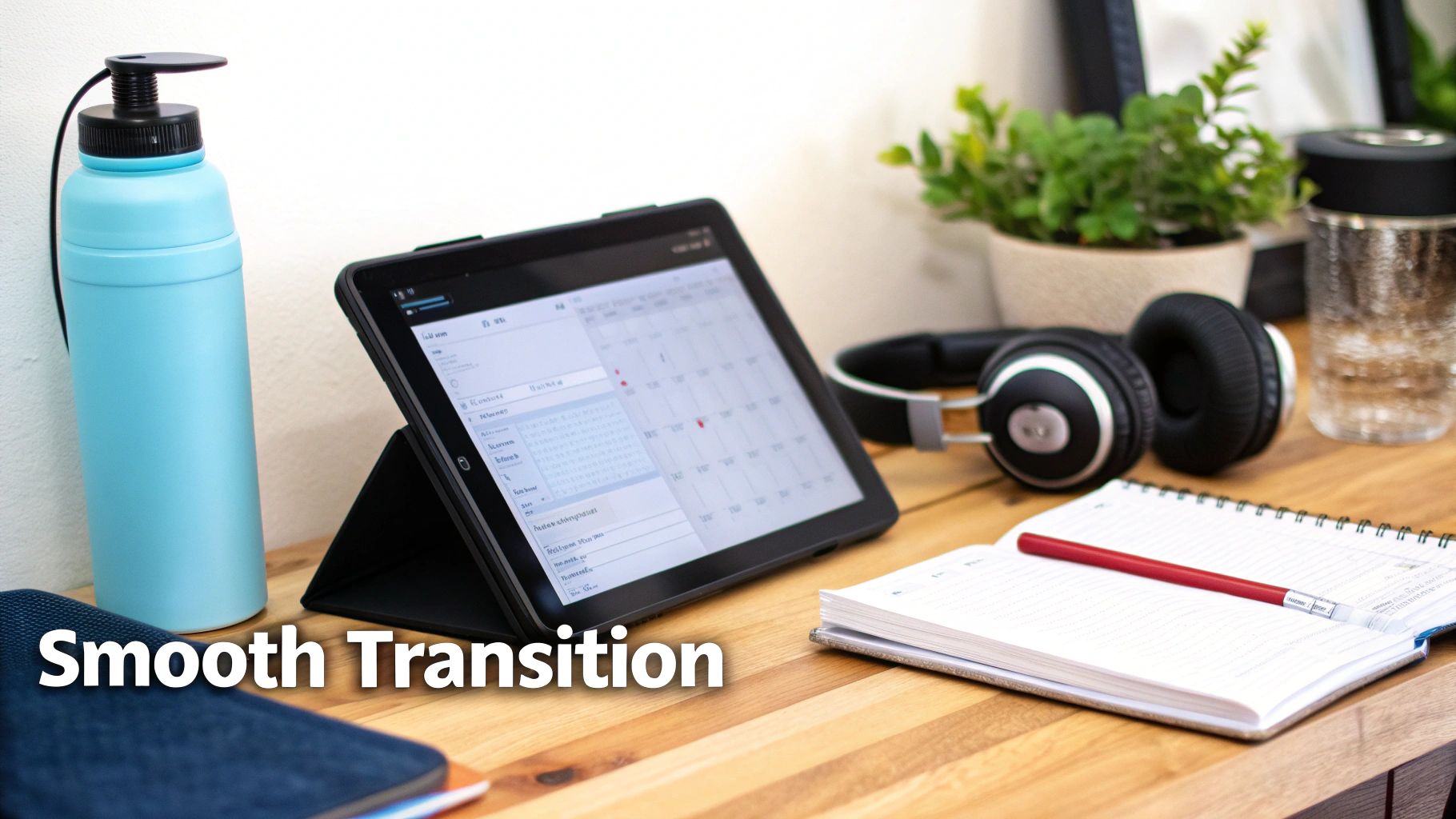
The first, most important step is to design a dedicated learning space with your child. This isn't just about logistics; it gives them a real sense of ownership and control over their new routine. It doesn’t have to be a whole separate room, but it should be a consistent, quiet, and organised area that clearly signals "it's time to learn."
Ask them what would help them focus. Maybe it's a comfy chair, noise-cancelling headphones, or having their art supplies within easy reach. Making this space their own helps build a powerful, positive association with their new school day. Is the area free from the tempting distractions of the TV or noisy siblings? This simple act of creating their personal zone shows them you’re on their team.
Co-Creating a Balanced Schedule
One of the greatest gifts of flexible learning is the freedom to craft a schedule that works for your child, not against them. Instead of imposing a rigid structure, sit down together with a piece of paper or a whiteboard and map out a daily rhythm. A visual timetable can be an absolute game-changer here.
Block out the non-negotiables first, like live class times, and then ask your child what else they need in their day to feel good. Schedule in generous breaks for running around outside, protected time for building LEGOs, and dedicated social time, whether that’s online with school friends or in person. This collaborative approach doesn't just create a better schedule; it teaches invaluable time management skills and reinforces that their well-being is the top priority.
Here’s a sample schedule for a Year 8 student, showing how structure and freedom can work hand in hand:
| Time | Activity | Notes |
|---|---|---|
| 8:30 – 9:00 | Morning Routine & Prep | Breakfast, get dressed, and review the day's schedule. |
| 9:00 – 9:50 | Live Class: Mathematics | Log into the virtual classroom for the interactive lesson. |
| 9:50 – 10:10 | Movement Break | A short walk, stretching, or just time away from the screen. |
| 10:10 – 11:00 | Live Class: English | Active participation in class discussions and activities. |
| 11:00 – 11:45 | Independent Study | Work on English homework while the lesson is fresh. |
| 11:45 – 12:45 | Lunch & Free Time | A full hour to eat, relax, and recharge. |
| 12:45 – 1:35 | Live Class: Science | Engage in the day's science lesson and experiments. |
| 1:35 – 2:30 | Hobby Time | Practice guitar, draw, or work on a coding project. |
| 2:30 – 3:30 | Independent Study & Review | Complete remaining assignments and prepare for tomorrow. |
| 3:30 Onwards | Free Time / Socialising | Time for friends, sports, or family activities. |
Communicating the Change with Positivity
How you frame this transition for your child is absolutely critical. Present it not as an escape from something negative, but as an exciting step towards something much better. Focus on the tangible positives that will matter to them: "You'll finally have the energy for your evening football practice," or "Imagine being in a class small enough that you can actually share all your great ideas about history!"
When you highlight the opportunities and involve them in the decisions, you empower them to see this as an adventure they are starting, not a change that is happening to them. That confidence is a powerful foundation for success.
This move also places you alongside a growing number of families choosing a more modern educational path. The UK's online education sector is projected to reach £5.0 billion in revenue in 2025, a testament to its stability and effectiveness. Choosing a flexible learning school isn't a gamble; it's a strategic move towards a future-focused education. You can learn more about the growth of online education on IBISWorld.
Smart Questions and Red Flags
When you speak with admissions teams, asking the right questions can reveal everything you need to know about a school’s culture and its commitment to your child.
A great flexible learning school won’t just enrol your child; they will onboard your entire family. Their process should be designed to build confidence, create connections, and ensure a seamless start from day one.
Arm yourself with these critical questions:
- "What does your student induction process involve?" A strong answer will detail a proper, structured orientation that helps students learn the platform, meet their teachers, and connect with peers before classes even start. It should be about making them feel welcome and safe.
- "How do you help new students make friends?" Look for concrete examples. Do they have virtual common rooms, collaborative projects, and a wide range of extracurricular clubs based on interests, like a Minecraft club or a creative writing group?
- "What is the primary method of communication between parents and teachers?" You want to hear about a clear, direct, and responsive system, like a dedicated parent portal or scheduled check-in calls. You need to know you can reach someone easily if your child is having a tough day.
Be wary of vague answers or obvious red flags. A lack of live, interactive teaching, poor communication channels, or an admissions team that seems more focused on sales than your child’s needs are all signs that a school may not be the supportive partner you're looking for. By asking the right questions, you can feel confident you’re choosing a school that will truly nurture your child's potential.
Got Questions About Flexible Learning? Let's Talk.
Choosing a new school path for your child is a big decision. It’s exciting, hopeful, and… a little nerve-wracking. It’s completely natural to have questions pop up. In fact, asking tough questions is the sign of a thoughtful, caring parent making sure they’re getting it right.
This is the part where we tackle the big concerns we hear most often from families just like yours. We want to give you clear, honest answers so you can feel confident and excited about what a flexible online school could mean for your child.
Will My Child Become Socially Isolated?
This is usually the number one worry, and it’s a valid one. The truth is, the best online schools don’t just hope socialisation happens; they actively build it into the school’s very DNA. The goal isn’t to isolate a child, but to create a different kind of community—one that is often safer, more inclusive, and free from the playground politics that can cause so much anxiety.
Think about it: in a small, live class, students aren’t just names on a screen. They’re actively collaborating on projects in breakout rooms, debating ideas, and getting to know classmates from all over the world. This creates a really unique global classroom where friendships are sparked by shared interests—like a love for Japanese anime or fantasy novels—not just by proximity.
And it doesn’t stop when the lesson ends. A vibrant social life is built through all sorts of virtual clubs. For example, a shy child who would never join the drama club in person might blossom playing a character in a virtual Dungeons & Dragons club. These moderated environments are where students build real, lasting friendships, away from the social pressures of a traditional schoolyard.
Are Qualifications from an Online School Recognised by Universities?
Absolutely—but with one huge condition: you must choose a properly accredited school. This is the deal-breaker. A high-quality flexible learning school is accredited by the same official exam bodies that oversee mainstream schools, like Pearson Edexcel or Cambridge International.
This means your child will study for and earn the exact same internationally recognised GCSEs and A-Levels. These are the gold-standard qualifications that unlock doors to top universities in the UK and across the globe.
Think of accreditation as your quality guarantee. It’s the official stamp that confirms the curriculum, teaching, and assessments all meet the highest educational standards, ensuring your child’s hard work gets the recognition it deserves.
Always ask a school for clear proof of their accreditation. Any school worth its salt will be proud to share this information and should also be able to tell you about their university acceptance rates and the support they offer for applications.
How Do I Know My Child Is Actually Learning Anything?
It's a fair concern. When you can’t physically see your child in a classroom, how can you be sure they're engaged and making progress? The reality is, a good online school often has more transparent and robust ways of tracking progress than many traditional schools.
The secret is in the small class sizes. When a teacher is working with just 8-12 students, they know your child. They know when they are struggling with a concept just by the hesitation in their voice. They use interactive tools like polls and virtual whiteboards to check for understanding in real-time, so learning gaps are spotted and fixed on the spot, not weeks later in a test that leaves your child feeling defeated.
What’s more, the focus shifts away from stressful final exams to regular, low-stakes assessments. This approach gives you a much clearer, continuous picture of how well your child is mastering a subject. As a parent, you’re part of the team. You’ll have your own online portal to monitor progress, see assignments, and keep an open line of communication with teachers. It creates a powerful, collaborative triangle between student, parent, and school, all focused on one thing: helping your child succeed and feel good about their learning again.
Ready to see how a flexible, supportive, and world-class education could reignite your child’s love for learning? At Queens Online School, we put your child at the centre of everything we do, offering a fully accredited British curriculum in a vibrant global community.