
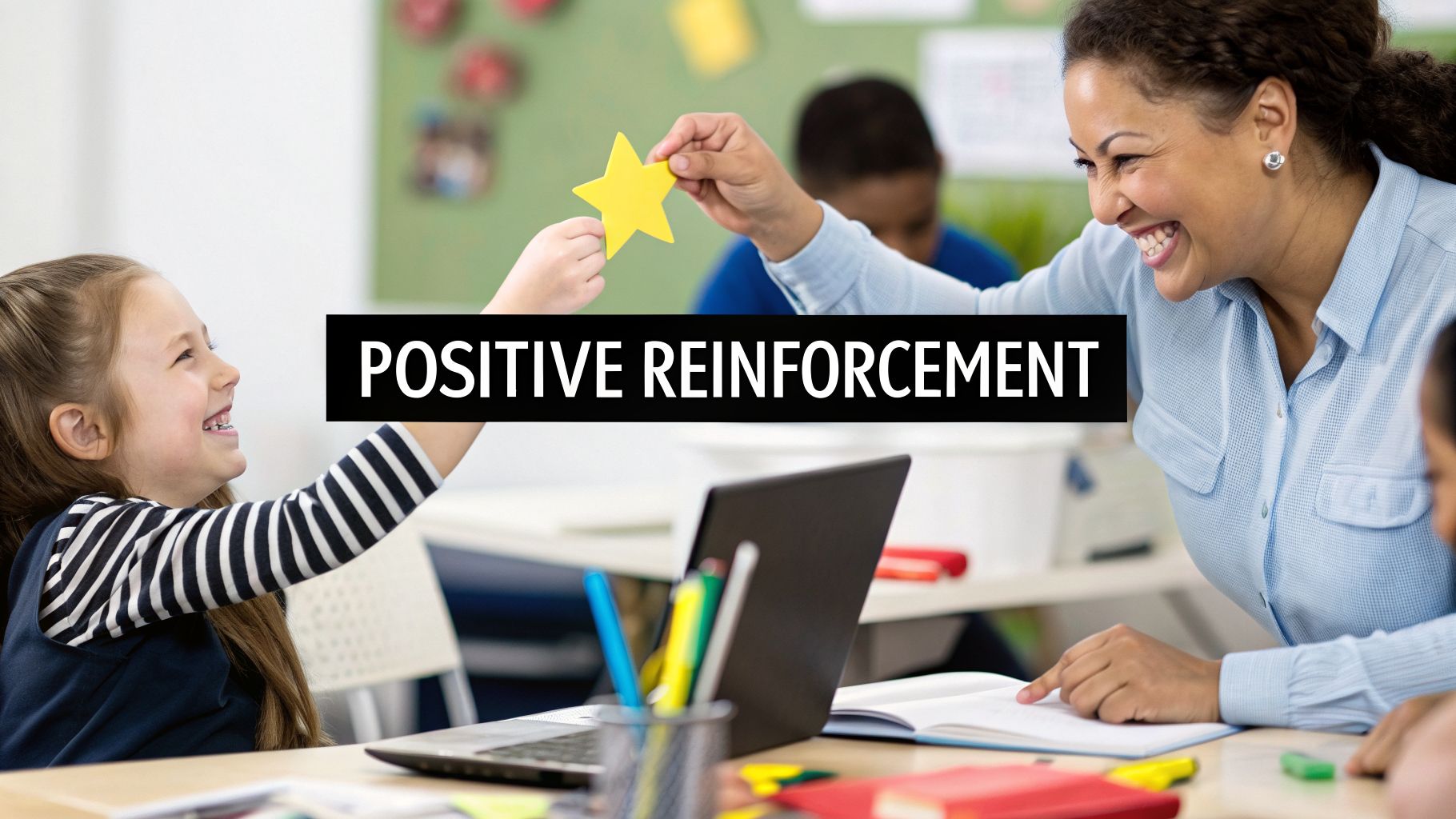
Positive reinforcement is more than a system of rewards; it's a way of seeing and nurturing a child's confidence, resilience, and love for learning from the inside out. When we mindfully celebrate their effort, progress, and positive behaviours, we create an environment where they feel seen, valued, and emotionally secure. This guide moves beyond theory to provide heartfelt, practical examples of positive reinforcement that you can adapt for your child today, whether they are in a traditional classroom, learning at home, or online.
We will explore ten distinct strategies, from the warmth of effective praise to fostering a child's inner drive through autonomy. Each example is broken down into actionable steps, focusing on your child's emotional experience and needs. Understanding the principles behind these techniques is key. To truly unlock a child's potential, it's essential to understand the underlying principles of reward psychology, which explains how their motivation is deeply connected to feeling successful and understood.
By focusing on these strategies, you can help shape not just your child's actions, but their fundamental belief in their own capabilities. This article is your roadmap to implementing positive reinforcement that builds lasting self-esteem and a lifelong passion for discovery, always putting your child's heart at the centre of their journey.
1. Verbal Praise and Recognition
Verbal praise is one of the most immediate and powerful examples of positive reinforcement. It's about offering genuine, specific acknowledgements that see the child behind the effort. This technique moves beyond a simple "good job," focusing instead on what they did to succeed, which helps build their self-esteem and inner motivation. When a child feels truly seen, the praise resonates deeply.

This approach is central to developing a growth mindset. By praising the process—the struggle, the strategy, the persistence—we teach children that their abilities can grow. For a child, hearing "I noticed how you took a deep breath when that question got tricky and then tried a new way to solve it. That was amazing to see," is far more impactful than "You're so clever." It validates their emotional effort and gives them a real tool for the next challenge.
Strategic Breakdown
- Focus: Praising the process, effort, and strategies a child uses.
- Goal: To help a child feel proud of their hard work, encourage persistence, and build their internal love of learning.
- When to Use: Immediately after you see a behaviour you want to encourage, especially in one-on-one moments where your words can truly land and boost their spirit.
Actionable Tips for Implementation
- Be Specific: Instead of "Great drawing," try, "I love the bright colours you chose for the sunset; it makes me feel so happy and warm."
- Praise Effort & Strategy: Acknowledge their hard work. "You really stuck with that difficult puzzle. I saw how you kept turning the pieces to find the right fit. Your patience paid off!"
- Connect to Feeling: Link their actions to positive feelings. "You were so kind to share your snack. I bet that made your friend feel really cared for."
- Vary Your Language: Use different heartfelt phrases so your praise always feels genuine and special to them.
2. Points and Reward Systems
A structured points system can turn learning into a fun game, allowing a child to earn tokens or stars for their achievements. This approach makes their progress visible and gives them clear goals to work towards, which can be incredibly motivating for children who thrive on visual feedback. The points can be saved up for pre-agreed rewards, turning their consistent effort into something they can look forward to.
This method works by creating a clear connection between an action and a positive outcome. For example, a child might earn a star for every night they read before bed, and five stars earns them an extra bedtime story with a parent. The system provides a steady stream of encouragement that helps them build good habits. To truly leverage the power of positive reinforcement, consider implementing a comprehensive chore chart and reward system that feels fun and fair for your child.
Strategic Breakdown
- Focus: To create a clear, visible, and consistent way of acknowledging and rewarding desired behaviours.
- Goal: To build positive habits, make progress feel tangible, and sustain a child's motivation for longer-term goals.
- When to Use: Ideal for tracking daily routines like getting ready for school, completing homework, or practising a musical instrument.
Actionable Tips for Implementation
- Co-create the System: Involve your child in deciding what behaviours earn points and what the rewards will be. This gives them ownership and makes it feel more exciting.
- Offer Choice in Rewards: Create a "reward menu" with things your child truly loves, like a family movie night, choosing dinner, or 30 minutes of one-on-one playtime with you.
- Celebrate Milestones: Make a big deal when they reach a goal! Acknowledge their hard work and celebrate together to build a positive, encouraging atmosphere.
- Keep it Attainable: Make sure the goals are achievable. The system should make your child feel successful and capable, not discouraged.
3. Constructive Feedback with Growth Framing
Constructive feedback, when framed with warmth and a belief in a child's potential, is a powerful form of positive reinforcement. Instead of just pointing out mistakes, this method highlights what they did well first, then offers clear, gentle steps for what they can try next. This approach reassures a child that mistakes are part of learning and that their effort will lead to growth.
This technique is deeply compassionate and effective for any child, especially those who feel anxious about getting things wrong. For a child writing a story, feedback like, "I absolutely love your main character! He’s so brave. To make the story even more exciting, what if you described the spooky forest he's walking through?" builds on their success while giving them a creative, non-critical path forward. It turns feedback from a judgment into a shared adventure.
Strategic Breakdown
- Focus: Emphasising the journey of learning and the exciting potential for growth.
- Goal: To build a child's resilience, help them see challenges as opportunities, and give them a clear, positive next step.
- When to Use: When looking at homework, a creative project, or discussing a challenging social situation. It is a cornerstone of effective formative assessment, where feedback is a loving guide, not a final score.
Actionable Tips for Implementation
- Start with Connection: Always begin by finding something you genuinely appreciate in their work. This opens their heart to hearing more.
- Provide One Clear Step: Offer a single, manageable next step. For example, "You've remembered all your number bonds to 10! The next fun challenge is to see if you can write them down."
- Use "We" and "Let's": Frame suggestions collaboratively. Phrases like, "Let's see if we can add more detail here," make the child feel supported, not singled out.
- Focus on Feelings: "How did you feel when you wrote this part?" This helps them connect with their work and feel understood as a creator.
4. Progress Tracking and Visual Goal Setting
Making progress visible is a deeply satisfying and tangible form of positive reinforcement. This method involves sitting down with your child to set clear, achievable goals and then tracking their journey visually. A colourful chart, a jar to fill with marbles, or a drawing of a mountain to climb transforms an abstract goal into a concrete adventure, creating powerful motivation from within.
This approach makes learning feel like a fun and rewarding game, where every small step forward is a victory to be celebrated. For a child learning to tie their shoes, adding a sticker to a chart for every successful attempt provides an immediate sense of accomplishment. It shifts the focus from the frustrating outcome to the brave, continuous process of trying, a key principle for building a child's inner fire.
Strategic Breakdown
- Focus: Making a child's learning gains visible and celebrating every small step forward.
- Goal: To help a child feel a sense of ownership over their learning, see their own growth, and feel proud of their journey.
- When to Use: At the start of a new school term, when learning a new skill (like riding a bike), or working towards a personal goal.
Actionable Tips for Implementation
- Make it Theirs: Involve your child in creating the tracker. Let them choose the colours, stickers, or theme. This makes the goal feel like their own personal quest.
- Use Visual Tools: Use a wall chart, a LEGO tower where each block is a book read, or a simple drawing. For a child saving pocket money, a transparent jar where they can see the coins accumulate is very powerful.
- Celebrate Small Wins: Acknowledge and praise each step. "Look! You've added another sticker to your chart. You're getting so close, and you've worked so hard!"
- Share Their Success: Let them show their progress chart to other family members. Sharing their success amplifies their feeling of pride.
5. Celebration of Effort, Process, and Inclusive Achievement
This heartfelt approach deliberately reinforces the hard work, persistence, and unique ways a child achieves something, shifting the focus from just the final result. It values the entire learning journey: asking for help when they're stuck, trying again after a mistake, or being a kind teammate. This method builds resilience and an inclusive feeling where every child’s unique way of learning is seen and valued.

This is a powerful example of positive reinforcement that shapes a child's entire outlook on challenges. When a child is praised for their bravery in reading aloud even when they stumbled, or celebrated for meticulously organising their toys, the message is clear: your effort matters. This validation of their internal process is crucial for building a child's confidence and encouraging them to embrace challenges without a paralysing fear of failure.
Strategic Breakdown
- Focus: Recognising and celebrating the process of learning—the courage, the strategy, and the emotional effort.
- Goal: To nurture a growth mindset, promote resilience, and help a child feel that their unique way of trying is what matters most.
- When to Use: During homework, after a challenging day, in family meetings, and whenever a child demonstrates a positive learning behaviour like asking for help.
Actionable Tips for Implementation
- Define 'Good Effort': Talk about what brave effort looks like. "Good effort isn't about getting it right; it's about not giving up when it feels hard."
- Normalise Struggle: Frame mistakes as "brain-growing moments." Use your own examples: "I tried a new recipe today and burned it, but that's okay! I learned what to do differently next time."
- Celebrate Asking for Help: When your child asks for help, praise their self-awareness. "Thank you for telling me you're stuck. That was a really smart and brave thing to do."
- Notice Their Character: Praise their kindness, their creativity, or their focus. "I noticed how you concentrated so hard on that drawing. Your focus was amazing."
6. Peer Recognition and Collaborative Learning Rewards
Peer recognition empowers children to build a kind and supportive community around them. This method shifts the focus from purely adult-led praise to a model where children acknowledge and celebrate each other's efforts, ideas, and kindness. This is a powerful form of positive reinforcement because validation from a friend can feel incredibly meaningful to a child.
This approach helps children develop empathy and social-emotional skills. At home, this could be a "Kindness Jar" where family members write down nice things they've noticed others do. Reading these notes aloud at the end of the week reinforces the kind behaviour and deepens the entire family's appreciation for one another, building a stronger, more loving home environment.
Strategic Breakdown
- Focus: Using the power of friendship and community to reinforce positive social and academic behaviours.
- Goal: To build a collaborative and kind environment, enhance a child's social-emotional skills, and show them the joy of lifting others up.
- When to Use: During group projects, playdates, family activities, or at the end of the week for reflection.
Actionable Tips for Implementation
- Establish Clear Criteria: Guide children on what to look for, like "who was a good listener?" or "who shared their ideas kindly?"
- Model It First: Teach them how to give specific and kind feedback. "I loved how Sarah helped me when I couldn't find the right puzzle piece."
- Use a Visual System: A "shout-out" board on the fridge where family members can post positive notes for each other is a wonderful daily visual.
- Make it About Contribution, Not Competition: Frame it as celebrating everyone's role. At the end of a family clean-up, everyone can share one thing they appreciated about someone else's help.
7. Privilege and Responsibility-Based Rewards
Granting increased independence and responsibility is a powerful form of positive reinforcement that speaks directly to a child's growing desire for autonomy. This method involves rewarding consistent effort and maturity with meaningful roles, such as being in charge of the family movie night choice, helping to plan a meal, or mentoring a younger sibling with their homework. It shifts the focus from getting "stuff" to earning trust and respect.
This approach honours a child's need to feel capable and competent. When a child earns the responsibility of watering the plants or feeding the family pet, they aren't just being rewarded; they are being told, "I trust you. You are an important part of this family." This fosters a profound sense of belonging and self-worth, making it one of the most impactful examples of positive reinforcement for developing a child's character and inner motivation.
Strategic Breakdown
- Focus: Linking positive behaviour to increased autonomy, trust, and meaningful family roles.
- Goal: To build a child's self-esteem, foster a sense of responsibility, and help them feel like a capable contributor.
- When to Use: When a child shows they are ready for a new challenge that benefits both them and the family.
Actionable Tips for Implementation
- Clearly Define the Path: Explain what behaviours lead to specific responsibilities. "When you've shown you can get your homework done without reminders for a week, you'll be ready to choose our Friday night takeaway."
- Offer Diverse Roles: Ensure roles are available for different strengths. A creative child might be in charge of decorating for a holiday, while an organised child could help sort the recycling.
- Provide Support: Guide them so they can succeed. If their new role is to set the table, do it with them the first few times until they feel confident.
- Start Small: Begin with low-stakes responsibilities, like choosing a story at bedtime, and gradually build up to more significant roles as they show they are ready.
8. Positive Home-School Communication
This powerful form of positive reinforcement extends the classroom celebration into the home, creating a supportive triangle between teacher, child, and family. It involves teachers proactively contacting parents to share specific good news about their child. This simple act strengthens the home-school bond and allows the child to receive authentic praise from the most important people in their life—their family.
Imagine your child's face lighting up when you say, "Your teacher emailed me to say how incredibly kind you were to the new student today. I am so proud of the person you are." That moment of shared pride validates their character far more effectively than any sticker chart. It shows the child that their positive actions are seen and celebrated by all the key adults in their world, deeply boosting their motivation and sense of self-worth.
Strategic Breakdown
- Focus: Sharing specific, positive news about a child’s effort, character, or growth with their family.
- Goal: To build a strong, trusting home-school partnership and give a child the gift of feeling celebrated at home for their school successes.
- When to Use: Periodically throughout the term, especially for children who may often find school challenging. A positive note can change their entire perspective.
Actionable Tips for Implementation
- Be Proactive: A quick, positive email or note home can have a huge impact. It doesn't need to wait for official report cards.
- Keep it Specific: Instead of "She's doing well," a teacher could say, "Aisha’s contribution to our history debate was so well-researched and insightful today."
- Highlight Character: Acknowledge personal growth. "I was so impressed with the resilience Sam showed when tackling that difficult maths problem. He didn't give up."
- Create a Positive Loop: When you receive good news, share it with your child and celebrate together, letting them feel your pride.
9. Intrinsic Motivation Development Through Autonomy and Choice
Fostering a child's own inner drive is one of the most lasting examples of positive reinforcement. This method involves giving children meaningful choices in their learning, which satisfies their deep need for autonomy and control. By allowing them to select between different curriculum-aligned tasks or topics, we empower them to take ownership, making learning feel personal, relevant, and exciting.
When a child gets to choose their project topic (e.g., "dinosaurs" or "space") or decides whether to present their findings as a poster or a model, the task itself becomes the reward. This sense of control and personal investment is a powerful reinforcer that transforms "have-to" tasks into "want-to" adventures, building skills for lifelong, self-motivated learning. For a deeper dive into this, explore the principles of self-directed learning.
Strategic Breakdown
- Focus: Granting genuine, age-appropriate choices in learning activities.
- Goal: To build a child's long-term intrinsic motivation and engagement by honouring their need for autonomy.
- When to Use: For homework assignments, creative projects, and even simple daily routines to increase a child's buy-in and creativity.
Actionable Tips for Implementation
- Offer "Bounded Choice": Give two or three good options, all of which you are happy with. "Would you like to do your reading now or after you've had a snack?"
- Start Small: Introduce choice with low-stakes tasks. "Which colour paper would you like to use for your drawing?"
- Connect Choice to Responsibility: Help them understand that their choices have outcomes. "You chose to play first, which was fun! Now we have a little less time for our story, so let's get started."
- Vary the Options: Offer choices in content (which book to read), process (work at the table or on the floor), and product (make a video or write a story).
10. Meaningful Academic Challenge and Success Cycles
Setting the right level of challenge is a subtle but powerful form of positive reinforcement. It involves providing tasks that are just a little bit tricky—demanding real effort but still achievable. This creates a "success cycle." When a child overcomes this "productive struggle" and has a breakthrough, the feeling of accomplishment becomes the reward, building their resilience and inner drive.
This approach places the child's needs at the centre by moving them just beyond their comfort zone with loving support. For a child learning to ride a bike, it’s the moment they manage to pedal for three seconds longer than yesterday. That small victory doesn't just teach them balance; it teaches them that they are capable of doing hard things. This feeling of competence is one of the most profound examples of positive reinforcement and builds a deep, unshakable self-belief.
Strategic Breakdown
- Focus: Calibrating tasks to a level of "optimal challenge" to foster a genuine feeling of achievement.
- Goal: To build a child's confidence and problem-solving skills through repeated cycles of effort and success.
- When to Use: During homework, when learning a new skill, or introducing new concepts. It is perfect for children who lack confidence or fear failure.
Actionable Tips for Implementation
- Know Their 'Just Right' Level: Observe your child to see what is easy, what is just right, and what is too frustrating, and aim for that middle ground.
- Scaffold, Don't Solve: Offer just enough help to get them over the hump, but let them take the final step. Instead of giving the answer, ask, "What could you try next?"
- Celebrate the Process: Acknowledge the effort during the struggle. "I can see you're working so hard on this! Your brain is really growing." Then, celebrate the breakthrough moment with them.
- Use Growth-Mindset Language: When a child says, "This is too hard," respond with, "It's meant to be a little tricky—that's how we learn! Let's find a strategy together."
10-Point Positive Reinforcement Comparison
| Method | Implementation Complexity 🔄 | Resource Requirements ⚡ | Expected Outcomes 📊⭐ | Ideal Use Cases | Key Advantages 💡 |
|---|---|---|---|---|---|
| Verbal Praise and Recognition | Low — immediate, teacher-dependent | Minimal — teacher time; live platform | 📊 Short-term confidence and engagement; ⭐ reinforces effort | Live virtual classes, one-to-one, small groups, SEMH support | Builds intrinsic motivation; personalised; low cost |
| Points and Reward Systems | Medium — design, rules and monitoring | Moderate — LMS integration, tracking tools | 📊 Measurable engagement and participation; ⭐ motivates consistency (extrinsic) | Large cohorts, gamified courses, online participation drives | Clear progress indicators; scalable; gamification-friendly |
| Constructive Feedback with Growth Framing | High — skilled, structured delivery | High — teacher time, training, feedback tools (video/written) | 📊 Sustained academic improvement and resilience; ⭐ actionable growth | Formative assessment, GCSE/A-Level prep, recovering learners | Provides clear next steps; builds growth mindset |
| Progress Tracking and Visual Goal Setting | Medium — setup dashboards and review cycles | Moderate — digital dashboards, data input, teacher review | 📊 Increased agency, visible progress, data-informed interventions; ⭐ promotes metacognition | Personalised learning, remote monitoring, SEN/SEMH support | Promotes ownership; transparent to parents and students |
| Celebration of Effort & Inclusive Achievement | Medium — cultural consistency across staff | Low–Moderate — planning, inclusive resources, training | 📊 Growth mindset and resilience; ⭐ validates diverse strengths | Whole-school culture, diverse cohorts, trauma-informed practice | Normalises productive struggle; enhances inclusion |
| Peer Recognition & Collaborative Rewards | Medium — needs protocols and facilitation | Low–Moderate — training, platform features for peer feedback | 📊 Stronger community and social-emotional skills; ⭐ meaningful peer reinforcement | Group work, breakout rooms, community-building online | Multiple reinforcement sources; develops feedback skills |
| Privilege & Responsibility-Based Rewards | Medium — role matching and oversight | Low — organizational structures and supervision | 📊 Increased agency and leadership; ⭐ builds intrinsic responsibility | Secondary students, mentoring programs, leadership development | Cost-free motivator; develops autonomy and maturity |
| Positive Home–School Communication | Medium — systematic scheduling and tracking | Moderate — staff time, communication tools, translation | 📊 Strengthened family partnership and motivation; ⭐ extends recognition beyond school | Remote learners, families of SEN/SEMH students, early years | Reinforces behaviour at home; builds trust with parents |
| Intrinsic Motivation via Autonomy & Choice | High — curriculum and assessment redesign | Moderate–High — planning, alternative assessments | 📊 Higher engagement and long-term intrinsic drive; ⭐ fosters agency | Secondary/project-based learning, differentiated classrooms | Supports differentiation; cultivates self-determination |
| Meaningful Academic Challenge & Success Cycles | High — diagnostic data and differentiated planning | High — formative assessment, scaffolds, specialist input | 📊 Deep learning, resilience, higher-order skills; ⭐ genuine accomplishment | Differentiated instruction, exam preparation, scaffolded SEN support | Optimises learning through productive struggle and success |
Putting It All Together: Your Next Steps in Positive Reinforcement
Navigating a child's behaviour and motivation can feel complex, but the heart of positive reinforcement is beautifully simple: see the good, and celebrate it. Throughout this article, we've explored a range of examples of positive reinforcement, from the immediate warmth of specific praise to the lifelong gift of nurturing their inner drive. We have seen how these strategies can be adapted to support a child at any stage, always with their emotional well-being at the centre.
The journey from understanding these ideas to weaving them into your daily life is one of love, intention, and consistency. The real takeaway is not just the techniques, but the mindset behind them. It's about shifting your focus from correcting what's wrong to celebrating what's right, thereby building a foundation of confidence, resilience, and a true love for learning and growing.
Your Actionable Blueprint for Success
To truly make these strategies part of your relationship with your child, the key is to start small, be patient with yourself and with them, and build from there.
Here are your next steps:
- Select and Start: Choose just one or two strategies from our list that feel most natural to you and your child right now. Perhaps it’s making a conscious effort to praise their effort instead of the result, or creating a simple visual tracker for a morning routine.
- Observe and Adapt: The most effective reinforcement is deeply personal. Pay close attention to what makes your child's eyes light up. Do they beam with pride at your words, or do they treasure extra one-on-one time with you? Be ready to adjust your approach based on their unique heart and spirit.
- Practise Consistency: The power of positive reinforcement grows over time. A single kind word is lovely, but a consistent pattern of recognition creates an emotionally secure environment where your child feels safe to try, fail, and try again. This consistency is what truly shapes their self-belief.
- Focus on the ‘Why’: Remember, the ultimate goal is not just good behaviour. It is to nurture your child's sense of self-worth and their own internal motivation. Every reward, point, or word of praise is a tool to help them eventually see their own capabilities and find joy in their achievements, all by themselves.
By putting your child at the centre of these practices, you are doing more than managing behaviour; you are building a stronger, more trusting, and more joyful relationship. These examples of positive reinforcement are not just tools for learning; they are powerful ways to connect, heart to heart. Embracing this approach is an investment in your child’s lifelong emotional well-being and their unshakeable belief in their own bright potential.
If you are looking for an educational environment where positive reinforcement and personalised student support are built into the very fabric of learning, discover Queens Online School. Our expert teachers use these very strategies in live, interactive lessons to help students build confidence and achieve their academic goals. Explore how our supportive, child-centred approach can make a difference for your family at Queens Online School.