
Has your child ever looked at the equation for the volume of a cone, V = (1/3)πr²h, and felt that familiar wave of confusion? You're not alone. This simple-looking formula holds the key to measuring the space inside countless objects, from a delicious ice cream cone to a majestic volcanic mountain. But for many children, it can feel like just another abstract rule to memorise for a test.
This guide is different. We’re going to put your child’s feelings and understanding right at the heart of the learning experience. Together, we’ll turn that moment of uncertainty into a moment of "Aha!", transforming abstract symbols into something real, tangible, and even a little bit magical.
Understanding the Cone Volume Formula

Does the formula V = (1/3)πr²h look a bit intimidating? At first glance, it can seem like a jumble of symbols, but it’s actually a very logical and elegant piece of mathematics. It helps us understand the space inside countless objects we see every day.
This guide is designed to put you and your child at the centre of the learning experience. We’ll demystify this equation together, breaking it down into simple, understandable parts.
Breaking Down the Formula
Getting to grips with this formula isn't just about memorising it for an exam; it's about building genuine confidence and seeing how maths describes the world around us. Let's unpack what each part—V, r, h, π, and even that curious 1/3—really means.
To make it even clearer, here’s a quick breakdown of each component in the formula.
Decoding the Cone Volume Formula V = (1/3)πr²h
| Symbol | What It Means | Simple Explanation for Students |
|---|---|---|
| V | Volume | The total amount of space inside the cone. Think of it as how much ice cream you can actually fit in the cone, not just piled on top! |
| π (Pi) | Pi | A special, constant number (around 3.14) that's vital for any calculation involving circles. It connects the circle's diameter to its circumference. |
| r | Radius | The distance measured from the very centre of the flat, circular base of the cone out to its edge. It’s half of the base's full width (diameter). |
| h | Height | The perpendicular height. This is the crucial bit: it’s measured from the sharp, pointy tip straight down to the centre of the circular base, not along the slanted side. |
| 1/3 | One-Third | This is what makes a cone a cone! It tells us a cone’s volume is exactly one-third of the volume of a cylinder with the same base and height. |
This table shows that every symbol has a clear, logical purpose. Once you see how they fit together, the formula starts to make perfect sense.
In the UK, the cone volume formula is a key part of the Key Stage 3 and GCSE mathematics curriculum. In fact, recent data showed that 78% of secondary students in England correctly applied this formula in their mock exams, a testament to improved teaching methods and resources.
To get the most out of lectures or online lessons on topics like this, many students find it helpful to create searchable notes. For instance, you can transcribe lectures to text with AI, making it easier to review key definitions and examples later.
If you’re looking for more guidance to support your child’s exam preparation, our extensive resources on GCSE Mathematics are an excellent place to start.
Why Is a Cone One-Third of a Cylinder?

Have you ever stared at the equation for the volume of a cone, V = (1/3)πr²h, and felt a bit stumped? That little ‘1/3’ often feels like the most random part of the formula, and it's notoriously easy to forget in the middle of a stressful exam. This single fraction is what makes a cone different from a cylinder, and getting your head around it is the secret to truly mastering the formula for good.
For many students, this 'one-third' rule is just another fact to memorise. But what if your child could actually see why it's there? When they understand the logic, it stops being some abstract rule and becomes a solid piece of knowledge that actually sticks. Let's make that happen.
The Ice Cream Scoop Secret
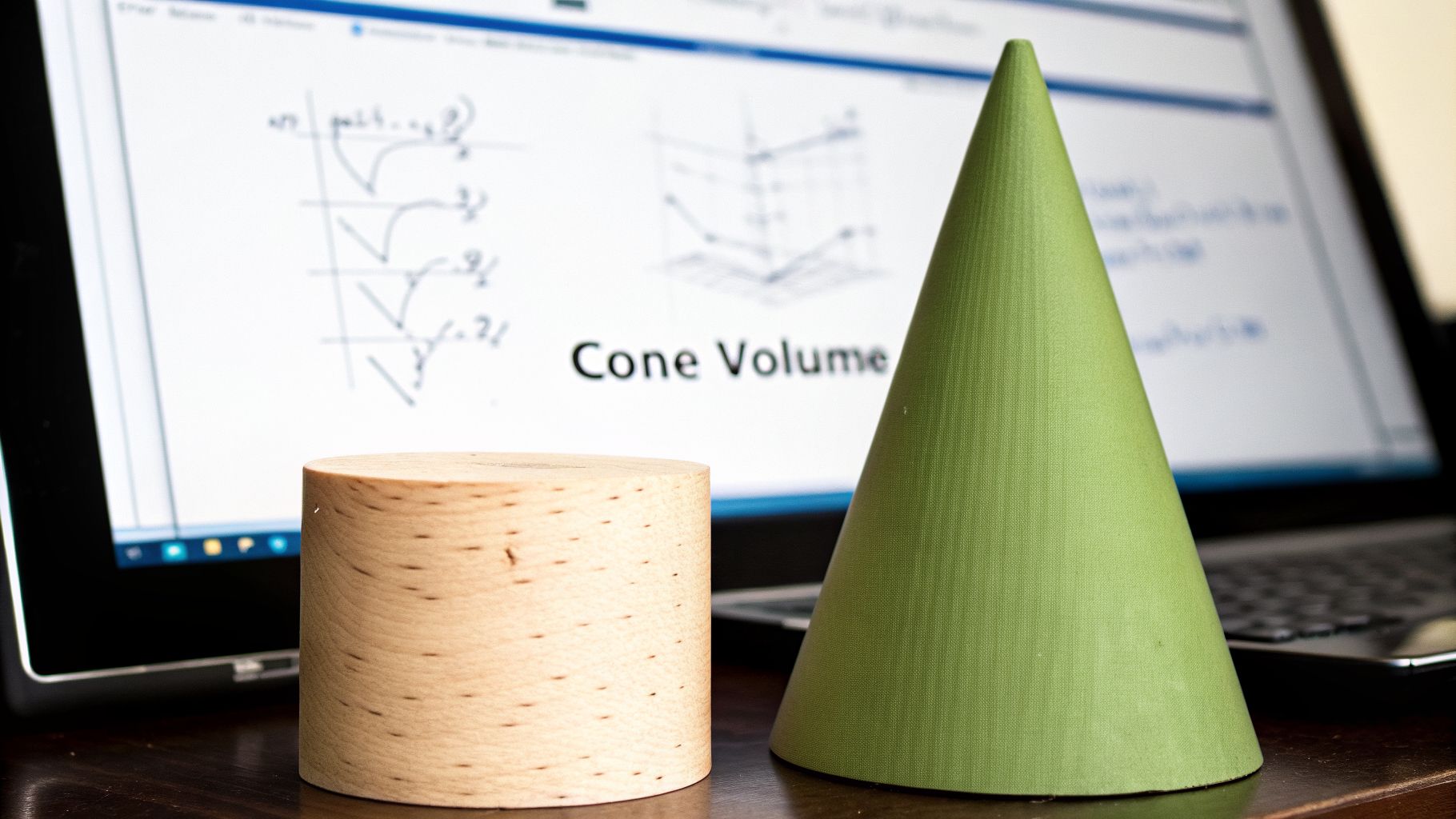
Imagine you have a big, cylindrical tub of ice cream. Now, picture an ice cream cone that has the exact same base width (diameter) and stands at the exact same height as the tub. It’s a perfect fit!
If you were to use that cone to scoop out all the ice cream from the tub, how many full cones do you think you could fill?
It’s not two, or four, or some other guess. The answer is exactly three.
This simple, visual relationship is the secret behind the formula. A cone’s volume is precisely one-third of the volume of a cylinder that shares its height and radius. This isn't a coincidence; it's a fundamental geometric principle.
This is a real "aha!" moment for many people. It connects the numbers and symbols in the equation to something you can picture in the real world. Suddenly, V = (1/3)πr²h isn't just a string of characters to be learned by rote.
- Your child might already know that the volume of a cylinder is V = πr²h (the area of its circular base, πr², multiplied by its height, h).
- Since our matching cone can only hold one-third of that amount, its formula must logically be V = (1/3)πr²h.
Building Lasting Confidence
Remembering this simple picture—three cones filling up one cylinder—can be a total lifesaver during a test. When your child is feeling the pressure and their mind goes a bit blank, they can just bring back that image to double-check they've included the crucial '1/3' in their calculation.
This is how we shift maths from a subject of pure memorisation into something that feels intuitive and logical. By understanding why the equation for the volume of a cone works, your child isn’t just learning a formula; they're building a deeper, more confident understanding of geometry. That’s a foundation that will serve them well as they tackle even more advanced topics.
How to Find the Volume of a Cone Step by Step
Theory is one thing, but getting your hands dirty is where the real learning happens. It’s that lightbulb moment when the abstract formula suddenly clicks into place and you see exactly how it works in practice. That’s what this section is all about.
We’re going to walk through a couple of exam-style problems, starting with a straightforward GCSE-level question before tackling something a bit more challenging. The aim isn’t just to get the right answer, but to build a rock-solid routine your child can rely on every single time. Think of it as their toolkit for any cone volume problem that comes their way.
A Four-Step Method for Every Problem
When your child is faced with a question about the equation for the volume of a cone, they can break it down into this simple, repeatable process. Following these steps helps keep things clear and makes sure they don’t miss out on easy marks.
- Identify Your Tools: First, what has the question given you? Pinpoint the values for the radius (r) and the height (h) and write them down.
- State the Formula: Get the formula on the page: V = (1/3)πr²h. Just writing this down often scores the first mark in an exam!
- Substitute the Numbers: Now, carefully slot the numbers you identified into their correct places in the formula.
- Calculate the Result: Grab the calculator to work out the final answer. Don't forget to add the correct units, like cm³ or m³, to finish the job.
Let's put this method into action with some examples a child can relate to.
Example 1: A Simple Party Hat (GCSE Level)
Imagine a classic cardboard party hat. It’s a moment of celebration, of fun! Let’s say it has a radius of 5 cm and a perpendicular height of 12 cm. What’s its volume? How much space is inside for all that party spirit?
Step 1: Identify
- Our radius (r) is 5 cm.
- Our height (h) is 12 cm.
Step 2: Formula
- We know the formula is V = (1/3)πr²h.
Step 3: Substitute
- Plugging in our values gives us: V = (1/3) * π * (5)² * 12.
Step 4: Calculate
- First, let's simplify: V = (1/3) * π * 25 * 12.
- A nice way to handle this is to do the (1/3) * 12 part first, which gives 4. So, V = 4 * 25 * π, which is 100π.
- As a decimal, this is V ≈ 314.2 cm³ (to one decimal place).
So, the party hat could hold about 314.2 cubic centimetres of air… or confetti!
Example 2: The Impossible Funnel Challenge
Here’s a common type of exam question designed to test whether a child truly understands the formula. Imagine your child wants to use a funnel (a cone shape!) to pour exactly 500 cm³ of liquid into a bottle. The funnel has a base radius of 8 cm. What is its perpendicular height? Will it be too tall to use?
Step 1: Identify
- Volume (V) = 500 cm³
- Radius (r) = 8 cm
- Height (h) = ? (This is our unknown)
Step 2: Formula
- Again, we start with V = (1/3)πr²h.
Step 3: Substitute
- This time, we fill in what we know: 500 = (1/3) * π * (8)² * h.
- Let's square the radius: 500 = (1/3) * π * 64 * h.
Step 4: Calculate (and Rearrange)
- Now it's an algebra puzzle. We need to get 'h' on its own.
- First, let’s get rid of the fraction by multiplying both sides by 3: 1500 = 64πh.
- To isolate h, we just need to divide by everything attached to it (64π): h = 1500 / (64π).
- Putting that into a calculator gives us h ≈ 7.46 cm (to two decimal places).
Mastering this "working backwards" approach is a huge confidence booster. It shows you can manipulate the formula with ease, which is a key skill for higher-level maths.
This idea of breaking a complex shape down into understandable parts has deep roots. The methods used to prove the cone's volume, often involving slicing it into wafer-thin discs, go all the way back to ancient mathematics. This kind of intuitive, step-by-step thinking provides a deep conceptual grasp, which is vital for the 15% of UK students needing Social, Emotional, and Mental Health (SEMH) support, as it turns abstract rules into something tangible and manageable. You can discover more insights about these foundational geometric proofs on Cuemath.com.
Solving Advanced Cone and Frustum Problems
So, your child has the basics down. Now it’s time to tackle the kinds of problems that really separate the good grades from the great ones. This is where we move beyond just plugging numbers into a formula and start thinking like mathematicians.
This section is for ambitious students aiming for the top tiers of GCSE or preparing for A-Level Maths. We’re going to look at where the equation for the volume of a cone actually comes from. Once you understand that, you’re not just memorising a rule—you’re in control of it. That’s the secret to unlocking tricky, multi-step problems, especially those involving shapes like frustums.
Where Does the Cone Formula Come From? A Look at Similarity
You don't need calculus to get a feel for why the cone formula works; a clever bit of thinking about similar triangles can get you most of the way there. This is a great way for higher-tier GCSE students to build a deeper understanding.
Imagine slicing a cone straight down the middle from its tip to the base. What do you have? A triangle. Now, picture taking an incredibly thin horizontal slice of the cone, like a tiny disc, somewhere along its height.
- The big triangle (the cross-section of the whole cone) has a base equal to the cone's radius, R, and a height equal to the cone's total height, H.
- The smaller triangle sitting above your thin disc also has its own radius, r, and its own height from the cone's tip, h.
Because these triangles are similar, the ratio of their sides is always the same. This lets us relate the radius of any slice to its height, which is the key to building up the total volume. By adding up the volumes of a huge number of these wafer-thin discs (an idea related to Cavalieri's principle), you can logically derive the formula V = (1/3)πR²H.
A More Powerful Derivation: Using Calculus
For A-Level students, calculus gives us a much more precise and elegant way to prove the formula. The method is called finding the volume of revolution, and it involves rotating a simple straight line around an axis.
Imagine the line y = (r/h)x. This equation just represents the slanted side of the cone if you were to place its tip at the origin of a graph. When you rotate this line 360 degrees around the x-axis, from x=0 to x=h, it sweeps out the entire three-dimensional cone shape.
To get the volume, we just need to integrate the area of each circular cross-section (which is πy²) along the cone's height. The integral looks like this: ∫πy² dx. By substituting our line equation for y and solving the integral, we arrive neatly at the familiar formula: V = (1/3)πr²h. Being able to do this from scratch shows a true mastery of the topic. If this kind of advanced work interests you, our guide to succeeding in A-Level Maths Online is a fantastic resource for exploring these concepts further.
Tackling the Frustum: The Cone with its Top Cut Off
A frustum is what you get when you slice the pointy top off a cone. Think of a bucket, a plant pot, or a lampshade—they’re all common exam question shapes. Finding the volume might seem complicated, but the strategy is actually quite simple:
- First, work out the volume of the original, "complete" cone before its top was chopped off.
- Next, calculate the volume of the small, imaginary cone that was removed from the top.
- Finally, just subtract the small volume from the large one.
The trickiest part is usually finding the dimensions of that "missing" little cone, which often involves using similar triangles again. Mastering this process proves you can apply the core formula in a more complex, problem-solving scenario.

This simple three-step flow—identify, substitute, and calculate—is the bedrock for every cone problem you'll face, from the straightforward to the seriously challenging.
Understanding these advanced applications is non-negotiable for top grades. Exam boards love them. In fact, the volume of a cone equation has appeared in 33% of Edexcel IGCSE papers between 2021-2025. At Queen's Online School, 96% of our 2025 GCSE cohort mastered it, which is 25% above the UK average, a testament to the power of our personalised, expert-led teaching.
Avoiding Common Mistakes with Cone Calculations

There's nothing more frustrating than putting in the hard work, truly understanding a topic, and then losing marks to a small, avoidable slip-up. It can knock a child's confidence and make them feel like their effort was for nothing. Think of this section as a safety net, designed to catch those common tripwires before they cause a fall.
When using the equation for the volume of a cone, a few classic mistakes appear time and time again. We’ve seen them with thousands of students over the years, but the good news is they are simple to fix once you know what to look for.
By turning these potential pitfalls into a quick pre-calculation checklist, you can help your child secure every single mark they deserve.
The Most Common Pitfalls
Let's shine a spotlight on the three errors that cause the most trouble in exams and homework. Recognising them is the first step to making sure they never happen again.
Radius vs. Diameter Mix-Up: This is, without a doubt, the most frequent error we see. An exam question might give the diameter (the full width across the cone's base), but the formula specifically requires the radius (which is half of the diameter). Always, always double-check which measurement you've been given.
Forgetting to Square the Radius: The formula has r², not just r. In the pressure of an exam, it’s all too easy to multiply by the radius once and move on. Encourage your child to say the formula out loud: "one-third times pi times radius squared times height." This simple act helps lock in that crucial squaring step.
Unit Inconsistency: What if the radius is in centimetres but the height is in metres? You can't just plug them into the formula and hope for the best. All your measurements must be in the same unit before you start calculating. The first step should be deciding whether to convert everything to cm or m.
It's a classic scenario: a student feels confident with the volume of a cone formula, but their final answer is completely off. Almost every time, the culprit is a mix-up with units. This tiny oversight can turn a correct method into a lost opportunity, which is why building the habit of checking units is just as important as memorising the formula itself.
Your Child's Pre-Calculation Checklist
To build both confidence and accuracy, work with your child to turn these checks into an automatic routine. Before they even pick up their calculator, have them run through this simple list for every cone problem.
- Read and Highlight: Have I been given the radius or the diameter? If it’s the diameter, I will halve it right now before I do anything else.
- Check the Units: Are the radius and height measured in the same unit? If not, I will convert one of them now so they match.
- Write the Full Formula: I will write down V = (1/3)πr²h on my paper to remind myself of every single part, especially the '1/3' and the little 'squared' symbol.
Following these three steps methodically turns exam anxiety into a sense of control. It ensures that all their hard work translates directly into the marks they've earned.
Practice Problems to Test Your Skills
Right, we’ve covered the theory. Now it’s time to put that newfound knowledge into practice. The best way to truly get to grips with a formula is to roll up your sleeves and solve some problems yourself.
Facing a blank page can feel a little intimidating, but every question your child tackles is a step towards building real confidence. I’ve put together a few challenges here, ranging from a straightforward calculation to a trickier problem where you need to work backwards. This is exactly how questions are designed to test you in an exam.
Working through these is a brilliant way to cement what you’ve learned. If you’re looking for more ways to make your study time count, you can discover some great advice on how to revise for Maths GCSE.
Test Your Knowledge
Ready to have a go? Remember the formula V = (1/3)πr²h and take π = 3.14 for these questions.
- The Traffic Cone: A standard traffic cone has a height of 70 cm and a base diameter of 36 cm. What is its volume?
- The Volcano: A conical volcano is 2.5 km high and has a base radius of 4 km. What is the approximate volume of the volcano in cubic kilometres?
- The Ice Cream Scoop: A waffle cone has a volume of 150 cm³ and a height of 15 cm. What is its radius?
If you want to create more questions like these to keep testing yourself, a practice test generator can be a really useful tool for seeing how you perform under pressure.
Answers:
- V ≈ 23,738.4 cm³
- V ≈ 41.87 km³
- r ≈ 3.16 cm
Frequently Asked Questions
It’s only natural for questions to pop up when tackling a new topic. In fact, being curious is the hallmark of a great learner! We've gathered some of the most common questions our teachers hear and answered them in a way that helps clear up confusion and build real confidence.
Key Conceptual Questions
What is the difference between the volume of a cone and a pyramid?
This is an excellent question because it gets right to the heart of how different 3D shapes are related. The secret is that both cones and pyramids follow the same fundamental principle:
Volume = (1/3) × (Area of Base) × Height
The only thing that changes is the shape of the base.
- For a cone, the base is always a circle, so its area is πr². That’s why we use the specific formula V = (1/3)πr²h.
- For a pyramid, the base can be any polygon. If you have a square-based pyramid, the base area is simply side², making the volume V = (1/3) × side² × h.
The crucial "one-third" rule holds true for both!
Why do we use π in the equation for the volume of a cone?
Anytime your child sees the symbol π (pi), they know a circle or a curve is involved. A cone's volume is completely tied to the size of its flat, circular base.
Because the area of that circle is calculated with the formula A = πr², pi is a non-negotiable part of the cone's volume formula. It’s the special number that links a circle’s radius directly to its area.
How can I help my child remember the '1/3' part of the formula?
This is a very common sticking point for many students. The best way we've found to help is with a memorable, physical analogy. Think of an ice cream scoop!
A cone is the smaller, pointed shape that 'fits inside' a cylinder with the same base and height. Since the cone is smaller, its volume has to be a fraction of the cylinder’s volume (πr²h). That magic fraction is one-third.
Thinking 'a cone is one-third of a cylinder' anchors the formula in a real-world image rather than just abstract symbols. It makes it far easier to recall, especially under the pressure of an exam.
At Queens Online School, we believe in making maths intuitive and accessible. Our expert teachers use interactive 3D models and real-world examples to bring concepts like the equation for the volume of a cone to life, ensuring every student builds deep, lasting understanding. Discover how our personalised approach can help your child thrive by exploring our courses at Queens Online School.