
An English GCSE online course offers the full, accredited qualification you'd get in a traditional school, but with a profoundly different, child-centred approach. Imagine live, interactive lessons where your child is known by name, and flexible recorded materials that fit around your family's life. It's a fantastic option for the child who blossoms with a bit more one-on-one attention, needs a schedule that respects their unique energy levels, or simply craves a calm, focused place to learn without the constant worry and pressure of a busy classroom.
Is an Online English GCSE Course Right for Your Child?
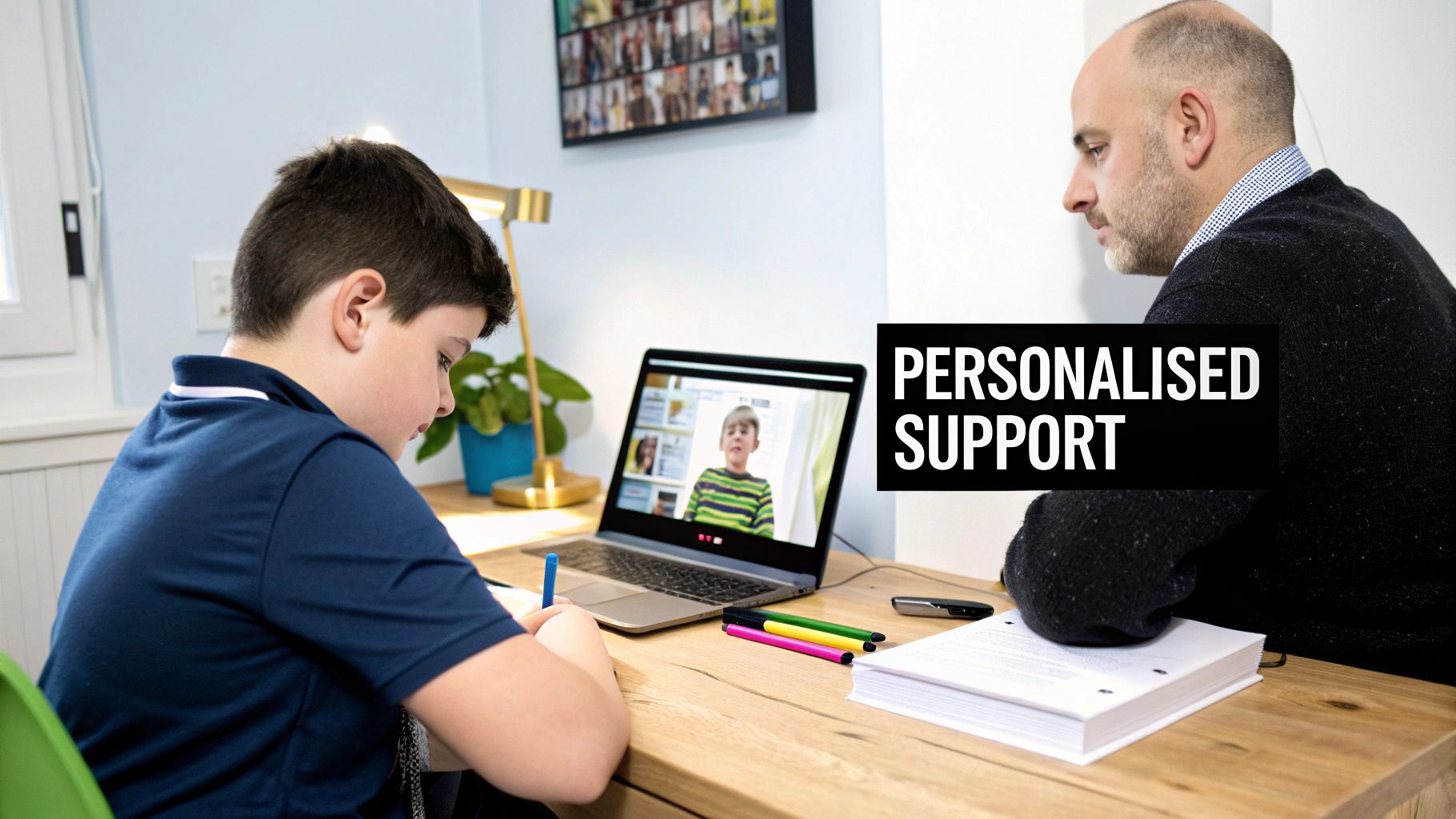
The jump to GCSEs can feel massive, both for your child and for you. It’s a time swimming with questions and the natural instinct to make sure they have the absolute best support. If you’ve found yourself wondering whether a mainstream school is the right fit, you are definitely not alone. More and more parents are discovering the real benefits of an online learning journey.
Picture a classroom where your child isn’t just another face in the crowd, but an individual the teacher knows by name. This is the heart of a quality English GCSE online course. It swaps the noise and rush of a busy school for a calm, focused, and genuinely supportive space where learning comes first.
A Personalised Path to Confidence
For so many children, the simple act of raising their hand in a class of thirty can be terrifying. That fear of getting an answer wrong or being judged by their peers can quickly shut down curiosity and stop them from taking part. Online learning completely changes that dynamic.
In small, live-streamed classes, students feel seen and heard. This personalised attention empowers them to ask questions, share ideas, and really get stuck into texts like Shakespeare or modern poetry without feeling self-conscious.
Think of a student like Tom. He loves creative writing but is far too shy to share his work out loud. In his online class of just eight students, he feels comfortable enough to finally read his stories. His teacher’s encouragement and the positive feedback from his classmates help him find his voice, turning something that caused him anxiety into a real source of pride. This is the kind of transformation a child-centred approach can spark.
Flexibility for Every Family's Needs
Life doesn't always fit neatly into a 9-to-3 school day. An online course gives you the structure of a proper timetable but with the flexibility that modern families so often need. This model works particularly well for students who:
- Feel anxious in large school settings: A calm home environment can massively reduce social pressures, letting them focus completely on their studies.
- Require specialised support (SEN/SEMH): Teachers with real expertise in SEN can provide targeted help in a setting where your child feels safe and secure.
- Are pursuing other passions: A budding athlete or talented musician can balance their training with their academic work without having to compromise.
This approach understands that every child’s path is unique. By providing a nurturing and adaptable environment, an English GCSE online course helps turn parental worry into genuine confidence. You can find out more about the structure of online home education and see how it supports all kinds of different student needs. It's about creating a personalised journey where your child doesn't just pass their exams—they develop a real, lasting love for learning.
Decoding the Online English GCSE Syllabus
The official English GCSE syllabus can look like a pretty intimidating puzzle. It's often filled with assessment codes and jargon that don't really explain what your child will be doing day-to-day. But at its heart, the qualification is built on two powerful pillars that work together to create strong, confident communicators.
An English GCSE online course brings this syllabus to life by breaking it down into two distinct but connected subjects: English Language and English Literature. This isn't just about ticking boxes to pass an exam; it’s about giving your child the tools to understand the world and express their own ideas with real clarity and impact.
Let’s take a look at what that means in practice.
English Language: Skills for the Real World
English Language GCSE is all about the mechanics of communication. It goes way beyond basic grammar and spelling to teach students how to analyse, persuade, and argue effectively. This is where your child learns to become a critical thinker—someone who can see beneath the surface of the words they read every single day.
Imagine your child in an interactive online lesson. Instead of staring at a dry textbook, they’re dissecting a recent newspaper article about a local environmental issue. The teacher guides them to spot the subtle, persuasive language the journalist uses, like emotive words or carefully chosen statistics. They learn to identify bias and understand how a writer is trying to shape their opinion.
This practical approach keeps the learning relevant. Students will explore:
- Persuasive Writing: They might be tasked with writing a letter to their local MP about something they feel passionate about, learning how to structure a powerful argument that actually inspires action.
- Creative and Descriptive Writing: They could be asked to write the opening of a story based on a dramatic image, focusing on building atmosphere and suspense to hook a reader from the first sentence.
- Analysis of Non-Fiction: This involves looking at everything from travel blogs and opinion pieces to famous historical speeches, understanding how language is used to inform, entertain, or inspire.
This isn’t about rote learning. It’s about equipping your child with the skills to confidently navigate a world saturated with information, making them savvy consumers of media and powerful creators in their own right.
The goal is to transform a student from a passive reader into an active analyst. They stop just reading the news and start questioning it—an essential skill for life, long after they leave the classroom.
English Literature: Bringing Stories to Life
While English Language focuses on how we use words, English Literature explores why we use them. This is where your child will dive into the timeless stories, poems, and plays that help us understand what it means to be human. A good English GCSE online course makes these classic texts feel immediate, relevant, and exciting.
Think about the challenge of teaching Shakespeare to a teenager. In a dynamic online classroom, this becomes a collaborative exploration. Students might use digital whiteboards to map out the complex relationships in Romeo and Juliet or hold a lively debate in a breakout room about whether Macbeth was a villain or a victim of his circumstances. The text is no longer just words on a page; it’s a living, breathing story.
The syllabus typically includes a rich mix of classic and contemporary works, such as:
- A Shakespeare Play: Exploring universal themes of love, ambition, and betrayal that still hit home today.
- A 19th-Century Novel: Discovering worlds like Dickensian London, getting to grips with social context and character development.
- Modern Drama or Prose: Analysing more recent texts that reflect the complexities of our own world.
- A Collection of Poetry: Learning how poets use imagery, sound, and structure to convey deep emotions in just a few lines.
The online format is brilliant for this, as teachers can bring in multimedia resources—clips of stage performances, historical documentaries, and author interviews—to provide rich context. This helps ensure every child can connect with the material on an emotional level, building not just knowledge, but genuine empathy and understanding.
What an Online English GCSE Classroom Looks Like
Stepping into a virtual classroom for the first time can feel a little strange. Parents often picture a lonely experience, with their child just watching videos in isolation. But a high-quality English GCSE online course creates a space that is vibrant, interactive, and deeply human, even through a screen.
It’s about replacing the unpredictable noise of a large, physical classroom with a calm, focused environment where your child feels confident and ready to learn. The experience is designed from the ground up to put their needs at the very centre of every lesson.
Live Lessons Versus Recorded Sessions
The heart of the online school week is the live, interactive lesson. This is not a passive webinar. It’s a real-time, scheduled class with a specialist English teacher and a small group of classmates, often fewer than ten students.
Imagine your child logging in and seeing friendly, familiar faces. The teacher greets them by name. When they discuss a poem, your child can raise a virtual hand to ask a question, type a thought into the chat box for immediate feedback, or join a small breakout room to collaborate with two or three peers on analysing a specific stanza. This constant interaction keeps them engaged and accountable.
In contrast, every live lesson is also recorded. These recordings are a powerful tool for flexible learning.
- Revision Powerhouse: If your child felt unsure about Shakespearean language in Tuesday’s lesson on Macbeth, they can re-watch that specific part of the class that evening, pausing and rewinding as needed.
- Consolidating Knowledge: It allows them to go over complex ideas at their own pace, transforming a moment of confusion into one of clarity without the pressure of having to keep up.
- Managing Life: If a medical appointment is unavoidable, they won’t miss out. The recorded session ensures they can catch up on the material and arrive at the next lesson fully prepared.
This blend of live interaction and flexible access gives your child both structure and control. It honours their need for connection while respecting their individual learning pace, building a sense of ownership over their studies.
A Typical Week in View
So, what does this actually look like in practice? An online school week is carefully structured to balance focused academic work with essential downtime and independent study, preventing screen fatigue and promoting well-being.
A weekly timetable might see live English lessons on Monday, Wednesday, and Friday mornings. These sessions are complemented by assigned independent tasks—perhaps drafting an essay, annotating a text, or completing a practice paper. Understanding the support systems available is key in an online setting; students can learn how to effectively use AI for homework help to support their independent study without compromising academic integrity.
Throughout the week, students also have access to teacher office hours for one-to-one support, virtual clubs, and school-wide assemblies, creating a genuine sense of community. To get a clearer idea of this structure, explore our guide on learning in virtual environments.
This sample timetable gives a feel for how a student's week is structured to include not just core academics, but also time for independent work, creative pursuits, and social connection.
Sample Weekly Timetable for a GCSE English Student
| Time Slot | Monday | Tuesday | Wednesday | Thursday | Friday |
|---|---|---|---|---|---|
| 9:00 – 10:00 AM | Live English Lesson | Live Maths Lesson | Live English Lesson | Live Science Lesson | Live English Lesson |
| 10:00 – 11:00 AM | Live History Lesson | Independent Study | Live Geography Lesson | Independent Study | School Assembly |
| 11:00 – 12:00 PM | Independent Study | Live Science Lesson | Independent Study | Live Maths Lesson | Independent Study |
| 12:00 – 1:00 PM | Lunch Break | Lunch Break | Lunch Break | Lunch Break | Lunch Break |
| 1:00 – 2:00 PM | P.E. / Wellbeing | Art Club | Independent Study | Teacher Office Hours | Independent Study |
| 2:00 – 3:00 PM | Independent Study | Independent Study | Debate Club | Independent Study | Free Time |
As you can see, the day is broken up into manageable chunks, mixing live teaching with self-directed learning and activities that build a sense of community.
How Assessments and Exams Work
The word "exam" can cause a spike of anxiety for any parent or student. A good English GCSE online course demystifies this process by building confidence through regular, low-stakes assessments.
Instead of one huge, high-pressure exam at the end, progress is monitored continuously. Your child will submit regular assignments and receive detailed, constructive feedback from their teacher. This feedback isn't just a grade; it's a conversation that highlights their strengths and provides clear, actionable steps for improvement. For example, instead of just seeing ‘B grade’, your child might get a comment like, “This is a fantastic analysis of the character’s motives! Next time, try adding a direct quote here to make your point even stronger.”
As the official exams approach, the school organises formal mock exams under timed conditions. This is a crucial step that helps your child:
- Practise Time Management: They learn how to allocate the right amount of time to each question.
- Build Resilience: It familiarises them with the pressure of an exam setting, reducing anxiety on the actual day.
- Identify Weak Spots: The results show exactly which areas need more focus during the final revision period.
When it comes to the final GCSEs, accredited online schools have a seamless process. They arrange for your child to sit their exams at a physical partner exam centre, ensuring the qualification is fully recognised and valued by universities and employers worldwide. This removes all the logistical worry, allowing your child to focus on one thing: showing what they know.
How to Find the Best Online School for Your Child
Choosing an online provider can feel like the single most important decision you’ll make—because it is. This isn't just about finding a course; it's about finding a community and a support system where your child will feel safe, seen, and genuinely inspired to do their best.
To get past the glossy brochures, you need to ask the right questions. It's about making sure a school’s values truly line up with your family’s needs and that the environment is not just academically strong, but emotionally nurturing too.
Teacher Qualifications and Class Sizes
At the end of the day, an online school is only as good as its teachers. When a teacher is passionate, properly qualified, and has the time to dedicate to each student, that’s when the magic happens. A great starting point is to look for teachers with Qualified Teacher Status (QTS), which is the benchmark for meeting national teaching standards in the UK.
But qualifications are just the beginning. The real game-changer is small class sizes. It’s what allows those brilliant teachers to make a genuine difference.
In a class of just eight, for instance, a teacher notices when a student is struggling with a concept, even if they don't speak up. They can gently encourage quieter children to share their thoughts and give instant, personalised feedback. If your child is finding Shakespeare’s language a bit daunting, a teacher in a small group can pause the lesson, pop them into a quick one-to-one breakout room for a simple explanation, and make sure they feel confident before rejoining the main group. That kind of personal attention is simply impossible in a class of thirty.
A smaller class size directly translates to a more personalised learning experience. It creates a supportive atmosphere where your child feels comfortable asking for help, which is fundamental to building academic confidence.
Support for SEN and SEMH Needs
For many families, finding the right support for Special Educational Needs (SEN) or Social, Emotional, and Mental Health (SEMH) challenges is the main reason for switching to an online school. A truly inclusive provider will have this support woven into its very fabric, not just bolted on as an afterthought.
Don't be afraid to ask direct questions about their SEN provision:
- Who is your SENCo (Special Educational Needs Coordinator)? A dedicated, experienced SENCo is a huge indicator of a well-resourced and serious school.
- How do you create and implement individual learning plans? They should be able to walk you through a clear process for assessing needs and adapting their teaching methods.
- What training do your teachers have in supporting specific needs? This shows a real commitment to staff development and student wellbeing.
Accreditation and Pastoral Care
Finally, there are two practical pillars that absolutely must be in place: official accreditation and strong pastoral care.
Accreditation from a recognised exam board like Pearson Edexcel or Cambridge International ensures the qualification your child earns is respected by universities and employers worldwide. This is a non-negotiable.
Pastoral care, on the other hand, is the school’s soul. It's all about creating a safe, positive online community. Ask providers about their anti-bullying policies, how they handle disagreements between students, and what they do to promote positive mental health. Do they run virtual school assemblies, offer online clubs, or use house systems to help students build friendships and feel like they belong?
This decision tree can help you weigh up whether live lessons or recorded sessions would be a better fit for your child’s learning style.
As the flowchart shows, the best choice really depends on whether your child thrives with real-time interaction or prefers the flexibility of studying at their own pace.
Ultimately, finding the right online school means choosing a provider that not only delivers an excellent education but also nurtures your child as an individual. For a broader look at what's available, you might find our guide to GCSE online courses in the UK helpful.
The Real Benefits of Studying GCSE English Online
It’s a question many families find themselves asking: why make the switch to an English GCSE online course? While convenience is certainly part of the appeal, the real reasons go much deeper. They’re found in the profound emotional and academic advantages that a different kind of learning environment can offer a child.
This is about far more than just passing an exam; it’s about creating the right conditions for your child to genuinely thrive. For many, that means stepping away from the pressures of a traditional school and into a space where their individual needs aren't just an afterthought, but the absolute priority.
Building Confidence One Lesson at a Time
Picture a child who dreads English lessons. They find analysing poetry a struggle, and the thought of reading their own work aloud in front of thirty others is terrifying. In a large, busy classroom, it’s all too easy for them to become invisible, their quiet struggles going unnoticed as the lesson moves on without them.
Now, imagine that same child in an online class with just six other students. When they don’t understand a metaphor in a poem, they feel comfortable enough to ask the teacher directly. In breakout rooms, they discuss ideas with a couple of classmates and discover they aren't the only one who finds Shakespeare’s language a bit tricky.
This personalised attention is the cornerstone of a great online course. It rebuilds the academic confidence that may have been chipped away in a busier setting. Suddenly, learning isn't something to fear; it's an empowering, positive experience where every question is heard and valued.
A supportive online environment creates a safe space where a child’s voice is heard. This fosters the courage to participate, make mistakes, and ultimately, to discover their own strengths.
Fostering Independence and Reducing Stress
The rigid, bell-driven structure of a traditional school day simply doesn't work for every child. For some, the early mornings, noisy corridors, and constant social pressures create a state of low-level anxiety that gets in the way of real learning.
An English GCSE online course offers a calmer, more flexible rhythm. It removes the daily commute and the exhausting social dynamics, freeing up mental and emotional energy for what truly matters: their studies. This isn’t about having less structure, but about a smarter structure—one that respects a young person's well-being.
This flexibility allows a student to flourish outside their academic life, too. A talented gymnast can attend morning training sessions without falling behind by catching up with recorded lessons later. A young carer can manage their family responsibilities while still pursuing their educational goals. This balance reduces stress and teaches invaluable life skills like time management and self-discipline.
Meeting the rigorous standards for GCSEs requires focus. The UK's GCSE pass rate (grade C/4 or above) stood at 67.4 percent in recent years, a figure that remains higher than pre-2019 levels. This data highlights the value of high-support learning models, where small classes and direct feedback help students meet these challenging benchmarks. You can find more insights about UK GCSE performance on Statista.com.
Preparing for a Connected World
Learning online does not mean learning in isolation. In fact, it often opens up a child’s world in ways a local school simply cannot. They connect and collaborate with peers from different cities, countries, and cultural backgrounds, all from their own home.
This global community offers some unique benefits:
- Enhanced Cultural Awareness: Discussing a novel with students who have different life experiences brings entirely new perspectives and deepens their understanding of the text.
- Modern Communication Skills: They quickly become adept at articulating their ideas clearly and respectfully in a digital setting—an essential skill for the future.
- A Sense of Belonging: Joining virtual clubs and school-wide events helps them build genuine friendships based on shared interests, not just geography.
This environment prepares them not just for their exams, but for a future where collaboration and communication will increasingly happen across digital platforms. It’s an education that reflects the reality of the modern world, empowering your child with the skills and confidence to succeed in it.
A Few Common Questions
Stepping into the world of online GCSEs can feel like navigating new territory. It’s completely normal to have questions, especially when it comes to something as important as your child’s education. We’ve put together some straightforward answers to the questions we hear most often from parents and students, designed to give you clarity and confidence.
How Do Universities View an English GCSE Earned Online?
This is usually the first thing parents want to know, and the answer is refreshingly simple. Universities and colleges see a GCSE from an accredited online school as completely equal to one from a traditional school. The magic word here is accreditation.
When an online school is an approved centre for exam boards like Pearson Edexcel or Cambridge International, it means they’re held to the exact same high standards. They follow the same curriculum, sit the same exams, and are graded in the same way. University admissions tutors care about the final grade your child achieves, not the building they learned in.
But there's another layer to this. Succeeding in an online course tells universities something more about a student. It shows they’re self-disciplined, organised, and comfortable in a digital world—all incredibly valuable traits for higher education.
Think about your child's university application. Alongside a strong grade in English, they can talk about how they managed their own revision schedule for mocks or collaborated on a project with classmates from another country. These are powerful, real-world examples of the maturity and independence that online learning helps build.
How Will an Online Course Keep My Child Motivated?
Motivation isn’t about flashy gimmicks; it’s about feeling connected, making real progress, and being genuinely engaged. The best online schools build this right into their teaching, and it’s a world away from just watching recorded videos in isolation.
It starts with the lessons themselves. Live, interactive classes in small groups are a game-changer. When a teacher knows your child by name and asks for their take on a poem, your child feels seen and valued. There's a natural incentive to be prepared and participate when you know your voice matters.
The learning is also just more interesting. Teachers use all sorts of digital tools to bring subjects to life. Instead of just reading An Inspector Calls, students might use an interactive whiteboard to map out the chain of events or jump into a breakout room to debate which character is most to blame. Learning becomes an active, collaborative experience, not a passive one.
And finally, nothing boosts motivation like seeing your own improvement. Regular, meaningful feedback is key. When a teacher provides detailed comments on an essay, showing exactly how to strengthen an argument, it gives a student a clear roadmap. This visible progress creates a positive loop: effort leads to improvement, which in turn fuels the desire to keep going.
What Technical Equipment Does My Child Need?
Getting set up for an online English GCSE course is far simpler than you might imagine. You won’t need a high-tech mission control, just a few basics that you probably already have at home. The aim is to create a straightforward, reliable, and comfortable space for learning.
Here’s the essential checklist:
- A reliable internet connection: This is the most important piece of the puzzle, ensuring smooth, uninterrupted live lessons.
- A computer or laptop: While tablets can work, a desktop or laptop is much better for things like writing essays and research.
- A webcam and microphone: These are vital for making lessons interactive, letting your child see, hear, and talk with their teacher and friends.
- A quiet space to work: A dedicated, calm spot for lessons helps your child focus without distractions, just like in a physical classroom.
Most online schools use learning platforms that are easy and intuitive to navigate. They’ll usually run an induction session before term starts to walk everyone through the software, so students and parents feel confident from day one. And if a technical hiccup does happen, there’s always an IT support team ready to sort it out quickly.
How Are Spoken Language Assessments Handled Online?
The Spoken Language Endorsement is a required part of the English Language GCSE, and accredited online schools have a well-established, fully approved process for it. This part of the course assesses your child’s ability to present ideas clearly and persuasively—a crucial skill in any setting.
Students prepare for it in the comfortable and supportive environment of their virtual classroom. They work on their presentations with their teacher and a small group of classmates, getting direct, encouraging feedback that helps build their confidence for the real thing.
When it comes to the formal assessment, the process is straightforward and secure:
- The student delivers their presentation to their teacher or a qualified assessor over a live, one-to-one video call.
- The whole assessment is recorded, providing the necessary evidence for the exam board.
- The teacher then awards a grade of Pass, Merit, or Distinction based on the official criteria.
This method doesn't just tick all the boxes for the exam board; it also gives your child vital modern communication skills. Learning to present confidently over a video call is an invaluable skill that will set them up for everything from university interviews to their future career.
At Queens Online School, we’re committed to providing a supportive, engaging, and fully accredited education that prepares your child for success. If you have more questions or would like to see how our live online classes work, we invite you to find out more about our school.