
It's a heart-wrenching experience: watching your bright, imaginative child struggle with words on a page, feeling lost and left behind in a classroom that doesn’t seem to understand how their mind works. This is the daily reality for countless children with dyslexia in schools across the UK.
But it’s so much more than just mixing up letters. Dyslexia is a fundamental difference in how the brain processes language.
A Different Way of Thinking, Not a Lack of Ability
If you’re watching your child fall behind, it’s easy to feel isolated. But you are far from alone. Dyslexia is one of the most common learning differences, affecting around 10% of the UK population. It is a neurological difference, completely unrelated to intelligence.
In fact, many people with dyslexia show incredible strengths in other areas, like creativity, big-picture thinking, and complex problem-solving. The real challenge for a child with dyslexia in school isn't their ability to learn; it's being in a teaching environment that relies almost entirely on text-based instruction—the very method that clashes with how their brain is wired. Imagine being a brilliant storyteller who can’t get the words onto the page, or a budding engineer who can’t make sense of the textbook. That’s the disconnect your child might be feeling every single day.

Dyslexia in UK Schools At a Glance
The gap between how common dyslexia is and how often it’s formally recognised is startling. The numbers paint a clear picture of a system where too many children are slipping through the cracks.
| Statistic | Figure | Implication for Parents |
|---|---|---|
| Estimated Prevalence | 1 in 10 children | Your child is not alone; this is a common learning profile. |
| Schoolchildren in England | Approx. 870,000 | The scale of the issue is massive within the school system. |
| Formally Diagnosed | Fewer than 150,000 | A huge diagnosis gap means most children are unsupported. |
| The Support Deficit | Over 80% undiagnosed | Without a diagnosis, accessing tailored support is difficult. |
These figures highlight why parental advocacy is so crucial. With the vast majority of dyslexic children left without formal support, understanding the system becomes the first step toward getting them the help they need.
For a child, this can feel like being asked to solve a puzzle with the wrong pieces. They see their peers succeeding with ease while they struggle, leading to frustration, anxiety, and a damaged sense of self-worth. Their confidence can plummet, not because they aren't capable, but because the system isn't speaking their language.
Seeing the Bigger Picture
Dyslexia is a specific learning difference that sits under the wider umbrella of neurodivergence. This term simply recognises that brain differences are natural, normal variations in the human population, not deficits. Understanding this broader context can be incredibly empowering. For a deeper dive, it's worth exploring a complete guide to understanding neurodivergence.
By reframing dyslexia not as a disability but as a different learning profile, we shift the entire conversation. The focus moves from what a child can't do to how we can adapt their learning environment to help them thrive. This guide is here to give you the knowledge and tools to advocate for your child, ensuring they get the understanding and support they deserve to flourish, both in and out of the classroom.
Recognising the Signs of Dyslexia at Different Ages
As a parent, you have a unique insight into your child's world. You might notice subtle struggles that others miss, leaving you with that nagging feeling: is this just a phase, or is it something more? Trusting those instincts is always the first step.
The signs of dyslexia aren't a simple checklist. They shift and change as a child grows, looking very different in a Year 2 classroom compared to a Year 9 science lab.
Recognising these signs isn't about labelling your child; it's about finally understanding their experience. It’s about seeing the world through their eyes and finding the key that unlocks their potential. For so many parents, identifying these patterns is the moment everything starts to click into place.
Clues in Primary School Years
The early years of school are all about building the foundations of reading and writing. This is often where the first clear signs of dyslexia surface, though they can easily be mistaken for daydreaming or not trying hard enough. The reality is that your child is likely working incredibly hard, but the results just don't reflect their obvious intelligence.
You might see a child who can tell the most vivid, imaginative stories but freezes when asked to write a single sentence. This gap between their verbal creativity and their written work is a classic hallmark of dyslexia.
Common signs you might observe include:
- Letter and Sound Confusion: They persistently mix up letters that look similar, like 'b' and 'd' or 'p' and 'q', long after their friends have moved on. For example, they might read the word 'pat' as 'bat' and not see the difference.
- Difficulty with Rhyming: Nursery rhymes and rhyming games that other children find fun can be genuinely confusing and frustrating for them. Being asked to find a word that rhymes with 'cat' might be met with a blank stare.
- Anxiety Around Reading: You may notice them becoming withdrawn, anxious, or even acting out when it's their turn to read aloud. This could look like sudden tummy aches before school or finding any excuse to avoid homework.
- Trouble with Sequences: Learning sequences like the days of the week, the months of the year, or even the alphabet can be a constant battle. They might be able to sing the alphabet song but can’t point to the letters individually.
Uncovering Signs in Secondary School
When students move into secondary school, the academic pace picks up dramatically. Here, the signs of dyslexia often become more subtle, masked by clever coping strategies your child has developed over years of trying to keep up. The child who once struggled with 'b' and 'd' may now be a teenager who is brilliant in debates but hands in essays that are disorganised and riddled with spelling mistakes.
Their intelligence isn't the problem; it's the sheer effort of processing written language that creates a bottleneck. This can be deeply frustrating for a teenager who knows exactly what they want to say but can't seem to get it down on the page. They might be spending three hours on homework that takes their friends one, leading to exhaustion and burnout.
It can feel like running a marathon every single school day. The mental effort required to decode text, organise thoughts, and get them down in writing is immense. This is why many bright, dyslexic teenagers are often misunderstood as being lazy or unmotivated.
Further signs in older students can include:
- Slow Reading Speed: They take an exceptionally long time to get through a chapter, making it almost impossible to keep up with the reading load. For example, they might re-read the same paragraph multiple times to grasp its meaning.
- Disorganised Written Work: Despite having fantastic ideas, their essays and reports often lack structure, flow, and coherence. They might jump between points or omit connecting words.
- Poor Spelling and Grammar: Spelling mistakes continue to appear, even with common words they’ve been taught time and time again. You might see the same word spelled three different ways on one page.
- Difficulty with Note-Taking: Copying notes from the board is a slow, painstaking process that often results in incomplete or jumbled information. They might miss half of what the teacher said because they were still writing the first point.
Recognising these signs is the first crucial step, but it’s also important to know that dyslexia can show up in different ways. To explore this further, you can learn more about the different types of dyslexia and their specific characteristics. Gathering a few specific examples of these challenges will be incredibly helpful when you decide it's time to talk to your child's school.
How to Get a Diagnosis and School Support
That nagging feeling that something isn’t quite right can be a heavy weight for any parent. You see your child’s bright, curious mind, but you also see them struggling with schoolwork that seems to come so easily to their friends. Knowing you need to do something is the first step; figuring out what to do can feel completely overwhelming.
Consider this your roadmap for becoming your child’s best and most effective advocate within the UK school system.
The journey doesn't start with a confrontation. It starts with a conversation. Your child’s teacher and the school's Special Educational Needs Coordinator (SENCo) are your first, and most important, partners in this.
It’s completely normal to feel a bit anxious about this first meeting. The secret is to go in prepared with specific, gentle observations. Instead of opening with, "I think my child is dyslexic," it’s often more constructive to frame it from your child's experience.
You could try saying something like, "I've noticed that even though he comes up with the most incredible stories, he gets really anxious when he has to write them down. Homework that should take an hour often takes us three. I was hoping we could talk about what you're seeing in the classroom?"
Starting the Conversation with School
The main goal of this first chat is simply to open up a line of communication and ask the school to begin its own assessment process. In school jargon, this is often called the 'assess, plan, do, review' cycle. You're asking them to formally observe your child, pinpoint where the difficulties lie, and start putting some initial support in place.
Here’s a simple game plan for that initial discussion:
- Request a Meeting: Send a polite email to the class teacher and the SENCo. Ask for a meeting to chat about your child's progress and share some concerns you have about their literacy development.
- Gather Examples: Bring a few clear, recent examples of the challenges you're seeing at home. This could be a photo of jumbled spellings, a quick note about how long a reading task took, or just your observation of their emotional response to schoolwork. For instance, "Here is a piece of writing he did last night; you can see he has great ideas, but the spelling is a real barrier for him."
- Ask Collaborative Questions: Use phrases like, "What support strategies could we try first?" or "How can we work together to keep an eye on this?" This immediately positions you as a partner, not an adversary.
This infographic shows how the signs of dyslexia can shift and change as a child moves from primary to secondary school, which can be a helpful way to frame your conversation with the teacher.
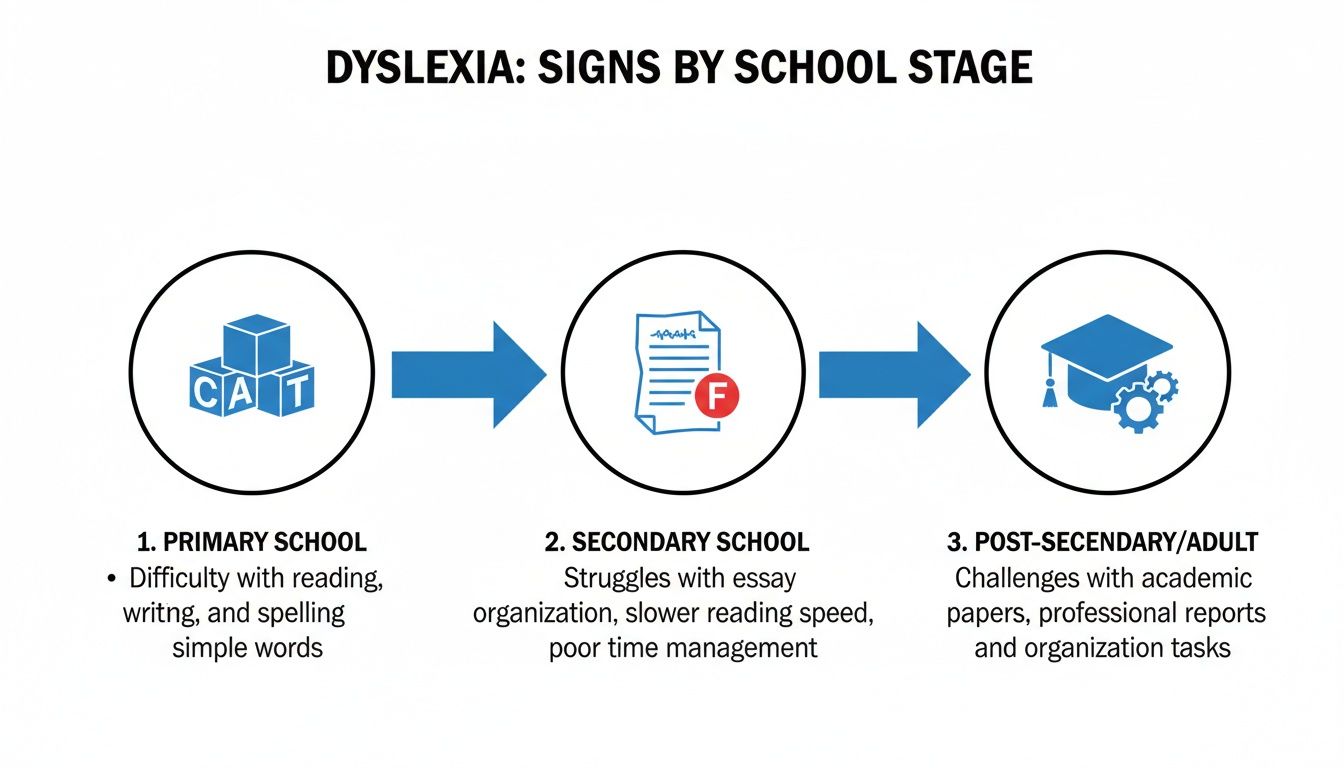
As you can see, early struggles with basic letter sounds can evolve into much bigger challenges later on, like difficulty with organisation and essay writing.
Understanding Diagnosis Pathways
After your chat, the school will likely conduct its own screening tests. It’s important to know these are not a formal diagnosis. Think of them as a way to flag a high probability of dyslexia, which then helps the school decide what kind of classroom support to try first. This is a crucial first step, but it definitely has its limits.
A formal diagnostic assessment is the next level. This is carried out by a qualified educational psychologist or a specialist teacher who holds an assessing practicing certificate. While it comes at a cost (usually between £500-£800), the report you get back is incredibly detailed and powerful. It doesn’t just stick a label on your child; it provides a complete cognitive profile of their unique strengths and weaknesses. It's a precise blueprint for the support they need to thrive.
A formal diagnosis is a powerful tool. It validates your child's experience, gives them language to understand their own brain, and provides the undeniable evidence needed to secure critical support like extra time in exams or more intensive interventions. For many children, hearing an expert say, "You're not lazy, your brain just works differently," is a moment of profound relief.
Your Child’s Legal Rights and the EHCP
Every child has a right to an education that meets their needs. Under the Equality Act 2010, schools have a legal duty to make "reasonable adjustments" for pupils with disabilities, and dyslexia is recognised as one. This duty exists whether your child has a formal diagnosis or not.
For children with more significant needs where standard school support just isn't enough, an Education, Health and Care Plan (EHCP) might be the next step. An EHCP is a legally binding document that spells out the specific provision a child must receive. Getting one is a formal process that starts by requesting a needs assessment from your local authority, and it's often essential for accessing specialist provision or funding for one-to-one support.
Navigating this system takes persistence. Understanding what is SEN support and what schools are required to deliver is vital. This knowledge empowers you to ask the right questions and hold the school accountable for fulfilling its obligations to your child.
Practical Classroom Strategies That Actually Help
Getting a diagnosis or even just recognising the signs of dyslexia is a huge step. But what really counts is what happens next, day in and day out, in the classroom. The right strategies can transform school from a place of anxiety into a space where your child's confidence can finally start to grow. It’s all about working with their brain, not against it.
This means moving beyond just acknowledging the struggle and putting practical, hands-on support in place to make learning accessible. For a child with dyslexia, a few simple adjustments can make a world of difference, turning what feels like an insurmountable wall of text into a clear, manageable path.
Making The Written Word Accessible
For many dyslexic students, the first battle is with the page itself. Letters can seem to swim, words blur together, and a dense paragraph feels overwhelming before they’ve even begun. Simple, practical tools can clear these initial hurdles right away.
- Coloured Overlays and Rulers: It might sound too simple, but for some children, a sheet of coloured plastic placed over a page can dramatically reduce visual stress, making letters stand out and easier to track. A reading ruler can help them focus on one line at a time, preventing them from losing their place.
- Dyslexia-Friendly Fonts: Fonts like Dyslexie or even Comic Sans have unique letter shapes that are harder to confuse, which can genuinely improve reading speed and cut down on errors. Ask if the teacher can print worksheets in one of these fonts for your child.
- Clear Formatting: Using larger print, adding more space between lines, and breaking text into short, digestible chunks on worksheets is key. It helps avoid that dreaded 'wall of text' that can cause a child to shut down immediately.
These adjustments aren't a cure, but they lower the amount of mental effort needed just to decode words. This frees up precious brainpower so your child can focus on what the text actually means.
Engaging All The Senses
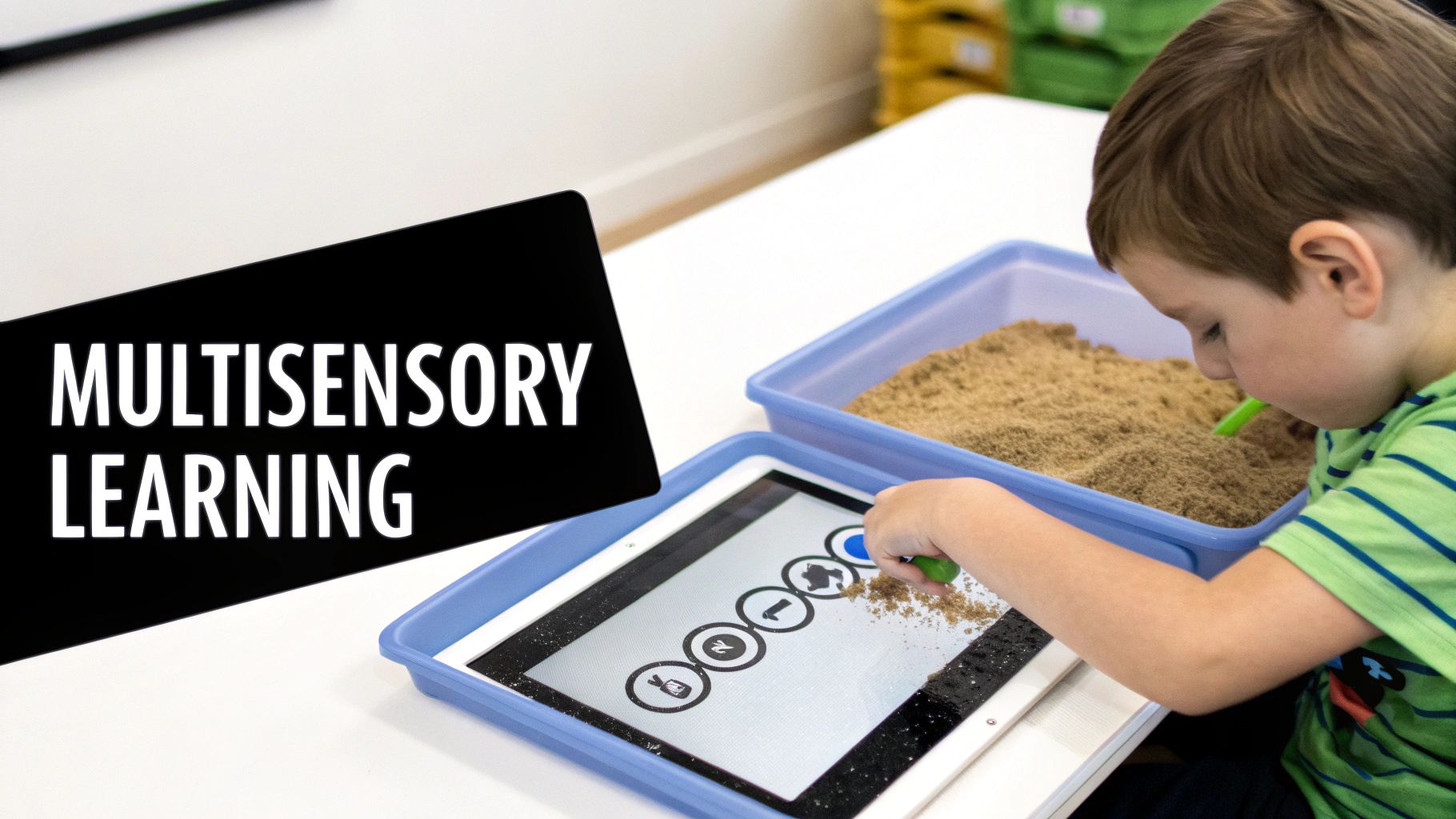
One of the most powerful ways to teach students with dyslexia in schools is through multisensory learning. This approach sidesteps the main area of difficulty—processing written symbols—by building new learning pathways in the brain that involve touch, movement, sight, and sound all at once.
Think about learning a new dance. You wouldn’t just read the instructions; you’d want someone to guide your body through the steps. That physical experience and muscle memory make it stick. Multisensory learning applies the same idea to reading and writing.
A teacher using this approach might have a child trace the shape of the letter 's' in a tray of sand while saying the 'sss' sound out loud. This connects the physical feeling of the shape (touch) with its sound (hearing) and its look (sight), forging a much stronger, more memorable connection in the brain.
And it’s not just for little ones. For older students, creating colourful mind maps with images, listening to audiobooks while following along in the text, or even acting out scenes from a novel can all reinforce learning in a way that just reading a page never could.
Embracing Assistive Technology
Technology has been a genuine game-changer for dyslexic students, levelling the playing field and allowing their intelligence to shine through. These tools aren't a crutch; they're essential accommodations, no different from glasses for someone with poor eyesight.
The goal here is simple: remove the mechanical barriers of reading and writing so the student can get on with the real work of thinking, creating, and learning.
- Text-to-Speech (TTS): Software that reads digital text aloud is incredible. It can be used for anything from an entire textbook to having exam questions read out, ensuring a child is tested on their knowledge, not their reading speed. This means your child can focus on showing what they know about history, not on how fast they can read the question.
- Speech-to-Text (Dictation): This allows a child to speak their ideas and watch the computer type them out. For a student with brilliant thoughts trapped by slow, difficult handwriting, this can be liberating. Imagine them finally being able to write a story at the speed of their imagination.
- Word Predictors and Spell Checkers: Modern tools can predict the word a student is trying to type, helping with spelling and sentence flow without derailing their train of thought. This reduces the anxiety of getting every word perfect and allows their ideas to flow freely.
These strategies are often formalised in a student’s support plan. It’s helpful to look at some individualized education plan examples to see how these accommodations are documented to ensure everyone is on the same page. As technology becomes more integrated into schooling, various AI tools for education are also becoming valuable resources for personalised support.
When schools combine these practical strategies, they create an environment where your child feels understood, supported, and truly capable of achieving their potential.
Choosing the Right School Environment
Finding the right school isn’t just about ticking academic boxes; it’s about finding a place where your child feels seen, understood, and emotionally safe. For a child with dyslexia, the right environment can be the difference between constantly feeling behind and finally discovering their own brilliance. It’s a decision that can completely reshape their relationship with learning and, more importantly, with themselves.
This search means looking beyond the Ofsted report and getting a feel for the school’s heart. Does it truly champion neurodiversity, or does it simply tolerate it? Does it see your child’s dyslexia as a challenge to be managed or as a different way of thinking that deserves support? The right school will feel like a partnership—a place where you are your child's advocate and they are your active allies.
What a Supportive Mainstream School Looks Like
Many children with dyslexia absolutely thrive in mainstream schools, but only when the right culture and support systems are firmly in place. A genuinely supportive school doesn't just have a SEN department tucked away in a corridor; its commitment to inclusive education is visible in every single classroom.
When you visit, pay close attention to the language the staff use. Do they talk about "making adjustments" with enthusiasm or with a sigh? A school that really gets it will have teachers who actively weave multisensory techniques into their lessons for everyone, not just as a special add-on for a few.
Here are the key things to look for in a dyslexia-friendly mainstream school:
- A Proactive SENCo: The Special Educational Needs Coordinator (SENCo) should be engaged, knowledgeable, and see parents as partners. They should be able to clearly explain their process for identifying and supporting students, not just when a parent raises a concern.
- Widespread Teacher Training: Ask if teachers receive regular, up-to-date training on dyslexia and other learning differences. A school that's truly committed will invest in its staff's professional development.
- Visible Accommodations: Look for physical evidence of inclusive practices in the classrooms. Are worksheets printed in dyslexia-friendly fonts? Are coloured overlays readily available? Is assistive technology treated as a normal part of the learning toolkit?
The best mainstream environments normalise difference. When text-to-speech software is available for any student who finds it helpful, it removes the stigma for the child who truly needs it. This creates a culture where asking for help is seen as a strength, not a weakness.
Online Schooling: A Powerful Alternative
For some children, even the best mainstream school can feel overwhelming. The sensory overload of a busy classroom, the social pressure of trying to keep up with peers, and the rigid pace of a fixed timetable can create a constant state of anxiety. This is where online schooling can offer a profoundly different and more nurturing path.
Imagine your child starting their day calm and focused, not already exhausted from the social and logistical stress of just getting to school. An online environment inherently removes many of the barriers that cause dyslexic students to struggle in a physical building.
The very design of a school like Queen's Online School directly addresses the needs of dyslexic learners from the ground up.
The Benefits of a Digital-First Approach
Online learning isn’t about just putting a traditional classroom onto a screen; it’s a complete reimagining of the educational experience. It places the child's individual needs right at the centre of how learning is delivered.
- Pacing and Control: One of the biggest sources of anxiety for a dyslexic student is the fear of being left behind. In an online school, lessons are often recorded. This simple feature is a game-changer, allowing a child to pause, rewind, and review a complex explanation as many times as they need—free from the embarrassment of asking a teacher to repeat themselves in front of 30 other students.
- Personalised Attention: Class sizes are typically much smaller online. This means teachers can give the kind of individualised feedback and real-time support that is often impossible in a larger mainstream class. A specialist teacher can immediately see when a student is struggling with a concept and adapt their approach on the spot.
- Integrated Technology: Assistive technology isn't an afterthought; it's built right into the learning platform. Tools like speech-to-text and text-to-speech are standard, making them feel like a normal part of the school day. This seamless integration empowers students to use the tools they need to succeed without feeling different.
Ultimately, choosing the right school is about finding an environment where your child can stop focusing on their struggles and start focusing on their strengths. Whether that’s in a highly supportive mainstream setting or a flexible online school, the goal is exactly the same: to give them the space and tools to regain their confidence and fall in love with learning again.
Frequently Asked Questions About Dyslexia
As a parent just starting to learn about dyslexia, it’s completely normal to feel like you’re navigating a confusing new world. The journey can feel a bit lonely, punctuated by moments of worry and an overwhelming desire to do the right thing for your child.
Here, we’ll tackle some of the most common and heartfelt questions we hear from parents. Our goal is to give you clear, practical answers that leave you feeling more confident and in control.
Can My Child Outgrow Dyslexia?
This is a question that often comes straight from the heart, filled with a parent’s hope for an easier path for their child. The straightforward answer is no—dyslexia isn't something a child 'outgrows' like a pair of shoes. It's a lifelong, neurobiological difference in the way the brain is wired for language.
But please, don't hear that as a limitation. It's actually a message of empowerment. The focus isn't on finding a 'cure,' but on equipping your child with the right strategies and tools to thrive. With the right support, they learn to navigate their challenges, and just as importantly, they start to harness their unique dyslexic strengths—like incredible creativity, big-picture thinking, and out-of-the-box problem-solving.
Think about it: many of the world's most brilliant innovators and entrepreneurs are dyslexic. They didn't stop being dyslexic; they learned how to work with their minds, turning a different way of thinking into their greatest advantage.
Do I Need a Formal Diagnosis to Get Support at School?
In the UK, the short answer is no. Schools have a legal duty to support any child who is struggling, whether they have an official diagnosis or not. You absolutely can, and should, ask for help based on what you’re seeing at home and in their schoolwork.
That said, a formal diagnosis from an educational psychologist is an incredibly powerful tool. Think of it as the difference between a rough sketch of your child's learning profile and a detailed architectural blueprint. It gives everyone a precise map of their cognitive strengths and weaknesses, which allows the school to put much more targeted and effective support in place.
A formal diagnosis does more than just outline a plan. It validates your child's struggle, giving them—and others—the language to understand that they aren't 'lazy' or 'not trying hard enough'. Their brain just processes information differently. It also carries real weight when requesting crucial exam accommodations, like extra time for GCSEs, and is often essential for securing an Education, Health and Care Plan (EHCP).
How Can I Protect My Child's Confidence?
This is, without a doubt, one of the most critical roles you will play. The daily grind of feeling behind in a classroom not designed for their brain can slowly chip away at a child's self-worth. Protecting and rebuilding that confidence is everything.
Here are three practical ways you can do this right now:
- Reframe Their Story: Make it clear, over and over again, that dyslexia has nothing to do with how smart they are. Share inspiring stories of successful people with dyslexia—artists, scientists, business leaders. Help them see they are in brilliant company.
- Find Their "Island of Competence": Every child has something they are naturally good at. Is your child a gifted artist, a natural leader on the football pitch, or a wizard with Lego? Pour energy and praise into that area. This builds the resilience they need to tackle the things they find harder.
- Teach Them to Speak Up: While you are their strongest advocate, you also need to teach them how to advocate for themselves. Practice simple, confident phrases they can use at school, like, "Could you show me that in a different way? I learn best when I can see it." This empowers them to take ownership of their learning.
How Can Online School Help a Child with Dyslexia?
For many families, online school offers an environment that naturally solves some of the biggest hurdles for students with dyslexia. It strips away many of the anxiety-inducing parts of a traditional classroom, freeing up the student to simply focus on learning.
Imagine your child being able to pause and rewind a teacher's explanation of a tricky science concept, as many times as they need, without the embarrassment of raising their hand in front of 30 other children. That alone can be a game-changer. Recorded lessons give students control over the pace of their learning, which is a massive confidence boost.
What’s more, the class sizes are usually much smaller. This allows teachers to provide the kind of personalised, in-the-moment support that's so often missing in a bustling mainstream school. Assistive technology, like text-to-speech software, is seamlessly built into the digital platform, making it a normal, everyday tool for success rather than a stigmatising add-on. This kind of calm, supportive, and flexible setting is often the perfect place for a child to rebuild their academic confidence.
At Queen's Online School, we know that a one-size-fits-all education doesn't work—especially for neurodivergent learners. Our small, live classes, specialist SEN support, and flexible platform are all designed to meet your child exactly where they are. We focus on building their strengths so they can rediscover their love for learning.
Discover how our personalised online environment can make all the difference for your child by exploring our approach.