

Choosing the right curriculum for your homeschool journey can feel like one of the biggest, most pivotal decisions you'll ever make. It’s that deep breath you take before plunging in, knowing this choice will shape everything. It's so much more than a list of subjects or a stack of textbooks; it's the very blueprint for your child's education and, just as importantly, their lifelong relationship with learning.
Why Your Curriculum Choice Is a Homeschool Game Changer
The decision to homeschool often comes from a deep-seated desire to give your child something more—or something different—than what traditional schools can offer. You’re not just picking out books and lesson plans; you’re carefully crafting an environment where your child can genuinely flourish, free from the anxieties or pressures that held them back.

It’s a path that an ever-growing number of families are now choosing. Across the UK, a record number of children were recently registered in elective home education, marking a staggering 21% increase from the previous autumn. This major shift is often driven by parental concerns over mental health, bullying, and the rigid school structures that simply don’t serve every child. You can read more about the rise in home education to see the full picture for yourself.
Putting Your Child at the Centre
The true beauty of homeschooling is its incredible power to put your child’s unique needs first. The right curriculum should feel less like a strict set of instructions and more like a supportive, flexible framework that adapts and grows with them. It’s about honouring the child you have, right now.
The goal isn’t to replicate school at home. It’s to create an education that is as unique as your child, nurturing their curiosity and building their confidence every single day.
Think about it: a child who feels anxious in large, noisy groups might thrive with a curriculum that prioritises one-on-one mentorship and a gentler pace. For example, instead of a timed maths test, they could demonstrate their understanding by helping you budget for the weekly shop. On the other hand, a child buzzing with creative energy could absolutely blossom with project-based learning that lets their imagination take the lead.
An Empowering Tool, Not an Overwhelming List
This guide is designed to be your partner through this emotional and important decision. We're going to explore the different types of curriculums for homeschool not as an endless, overwhelming list of options, but as a set of tools you can use to build the best possible learning path for your child.
Ultimately, you want to find a curriculum that helps your child feel:
- Seen: Their individual learning style isn't just acknowledged; it's actively supported.
- Understood: Their emotional well-being is treated as a priority, not an afterthought.
- Excited to Learn: Their education sparks curiosity instead of causing stress and anxiety.
By keeping these core needs at the forefront of your mind, you can confidently choose a curriculum that transforms your home into a place of joyful, meaningful discovery.
Finding Your Family's Educational Philosophy
Before you even think about buying a single workbook, it’s worth pausing to ask a fundamental question: what is our family’s educational philosophy? Think of it like a parenting style. Some families thrive on clear routines and structures, while others prioritise freedom, creativity, and following a child’s natural curiosity. That feeling of relief when you find a parenting approach that just clicks? That’s what you’re looking for here.
Choosing a philosophy isn't about boxing yourself in with a restrictive label. It’s about finding a guiding principle that resonates with your family's values and, most importantly, honours the unique way your child sees the world. This philosophy becomes your compass, helping you navigate the vast sea of curriculums for homeschool.
Some approaches are like a detailed recipe from a master chef—every step is precisely laid out for a predictable, excellent result. Others are more like a basket of fresh, seasonal ingredients, inviting you and your child to create something wonderful together, guided by instinct and inspiration.
Matching Philosophy to Your Child's Needs
The right educational philosophy can be a game-changer for a child’s well-being. It’s no secret that mental health concerns fuel much of the homeschool boom; one report showed families leaving traditional schools rose by 64% for anxiety-related reasons in recent years. For many parents, picking an approach that dials down the academic pressure and fits their child's temperament is the number one goal. Learn more about why families choose to homeschool.
For example, a child who feels crushed by rigid deadlines might just blossom with a more flexible, interest-led philosophy. Imagine their history project on the Vikings isn't a 500-word essay due on Friday, but an ongoing mission to build a model longship or cook a Viking-era meal. The key is to watch your child closely and listen to what their behaviour and emotions are telling you about how they learn best.
A philosophy isn’t just about what you teach; it’s about how you want your child to feel about learning. Does it build confidence? Does it spark joy? Does it make them feel safe to explore and make mistakes?
Exploring Popular Homeschooling Philosophies
There are several well-established approaches out there, each with its own distinct flavour. Understanding them is the first real step to finding your family's fit. When figuring out what works for you, many homeschooling parents find great success with hands-on methods like project-based learning, which centres education around engaging, real-world investigations.
To help you get started, here are a few popular philosophies that families often consider.
Comparing Homeschool Philosophies at a Glance
This table breaks down some of the most common homeschool approaches. Think of it as a quick reference to see which philosophy might align best with your child's learning style and your family's goals.
| Philosophy | Core Principle | Best For a Child Who… | Parental Involvement |
|---|---|---|---|
| Traditional | Replicates a conventional school environment with set schedules, textbooks, and formal assessments. | Thrives with structure, clear expectations, and a predictable routine. | High (planning, teaching, grading). |
| Charlotte Mason | Believes children are whole persons who deserve a rich, "living" education with great books, nature, and arts. | Is curious, loves stories and the outdoors, and benefits from short, engaging lessons. | High (curating resources, facilitating nature study). |
| Unschooling | Child-led learning where education happens organically through everyday life, interests, and play. | Is self-motivated, has strong interests, and learns best by doing and exploring. | High (facilitating, providing resources, following child's lead). |
| Classical | Follows a three-stage process (the Trivium) that aligns with a child's cognitive development. | Enjoys logic and debate, and benefits from a systematic approach to knowledge. | High (requires deep understanding of the method). |
| Montessori | Emphasises hands-on, self-directed activity in a thoughtfully prepared environment. | Is independent, learns kinesthetically (by touch and doing), and likes to work at their own pace. | Medium to High (preparing the environment, guiding). |
Ultimately, there's no single "best" philosophy—only the one that feels like the most natural and nurturing fit for your child. Exploring these different mindsets is the first step in turning your homeschool into a place where they can truly thrive.
Blending Homeschool Freedom with Online School Support
What if you could give your child a bespoke education without having to become an expert in every single subject? It's a huge weight on any parent's shoulders—the pressure to plan every lesson, find every resource, and guide every step of your child’s academic journey. This is exactly where a hybrid model comes in, offering a powerful and reassuring alternative.
This approach blends the freedom and flexibility you love about homeschooling with the structure and support of an accredited online school. Picture this: your child learns from a high-quality, organised British curriculum delivered by expert teachers, but still has the space to learn in a way that truly works for them. This means they get a fantastic live lesson on photosynthesis in the morning, and in the afternoon, you can take them to the park to find different types of leaves, with no lesson-planning stress for you.
It’s less about being the sole instructor and more about becoming a supportive mentor.
Solving Common Homeschooling Challenges
Partnering with an online school directly tackles the most common pain points that can lead to parental burnout. Forget spending your evenings frantically planning the next day's Maths lesson or worrying if you’re covering the science syllabus properly. Instead, you can hand over the academic framework to professionals you trust.
This structure is a game-changer for families in all sorts of situations:
- Children with SEN: They can flourish in small, supportive online classes where teachers give them personalised attention, far from the sensory overload of a typical large classroom.
- Families Living Abroad: It gives you access to globally recognised qualifications like GCSEs and A-Levels, paving a smooth path to university no matter where you are in the world.
- Parents Needing Support: It frees you up to focus on your child’s well-being, passions, and unique interests, knowing their core academic needs are being met to a high standard.
This hybrid model isn’t about giving up control; it’s about gaining a powerful educational partner. You get to keep the emotional connection of homeschooling while outsourcing the curriculum planning and direct instruction.
This method beautifully combines structured lessons with the room for self-directed discovery, creating a balanced and effective learning environment. To see just how this synergy works, you can explore more about the blended learning model and imagine how it could fit into your family’s life.
Putting Your Child’s Needs First
One of the best parts of bringing an online school into your homeschool setup is the built-in accessibility. When you're looking at online curricula, it’s vital to think about how they serve different learning styles. For instance, features like accessible teacher lesson captions can make a world of difference to a child's comprehension, especially for visual learners or those with auditory processing challenges.
Ultimately, this blended approach lets you design an education that truly honours your child. It allows a student who struggles with morning focus to attend live afternoon classes. It means a gifted athlete can train for hours without sacrificing their academic future. It puts your child's needs right at the centre of their learning journey, giving them both the expert guidance they need and the compassionate flexibility they deserve.
A Practical Guide to Selecting Your Child's Curriculum
So, how do you turn all this theory into a practical decision? It starts by putting your child right at the heart of the process. The best curriculums for homeschool aren't waiting in a catalogue; you find them by truly understanding who your child is and how they see the world. Think of this as your roadmap to making that choice with confidence.
Before you even glance at a single programme, grab a notebook and take a moment to reflect. The right path forward will become much clearer once you ask a few honest, child-focused questions.
Key Questions to Ask Yourself
- How does my child learn best? Are they a visual learner who lights up with videos and diagrams? An auditory learner who soaks up everything they hear? Or are they a kinaesthetic learner who absolutely needs to build, touch, and do to understand? Think about how they play. Do they draw, tell stories, or build elaborate Lego creations? Their play is a huge clue.
- What is their ideal learning environment? Do they need the comfort and predictability of a structured routine, or do they truly shine when given the freedom to follow their curiosity wherever it takes them?
- What is our family’s capacity? Let's be realistic. How much one-on-one teaching time can you commit to each day without it becoming a source of stress for everyone? Be honest about your own energy levels and schedule.
This simple decision tree can help you visualise one of the first major forks in the road: do you need the comprehensive support of an online school, or does the independence of a DIY approach feel right?
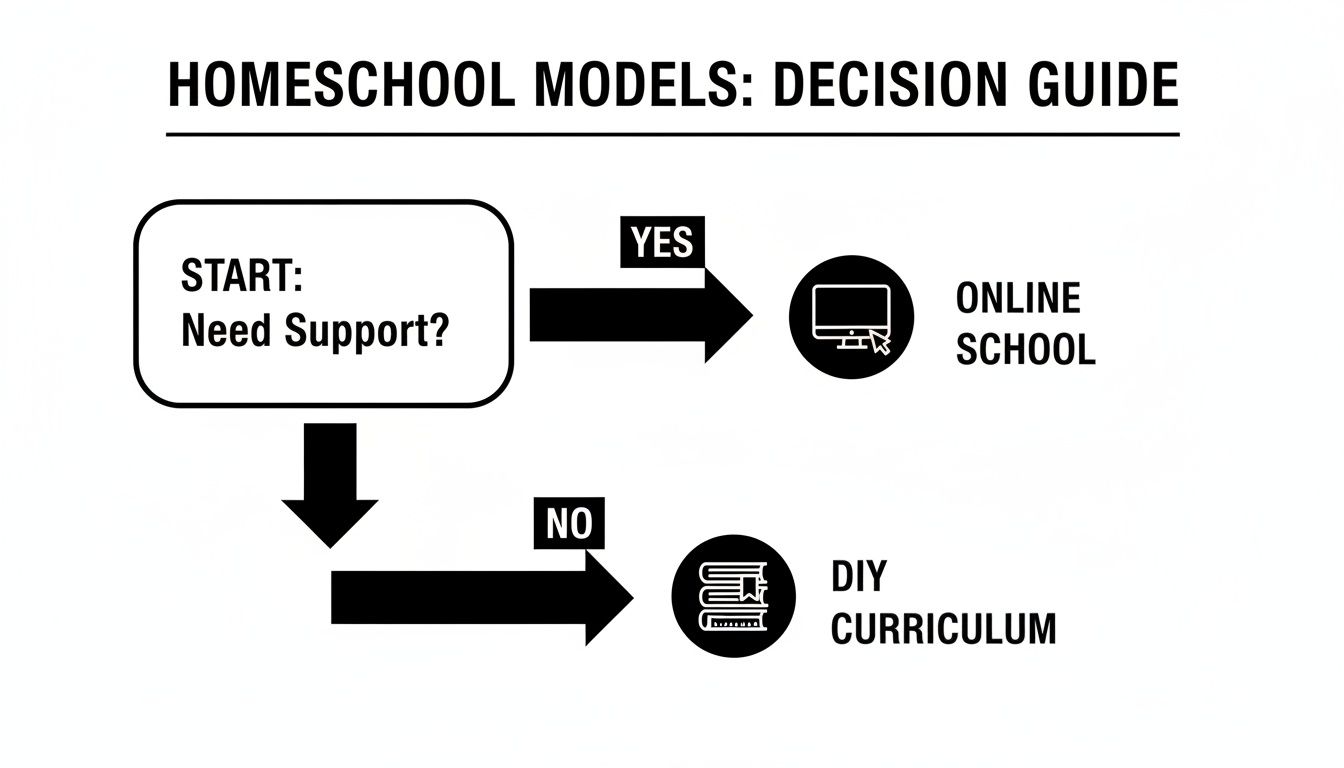
As you can see, thinking about your family's support needs is a brilliant first step. It immediately helps to narrow down the options in a meaningful way.
It’s no secret that many parents are looking for alternatives. With millions of pupils in UK schools, rising exclusions and mental health crises are becoming impossible to ignore. Homeschooling offers a safe harbour, and choosing a curriculum that puts your child's well-being first is everything. This focused, child-led approach pays off, with research often showing homeschooled children scoring in the 65th-75th percentile on standardised tests.
Putting It into Practice
Let's make this real. Imagine two different children.
The first is wonderfully creative and artistic but wilts under the pressure of rigid deadlines. After asking the key questions, their parents realise they need flexibility and project-based learning. They opt for an online curriculum that lets their child demonstrate knowledge by building models or creating digital stories instead of sitting timed tests. This choice honours their child's spirit and makes learning feel like play again.
Now, think of a second child who needs to learn at a very particular pace due to a learning difference. Their family quickly sees that a standard curriculum won't work. They choose an accredited online school offering a structured but flexible UK homeschooling curriculum, complete with specialist teachers. This gives their child consistent, expert guidance without the fear of falling behind, turning anxiety into quiet confidence.
Choosing a curriculum is an act of love. It’s about saying, "I see you, I understand how you learn, and I’m going to give you the tools you need to succeed on your own terms."
What Does a Week of Blended Homeschooling Actually Look Like?
The idea of blending structured online learning with the hands-on freedom of homeschooling can sound a bit abstract. What does it really mean day-to-day? This is where we can bust the myth that a structured curriculum means your child is glued to a screen from dawn till dusk.
A well-designed blended approach isn't about rigid control; it’s about creating a rhythm for the week that feels both productive and wonderfully liberating. It's the difference between a schedule that feels constricting and one that feels like a supportive rhythm for your family.

It’s all about striking that perfect balance. Your child gets the benefit of expert teaching in core subjects, but still has plenty of time for play, exploring their own interests, and just being a kid. Let’s bring this to life with a sample week for a Year 7 student to show how different curriculums for homeschool can be woven together seamlessly.
A Sample Week in Action
A timetable like this shows just how easily you can combine live online classes with child-led projects and activities. There’s structure where you need it and freedom where it counts.
Here is an example of what that could look like:
Sample Weekly Timetable: A Blended Approach
| Time | Monday | Tuesday | Wednesday | Thursday | Friday |
|---|---|---|---|---|---|
| 9:00 – 10:00 | Live Maths Class | Live Science Class | Live English Class | Live History Class | Family Project Work |
| 10:00 – 11:00 | Independent Maths Work | Independent Science Work | Independent English Work | Independent History Work | Field Trip/Museum Visit |
| 11:00 – 12:00 | Reading Hour | Music Practice | Reading Hour | Art Project | Free Exploration |
| 12:00 – 13:00 | Lunch Break | Lunch Break | Lunch Break | Lunch Break | Lunch Break |
| 13:00 onwards | Nature Walk & Journaling | Sports/Physical Activity | Coding Club (Online) | Baking/Life Skills | Unstructured Free Play |
As you can see, the mornings are anchored by the core academic subjects, delivered by specialist teachers in live, interactive lessons. This takes the pressure off you to teach complex topics like algebra or historical analysis, ensuring those foundations are solid.
Then, the afternoons open up. This is where the magic of homeschooling really shines through. After a good screen break and lunch, your child can dive into hands-on learning that connects with what they’ve been studying. Maybe Monday’s nature walk is about identifying plant species for their science class, or Thursday’s art session is inspired by their history lesson on the Romans.
Fridays are intentionally kept light on formal lessons. It’s the perfect day for a family trip to a museum, a deep dive into a passion project, or catching up with friends from their online school clubs.
The real beauty of a blended schedule is how responsive it is. It gives you a reliable framework for the academic essentials while leaving generous room for a child’s curiosity to lead the way.
More Than Just a Timetable
This schedule is much more than a simple list of subjects; it's a blueprint for a vibrant, well-rounded educational life. It’s about creating days where your child feels both challenged and cherished.
The live lessons provide crucial social interaction and expert guidance, which is a game-changer for parents. Meanwhile, the flexible afternoons allow for the kind of deep, meaningful learning that makes homeschooling so powerful in the first place.
This balance ensures your child develops essential academic skills without ever sacrificing their mental well-being or their natural love for discovery. If you’re looking for more ideas and support, there are many fantastic homeschooling resources in the UK that can help you flesh out your family’s perfect week.
What’s Next on Your Homeschooling Adventure?
If you’ve made it this far, hopefully, that initial tidal wave of curriculums for homeschool feels a little less overwhelming. What might have started as a daunting list of options should now feel more like a clear path forward, one you get to design with your child at your side.
The whole point of this journey isn't to tick boxes or find a one-size-fits-all solution. It's a much more personal process of getting to know your child as a learner. Remember, the 'best' curriculum is simply the one that clicks—the one that meets your child where they are, respects their unique personality, and sparks a genuine desire to learn. This is about progress, not perfection.
Bring Your Child into the Conversation
One of the most powerful things you can do right now is to invite your child into the final decision. This is their education, after all. Sit down together and explore the options you’ve shortlisted. Watch the sample lessons, click through the online school’s website, and see what catches their eye.
Ask them what looks fun. What makes them feel curious? What feels exciting?
When you give them a voice, you’re doing more than just picking a curriculum. You’re handing them a sense of ownership over their own learning. It shifts their education from something that happens to them into a thrilling adventure they get to co-create. That feeling of being heard and respected is a lesson in itself.
This isn’t just a logistical decision; it’s the start of a partnership. You’re opening up a conversation with your child about how they learn best—a dialogue that will shape their entire educational experience from here on out.
You are at the start of an amazing, rewarding journey. By putting your child’s needs, passions, and personality at the very centre of this choice, you’re already giving them the greatest gift possible: an education built on a foundation of love, respect, and understanding. You've got this.
Common Questions About Homeschool Curriculums
Choosing the right path for your child’s education can feel like a huge responsibility, and it’s only natural to have questions. You’re making big decisions, and you want to get them right. Let’s tackle some of the most common worries we hear from parents.
How Do I Ensure My Child Is on Track for University?
This is probably the number one concern for parents of secondary school-aged children, and for good reason. The key is to look beyond just the learning materials and focus on a curriculum that leads to internationally recognised qualifications.
While there are countless wonderful resources for learning out there, not all of them end with formal exams. This is where an accredited online school really proves its worth. By following the complete British curriculum, your child has a clear, structured path towards Pearson-accredited GCSEs and A-Levels. These qualifications are the gold standard for university entry in the UK and are highly respected by institutions all over the world. Following this route ensures your child builds an academic transcript that admissions officers understand and trust.
What if My Child Has Special Educational Needs?
Many families turn to homeschooling specifically to create a more nurturing and effective environment for children with SEN. If this is your situation, you’ll want to find a curriculum that offers genuine flexibility and specialist support. A rigid, one-size-fits-all ‘curriculum-in-a-box’ is unlikely to be the answer.
An online school designed with SEN in mind can be a game-changer. Here are a few things to look for:
- Small class sizes: This means more one-on-one attention from the teacher and less sensory overwhelm for your child.
- Live teacher interaction: A live format allows a skilled educator to adapt their teaching methods in the moment, responding directly to your child's needs.
- Personalised learning paths: This allows your child to progress at a pace that feels comfortable and builds confidence, without the pressure of having to keep up with a large group.
This kind of environment empowers a child to learn confidently while receiving the expert, tailored instruction they deserve.
Can I Switch if Our First Choice Isn’t Working?
Yes, absolutely. One of the greatest strengths of homeschooling is its adaptability. It’s perfectly okay—and very common—to discover that your first choice of curriculum isn't the right fit. The crucial thing is to see this not as a failure, but as a valuable learning experience. It’s simply more data about what makes your child tick.
Don’t be afraid to change direction. The goal is to find what helps your child thrive, and sometimes that takes a little trial and error. The right curriculum should reduce stress, not add to it.
Our advice is to give any new programme a fair trial—a school term is usually about right—to get past the initial adjustment period. If it’s still causing friction after that, it’s time to reassess based on what you’ve now learned about your child’s learning style and emotional needs. Many families find that a blended online model provides a stable, long-term solution, as the core academic structure is managed by experts. This frees you up to focus on what you do best: nurturing your child’s journey.
At Queen’s Online School, we provide a structured and supportive British curriculum designed to meet the unique needs of every learner. Discover how our accredited online school can empower your family on your homeschooling adventure by visiting us at https://queensonlineschool.com.