

A curriculum for homeschool isn't just a stack of textbooks; it's the unique roadmap you create for your child's education, one that respects their learning style and aligns with your family’s values. This journey doesn't begin with choosing a product off a shelf. It starts with understanding the wonderful, curious person you're raising.
Your Homeschool Journey Starts with Your Child

Choosing a curriculum can feel like standing at the edge of a vast ocean without a map. The pressure to "get it right" is immense, a heavy weight felt by every parent who wants the absolute best for their child. It’s a decision wrapped in love, hope, and more than a little bit of fear.
But what if the first step wasn't about scrolling through endless catalogues, but about simply looking at your child? The real power of home education lies in its incredible flexibility to be built around the individual learner. You already hold the most important key: your deep, intuitive knowledge of your own child.
Shifting Your Focus from Product to Person
Before you dive into different methodologies and resources, just take a moment to observe. This quiet observation is the true foundation of a successful and joyful homeschool experience.
- Notice Their Spark: What makes your child’s eyes light up? Is it building intricate LEGO worlds, getting lost in a fantasy novel, or taking apart a remote control just to see how it works? This isn't just a hobby; it's a doorway into physics, engineering, or literature.
- Understand Their Rhythm: Are they a morning person, bursting with energy and questions before breakfast, or do they really come alive in the afternoon? Forcing a sleepy child into complex maths at 9 am can create a lifelong aversion to the subject.
- Recognise Their Learning Language: Do they need to move their body to think (kinaesthetic), listen to stories (auditory), or see diagrams and pictures (visual)? Imagine asking a child who needs to do things to learn to sit still for hours; it's a recipe for frustration for everyone.
The goal isn't to replicate a classroom at your kitchen table. It's to create an environment where your child’s natural curiosity is the main engine for learning.
The Heart of the UK Homeschool Movement
This very shift in focus is why so many families are embracing home education. It’s not a fleeting trend; it’s a quiet revolution against one-size-fits-all learning. The numbers tell the story. Back in 2015, around 34,000 UK children were homeschooled, but that figure has now soared to over 111,700. This surge highlights a deep-seated desire for an education that truly honours the individual.
This movement is driven by parents who see something special in their children that a rigid system might miss. They want an education filled with connection, joy, and meaningful discovery.
If you're wondering about the practical steps involved, our guide on how to do homeschooling is a brilliant starting point for your journey. It will help you move from feeling overwhelmed to feeling empowered, ready to build a truly bespoke education for the person who matters most.
Before you even think about buying a single textbook, it’s worth taking a step back to understand the heart behind different teaching methods. Think of these homeschool philosophies as different recipes for learning. Some are like a detailed Mary Berry recipe—precise, structured, and reliable. Others are more like Jamie Oliver’s cooking—a bit of this, a dash of that, guided by intuition and your child's appetite for knowledge.
The beauty is that there’s no single "right" recipe. The goal is to find the one that feels nourishing for your child and fits your family’s unique flavour. Choosing a curriculum for homeschool becomes much simpler once you have a feel for which educational philosophy truly resonates with you.
The Structured Approach: School-at-Home
For many families just starting their homeschooling journey, the School-at-Home approach feels safe and familiar. It essentially mirrors the structure of a traditional school, often following the National Curriculum or a similar, rigorous framework like the Cambridge curriculum. This style provides a clear, predictable path with pre-planned lessons, workbooks, and assessments.
It’s an excellent choice if you value clear expectations and measurable progress, or if you have a child who genuinely thrives with routine. This method can also ease the transition from mainstream school, giving you the confidence that you’re "covering all the bases."
A typical day for your child might look something like this:
- English from 9-10 am: Working through a specific textbook and completing the assigned exercises on verbs.
- Maths from 10-11 am: Following a lesson plan from a complete curriculum package on long division.
- Science at 11:15 am: Conducting a planned experiment with clear, step-by-step instructions on photosynthesis.
This kind of structured curriculum provides a strong framework, but the challenge can be resisting the urge to simply replicate a classroom at home—which might defeat the purpose of why you chose to homeschool in the first place.
The Gentle Rhythm of Charlotte Mason
Now, imagine a learning day filled not with dry textbooks, but with captivating stories, poetry, and art. This is the essence of the Charlotte Mason method, which is built on the idea that children are whole people who learn best through rich, real-world experiences.
This philosophy champions the use of "living books"—beautifully written, narrative-driven books by authors who are passionate about their subject, rather than committee-written, fact-heavy textbooks. It also emphasises short lessons to hold a child's attention, plenty of time for nature study, and daily exposure to great art and music. It’s about cultivating a genuine love for learning, not just ticking off assignments.
A Charlotte Mason education is a generous and wide curriculum for the children. It is not an alternative to a classical education, but a version of it which is fit for children.
For instance, instead of tackling a worksheet on the Norman Conquest, your child might read a brilliant historical novel set in 1066, narrate the story back to you in their own words, and spend the afternoon sketching a local castle in their nature journal. This approach is designed to connect deeply with a child’s heart and mind.
Child-Led Exploration: Montessori and Unschooling
On the other end of the spectrum are philosophies where the child’s own curiosity takes the lead. These methods are founded on a deep trust that children are natural learners who will actively pursue knowledge when given the freedom and resources to do so.
- Montessori: You could call this a "structured freedom" approach. The parent or educator carefully prepares a learning environment with hands-on, self-correcting materials. For example, your child might learn maths not from a book but by physically manipulating beautiful wooden beads, or master geography by assembling intricate puzzle maps, all at their own pace.
- Unschooling: This is the most organic, fluid approach, where learning is entirely driven by the child's current interests. There are no set subjects or schedules. If your child becomes fascinated by dinosaurs, that fascination becomes the "curriculum"—leading naturally to reading books about palaeontology, doing maths by measuring fossils, and even creating dinosaur art.
These styles are wonderful for fostering independence and a profound, lifelong love of learning. However, they require a great deal of trust in the process and can feel unnerving for parents who prefer a more predictable path, especially when thinking ahead to formal qualifications.
To help you see the differences at a glance, here’s a quick comparison of these popular approaches.
Comparing Homeschool Curriculum Approaches
This table offers a quick-glance comparison of the most common homeschooling philosophies to help you identify the best fit for your family's goals and your child's learning style.
| Curriculum Approach | Core Philosophy | Best Suited For | Structure Level |
|---|---|---|---|
| School-at-Home | Replicates a traditional school environment with clear lesson plans. | Children who thrive on routine and parents who want a clear framework. | High |
| Charlotte Mason | Education through living books, nature, and the arts. | Families who value a rich, literature-based and holistic education. | Medium |
| Montessori | Child-led learning within a carefully prepared environment. | Independent children who learn best through hands-on exploration. | Low to Medium |
| Unschooling | Learning is driven entirely by the child's natural curiosity. | Self-motivated children and families who embrace organic learning. | Low |
Ultimately, many families find they don't stick rigidly to one single philosophy. Instead, they borrow elements from several to create a bespoke approach that works perfectly for them. The key is to stay flexible and be willing to adapt as your child grows and their needs change.
A Practical Framework for Choosing Your Curriculum
Right, you’ve got your head around the different educational philosophies. Now it’s time to turn those big ideas into a practical, heartfelt plan for your family. Choosing a curriculum isn't like picking something off a shelf; it’s an act of love and careful observation. The journey begins not in a catalogue, but right in your own home, by paying close attention to the unique little person you are raising.
This mindset transforms what can feel like an overwhelming task into an exciting project of co-creating your child's education. Let go of the pressure to find a "perfect" system. Instead, let's focus on finding the right fit for your child, for right now.
Step 1: Start with Your Child, Not the Curriculum
Before you even think about browsing a single website, take a week to simply be an observer. This is the most critical step, and it costs absolutely nothing. Watch your child when they think no one is looking. Really listen to their questions. See what genuinely captures their imagination.
Think about these key areas:
- Their Passions: Do they get completely lost in building LEGO cities? Are they constantly asking "why" about the natural world? Do stories transport them to another place entirely? Their organic interests are powerful clues. For example, a love for LEGO isn't just play; it's a seed for studying engineering, architecture, and even storytelling.
- Their Energy: When are they most switched-on and engaged? Some children are ready to tackle complex problems first thing in the morning, while others need a slower start and do their best thinking in the afternoon. Honouring this rhythm prevents so many battles.
- Their Learning Style: How do they best absorb information? A kinaesthetic learner needs to move and build; a curriculum heavy on textbooks will just lead to frustration. An auditory learner will thrive with discussions and audiobooks, while a visual learner needs diagrams, videos, and colourful books to make sense of new concepts.
This simple infographic gives you a starting point to see how your observations might point you toward a specific curriculum style.
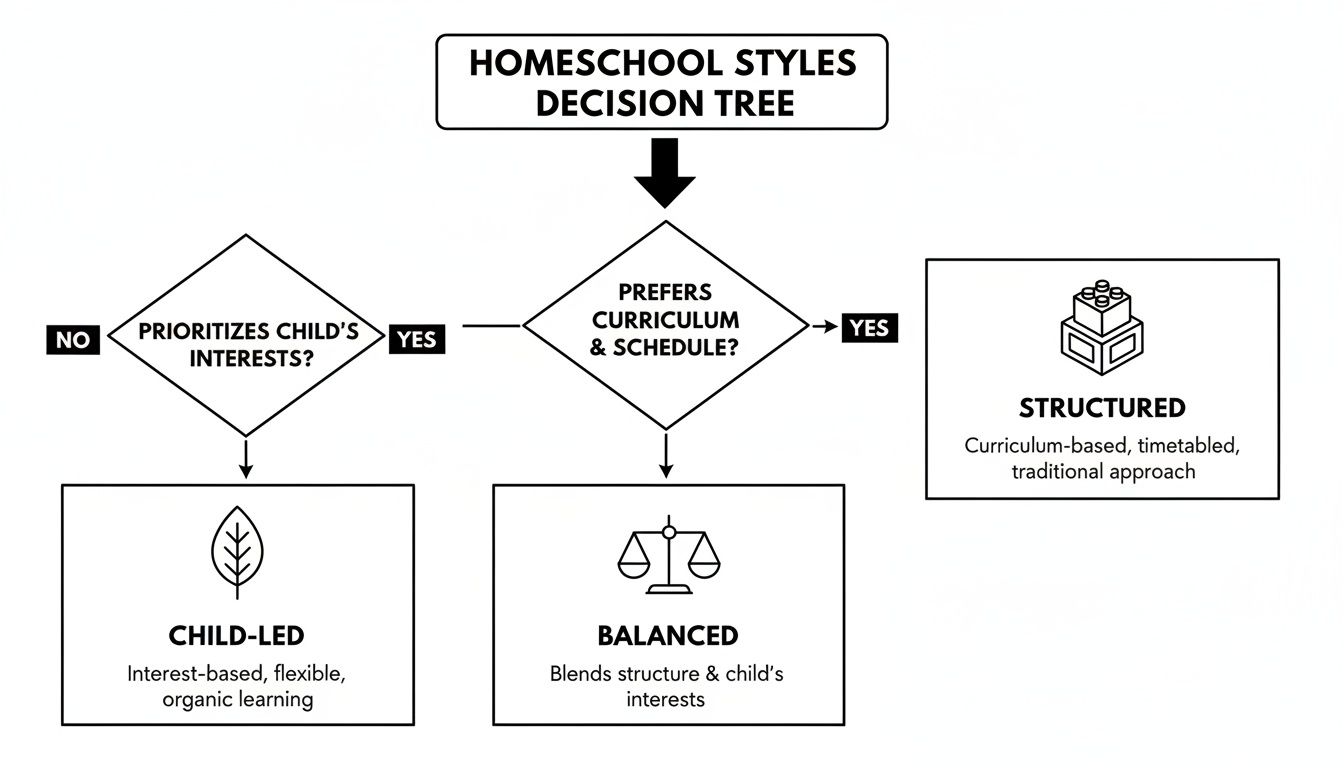
Think of it as a helpful map, connecting your child's natural tendencies to a broader educational approach. It makes the next steps so much clearer.
Step 2: Define Your Family’s Goals and Vision
With a clearer picture of your child, you can now think about your own goals. This isn't about creating a rigid five-year plan, but about defining your family’s "why." This vision will be your compass when you feel lost in all the options.
Are you aiming for specific qualifications like IGCSEs and A-Levels for a clear university path? Or is your primary goal to nurture a deep-seated love of learning, independent of formal assessments? Perhaps your main objective is simply to create more family connection and reduce the stress that came with mainstream school.
Your homeschool mission statement could be as simple as: "To create a joyful learning environment where our children feel supported to explore their interests and build the confidence to pursue their goals."
Having this guiding principle makes it much easier to filter out options that don't align with your core values. It stops you from getting distracted by glossy marketing or what another family is doing.
Step 3: Consider the Practical Realities
Education doesn't happen in a vacuum; it’s about logistics too. Now is the time to get honest about the practical side of homeschooling.
- Your Budget: Homeschooling can be done on a shoestring using libraries and free online resources. Or it can involve a significant investment in all-in-one boxed curricula or online schools. Be realistic about what is sustainable for your family long-term.
- Your Time and Energy: How much time can you realistically dedicate to direct teaching each day? Some curricula require intensive parental involvement, while others are designed for more independent learning—a lifesaver if you're also working from home.
- All-in-One vs Eclectic: Do you prefer the security of an all-in-one curriculum, where every subject is planned out for you? Or does the idea of an eclectic approach—piecing together the best resources for each subject—feel more exciting and personalised?
For instance, you might choose a highly structured maths programme because it gives you confidence, but take a more relaxed, literature-based approach to history by reading historical novels and visiting castles. For a deep dive into specific subject approaches, resources like this guide on Finding the Best Homeschool Reading Curriculum can show you how to mix and match effectively.
This three-step framework puts your child at the very centre of the decision. It ensures that your final choice isn't just a curriculum, but a true reflection of their needs and your family's dreams.
Tailoring Your Curriculum for Every Learner
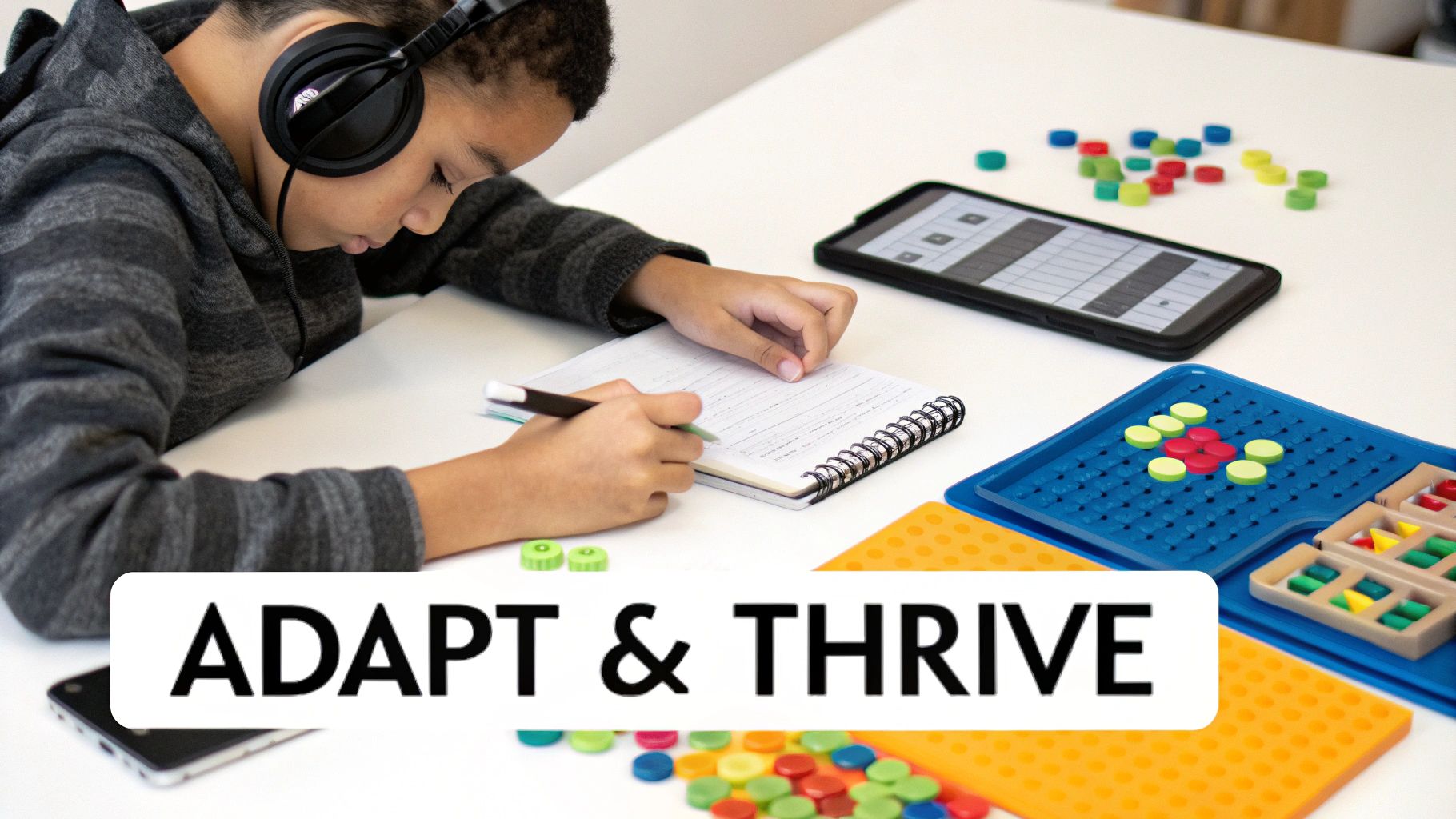
No curriculum, however highly praised, is a perfect fit straight out of the box. The best way to think of it is less like a rigid script and more like a beautiful piece of sheet music. All the notes are there, but you, as the conductor of your home, get to change the tempo, adjust the volume, and spotlight the instruments that let your child’s unique melody soar.
This power to adapt is the true magic of homeschooling. It’s the point where you shift from being a curriculum-follower to a curriculum-creator, shaping each lesson to make your child feel seen, understood, and set up for success.
Adapting for Different Learning Needs
Every child learns differently. A one-size-fits-all approach often ends in frustration and knocks a child's confidence. Adapting your curriculum for homeschool is an act of compassion that honours your child’s individual neurology; it’s about building bridges to understanding, not forcing them down a path that doesn’t fit.
Let’s look at a couple of real-world examples:
- For a child with dyslexia facing a text-heavy history lesson: Swap the textbook for an engaging audiobook or a well-made documentary. Instead of a written report, ask them to create a timeline with pictures, build a model of a historical site, or record themselves explaining what they’ve learned. You get to see their brilliant understanding shine through without the barrier of writing.
- For a child with ADHD who struggles with long maths sessions: Break one lesson into three short, 15-minute bursts throughout the day. You could use tangible objects like LEGO bricks for multiplication or even bake a cake to get your heads around fractions. Let them complete workbook pages while bouncing on a yoga ball if it helps them focus. This meets their need for movement and makes learning feel active and fun.
The goal is never to lower expectations but to change the method of delivery. It's about ensuring your child can access the knowledge and show you what they've learned in a way that plays to their strengths.
For learners with specific challenges, making these adjustments is vital. For instance, this article discussing strategies for learning a second language with dyslexia offers some brilliant insights for parents navigating similar situations. Small, thoughtful tweaks can make all the difference.
Juggling Different Ages and Stages
Homeschooling multiple children can often feel like you’re running a one-room schoolhouse, with learners at completely different stages. The secret is to find a common thread and then differentiate the tasks. You can often use the same core topic but simply expect different outcomes based on age and ability.
Imagine your family is studying Ancient Rome.
- Your 6-year-old might listen to a picture book about Roman myths, build an aqueduct from cardboard tubes, and draw a picture of a chariot. Their focus is on imagination and hands-on creation.
- Your 11-year-old could read a chapter from a rich, story-based "living book" on the life of Julius Caesar, write a short report, and label a map of the Roman Empire. They are developing their comprehension and research skills.
- Your 15-year-old preparing for GCSEs might be analysing primary source documents, writing an essay on the fall of the Republic, and comparing Roman and Greek systems of government. Their work is geared towards critical analysis.
Everyone is learning together, creating a shared family experience, but the work is perfectly scaled to their individual level. This strategy is at the very heart of what educators call differentiated learning. To get a better handle on this, you can learn more about what differentiated learning is and how to apply it effectively at home.
This flexible, responsive approach is what makes home education so powerful. You're not just delivering a curriculum; you are cultivating a person, responding to their needs, and empowering them to find joy and success in their own unique way.
Planning Your Year and Navigating Qualifications
Once you’ve gathered your resources, the next question can feel even bigger: "So, what does our year actually look like?" This is where the fear of falling behind or missing something crucial can creep in, especially when you start thinking about formal qualifications.
But here’s the thing: planning your homeschool year isn’t about recreating a rigid, colour-coded school timetable. Far from it.
Think of your plan as a trellis for learning to climb on. It needs just enough structure to provide support, but plenty of space for spontaneity, deep dives into rabbit holes, and all those wonderful, unexpected learning moments that make homeschooling so special. It’s about finding a rhythm, not a routine.
Crafting a Flexible Annual Rhythm
Forget trying to map out every single day for the next 365 days. A much gentler, more realistic approach is to think in broader strokes—focusing on terms and overarching themes rather than daily lesson plans. This gives you a clear sense of direction without sacrificing the very freedom you’re homeschooling for.
Here’s a simple, child-centred way to think about your year:
- Sketch Out Your Terms: Break the year into manageable blocks. Maybe six to eight weeks of focused learning, followed by a week or two of rest, field trips, or project-based work. This simple rhythm helps prevent burnout for everyone.
- Choose a "Big Rock" Theme: For each term, pick a central theme that can act as an anchor, ideally based on your child's interests. If they love space, a term on "The Solar System" will feel like an adventure, not a chore. This theme can then weave through many of your other subjects.
- Weave in Core Skills: Decide how you’ll consistently practise core skills like maths and English. This might be a dedicated 45-minute slot each morning before you dive into the term's main theme.
This approach gives each block of time a clear purpose. A child obsessed with space will know that the "Solar System" term is coming up, building genuine excitement and anticipation for their own learning.
The Path to GCSEs and A-Levels
One of the biggest anxieties for homeschooling parents is how their child can possibly gain official UK qualifications. The good news? The path is well-trodden and completely achievable. Homeschooled students can, and regularly do, sit for GCSEs and A-Levels as private candidates.
This simply means you take on the responsibility for preparing them for the exam, and then you book them a place at an approved exam centre to sit the paper alongside other students. Many centres are very welcoming to private candidates, and it gives your child the exact same qualification as their schooled peers.
In fact, the tailored nature of a curriculum for homeschool can be a huge advantage. UK homeschooled children often achieve 15% to 30% higher marks on standardised tests because their education allows them to explore their strengths at their own pace, without classroom distractions. You can discover more insights about these homeschooling outcomes and see how this flexible approach is perfectly suited for excelling in exams.
Assessment in homeschooling shouldn't feel like a high-stakes judgement. Think of it as a gentle check-in—a chance to see what's clicking, celebrate progress, and lovingly adjust your approach where needed.
For GCSE and A-Level subjects, this "gentle assessment" often means working through past papers. This isn't about high-pressure testing; it's about building familiarity and confidence. It helps you both see which areas are solid and which might need a little more time and attention.
This collaborative, low-stress approach to assessment builds resilience and a true sense of ownership over their academic journey. It gives you the confidence you need to plan a successful and fulfilling year ahead.
Finding Support with Online Schooling
Choosing a curriculum is a huge commitment, but you absolutely don't have to carry the entire weight of your child's education on your own shoulders. So many families find the journey is at its best when they have a partner—someone who shares the load, respects their approach, and champions their child’s success. This is where the right support changes everything.
An online school can offer that perfect blend of structure and freedom. It takes the pressure off you while still keeping your child right at the heart of their own education. It's a way to provide a robust, accredited British curriculum without needing to become a subject matter expert in everything yourself.
The Best of Both Worlds
Let’s be realistic. Imagine your child needs to prepare for their Chemistry IGCSE. The thought of teaching complex topics like stoichiometry or organic chemistry is enough to make any parent feel overwhelmed.
Instead of spending your evenings frantically trying to get your head around the material, your child could be logging into a live, interactive class with a specialist teacher who genuinely loves the subject. This kind of partnership frees you from the role of instructor and lets you get back to the role you cherish most: being your child's biggest supporter and mentor. You get to focus on the big-picture goals and their wellbeing, knowing the academics are in expert hands.
A supportive online school doesn't replace the parent's role in home education; it enhances it. It provides the academic framework so you can focus on nurturing your child's confidence, curiosity, and love for learning.
Rebuilding Confidence and Passion
For many children, the traditional classroom was a place of anxiety or frustration, where their unique spark started to dim. They might have felt lost in a class of thirty or just couldn't learn at a pace that worked for them.
Live online classes create a completely different dynamic. In a small, supportive group, a quiet child who was once afraid to put their hand up might suddenly find their voice. It happens all the time. A student who struggled with maths anxiety can get real-time, gentle guidance from their teacher, turning a moment of panic into a real breakthrough. This is how confidence is rebuilt, one lesson at a time.
This collaborative approach gives you a clear, structured path towards qualifications like IGCSEs and A-Levels while honouring the flexibility that makes home education so powerful in the first place. To see how this works in practice, you can explore the benefits of online home education in the UK and discover a supportive route for your family's journey.
Common Homeschool Curriculum Questions
Stepping into the world of home education often feels like learning a new language, and it's completely normal to have a flood of questions. As you start this journey, getting clear, straightforward answers is key to feeling confident and prepared. Here are some of the most common queries we hear from UK parents, with answers designed to help you find your feet.
Am I Legally Required to Follow the National Curriculum?
In a word: no. You are not legally bound to follow the National Curriculum. The law in the UK simply requires that you provide a full-time education suitable for your child’s age, ability, and aptitude. This is incredibly freeing.
It means you have the flexibility to design an education that truly ignites your child’s passion for learning. While some families find the National Curriculum a useful benchmark, many others build a rich, effective, and deeply personal education using other brilliant approaches, from the internationally recognised Cambridge curriculum to completely child-led exploration.
How Much Does a Homeschool Curriculum Cost?
This is a bit like asking "how long is a piece of string?". The cost of a homeschool curriculum can vary dramatically, from almost nothing to several thousand pounds per year. It all comes down to the path you choose, and there's no right or wrong answer—only what’s sustainable and right for your family.
You can create an incredible learning experience using free resources from your local library, fantastic online educational websites, and documentaries. On the other hand:
- Boxed Curricula: A complete, all-in-one curriculum package can set you back anywhere from £300 to £1,500 per child, per year.
- Online Schools: These provide a fully structured curriculum with live teaching for a set fee, which removes the heavy lifting of sourcing and planning everything yourself.
How Can I Measure My Child's Progress?
In home education, you'll quickly realise that progress is so much more than a test score. You will see it every single day. It's in your child’s growing confidence, the thoughtful questions they start asking, and the moment they finally grasp a concept they've been wrestling with. It’s in the passion they pour into a project they genuinely care about.
For older children aiming for formal qualifications, practice papers are certainly a useful tool for building familiarity and confidence before exams. But the most meaningful measure of their success will always be their individual growth, their engagement with the world around them, and their enduring love for learning. It's a powerful shift from measuring what they know to celebrating who they are becoming.
At Queens Online School, we provide a complete, accredited British curriculum with live, interactive lessons from specialist teachers. We give your family the structure and expert support you need to thrive. Discover how we can partner with you on your educational journey by exploring our programmes.