
Cognitive development during the teenage years is a truly remarkable—and often turbulent—process. It's a period of intense brain rewiring that shifts your child's thinking from the concrete and immediate to the abstract and complex. This isn't just about learning new facts; it's a fundamental change in how they see and process the world, opening up new abilities in reasoning, problem-solving, and self-awareness. It can be a confusing and emotional time for them, but it’s a normal, necessary part of growing into the person they are meant to be.
Your Teen's Brain: A Remarkable Transformation
Parenting a teenager can sometimes feel like trying to navigate a beautiful but chaotic storm. One moment you’ll see a flash of profound insight and maturity that fills you with pride, and the next you’re left baffled by a decision that seems impulsive or overly emotional. This rollercoaster isn't a sign of defiance; it's the outward evidence of the incredible, and sometimes overwhelming, process happening inside their brain.
Think of it like this: your teen’s brain is a high-performance engine being built while the car is already racing down the road. The parts responsible for emotion and reward are firing on all cylinders, creating intense feelings and a powerful drive for new experiences. Meanwhile, the part in charge of impulse control and long-term planning—the prefrontal cortex—is still under major construction. It's no wonder they sometimes feel lost at sea with their own emotions.
The Brain's Great Rewiring
This developmental mismatch explains so much about your teen's behaviour. The sudden questioning of authority, the laser-focus on friendships, and the appetite for risk-taking aren't signs that something is wrong. They are the natural, heartfelt results of a brain being actively fine-tuned for the demands of adulthood.
This period of neural maturation is driven by a process called synaptic pruning. The brain gets rid of weaker, less-used neural connections to make the more important ones faster and more efficient. Research shows this process ramps up around age 11 in girls and 12 in boys, which improves processing speed but also leaves them a bit vulnerable. Their emotional and reward centres are highly active, while the control regions are still playing catch-up—a combination that can easily lead to impulsive actions. You can learn more about the research behind adolescent brain development and its implications.
This diagram helps to visualise the dynamic interplay between the emotional, reward-driven, and control centres of the teenage brain.
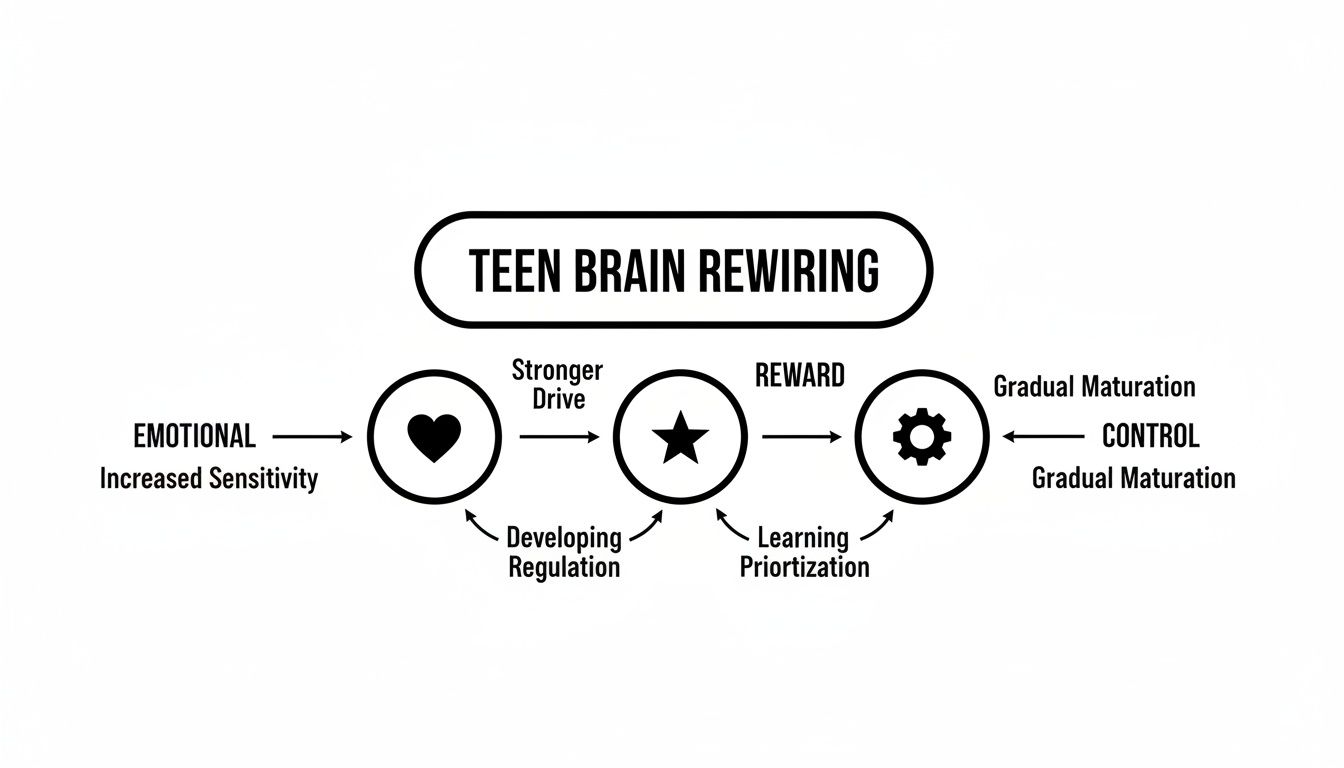
As you can see, the imbalance between the supercharged emotional and reward systems and the still-maturing control system is at the very heart of cognitive development in adolescence.
"Understanding this biological reality can shift your perspective entirely. Instead of seeing a 'difficult teen,' you can begin to see a young person courageously navigating one of the most significant transformations of their life."
This stage isn't something to just endure; it's a critical journey that needs our support. By understanding the why behind their behaviour, we can provide the guidance and empathy our children need as their brains build the foundations for a capable and thoughtful adulthood.
The Shift From Concrete Rules to Abstract Ideas
One of the biggest mental shifts during the teenage years is the move away from black-and-white thinking. Younger children tend to see the world in very concrete terms—fairness, for example, is when everyone gets exactly the same number of sweets. But as they hit adolescence, their minds begin to unlock the ability to handle shades of grey and complex, abstract ideas. It can feel like the world has suddenly become more complicated, and they are trying to find their footing in it.
This isn’t just a small step; it’s a monumental leap. Suddenly, they can understand sarcasm, see the symbolism in poetry, and think about massive concepts like infinity or faith. This is exactly why they start questioning everything, from family rules that once seemed absolute to broader societal norms. It’s a messy, exciting, and absolutely essential part of them figuring out who they are and what they believe.

This mental rewiring can be both dazzling and a bit of a challenge. You might find yourself locked in a passionate debate about social justice with the same child who, just a few years earlier, was solely focused on playground politics. They’re no longer just accepting information; they are analysing it, testing their own hypotheses, and building their own moral compass from the ground up. This search for meaning can be deeply personal and emotional for them.
From Simple Answers to Complex Questions
This blossoming ability for abstract thought has a direct impact on their academic and personal lives. Your teen can now properly engage with hypothetical situations ("What if…?") and mentally game out multiple outcomes before making a decision. This is the very foundation of higher-level reasoning and sophisticated problem-solving.
As they navigate this journey, their capacity for complex reasoning becomes critical. You can see this clearly in academic tasks that demand they build and defend an argument, such as writing an effective argumentative essay.
This journey into abstract thinking is what allows them to:
- Form a Stable Identity: They can imagine their future self, trying on different values and beliefs to see which ones fit. This can feel both exciting and frightening.
- Develop Empathy: They get much better at understanding someone else's perspective, even if it’s completely different from their own. Imagine them defending a friend you disagree with; they are practising seeing the world through another's eyes.
- Engage in Moral Reasoning: They can debate tricky ethical dilemmas, moving beyond simple "right" and "wrong" to consider things like intent and context. For example, they might argue that a character in a book wasn't "evil," just misunderstood.
The table below shows just how different this new way of thinking is, helping to illustrate the cognitive leap your teen is making.
Cognitive Shifts From Childhood to Adolescence
| Cognitive Area | Childhood Thinking (Concrete) | Adolescent Thinking (Abstract) |
|---|---|---|
| Problem-Solving | Relies on trial-and-error. Sees one clear, correct answer. | Can think hypothetically ("what if?") and systematically test solutions. |
| Understanding Rules | Rules are absolute and unchangeable. "Because I said so" is accepted. | Questions the logic behind rules; sees them as agreements that can change. |
| Social Perspective | Thinks mainly from their own point of view. | Can understand and consider multiple perspectives at once (metacognition). |
| Future Thinking | Focuses on the immediate here and now (today or this week). | Can plan for the long-term future (university, career) and set goals. |
| Language Use | Interprets language literally. Sarcasm and metaphors are confusing. | Understands nuance, sarcasm, symbolism, and double meanings in language. |
Seeing these changes in real-time helps us appreciate the incredible development happening inside their minds.
This period is about more than just becoming smarter; it's about becoming a more thoughtful and self-aware individual. Your teen is learning to construct their own worldview, piece by piece, using these powerful new cognitive tools.
Understanding this shift is the key to supporting them. When they question your rules, it’s rarely simple defiance—it's an attempt to grasp the reasoning behind them. For anyone looking to encourage this growth, you can find practical ways to develop critical thinking skills in your teen.
Engaging them in these discussions, listening to their developing arguments, and valuing their perspective helps build both their confidence and their cognitive abilities for life.
Understanding Your Teen's Developing Executive Functions
Does the state of your teen's bedroom, with clothes strewn everywhere, fill you with a unique sense of despair? Have you ever felt that jolt of panic when you realise a major school project, mentioned weeks ago, is now due tomorrow? It's a deeply frustrating experience, and it's easy to jump to conclusions about laziness or a lack of care.
But what if it's not about defiance? For your teen, this chaos might feel overwhelming and even shameful. The real reason often lies in the ongoing cognitive development in adolescence, specifically with a set of skills known as executive functions. Think of these as the CEO of the brain—the control centre responsible for planning, organising, managing time, and controlling impulses. Just like the rest of their brain, this CEO is still in training.
The Brain's CEO Is Still Learning
A younger child's life is largely structured by adults. We tell them when to get up, what to wear, and when homework needs to be done. As they become teenagers, we expect them to start managing these things themselves, but the mental wiring to do so effectively hasn't fully formed yet. Their brain's CEO is brilliant at creative, in-the-moment thinking but struggles to see the long-term picture.
This is why a simple command like "clean your room" feels so overwhelming to them. To an adult, it's a single, straightforward task. But to a teen whose planning skills are still developing, it's a massive, undefined project with no clear starting point. For them, it can feel like being told to climb a mountain without a map. The same goes for a long-term school assignment; they can't easily visualise the sequence of steps needed to get from start to finish.
The last-minute panic isn't a sign of failure—it's a sign that the underlying systems for planning and organisation are still under construction. Your child needs a supportive project manager, not just a demanding boss.
Supporting them doesn't mean doing the work for them. It means acting as a scaffold, providing just enough structure to help their own skills grow without causing constant arguments or making them feel incapable.
Practical Ways to Support Their Inner CEO
Instead of getting caught in a cycle of reminders and frustration, you can provide the tools their developing brain needs to succeed. The goal is to build their capacity for self-management by making abstract tasks concrete and achievable, always centring their feelings and needs.
Here are a few strategies that put your teen's needs at the centre:
- Make Planning Visual: Use a large whiteboard or a shared digital calendar. Mapping out exam dates, project deadlines, and social events together makes time tangible. For example, you could say, "I see your science project is due here, and you have that party on Friday. Let's find a couple of 30-minute slots to work on it so you don't have to stress."
- Break It Down: That big history project? Sit with them for ten minutes and break it down into tiny, manageable steps. "Research topic," "Write outline," "Find three sources," and "Draft introduction" are far less intimidating than the monumental task of "Write essay." Celebrate each small step to build their confidence.
- Use Collaborative Problem-Solving: Instead of declaring, "Your room is a disaster," try a different tack. "I know it's hard to keep things organised when you're so busy. This space feels stressful for both of us. What's one small thing we could tackle together right now to make it feel a bit calmer?" This approach invites cooperation instead of triggering defensiveness, empowering them to take ownership.
The Power of Peers in Shaping a Teen's World
If you suddenly feel like your voice is being drowned out by your teenager’s friends, you’re not alone. It can hurt to feel like you're losing them. But this intense shift towards peers isn't a rejection of your family; it’s a powerful, neurologically-driven stage of cognitive development. Their brain is literally hardwired to seek social connection and figure out its place in the world outside the family unit.
This focus is essential for developing crucial social skills like empathy, negotiation, and seeing things from another person’s point of view. Every whispered secret, group chat, and shared joke is a live training session for understanding complex social dynamics. That desperate need to belong isn’t trivial—it’s about building a sense of self and identity among equals. For them, fitting in can feel like a matter of survival.

For them, the stakes feel incredibly high. Social acceptance triggers the brain’s reward centres, while rejection can feel as painful as a physical injury. Understanding this helps explain the emotional turmoil that can follow even a minor disagreement with a friend. What might seem like "drama" to us can feel like a genuine crisis to them.
The Science of Social Belonging
This deep-seated need for peer approval is a biological imperative. As teens become more independent, their survival instincts pivot towards building a strong social network. This creates a hyper-awareness of social cues, group norms, and their own status within the hierarchy, making them incredibly emotionally sensitive. This is a core part of their growth.
Of course, this journey isn't always smooth. The path through adolescence is deeply shaped by early life experiences. A long-term UK study found that children with persistent cognitive and socioemotional difficulties were over three times more likely to experience mental ill-health by age 14, highlighting just how crucial early support is for navigating these complex social years. You can read the full government findings on childhood developmental paths.
Your role isn't to compete with their friends, but to be the safe harbour they can return to. Keeping lines of communication open, even when you don't agree with their choices, shows them they are unconditionally loved and accepted.
This phase requires patience and empathy from us. By acknowledging the importance of their social world—perhaps by asking about their friends with genuine curiosity—you validate their feelings and ultimately strengthen your connection. Supporting their journey means understanding the emotional landscape they navigate daily; you can learn more about the principles of social-emotional learning to help guide them.
Ultimately, listening without judgement is one of the most powerful tools you have to help your teen build a confident, secure identity.
Navigating Academic Pressures and Learning Needs
The teenage years run parallel to some of the most intense academic pressures a young person will ever face. Watching your child navigate the high-stakes world of GCSEs and A-Levels can be a rollercoaster, especially when you see them struggle. It’s completely natural to feel a knot of worry about their future when they seem disorganised, overwhelmed by exam stress, or just unable to keep up.
Often, these struggles are a direct reflection of what’s happening inside their developing brain. The very skills needed for long-term revision planning, managing stress, and organising complex information are all executive functions—and these are the skills still under construction in the adolescent mind. For some teens, this developmental gap is more pronounced, making the academic climb feel impossibly steep and lonely.

This isn’t about a lack of intelligence or effort. It’s about a mismatch between what school demands and the cognitive toolkit they currently have. In this demanding environment, it's crucial for both teens and parents to understand what is cognitive overload and learn how to manage it. Spotting the signs early is the first step toward getting them the right support and easing their burden.
Recognising When Your Teen Needs Support
It’s one thing to deal with typical teenage procrastination; it’s another to see signs of a deeper struggle. Paying close attention can help you become their best advocate, whether that means arranging school accommodations or trying new strategies at home.
Look out for persistent patterns like these:
- Chronic Disorganisation: Consistently losing homework, forgetting key deadlines, or finding it impossible to manage a study schedule, even with your help. This isn't just messiness; it's a sign they feel completely swamped.
- Intense Exam Anxiety: More than just pre-exam nerves, this can show up as physical symptoms like headaches or sleeplessness, avoiding revision altogether, or full-blown panic. Imagine the fear they must be feeling.
- Difficulty with Multi-Step Tasks: Struggling to break down large projects or follow complex instructions, often leading to last-minute, high-stress crises that leave them feeling like a failure.
- Emotional Dysregulation: Extreme frustration, anger, or shutting down completely when faced with challenging schoolwork. This is often a cry for help masked by a protective wall.
If these signs feel familiar, it may be time to consider if an underlying Special Educational Need (SEN), such as ADHD, is playing a role. Exploring these possibilities is a proactive step toward getting them the help they deserve. For more targeted advice, you might find our guide on studying with ADHD a useful starting point.
"The goal isn't to eliminate academic challenges, but to build your teen's resilience and equip them with the strategies they need to face those challenges confidently. It’s about prioritising their well-being and effort over perfect grades."
The connection between a child’s early development and their later academic success is undeniable. UK research found that children with persistent cognitive and socioemotional problems from a young age were nearly 4.5 times more likely not to achieve a standard pass in five GCSEs. This really underscores just how vital continued support is throughout their entire school journey.
Creating a supportive home environment—a place where it’s safe to struggle and ask for help—is the most powerful tool you have. By focusing on building skills and celebrating their effort, not just the outcome, you give your teen the foundation they need to succeed on their own terms.
Frequently Asked Questions From Parents
Navigating the teenage years often brings more questions than answers. It’s a time filled with intense emotions and rapid changes, leaving many parents wondering what’s normal and how best to offer support. Here are some direct, heartfelt answers to the most common concerns we hear.
How Can I Tell if My Teen's Struggles Are Normal Development?
This is the question that keeps so many parents up at night. The line between typical teen moodiness and something more serious can feel blurry. A key difference is the impact on their daily life.
Is their moodiness preventing them from going to school, seeing friends, or enjoying hobbies they once loved? A bad day or even a difficult week is normal. A persistent pattern of withdrawal, extreme irritability, or deep sadness that lasts for weeks is a signal to pay closer attention. For example, if your normally social teen has stopped talking to their best friend for over two weeks and isn't interested in their favourite game anymore, it's worth a gentle conversation.
Trust your intuition. You know your child better than anyone. If your gut tells you something is genuinely wrong, it’s always better to seek professional guidance. Early support can make all the difference, providing them with the tools they need to navigate their feelings.
What Are the Best Ways to Support Executive Function Skills at Home?
Supporting their developing 'brain CEO' isn't about nagging; it’s about collaborating. Instead of getting frustrated by a messy room or forgotten homework, think of yourself as a supportive project manager helping an intern learn the ropes.
The goal is to provide external structure until their internal skills catch up.
Try these practical, cooperative strategies:
- Co-create visual systems. Use a shared family calendar or a whiteboard to map out deadlines and chores. This makes time a visible, concrete thing they can manage. "Let's put your exam schedule up here so we can both see it. Where do you think we should put reminders for study time?"
- Break down tasks together. Instead of "do your homework," try, "Let's spend ten minutes figuring out the first three steps for that history project." Small wins build momentum and fight that feeling of being overwhelmed.
- Establish predictable routines. Consistent times for homework, chores, and downtime reduce decision fatigue and help make self-management automatic. This creates a sense of safety and predictability when their inner world feels chaotic.
How Does Screen Time Impact a Teenager's Developing Brain?
It's tempting to view screens as the enemy, but the reality is more nuanced. Technology is a huge part of your teen's social and learning world. The real concern isn’t about screen time itself, but about what it displaces—sleep, face-to-face interaction, and physical activity.
Research shows a strong link between high smartphone use and poorer sleep, which directly impacts mood and concentration. The constant pings and notifications can also lead to what’s called "fragmented attention," making it harder for their brain to focus deeply on complex tasks like studying.
Rather than imposing strict, top-down bans which often backfire and make them feel controlled, aim for open conversation. Sit down together and create a family media plan that you all agree on. Maybe the rule is "no phones at the dinner table" for everyone, including you. Model healthy habits yourself by putting your phone away during meals and conversations. This shows them that you value connection over distraction—a powerful lesson for their developing mind.
At Queen's Online School, we understand that supporting adolescent development requires a partnership between school and home. Our small class sizes, personalised learning paths, and focus on student well-being create an environment where every teen can thrive, both academically and emotionally. Discover how our approach makes a difference.