
That sinking feeling your child gets when they look at the A-Level Business syllabus? It’s completely normal, and as a parent, it's heartbreaking to watch. The sheer volume of content, from Ansoff’s Matrix to stakeholder mapping, can feel like an unclimbable mountain. It's that feeling of being overwhelmed that leads to procrastination or worse, hours of just rereading notes without anything actually sinking in, leaving them feeling frustrated and defeated.
But what if you could help them turn that anxiety into a clear, focused plan of attack?
Ditch the Overwhelm, Start with a Plan
The best way to start your child's revision isn't by diving into the first chapter of their textbook. It's by taking a step back together and figuring out exactly where they stand right now. You wouldn't set off on a journey without knowing your starting point, and the same goes for their A-Levels.
This means doing a personal audit of the entire syllabus. It’s a simple but incredibly powerful exercise that shifts their focus from one massive, intimidating task ("revise Business") to a series of smaller, manageable steps. It's about helping them see what they already know, not just fixating on the terrifying gaps.
From Anxiety to Actionable Steps
First, sit down with your child and grab the official syllabus for their exam board (whether it’s AQA, Edexcel, or another). The goal is to go through it, topic by topic, and give each one a rating: Red, Amber, or Green.
- Green: They feel confident with this. They could probably explain it to you or a friend.
- Amber: They get the basics, but feel a bit shaky on applying it or need more practice.
- Red: This is a weak spot. It’s a topic that makes their stomach drop or where they have major gaps in their knowledge.
This RAG rating system instantly clarifies where their focus needs to be. Suddenly, the vague, scary task of "revise Business" becomes "practise cash flow forecasts" or "ask my teacher for help with Carroll's CSR pyramid." For a child who feels lost and struggles to get started, breaking it down like this is a game-changer. For this to really work, they'll need solid study techniques. Understanding how to study for exams effectively and boost grades is a great place to start building those habits.
A-Level Business is a popular subject for a reason. In summer 2023, there were 45,235 entries, making it one of the top 15 most chosen A-Levels in the UK. And with nearly 49% of students achieving A*-B grades, success is definitely within reach if you have the right strategy in place.
Here’s a simple template you can use for their syllabus audit:
A-Level Business Syllabus Self-Audit Using RAG Rating
| Syllabus Topic | My Confidence Level (Red/Amber/Green) | Action I Will Take |
|---|---|---|
| e.g., Porter's Five Forces | Amber | Review my class notes and complete two past paper questions on this. |
| e.g., Investment Appraisal | Red | Ask my teacher for help with ARR and NPV calculations because I feel lost. |
| e.g., Marketing Mix (7Ps) | Green | Quickly recap with flashcards before moving to an Amber topic to feel a quick win. |
| e.g., Sources of Finance | Amber | Create a mind map comparing the pros and cons of each source so I can see it visually. |
Once they’ve RAG-rated their syllabus, they’ll have a visual map of their revision priorities. Now, you can help them build a study schedule that’s truly supportive and effective.
By identifying their specific 'Red' areas, you can empower your child to ask for targeted help from teachers or focus their energy where it’ll make the biggest difference. It's a far more efficient and confidence-boosting way to revise than just trying to cover everything at once. And for more tips on staying focused, check out our guide on how to concentrate when studying.
Building a Revision Timetable That Actually Works
So, your child has done their RAG rating audit and knows exactly where their strengths and weaknesses lie. That’s a huge first step. The next is turning that insight into a concrete plan, but this is where so many students, and well-meaning parents, go wrong.
The classic, hour-by-hour revision timetable is often a recipe for burnout and misery. It’s too rigid and doesn’t account for the natural ebbs and flows of a teenager's energy, or the simple fact that some days are just harder than others. The goal here isn’t to create a punishing schedule but a supportive one that makes your child feel in control, not trapped.
A truly effective revision plan is personal and flexible. It should work with your child's natural rhythm, building in the breathing room they need to really get to grips with complex A-Level Business topics without feeling totally swamped. Think of it less as a set of rules and more as a compass to guide their efforts.
From Topics to Time Blocks
Instead of just pencilling in "Business Studies" for two hours, encourage your child to try topic batching. This is all about grouping related concepts into a single, focused study session. For instance, they could create a "Finance Focus" block to tackle cash-flow forecasting, break-even analysis, and sources of finance all at once. Imagine they're setting up a small business like a local coffee shop; they'd need to understand where their initial money comes from (sources of finance), when they'll start making a profit (break-even), and how money will move in and out each month (cash-flow).
Why does this work so well? It helps build deeper connections between ideas. When they study these concepts together, they start to see how one directly impacts the other in a real-world business—which is exactly the kind of joined-up thinking the examiners are looking for.
A simple visual can help map this out. This three-step flow shows how to turn their audit into an actionable plan.
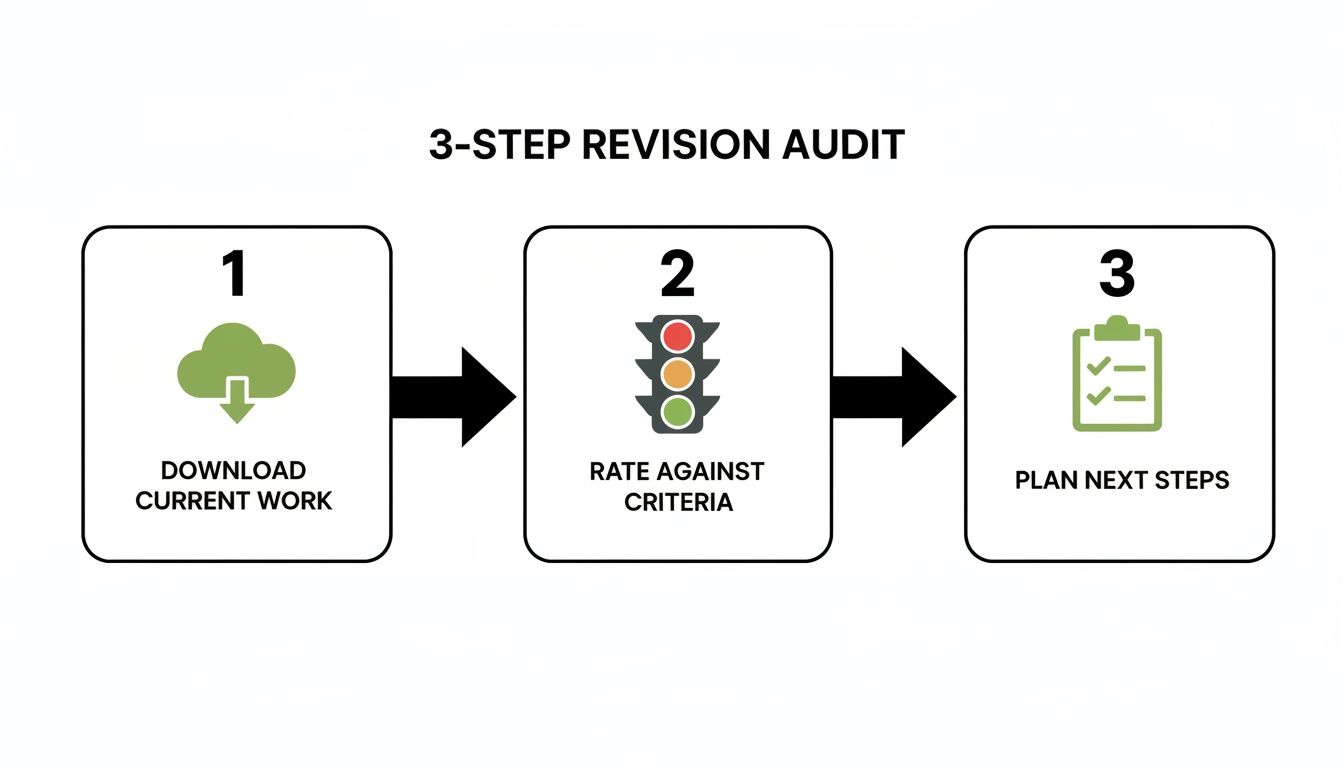
This just reinforces how downloading the syllabus, rating the topics, and planning the sessions are all connected parts of the same smart revision process.
Structuring Study Sessions for Maximum Impact
Let's be honest, watching your child stare at a textbook for long, unbroken hours is painful, and it just doesn't work. Research has shown time and again that our brains can only maintain peak focus for short bursts. This is where the Pomodoro Technique can be a total game-changer, especially for a child who feels restless. It’s incredibly simple but brutally effective for staying on task.
- Work for 25 minutes: Set a timer and they go all-in on one specific task, like making flashcards for marketing theorists. No distractions.
- Take a 5-minute break: They must get up and walk away from the desk. They can stretch, grab a drink, or look out the window—anything to reset.
- Repeat four times: After four of these cycles, they take a proper break of 15-30 minutes.
This method chops the overwhelming feeling of "endless revision" into manageable, bite-sized chunks. Each completed 25-minute session feels like a small win, building momentum and making it much harder to procrastinate. For students who find staying on track particularly tough, looking into specific time management tips to boost productivity can make a huge difference.
Remember, downtime isn't a luxury; it's a critical part of the learning process. Scheduling non-negotiable breaks for hobbies, exercise, or simply relaxing allows your child's brain to consolidate information and prevents the mental fatigue that leads to meltdowns. A student who is well-rested will always outperform one who is overworked.
Adapting the Plan for Every Learner
Every child is different, and their revision plan should reflect that. For students who need a bit of extra support, a few small adjustments can make revision feel less daunting and far more sustainable.
- For visual learners: Use colour-coded planners or digital calendar apps. They could assign different colours to subjects or topic types—like green for marketing and blue for finance—to make the schedule easy to process at a glance.
- For students who need sensory breaks: Schedule short, 10-minute activities that engage the senses. This could be listening to a favourite song, using a stress ball, or doing some light yoga to help reset their focus.
- For those overwhelmed by big tasks: Help them break down those scary ‘Red’ topics into tiny, achievable steps on the timetable. Instead of a daunting entry like "Revise Investment Appraisal," the plan could list "1. Define ARR," then "2. Practise one ARR calculation," and finally "3. Watch a video on NPV." Each ticked box is a small victory.
By building a timetable that is both structured and compassionate, you empower your child to take ownership of their business revision a level journey. This approach not only gets them ready for their exams but also teaches them invaluable life skills along the way.
Active Revision Techniques That Make Knowledge Stick
A solid timetable is a great start, but what your child actually does in their revision slots is what makes all the difference. Too many students fall into the classic trap of passive revision—endlessly re-reading notes or highlighting textbooks, hoping something will sink in. It feels productive, but it’s one of the least effective ways to make information stick long-term, and can leave them feeling like a failure when they can't recall anything.
To truly get to grips with A-Level Business, your child needs to shift to active recall. This is all about pulling information out of their brain, not just passively putting it in. Think of it like lifting weights for the mind; it strengthens the neural pathways and cements knowledge where it needs to be.
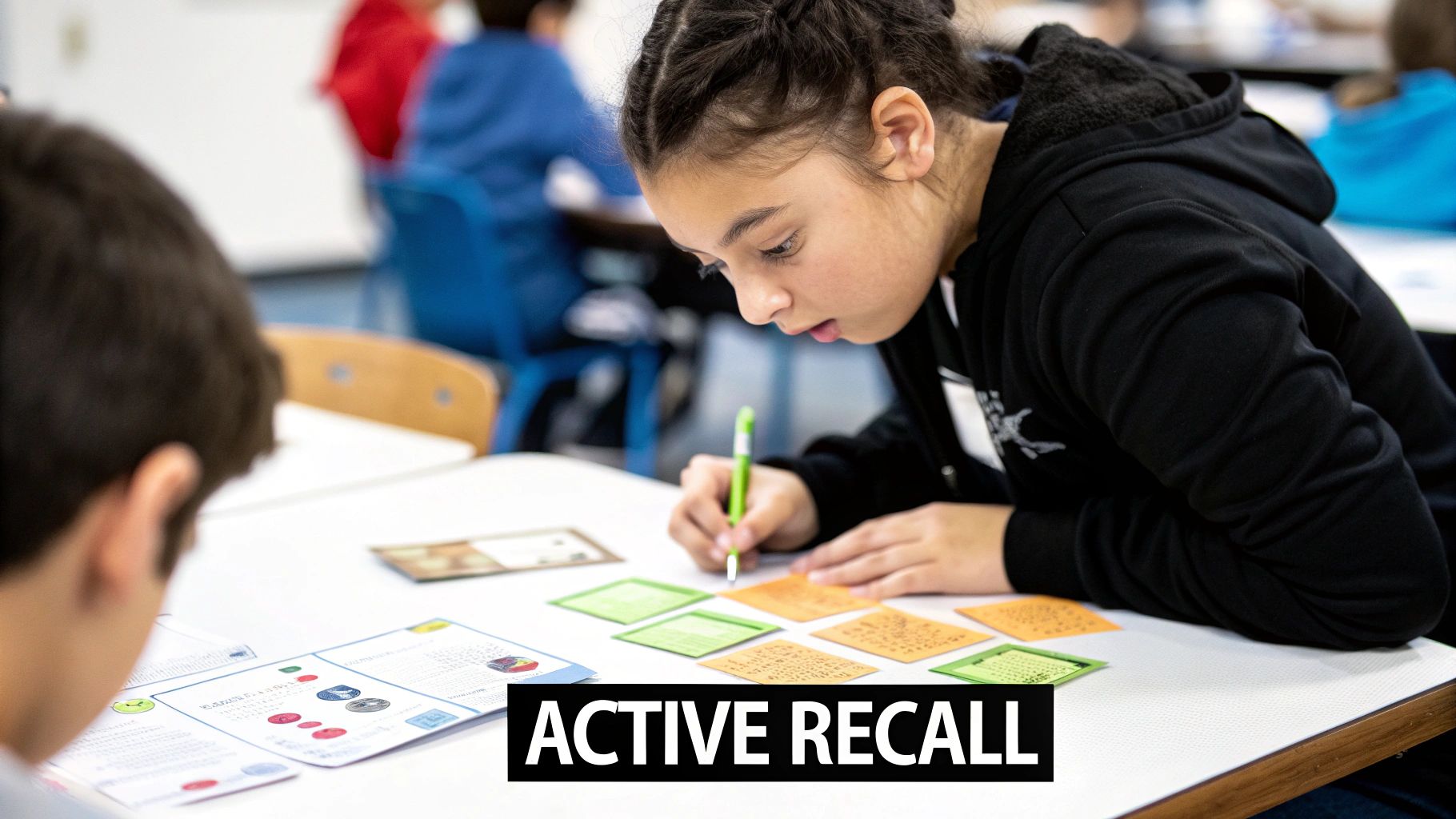
This single change—from passive reviewing to active recalling—is the secret to unlocking higher grades. It’s about helping them build a deep, connected understanding of the material, not just a vague familiarity.
Beyond the Textbook: Synoptic Thinking
A-Level Business isn’t a memory test of isolated facts. Examiners are looking for students who can see the big picture and connect ideas from different parts of the syllabus. This is called synoptic thinking, and it's a skill you can help your child build with practice.
A fantastic way to do this is with synoptic mind maps.
- Pick a central business decision. For example: "Imagine your favourite local café decides to launch a new vegan menu."
- From that centre, branch out to the different business functions. How does this decision affect Marketing (new posters, Instagram ads, reaching a new type of customer)? What about Finance (cost of new ingredients, will they need to raise prices)?
- Then think about Operations (finding vegan suppliers, training staff on new recipes) and Human Resources (do they need to hire a chef who specialises in vegan food?).
This exercise forces your child to think like a manager, tracing the ripple effects of a single decision across the entire organisation. It’s a powerful revision tool because it perfectly mimics the kind of analytical thinking needed for the big-mark essay questions.
Explaining It Simply: The Feynman Technique
Another brilliant tool for a child struggling with a complex topic is the Feynman Technique, named after the Nobel Prize-winning physicist Richard Feynman. Its core idea is simple but powerful: you don't really understand something until you can explain it to someone else in simple terms.
Here’s how it works for a tricky topic like Porter’s Five Forces:
- Learn the concept: Your child revisits their notes and textbook on Porter's model.
- Teach it: Ask them to explain it to you, or even a younger sibling. The rule is no jargon. Can they explain "threat of new entrants" using the example of a new pizza place opening on your high street?
- Find the gaps: Where do they hesitate or get stuck? Which bits are fuzzy? This instantly shines a spotlight on their weak spots.
- Go back and simplify: They return to their notes to fill in those gaps, then try the explanation again, making it even clearer and simpler this time.
This process turns them from a passive learner into an active teacher, a mental shift that dramatically boosts retention and confidence. To discover more strategies like this, have a look at our guide on the most effective revision techniques.
The beauty of the Feynman Technique is that it exposes flawed understanding. If your child can’t explain the difference between ‘threat of substitutes’ and ‘threat of new entrants’ simply, it’s a clear sign they need to revisit that area before the exam.
Turning Case Studies into Revision Tools
Case studies are the bread and butter of the A-Level Business exam, so they need to be at the heart of your child’s revision. Don't just let them read them—encourage them to dissect them.
A great practical task is to turn a case study into a pack of analytical flashcards. For a business like Tesco, they could create cards asking:
- Question Side: "Analyse one benefit for Tesco of using a cost-leadership strategy."
- Answer Side: Bullet points covering key benefits—attracting price-sensitive shoppers, achieving high sales volume, creating a barrier to rivals—backed up with specific evidence from the case study itself. For example, "They can bulk-buy products to keep prices low, which is mentioned on page 2 of the case study."
This method cleverly combines active recall (remembering the theory) with application (linking it directly to the business context), which is exactly what examiners reward with top marks.
Mastering Exam Technique for Higher Grades
Having a deep well of business knowledge is essential, but it’s only half the battle. We’ve all seen it happen: a bright student knows their subject inside out, yet their exam results just don't reflect their true ability.
The missing piece of the puzzle is almost always exam technique—the art of giving the examiner exactly what they want to see. It can be heartbreaking for a young person to feel they’ve failed when, in reality, they just haven’t learned how to communicate their knowledge in the right way. This section is all about demystifying that process and turning good responses into great ones.
Decoding the Language of the Exam
Every exam question is built around a command word. This isn't just a suggestion; it’s a direct instruction telling your child precisely what to do. Misinterpreting this one word is one of the fastest ways to lose marks. They might write a brilliant description of a marketing strategy, but if the question asked them to evaluate it, they’ve missed the point entirely and capped their potential score. It's a painful mistake to make after so much hard work.
Understanding these terms is the first step towards writing with precision and purpose. It helps shift them from just listing facts to developing the kind of critical analysis that earns top grades.
Decoding Exam Command Words for A-Level Business
To get this right, students need to know what the examiners are really asking for when they use these key terms. It’s about looking past the word and understanding the required thinking process.
| Command Word | What It Really Means | Example Action for Full Marks |
|---|---|---|
| Analyse | Break the topic down into its core parts and explain how they connect. It's about showing the relationship between cause and effect. | For a question on changing interest rates, your child would explain how a rise in rates affects both a business's costs (loans) and consumer spending (demand), linking the two sides together to show the full picture. |
| Evaluate | Make a final, supported judgement. This means they have to weigh up the pros and cons, consider different viewpoints, and then come to a decisive conclusion. It's like being a judge in a courtroom. | When evaluating a decision for a business to expand overseas, they must discuss the benefits (e.g., new markets) and the drawbacks (e.g., cultural barriers), then conclude with a final judgement on whether it was the right move, justifying why. |
| Justify | Give solid reasons and evidence to support an answer or conclusion. It’s all about backing up their point of view with business theory or specific data from the case study. | If they recommend a specific pricing strategy for a new phone, they must justify why it's the best option for that particular business in its current market, using evidence from the text to support their reasoning. |
Think of this table as an exam dictionary. Helping your child get familiar with these distinctions is a non-negotiable part of effective revision.
Building the Perfect Paragraph with PEEL
Once your child understands the question, they need a reliable structure to build their answer. The PEEL paragraph structure is a simple yet powerful framework that ensures every point they make is well-developed, backed by evidence, and directly relevant.
It’s a way to train their thinking, helping them move from a scattergun approach to a logical, compelling argument that is easy for an examiner to follow and, more importantly, to reward with marks.
Here’s how it works:
- P – Point: Start with a clear topic sentence that directly answers the question.
- E – Evidence: Back it up with specific information. This could be a business theory, a statistic, or a crucial detail from the case study.
- E – Explanation: Explain how your evidence supports the point. This is where the real analysis happens—connecting the dots for the examiner.
- L – Link: Finish by linking the point back to the question and the wider context of the business in the scenario.
Using the case study isn't optional; it's essential for getting high marks. Examiners repeatedly state that the best answers are 'rooted in the context' of the business. Encourage your child to see the case study as their toolbox of evidence, not just background reading.
Putting It All into Practice
Let’s imagine a typical 12-mark question: "Analyse the benefits to CoffeeCo, a premium coffee shop chain, of using a differentiation strategy."
A weak answer might just list generic benefits that could apply to any company, showing a lack of engagement. A top-tier answer, however, will use PEEL and weave in details from the CoffeeCo case study in every single paragraph, showing genuine understanding.
Here’s a worked example of a single, powerful PEEL paragraph:
(Point) One significant benefit for CoffeeCo of using a differentiation strategy is its ability to build strong brand loyalty among its target market of young professionals.
(Evidence) The case study states that CoffeeCo invests heavily in ethically sourced beans and provides a unique in-store experience with free Wi-Fi and comfortable workspaces, setting it apart from budget competitors like Greggs.
(Explanation) This focus on quality and atmosphere creates a premium brand image that resonates with customers who are less sensitive to price and value the 'experience' of buying coffee. As a result, these customers feel a connection to the brand, are more likely to become repeat purchasers, and are less likely to be tempted by lower prices elsewhere, which helps create a stable revenue stream for the business.
(Link) Therefore, by differentiating itself through these non-price factors that appeal to its specific customers, CoffeeCo can effectively secure a loyal customer base—a crucial advantage in the highly competitive coffee shop market.
See how every part of the paragraph is focused, evidenced, and tied directly back to CoffeeCo? Mastering this technique takes practice, but it's what transforms a student's ability to perform under pressure. It ensures all their hard work in their business revision a level truly pays off when it matters most.
Putting It All Together: Past Papers and a Supportive Home Base
All the active revision and exam technique practice has been leading to this moment: applying it all under real pressure. This is where past papers stop being just another resource and become the single most valuable tool in your child’s revision kit. But the goal isn't just to churn through paper after paper. The real magic happens when they're used strategically to diagnose weaknesses, build confidence, and demystify the exam hall experience.
At the same time, your role as a parent shifts. Creating a calm, supportive, and low-pressure home environment is just as powerful as any revision technique. Your child’s emotional well-being is the foundation on which all their hard work is built.

This final phase is about weaving everything together—academic preparation and emotional resilience—to make sure they can walk into their exam feeling capable and ready.
A Gradual Approach to Past Papers
Throwing a student into a full, timed exam paper before they're ready can be incredibly daunting. It can easily knock their confidence and make them feel like giving up. A far kinder, and frankly more effective, approach is to build up to it in stages.
- Start with Open-Book Papers: For the first few attempts, let them use their notes. The aim here isn't to test their memory, but to perfect their technique. Can they find the right information to structure a brilliant PEEL paragraph? This takes the pressure off, allowing them to focus purely on crafting high-quality answers.
- Move to Timed Sections: Next, get them to tackle individual sections against the clock. If a full paper is 90 minutes, they could spend 30 minutes just on the 20-mark essay. This helps them get a feel for the required pace without the exhaustion of a full mock.
- Finish with Full Mocks: In the final weeks leading up to the exam, it's time for full papers under strict exam conditions. That means no phone, no distractions, just a timer and the paper. This is crucial practice for managing time and energy across the entire exam.
But the work doesn't stop when the timer does. The most important step is what comes next: marking their own work against the official mark scheme. This is a non-negotiable part of effective business revision a level. It forces them to think like an examiner and confront their mistakes head-on.
Turning Mistakes into a Masterplan
Every single mistake on a past paper is a golden learning opportunity, not a reason for despair. Encourage your child to keep an "Error Log"—a simple notebook or document where they track recurring slip-ups.
This log transforms vague feelings of weakness into a concrete action plan. It might look something like this:
| Question Topic | My Mistake | Why It Happened | What I'll Do Differently |
|---|---|---|---|
| Investment Appraisal | Mixed up the ARR and NPV formulas. | I panicked, rushed the question and didn't double-check my workings. | I'll create a formula sheet and do five practice questions focusing only on NPV until it feels automatic. |
| Porter's Five Forces | Described the forces but failed to apply them to the case study. | I forgot to link my points back to the business in the scenario. My answer was too generic. | I'll re-read the section on using context and physically highlight evidence in the case study before I start writing. |
This simple process reframes the narrative. It turns "I'm just bad at finance questions" into a specific, manageable task: "I need to practise my NPV calculations." It's an incredibly empowering shift in mindset that can restore a child's sense of control.
Nurturing a Supportive Home Environment
Your child is navigating a huge amount of pressure. Your support can be the anchor that keeps them steady. This isn't about becoming their tutor; it's about being their safe harbour.
- Listen, Don't Just Fix: Often, they don't need solutions; they just need to vent their fears and frustrations. Ask open-ended questions like, "How are you feeling about things?" and then just listen, without immediately jumping in with advice.
- Fuel Their Brain (and Body): Keep the kitchen stocked with healthy snacks and make sure they're drinking plenty of water. Small gestures, like cutting up some fruit or making them a hot drink, can feel like a huge act of love and support when they're stressed.
- Celebrate the Effort, Not Just the Results: Praise their hard work and resilience, not just the marks they get on a practice paper. Saying, "I'm so proud of how hard you're working on this," reinforces that their value isn't tied to their final grade.
- Protect Their Downtime: Make sure they are taking proper breaks. Encourage screen-free time, a walk outside, or whatever helps them truly switch off and recharge. Rest isn't a luxury; it's essential for their brain to process and retain information.
This supportive structure is particularly important when you look at the bigger picture. Official UK data shows a stark difference in A-level outcomes depending on school type. In 2023, for instance, around 44% of grades in selective secondary schools were A or A*, compared to just 14.4% in further education colleges. For learners whose needs make a busy sixth form challenging, a calm home and the right support can help level that playing field. You can read more about these trends in A-level results.
By combining targeted, intelligent past paper practice with a genuinely supportive home life, you give your child the best possible chance to not just succeed, but to thrive during this challenging period.
Answering Those Common Last-Minute A-Level Business Questions
As exam season hits its final stretch, it’s completely normal for a few nerves and last-minute questions to surface. You and your child have put in months of hard work, but this final leg of the journey can feel particularly uncertain. We hear the same worried queries from families year after year, so we’ve brought them together here to offer some calm, practical advice.
Think of this as that final chat to settle the nerves and sharpen the focus. It’s all about getting through these last few days with a sense of control, so your child can walk into that exam hall feeling prepared, not panicked.
"How Much Revision Is Enough?"
This is the big one, and the honest-to-goodness answer is there’s no magic number. It has never been about the number of hours clocked; it’s about the quality and focus of those hours. A student who spends two hours on active, focused revision is achieving far more than one who simply stares at a textbook for six, feeling their anxiety rise with every passing hour.
The real measure of ‘enough’ is confidence. Can they glance at their RAG-rated syllabus and see that most of the red topics have turned amber or green? Can they attempt a past paper question without that initial feeling of being completely lost?
Your child has done enough when they can consistently apply what they know to different business scenarios. If they can explain a concept in simple terms (the classic Feynman test) and confidently structure an answer using PEEL, they’re in a great place. The goal is readiness, not exhaustion.
"What Should We Do the Night Before the Exam?"
The night before an exam is absolutely not the time for frantic, last-minute cramming. Your child's brain needs a chance to rest and consolidate everything it has taken in. Trying to learn a whole new topic at 11 p.m. is far more likely to induce panic than it is to add a few extra marks.
Instead, the focus should be on creating a calm and organised evening.
- A Gentle Review: A light, 30-minute flick through key definitions or flashcards is perfectly fine, but that should be the limit.
- Get Everything Ready: Help them pack the exam bag with pens, pencils, a calculator (with fresh batteries!), a clear water bottle, and anything else they need.
- Plan the Morning: Lay out their clothes and double-check travel plans and timings for the next day. Removing those small decisions helps reduce morning stress.
- Switch Off: Encourage at least an hour of screen-free time before bed. Reading a book, listening to music, or just having a quiet chat is much better for promoting a restful night's sleep.
"How Can They Handle Exam Day Nerves?"
Nerves are completely normal—in fact, they’re a good sign. They show that your child cares about the outcome. The trick is to manage them so they don’t become overwhelming. On the morning of the exam, a calm, familiar routine is their best friend. And a good breakfast is non-negotiable; their brain needs fuel to perform under pressure.
If they feel a wave of panic in the exam hall, a simple breathing technique can work wonders. It's a great idea to practise this together beforehand:
- Close their eyes for a moment.
- Breathe in slowly through the nose for a count of four.
- Hold that breath for a count of four.
- Breathe out slowly through the mouth for a count of six.
Repeating this just three or four times can slow a racing heart and clear the mind. It’s a small, discreet tool that helps them regain a sense of control right when they need it most, allowing them to refocus on the question in front of them.
At Queens Online School, we understand that academic success is built on a foundation of well-being and personalised support. Our live, interactive classes and small group sizes ensure every student, including those with SEN or SEMH needs, gets the focused attention they deserve to thrive. If you're looking for an educational path that nurtures your child's confidence as well as their grades, discover more about our A-Level programmes.