

Alternatives in education are simply learning paths that exist outside the mainstream state or private school system. These options, including online schooling, home education, and flexi-schooling, are designed to offer a more personalised experience—one that’s a better fit for a child's unique needs, personality, and family situation. They offer a lifeline for children who aren't thriving in a traditional classroom, creating a space where a child's well-being is the foundation for their success.
Is the Traditional School System Failing Your Child?
Does your bright, curious child seem to fade into the background in a bustling classroom of thirty? It’s a quiet worry that keeps many parents up at night—that nagging feeling that their child’s unique spark is being dimmed by a system built for the masses. You see their potential and their distinct way of seeing the world, yet the daily report is one of struggling to keep up, feeling overwhelmed, or simply being overlooked.
If you have that feeling in your gut, you’re not wrong. The long-held belief that a conventional school is the only route to a successful future is being challenged by the very children it's meant to serve. For too many, the pressure to conform, the rigid pace of the curriculum, and the social complexities create an environment of anxiety, not inspiration.
A Path Centred on Your Child
Looking into alternatives in education isn’t about rejecting the system entirely. It’s a compassionate and practical response to a simple truth: every child is different. It’s about putting your child’s needs, well-being, and learning style at the absolute centre of their educational journey.
Think of it this way: you wouldn't force a budding artist to study only spreadsheets, or a future engineer to focus solely on poetry. Education should be the key that unlocks a child's potential, not a box that confines it. For example, a child who is brilliant at coding but struggles with social anxiety might feel defeated in a traditional school. An alternative could let them excel in their passion while learning in a calm, supportive environment that doesn't trigger their anxiety every day.
This journey is about asking a courageous question: "What does my child truly need to flourish?" It’s a shift from fitting the child to the school, to finding a school that fits the child.
Redefining a Successful Education
For a growing number of families, the search for alternatives is driven by a desire to protect their child's mental health and nurture their innate love of learning. It’s a proactive choice to step away from a one-size-fits-all model that can inadvertently cause more stress than success.
The goal is to find an environment that offers:
- Personalised Attention: Where a teacher knows your child's strengths and struggles, not just their name on a register.
- Flexible Pacing: Allowing them to spend more time on tricky topics, like mastering algebra, or accelerate through subjects they love, like history.
- A Safe Space: An atmosphere free from the social pressures and anxieties that can hinder learning and emotional growth.
Just questioning the status quo is the first, most crucial step. You are not alone in this. Recognising that the traditional path may not be the best path for your child is an act of advocacy and love. It opens the door to a world of educational possibilities where they can feel seen, supported, and genuinely excited to learn again.
Why Are So Many Families Looking for Something Different?
The move towards alternative education isn't just a passing trend. It's a deeply personal response from parents who see their children struggling in a system that simply wasn't built for them. This shift is driven by thousands of real, often painful, stories happening in homes just like yours.
For many children, the modern classroom has become a source of profound anxiety. Imagine a sensitive child trying to focus on a maths problem while the noise of 29 other children, the scraping of chairs, and the fear of being called on create a constant buzz of panic. What often gets labelled as "bad behaviour" is actually a child's desperate signal that their needs aren't being met. It’s a cry for help, not an act of defiance.
From Unmet Needs to a Positive Choice
When a school environment isn't working, the signs are usually crystal clear. It might be the child who feels invisible in a class of thirty, the bright student who is emotionally drained by the end of each day, or the creative thinker whose unique learning style is mistaken for a lack of focus. This is where the search for an alternative begins—not as a last resort, but as a proactive, loving step towards a better future.
Parents are quickly realising that if the system won't adapt to their child, they need to find an environment that will. It’s a decision to reclaim their child’s right to feel safe, understood, and truly engaged in their own education. It's about putting well-being first, knowing it’s the only solid foundation for academic success.
At its heart, seeking an alternative is an act of advocacy. It's a parent saying that their child's mental health and emotional stability are non-negotiable.
A System Under Pressure
Let’s be honest: the mainstream school system is under immense strain. With stretched resources, oversized classes, and constant pressure to hit standardised targets, it’s incredibly difficult for even the most dedicated teachers to give every child the individual support they need.
This pressure hits children with Special Educational Needs (SEN) and those facing Social, Emotional, and Mental Health (SEMH) challenges the hardest. When a child with dyslexia needs more time but the class moves on, or a child with anxiety needs a quiet space but there isn't one, school can actually make things worse. This creates a vicious cycle of frustration and disengagement.
The official numbers paint a stark picture. School exclusions and suspensions in England have hit alarming levels, pointing to an urgent need for different solutions. During the 2023–24 academic year, a staggering 955,000 suspensions were issued in English schools—a 21% jump from the year before. On top of that, 10,900 children were permanently excluded. The system is failing its most vulnerable learners at a devastating rate. To understand more about this growing crisis, you can explore the full report on school exclusion trends from genuinefutures.co.uk.
The Power of Finding the Right Path
Choosing a different educational path is about finding a place where your child is seen as a whole person, not just a grade on a report card. It’s about giving them the power to learn in a way that respects their pace, fuels their interests, and supports their emotional health.
These stories are becoming more and more common:
- The Anxious Learner: A child who used to have panic attacks before school now logs into a calm, structured online classroom, free from the social chaos of a busy corridor.
- The Gifted Thinker: A student once bored by the slow pace of their class is now flying through subjects they love in a self-paced programme, their passion for learning reignited.
- The Neurodivergent Child: A learner with SEN finally gets consistent, one-on-one support tailored to them, allowing their confidence to blossom.
These aren't just hypotheticals; they show the incredible difference the right environment can make. By moving away from a setting that causes distress, you're not just fixing a problem. You are creating the opportunity for your child to succeed on their own terms, building resilience and a genuine love of learning that will stay with them for life.
Mapping Your Options in Alternative Education

Choosing an educational path for your child can feel a lot like planning a life-changing journey. You know the destination—a future where they are confident, capable, and happy—but which route is the best one to take? The world of alternatives in education can seem vast and confusing at first, but it helps to think of each option as a different style of travel, designed for a different kind of explorer.
Let's demystify these paths by looking at them in a new way. Imagine one is a meticulously planned guided tour, another a spontaneous backpacking adventure, and a third a custom-built road trip. Each has its own rhythm, level of freedom, and unique experiences, just like the educational models available to your family.
This approach helps shift the focus from a confusing list of terms to a more intuitive question: what kind of journey does my child need to thrive?
The Guided Tour: Home Education
Home Education, often called homeschooling, is like a bespoke guided tour where you, the parent, are the lead guide. You have complete control over the itinerary—the curriculum, the daily schedule, and the learning pace are all in your hands. This is a deeply involved role, demanding significant time and dedication.
For a child who feels lost in a large group or needs to learn at their own speed, this model can be a sanctuary. You can build lessons around their passions. For example, if your child is obsessed with ancient Egypt, you can plan a whole term around it, blending history, art, and even maths (calculating pyramid dimensions!). You’re there for every ‘aha!’ moment and every challenge.
The Self-Guided Adventure: Unschooling
If Home Education is a guided tour, Unschooling is the ultimate backpacking adventure. This philosophy is built on the belief that children are natural learners who will pursue knowledge driven by their own curiosity. There’s no set curriculum or formal schedule; learning happens organically through real-life experiences, questions, and exploration.
This path is perfect for the self-motivated, inquisitive child who chafes against rigid structure. For instance, their interest in baking a cake could lead to learning about fractions, chemistry (how yeast works), and budgeting for ingredients. Their classroom becomes the world around them—the library, the kitchen, a local museum, or a conversation with a mentor. The parent's role isn't to teach, but to facilitate, providing resources and opportunities as the child leads their own intellectual expedition.
The All-Inclusive Resort: Online Schooling
Accredited online schooling is like an all-inclusive holiday package. You get the structure, expertise, and resources of a traditional school, but with all the comfort and safety of being at home. Qualified teachers lead live, interactive classes, a proven curriculum is followed, and your child connects with classmates from all over the world.
This is often the ideal solution for families who want a recognised educational framework (including GCSEs and A-Levels) without the social or emotional pressures of a physical school. For a child who needs routine and expert instruction but finds the mainstream environment overwhelming, online school offers the best of both worlds. The entire journey is planned and delivered by professionals, allowing you to be the supportive parent, not the primary educator.
The most important decision is choosing a journey that matches your child's temperament. A child who craves structure might feel adrift in an Unschooling model, while a fiercely independent learner may feel constrained by a highly structured programme.
The Hybrid Holiday: Flexi-Schooling
Flexi-schooling is the hybrid option, like combining a few days of a guided tour with some free time to explore on your own. Here, your child attends a mainstream school part-time and is formally home-educated for the rest of the week. This arrangement, of course, requires a strong partnership with a willing school.
This model can be a wonderful compromise for a child who benefits from some classroom socialisation but also needs quiet, focused time at home. For example, they might attend school for art and PE, but learn core subjects like maths and English at home where they can get one-to-one support. It offers a taste of both worlds, blending structured learning with personalised, parent-led education. To learn more about how this can work in practice, explore our guide on flexible learning schools and the benefits they offer.
Comparing Educational Alternatives at a Glance
To help you see how these different "journeys" stack up, we’ve put together a quick comparison table. It breaks down the key differences in structure, curriculum control, and social opportunities to help you find the best fit for your child.
| Model | Structure | Curriculum Control | Social Interaction | Best For Learners Who… |
|---|---|---|---|---|
| Home Education | High (Parent-defined) | Full Parent Control | Parent-facilitated via groups, co-ops, activities | Need a highly personalised pace and curriculum. |
| Online Schooling | High (School-defined) | School-led Curriculum | Structured and moderated online classes, clubs | Thrive with expert teaching and routine in a calm setting. |
| Unschooling | Low (Child-led) | Full Child Control | Organic, based on child's interests and activities | Are highly curious, self-motivated, and independent. |
| Flexi-Schooling | Hybrid (School & Parent) | Shared Control | Blended (classroom and parent-facilitated) | Benefit from both classroom structure and home learning. |
Ultimately, there is no single "best" path—only the path that is best for your child. By understanding the core philosophy behind each model, you can make an informed choice that sets them up for a successful and fulfilling educational journey.
How Alternatives Nurture Children with Unique Needs
For some children, a mainstream school is a perfect fit. But for others, the daily reality is a constant struggle against a backdrop of sensory overload, social pressure, and a learning pace that feels either too fast or too slow. If this sounds like your child, please know you are not alone, and there are environments specifically designed to help them thrive.
The right educational alternative can be more than just a different school; it can be a sanctuary. For a child with Special Educational Needs (SEN) or Social, Emotional, and Mental Health (SEMH) challenges, moving away from the noise and chaos of a traditional classroom can feel like a weight being lifted. It creates the mental and emotional space they need to actually learn.
A Calm Space for Complex Minds
Imagine a bright child on the autism spectrum who finds the crowded corridors, ringing bells, and unpredictable social interactions of a big school utterly debilitating. By the time they sit down in class, they are already so overstimulated that their capacity to learn is gone.
Now, picture that same child in a calm, predictable online classroom at home. The routine is clear, the sensory input is controlled, and the focus is entirely on the lesson. They can use fidget toys without judgement or take a five-minute sensory break when needed. This change of environment isn't about avoiding challenges; it's about removing unnecessary barriers to let their true potential shine through.
The recent surge in home education is directly linked to a crisis in mental health and SEN support within UK schools. A recent report highlighted that families are increasingly choosing home education because their children are struggling with anxiety and unmet special educational needs. With one in six home-educated pupils requiring SEN support, it is clear that families are actively choosing alternatives because the mainstream system is failing to meet their child's complex needs.
Consistent Support for Global Families
This tailored approach extends far beyond SEN support. For international families who move frequently for work, educational stability is a constant worry. Imagine your child finally making friends and getting used to a new curriculum, only to be told they are moving countries again in six months. The disruption can be heartbreaking and academically damaging.
An accredited online school offering a consistent framework like the British curriculum provides a powerful solution. It becomes an anchor of stability in a life of movement.
- Uninterrupted Learning: Your child can continue their studies seamlessly, whether you are in Dubai, Singapore, or London, without gaps in their knowledge.
- Globally Recognised Qualifications: They work towards GCSEs and A-Levels that are respected by universities worldwide, keeping their future options wide open.
- A Stable Community: They build lasting friendships with teachers and classmates in a consistent virtual community, giving them a sense of belonging no matter the postcode.
This consistency is not just about academics; it's about giving your child a sense of security and continuity. It allows them to focus on their learning and growth, rather than constantly having to start over.
Whether your child needs a quieter learning space, specialised SEN support, or the stability of an international curriculum, alternatives are designed with their individual needs at the very heart of the experience. It’s about finding a place where they are not just another student in the system, but a valued individual with a unique path to success. You can explore our dedicated guide to learn more about what SEN support looks like in an online environment.
A Practical Guide to Choosing the Right Path
Choosing an educational path feels like one of the biggest decisions you’ll ever make as a parent. The weight of that choice can be overwhelming, but you don’t have to navigate it in the dark. By breaking the process down into manageable, child-focused steps, you can move from a place of uncertainty to one of real clarity and confidence.
This isn't about finding a mythical 'perfect' school. It's about finding the right fit for your child and your family. And that process doesn’t start with glossy prospectuses—it starts by taking a close, honest look at your child.
Step 1: Deeply Understand Your Child
Before you even start looking at alternatives in education, the first step is to create a detailed picture of your child as a learner and, just as importantly, as a person. This goes far beyond their academic report card. It’s about truly understanding the environment where they feel safest, most capable, and most like themselves.
Ask yourself these heartfelt questions:
- When do they feel most confident? Is it when they're lost in a passion project on their own, or is it when they’re collaborating with a small, trusted group of friends?
- What triggers their anxiety? Is it the overwhelming noise of a crowded hallway, the fear of being put on the spot in class, or the looming pressure of a timed test?
- How do they really learn best? For example, does your child need to move around to think clearly? Do they remember everything they hear, or do they need to see it written down?
Answering these questions honestly gives you a blueprint for their ideal learning environment. This simple act of observation is the most powerful first step you can possibly take.
Step 2: Navigate the Legal and Practical Landscape
Once you have a clearer picture of your child's needs, it’s time to get practical. Every educational choice comes with its own set of responsibilities and day-to-day logistics that will absolutely shape your family's life.
Think through these essential points:
- Legal Responsibilities: If you decide to take your child off a school roll in the UK, what are your obligations to the local authority? Getting to grips with the deregistration process is crucial.
- Family Reality: What level of parental involvement is genuinely realistic for your family? For example, can you realistically dedicate several hours a day to direct teaching, or does your work schedule mean an online school with live lessons is a better fit?
- Financial Planning: What’s your budget? The financial commitment for alternatives can range from the low overheads of unschooling to the structured fees of a private online school.
For families exploring different routes, homeschooling is a significant option. Great resources like this guide on The Best Homeschool Planner For Parents can be a huge help in getting organised. This planning stage is all about making sure your final choice aligns with what your family can realistically manage.
Step 3: Vet the Curriculum and Community
The final pieces of the puzzle are the academic and social sides of the equation. You need to be sure the path you choose not only nurtures your child’s well-being but also properly prepares them for a successful future.
This decision tree infographic can help you visualise the key considerations, especially for children with SEN, SEMH, or international backgrounds.
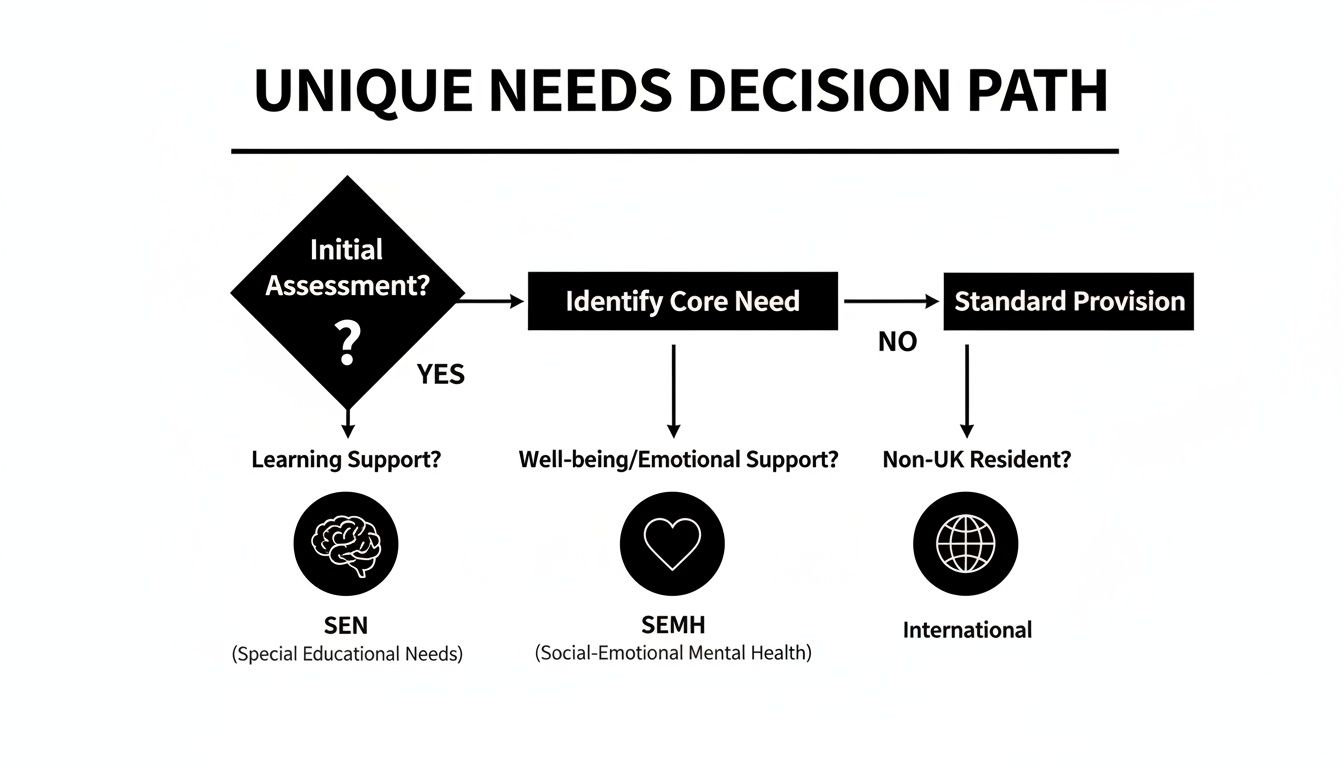
As the visual guide shows, different needs lead to different priorities. For some, specialist support is non-negotiable; for others, it might be emotional safety or gaining globally recognised qualifications that top the list.
This isn't just about passing exams. It's about finding a place where your child feels they belong and can build genuine, supportive friendships.
Key questions to ask any potential provider, or to factor into your home education plan, include:
- Accreditation: Will this path lead to recognised qualifications like GCSEs and A-Levels that keep doors open for university and future careers?
- Social Life: How will my child make and keep friends? Look for structured opportunities, whether that’s online clubs for coding or art, collaborative projects, or local homeschooling meetups.
- Support Systems: What mental health and well-being support is in place? Is there a clear, zero-tolerance policy on bullying?
By thoughtfully working through these steps, you transform a daunting decision into an empowering journey. You’re not just choosing a school; you are consciously designing an educational experience that honours your child for who they are and gives them the best possible foundation to truly flourish.
Finding Your Place and Thriving with Online Schooling
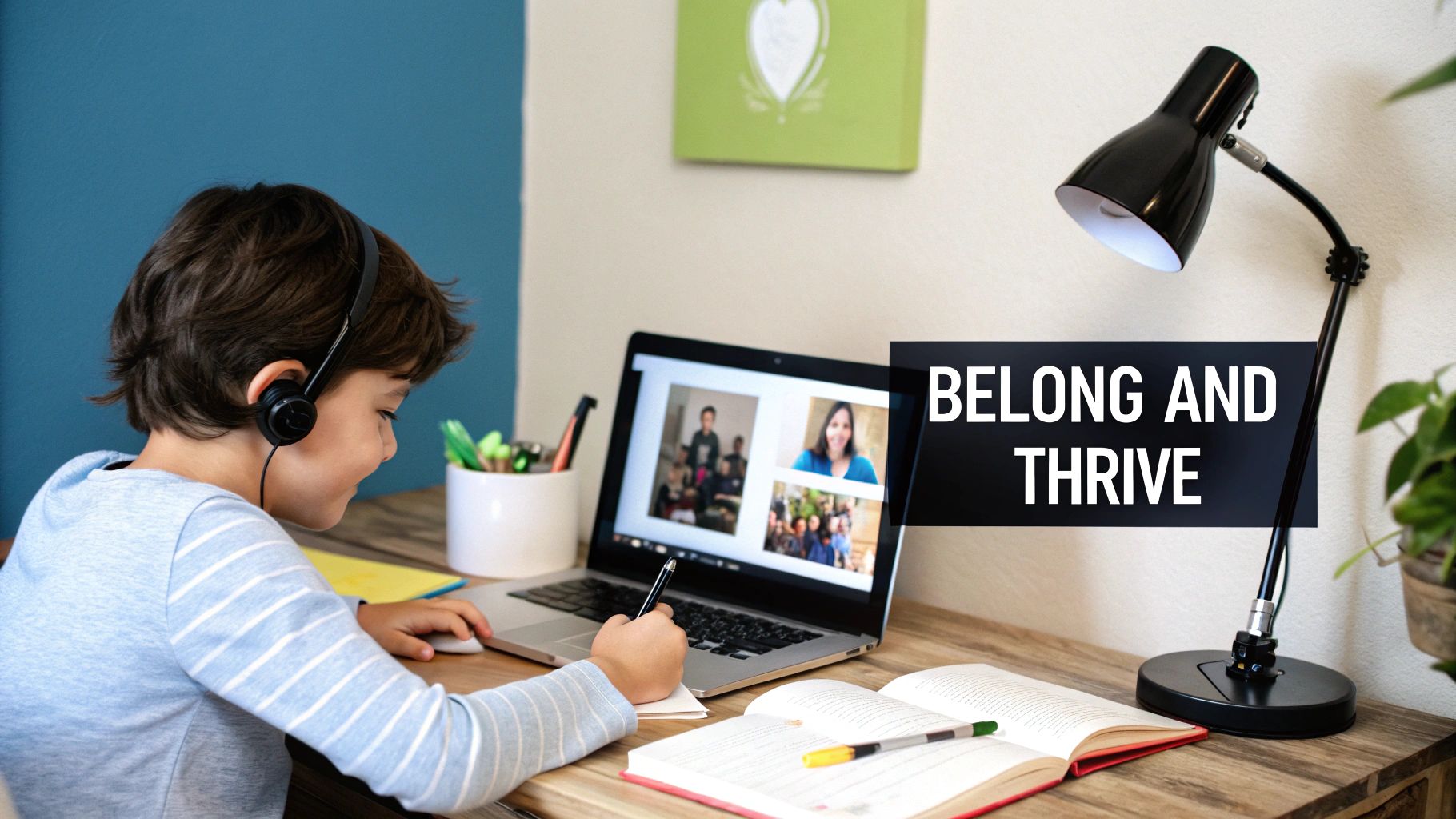
It can be hard to imagine what school looks like when it isn’t in a traditional brick-and-mortar building. But for so many children, a well-run online school isn’t just an alternative; it’s the place where they finally find their footing, their confidence, and a genuine community. The experience is a world away from simply watching recorded videos alone.
Picture a different kind of morning. Your child, who once dreaded the school run, now logs into a live, interactive history class from the comfort of their own desk. The teacher isn't just a face on a screen. They’re a passionate subject expert who knows your child by name, gets their learning style, and encourages them to ask questions without feeling judged.
That’s the difference a child-centred approach makes. With small class sizes, no one can get lost in the crowd. Every single student is seen, heard, and valued, which allows their self-belief to grow, day by day.
More Than Just Lessons
The school day is also woven together with chances for real connection. Later, your child might jump into a virtual breakout room to work on a science project with classmates from three different countries. They learn to share ideas, listen to different points of view, and build friendships based on shared passions, not just postcodes.
This whole structure is designed to fix the very problems that push families to look for alternatives in education in the first place.
- Dedicated SEN Support: Specialist help is built into their learning from the start, not just tacked on as an afterthought.
- Zero-Tolerance on Bullying: The moderated online environment creates a genuinely safe space where kindness and respect are the norm.
- Personalised Feedback: Teachers give detailed, constructive feedback that builds a child up, rather than slowly chipping away at their self-esteem.
This shift can completely transform a child's relationship with learning. When they feel safe and supported, they have the freedom to be curious, take academic risks, and finally discover what they're capable of.
Building a Foundation for the Future
Of course, this supportive community is built on a bedrock of academic rigour. The goal isn't just to provide a safe haven, but to give students the qualifications and skills they need to build a successful future. The curriculum is challenging, leading to internationally recognised GCSEs and A-Levels that open doors to top universities all over the world.
In many ways, an online education prepares students for university and modern careers in a way that traditional schooling can’t. They naturally develop independence, solid time-management skills, and a level of digital literacy that will serve them for the rest of their lives. By blending serious academics with a real commitment to well-being, this model offers a complete and compelling vision for a better way to learn.
To see exactly how this works day-to-day, you can learn more about the structure of online home education.
Of course. Here is the rewritten section, adopting the expert, human-written style from the provided examples.
Common Questions About Alternative Education
Making the leap to a different way of learning is a big decision, and it’s natural to have questions. As a parent, you’re not just looking for a solution to today’s problems; you’re trying to build the best possible future for your child. Let's tackle some of the most common concerns we hear from families just like yours.
Will My Child Be Socially Isolated?
This is usually the first question on every parent's mind, and it’s an important one. The truth is, socialisation in a good online school is about quality, not just quantity. It’s a world away from the chaotic, and sometimes passive, social interactions of a crowded playground.
Think of it less like navigating a noisy canteen and more like joining a focused workshop. Your child connects with peers during live, interactive classes, collaborates on projects in small breakout groups, and joins virtual clubs built around things they genuinely love—like a debate club or a creative writing group. For many children, especially those who find large groups overwhelming, this structured environment is a far more meaningful way to build real, lasting friendships.
Can My Child Still Get into a Top University?
Without a doubt. The single most important factor here is accreditation. An online school that is a Pearson Approved Examination Centre, for example, offers the exact same internationally recognised GCSEs and A-Levels that students get in any traditional UK school.
Top universities care about the qualification and the grade, not the building where the learning happened. In fact, admissions tutors often see the skills developed through online learning—like self-discipline, time management, and independent thinking—as a massive advantage and a sign of university readiness.
The goal is to ensure the qualifications your child earns are globally respected. This keeps every door open for their future, from university to international career opportunities.
How Do I Know if It's Time for a Change?
You know your child best. Trust that instinct and start looking for consistent patterns in how they feel and act. Are they constantly anxious or withdrawn when school is mentioned? Do those mysterious headaches or stomach aches only seem to appear on school mornings?
Perhaps their spark for learning has gone out, or they're dealing with ongoing issues like bullying that just aren't being resolved. These aren’t just "phases." They are clear signals that their current environment isn't giving them what they need. The aim isn’t to run away from a challenge, but to find a space where your child feels safe, seen, and supported enough to truly thrive.
At Queen’s Online School, we know this is a deeply personal journey for your family. We offer a fully accredited British curriculum in a supportive community that prioritises your child's well-being just as much as their academic success. Explore Queen’s Online School today and see how the right environment can make all the difference.