

In a world of online classrooms, it's easy to worry if our children are truly engaged or just passively watching a screen. We've all felt that pang of concern: is my child just memorising facts for an exam, or are they developing the curiosity, critical thinking, and confidence they need to thrive? This article moves beyond that worry and into a space of active, empowered learning where your child feels seen, heard, and excited to learn.
This isn't just another list of educational buzzwords. We will explore ten transformative active learning strategies specifically adapted for the British curriculum in an online or blended classroom. Each strategy is more than a technique; it’s a practical method for putting your child at the heart of their own education, empowering them to question, collaborate, and connect deeply with their learning material. The core principle is simple and deeply human: learning is not a spectator sport. When children actively participate, they don't just remember information; they build a lasting, emotional connection to it.
Understanding the cognitive science behind effective learning, such as strategies for beating the forgetting curve, can illuminate how active learning truly ignites a child's potential.
Within this guide, you will find actionable steps to implement these strategies, from Key Stage 2 right through to A-Levels. We will provide activity templates, ideas for adapting tasks for learners with SEN or SEMH needs, and tips for assessing progress. Prepare to see how online education can be a vibrant, interactive space where your child doesn’t just learn—they flourish.
1. Think-Pair-Share: Building Confidence Through Collaboration
Think-Pair-Share is a foundational active learning strategy that gently structures classroom discussion to ensure every child feels safe enough to participate. It unfolds in three distinct stages: a student first considers a question quietly on their own (Think), then discusses their ideas with a single classmate (Pair), and finally, shares their combined insights with the wider class (Share). This measured approach gives every child, especially the more reflective or anxious ones, vital processing time, building a foundation of confidence before they are asked to speak publicly. Imagine the relief a shy child feels, knowing they can test their thoughts in a safe, one-on-one setting before facing the whole class.
This method transforms passive listening into active, heartfelt participation, making it a cornerstone for developing deeper understanding and critical thinking skills. It tells every child, "Your thoughts matter, and we'll give you the space you need to share them."
How to Implement Think-Pair-Share
- For KS3 History: When exploring the human impact of the Blitz, a child can first privately reflect on a photo or a diary entry (Think). They can then join a breakout room to share their feelings and ideas with a partner (Pair). Finally, they can contribute one shared insight to a whole-class discussion (Share), feeling more confident because their idea has already been validated by a peer.
- For A-Level Mathematics: A teacher presents a complex, multi-step problem. Students first attempt it alone, not to find the answer, but just to map out their first steps (Think). They then work with a partner to compare approaches and navigate tricky parts together, feeling the relief of shared struggle (Pair). Finally, pairs present their different methods to the class (Share), celebrating the fact that there are many ways to reach a solution.
Actionable Tips for Success
- Structure the Time: Use a visible on-screen timer to clearly define each stage (e.g., 2 minutes for Think, 4 for Pair, 5 for Share). This predictability can be very comforting for children who thrive on routine.
- Support All Learners: For a child with SEN or SEMH needs, provide reassuring sentence starters like, ‘My first thought was…’ or ‘I wonder if…’ to help them begin their paired discussion. Strategic pairing can create a wonderful peer support system. To effectively build confidence through collaboration, consider integrating engaging group activities that nurture friendships and mutual support.
- Vary the 'Share' Format: Sharing doesn't have to be a big, scary speech. Ask your child to post their key takeaway in the chat or add a sticky note to a digital board. This allows them to contribute in a way that feels comfortable and safe.
2. Peer Teaching and Reciprocal Learning: Deepening Understanding Through Shared Expertise
Peer Teaching is where a child gets to step into the teacher's shoes, explaining a concept to a classmate. This powerful method reverses traditional classroom dynamics, sparking a profound sense of ownership and pride. To teach something well, a child must first truly understand it, organise their thoughts, and find a way to make it clear to someone else. This process doesn't just transfer knowledge; it cements it in their own mind like nothing else.
This approach builds a warm, collaborative learning environment where a child feels safe enough to say, "I'm not sure I get it." By empowering learners to share what they know, it validates their expertise and boosts their confidence in a deeply personal way. Imagine the joy a child feels when they see the "aha!" moment on a classmate's face, all because of their explanation.
How to Implement Peer Teaching
- For KS4 Science: In a biology lesson on the human eye, assign small groups different parts (e.g., the lens, the retina). After researching, each group becomes the "expert" and teaches their part to others in breakout rooms. The child isn't just learning a list of facts; they are taking responsibility for a piece of the puzzle, feeling valued and essential to the group's success.
- For A-Level English Literature: When analysing a complex poem, a student who has a strong grasp of a particular literary device (like metaphysical conceits) can prepare a short explanation for a peer. Using screen sharing, they can highlight examples in the text, feeling a sense of mastery as they guide their classmate through the analysis.
Actionable Tips for Success
- Provide Clear Structure: Equip your child with supportive sentence frames like, ‘The key thing to remember is…’ or ‘An easy way to think about this is…’. This scaffolding helps them structure their explanations and reduces the anxiety of not knowing where to start.
- Train Student Tutors: Before starting, run a brief, encouraging session on how to give clear explanations and kind feedback. This prepares them for the role and ensures the experience is positive for both the "teacher" and the "learner."
- Integrate Reflection: After a session, ask both children to reflect. The tutor can consider, ‘What was the hardest part to explain, and how did I overcome it?’ while the learner can reflect, ‘What did my friend say that finally made it click for me?’. This moment of reflection honours their effort and reinforces the learning.
3. Problem-Based Learning (PBL): Fostering Real-World Resilience
Problem-Based Learning (PBL) is an exciting, child-centred approach where learning is driven by tackling real-world problems. Instead of just being told facts, your child is presented with a meaningful challenge that makes them want to investigate, research, and collaborate to find a solution. This method shifts the focus from memorising answers to applying knowledge, building the resilience and adaptability they need to thrive in the real world.
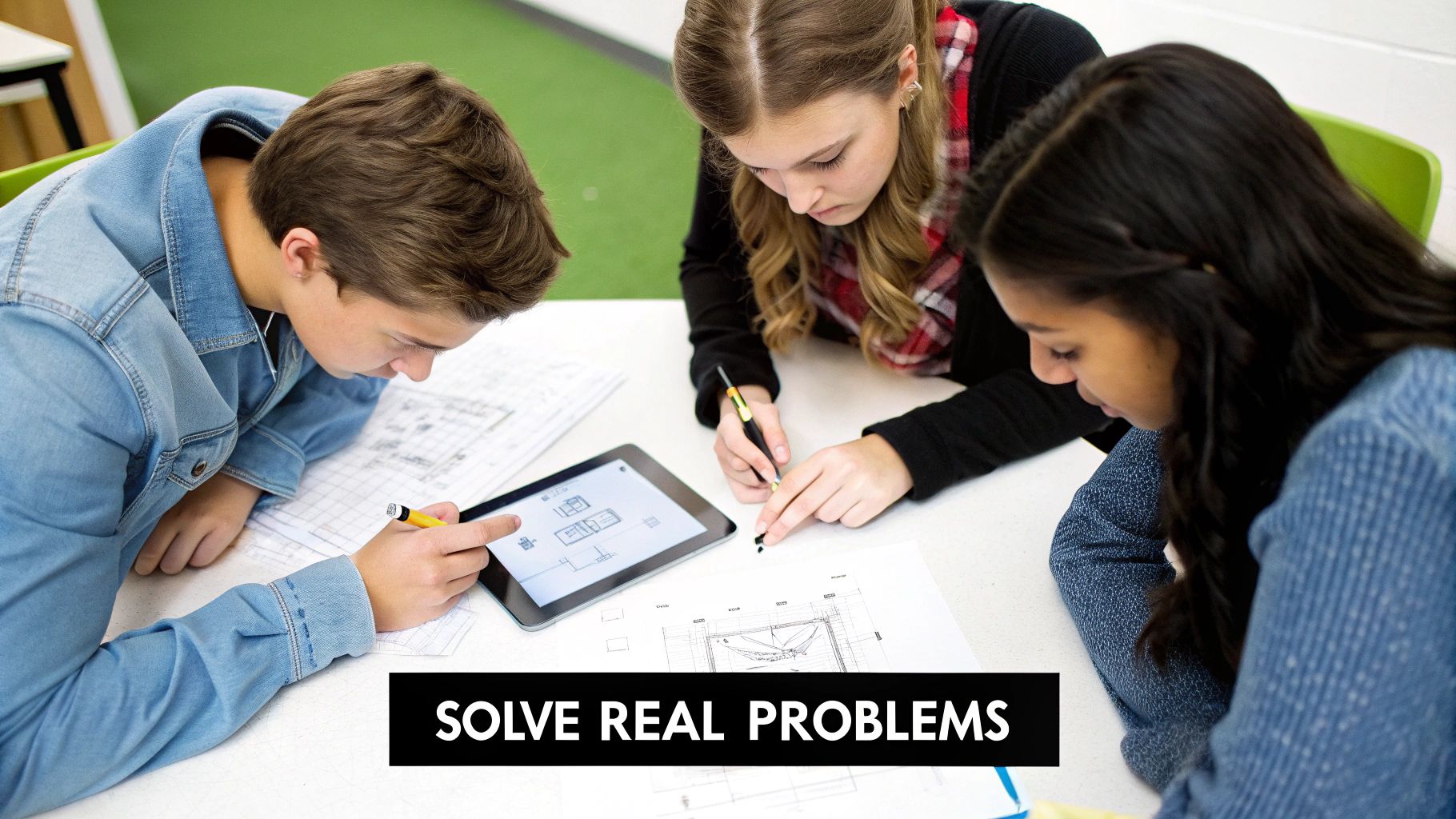
PBL empowers your child by connecting what they learn in class to their own life and the world around them. This relevance sparks a powerful sense of purpose and motivation, turning them into an active hero in their own learning story. It's one of the most effective active learning strategies for showing a child that their knowledge has the power to make a real difference.
How to Implement Problem-Based Learning
- For GCSE Biology: Present the challenge: "Our local community has a litter problem. How can we use our knowledge of ecosystems to help?" Your child could work in a group to research the impact of litter, design a community clean-up campaign, and create a presentation for a local council, feeling a real sense of civic pride.
- For A-Level Economics: Students tackle a problem they care about, like the ethics of fast fashion. They analyse supply chains, evaluate the human and environmental costs, and present a practical "consumer guide" for their peers, feeling empowered to make informed choices.
Actionable Tips for Success
- Scaffold the Challenge: Begin with smaller, more defined problems to build your child's confidence and skills. Feeling successful early on will give them the courage to tackle bigger challenges later.
- Establish Clear Roles: Assign supportive roles within groups (e.g., researcher, encourager, presenter) to ensure every child feels they have a specific and important part to play. For more ways to nurture these skills, you can learn how to develop problem-solving skills in a structured way.
- Assess the Process: Celebrate the journey, not just the destination. Focus feedback on your child's critical thinking, their collaboration with others, and their perseverance, rather than just the final answer.
- Provide Sentence Starters: To support a child who is hesitant to contribute, offer gentle prompts like, ‘What if we tried…?’ or ‘A question I have is…’ to help them voice their ideas and feel included in the group's work.
4. Flipped Classroom: Maximising Live Learning Time
The Flipped Classroom is a thoughtful active learning strategy that inverts the traditional teaching model to make live lessons more personal and interactive. Instead of the teacher talking for the whole class, your child first engages with new content at home, perhaps by watching a short, engaging video or reading a story. This frees up precious live lesson time for what truly matters: applying their knowledge, solving problems together, and getting one-on-one help from their teacher. It transforms the classroom into a supportive workshop where your child actively does the subject, rather than passively listening to it.
This approach is wonderful for online learning because it puts your child's needs first. It allows them to learn new ideas at their own pace, re-watching a video as many times as they need without feeling rushed or embarrassed. They can then arrive at the live lesson feeling prepared and confident, ready to ask questions and work with their friends. It’s a model built on trust and respect for the individual learner.
How to Implement the Flipped Classroom
- For GCSE Science: Your child watches a short, pre-recorded video demonstrating a chemical reaction at their own pace (independent learning). Live class time is then used for a fun, virtual lab where they work in groups to analyse data and discover the principles for themselves, with the teacher there to guide and encourage them.
- For A-Level Literature: Before class, a student reads a chapter of a novel and watches a brief video on its key themes (independent learning). The live lesson then becomes a rich, Socratic discussion where they can share their own interpretations, debate ideas with peers, and feel like a true literary critic.
Actionable Tips for Success
- Keep Pre-Class Content Concise: Pre-recorded videos should be short, warm, and engaging, ideally 5-10 minutes long. This respects your child's time and attention span.
- Check for Understanding: Include a quick, low-stakes quiz or a single reflection question with the pre-class materials, such as, "What was the most interesting or confusing part for you?" This isn't a test; it's a way for the teacher to see where help is needed. To dive deeper into this methodology, explore the core principles of flipped learning in online classrooms.
- Design Purposeful Live Activities: The live session must feel like a meaningful follow-up to the prep work. When your child sees how the pre-learning helps them succeed in the fun group activities, they'll feel that their effort was worthwhile.
5. Inquiry-Based Learning: Fostering Curiosity and Ownership
Inquiry-Based Learning is a beautiful active learning strategy that honours a child's natural curiosity. Instead of being given all the answers, your child gets to ask the questions. They drive the learning process by investigating topics that genuinely excite them, following their own lines of inquiry to build their own understanding. This approach mirrors how real scientists, historians, and artists work, empowering your child with a profound sense of agency and ownership over their education.
This method transforms the classroom from a place of facts into a playground of discovery. It nurtures not just knowledge, but the critical thinking and problem-solving skills they need for life. By trusting your child to explore their own questions within a supportive framework, we send them a powerful message: "Your curiosity is amazing, and your questions are important."
How to Implement Inquiry-Based Learning
- For KS2 Science: A class can begin with a wondrous question like, ‘How do plants drink water?’ Your child can then design their own simple experiment at home (like putting a flower in coloured water), documenting their observations with photos and notes. Sharing their personal discoveries with the class will feel like a true scientific breakthrough.
- For GCSE Humanities: Instead of just learning about a historical event, your child can ask their own question, like "What was life like for a child during the war?" They can use online archives and digital museums to find stories and images that connect with them on a human level, making history feel personal and real.
- For A-Level Physics: When studying renewable energy, a learner can be challenged to answer a question that matters to them, such as, ‘How could my own home become more energy-efficient?’ This prompts them to research, analyse their own energy use, and propose real solutions, connecting complex theories to their own life.
Actionable Tips for Success
- Start with Structure: Begin with a gentle, guided inquiry, providing a clear central question and some fun resources. As your child’s confidence grows, they can move towards more open-ended, independent projects.
- Teach the Skills Explicitly: Dedicate time to teaching the practical skills of inquiry, like how to ask a great question or how to know if an online source is trustworthy. This equips them to explore safely and effectively.
- Document the Journey: Encourage your child to keep an ‘inquiry journal’ to log their questions, findings, and even their "interesting dead-ends." This celebrates the entire process of discovery, showing them that learning isn't a straight line.
- Celebrate the Process: Authentic inquiry often involves surprises and changing course. Frame these moments not as mistakes, but as exciting plot twists in their learning adventure that build resilience and true understanding.
6. Gamification and Game-Based Learning: Motivating Through Play
Gamification brings the joy and excitement of games into the classroom by using elements like points, badges, and leaderboards. Game-based learning takes it a step further, using entire educational games to teach concepts. Both of these active learning strategies tap into the immense motivational power of play, turning learning tasks into fun challenges that inspire a child to persevere and celebrate their own progress.

By tapping into a child’s natural love for challenge and achievement, gamification makes learning feel less like a chore and more like an exciting quest. This method builds resilience by reframing mistakes as chances to "try again," fostering a positive mindset that is vital for both academic success and emotional well-being. It brings a sense of fun and light-heartedness to the hard work of learning.
How to Implement Gamification and Game-Based Learning
- For KS2 English: Create a "Reading Quest" where your child earns points for each book they finish. They can collect special badges like 'Fantasy Explorer' or 'Mystery Detective'. This turns reading into a personal adventure, not just an assignment.
- For GCSE Computer Science: Use a platform where students complete coding challenges to "level up." Each level feels like a victory, and they can earn badges for solving a tough problem or helping a friend, making an abstract subject feel tangible and rewarding.
Actionable Tips for Success
- Align with Learning Goals: Make sure every game element has a purpose that supports your child's learning. The points and badges should feel meaningful, not just decorative.
- Balance Competition and Collaboration: While friendly competition can be fun, also include team challenges where children work together to achieve a goal. This builds a sense of community and shared success.
- Reward Process, Not Just Perfection: Create badges that celebrate effort, curiosity, and resilience, like ‘Courageous Questioner’ or ‘Problem-Solving Pioneer’. This tells your child that how they learn is just as important as what they learn.
- Keep it Transparent and Fair: The rules should be simple and clear so every child feels the game is fair. The focus should always be on the joy of learning, with the game elements as a fun, supportive framework.
7. Case Study Analysis and Real-World Application
Case Study Analysis is a powerful active learning strategy that connects what your child learns in class to the real world. They are given a detailed, true-to-life story or problem that they need to analyse and solve. This method goes beyond abstract theories, asking your child to step into the shoes of a scientist, a doctor, or a business leader. By wrestling with real situations, they develop critical thinking and problem-solving skills that feel incredibly relevant and important.
This strategy is effective because it shows that learning isn't just for exams—it's for life. It encourages your child to think about different perspectives and the real human impact of decisions. By exploring these stories in a safe classroom environment, they can learn from complex situations without facing real-world consequences, building both knowledge and wisdom.
How to Implement Case Study Analysis
- For GCSE Geography: When studying water scarcity, your child could analyse the real story of Cape Town’s “Day Zero” water crisis. They would explore the environmental and human factors involved, discuss how different people were affected, and brainstorm compassionate, sustainable solutions for other cities.
- For A-Level English Literature: To explore a character’s difficult decision in a novel, a teacher could frame it as a case study. Your child would analyse the character's motivations, fears, and hopes, and then discuss with classmates what they might have done in that situation, connecting deeply with the human drama of the story.
Actionable Tips for Success
- Provide an Analysis Framework: Give your child a clear, simple guide to follow, with questions like, ‘Who are the people involved and what do they want?’, ‘What is the main challenge here?’, and ‘What are some possible kind solutions?’
- Adapt for All Learners: For a child with SEN, provide a simplified case study with clear headings and key vocabulary explained beforehand. A graphic organiser can help them structure their thoughts and feel successful.
- Encourage Diverse Solutions: Emphasise that in real life, there often isn't one "right" answer. Celebrate thoughtful disagreement and creative solutions. This teaches your child that their unique perspective has value.
8. Student-Led Discussions and Socratic Seminars
Student-led discussions and Socratic seminars are beautiful methods that place a child's voice at the very centre of the classroom. Instead of the teacher doing all the talking, children are empowered to ask their own questions, share their own ideas, and build understanding together. This approach develops not just clear communication, but also the confidence to engage with big, complex ideas. Socratic seminars, in particular, use thoughtful, open-ended questions to explore stories and concepts in a deep and meaningful way.
This strategy transforms the virtual classroom into a true community of inquiry, where every child's contribution helps to build a richer, shared understanding. It sends a powerful message to your child: "Your thoughts are valuable, and your voice deserves to be heard." For a child who often feels quiet or overlooked, this experience can be transformative, building a sense of belonging and intellectual self-worth. It is one of the most powerful active learning strategies for nurturing mature, respectful dialogue.
How to Implement Student-Led Discussions
- For GCSE English: When discussing a moving poem, a teacher can start with a broad, heartfelt question like, ‘How did this poem make you feel?’ Children then lead the conversation, using lines from the poem to explain their feelings and connect with each other's interpretations.
- For A-Level History: To explore a controversial historical event, students can be given different eyewitness accounts. In small groups, they lead discussions to try and understand the event from multiple human perspectives, building empathy and a more nuanced understanding of the past.
Actionable Tips for Success
- Establish Clear Norms: Before starting, create a few simple, kind rules together, like ‘listen with your heart,’ ‘it’s okay to disagree gently,’ and ‘build on each other's ideas.’
- Teach Socratic Questioning: Model and provide gentle question stems to help children dig deeper, like, ‘Can you tell me more about why you think that?’, ‘I wonder if…’, or ‘How does that connect to your own experience?’
- Ensure Balanced Participation: Use a 'talking stick' (virtual or real) or a gentle round-robin format to ensure every child who wants to speak has a chance. This prevents louder voices from dominating and creates a safe space for quieter children.
- Support Anxious Learners: For a child with anxiety, allow them to write their thoughts in the chat or on a shared document first. Starting in very small groups before joining the main discussion can also help build their confidence step-by-step.
9. Personalized and Self-Directed Learning Paths
Personalized and Self-Directed Learning is a compassionate approach that moves away from a one-size-fits-all model and towards an experience tailored to your child's unique needs, pace, and passions. It empowers your child to take ownership of their learning journey by helping them set their own goals, choose their resources, and see their own progress. It honours the fact that children learn in different ways and at different speeds, allowing for deep dives into things they love and extra help where they need it most.
This method transforms your child from a passenger into the driver of their own education. By putting them at the centre of the process, it nurtures their natural motivation, builds resilience, and teaches them vital life skills like time management and how to ask for help. It respects your child's individuality, ensuring they feel seen, supported, and challenged in a way that feels just right for them.
How to Implement Personalized and Self-Directed Learning
- For GCSE Science: A student needing to master a tricky concept like chemical bonding could be given a choice board. They might choose to watch a fun animated video, play an interactive game, join a live small-group tutorial, or work through practice problems. They get to choose the path that feels best for them.
- For KS2 English: When starting a creative writing project, your child can choose what they want to create—a short story, a comic strip, or a play script. They set their own goals for finishing the first draft and the final piece, using a simple checklist from the teacher to feel a sense of accomplishment along the way.
Actionable Tips for Success
- Balance Autonomy with Structure: Offer meaningful choices within a clear and supportive framework. Your child might choose how they learn a topic, while the teacher ensures they meet the essential learning goals.
- Explicitly Teach Executive Function Skills: Gently teach your child how to set small, achievable goals, how to manage their time, and how to reflect on their work. These are the skills that build lifelong confidence. Explore more about self-directed learning.
- Leverage Technology and Data: Use learning platforms that can help identify areas where your child might need a little extra support, allowing the teacher to step in with kindness and encouragement.
- Celebrate Progress Over Performance: Shift the focus from grades and comparisons to celebrating your child's individual growth. Acknowledge their effort and the clever strategies they used to overcome a challenge. This builds a positive and resilient learning identity.
10. Formative Assessment and Real-Time Feedback: Guiding Learning Moment-by-Moment
Formative assessment isn't about tests and grades; it's about listening. It's a continuous, caring process that turns teaching into a responsive dialogue. Instead of a big test at the end of a unit, this strategy uses small, ongoing checks to see what your child understands and where they might be feeling a bit stuck. Paired with immediate, kind feedback, it turns mistakes into wonderful learning opportunities. This gentle cycle of checking in, offering help, and adapting is one of the most powerful active learning strategies for building a child’s confidence and ensuring they never feel left behind.
This approach puts your child's learning journey at the very heart of teaching. By consistently seeing how they are doing, their teacher can adjust their approach in the moment, offering a helping hand right when it's needed. This creates a safe, supportive classroom where your child feels seen and understood, knowing that their effort and progress are what truly matter.
How to Implement Formative Assessment and Real-Time Feedback
- For KS2 Science: After explaining the water cycle, the teacher can launch a quick, fun poll asking students to vote on the next stage after evaporation. The results instantly and privately show the teacher who might need a quick, gentle recap.
- For GCSE English: While your child is writing a paragraph in a shared document, their teacher can add a private, encouraging comment. A note like, "This is a beautiful point about the character's feelings. Can you add a specific quote from the book to make it even stronger?" guides your child to improve their work without making them feel criticised.
Actionable Tips for Success
- Keep it Brief and Frequent: Use short, simple activities, like asking "What was the most confusing part of today's lesson?" This gives the teacher invaluable insight without feeling like a test.
- Make Feedback Specific and Kind: Move beyond "Good job." Instead, use encouraging feedback like, "You've used the formula perfectly here! Let's just double-check the calculation in the second step together." This validates their effort while gently pointing the way forward.
- Utilise Digital Tools: Fun platforms like Kahoot! or simple Google Forms can gather instant feedback in a low-pressure way, freeing up the teacher to focus on supporting the children.
- Empower Student Self-Assessment: Give your child a simple checklist to look at their own work. Asking them to rate their confidence on a topic with a smiley face or a question mark helps them develop self-awareness and feel in control of their learning.
Active Learning Strategies: 10-Point Comparison
| Strategy | 🔄 Implementation complexity | ⚡ Resource & tech requirements | ⭐ Expected outcomes | 📊 Ideal use cases | 💡 Key advantages / tips |
|---|---|---|---|---|---|
| Think‑Pair‑Share | 🔄🔄 Moderate — needs timing & clear instructions | ⚡ Low — breakout rooms/paired setup, timers | ⭐⭐⭐⭐ Higher participation; reduced anxiety; improved speaking | Small-to-medium classes; online breakout rooms; processing complex prompts | 💡 Set clear timers; assign partners; provide sentence starters |
| Peer Teaching & Reciprocal Learning | 🔄🔄🔄 Moderate‑High — requires training & pairing | ⚡ Low‑Med — pairing tools, guidelines, monitoring | ⭐⭐⭐⭐ Deepened understanding; leadership and retention gains | Peer tutoring, mixed-ability groups, mentoring programs | 💡 Train tutors; use frames; monitor pairs to prevent misinformation |
| Problem‑Based Learning (PBL) | 🔄🔄🔄🔄 High — complex design & facilitation | ⚡ Med — resources, research tools, collaboration platforms | ⭐⭐⭐⭐–⭐⭐⭐⭐⭐ Strong critical thinking, real‑world skills, resilience | STEM projects, interdisciplinary courses, long-term modules | 💡 Scaffold early problems; define roles; use checkpoints and rubrics |
| Flipped Classroom | 🔄🔄🔄 Moderate — prep content + in‑class design | ⚡ 🔌 High tech — video hosting, LMS, analytics | ⭐⭐⭐⭐ Better in‑class engagement; personalized support | Online schools, asynchronous learners, mixed time zones | 💡 Keep videos short; include comprehension checks; track pre‑work |
| Inquiry‑Based Learning | 🔄🔄🔄🔄 High — requires facilitation and scaffolding | ⚡ Med — research access, digital tools, journals | ⭐⭐⭐⭐–⭐⭐⭐⭐⭐ Increased curiosity, investigation skills, agency | STEM inquiry, gifted learners, projects with open questions | 💡 Begin structured inquiry; teach research skills; use reflection logs |
| Gamification & Game‑Based Learning | 🔄🔄 Moderate — design & ongoing maintenance | ⚡ Med — platforms, badges, analytics | ⭐⭐⭐⭐ High engagement and persistence; immediate feedback | Practice drills, language learning, motivation‑focused tasks | 💡 Align mechanics to objectives; offer multiple win paths; refresh rewards |
| Case Study Analysis & Real‑World Application | 🔄🔄🔄 Moderate — needs quality cases and facilitation | ⚡ Low‑Med — curated cases, discussion tools, sources | ⭐⭐⭐⭐ Strong transfer of theory to practice; decision skills | Business, humanities, professional studies, applied STEM | 💡 Use structured frameworks; include diverse perspectives and evidence |
| Student‑Led Discussions & Socratic Seminars | 🔄🔄🔄 Moderate — norms + prep required | ⚡ Low — readings, breakout rooms or seminar format | ⭐⭐⭐⭐ Deep analytical thinking; improved communication | Humanities, debate, advanced literature or ethics classes | 💡 Teach questioning techniques; set norms; use tokens to balance talk |
| Personalized & Self‑Directed Learning Paths | 🔄🔄🔄🔄 High — planning, data systems, coaching | ⚡ High — LMS, adaptive platforms, dashboards | ⭐⭐⭐⭐–⭐⭐⭐⭐⭐ Increased autonomy, motivation, tailored progress | Online schools, diverse learners, SEN support, enrichment paths | 💡 Balance structure with choice; regular check‑ins; data‑driven support |
| Formative Assessment & Real‑Time Feedback | 🔄🔄 Moderate — routine processes, data use | ⚡ Med — quick quizzes, polling, feedback tools | ⭐⭐⭐⭐⭐ Early misconception detection; improved learning gains | Any setting needing rapid adjustment; online classes with analytics | 💡 Keep checks brief; make feedback specific and actionable; use varied formats |
Creating a Future-Ready Education, One Child at a Time
The journey through these ten powerful active learning strategies reveals a profound truth about education today. This isn't about simply replacing a blackboard with a screen; it's about putting your child’s heart and mind at the centre of everything we do. The goal is no longer just to fill their heads with facts, but to nurture curious, resilient, and compassionate human beings.
By moving beyond passive listening, we empower our children to become the architects of their own understanding. Each strategy we've explored is a tool for connection. The real magic happens when we thoughtfully select and combine these tools to build a learning experience that honours your individual child—their hopes, their worries, their unique spark. This approach shifts the focus from a rigid curriculum to a personal journey that nurtures their strengths and ignites their love for learning.
Weaving a Tapestry of Engagement and Support
Think of these active learning strategies not as separate techniques, but as interconnected threads in a tapestry of care. A project might begin with a short Flipped Classroom video to build a child’s confidence. Within that project, they might use Peer Teaching to help a friend, feeling a sense of pride and connection. Throughout, continuous Formative Assessment provides the gentle, real-time feedback they need to feel safe and supported.
This integrated, heartfelt approach is transformative for children with Special Educational Needs (SEN) or Social, Emotional, and Mental Health (SEMH) needs. For a child who finds large groups overwhelming, the quiet, one-on-one nature of Think-Pair-Share is a lifeline. For a learner who thrives on clear goals, the fun rewards of Gamification can turn frustration into joyful determination. It’s about creating a flexible, responsive environment where every child feels seen, heard, and capable of success.
The ultimate aim of these active learning strategies is not just to teach subjects, but to teach children how to learn, how to be curious, and how to be kind to themselves in the process. It’s about building the intellectual and emotional toolkit they will carry with them long after their A-Levels.
Your Role as a Partner in Their Discovery
Embracing these methods transforms your role from a supervisor into a cherished partner in your child’s educational adventure. It’s about asking curious questions over dinner, connecting a classroom topic to your family's own stories, or celebrating the courage it took for them to tackle a tricky problem. This partnership is at the heart of a truly child-centred education.
When we place a child's emotional well-being and intellectual curiosity at the centre of everything, the digital classroom becomes a launchpad for a brilliant future. We are not just preparing them for exams; we are equipping them with the confidence and skills to navigate a complex world with a strong and open heart. The education your child receives should feel like a journey of discovery you take together, and these strategies are your map. The path forward is not about perfection, but about connection, growth, and the incredible potential that unfolds when a child truly knows they are valued.
Are you ready to see how a curriculum built around these dynamic active learning strategies can unlock your child's full potential? Discover how Queens Online School embeds these child-centred approaches into every live, interactive lesson to create an engaging and supportive global learning community. Explore our programmes at Queens Online School today.