
The journey through A-Level Biology can feel like a real rollercoaster. One minute you're totally engrossed in the magic of DNA replication, and the next you're staring at a diagram of the Krebs cycle, feeling that familiar knot of dread in your stomach.
If that sounds even remotely familiar, you are definitely not alone. It's a feeling shared by thousands of students, and it's okay.
Feeling Overwhelmed by A-Level Biology?
It’s completely normal to feel swamped by A-Level Biology. The sheer volume of content is staggering, jumping from microscopic cellular processes to entire ecosystems. But this isn't just a memory test; it's about applying complex ideas under serious pressure. We see the anxiety it causes: you’re expected to link concepts from wildly different topics, analyse data you’ve never seen before, and explain intricate biological mechanisms with pinpoint precision.
Of course, this challenge is exactly why so many students are drawn to it. A-Level Biology is one of the most popular subjects in the UK, a testament to its value for aspiring medics, vets, and scientists. In summer 2023, there were 71,400 entries, making it the third most entered A-Level. Its enduring appeal for those aiming for top university courses is clear, as shown in recent JCQ and OCR data.
Why It Can Feel So Tough
The pressure can build up from all sides, creating a perfect storm of anxiety that gets in the way of effective a levels biology revision. That feeling of your heart sinking when you open the textbook is real, and it often comes from:
- The Fear of Forgetting: You spend a whole week mastering immunology, only to feel a wave of panic when you realise you've forgotten everything about respiration. This is a classic, common anxiety caused by the sheer breadth of the syllabus. It's not a personal failing; it's a sign that your brain needs a better system.
- The Pressure to Perform: When you know Biology is a non-negotiable requirement for that dream university course, it adds a huge layer of stress. Every single mark starts to feel critical, and the fear of not being "good enough" can be paralysing.
- Complex Application Skills: Unlike subjects that rely more on pure memorisation, Biology demands that you interpret graphs, evaluate experiments, and structure those long-form answers perfectly. It's a different skill set entirely, and it can feel frustrating when your knowledge doesn't translate into marks.
This guide is here to help you transform that feeling of being overwhelmed into focused, confident action. It’s all about building a revision strategy that is compassionate, realistic, and highly effective—putting your well-being right at the centre of your learning.
Understanding these challenges is the first step. Instead of fighting that feeling of being swamped, we're going to acknowledge it and use it to build a smarter revision plan. It’s about working with your brain, not against it, to build genuine understanding and confidence that will see you through to exam day.
Building a Revision Timetable That Works for You
Let's be honest: a generic revision timetable you've downloaded from the internet probably won't work. Why? Because it wasn't made for you. It doesn't know you find photosynthesis fascinating but secretly dread the intricacies of gene technology. Real, lasting success in your A-Levels comes from a plan that understands your unique strengths, weaknesses, and natural learning rhythm.
This is the point where you stop feeling powerless and start taking back control. A personalised timetable isn’t about cramming "study" into every empty box on the calendar; it's about making smart, strategic choices that fuel your progress without leading to burnout. Your well-being is the single most important part of this whole process.
The goal is to move from that familiar feeling of biology-overwhelm to a state of clear, focused action.
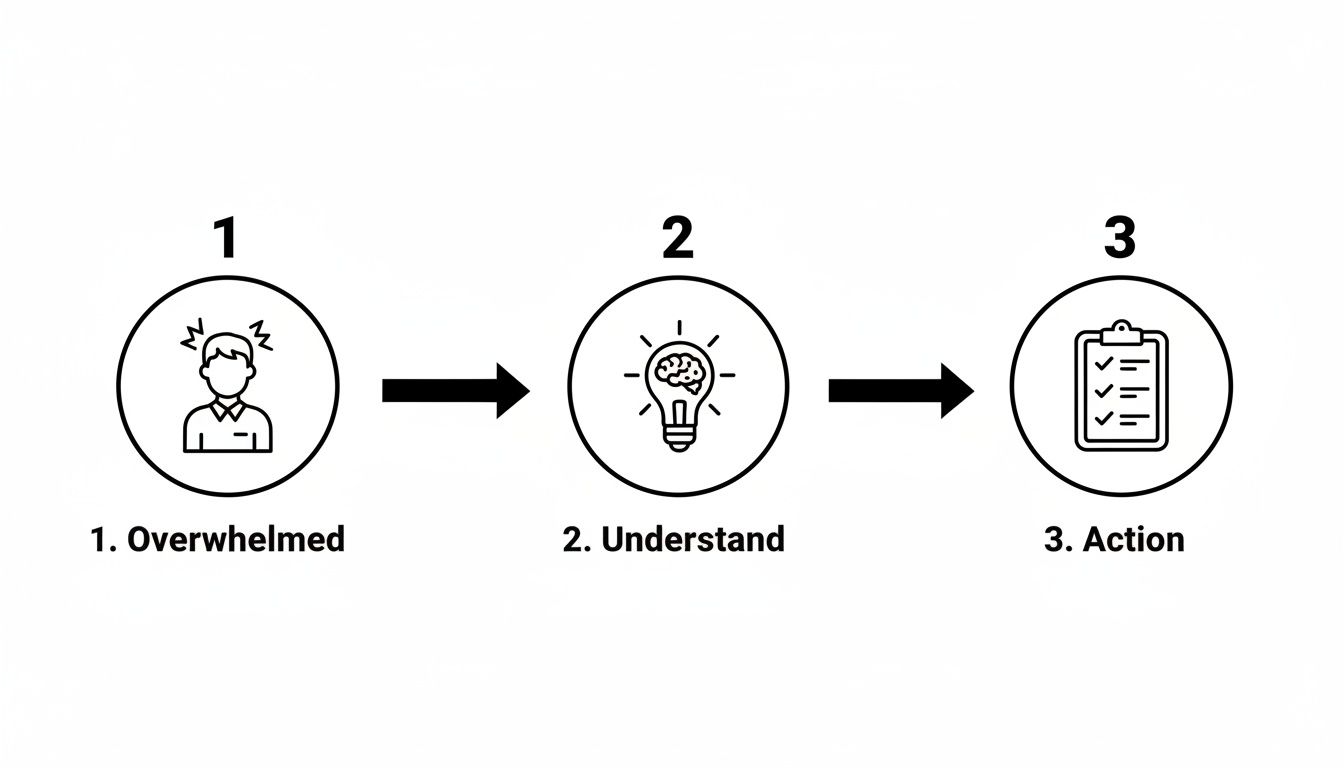
This diagram perfectly illustrates that crucial shift. It starts with stress, moves to understanding exactly what the challenges are, and then empowers you to take structured, effective action.
Start With an Honest Topic Audit
Before you can schedule anything, you need a clear picture of where you stand right now. The most effective way to do this is with a simple Red-Amber-Green (RAG) rating system. It's a way to be kind and honest with yourself about what you truly need to work on.
First, get your hands on the official A-Level Biology specification from your exam board (whether that's AQA, OCR, Edexcel, or another). Go through it, line by line, and categorise every topic.
- Red: These are the topics you find genuinely difficult, tend to avoid, or consistently lose marks on. This might be synaptic transmission or the Calvin cycle. Be brutally honest here—acknowledging these is an act of courage, and these are your top-priority areas.
- Amber: These are the topics you're okay with but know you could be stronger on. Maybe you understand the basics of the cardiac cycle but feel a flicker of uncertainty when asked to interpret complex ECGs or pressure graphs.
- Green: These are your comfort zones. Topics you feel confident about, like gas exchange in plants, which you could probably explain to a friend without even looking at your notes. These topics give you a confidence boost!
This audit gives you a powerful visual map of your revision landscape. It immediately tells you where to direct the bulk of your energy for your A-Levels Biology revision.
Allocate Your Time Strategically, Not Equally
With your RAG list complete, you can start building your schedule. The golden rule here is to give your 'red' topics the most attention, but without completely ignoring everything else. A classic mistake students make is spending hours grinding away at a difficult subject, only to end up with no mental energy left for anything else.
Try this balanced approach instead:
- Schedule short, frequent sessions for 'red' topics. For instance, plan a focused 30-minute session on gene technology three times a week, ideally when your mind is at its freshest. This stops you from getting overwhelmed and builds mastery step-by-step.
- Use longer, more relaxed sessions for 'amber' and 'green' topics. A 50-minute block on a Saturday morning could be perfect for reviewing ecology (a 'green' area) by working through past paper questions to keep that knowledge sharp and feel a sense of achievement.
A good timetable should also be a living document, not something set in stone. Life happens. If you have to miss a planned session on respiration, don't panic. The key is to build in some flexibility and maybe a catch-up slot or two, so an unexpected event doesn't throw your entire week off course.
To give you a clearer idea, here’s what a single revision block might look like in a well-structured timetable.
Example Weekly Revision Timetable Block
| Time Slot | Monday Focus | Activity Type | Notes for Success |
|---|---|---|---|
| 4:30 – 5:10 PM | Synaptic Transmission (Red Topic) | Active Recall & Blurting | Use a blank whiteboard. Write down everything you know for 15 mins, then use your notes to fill in the gaps. Short, intense, and effective. Feel the satisfaction of seeing what you do know. |
| 5:10 – 5:20 PM | Break | Screen-Free Rest | Get away from your desk. Grab a drink, stretch, or listen to a song. Do not scroll on your phone. Let your brain breathe. |
| 5:20 – 6:00 PM | Cardiac Cycle (Amber Topic) | Past Paper Questions | Find 3-4 specific questions on interpreting pressure graphs. Mark them strictly using the official mark scheme. Notice how you improve with each one. |
| 6:00 – 6:15 PM | Review & Plan | Consolidation | Quickly review the mark scheme comments from your cardiac cycle questions. Jot down what you'll tackle in tomorrow's first session. End the day feeling in control. |
This structure shows how to mix high-intensity work on difficult topics with practice on more familiar ones, all while making sure you get the breaks you need to stay focused.
Build in Breaks and Proper Downtime
This is absolutely non-negotiable. Your brain desperately needs time to process and consolidate new information. Trying to power through back-to-back revision sessions without breaks is one of the fastest routes to burnout and forgetting what you've just learned.
Effective time management for students isn't about working more; it's about working smarter.
Think about what actually recharges you. Is it a quick walk outside, listening to music, or just chatting with family for a few minutes? Schedule these activities into your timetable with the same importance as a study session. Even a 10-minute break after every 50 minutes of revision can make a world of difference to your focus and mental well-being.
Ultimately, your revision timetable is your personal roadmap. It should feel supportive and realistic, guiding you towards your goals without sacrificing your health. It’s a tool designed to serve you, not control you.
Mastering Content With Active Recall and Spaced Repetition
Simply re-reading your notes is one of the least effective ways to revise. We often fall into this trap because it feels productive, but it only creates what psychologists call the "illusion of competence." You start to recognise the material, but you can't actually retrieve it from memory when it really matters. It's a gut-wrenching feeling to stare at an exam question and know you've "seen" the answer but can't pull it out of your brain.
To build strong, lasting memories for the dense content in your A-Levels Biology revision, your brain needs to be actively challenged. This is where you move from passively highlighting text to actively learning. Two of the most powerful, evidence-backed techniques are Active Recall and Spaced Repetition. Used together, they can transform revision from a draining chore into a powerful process that genuinely cements knowledge.

Go Beyond Flashcards With Active Recall
Active recall is just what it sounds like: deliberately retrieving information from your memory. Every single time you force your brain to pull out a fact, you strengthen the neural pathway to that information, making it easier to recall the next time. It’s like exercising a muscle; the more you use it, the stronger it gets. It's a truly empowering feeling.
While flashcards are a classic tool for this, you can get much more creative and effective.
- Try ‘Blurting’ Sheets: This is a game-changer. Take a blank piece of A4 paper and pick a single topic, like photosynthesis. Set a timer for 10 minutes and write down everything you can remember about it—diagrams, key terms, equations, the lot. When the timer goes off, grab your textbook and fill in the gaps in a different colour pen. This instantly shows you what you know cold and where your weaknesses are, turning frustration into a clear action plan.
- Teach a Concept Out Loud: Find a willing family member (or even just talk to the wall!) and explain a complex process like synaptic transmission from start to finish. If you stumble, get confused, or can't explain it simply, you've just found a gap in your understanding that needs more work. The moment you successfully explain it, you'll feel a huge confidence boost.
- Create Mind Maps From Memory: Don't just copy information to create a mind map. Start with a blank page and draw it entirely from memory. This is a brilliant way to test your ability to connect different concepts within a larger topic, such as how the different parts of the immune system interact.
To get even more out of your study sessions, you can also learn to Master the Cornell Method for Video Note Taking and Boost Retention.
Lock In Knowledge With Spaced Repetition
Spaced repetition is your weapon against the "forgetting curve"—our natural tendency to forget information over time. By revisiting topics at increasing intervals, you interrupt this forgetting process. You're essentially signalling to your brain that this information is important and needs to be moved into long-term memory. It's about working smarter, not harder.
Let's say you've just learned the cardiac cycle. A spaced repetition schedule might look something like this:
- Day 1: Review the topic (maybe with a blurting sheet).
- Day 3: Test yourself again with a few past paper questions.
- Day 7: Briefly explain the Wiggers diagram to a friend.
- Day 14: Tackle another set of exam questions on the topic.
This approach feels far less overwhelming than last-minute cramming and is scientifically proven to be more effective for long-term retention. You can learn more about how to structure these study sessions by exploring our guide on effective revision techniques.
The combination of pulling information out of your brain (active recall) and doing so at strategic intervals (spaced repetition) is the secret to making knowledge stick. It’s the difference between temporarily memorising and truly understanding.
This strategic approach is particularly vital in a subject as competitive as Biology. Provisional UK government data shows that A-Level entries in England for summer 2025 stood at 171,690. While this reflects a post-pandemic stabilisation, Biology maintains an impressive 84% retention rate for students continuing to A2.
From our experience at Queen's Online School, we see how mastering high-stakes content like neurotransmission and inheritance—which can dominate exam papers—is absolutely crucial for success. These efficient study methods are not just helpful; they're essential.
By building your revision around these two core principles, you'll learn more deeply and face your exams with genuine confidence, knowing the information is truly locked in.
Unlocking Top Marks with Smart Exam Technique
Knowing the Krebs cycle inside and out is a brilliant achievement, but honestly, it’s only half the battle. So many bright, capable students feel the sting of disappointment on results day, not because they didn't know their biology, but because small gaps in their exam technique let precious marks slip through their fingers.
This is where your A-Levels Biology revision needs to get strategic. It’s about turning all that deep biological knowledge into exam-day success. You need to learn how to think like an examiner, understand the subtle language they use in questions, and structure your answers to hit every single marking point. This is how you show the examiner what you truly know.

Go Beyond Answering—Get Inside the Mark Scheme
Simply churning through past papers isn't enough. The real learning happens when you analyse the mark scheme with forensic detail. Think of this document as your direct line into the examiner's mind; it reveals the exact phrases, keywords, and scientific terms they are trained to look for and reward.
Don’t just tick off your correct answers and move on. For every single question, especially those where you lost marks, you need to ask:
- What specific keyword did I miss? (e.g., did I write 'create' energy instead of the more accurate 'release' energy during respiration?)
- Did I completely misinterpret the command word?
- Was my answer too vague where it needed to be precise?
I know this process can feel slow and meticulous, but it’s one of the highest-impact activities you can do. It trains you to give examiners exactly what they’re looking for, which is the key to turning a B-grade answer into an A-grade one and feeling that pride in your work.
Decode the Command Words
The very first word of an exam question is often the most important. It dictates the depth and style of the answer required, and confusing them is a costly mistake that can leave you feeling deeply frustrated.
Here are a few common examples and what they really mean:
- Describe: This is asking for a 'what' answer. You need to state the key features or steps of a process. Think of it as painting a picture with words. For example, "Describe the structure of a chloroplast."
- Explain: This demands a 'why' or 'how' answer. You must provide reasons and link cause with effect using solid biological principles. For example, "Explain how the structure of a chloroplast is adapted for its function."
- Compare: This requires you to identify both similarities and differences. A classic pitfall here is only listing the differences and forgetting the similarities.
- Suggest: This is an application question. You'll need to use your existing biological knowledge to propose a reasoned hypothesis for a new or unfamiliar scenario you haven't seen before. This is your chance to shine and show you can think like a scientist.
Understanding these nuances is critical. An A-grade student provides a detailed, reasoned explanation for an 'explain' question, while a C-grade student might only offer a simple description, instantly capping their potential marks.
Structuring Long-Form Answers
Let's make this practical. Imagine you’re faced with a 6-mark question about enzyme inhibition. A student feeling the pressure might just jot down a disorganised paragraph, jumping between different ideas. An A-grade student, however, structures their answer logically, point by point, to make it easy for the examiner to award marks.
Case Study: Comparing C-Grade and A-Grade Answers
Question: Explain how a non-competitive inhibitor affects the rate of an enzyme-controlled reaction. (6 marks)
A C-Grade Answer might look like this:
"A non-competitive inhibitor slows down the reaction. It binds to the enzyme somewhere else, not the active site. This changes the enzyme's shape, so the substrate can't fit in anymore. So, the rate of reaction goes down, and adding more substrate won't help because the enzyme is broken."
This answer has the right general idea, but it lacks the precise, scientific language needed for top marks. It would likely score just 2 or 3 out of 6, which can feel really disheartening when you feel you understood the concept.
An A-Grade Answer would be far more precise and structured:
"1. A non-competitive inhibitor binds to the enzyme at an allosteric site, which is a location distinct from the active site.
2. This binding causes a conformational change in the tertiary structure of the enzyme.
3. As a result, the specific 3D shape of the active site is altered.
4. The substrate is therefore no longer complementary to the changed active site, so it cannot bind to form an enzyme-substrate complex.
5. This reduces the number of available, functional enzyme molecules at any given time, which decreases the overall rate of reaction.
6. Increasing the substrate concentration will not overcome this type of inhibition because the active site remains changed and inaccessible to the substrate."
See the difference? This answer is structured, uses essential keywords, and clearly links each point to the next. It demonstrates a deep, confident understanding and would secure all 6 marks.
Mastering exam technique also involves managing your state of mind. Nerves can get in the way of showcasing all your hard-earned knowledge. To refine your approach and ensure you perform your best on the day, explore these valuable tips for managing test anxiety.
Making Revision Work for Everyone
A-Level Biology is a demanding course, and let's be honest, a one-size-fits-all revision plan just doesn't work. Every student is different, with their own way of thinking, learning, and handling pressure. Real, sustainable progress comes from building an a levels biology revision strategy that plays to their strengths and genuinely supports them through their challenges.
It’s tough watching your child get frustrated with revision methods that just don’t sync with how their brain works. That frustration is real. This isn't about forcing a square peg into a round hole; it's about creating a revision environment where they feel seen, supported, and capable.
Support for Students with SEN
For students with Special Educational Needs (SEN) like dyslexia or ADHD, traditional revision can feel like an impossible climb. The trick is to adapt your techniques to work with their learning style, not fight against it.
- For Dyslexia: Staring at dense blocks of text in textbooks or past papers can be exhausting. Try using text-to-speech software to read questions and revision notes aloud. This frees up so much mental energy, allowing them to focus on understanding the biology, not just decoding the words. Imagine the relief of just being able to absorb the information.
- For ADHD: We know that sitting still for hours is a huge ask. The Pomodoro Technique can be a game-changer here. Encourage them to work in short, focused bursts of 15-20 minutes, followed by a strict 5-minute break to move around. It makes revision feel much more manageable and far less overwhelming, replacing dread with a sense of accomplishment.
- For Organisation: A-Level Biology is full of complex, abstract concepts that can easily get jumbled. Colour-coded notes or mind maps are brilliant for organising information visually. For instance, you could use green for keywords, blue for processes, and yellow for examples. This can turn a chaotic page of notes into a clear, understandable story.
Nurturing SEMH Needs
Exam season can be a huge trigger for students dealing with Social, Emotional, and Mental Health (SEMH) challenges. For them, creating a sense of calm and control is the absolute priority.
Start by setting up a dedicated, calming revision space. It doesn't have to be a whole room—just a quiet corner with good lighting, a comfy chair, and zero distractions. Adding something simple like a plant or using a relaxing scent diffuser can turn it from a study prison into a sanctuary where they feel safe to learn.
It’s also worth incorporating mindfulness and breathing exercises before each revision session. A few minutes of guided breathing can work wonders to lower stress levels, helping them approach their work with a clearer, less anxious mind. Remember, their well-being has to come first; the academic progress will naturally follow.
Every student deserves to feel empowered by their revision, not defeated by it. Adapting your approach shows them that their needs are valid and that success is achievable on their own terms.
Bridging the Gap for International Students
International students often face a double challenge: mastering complex biological concepts while also getting to grips with unfamiliar UK-specific terminology or cultural context in exam questions. It's a hurdle that can shake the confidence of even the brightest learner.
A great way to bridge this gap is to create a running glossary for UK-specific or ambiguous terms they come across in past papers. For example, a question might mention a "hedgerow" as an ecosystem, a term that might not be immediately obvious. Watching documentaries or science videos from UK sources can also be a massive help in getting them familiar with the language and style of the curriculum.
This kind of tailored support is vital. In 2025, the national A*-A rate for UK A-Levels stood at 28.2%, with Biology being a major subject contributing to the 65,355 results issued in England. At Queen's Online School, we see day-in and day-out how targeted revision—especially on high-value topics like the Paper 3 essays on gene expression—makes a tangible difference in hitting those top grades. You can explore the full results and trends from the 2025 infographics on the official government website.
Answering Your Top A Level Biology Revision Questions
As exam season creeps closer, it’s completely normal for a new wave of questions and worries to bubble up. It’s that feeling in the pit of your stomach when you start to wonder if you’re doing enough, or if you're even focusing on the right things.
You are definitely not alone in feeling this way. Here, we'll tackle some of the most common—and pressing—questions we hear from both students and parents about A-Level Biology revision. Our goal is to give you clear, honest, and practical answers to help you navigate these final stages with confidence.
How Many Hours a Day Should I Revise for A Level Biology?
There's no magic number, and the honest truth is that quality will always trump quantity. The pressure to hit a certain number of hours can often do more harm than good, leading straight to burnout and completely ineffective study sessions. It's heartbreaking to see a student spend eight hours revising only to retain nothing.
Instead of clock-watching, aim for consistency and focus. For most students, a strong target during intense revision periods is between 1.5 to 2 hours of focused Biology study, four or five days a week. It’s absolutely crucial to break this down. Three sharp, 30-minute sessions using active recall, separated by short breaks, are far more powerful than one long, draining 90-minute slog where your concentration just fades away.
Listen to your mind and body. If you feel exhausted and overwhelmed, taking a day off is often more productive than forcing yourself to stare at a textbook when nothing is sinking in. An hour of quality revision each day is infinitely better than a frantic six-hour cramming session once a week.
What Are the Hardest Topics in A Level Biology?
While every student has their own tricky areas, some topics consistently prove to be major hurdles. This is usually down to their abstract nature or the detailed application skills they demand. Knowing what these are ahead of time helps you allocate your revision time much more strategically, so you can face them without fear.
The usual suspects often include:
- Respiration and Photosynthesis: The Krebs and Calvin cycles are notorious. They're packed with intricate steps and precise terminology that require a solid memory alongside a deep understanding of the whole process. It's easy to feel lost in the details.
- Gene Technologies: Concepts like PCR, gel electrophoresis, and DNA sequencing can feel conceptually complex. Unsurprisingly, they often feature in those challenging application-based exam questions that can make your stomach drop.
- Immunology: The sheer number of different cells, antibodies, and their complex interactions can be incredibly difficult to visualise and remember in the correct sequence.
- Nervous and Hormonal Control: Getting your head around the fine details of synaptic transmission or complex hormonal feedback loops requires a really deep level of conceptual understanding.
The best way to conquer these isn't to fear them, but to face them head-on. Break each one down into smaller, manageable chunks. Use active recall methods like blurting to really test your memory, and then tackle as many past paper questions on these topics as you can possibly find. It's this repeated practice that builds true mastery and turns fear into confidence.
Tackling the topics you find hardest is where the biggest grade improvements are made. Don't avoid them—prioritise them. This strategic focus is what separates a good grade from a great one.
How Can I Improve My Grade from a C to an A?
Seeing that jump from a C to an A on your results slip is absolutely achievable. It does, however, require a conscious shift in how you revise. You need to move beyond simply knowing the content to applying it with the kind of precision that examiners reward with top marks. It's about turning that feeling of "I'm just not an A student" into a reality.
Making this leap involves a few key actions. First, you have to become a master of your exam technique. This means meticulously analysing mark schemes to understand the exact keywords and phrasing that secure the points. Don't just check if you were right or wrong; figure out why the A-grade answer is structured the way it is.
Second, relentlessly focus on application questions. These are the data analysis, graph interpretation, and "suggest why" questions that are specifically designed to separate the top students from the rest. They test your ability to think like a scientist, not just recall facts. Practice these until they feel less intimidating and more like an exciting puzzle to solve.
Third, perfect your knowledge of the core practicals. You must know the principles, the methods, and—crucially—the potential sources of error and limitations for every single one. This knowledge is tested frequently and can be a source of easy marks if you’re well-prepared.
Finally, dedicate focused time to those "hardest topics" we mentioned earlier. These areas are often where the A and A* marks are won or lost. Getting targeted support to clarify any lingering misconceptions can be invaluable in unlocking those higher grades and giving you the confidence you need to excel.
At Queens Online School, we understand that A-Level Biology is a challenging journey. Our subject-specialist teachers provide live, interactive lessons designed to build deep understanding and perfect exam technique, helping students turn their hard work into the grades they deserve. Find out how we can support your A-Level success.