

A-Level online courses in the UK are a fully accredited, flexible alternative to a traditional sixth form or college. They allow students to study for the exact same qualifications that universities across the globe recognise, but in a way that’s built around them. Through a blend of live, interactive lessons and self-paced study, this modern approach provides a structured yet adaptable path for your child to reach their academic potential in a focused, supportive setting.
The Rise of Online A-Levels in the UK
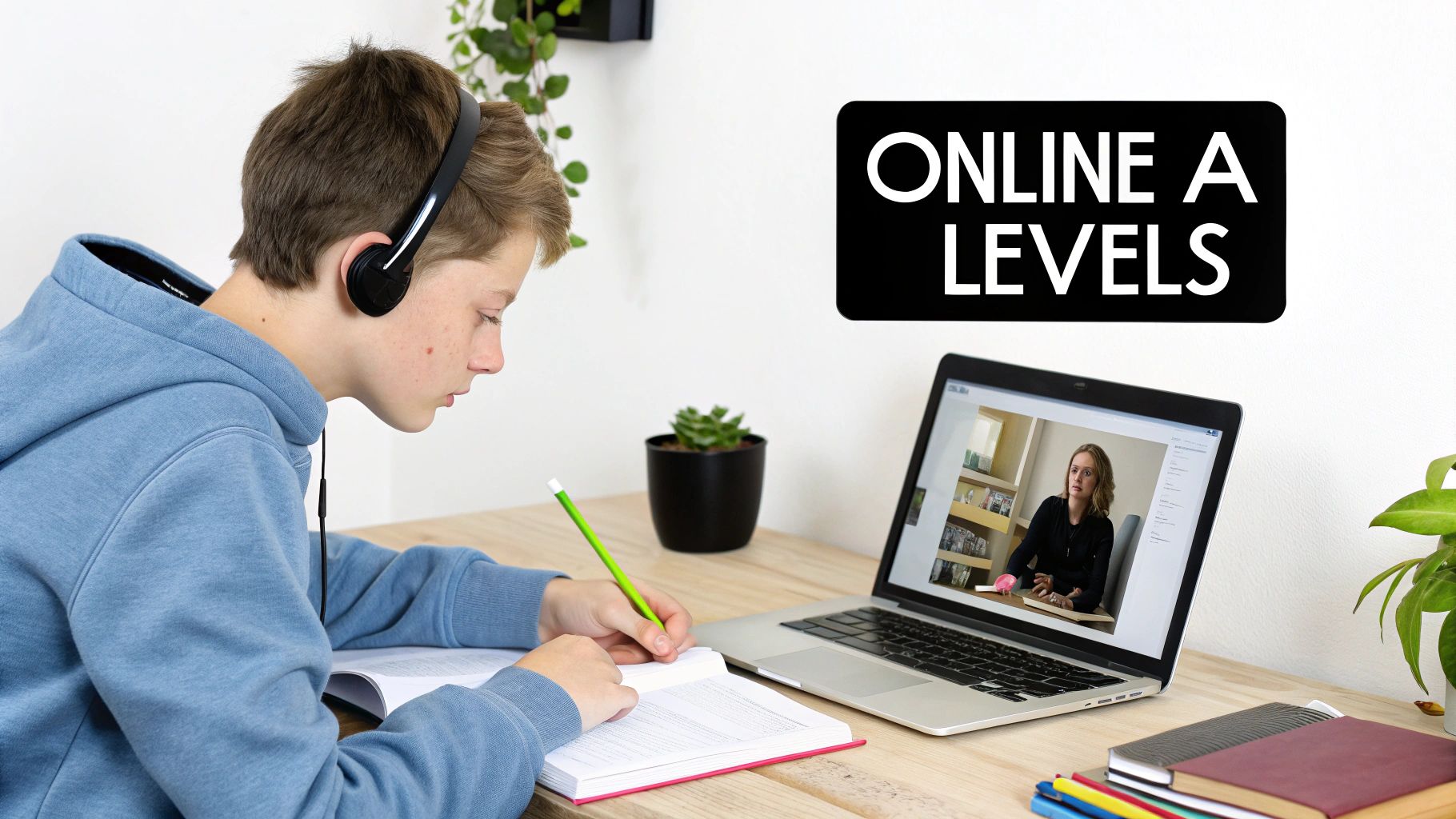
As a parent, your main concern is making sure your child gets a high-quality education that opens doors to top universities and a successful future. The decision of where they study for their A-Levels can feel monumental, and it’s natural to feel a knot of worry about online learning, especially around academic rigour and recognition.
But the educational world has changed. High-quality a level online courses uk are no longer a niche choice; they've become a powerful, mainstream option for families who want the very best for their children.
A Personalised Path to Success
Think of a traditional classroom. The bell rings, and thirty teenagers pile in, each with their own unique way of learning. For some, the pace is perfect. But what about your child? Is she bored, waiting for others to catch up? Is he struggling to keep up, feeling that familiar pang of anxiety as the teacher moves on?
An online A-Level programme, on the other hand, is like giving your child an academic personal trainer. The entire experience is designed around their unique strengths, challenges, and goals, nurturing their potential far more effectively.
This shift towards tailored education isn't just a trend; it's a strategic response to the diverse needs of modern learners. It empowers students to take ownership of their studies in an environment built around them, not around the constraints of a physical building.
What does this mean for your child? If they grasp a complex maths concept in one go, they can move ahead. If a historical period is proving tricky, they can pause, re-watch a recorded lesson, and ask for one-to-one help without the fear of looking "slow" in front of their peers.
Proven Quality and Growing Demand
This model also provides incredible access to specialist teachers, regardless of your postcode. Your child gets to learn from passionate experts in their field, not just the teachers who happen to be available locally. It’s no surprise that demand for a level online courses in the UK has surged as more families recognise these benefits.
Before the pandemic, distance learning was a tiny fraction of A-Level entries. By 2023, it accounted for nearly 20% of entries from private candidates, many of whom study through dedicated online platforms. You can explore more insights into the growth of A-Level home study here.
This growth makes one thing clear: accredited online qualifications carry the exact same weight as those earned in a traditional school. It isn’t a compromise; it’s a strategic choice for academic excellence.
How Online A Level Courses Actually Work

It’s one thing to understand the benefits of online A-Levels, but what does a typical week really look like for your child? Many parents picture their child isolated in their room, staring blankly at a screen. The reality is a structured, engaging, and deeply supportive experience.
At the heart of high-quality a level online courses uk is a blend of live, timetabled lessons and flexible, self-paced learning. This isn’t about just handing your child a stack of pre-recorded videos and wishing them luck; it’s about creating a dynamic and responsive school day.
The Rhythm of a Typical Week
Imagine your child starting their Monday morning not with a frantic rush for the bus, but by logging into a calm, focused virtual classroom from the comfort of home. Instead of the noise and distraction of a busy school, they’re greeted by their subject teacher and a small group of classmates, ready to learn.
This routine is vital. Live lessons form the backbone of the week, providing that all-important direct interaction. It’s their chance to ask a question the moment it pops into their head and get an immediate, thoughtful answer. To get a better sense of the technology that makes this possible, it helps to understand how virtual classrooms function to create these collaborative spaces.
Outside of these live sessions, your child learns to manage their own time. They might re-watch Tuesday's Biology lesson on osmosis until it clicks, complete their English essay on Thursday afternoon when they feel most creative, or spend a quiet Friday morning diving deeper into a topic that’s sparked their curiosity. This fosters independence and time-management skills—both crucial for success at university.
A Sanctuary for Focused Learning
For many students, the emotional benefits are just as important. Think of the child who feels overwhelmed by a bustling school corridor or dreads being asked to speak in a class of thirty. Online learning strips away these social pressures, creating a safe space where they can focus purely on their studies.
This doesn't mean learning in isolation. It means learning in a controlled, predictable environment where they can be themselves. They build confidence by contributing in ways that feel comfortable, whether that’s speaking up or using the chat function. Fostering this kind of positive educational space is something we explore in our guide to learning in virtual environments.
This shift from a crowded classroom to a personalised study space allows a child’s true academic potential to shine. When the anxiety of the social environment is removed, their intellectual energy can be fully dedicated to mastering their subjects.
From Assignments to Official Exams
The practical side of things is designed to be clear and straightforward, ensuring a seamless journey from the first lesson to the final qualification.
- Submitting Assignments: Coursework and practice papers are uploaded through a secure online portal. Everything is organised in one place, creating a clear digital record of your child’s progress.
- Receiving Feedback: Teachers provide detailed, personalised feedback on every piece of work. Instead of a quick tick in a physical notebook, your child might receive a two-minute audio note from their teacher explaining exactly how to strengthen their essay argument.
- Sitting Official Exams: This is a common worry for parents, but the process is simple. Students are registered as private candidates and sit the very same exams as their peers in traditional schools. A good online provider will guide you through finding and registering with an approved local exam centre, ensuring the qualification is fully recognised and accredited.
This structured system demystifies the process, proving that online A-Levels aren’t an "alternative" in quality, but a powerful and effective route to academic excellence.
Is an Online A‑Level Right for Your Child?
Deciding on the right educational path for your child is one of the most significant choices a parent can make. It’s a decision that touches your heart, stirring up hopes and fears. It’s not just about qualifications; it’s about finding an environment where they can genuinely flourish. An online A‑Level isn't a one-size-fits-all solution, but for certain students, it can be the key that unlocks their full potential.
So, how do you know if this model fits your child’s unique personality, learning style, and emotional needs? Let's move beyond generic pros and cons and look at some real-world scenarios to see who really thrives with a level online courses uk.
Finding the Perfect Fit: Student Scenarios
Every child is different, and the "best" learning environment is the one that aligns with their specific character and circumstances. The flexibility of online learning means it can cater to a wide range of students who might find a traditional sixth form restrictive.
Here are a few profiles of students who often excel in an online setting:
- 'The Driven Scientist': Meet Amelia. She's passionate about Biology and wants to get into a top medical school. In her mainstream school, she often feels held back by the pace of the class and frustrated by classroom disruptions. An online course allows her to dive deep into her subject, moving ahead when she grasps a concept and spending extra time on complex topics without distraction.
- 'The Elite Athlete': Think of Liam, a talented swimmer with a demanding training schedule. Early morning practices and competitions across the country make attending a traditional 9-to-4 school day nearly impossible. Online A‑Levels give him the freedom to build his studies around his training, ensuring he doesn’t have to sacrifice his academic ambitions for his athletic dreams.
- 'The Creative Explorer': There's also Chloe, an aspiring artist who finds the rigid structure of a school timetable stifling. She works best in long, uninterrupted creative bursts. An online model allows her to complete her academic work efficiently, freeing up large blocks of time for her passion projects and building a portfolio for university.
For each of these students, the online environment isn't a compromise; it's a strategic choice that empowers them to pursue excellence on their own terms.
A Sanctuary for Students with Additional Needs
For many parents, the most compelling reason to consider online education is the well-being of their child, particularly for those with Special Educational Needs (SEN) or Social, Emotional, and Mental Health (SEMH) challenges. The traditional school environment—with its crowded corridors, social pressures, and sensory overload—can be an immense barrier to learning.
Online A‑Level courses can create a sanctuary for these students. The environment is predictable, customisable, and safe. A child who experiences social anxiety can engage confidently through a chat box. A student with sensory sensitivities can control their own workspace, free from overwhelming noise and light. This control reduces cognitive load, freeing up mental energy for learning.
For a child who has struggled in a bustling school, finding a calm, focused learning space can feel like coming home. It’s an environment where their academic abilities are no longer overshadowed by social or sensory challenges, allowing their confidence to grow alongside their knowledge.
This supportive structure has a real impact. For SEN and SEMH students, online learning removes many traditional barriers, and some studies even suggest higher retention rates thanks to features like recorded lessons and one-to-one feedback. Economically, these courses also improve access, as traditional sixth forms can carry significant hidden costs, whereas online options often present a more straightforward financial commitment. To learn more about this, you can discover further insights into A‑Level options on openstudycollege.com.
By placing the child's emotional and academic needs at the centre, a level online courses uk offer a powerful pathway for them to not just cope, but truly thrive. This focus allows them to build a strong foundation for whatever comes next, whether that's university or another path.
For those planning their next steps, understanding how different subjects work together is key; you can explore our guide on effective A-Level subject combinations to help map out their academic journey.
Choosing the Best Online A‑Level Provider
With so many providers offering A‑Level online courses UK, making the right choice can feel overwhelming. It’s a decision that goes far beyond just picking subjects; it’s about finding a true educational partner who will support your child’s academic journey and personal growth.
This isn’t just about finding a course; it’s about finding a school. The difference is vast. A simple distance learning course can feel like being handed a textbook and a list of exam dates. A real online school, however, provides a personal mentor, a community of peers, and a structured support system designed for your child.
Differentiating the Good from the Great
The first step is to look beyond the glossy brochures and dig into the details that truly matter. A great online provider operates like a top-tier physical school, just in a virtual setting. Their focus should be squarely on your child's well-being and academic success, not simply on delivering content.
To start, think about how different online A‑Level paths might suit your child's specific needs and personality. This decision tree can help you visualise which features to prioritise based on their unique learning style.
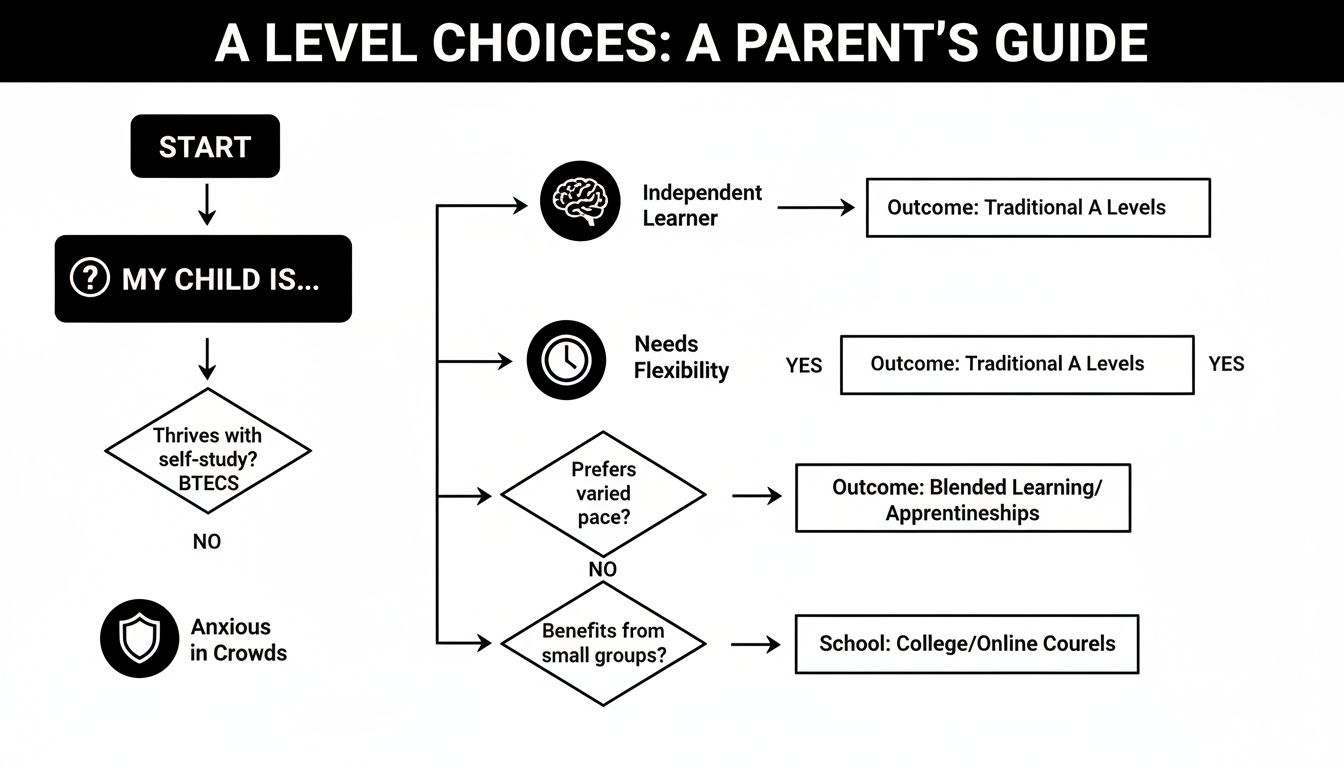
As the flowchart shows, whether your child is an independent learner, needs a flexible schedule, or feels anxious in crowds, there are specific provider features that will best support their journey.
Your Essential Evaluation Checklist
When you begin researching providers, use this checklist to ask the right questions. The answers you get will reveal the true quality and depth of their educational offering.
-
Accreditation and Exam Centre Status: Is the provider officially accredited by an awarding body like Pearson or AQA? Even better, are they an approved exam centre themselves? This simplifies things immensely, as it means they can handle exam entries directly, removing a huge administrative headache for you.
-
Teacher Qualifications and Accessibility: Who will be teaching your child? Ask about their qualifications and experience, specifically in online teaching. Crucially, how accessible are they? Can your child easily message their teacher with a question about homework, or do they have to wait a week for an answer?
-
Class Sizes and Interaction: Small class sizes are a hallmark of quality online education. Always ask for the average and maximum class size. This number directly impacts your child's ability to participate, ask questions, and get the personalised attention they deserve from their teacher.
A small class size in an online environment means your child is not just a face on a screen, but a known individual with unique strengths and needs. It transforms a lecture into a conversation, fostering confidence and deeper understanding.
Looking Beyond the Academics
A child's education is about so much more than grades. The best online schools understand this and invest heavily in pastoral care and community building, creating an environment where your child feels safe, seen, and supported.
-
Pastoral and SEN/SEMH Support: How does the school support student well-being? Is there a dedicated team for pastoral care? If your child has SEN or SEMH needs, ask detailed questions about their support structure, including individualised learning plans and access to specialist staff. For example, "What specific strategies do you use for students with dyslexia?"
-
Community and Socialisation: How does the provider foster a sense of belonging? Look for virtual common rooms, student-led clubs, and collaborative projects. A strong community helps prevent feelings of isolation and builds the social skills necessary for life beyond A‑Levels.
-
School Policies: A serious provider will have clear, robust policies. Don't be afraid to ask to see their anti-bullying policy. A zero-tolerance approach is non-negotiable and shows a deep commitment to creating a safe and respectful learning environment for every single student.
The right provider will deliver not only exceptional academic results but also a positive, nurturing experience. The results from top-tier A‑Level online courses in the UK often rival those of elite physical colleges. For instance, some providers report a 98% pass rate with 69% of students achieving A*/A grades, showcasing that with the right support, students can significantly outperform their peers. To see how this is achieved through features like unlimited tutor access, you can read more about these impressive student outcomes.
By using this checklist, you can confidently evaluate your options and choose a provider that will help your child truly thrive.
Navigating University Applications with Online A Levels
One of the biggest questions parents ask is, "Will my child's online A‑Levels be taken seriously by top universities?" It’s a completely fair question. You’re investing your heart, your hopes, and your finances into their future, and you need to know that this path leads to the same incredible opportunities as a traditional one.
Let me put your mind at ease. The answer is a clear and resounding yes. When it comes to university applications, qualifications from accredited a level online courses uk are viewed as identical to those from any physical sixth form. They carry the exact same weight, the same recognition, and the same UCAS points.
The UCAS Process Explained
Universities don’t distinguish between an A* in Chemistry earned online and one earned in a brick-and-mortar classroom. What they really care about is the accreditation behind the grade. This is precisely why choosing a reputable, officially recognised provider is non-negotiable.
With accreditation from respected bodies like Pearson, these qualifications guarantee a smooth path to university. The UCAS points are equivalent to classroom-based study, putting your child on a completely equal footing with every other applicant in the country. For families wanting a top-tier British curriculum without being tied to one location, online A-levels are a smart, future-ready choice.
An online A-Level isn't a footnote on a university application; it's a testament to a student's self-discipline, motivation, and modern learning skills. Universities see these qualities as powerful indicators of a student's readiness for undergraduate study.
A quality online school does far more than just deliver academic content; it provides robust support throughout the entire university application journey. This includes things like:
- Expert UCAS Guidance: Dedicated staff are on hand to help your child navigate the complexities of the UCAS system, from picking the right courses to hitting every deadline.
- Personal Statement Workshops: Crafting a compelling personal statement is an art form. The best online schools provide workshops and one-to-one support to help students articulate their passions and achievements effectively.
- Strong Teacher References: Because teachers in small online classes get to know their students so well, they can write detailed, insightful, and powerful references that truly capture a child's strengths.
From Overlooked to Outstanding: A Real Story
Think about a student like Ben. In his large, busy secondary school, Ben was quiet and often felt overlooked. He was bright, but he rarely raised his hand and his confidence suffered as a result. His parents watched with a heavy heart, worried he wouldn't get the focused support needed for a competitive university application.
They decided to switch to an online A‑Level school for his Sixth Form studies. It changed everything. In the small, interactive classes, Ben found his voice. His teachers spotted his sharp analytical skills and actively encouraged him, providing the detailed feedback he needed to excel. When it was time to apply for university, his personal statement shone, and his teacher references were glowing with specific examples of his progress.
The result? Ben landed a place to study History at a prestigious Russell Group university—a goal that once felt out of reach. His story shows that for the right child, a level online courses uk aren't a hurdle, but a powerful launchpad. As students look ahead, their hard work culminates in a recognised degree, and it's worth considering the significance of a personalized diploma cover to mark such an important achievement. For a detailed walkthrough of the application process itself, check out our guide on how to apply to UK universities.
Your Questions About Online A Levels Answered
It’s completely normal to have a few practical questions, even after seeing all the benefits. Choosing the right path for your child’s education is a huge decision, and you deserve clear, straightforward answers that give you confidence. Let's tackle the most common queries we hear from parents, putting your child's experience at the heart of every answer.
How Much Do A Level Online Courses in the UK Cost?
The cost for a high-quality A-Level online course in the UK typically falls between £3,000 and £7,000 per subject for the full two-year programme. This isn't just a fee for materials; it's an investment in a comprehensive educational service.
Think of it this way: cheaper, self-study options are often little more than digital textbooks. A proper online school, however, provides the live teaching, structure, and emotional support that make all the difference to your child’s success and happiness.
So, what does that investment usually cover?
- Live, timetabled lessons with qualified, subject-specialist teachers.
- Small class sizes, so your child gets genuine, personal attention.
- All digital learning materials, plus access to a library of recorded lessons for revision.
- Regular assessments with detailed, constructive feedback that helps them improve.
- Dedicated pastoral support from a team focused on student well-being.
- Expert guidance on everything from UCAS applications to exam registration as a private candidate.
When you factor in the hidden costs of a traditional sixth form—things like transport, uniforms, and pricey school trips—the value of a top-tier online programme becomes even more apparent.
How Do Students Socialise Without a Physical School?
This is often a parent's number one concern, and rightly so. We all want our children to build friendships and feel like they belong. The best online schools have put a tremendous amount of thought into this, creating vibrant social structures that go far beyond the classroom.
Picture a school common room, but online. Students have their own dedicated spaces to chat, collaborate on projects, and simply hang out between classes. It’s where friendships are sparked by shared interests, not just by sitting next to someone in maths.
A strong online community ensures a child never feels they are learning in isolation. It replaces the chaos of a crowded corridor with intentional, positive social interactions, building confidence and a real sense of belonging.
Beyond these virtual common rooms, a thriving community is built through:
- Student-Led Clubs: From a debating society and a creative writing club to a gaming guild, these groups let your child connect with peers who share their passions.
- Collaborative Projects: Teachers intentionally design group assignments that foster teamwork, communication, and problem-solving—the exact skills needed for university and the modern workplace.
- School-Wide Events: Think virtual assemblies, guest speaker events, and even online talent shows. These create a shared school spirit and a sense of collective identity.
For a child who finds the social pressure of a large school overwhelming, these structured, interest-based interactions can be a much healthier and more enjoyable way to build lasting friendships.
What Technology is Required for Online A Levels?
You’ll be relieved to hear you don’t need a high-tech command centre to get started. The required tech is refreshingly simple and is probably already in your home. The goal is accessibility, not expensive gadgets.
At its core, all your child needs is a reliable computer and a stable internet connection.
Here’s a quick checklist of the essentials:
- A desktop or laptop computer: While you can use a tablet for some things, a proper keyboard makes all the difference for writing essays and actively participating in live lessons.
- A stable internet connection: This is the most crucial piece. A good connection ensures smooth, uninterrupted access to the virtual classroom.
- A webcam and microphone: Most modern laptops have these built-in, but they are essential for your child to see, hear, and interact with their teachers and classmates.
- An up-to-date web browser: The learning platforms are browser-based, so using the latest version of Chrome, Firefox, or Safari is all that’s needed.
And that’s really it. No specialised software or powerful hardware is required. The platforms used by the best A-Level online courses in the UK are designed to be intuitive and user-friendly, ensuring technology empowers learning, rather than getting in the way of it.
Can My Child Study Just One A-Level Online?
Absolutely. This flexibility is one of the biggest advantages of online learning. It allows you to build a truly bespoke educational path that fits your child's unique needs and ambitions.
For instance, maybe your child’s current school doesn’t offer A-Level Psychology, but it's the subject they dream of studying at university. They can stay at their physical school for their other subjects and take just Psychology online.
This ‘hybrid’ model is also perfect for a student wanting to add a fourth A-Level to strengthen their university application without completely overloading their in-school timetable. It gives your child the power to create an academic profile that truly reflects their goals, free from the limitations of a single school's course catalogue.
At Queen's Online School, we understand that every child's educational journey is unique. We offer a fully accredited, live online British education that puts your child's well-being and future at the heart of everything we do. From our small, interactive classes to our dedicated pastoral care, we provide an environment where every student can truly thrive. To discover how we can build a personalised learning plan for your child, visit Queen's Online School today.