
A-Level Human Biology is so much more than just another subject—it’s the remarkable, deeply personal story of us. It's the journey of discovering the science that powers our own bodies, turning abstract concepts into a relatable narrative that builds a powerful foundation for university and a future where your child can truly make a difference.
Starting Your A-Level Human Biology Adventure
Choosing an A-Level subject can feel like a huge decision, stirring up that familiar mix of excitement for your child's future and a little bit of worry about making the right choice. When it comes to A-Level Human Biology, that decision is almost always driven by a deep, personal curiosity about the most complex machine we know: the human body.
For your child, this isn't just about memorising dry facts for an exam. It’s about finally getting answers to the questions they've always wondered about. Why does my heart race when I'm nervous? How does a tiny cut heal all by itself? A-Level Human Biology connects the science they learn in the virtual classroom to their own lived experience. A practical example is when they learn about the endocrine system; they'll finally understand the rush of adrenaline they feel before a sports match is caused by a real hormone preparing their body for action. This makes every single topic feel personal and deeply relevant.
As a parent, you see that spark of interest and want to nurture it into a lifelong passion. You understand that this A-Level is a critical stepping stone, unlocking doors to prestigious university degrees in medicine, dentistry, physiotherapy, and biomedical sciences. You feel a sense of hope, picturing their hard work translating into a future where they can make a real difference in people's lives. If you're new to this stage of education, understanding how A-Levels work is a great place to start.
This guide is designed to turn that uncertainty into confidence. We’ll demystify the entire A-Level Human Biology journey, framing it not as a daunting academic challenge, but as an exciting adventure of discovery that puts your child at the heart of the story.
What This Guide Will Cover
We'll walk you through everything you and your child need to feel prepared and empowered. Think of this as a clear, supportive roadmap for success, designed with your child's well-being in mind.
Together, we'll explore:
- The Core Syllabus: We’ll break down exactly what your child will be learning, from the microscopic world of cells to the complex organ systems that keep us going.
- Navigating Exams: Discover practical tips and real strategies to help your child approach assessments with confidence and less anxiety.
- Effective Revision Plans: Learn how to build a personalised study schedule that truly works for your child’s unique learning style and emotional needs.
- Future Pathways: See the incredible range of career and university opportunities that this A-Level unlocks, connecting their studies to a meaningful future.
What Your Child Will Learn in A Level Human Biology
Taking on A-Level Human Biology is like being handed the ultimate user manual for the most complex machine on Earth—their own body. This isn't just about memorising facts from a textbook; it's about piecing together the incredible puzzle of how we function, think, and survive. For your child, this course closes the gap between abstract science and their own lived experience, answering those "why" and "how" questions with genuine scientific insight.
This journey is a partnership, where your child's hard work, supported by your encouragement at home, paves the way for success at university and in their future career. Your child is at the centre of this journey.
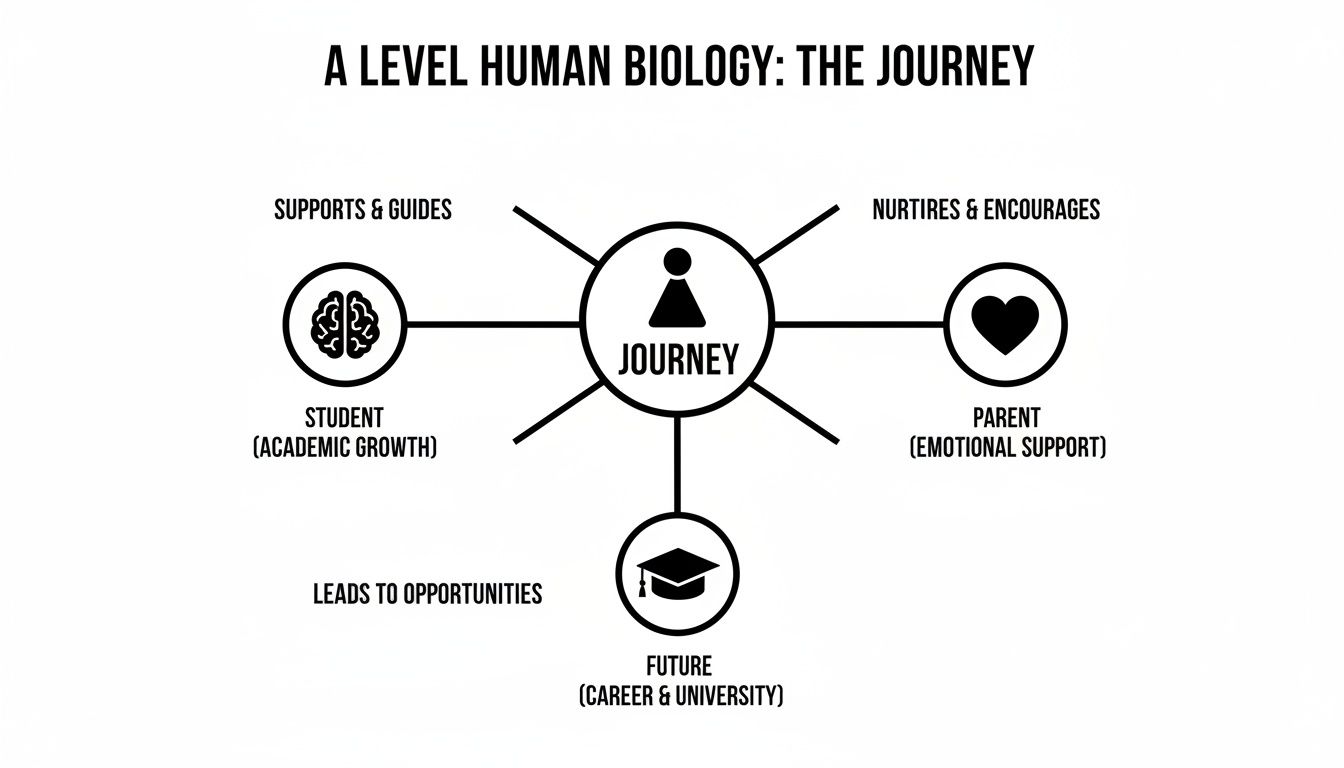
The syllabus is smartly designed to build knowledge from the ground up, placing your child's understanding at the core. It starts with the absolute fundamentals of life and gradually builds to the intricate, interconnected systems that make us who we are.
To give you a clearer picture, here’s a summary of the key topics your child will explore. You can see the logical progression from foundational concepts to complex biological systems.
A Level Human Biology Syllabus Overview
| Core Topic Area | Key Concepts Your Child Will Master |
|---|---|
| Biological Molecules | Understanding the building blocks of life: carbohydrates, proteins, lipids, and nucleic acids. |
| Cells | Exploring the structure and function of eukaryotic cells—the microscopic powerhouses of the body. |
| Organisms & Exchange | Investigating how substances get into and out of organisms, focusing on gas exchange and digestion. |
| Genetic Information | Uncovering the secrets of DNA, genes, and inheritance, including protein synthesis. |
| Energy Transfers | Learning how energy flows through biological systems, including respiration and photosynthesis. |
| Organismal Response | Studying the nervous and hormonal systems that coordinate the body's responses to its environment. |
| Genetics & Ecosystems | Looking at populations, evolution, and how organisms interact within their ecosystems. |
| Gene Expression | Delving into the control of gene expression and the technologies that shape modern genetics. |
Each topic builds on the last, creating a rich, interconnected understanding of human biology that goes far beyond simple fact-finding.
From Microscopic Blueprints to Major Systems
The course kicks off at the smallest scale, diving into the world of biological molecules and cells. Imagine the moment of wonder for your child when they discover that their entire body is constructed from the same proteins and carbohydrates they hear about on food labels. They'll learn that DNA isn't just an abstract code; it’s the master blueprint that gives every single one of their cells its instructions.
They'll get to grips with core processes like transcription and translation in biology, which are the steps cells use to read that DNA blueprint and build the proteins we need to live. For instance, they'll learn how this process creates haemoglobin, the protein in their own red blood cells that carries oxygen with every breath they take. This foundation is so important because it explains everything from how our bodies grow and repair to how genetic conditions are passed down.
It’s often here that students have that first "aha!" moment, a feeling of pure awe when they realise the immense complexity of the human body all starts with these tiny, elegant chemical processes.
From there, the course zooms out to see how these cells work together as a team. Your child will investigate how substances move across cell membranes—the bouncers at the door of every cell—and learn about enzymes, the biological catalysts that make life’s chemical reactions happen at lightning speed. Think of enzymes in their own digestive system, like amylase in their saliva, breaking down the starch in a piece of bread before they've even swallowed it. It's their body’s tiny but tireless factory workers, managing everything from digestion to energy release.
Understanding the Body's Communication Networks
As their confidence grows, students move on to explore how different parts of the body talk to each other and work in harmony. They’ll study the nervous system, picturing it as a super-fast electrical wiring network that sends messages in milliseconds. A great practical example is understanding the precise chain reaction that occurs when they touch something hot—from the signal flashing from their skin to the brain, and the return message telling their muscles to pull away, all in an instant to protect them.
They'll also explore the hormonal system, which is more like a chemical postal service, sending messages that regulate everything from mood and growth to metabolism. This is where learning connects directly to their own lives, explaining the adrenaline rush before a big match or the science behind a sugar high after a birthday party.
This section of the course often feels the most personal, creating a profound connection as students can directly relate the concepts to their own daily feelings and physical responses.
Exploring Defence, Disease, and Genetics
Towards the end of the course, the focus shifts to some of the most relevant topics in science today. Your child will learn about the immune system, seeing it as their body’s highly intelligent and adaptive army, constantly defending against invaders like bacteria and viruses. They’ll finally understand the science behind vaccines—for example, how the MMR vaccine they had as a child trained their immune system to recognise measles, mumps, and rubella, protecting them for life. This makes the concept of immunity feel incredibly personal and vital.
The curriculum also covers genetics, inheritance, and the ethical questions that come with new technologies. This goes far beyond the simple Punnett squares they might remember from GCSE. It’s about understanding the real-world impact of genetic screening, the potential of gene therapy, and forming an educated opinion on some of the biggest scientific debates of our time. By the end, they don't just know the facts; they feel the incredible story of human life in a way they never have before.
How to Turn Exam Nerves into Exam Confidence
Let's be honest: exams can feel incredibly daunting. That knot in the stomach is a familiar feeling for students and for you, the parents supporting them through the revision trenches. The worry that all those months of hard work won't translate on the day is very real, and it can be heartbreaking to watch your child struggle with that pressure.
But preparing for A-Level Human Biology exams doesn’t have to be an exercise in stress management. Think of it like a sports team getting ready for a final. Success isn't just about raw talent; it’s about knowing the rules of the game, practising your moves, and walking onto the pitch with a solid game plan that makes you feel strong and capable.
This section is your guide to swapping that anxiety for quiet confidence. We’ll demystify what the assessments actually look like, so there are no surprises. More importantly, we'll share strategies to prepare in a way that feels empowering, not exhausting, putting your child’s well-being and emotional needs front and centre.
Getting to Grips with the Question Types
A-Level Human Biology exams are designed to see if your child can think like a scientist, not just memorise a textbook. Examiners use a mix of question formats to test different skills, and knowing what’s coming is half the battle won against anxiety.
Here’s what they’ll encounter:
- Multiple-Choice Questions (MCQs): These look easy but are crafted to be tricky. They test pinpoint knowledge and often throw in very similar-looking distractors. A practical example is a question about the heart, where options might include 'atrium', 'artery', and 'aorta'—all similar words testing precise understanding. The trick is to read every word carefully and methodically eliminate the options you know are wrong.
- Short-Answer Questions: These usually need just a few sentences to define a key term, recall a specific fact, or explain a process. A classic example might be to describe the role of insulin in regulating blood glucose after a meal. They’re looking for clarity and precision.
- Data Interpretation Questions: Here, your child will face graphs, tables, or charts from a scientific study and be asked to analyse them. This is a test of their ability to spot trends, draw logical conclusions, and sometimes even critique the experimental method itself.
- Extended-Response and Essay Questions: These are the big-ticket items that carry the most marks. They demand a deep, well-structured answer that pulls together concepts from different parts of the syllabus to build a coherent argument.
Familiarity with these formats turns the exam paper from a big, scary unknown into a series of smaller, manageable tasks. It's something your child can practise until it feels less intimidating and more like second nature.
Answering Questions for Maximum Marks
Just knowing the facts isn’t enough; your child has to communicate that knowledge in the way examiners want to see it. It’s a bit like building a case in a courtroom—every point needs to be clear, logical, and supported by evidence from their biological understanding.
Data interpretation is a common stumbling block. A student might see a graph showing heart rate increasing with exercise intensity. A basic answer simply describes this: "As exercise increases, heart rate goes up." But a top-tier answer explains why, connecting it to the child's own experience. It applies biological knowledge, linking the trend to their muscles' increased demand for oxygen during a run, the role of adrenaline making their heart pound, and the response of their nervous system.
The secret to the highest marks isn't just knowing more stuff. It's about using the facts to explain the 'how' and 'why' behind the data. It's about connecting the dots to prove you really understand it, making the science feel real and applied.
For those longer essay questions, structure is absolutely everything. A brain-dump of correct information, however brilliant, will lose marks if it’s scattered. Encourage your child to spend just two or three minutes planning their response with a few bullet points. It’s a tiny investment of time that pays huge dividends, calming their nerves, keeping them on track, and ensuring their argument flows like a good story.
Support for Every Kind of Learner
We know that for students with SEN (Special Educational Needs) or SEMH (Social, Emotional, and Mental Health) needs, the pressure-cooker environment of exams can be especially tough. A traditional classroom, with its fixed pace and social pressures, can sometimes amplify feelings of anxiety or being left behind.
This is where a flexible and supportive learning environment can be a game-changer for your child. Imagine them being able to re-watch a recorded lesson on a tricky topic like the immune response as many times as they need, in the comfort of their own room, without feeling self-conscious about asking the teacher to repeat themselves.
That ability to learn at their own pace builds genuine mastery and, just as importantly, relieves anxiety and builds confidence. It puts your child back in the driver's seat of their own education, allowing them to prepare for exams in a way that works for them. This compassionate approach reduces stress and helps their true knowledge shine through when it counts.
Building a Personalised Study and Revision Plan
Handing a student a generic, one-size-fits-all study plan is a bit like giving them a map to a city they've never visited. It's a start, but it doesn't account for their personal journey, their unique way of seeing the world, or the unexpected roadblocks they'll inevitably face.
Every child is different. For a content-heavy subject like A-Level Human Biology, a personalised revision plan isn't a luxury; it's the key to turning that feeling of being overwhelmed into a sense of calm control. The goal isn't just to tick off syllabus topics but to empower your child to feel in charge of their learning. This means moving beyond passive reading and building a strategy that feels manageable, effective, and supportive of their well-being.

Moving Beyond Rereading Notes
So many students fall into the trap of simply rereading their notes, hoping the information will magically stick. While it feels familiar and productive, it's a passive technique that can create a false sense of security, leading to that heartbreaking moment in an exam when the information just won't come back.
The most powerful learning happens not when we put information into our brains, but when we have to pull it out. This is the foundation of effective, evidence-based revision that respects how your child's brain actually works.
To help your child build a plan that truly works for them, let's explore a few powerful techniques that are proven to be effective, especially for a complex subject like A-Level Human Biology. As you build this plan, incorporating strategies to actively improve working memory can make a huge difference in their ability to retain and recall intricate details under pressure.
To get started, it's helpful to compare a few popular, evidence-based revision techniques. This allows you and your child to choose the best methods for their specific learning style and emotional needs.
Comparing Effective Revision Techniques
| Revision Technique | How It Works | Best For | SEN/SEMH Consideration |
|---|---|---|---|
| Active Recall | Forcing your brain to retrieve information without looking at notes. Examples: flashcards, blank page summaries, teaching a topic to someone else. | Embedding complex processes and definitions into long-term memory. Excellent for identifying genuine knowledge gaps and building confidence. | Can be adapted to be multi-sensory (e.g., drawing diagrams, speaking answers aloud). Breaks revision into manageable chunks, reducing cognitive load and anxiety. |
| Spaced Repetition | Revisiting topics at increasing intervals (e.g., after 1 day, 3 days, 1 week, 3 weeks). Works with the brain's natural "forgetting curve." | Retaining a large volume of information over the entire course. Prevents the panic of last-minute cramming. | The predictable structure can be very calming and reassuring. Digital tools can automate the schedule, removing the organisational burden for your child. |
| Interleaving | Mixing up different topics in a single study session, rather than studying one topic in a block. For example, 20 mins of genetics, then 20 mins of immunology. | Developing the ability to switch between different concepts, which is crucial for answering mixed-topic exam questions. | May be overwhelming for a child who struggles with task-switching. Best introduced gradually once foundational knowledge feels secure. |
| Past Papers | Using past exam papers to practise applying knowledge, understanding command words, and refining exam technique under timed or untimed conditions. | Simulating exam conditions in a safe way, improving time management, and pinpointing weaknesses in both knowledge and application. | Start with untimed, open-book papers to build your child's confidence. Focus on one question type at a time to avoid feeling overwhelmed. |
Choosing a mix of these strategies is far more effective than relying on just one. Active recall and spaced repetition, in particular, form a powerful and compassionate duo for mastering the sheer volume of content in A-Level Human Biology.
Embracing Active Recall
Active recall is simply the act of trying to retrieve information from memory. Instead of rereading the chapter on the nervous system, your child would close the book and try to draw the structure of a neuron from scratch, labelling its parts and explaining what each one does. It's a low-stakes way to test themselves.
Here are some practical ways to put it into practice:
- Create Flashcards: Go beyond simple definitions. One side could say, "Explain the role of adrenaline in the 'fight or flight' response," prompting a detailed explanation on the back that they can relate to their own experiences.
- Use the 'Blank Paper' Method: After a study session, your child takes a blank sheet of paper and writes down everything they can remember. They then compare it to their notes to see what they missed. This isn't a test; it's a tool that gently reveals their true knowledge gaps.
- Teach the Topic: Ask them to explain a concept to you, like how vaccines work. Having to articulate the ideas out loud forces their brain to organise the information logically and clearly, and gives you a chance to show your support and interest.
The Power of Spaced Repetition
The second key is spaced repetition. Our brains are designed to forget things over time—it's completely normal and nothing for your child to feel bad about. This technique works with that natural process by getting students to revisit topics at increasing intervals.
For example, after learning about the heart:
- Day 1: Review the topic at the end of the study session.
- Day 3: Briefly review it again.
- Day 7: Have another quick look.
- Day 21: Revisit it one last time before the next cycle.
This method feels much less intense than cramming and is scientifically proven to move information from short-term to long-term memory, making it far easier to recall under exam pressure. It builds a foundation of knowledge slowly and steadily, which is a huge source of comfort and confidence. You can find more powerful strategies in our guide on how to revise for Biology A Level.
Using Past Papers as a Diagnostic Tool
Past papers shouldn't just be saved for scary mock exams in the final weeks. They are incredibly powerful and gentle diagnostic tools that can guide your child's revision right from the start.
Instead of completing a full paper under timed conditions, encourage your child to work through it with their notes open beside them. When they get stuck on a question about gene expression, for example, that’s a clear, non-judgmental signal to go back and strengthen their understanding of that specific topic. This approach turns past papers from a dreaded test into a personalised learning guide, pinpointing exactly where to focus their energy for the biggest impact and building their self-esteem along the way.
Your Child's Future: From A-Levels to a Life of Impact
When your child is buried deep in revision, memorising something like the Krebs cycle can feel disconnected from real life. It’s that classic moment when they look up and ask, "When am I ever going to need to know this?" As a parent, you know the answer is "everywhere," but it’s our job to help them see it. That feeling of purpose is what will carry them through the tough times.
An A-Level in Human Biology isn’t just another qualification; it's a passport to some of the most respected, rewarding, and impactful careers imaginable. This is about more than just getting a job. It’s about empowering your child to see the incredible future they are building with every past paper they complete. It's about showing them that their hard work is a direct investment in a life where they can help people, solve problems, and make a genuine difference in the world.
Building a Competitive University Application
The first step on this journey for many is university, and A-Level Human Biology is a subject that top admissions tutors actively look for. It demonstrates a high level of scientific literacy, sharp analytical thinking, and the sheer dedication required to succeed in demanding degree programmes. For many health and science courses, it’s not just a preferred subject; it’s essential for your child's future.
Take Human Sciences at Oxford University, a programme that aligns closely with A-Level Human Biology. In a recent admissions cycle, an impressive 90.3% of students who received an offer had studied Biology. This statistic really highlights its critical role in preparing students for the rigours of advanced degrees. You can find more insights in the Oxford admissions report here.
Exploring Diverse Career Pathways
The real beauty of this A-Level is the sheer breadth of opportunities it unlocks for your child. It gives them the freedom to explore their interests and find a path that truly ignites their passion, whether that’s on the front lines of healthcare or in a pioneering research laboratory.
Here are just a handful of the exciting destinations this subject can lead to:
- Medicine and Dentistry: This is the most direct route for the child who dreams of diagnosing illnesses, caring for patients, and holding a hand in a time of need. A-Level Human Biology lays down the fundamental knowledge of anatomy, physiology, and disease that forms the bedrock of all medical training.
- Biomedical Science: Perfect for the student who is fascinated by the 'why' behind diseases. Biomedical scientists are the detectives of the medical world, working in labs to conduct tests—from blood samples to tissue analysis—that help doctors give families the answers they are so desperately waiting for.
- Physiotherapy: A fantastic path for students who want to help people recover movement and function after an injury or illness. A deep understanding of the musculoskeletal and nervous systems isn't just helpful here; it’s absolutely essential for helping a grandparent learn to walk again after a fall.
- Genetic Research: For the true innovator who wants to be at the forefront of science. Geneticists and researchers explore the very blueprint of life, working to understand inherited diseases and develop groundbreaking new treatments that can change lives for generations to come.
This A-Level gives your child options. It empowers them to choose a future that isn’t just a career but a calling—a way to apply their passion for science to improving human lives, which is a source of immense pride.
This course does more than just teach biology; it teaches a way of thinking. It develops the critical analysis, problem-solving, and data interpretation skills that are invaluable in any field. The journey through A-Level Human Biology is certainly challenging, but it shapes resilient, inquisitive, and capable young adults who are ready for whatever future they choose.
Why Online Learning Can Make the Difference
The journey through A-Level Human Biology is intense. It demands focus, resilience, and a deep well of curiosity. For many students, however, the traditional classroom—with its fixed pace and unspoken social pressures—can feel more like a hurdle than a helping hand. This is where a different approach to learning can completely change the story, letting your child’s true potential shine through.

Imagine your child, who’s hesitant to ask questions in a large class, worried about slowing everyone else down or looking foolish. In a small, live online class, that fear simply melts away. Specialist teachers can offer individual attention, creating a safe, encouraging space where your child's every question is seen as a valuable step towards understanding.
A Supportive Space for Every Learner
This kind of personalised support is particularly powerful for students with SEN or SEMH needs. Think about a learner who struggles to grasp complex information the first time around. Instead of the panic of falling behind, they can simply re-watch recorded lessons on tricky topics—like the stages of cellular respiration—as many times as they need, in their own time and space.
This simple feature—the ability to pause, rewind, and review—puts your child in complete control of their learning pace. It transforms revision from a stressful scramble into a calm, methodical process, building genuine confidence and deep understanding from a place of safety and support.
This flexible environment empowers your child to master the subject without the pressure, ensuring they walk into exams feeling prepared, not panicked. This supportive, child-centric approach is central to our online A-Level Biology course, where your child's well-being is every bit as important as their academic results.
Building the Confidence for Top Universities
Ultimately, the goal is to help your child gain the grades and self-belief they need to succeed at the highest level. The competition for places at top universities is fierce, and A-Level Biology is a popular and highly respected qualification, with over 60,000 entrants in recent years.
For sought-after courses like Natural Sciences at Cambridge, the offer rate is just 13.7%, with the vast majority of successful applicants holding grades of A*AA or better. Securing these top marks requires more than just knowing the facts; it demands confidence and a robust, intuitive grasp of the subject.
An online learning environment that nurtures each child individually can be the critical factor that helps them secure those top grades. By placing your child's needs at the very centre of their education, we help them build not just an impressive academic record, but the personal resilience and self-worth to thrive on whatever path they choose.
Got Questions? We've Got Answers
Choosing the right A-Levels can feel like a huge decision, and it’s natural for parents and students to have questions. We get it. Here are some of the most common queries we hear about A-Level Human Biology, answered honestly to help your family feel confident and reassured about the road ahead.
Is A-Level Human Biology Too Difficult for My Child?
There’s no sugarcoating it: A-Level Human Biology is a demanding course, which is exactly why top universities hold it in such high regard. It requires real dedication to get to grips with complex terminology and intricate biological processes.
But here’s the thing we see time and again: when a student is genuinely curious about how their own body works, that feeling of "difficulty" transforms into a fascinating puzzle they actually want to solve. That spark of passion is the most powerful motivator your child can have.
The right support is the game-changer. When tricky topics, like how kidneys filter blood, are broken down into manageable, bite-sized pieces, it builds your child's confidence brick by brick, so they never feel swamped or left behind. Your child’s passion, combined with brilliant teaching that puts their needs first, is the real formula for success.
What GCSE Grades Are Recommended for This A-Level?
Most schools and colleges will look for at least a grade 6 in GCSE Biology or Combined Science. A solid grasp of the fundamentals from GCSE is vital for helping your child keep up with the faster pace and greater depth of the A-Level curriculum without feeling overwhelmed.
On top of that, a grade 5 or 6 in GCSE Maths is a huge advantage. Many people are surprised by how much mathematical skill the course involves—from interpreting data on graphs showing patient recovery times to calculating medication dosages or understanding statistical significance in clinical trials. Having these grades means your child has the tools they need to hit the ground running.
We always encourage families to chat with us about their child's specific situation, though. We believe passion and potential count just as much as grades on a certificate.
Remember, these grade recommendations aren't just arbitrary gatekeeping. They’re a good indicator that a student has the core skills needed to engage with the material confidently, ensuring they feel capable and empowered rather than constantly playing catch-up.
How Can We Best Prepare During the Summer Holidays?
The best way to prepare over the summer is to spark your child's curiosity, not cause burnout. The goal is for them to walk into their first A-Level lesson feeling excited and ready, not drained from weeks of forced, intensive revision. It's about nurturing their love for the subject.
Try encouraging them to connect with science in fun, low-pressure ways:
- Watch documentaries on the human body or medical breakthroughs. David Attenborough is always a winner, but there are some fantastic series on genetics and modern medicine that can spark incredible conversations.
- Listen to science podcasts that dig into interesting biological questions during a car ride.
- Read a popular science book—something that makes complicated ideas feel exciting and easy to understand.
A light review of core GCSE topics like cell structure or genetics can also be a fantastic confidence booster. This gentle approach ensures they start their A-Level journey with their passion for the subject firing on all cylinders, feeling positive and eager to learn more.
At Queen’s Online School, we place your child at the centre of their A-Level Human Biology education, providing the expert teaching and personalised support they need to truly shine. Explore our online A-Level courses today.