

You may be reading this after another difficult morning. Your child says they're fine, but you can see the change. A once chatty Year 7 or Year 8 student now seems drained, reluctant, or constantly on edge. Homework takes twice as long as it should. Small setbacks feel huge. You're not looking for a trendy alternative. You're looking for a way for your child to feel safe, capable, and interested in learning again.
That's often where the search for online school middle school begins in the UK. Not with a love of screens or a wish to avoid real life, but with a parent asking a simple question: is this school environment helping my child grow, or just asking them to cope?
Is Your Child Thriving or Just Surviving Middle School
A lot can change between the end of primary school and the middle years of secondary. One child may become quieter because the classes are too big. Another may start masking anxiety so well that school reports still look “fine” while home life tells a different story. Some children are academically able but emotionally worn down. Others are bright, curious, and falling behind because the pace, noise, or social pressure around them is too much.

I speak to parents in this position often. They usually say some version of the same thing. “My child used to love learning.” That sentence matters. It tells you the issue may not be ability at all. It may be fit.
When the school day costs too much
A child can be attending every lesson and still be barely holding on. You might notice:
- Morning resistance: Getting ready for school turns into tears, stomach aches, or shutdowns.
- After-school collapse: Your child comes home and has nothing left emotionally.
- Loss of confidence: They start saying they're “bad” at subjects they once enjoyed.
- Social fear: Lunch, corridors, changing rooms, and peer dynamics become harder than the academic work.
For some families, this leads to conversations about emotional wellbeing, attendance, and whether a different model could help. If your child is struggling in ways that affect confidence or daily stability, support around social, mental and emotional health can be a useful starting point.
Online school is not the same as emergency remote learning
Many parents still hear “online school” and think of the disruption of 2020. That reaction is understandable. But the main lesson from that period was clear. Live teaching, structured timetables, and reliable access are not optional extras but the core conditions that make online schooling work, especially for younger learners. The wider evidence from that period also showed that engagement was uneven when families lacked devices, space, or support, as noted in this remote learning benchmark summary.
A well-run online school doesn't ask a child to manage everything alone. It builds the day around routine, teacher contact, and visible support.
That's why I don't see online schooling as a last resort. For the right child, it can be a thoughtful, positive decision. It can replace chaos with calm, invisibility with attention, and survival mode with the chance to learn properly again.
What Online Middle School Really Means for Your Child
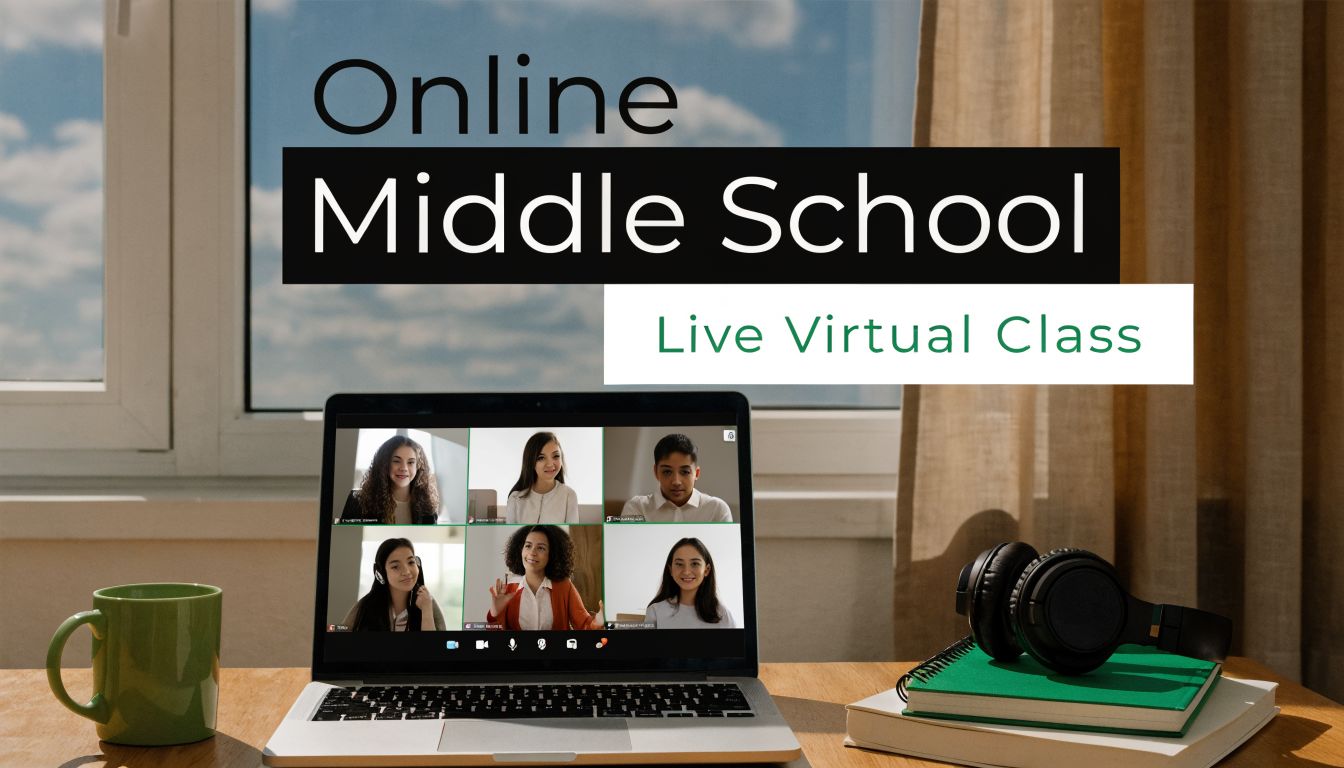
A genuine online middle school is not a bank of videos, worksheets, and automated quizzes. It's a full-time school experience delivered online, with teachers, classmates, routines, expectations, and pastoral care. Your child doesn't just log in to consume content. They join lessons, answer questions, complete work, hear feedback, and become known.
That difference matters at Key Stage 3. Children in these years still need adults to notice when they're confused, drifting, worried, or ready for more challenge. Passive platforms can't do that. Good schools can.
What your child should experience each week
A proper online school should feel more like a focused classroom than a lonely screen. In practice, that usually means:
- A set timetable: Your child knows when English, maths, science, and other subjects happen.
- Subject-specialist teachers: Different teachers bring expertise and consistency to each class.
- Live lessons: Students interact in real time rather than working only through pre-recorded material.
- Regular feedback: Teachers check understanding before small gaps become large ones.
- A learning community: Classmates work together, discuss ideas, and build familiarity over time.
If you're trying to picture the digital side of this, a virtual learning environment is the online space where lessons, assignments, feedback, and communication are organised.
The difference between access and belonging
Parents often ask whether online school feels isolating. It can, if the model is poor. But a well-structured programme creates belonging in a different way. A child who feels overwhelmed in a noisy building may contribute more in a calm live lesson. A shy student may use the chat confidently before speaking aloud. A pupil who struggled to keep up in a large class may finally receive direct, timely feedback.
Think of the contrast like this:
| Approach | Child's likely experience |
|---|---|
| Content-only platform | “I'm watching things, but I'm not sure anyone knows whether I understand.” |
| Live online school | “My teacher noticed I was stuck and helped me before I got lost.” |
What parents often get wrong at first
The biggest misunderstanding is assuming online learning means less structure. For younger secondary pupils, the opposite is true. The best online middle school models are highly organised because children still need rhythm in the day.
Practical rule: If a school talks a lot about flexibility but very little about timetables, teacher contact, and safeguarding, ask more questions.
Your child doesn't need endless freedom. They need a school model that gives them room to breathe while still holding the shape of the day together.
A Day in the Life of an Online Student
Let's make this concrete. A typical Year 8 student in an online school middle school setting doesn't spend the day staring at a screen from morning to afternoon. Their day should move between short live teaching, guided tasks, breaks, written work, and check-ins with teachers.
That pattern works particularly well for this age group. UK remote education guidance consistently pointed to the value of live teaching combined with structured independent work, especially because younger secondary pupils are still developing self-regulation. It also stressed that short live inputs, immediate checks, and offline practice help teachers spot barriers quickly, as reflected in this guidance summary on middle school online learning.
What one school day can feel like
A Monday might begin with registration and an English lesson. The teacher introduces persuasive writing in a live class, asks students to annotate a short text, and checks responses in real time. Your child then logs off for a focused writing task with clear instructions. If they get stuck, there's a route back to the teacher.
Later, maths may involve a live explanation of algebraic expressions followed by a short problem set. Science might include a demonstration, data analysis, or discussion rather than a passive lecture. There are breaks between sessions, and the child isn't expected to remain “on camera” for every minute of the school day.
Sample Weekly Timetable for a Year 8 Student
| Time | Monday | Tuesday | Wednesday | Thursday | Friday |
|---|---|---|---|---|---|
| 8:45 to 9:00 | Registration | Registration | Registration | Registration | Registration |
| 9:00 to 9:45 | English live lesson | Maths live lesson | Science live lesson | English live lesson | Humanities live lesson |
| 9:45 to 10:15 | Independent English task | Guided maths practice | Science notes and quiz | Writing task | Source analysis |
| 10:15 to 10:30 | Break | Break | Break | Break | Break |
| 10:30 to 11:15 | Maths live lesson | Humanities live lesson | English live lesson | Science live lesson | Maths live lesson |
| 11:15 to 11:45 | Maths practice | Humanities task | Reading and comprehension | Science follow-up | Problem-solving task |
| 11:45 to 12:30 | Creative subject | Computing | PSHE or wellbeing | Languages | Creative subject |
| 12:30 to 1:15 | Lunch | Lunch | Lunch | Lunch | Lunch |
| 1:15 to 2:00 | Science | English | Humanities | Maths | Project work |
| 2:00 to 2:30 | Offline task | Teacher feedback slot | Independent study | Quiz and reflection | Weekly review |
| 2:30 to 3:00 | Club or pastoral check-in | Physical activity time | Club or reading | Physical activity time | Assembly or tutor time |
Why this rhythm works
The goal is balance. Your child gets teacher interaction when it matters most, then time away from the live lesson to process, practise, and reset. That's very different from endless screen exposure.
A strong school also teaches students how to stay engaged online. Small habits matter. Keeping materials ready, using chat thoughtfully, taking short movement breaks, and knowing when to ask for help all improve learning. Parents who want to support these habits at home often find practical student engagement strategies useful.
If your child finishes a school day feeling mentally used but not emotionally flattened, the structure is probably doing its job.
The True Benefits and Challenges for Young Learners
Online school can be life-changing for some children. It can also be the wrong fit if a family expects it to run itself. The fairest way to judge it is to look at your child as they are now, not at an idealised version of how school “should” work.
Where online schooling often helps
For a child who feels overwhelmed by noise, social tension, or constant transitions, learning from home can remove a layer of daily stress. They may find it easier to focus because they're not spending energy navigating corridors, lunch politics, or the fear of being singled out.
Children with SEN or SEMH needs can also benefit when teachers can respond more personally to pace, processing time, and emotional regulation. Some students answer more confidently in chat before speaking aloud. Others do better because the day becomes more predictable.
A few examples parents recognise quickly:
- The anxious learner: She stops dreading the journey to school and begins answering in class again.
- The child with attention difficulties: He manages shorter live inputs better than long in-person lessons with repeated distractions.
- The student with understated ability: They finally receive extension work instead of waiting for the rest of the class to catch up.
What families need to manage honestly
Online learning still requires adult oversight, especially at the start. Not constant supervision, but active interest. You may need to help your child build routines, protect break times, and separate school hours from home hours.
Some challenges are practical rather than academic:
- Screen balance: Your child needs offline reading, written work, movement, and rest built into the day.
- Friendship opportunities: Online classmates matter, but local activities, clubs, and face-to-face friendships matter too.
- Household boundaries: A student needs a workable place to learn, even if it's simple and shared.
- Motivation dips: Even happy students have flat days. Good schools and families respond early.

Helpful supports can make a big difference
Technology can reduce friction for children who struggle with note-taking, processing spoken information, or keeping pace in live lessons. For some families, tools such as educational transcription software are useful because they help turn spoken teaching into text a child can review more calmly afterwards.
The right question isn't “Is online school easier?” It's “Does this environment let my child learn without carrying unnecessary distress all day?”
That's the comparison worth making.
Choosing a School That Guarantees Quality and Safety
Understandably, many parents become cautious. The phrase online school middle school can describe very different things. Some providers deliver a real school structure. Others offer little more than course access. For a Key Stage 3 child, that difference affects learning, safeguarding, attendance, and future options.
Start with the legal position
In the UK, many parents aren't given a clear explanation of the difference between elective home education and enrolling with a formal online school. That confusion matters. According to the verified data provided, the number of children recorded as electively home educated in England reached 111,700 in autumn 2023, which was up 10.9% year on year, and this has made questions about attendance, responsibility, and safeguarding more urgent for families, as summarised in this UK online middle school legal overview.
If you are considering a move, ask these direct questions:
- Who monitors attendance? You need a clear answer, not general language about flexibility.
- Who holds safeguarding responsibility day to day? The school should explain procedures plainly.
- Is my child formally enrolled with a school, or are we effectively home educating with online support? Those are not the same arrangement.
Quality is more than polished marketing
A provider may have a beautiful website and still leave important gaps. For middle school-aged learners, I'd treat these as absolutely essential.
Safeguarding and pastoral care
Your child needs more than subject teaching. They need a school culture where adults notice changes in mood, participation, and behaviour. Ask how concerns are logged, who follows up, and how students report problems.
Also ask about bullying. A serious school won't dismiss the issue because lessons are online. It will have clear expectations for behaviour in chat, live classes, private communication, and group work.
A route towards recognised qualifications
Parents often focus on the immediate problem, such as anxiety, attendance, or school refusal. That's understandable. But Key Stage 3 should still lead somewhere. Ask how the school prepares students for GCSE pathways, what curriculum it follows, and how transitions into examination years are handled.
One example in the UK market is Queens Online School, which offers the British curriculum online and is described by the publisher as a Pearson Approved Examination Centre with live lessons and support for learners including those with SEN and SEMH needs. That kind of detail matters because it tells you whether a school has thought seriously about progression, not just access.
Specialist support for the child in front of you
If your child has anxiety, autism, attention difficulties, sensory needs, or a history of school-based distress, don't settle for vague assurances. Ask what support looks like in practice. Is there flexibility inside lessons? Are teachers trained to notice overload? Can the school adjust communication and expectations when needed?

Questions worth asking before you decide
| Question | Why it matters |
|---|---|
| How many live lessons are there each week? | This shows whether teaching is active or mostly self-directed. |
| What does a normal week look like for a Year 7 or Year 8 pupil? | It helps you picture the daily reality, not just the brochure. |
| How do you handle safeguarding concerns online? | Safety systems must be clear and practical. |
| How do you support SEND or SEMH needs? | Your child may need adaptation, not just access. |
| How do students move on to GCSEs? | A strong KS3 experience should connect to recognised next steps. |
A credible school answers hard questions calmly and specifically. If you leave a conversation with more uncertainty than clarity, keep looking.
Your Simple Path to Enrolment
Families often delay reaching out because they assume enquiry means commitment. It doesn't. A good admissions process should feel calm, informative, and respectful of the fact that your child is not a form to be processed. They are a young person whose confidence may already feel fragile.
Step 1 and Step 2
The first conversation
This should be a no-pressure discussion about your child. Not just grades, but temperament, worries, strengths, and what hasn't worked so far. If the conversation feels rushed or overly sales-focused, that tells you something.A taster lesson or live observation
Your child needs to feel the rhythm of online learning, not just hear about it. Watching how they respond to a live class can be very revealing. Some children relax immediately. Others need reassurance, and that's fine too.
Step 3 and Step 4
Academic and pastoral review
The school should look carefully at prior learning, support needs, subject placement, and likely transition points. If your child has SEN, SEMH concerns, or a disrupted school history, this stage matters enormously.Welcome and onboarding
The first week should not feel like being dropped into the deep end. Your family should know the timetable, the platform, who to contact, and what support is available if your child wobbles.
A smooth start often depends on small details. Knowing where homework appears. Knowing how to message a teacher. Knowing what to do if technology goes wrong. When those basics are handled well, children settle faster because they don't feel they are constantly trying to decode the system.
Answering Your Lingering Questions
What about PE and physical activity
Online schools usually handle this through planned movement, independent physical activity, and encouragement to join local sports, dance, martial arts, walking groups, or swimming. The key is intention. A child shouldn't sit all day because lessons happen online. Families often do best when physical activity becomes part of the weekly routine rather than an optional extra.
Can bullying still happen online
Yes, which is why policy and enforcement matter. A responsible school should have clear conduct rules for live lessons, chat, messaging, and group work. Students need to know how to report concerns. Parents need to know what the response process is. Virtual learning doesn't remove the need for boundaries. It changes where those boundaries must be watched.
Could my child return to mainstream school later
In many cases, yes. Some families use online schooling as a long-term fit. Others use it as a stabilising chapter before a later move. The smoother that transition is likely to be, the more important it becomes to choose a school with a clear curriculum, formal reporting, and recognised progression routes.
Will my child make friends
They can, but it won't look identical to a local school friendship group. Some children form strong bonds through live classes, clubs, and shared projects. Others keep their local friendships and use online school as their academic base. For many middle schoolers, this combination works well because social life becomes less pressured and more intentional.
What if my child is bright but very reluctant
That's common. Reluctance doesn't always mean resistance to learning. Sometimes it means fear of another bad fit. Give them a voice in the process. Let them ask questions. Let them try a lesson. Children often settle once they realise online school still includes teachers, classmates, routines, and support.
If you're weighing whether online learning could give your child a safer, calmer, more purposeful school experience, Queens Online School is one option to explore. You can contact the team to discuss your child's age, learning needs, and next steps in a straightforward, no-pressure conversation.