

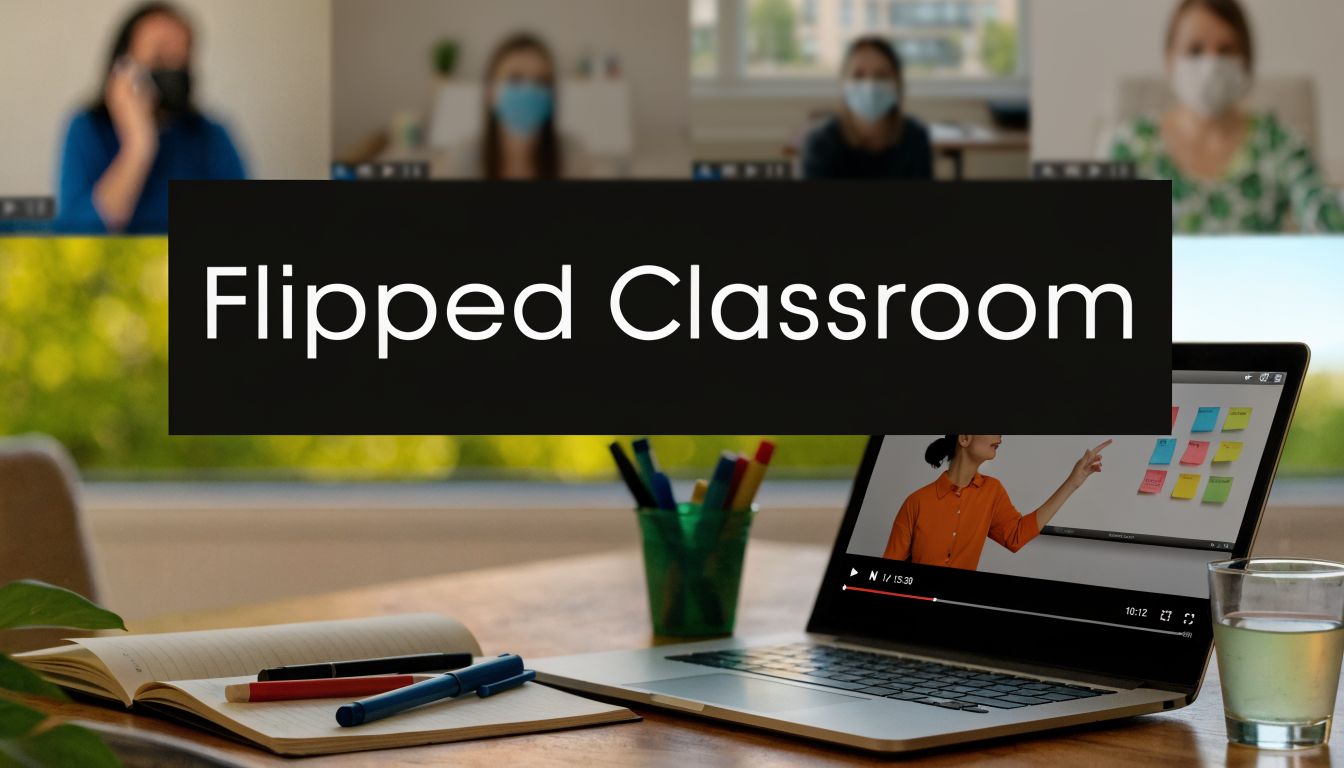
You may have heard the phrase “flipped the classroom” from a school, a tutor, or another parent and wondered whether it signifies a novel approach or is confusing. For many families, the first worry is practical. Does this mean my child is teaching themselves at home and then turning up to class already expected to understand everything?
That concern is reasonable. Parents want flexibility, but they also want reassurance that their child won’t be left alone with a screen, a worksheet, and rising anxiety.
Used well, a flipped classroom can make learning far more active, personal, and engaging. Used badly, it can become little more than outsourced teaching. The difference is not the video. The difference is what happens around it, especially in the live lesson, where a teacher notices confusion, draws out quiet students, and helps a child move from “I watched it” to “I understand it”.
What Does It Mean When a School has Flipped the Classroom
When a school says it has flipped the classroom, it means the order of learning has changed.
In a traditional lesson, a teacher explains new content in class, then the child goes away and tries to practise it alone as homework. In a flipped model, the child meets the basic content first, often through a short video, guided reading, audio explanation, or interactive task. The live lesson is then used for discussion, practice, problem-solving, and support.
A simple analogy helps. Think of a cooking programme. The chef doesn’t usually start by washing vegetables, measuring every ingredient, and searching for utensils on camera. That preparation happens first, so the valuable time can be spent on technique, judgement, and making the dish come together. A flipped classroom works in a similar way. The “ingredient prep” happens before class. The learning work happens with the teacher.

What changes for the child
The child is no longer sitting through most of the explanation during live time. Instead, they arrive with some early familiarity.
That matters because first exposure and understanding are not the same thing. A child might watch a short maths explanation before class and still feel unsure. That’s fine. In a good flipped lesson, they bring that uncertainty into the room and work through it with expert help.
A flipped lesson often looks like this:
- Before class the student watches a short explanation, reads a text, or completes a starter activity.
- During class they ask questions, solve problems, discuss ideas, write, analyse, or collaborate.
- After class the teacher may set a targeted follow-up task based on what the child needs.
A strong flipped model doesn’t remove teaching. It moves direct explanation so live time can be used where children need adults most.
Why schools use it
Schools turn to this model because live teaching time is precious. If a child can pause, replay, or revisit an explanation at their own pace before class, the teacher can spend the lesson doing things that are harder to do alone. Correcting misconceptions. Giving feedback. Stretching a confident learner. Reassuring a hesitant one.
For online learning, this idea can be especially powerful when it’s built around live support rather than independent isolation. Families exploring this approach often want to understand how that balance works in practice, which is why a closer look at flipped learning classrooms is useful.
What it does not mean
It does not mean children are left to fend for themselves.
It does not mean endless homework before every lesson.
It does not mean passive screen time replaces real teaching.
When people say a school has flipped the classroom, the best interpretation is simple. The school is trying to use live lesson time for the parts of learning that most benefit from human interaction.
The Real-World Benefits and Challenges of Flipped Learning
Parents deserve an honest answer here. Flipped learning can be highly effective, but it isn’t magic. The model works best when the school has strong systems, clear expectations, and live teaching that turns preparation into understanding.
The strongest argument in favour of flipped learning is that it gives children more room to think actively with a teacher present. The Education Endowment Foundation notes that flipped approaches can yield +3 months of additional progress on average for disadvantaged pupils, and 78% of teachers in a UK pilot reported enhanced student engagement when using pre-recorded videos followed by in-class problem-solving, as highlighted in the verified EEF summary provided in the brief.
What tends to work well
When flipped learning is organised properly, several benefits appear quickly.
- Pacing improves: A child can pause a video, replay a difficult explanation, or revisit notes without the pressure of keeping up with the whole class in real time.
- Lesson time becomes more useful: Instead of spending the whole session listening, students use that time to answer questions, test ideas, and receive feedback.
- Confidence often grows: Quiet pupils who need longer to process can arrive better prepared to contribute.
- Teachers can teach more responsively: They can spot who understood the pre-learning and who needs help straight away.
This is closely related to active learning, where students do more than absorb information. They solve, discuss, create, and explain. In practice, that’s where many children stop merely memorising and start making sense of what they’re studying.
Practical rule: If the pre-class task is short, focused, and clearly linked to the live lesson, students usually see the point of doing it.
Where families can struggle
The challenges are just as real.
Some children won’t consistently complete the preparation without support. Others may technically “do” it, but only skim it without understanding. Homes also differ. One child has a quiet desk, a strong internet connection, and a parent available after school. Another is sharing devices, working around family schedules, or managing anxiety before they even open the task.
Here are the pressure points parents should watch for:
- Readiness at home: Some students need structure, reminders, or a clear routine.
- Technology access: The method depends on reliable access to materials.
- Motivation: Independent preparation can feel heavy if the child doesn’t see how it connects to the lesson.
- Task design: Long videos and vague instructions turn useful preparation into avoidance.
A school using this model well should already have answers to these issues. That includes simple instructions, manageable pre-class activities, checks for understanding, and a plan when a pupil arrives unprepared.
The key question to ask
The important question isn’t “Is flipped learning good or bad?” It’s “How is it being delivered for actual children?”
A balanced model often sits close to blended learning, where independent study and live teaching support each other rather than compete. If a school can’t explain what happens when a child is confused before class, late with preparation, or anxious in live sessions, the model probably needs more thought.
Parents should trust what they observe. If a child feels more engaged, asks better questions, and can explain what they’re learning, the approach is doing something useful. If they feel lost and alone, it isn’t.
How the Flipped Classroom Works in an Online School
One of the biggest misunderstandings about online flipped learning is that it means children spend hours alone watching lessons. That isn’t a healthy online model. It’s just digital homework with a fashionable label.
A strong online flipped approach is much more deliberate. The independent piece is brief and purposeful. The live lesson carries the emotional and academic weight. That’s where students test ideas, speak up, collaborate, and receive immediate support from a teacher who can adapt in real time.

Before class the child prepares
Preparation should be realistic. In a good online school, this might mean a short teacher-recorded video, a guided reading with prompts, a mini quiz in Google Classroom, or a quick task in Moodle.
The goal is not mastery before the lesson. The goal is familiarity.
A 2019 UK study cited in the brief found that integrating pre-class videos via an LMS like Google Classroom was linked to a 12% reduction in SEN pupil dropout risk and enabled 25% more in-class time for active problem-solving (PowerSchool overview of the flipped classroom). That tells us something important. The platform matters, but the bigger gain comes from what the saved time allows teachers and students to do together.
Typical pre-class materials include:
- Short explanation videos: Better when tightly focused on one concept than when they try to replace a full lesson.
- Guided notes: Prompts that tell students what to listen for.
- Quick retrieval quizzes: These help teachers see who has engaged and where misconceptions are forming.
- Readiness questions: “What confused you?” can be more useful than “Did you finish?”
During class the teacher turns preparation into learning
This is the heart of the model.
In a live online lesson, students don’t need another long lecture that repeats the video. They need a workshop. They might join breakout rooms, annotate a shared text, tackle exam questions on screen, debate interpretations, or solve a maths problem step by step with teacher prompting.
A teacher’s role changes here. They are still teaching, but they are teaching interactively. They are listening to students explain, noticing gaps, and deciding when to step in.
Students should leave a flipped lesson feeling more supported, not more responsible for teaching themselves.
A useful contrast makes the difference clear:
| Model | What happens before class | What happens live |
|---|---|---|
| Weak online flipped model | Long video, little guidance | Teacher checks who watched it, then moves on |
| Strong online flipped model | Short focused task, clear prompts, simple quiz | Teacher uses responses to guide discussion, support, and practice |
After class the child applies and reflects
The best online schools don’t stop at “watch, attend, submit”. After the live lesson, students need a chance to consolidate.
That might include a short written response, an exam-style question, targeted feedback, or a recording of the class they can revisit. Sometimes the follow-up is extension work. Sometimes it’s a smaller scaffolded task because the child needs another step before moving on.
A useful sequence often looks like this:
- Prepare with purpose
- Engage live with others
- Apply with feedback
That structure protects what children need most in online learning. Not just content, but connection.
What does not work online
Some versions of flipped learning fail for very predictable reasons.
- Videos that are too long: Children switch off.
- No link between preparation and lesson: Students feel the task was pointless.
- No accountability: Teachers can’t tell who needs help.
- No live scaffolding: Struggling learners fall behind.
- Too much independence too soon: Especially risky for younger learners and those who need emotional reassurance.
The phrase flipped the classroom sounds modern, but the principle is simple. Let the child meet the content first, then use valuable live time for guided thinking. Online, that principle only works when adults stay highly present.
A Day in the Life A Flipped Lesson for KS2 and GCSE
Parents often understand the idea of flipped learning once they can picture a real child moving through the day. The rhythm matters. So does the feeling.
A good flipped lesson doesn’t feel like “do the teaching at home, then attend class”. It feels like the child arrives ready to participate because they already have a foothold. They are not starting from zero. That changes confidence.

A KS2 English lesson on show don’t tell
A primary pupil logs in after breakfast and sees a short English task for later that day. It isn’t a heavy homework load. It’s a brief animated explanation on show, don’t tell, with examples such as “Tom was nervous” compared with “Tom twisted his sleeve and stared at the floor”.
The child watches it once, then again. They pause to jot down two phrases they like. There’s also a simple prompt underneath. “Write one sentence that shows a feeling without naming it.” That small task matters because it gets the child trying, not just watching.
By the time the live lesson begins, the student isn’t hearing the phrase for the first time. They’ve already tested it.
What happens in the live class
The teacher starts with a warm, low-pressure question in chat. Students post examples of “telling” sentences and work together to improve them. A few children are eager. One is hesitant. Another has clearly misunderstood and written a sentence that still names the emotion directly.
That is exactly why the live lesson matters.
The teacher shares a short model paragraph on screen. Students highlight where the writer shows emotion through action, dialogue, and sensory detail. Then they move into a collaborative writing activity. In a small group, they help build a scene about a child opening a mysterious letter.
One pupil suggests, “Her hands were shaking.” Another adds, “She read the first line three times.” The teacher praises the choices, nudges a quieter child with a direct question, and helps the group shape the paragraph into stronger writing.
“Good flipped learning gives children a safer first step before they perform in public.”
By the end, the child who felt unsure earlier has contributed two useful lines. That matters emotionally. They don’t just leave with a grammar point. They leave with the sense that they can do it.
A GCSE Physics lesson on electromagnetism
Now consider an older student preparing for a GCSE Physics lesson on electromagnetism. This subject often exposes the limits of passive learning. A student can watch an explanation and still struggle when they meet an unfamiliar question.
The pre-class task is designed to avoid overload. The student reviews a short explanation of magnetic fields and current, then uses an interactive simulation to observe how changing one variable alters the result. They answer a few readiness questions in their notes. “What changed?” “What stayed the same?” “Which part still feels unclear?”
That final question is often the most valuable one.
What happens in the live class
The teacher doesn’t repeat every definition. Instead, the class opens with a diagnostic problem. Students predict what will happen in a circuit setup, justify their thinking, and compare answers. A misconception appears straight away. Several pupils think a stronger current changes the field in a way it doesn’t.
The teacher catches it live, sketches the idea, asks follow-up questions, and sends students into pairs to work through an exam-style item. They talk through method marks, command words, and how to avoid vague answers.
A little later, this video gives a useful sense of how active, guided learning can look in practice:
When the class returns, the teacher reviews common errors and asks one student to explain their reasoning aloud. That moment is powerful. Not because every answer is perfect, but because the student is practising scientific thinking with support available immediately.
After the lesson the difference becomes clear
In both examples, the child has done some preparation before class. But the breakthrough did not happen in isolation.
It happened when the teacher noticed confusion. It happened when peers offered ideas. It happened when a student tested a half-formed thought and got feedback before the mistake hardened into a habit.
That’s the version of flipped learning parents should look for. One where the live lesson becomes the place where understanding is built, not the place where missing preparation becomes a disadvantage.
Adapting Flipped Learning for Every Child Including SEN and SEMH
A flipped model only deserves praise if it works for the children who need the most care, not just the children who would probably cope in any system. This is especially important for learners with SEN and SEMH needs.
For some pupils, the flexibility of pre-class materials is a gift. They can replay instructions, slow the pace, or return later when they feel regulated and ready. For others, independent pre-learning can create stress very quickly, especially if expectations are unclear or support is delayed.

Why live scaffolding matters
The most important principle is simple. Adapt the model to the child, not the child to the model.
The verified data in the brief makes the risk clear. Department for Education data from 2024 to 2025 shows 1.9 million pupils have SEND, and a 2025 UK pilot in 12 academies found a 15% regression in wellbeing scores in flipped models that lacked individualized, live support systems, as summarised in the assigned source context from Discovery Education’s flipped classroom overview.
That should make every school pause. A child who feels unsafe, unsupported, or overwhelmed will not benefit just because the timetable looks modern.
What adaptation looks like in practice
A supportive flipped model for SEN and SEMH learners often includes adjustments such as:
- Captioned and chunked materials: Shorter videos with clear visual structure help pupils who struggle with processing load.
- Flexible access: Some children need to preview content earlier in the day or revisit it later.
- Simple written instructions: One page is better than multiple scattered messages.
- Live check-ins: A teacher or support adult confirms understanding before the child is expected to perform.
- Breakout support: Small-group or one-to-one moments during the live class can prevent shutdown.
- Alternative ways to respond: Voice notes, verbal answers, visual organisers, and guided prompts can all reduce pressure.
For families exploring accessibility supports around lecture capture, subtitles, and text conversion, resources on academic transcription services can also help them think more broadly about how spoken teaching can be made easier to revisit and process.
Some children don’t need less challenge. They need more scaffolding before they can show what they know.
What parents should ask
A parent of a child with additional needs should ask practical questions, not general ones.
| Ask this | Why it matters |
|---|---|
| What happens if my child cannot manage the pre-class task alone? | This reveals whether support is proactive or reactive. |
| Can materials be adapted or shortened? | This shows whether flexibility is built in. |
| How does the teacher notice distress or confusion online? | Emotional safety matters as much as academic access. |
| Is there specific SEN support available? | General promises aren’t enough for individual needs. |
Families often need clarity on what individualized provision looks like day to day, which is why detailed guidance on what SEN support can include in an online school is so useful.
The emotional side matters too
Children with SEN or SEMH needs often carry educational memories that adults underestimate. A child who has felt behind, corrected too often, or overlooked in a lesson may approach any independent task with dread.
In those cases, the right flipped model can help because it gives the child a gentler first contact with new learning. But that only works if a teacher then meets them warmly, checks understanding, and turns that small beginning into something they can succeed in.
Without that support, flipped learning can widen the gap between the child who is ready and the child who is barely coping. With it, the same method can become more humane, more flexible, and more hopeful.
Preparing for Success in GCSE and A-Level Exams
For older students, parents often ask a fair question. This all sounds engaging, but does it prepare a child for exams?
It can, if the model is used properly. GCSEs and A-Levels don’t only reward recall. They reward accurate application, careful interpretation of questions, time management, and the ability to explain thinking clearly under pressure. A well-run flipped approach creates more live time to practise exactly those skills.
Why the model fits exam preparation
When a student first meets core content before class, they don’t waste the live lesson copying notes they could have read elsewhere. Instead, the teacher can use that time for the work that tends to lift performance most meaningfully. Modelling exam answers. Diagnosing misconceptions. Comparing weak and strong responses. Practising command words. Breaking down mark schemes.
That shift matters because many students don’t struggle only with knowledge. They struggle with using knowledge when a question is worded differently from the example they revised.
A 2021 UK Department for Education analysis of flipped learning in online A-Level sciences reported a 15% improvement in GCSE Chemistry pass rates (grade 4+) in flipped cohorts versus controls, with the effect driven by pre-class videos that freed up class time for applying concepts and boosting grades for both top and bottom-third performers (eLearning Industry summary of flipped learning tools and types).
What this looks like in real revision
A student preparing for biology might watch a concise explanation of cell transport before class. In the live session, they don’t just hear the process described again. They tackle structured exam questions, identify where marks are won and lost, and learn how to answer with precision.
An A-Level literature student might read a poem and review contextual notes in advance. The live lesson then becomes a place to test interpretation, defend an argument, and refine essay structure under teacher guidance.
Here’s where the method supports exam growth:
- Independent review builds familiarity: Students arrive with key terms already in mind.
- Live lessons build application: Teachers help them use knowledge, not just store it.
- Feedback sharpens exam technique: Errors are corrected while thinking is still fresh.
- Routine builds confidence: Students get used to arriving prepared, asking sharper questions, and handling challenge.
What students carry beyond the exam
The hidden advantage is independence with support. That combination matters for sixth form, university, and work.
Students learn how to prepare before a seminar, identify what they don’t understand, and use teacher or peer interaction productively. Those are not soft extras. They are part of academic maturity.
The best exam preparation doesn’t train a child only to survive the next paper. It teaches them how to think when the answer isn’t obvious at first glance.
The Flipped Classroom A Tool Not a Rule
The phrase flipped the classroom can sound like a fixed method that schools either follow or reject. In practice, it should be treated as a tool.
Some lessons benefit greatly from pre-learning. Others need more direct live teaching from the start. Some children flourish when they can preview content independently. Others need a teacher beside them, even virtually, before they can begin. Good education is responsive enough to know the difference.
What the best version keeps at the centre
The strongest form of flipped learning does not worship independence for its own sake. It uses independence carefully so that live teaching becomes more human, not less.
That means:
- Children are prepared, not abandoned
- Teachers are freed to guide, not replaced
- Live lessons are active, not crowded with one-way explanation
- Support is individualized, especially when a child is vulnerable
- Learning builds confidence as well as knowledge
The question is never whether a classroom has been flipped. The question is whether the child feels seen, supported, and able to grow within it.
What parents should remember
If your child hears an explanation at home, then arrives in class to think harder, ask better questions, and receive more personal feedback, that can be a strong model. If they are expected to absorb new content alone and then somehow perform in public without support, that is not thoughtful flipped learning. It is poor design.
Children do not need fashionable systems. They need teaching that respects how learning really works. They need structure, encouragement, challenge, and room to make mistakes safely. They need adults who notice when confidence slips. They need live interaction that turns confusion into clarity.
A flipped classroom can help create that. But only when it stays flexible, relational, and centred on the child.
Families looking for a live, supportive online learning environment can explore Queens Online School, where the British curriculum is taught through interactive lessons, personalised guidance, and a strong focus on each child’s academic progress and wellbeing.