

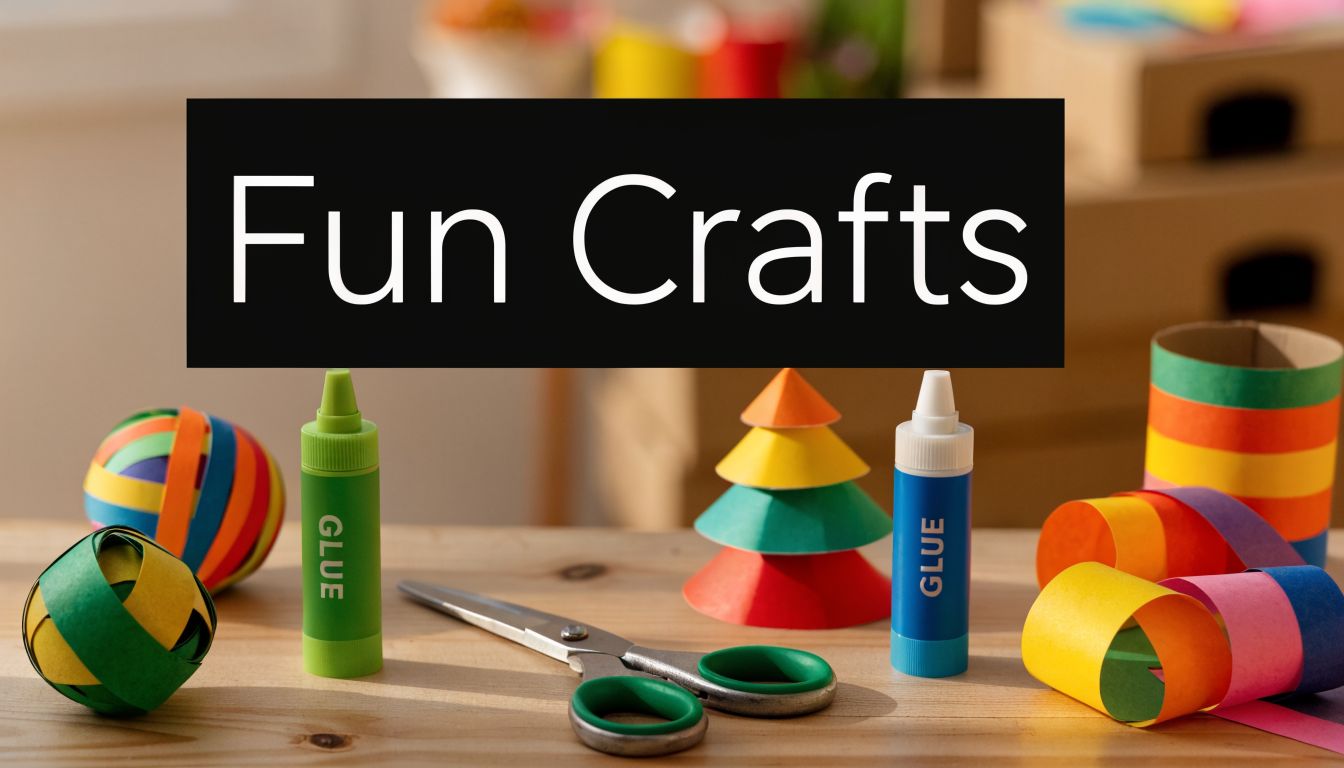
How do you help a 5-year-old feel settled, capable, and ready to learn after a digital lesson? For many families, the answer is surprisingly simple. Put real materials into small hands and let children cut, press, paint, build, and arrange.
Crafts for 5 year olds support far more than occupied time. They give children practice with fine motor control, attention, decision-making, and self-expression at an age when learning still needs to move through the hands as much as the mind. In early education, making is part of how children test ideas. A child who rolls playdough into number shapes or builds a house from a box is doing something very similar to an adult using notes or diagrams to clarify a thought. The hands help the brain organise what it knows.
That matters in online schooling. Digital lessons can introduce phonics, number bonds, seasons, stories, and topic vocabulary clearly and efficiently. Young children still need offline ways to rehearse that learning, regulate their emotions, and make sense of it in a physical form. Craft offers that bridge. It works especially well for children with different preferences for taking in information, including visual, auditory, and kinaesthetic learners, which you can explore in this guide to different learning styles in children.
Crafting also supports SEMH development in quiet, practical ways. Repeating actions such as tearing paper, kneading dough, or brushing paint across a page can calm the nervous system after a demanding morning. Choosing colours and materials gives a child a sense of agency. Finishing even a simple piece of work helps them feel, "I can do this." That feeling matters. It builds confidence that carries back into reading, maths, and independent work online.
If you’d like more inspiration beyond this list, these 10 creative art projects for preschoolers can help you build a playful routine at home.
The activities below were chosen with that full picture in mind. They are simple to set up, flexible enough for busy families, and well matched to what many 5-year-olds need from a modern education that blends screen-based learning with hands-on growth.
1. Paper Collage and Cut-and-Paste Art
Paper collage is often the first craft I recommend to families because it asks so much of a child in such a gentle way. A 5-year-old chooses colours, handles scissors, applies glue, places pieces with care, and sees an idea take shape step by step. That combination of planning and making is satisfying.
For children learning online, collage works beautifully after a lesson that has introduced a story, a season, or a topic. If your child has just learned about autumn, they might tear brown, orange, and yellow paper into leaf shapes. If they’ve read a picture book, they can build a scene from the story. If they’re missing grandparents or feeling unsettled, a family portrait collage can help them express belonging without needing the perfect words.

Why collage works so well at five
At this age, many children still need practice crossing the midline, controlling small hand movements, and coordinating both hands together. Cutting with one hand while turning paper with the other supports exactly that. Glueing pieces into position also builds patience, and patience can be hard for a tired child after online learning.
A collage task also suits different temperaments. One child may create a careful house with windows and a door. Another may cover the whole page in bright overlapping scraps. Both are learning.
Practical rule: If scissor work causes frustration, pre-cut a tray of shapes and let your child become the designer rather than the cutter.
The beauty of collage is that it adapts easily to different preferences and profiles. That’s especially useful if your child responds strongly to routine or gets overwhelmed by too many choices. Families exploring personalised learning often notice that children engage more readily when activities match how they naturally process information, which is one reason this connects so well with different learning styles in children.
Practical ways to use it at home
You don’t need specialist materials. Start with sugar paper, old magazines, junk mail, tissue paper, wrapping paper, child-safe scissors, and a Pritt Stick or similar glue stick. Keep the setup simple enough that you’ll use it.
A few child-centred ideas work especially well:
- Seasonal scenes: Use green and brown paper for trees in spring or orange and red scraps for autumn leaves.
- Story retelling: After an online literacy lesson, invite your child to make the “beginning”, “middle”, or “end” of the story.
- Feelings pictures: Ask, “What colour feels calm today?” and let them build from there.
Display the finished piece somewhere visible. A fridge door, bedroom wall, or learning corner tells a child, “Your ideas matter.” That emotional message often lasts longer than the craft itself.
2. Playdough Modelling and Sensory Exploration
What helps a five-year-old shift from screen focus to hands-on understanding without feeling as though learning has only changed form? Often, it is something as simple as playdough.
Playdough gives children a material they can press, roll, squeeze, and reshape at their own pace. That matters after online learning, where so much attention is directed through the eyes and ears. Dough brings the body back into the process. For many children, especially at five, the hands help organise the mind in the same way counters help organise early maths thinking. The child is not only making a model. They are building control, concentration, and calm.
A child might roll long snakes, pinch tiny buns, press in shells or buttons, form letters, or make animals linked to a current topic. While that looks playful, important development is happening underneath. The muscles used for squeezing and pinching support pencil control later on. The turning, flattening, and shaping also strengthen hand coordination, which children use for dressing, cutlery, and other everyday tasks.

A steadying activity with academic and emotional value
Playdough is often one of the best choices for a child who seems unsettled after a live lesson or tired after concentrating online. The gentle resistance of the dough gives clear feedback to the hands, and that physical feedback can feel settling. Some children talk more easily while they are moulding than when they are asked direct questions face to face.
This is especially helpful for children with SEMH or additional sensory needs. If a child dislikes sticky textures, offer firmer dough, a rolling pin, cutters, or a tray to contain the activity. Good adaptation helps a child stay engaged rather than overwhelmed. That sense of success feeds directly into building children’s confidence through everyday learning experiences.
Turning digital lessons into something a child can hold
One of playdough’s strengths is that it makes abstract ideas concrete. A phonics sound on a screen can become a letter your child shapes with their fingers. A maths lesson on quantity can become five dough balls lined up in a row. A science session about minibeasts can become a snail with a spiral shell and feelers.
That link between online teaching and physical making suits a flexible home learning rhythm very well. The screen introduces the concept. The craft helps the child test it, repeat it, and remember it. For five-year-olds, that kind of repetition through movement is often more effective than asking them to complete another worksheet.
A few simple invitations work well:
- Phonics practice: Shape the letter of the day and say its sound aloud.
- Early maths: Make two groups and compare which has more or fewer.
- Topic work: Model a habitat, an animal, or a weather symbol from the week’s lesson.
- Feelings check-in: Ask your child to make a “calm shape” or a “worried shape” and talk while they work.
If you’d like a homemade version, this guide on how to make homemade playdough gives a straightforward starting point. Keep it in an airtight tub with a few simple tools nearby. That way, it is easy to bring out between lessons, after transitions, or whenever your child needs learning to become tactile again.
3. Nature Crafts Using Collected Materials
Nature crafts do something especially valuable for modern children. They get them out of the house, into fresh air, and into the habit of noticing. Before the craft even begins, a child is already learning to look carefully, collect thoughtfully, and connect what they see outdoors with what they’re learning indoors.
That connection matters in an online schooling rhythm. A child might learn about seasons, habitats, or plants on screen, then step outside to gather leaves, twigs, grass, petals, seed pods, or smooth stones. Suddenly the lesson is no longer abstract. It’s in their pocket.
From outdoor walk to meaningful making
A short collection walk is enough. You don’t need a woodland adventure. A garden, local park, pavement edge, or school run route can provide plenty. Encourage your child to gather only fallen items, and give them a small bag or basket so the task feels purposeful.
Back at home, those materials can become all sorts of creations. Twigs and grass can become a bird’s nest. Leaves can become animal ears or wings. Petals and seeds can be arranged into a circular pattern on a tray. Pressed flowers can be added to a seasonal nature journal.
The child who struggles to sit still during online lessons often thrives here because the activity begins with movement. The child who feels shy often finds confidence in collecting “just the right leaf” or “the longest twig”.
A confidence boost can come from creating something that has no single correct answer, which links closely with how children learn to trust their own ideas. That same principle sits behind building children’s confidence through supported independence.
Good options for different needs
Nature crafts can be wonderfully open-ended, but not every child enjoys the same textures. Some children dislike damp leaves or gritty bark. Others become distressed if materials break unexpectedly. Offer choice.
You might prepare three baskets: dry leaves, smooth stones, and twigs. Let your child choose what feels manageable. If mess is a concern, use contact paper so children can press items down without handling lots of glue.
- Leaf collage: Stick leaves onto card to make trees, hedgehogs, or crowns.
- Nature mandala: Arrange petals, seeds, and stones in a circular pattern for a calming activity.
- Mini habitats: Use a shoebox and collected items to create a fox den, nest, or bug home.
Keep the focus on observation before production. A child who studies the veins in a leaf or compares two seed pods is already learning, even if the final craft stays simple.
This gentle attention to detail helps children slow down, regulate, and feel part of the world around them. For many 5-year-olds, that’s exactly what they need after a busy digital morning.
4. Painting and Mark-Making with Various Tools and Mediums
What does a child need after a morning of screens, listening, and clicking. Often, they need to move colour across a page and see an idea appear under their own hand.
Painting and mark-making give 5-year-olds a different kind of learning space. Online lessons can build knowledge beautifully, but young children also need chances to test that knowledge through movement, sensation, and choice. A brushstroke, a sponge print, or a row of chalk dots helps learning travel from the screen into the body. That matters at this age, because children are still joining up thought, feeling, and action.
Why mark-making still matters at five
Families often notice letter formation becoming more important at five and assume painting should give way to pencil tasks. In practice, the two support each other. Large arm movements in painting work like the wide practice strokes musicians use before playing precise notes. They build stability first. Then finer control becomes easier.
Lines, loops, curves, dots, and zigzags all strengthen the foundations children use for writing, drawing, and early maths recording. They also help children organise space on a page, notice patterns, and repeat a sequence with intention. Those are small but meaningful building blocks for school readiness.
Painting also supports emotional expression, which is especially helpful in a flexible online education where children may move between focused academic work and quieter independent time. Some children talk readily about their feelings. Others show them first through colour, pressure, and movement. Thick red swirls, soft blue washes, or quick repeated marks can tell you a great deal about a child’s inner state without asking them to find perfect words.
Change the tool, change the thinking
A paintbrush is only one option. Different tools invite different kinds of attention, and that can remove the pressure a child feels when they say, “I don’t know what to paint.”
Try offering:
- Sponges for broad patterns and hand strength
- Cotton buds for dots, detail, and careful control
- Corks or bottle tops for printing and repeating shapes
- Old toothbrushes for splatter effects and sensory play
- Cardboard strips or tubes for stamping lines, circles, and textures
A simple change of tool often changes the whole task. A hesitant child may avoid “painting a picture” but enjoy printing circles with a cork. A child who finds sitting still difficult may focus for much longer when dabbing, rolling, or tapping paint in a rhythmic way.
Connect painting to online learning without making it feel like homework
Painting works best here when it reinforces learning lightly. The goal is not to turn every craft into an assessed task. The goal is to help children revisit ideas in a form that feels open and manageable.
You could try:
- Colour mixing after an online science lesson on observation
- Story painting to retell a character, setting, or key event from literacy
- Number marks such as groups of dots, lines, or shapes to represent counting
- Emotion paintings that help children recognise and name feelings
- Weather or seasons art to revisit topic work from geography or science
This kind of activity also strengthens problem-solving skills in young learners. A child deciding how to make rain look misty, how to mix a darker green, or how to print a repeated pattern is planning, testing, noticing, and adjusting.
Use gentle prompts rather than instructions. “What happens if you press more lightly?” teaches more than “Paint a tree like this.”
Keep the setup simple. Washable poster paint, thick paper, aprons, and a wipe-clean surface are usually enough. Let paintings dry flat. Display a few finished pieces at child height if you can.
That display does more than celebrate effort. It tells the child, subtly yet clearly, that their ideas belong in the learning environment too.
5. Simple Construction and Building with Recyclables
What does a child learn when an empty cereal box becomes a garage, a rocket, or a tiny animal home? Quite a lot, especially if much of their formal learning happens through a screen.
Simple construction with recyclables gives 5-year-olds a chance to work with ideas they can hold, turn, stack, tape, and test. A cardboard tube is not just a tube. It can become a pillar, a telescope, a chimney, or the body of a robot. That kind of open-ended making supports the flexible thinking children need in a modern learning routine, where online lessons build knowledge and hands-on tasks help that knowledge settle more firmly.

Building supports thinking, language, and self-regulation
At five, many children are still learning how to plan a sequence and hold an idea in mind while working through small setbacks. Construction play gives them practice in a concrete way. They choose materials, predict what might work, notice when something wobbles, and try another solution. The process works like early engineering, but in a form that feels playful and manageable.
It also meets an important emotional need. Online schooling can ask children to listen, watch, and respond carefully for parts of the day. Building lets them reset through movement and action. Taping, arranging, pressing, and repositioning materials can help some children feel calmer and more organised, especially after a lesson that required sustained attention.
This is also a strong way to revisit digital learning without making home education feel rigid. A child learning about transport might build a bus or train. A child studying space might make a rocket with fins and windows. A topic on communities or homes can turn into a row of model houses, shops, or shelters. The screen introduces the idea. The craft helps the child test and express it in three dimensions.
Keep materials easy to access
A simple collection box often works best. You might keep cardboard boxes, kitchen roll tubes, yoghurt pots, egg cartons, bottle tops, paper scraps, masking tape, glue, child-safe scissors, and felt-tip pens together in one place.
Preparation matters here. If thick cardboard is frustrating to cut, an adult can trim a few pieces in advance. That small adjustment keeps the challenge in the thinking, not in the hand strain.
Children often do better when the invitation is clear but open. “Can you build a home for a toy animal?” is usually more helpful than “Make anything.” The first prompt gives direction. The child still makes the design choices.
A few reliable starting points include:
- Rocket model: kitchen roll tube, card fins, paper cone, stickers or drawn controls
- Animal habitat: shoebox base with walls, bedding, trees, water, or shelter
- Mini town: small boxes for buildings, strips of card for roads, bottle tops for wheels or signs
Support without taking over
Adults make the biggest difference through the questions they ask. Instead of fixing a leaning tower straight away, try: “What part feels weakest?” or “What could help it stay upright?” Those prompts build reflection and resilience. They also connect naturally with guided ways to build problem-solving skills in young learners.
A quick sketch can help too. At this age, a plan does not need to be neat or detailed. It helps the child pause, picture, and begin with purpose.
If you'd like a visual example to spark ideas, this short video can help children picture what cardboard construction can become.
The finished model matters less than the thinking that happened along the way. When a child keeps adjusting a design after it falls apart, they are practising patience, spatial reasoning, and confidence. Those are qualities that support learning far beyond craft time.
Comparison of 5 Crafts for 5-Year-Olds
| Activity | Implementation Complexity 🔄 | Resource Requirements ⚡ | Expected Outcomes 📊 | Ideal Use Cases 💡 | Key Advantages ⭐ |
|---|---|---|---|---|---|
| Paper Collage and Cut-and-Paste Art | Low, simple cutting and gluing; adult supervision for scissors | Very low, paper, glue stick, child-safe scissors, recycled magazines | Fine motor control, colour recognition, composition skills | Short offline creative breaks; literacy/storytelling integration | Inexpensive, adaptable, quick visible results |
| Playdough Modelling and Sensory Exploration | Low–Medium, mixing/storage management; needs contained play area | Low, storeable playdough (homemade or bought), simple tools, airtight containers | Sensory regulation, hand strength, spatial awareness, SEMH support | Calming sensory breaks, handwriting prep, therapeutic activities | Reusable, calming, excellent for SEN/SEMH |
| Nature Crafts Using Collected Materials | Medium, requires outdoor collection, preparation and possible cleaning | Very low, found leaves, twigs, seeds; basic adhesives and drying space | Environmental awareness, observation skills, gross motor activity | Outdoor learning, science topics, seasonal curriculum links | Cost-free materials, connects outdoor exploration to learning |
| Painting and Mark‑Making with Various Tools | Low–Medium, setup for mess control and drying; varies by medium | Low, washable paints, brushes/sponges, paper, protective coverings | Colour mixing, brush control, emotional expression, experimentation | Quick creative breaks, curriculum-themed art, mindfulness projects | Immediate visual feedback, highly adaptable, engaging |
| Simple Construction with Recyclables (Boxes, Tubes) | Medium, planning and assembly; may need adult cutting/adhesive help | Low, recycled containers, tape/glue, scissors; occasional special adhesives | Spatial reasoning, problem-solving, basic engineering concepts | Extended STEM projects, imaginative play, design challenges | Promotes sustainability, STEM thinking, open‑ended creativity |
Fostering a Lifelong Love for Creating and Learning
What helps a five-year-old turn online lessons into knowledge they can hold onto?
Regular craft time gives children that chance. At this age, learning works best when ideas can be touched, moved, seen, and remade. A child may hear about shapes, seasons, stories, or patterns on screen, but cutting, rolling, painting, and building help those ideas settle in the mind and body together.
That matters at five, when attention, hand control, language, and emotional regulation are still growing side by side.
Crafts support far more than creativity. They strengthen fine motor skills for writing, build patience, encourage flexible thinking, and give children a safe way to express feelings that they may not yet have the words to explain. They also suit a modern, flexible education because they bring balance to screen-based study. After a live lesson or independent online task, a practical activity can work like a reset for the brain. It helps a child shift from watching and listening to doing and discovering.
This is especially helpful in online schooling. Digital learning can teach concepts clearly and efficiently, but young children still need frequent opportunities to make sense of those concepts through real materials. A collage linked to phonics can reinforce sound sorting. Playdough can turn number bonds into something physical and visible. Painting can help a child respond to a story or calm after a demanding lesson. A recyclable model can extend science or design work into problem-solving that feels personal and memorable.
Crafting also supports SEMH development in a quiet but important way. When a child chooses colours, changes a plan, copes with glue that will not stick, or starts again after a mistake, they practise resilience. When an adult sits nearby, notices their effort, and talks through the process, the child feels secure and understood. Those small moments build confidence over time.
Family connection grows here too. Children often remember the shared routine as much as the finished piece. They remember that an adult sat with them, listened to their ideas, and treated their work as meaningful. That sense of being noticed helps learning feel safe, and children learn best when they feel safe.
A good starting point is simple. Choose one activity from the list. Keep materials easy to reach. Let the session be short if needed. Five focused minutes can be more useful than twenty rushed ones.
Children do not need perfect results. They need repeated chances to try, adjust, solve problems, and enjoy making something with their own hands. That is how confidence grows, curiosity stays active, and learning begins to feel like something they can shape for themselves.
If you're looking for a school that understands both academic excellence and the whole child, Queens Online School offers a flexible British education that values creativity, confidence, and personalised support alongside live online teaching.